Get the latest AI news, understand why it matters, and learn how to apply it in your work — all in just 5 minutes a day. Join over 2,000,000+ subscribers.
Meta taps chats for ad targeting
Read Online | Sign Up | Advertise

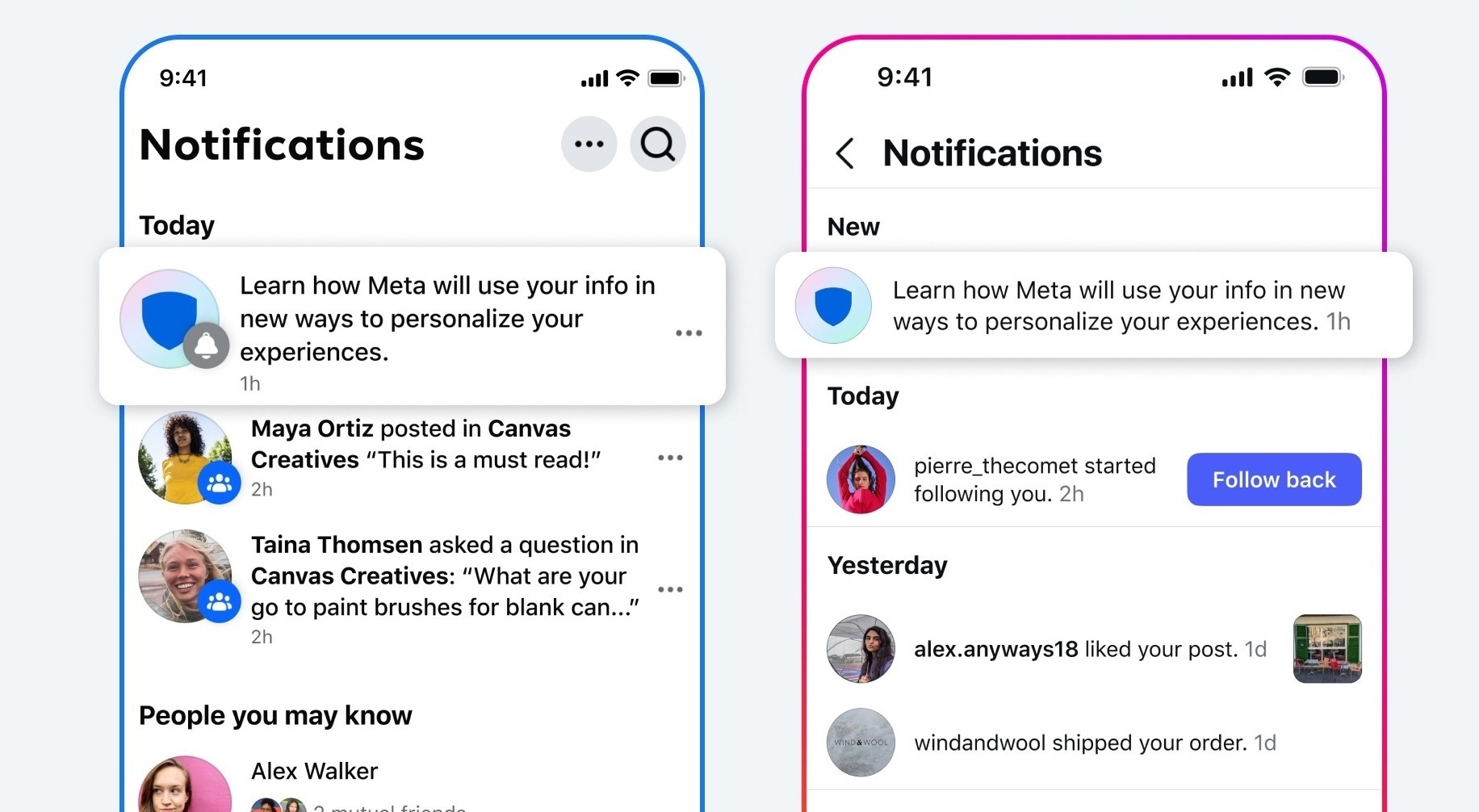
Good morning, tech enthusiasts. Starting December 16, Meta will begin using your chats with its AI assistant to sharpen its ad targeting — and there's no way to opt out.
While OpenAI bets on in-chat commerce, Meta is feeding its $180B ad machine with something far more valuable: the unfiltered things you tell your chatbot.
Reminder: Our next live workshop is today at 4 PM EST! Join and learn how to create working prototypes in Cursor, without writing any code. RSVP here.
In today’s tech rundown:
Meta to mine AI chats for ad targeting
Oura’s smart ring gets a ceramic glow-up
This startup wants to deliver cargo from space
Tesla sells 497K EVs in record quarter
Quick hits on other tech news
LATEST DEVELOPMENTS
META
😵💫 Meta to mine AI chats for ad targeting
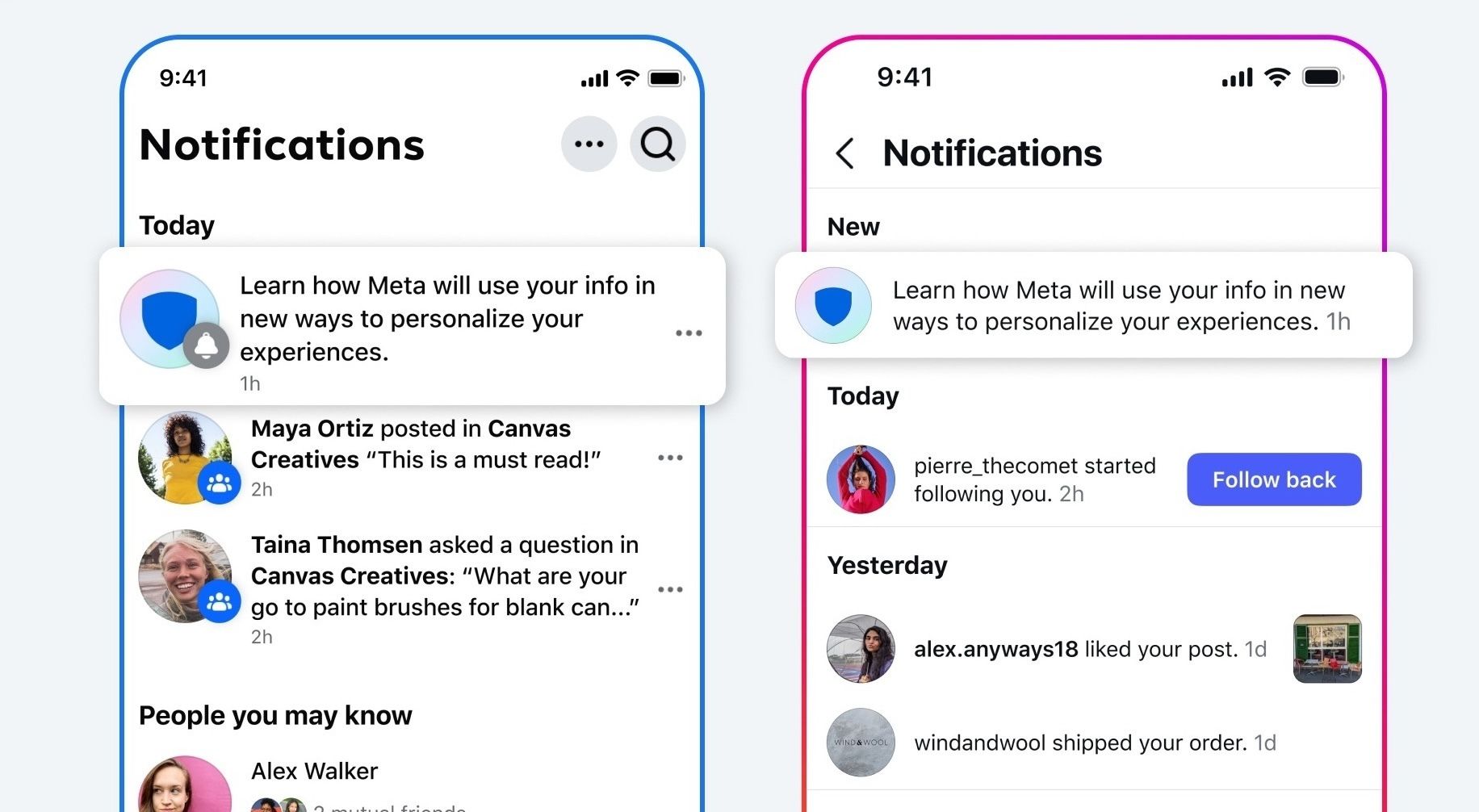
Image source: Meta
The Rundown: Meta plans to mine your chats with its AI assistant for ad targeting, starting December 16. Those casual conversations about vacation plans or personal problems? Now they're data points for hyper-personalized marketing.
The details:
The company already collects data from posts, likes, and clicks to build ad profiles, but chatbot interactions add a more direct layer.
Meta also plans to feed chatbot data into its recommendation algorithms, potentially reshaping the news, posts, and videos you see in your feeds.
Meta’s advertising already pulled in a staggering $46.5B in revenue last quarter, a 21% jump from the year before.
The new policy applies globally, except in the EU, the UK, and South Korea, where privacy laws block this type of data collection.
Why it matters: Chatbot conversations reveal intent in ways that likes and clicks can't — they're explicit requests, unfiltered problems, real-time needs. For advertisers, that's precision targeting at its finest. For users, the trade-off hinges on whether Meta's AI can deliver genuinely useful recommendations without crossing into creepy.
INVERSION SPACE
🚀 This startup wants to deliver cargo from space

Image source: Inversion Space
The Rundown: Inversion Space, a Los Angeles startup with a flair for the dramatic, just unveiled its answer to rapid-response logistics: a capsule called Arc that’s less delivery van and more miniaturized spacecraft.
The details:
The sleek vehicle is designed to carry about 500 pounds of cargo, or roughly the payload of a pickup truck bed.
Instead of conventional transport, Arc would launch into orbit and reenter Earth’s atmosphere before landing its cargo essentially anywhere in the world.
The pitch targets the military: medical supplies, ammunition, or emergency gear dropped into combat zones or disaster sites within hours.
Inversion’s approach echoes decades of speculative projects, from DARPA’s experiments to SpaceX’s musings about “point-to-point” rocket travel.
Why it matters: The Arc vehicle — roughly table-sized and built as a lifting-body spacecraft that uses parachutes for landing — is slated for launch by late 2026. Think FedEx by way of DARPA, with hefty price tags to match. But whether the Pentagon actually cuts the check remains very much an open question.
OURA
💍 Oura’s smart ring gets a ceramic glow-up
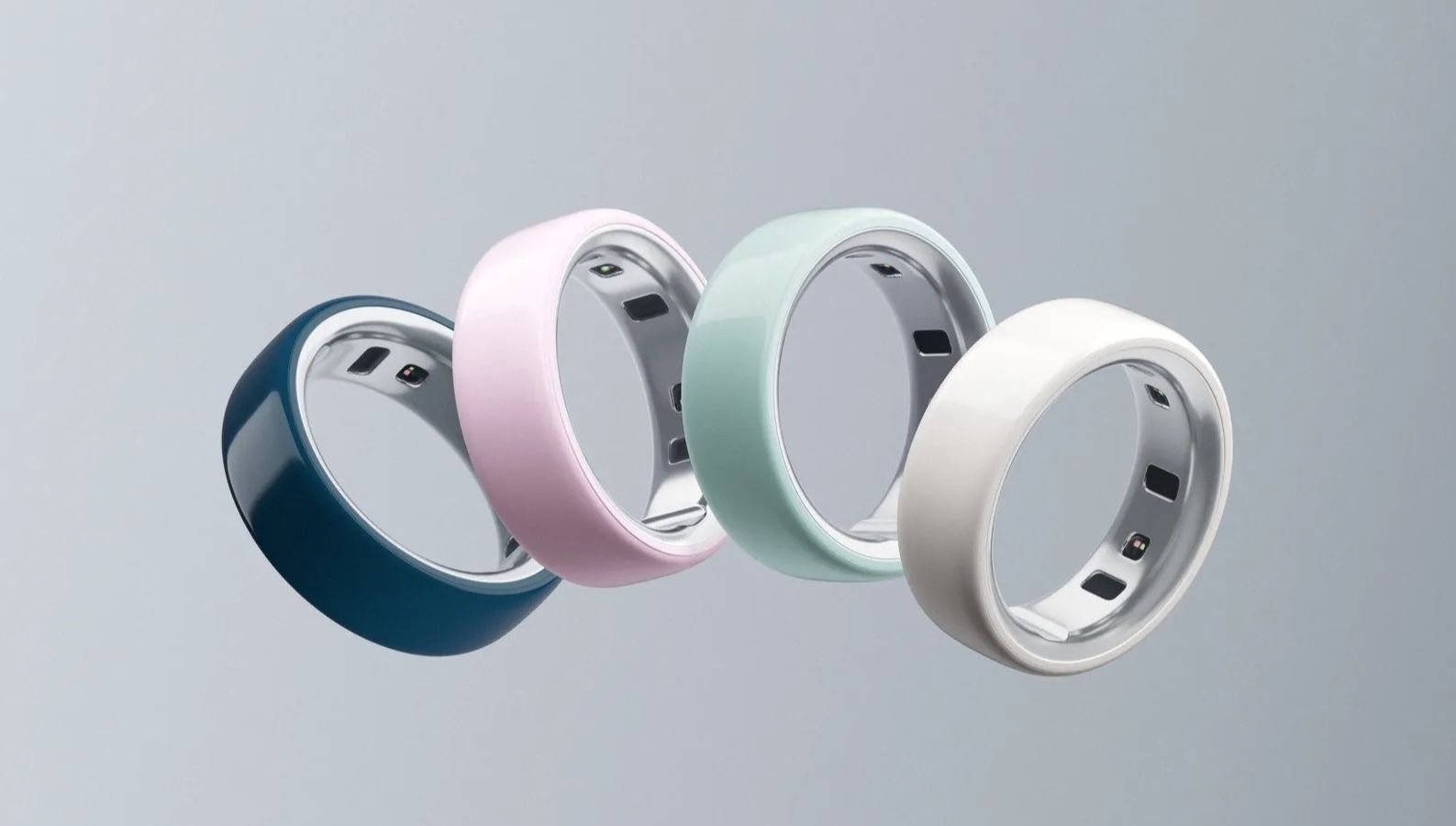
Image source: Oura
The Rundown: Oura just dropped a colorful ceramic ring lineup with multi-ring support in its app, a slick new USB-C charging case that juices your ring up to five times, and the ability to order blood panels without leaving the app.
The details:
The $499 ring is slightly thicker and heavier than the titanium Oura Ring 4 but retains the same inner sensors and features.
Users can track over 50 health metrics, including sleep, readiness, activity, heart health, stress, metabolic health, and women’s health.
At $499, the Oura Ring 4 Ceramic is priced well above the $349 titanium base model, yet it matches the cost of Oura’s premium gold and rose gold editions.
The company launched a new bloodwork tracking feature called Health Panels, letting U.S. users order blood tests and view results directly in the Oura app.
Why it matters: Oura’s health rings — especially popular among women, which represent 60% of its user base — are launching a new model just as the company seeks $875M in funding at an $11B valuation, double last year’s worth. Rival Whoop is also integrating blood-test data and expanding its holistic health offerings.
TESLA
🚘 Tesla sells 497K EVs in record quarter

Image source: Phillip Pessar / Wikimedia Commons
The Rundown: After a sluggish first half of 2025 and mounting skepticism about Elon Musk’s political distractions, Tesla roared back to life in Q3, delivering over 497K vehicles, outpacing rivals, and beating Wall Street’s expectations.
The details:
Most of the surge came from the U.S., as buyers rushed to close purchases ahead of the expiration of the $7,500 federal tax credit for EVs.
Deliveries jumped nearly 29% from the previous quarter and over 7% year-over-year, marking Tesla’s strongest three-month run ever.
Model 3 and Model Y dominated, accounting for 481,166 vehicles delivered globally — a 9% annual increase and the backbone of Tesla's business.
Tesla also posted a record in its energy storage segment, deploying 12.5 gigawatt hours of battery storage worldwide during the quarter.
Why it matters: The blowout quarter shows Tesla can still execute when the incentives align, but it also exposes how dependent the company remains on subsidies and Musk's ability to stay out of his own way. Whether this momentum holds or evaporates along with tax credits will determine if Tesla's comeback is real or not.
QUICK HITS
📰 Everything else in tech today
Elon Musk’s fortune briefly topped $500B on Wednesday before settling at $499.1B by 5 p.m. ET, according to Forbes’ billionaire index.
Amazon launched Amazon Grocery, a new private-label brand uniting staples from Amazon Fresh and Happy Belly, with over 1K grocery items, most priced under $5.
Amazon-owned Zoox will begin mapping Washington, DC, with sensor-equipped vehicles this year before starting tests of its self-driving cars by the end of 2025.
Fitness band maker Whoop officially opened its Advanced Labs blood-testing service this week, giving access to a 350K-person waitlist.
Waymo’s permit to test its robotaxis in NYC has been extended through year-end, still requiring a human driver but exempting them from New York’s hand-on-wheel rule.
The FTC alleges Zillow paid Redfin $100M to eliminate it as a rental ad competitor, leading to fewer unique listings and less choice for renters across both platforms.
Spotify founder Daniel Ek is stepping down as CEO and will take on the role of executive chairman at the end of the year.
German AI translation company DeepL is considering a U.S. IPO that could value it at up to $5B, more than doubling its $2B valuation after a March funding round.
Einride, the Swedish startup behind self-driving electric freight trucks, raised $100M in new funding.
Japanese beer giant Asahi Group Holdings was hit by a cyberattack this week that forced it to halt production in its Japanese factories and suspend shipments.
COMMUNITY
🎓 Highlights: News, Guides & Events
Read our last AI newsletter: OpenAI’s record-breaking $500B valuation
Read our last Tech newsletter: Microsoft launches ‘vibe working’ AI
Read our last Robotics newsletter: Drones that hunt down shoplifters
Today’s AI tool guide: Create n8n workflows directly from Claude
RSVP to our next workshop today @ 4PM EST: Vibe coding for non-devs
See you soon,
Rowan, Jennifer, and Joey—The Rundown’s editorial team

OpenAI's record-breaking $500B valuation
Read Online | Sign Up | Advertise

Good morning, AI enthusiasts. OpenAI just claimed a crown that no private company has ever held — a $500B valuation that officially makes it more valuable than SpaceX, ByteDance, and every other privately-held giant on Earth.
But with revenue surging and employees declining to sell billions in available shares, the AI leader’s rocket ship may be just taking off.
Reminder: Our next live workshop is today at 4 PM EST! Join and learn how to create working prototypes in Cursor, without writing any code. RSVP here.
In today’s AI rundown:
OpenAI becomes world’s most valuable private company
Where startups actually spend on AI
Create n8n workflows directly from Claude
Google pushes Jules coding agent into terminals
4 new AI tools, community workflows, and more
LATEST DEVELOPMENTS
OPENAI
💰 OpenAI becomes world’s most valuable private company

Image source: Reve / The Rundown
The Rundown: OpenAI just completed a secondary share sale, allowing employees to liquidate $6.6B in stock at a $500B valuation, officially making it the world's most valuable private company and surpassing SpaceX's $456B mark.
The details:
Buyers included Thrive Capital, SoftBank, and MGX, with employees who held shares for 2+ years eligible to participate in the tender offer.
OpenAI authorized $10.3B in available shares, but employees sold only $6.6B, a gap some company insiders attributed to optimism about future upside.
The valuation jumped from $300B in March, following OpenAI generating $4.3B in revenue during the first half of 2025, exceeding all of 2024.
Why it matters: The sale gives OAI employees liquidity to compete with rivals circling with nine-figure pay packages, and there is no shortage of investors trying to get in on the company's massive ambitions. OpenAI now sits at the top of the private company universe, and the scary part is that it still feels like that valuation has a lot higher to go.
TOGETHER WITH LOVART
🍌 The design agent that mastered Nano Banana

The Rundown: While everyone scrambles to access the latest AI models individually, Lovart users get them all in one collaborative workspace. From trending models like Nano Banana to powerhouses like Veo 3, Lovart orchestrates multiple AI engines to deliver results no single tool can match.
The world's first design agent offers:
Multi-model orchestration with Nano Banana, Veo 3, GPT-Image, and more
ChatCanvas collaboration that thinks and iterates with you in real-time
Professional design quality that saves time and lowers costs
Try Lovart and join nearly 2M other users experiencing multi-model design collaboration.
AI USAGE RESEARCH
💰 Where startups actually spend on AI
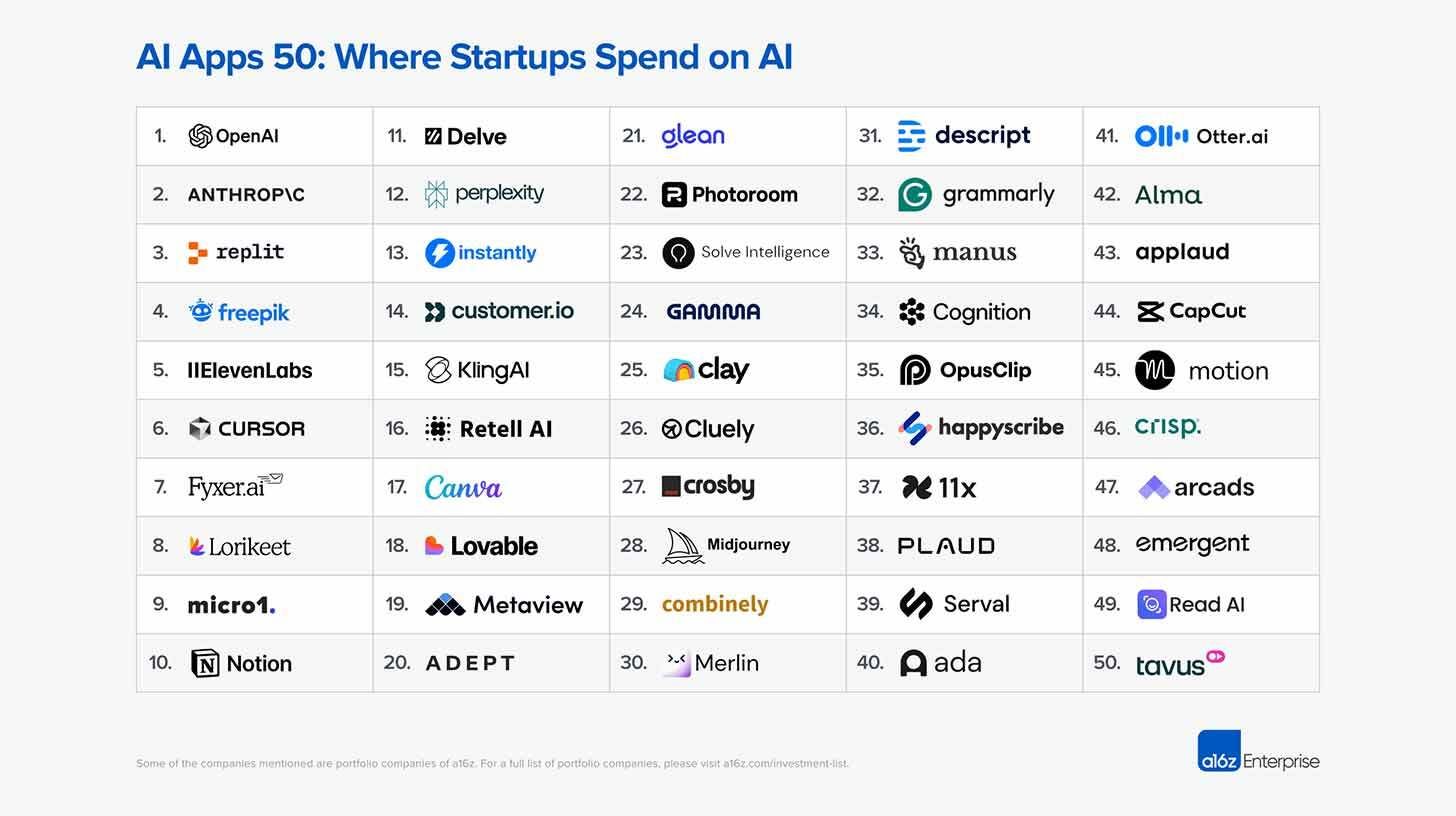
Image source: a16z
The Rundown: Andreessen Horowitz released its AI Spending Report, analyzing transaction patterns from fintech startup Mercury’s 200,000+ customers to show which AI companies are capturing real startup dollars versus just generating traffic.
The details:
OpenAI took the top spot, with Anthropic in the second place, and Perplexity (No. 12) and Merlin AI (No. 30) rounding out the list of general assistants.
Four vibe coding platforms (Replit, Cursor, Lovable, and Emergent) appear on the list, showing the trend seeping beyond consumers into the enterprise.
Creative tools make up the biggest category with 10 featured, including Freepik (No .4), ElevenLabs (No. 5), Kling (No .15), and Canva (No .17).
Other trending categories included meeting assistants, AI employees for specific industries/tasks, and agentic tools.
Why it matters: While ChatGPT and Claude at the top of the chart is no surprise, some of the other popular categories are — with vibe coding becoming much more than just a personal tool, and agentic AI platforms starting to proliferate beyond novelty and across actual work use cases.
AI TRAINING
🤩 Create n8n workflows directly from Claude
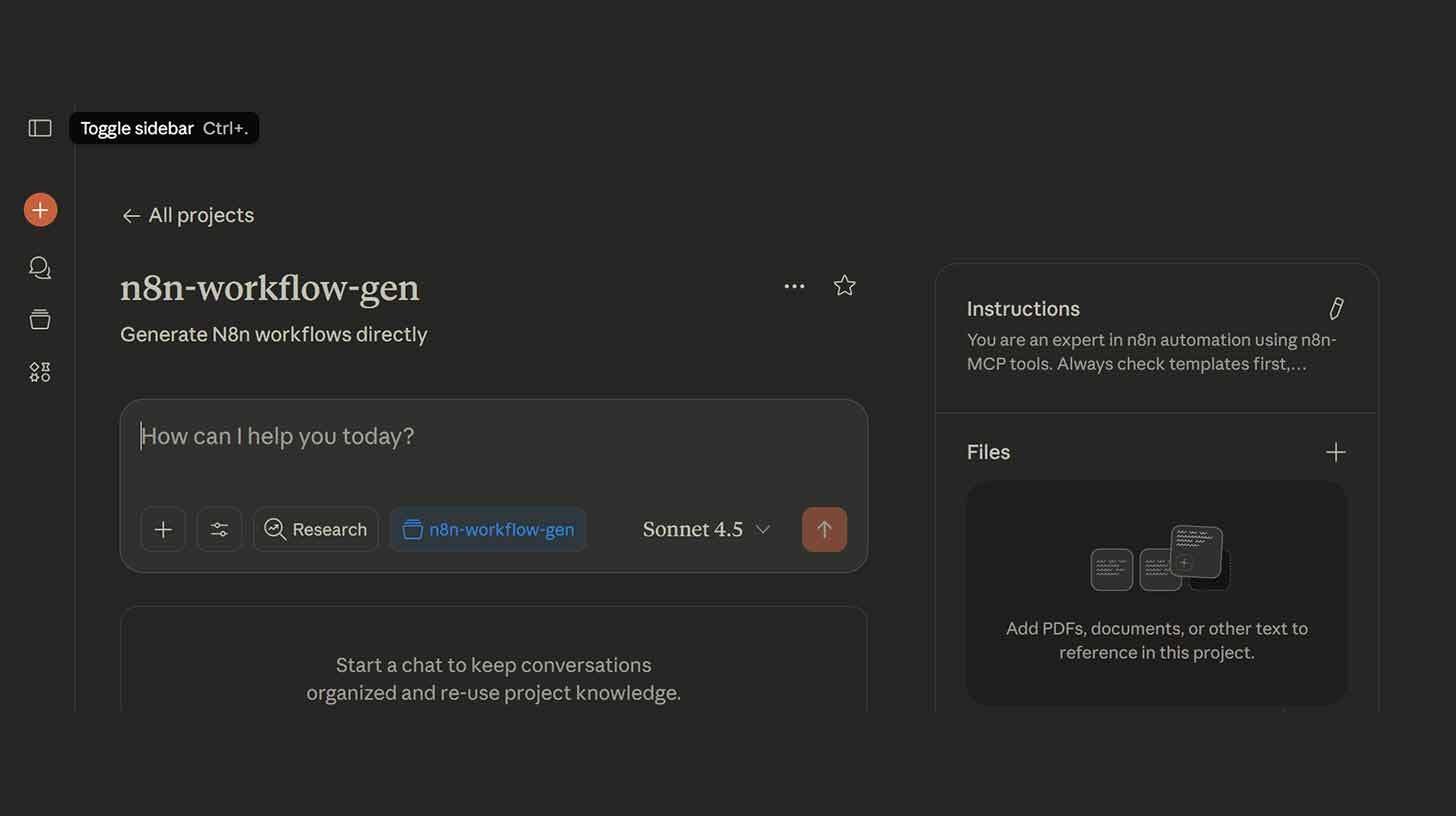
The Rundown: In this tutorial, you will learn how to generate complete n8n workflow automations by describing what you want in plain English — using Claude Sonnet 4.5 via MCP to build workflows without manually connecting nodes.
Step-by-step:
Install Claude Desktop and Node.js, then open your terminal and run
npx n8n-mcpto start the MCP serverIn Claude Desktop, go to Settings > Developer > Edit Config and paste the configuration code, adding your n8n URL (from your workflow dashboard) and API key (Settings > n8n API > Create API Key)
Restart Claude Desktop, click the n8n MCP icon in the bottom right, and hit "Enable all tools" to give Claude access to your workflows
Describe your automation to Claude: "Build an n8n workflow that monitors my Gmail for emails with 'invoice' in the subject, extracts the invoice amount using AI, and logs it to a Google Sheet"
Claude will build the automation and give you a direct link to open in n8n
Pro tip: Claude works best with specific requests. Instead of "automate my emails," try "when I get a Slack message with 'urgent,' create a task in Todoist and send me a calendar reminder." The more details you give, the better the workflow.
PRESENTED BY ENCORD
📈 Scale AV data workflows 10x faster

The Rundown: Encord is the universal data layer trusted by the world’s leading AV & ADAS teams, like Woven by Toyota and Zipline. They rely on Encord’s unified workflow to prepare high-quality, labeled multimodal datasets 10x faster, accelerating iteration cycles and deploying production models at scale.
Join Encord’s LiDAR experts on Oct. 28 for a masterclass on how to:
Visualize and curate multimodal data, including LiDAR and radar data
Automate 3D segmentation of obstacles with single-shot labeling and object tracking
Create robust, scalable pipelines for model training and evaluation
Sign up here to join live or catch the replay.
🐙 Google pushes Jules coding agent into terminals

Image source: Google
The Rundown: Google launched Jules Tools, a new command-line interface and public API for its autonomous coding agent, allowing developers to trigger tasks and monitor progress from terminals rather than switching to separate browser windows.
The details:
Developers can now control Jules through typed commands in terminal windows, automating repetitive tasks or creating coding assignments.
Google opened access to Jules' underlying connections, allowing companies to plug the assistant into workplace tools like Slack and development pipelines.
The assistant now remembers programmer preferences and past corrections, and includes tools for managing access to credentials during automated work.
Jules also handles tasks in the background on Google's server, allowing devs to focus on their primary workspace instead of monitoring browser tabs.
Why it matters: After launching almost a year ago, Jules has been quiet despite the AI coding space as a whole going parabolic. With the new CLI and API access, Jules’ better integrations into dev workflows could boost adoption — but it also faces no shortage of competition from OpenAI’s Codex, Anthropic’s Claude Code, and others.
QUICK HITS
🛠️ Trending AI Tools
☄️ Comet - Perplexity’s AI-first browser, now generally available
⚙️ Tinker - Thinking Machines’ API for fine-tuning language models
💼 Claude in Slack - New connection to search and reference workspaces
⚡️ IBM Granite 4.0 - New, efficient, hybrid models for enterprise
📰 Everything else in AI today
Perplexity announced the official open launch of its AI-native Comet web browser, now available for free worldwide after an invite-gated initial rollout in July.
OpenAI issued a response and motion to dismiss Musk and xAI’s lawsuit alleging trade secret theft, saying the company “won’t be intimidated by his attempts to bully them.”
Google rolled out Gemini 2.5 Flash Image (Nano Banana) as generally available, with new features including additional aspect ratios and prompt customizations.
The NBA is partnering with AWS to launch Inside the Game, a new platform for TV broadcasts with AI-powered advanced stats, strategy, and player tracking.
IBM launched Granite 4.0, a new family of open, small, efficient LLMs that excel at agentic workflows and enterprise tasks.
Samsung and Korean manufacturer SK Hynix joined OpenAI's Stargate initiative, with a focus on increasing production of memory chips and data centers in the region.
COMMUNITY
🤝 Community AI workflows
Every newsletter, we showcase how a reader is using AI to work smarter, save time, or make life easier.
Today’s workflow comes from reader Sam S. in Big Sur, CA:
"I use AI as a coach, particularly for tasks I'm afraid to tackle. I'll identify a goal and then say, "I want to work for 30 minutes every day; I want you to guide me in every step of the process. Be my cheerleader but also a very honest critic." I know AI is sycophantic, but in certain cases, that's really helpful. Just committing to the task in and of itself is a big step forward — crucially, I feel like I'm not doing it alone."
How do you use AI? Tell us here.
🎓 Highlights: News, Guides & Events
Read our last AI newsletter: Apple chases Meta’s AI glasses lead
Read our last Tech newsletter: Microsoft launches ‘vibe working’ AI
Read our last Robotics newsletter: Drones that hunt down shoplifters
Today’s AI tool guide: Create n8n workflows directly from Claude
RSVP to our next workshop today @ 4PM EST: Vibe coding for non-devs
See you soon,
Rowan, Joey, Zach, Shubham, and Jennifer — the humans behind The Rundown


Drones that hunt down shoplifters
Read Online | Sign Up | Advertise

Good morning, robotics enthusiasts. Retailers are cracking down on shoplifting — and Atlanta-based startup Flock Safety wants drones to do the chasing.
Once the go-to for police surveillance, the company hopes to arm big-box stores with autonomous aerial patrols that hunt down suspected shoplifters in real time. But do we really want drones stalking people through the parking lot at Walmart?
In today’s robotics rundown:
This startup wants its drones to chase shoplifters
DoorDash unveils cute new delivery bot
A spider-shaped bot builds a house a day
Seven-Eleven to overhaul staff with humanoids
Quick hits on other robotics news
LATEST DEVELOPMENTS
FLOCK SAFETY
🛒 This startup wants its drones to chase shoplifters

Image source: Flock Safety
The Rundown: Flock Safety, once known for flooding neighborhoods with automated license plate readers, is now pitching its autonomous drones directly to retailers to hunt down suspected shoplifters. Welcome to the next phase of privatized surveillance.
The details:
Previously marketed to police departments, Flock’s drones are now being pitched to retailers looking to clamp down on shoplifting.
Companies install docking stations on their premises, and when an alarm goes off, a drone automatically launches to track down the suspect.
The drones stream real-time video feeds back to security teams, offering live tracking rather than passive footage like traditional CCTV.
Flock is pitching this as the antidote to rising retail theft, particularly for big-box stores watching their shrinkage numbers climb, MIT Tech Review reports.
Why it matters: Police, however flawed, are at least accountable to the public. Corporate drones, on the other hand, answer only to shareholders. And once this tech is normalized, what’s to stop it from tracking union organizers, monitoring protests, or flagging customers who return too much? Mission creep is the business model.
DOORDASH
🥡 DoorDash unveils cute new delivery bot
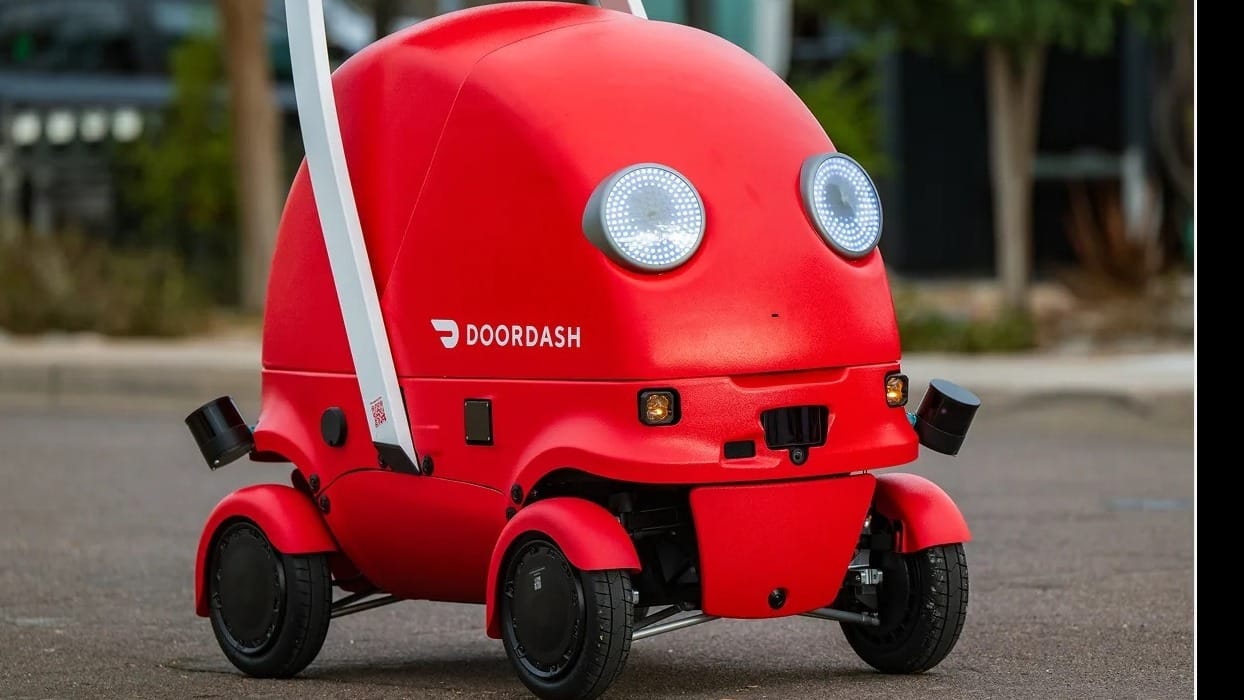
Image source: DoorDash
The Rundown: DoorDash just unveiled Dot, a squat, candy-red machine that cruises roads, bike lanes, and sidewalks at up to 20 miles per hour with one simple job: getting food from restaurant to doorstep without a human in between.
The details:
Standing under 5 feet tall and weighing 350 lbs., Dot's cargo hold fits six pizza boxes or 30 lbs. of goods with modular inserts.
Dot launches in Tempe and Mesa, Arizona, with a full support ecosystem of warehouses, charging stations, and operators for cleaning and emergencies.
Co-founder Stanley Tang's pitch is simple: “You don't always need a full-sized car to deliver a tube of toothpaste or pack of diapers.”
A camera inside the cargo space ensures humans don't climb in, but the robot is light enough to be tipped by a few determined people.
Why it matters: DoorDash’s autonomous push arrives as competitors like Uber, Waymo, Nuro, and Serve Robotics race to redefine food delivery with robots and drones. But DoorDash is betting its advantage lies in owning both the platform and the hardware, leveraging routing data from 10B deliveries to power custom-built robots.
CONSTRUCTION BOTS
🏠 A spider-shaped bot builds a house a day
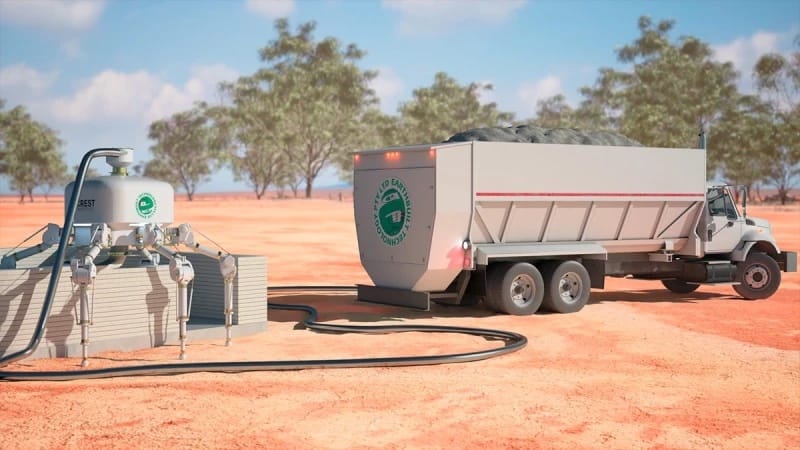
Image source: Crest Robotics / Earthbuilt Technology
The Rundown: A spider-shaped construction robot named Charlotte can roll onto a vacant lot and autonomously build a 2,150-square-foot home in 24 hours, matching the output of 100 bricklayers working in tandem.
The details:
Charlotte uses industrial-scale 3D printing to extrude walls layer by layer, creating structures that are inherently flood-proof and fire-resistant.
The system requires only minimal human oversight for setup, material feeds, and software updates, while automating the structural build process.
Developers are targeting disaster relief zones and affordable housing developments in underserved communities.
Charlotte is in prototype phase, with pilots in Australia and expanded field tests slated for 2025, and lunar construction ambitions on the horizon.
Why it matters: Charlotte isn't the first construction robot, but it's among the first attempting full-structure automation at speed, compressing several weeks of work into a single day. If it actually delivers on that promise at scale, housing stops being constrained by labor availability and becomes purely a question of materials and land.
JAPANESE ROBOTS
🍘 Seven-Eleven to overhaul staff with humanoids
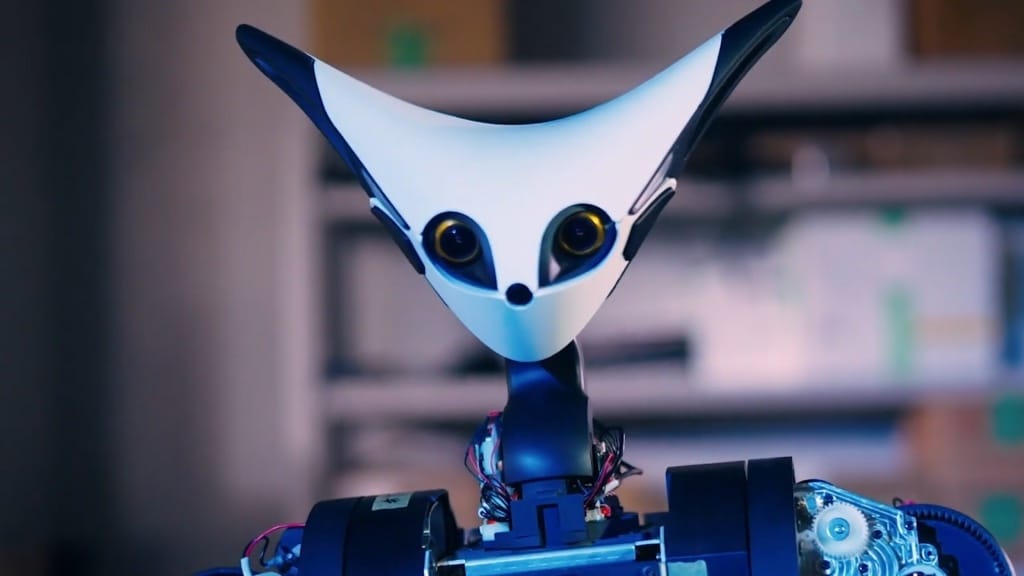
Image source: Telexistence
The Rundown: Japan’s convenience store giant Seven-Eleven is going all-in on humanoids, partnering with Tokyo’s Telexistence to fast-track Astra, a robot designed to handle stocking, cleaning, and customer interaction in its network of 20K stores.
The details:
The partnership with Telexistence moves beyond typical pilot projects as a full-scale bet on robots as a solution to Japan's labor crisis.
Expected in stores by 2029, Astra is custom-built to handle the grunt work: stocking shelves, cleaning floors, and managing basic customer interactions.
Telexistence’s pilot “Ghost” beverage restocking robots are already operating in Tokyo stores, serving as early testbeds for Astra's capabilities.
With Toyota and top universities collaborating on the project, the partnership aims to make humanoids a practical and scalable reality.
Why it matters: Japan looks to be building the world's largest humanoid workforce to staff convenience stores — machines trained on massive retail datasets using vision-language-action models. If Astra works at scale, it’ll prove that humanoids can be economically viable workers, not just expensive demos doing backflips for YouTube.
QUICK HITS
📰 Everything else in robotics today
NVIDIA just unveiled major updates to its robotics platform, showcasing new open-source models and simulation libraries to streamline and accelerate robotics R&D.
China launched humanoid training facilities in Beijing, with its Shijingshan base spanning over 10K square meters and expected to generate 6M data points annually.
South Korea’s CJ Logistics is leading a $3M, government-backed project to build humanoids with dexterous hands capable of handling warehouse tasks by 2028.
Australia’s SwarmFarm Robotics raised $30M to expand its automated farming tech in North America and boost both productivity and sustainability.
Startup Westlake Robotics unveiled General Action Expert, a “Shadow Function” AI model that enables robots to mirror a human handler’s movements in real time.
CIRTESU robot fish completed successful wireless tests, unlocking hands-free inspection, maintenance, and sensor deployment in aquaculture and port environments.
A UC Berkeley-led team unveiled an AI-powered design framework that automates the creation of complex, shape-shifting truss robots.
Unitree's G1 humanoid just pulled off a butterfly twist, a full 360-degree airborne spin that puts it firmly in parkour territory.
COMMUNITY
🎓 Highlights: News, Guides & Events
Read our last AI newsletter: Apple chases Meta’s AI glasses lead
Read our last Tech newsletter: Microsoft launches ‘vibe working’ AI
Read our last Robotics newsletter: Google’s robots learn to ‘think’ first
Today’s AI tool guide: Create a professional headshot with Gemini
RSVP to our next workshop @ 4 PM EST Friday: Vibe coding for non-devs
See you soon,
Rowan, Jennifer, and Joey—The Rundown’s editorial team

Apple chases Meta's AI glasses lead
Read Online | Sign Up | Advertise

Good morning, AI enthusiasts. Mark Zuckerberg said glasses are the “ideal form factor” for personal AI, and Apple seems to be a believer.
The tech giant just reportedly scrapped its Vision Pro overhaul to go all-in on smart glasses that compete with Zuck’s successful Ray-Ban lineup. But with Apple’s AI issues already mounting, can they actually compete?
In today’s AI rundown:
Apple to join smart glasses race
Mira Murati's startup unveils first product
Create a professional headshot with Gemini
Google’s AI agent masters Minecraft via simulation
4 new AI tools, community workflows, and more
LATEST DEVELOPMENTS
OPENAI
🕶️ Apple to join smart glasses race

Image source: Nano Banana / The Rundown
The Rundown: Apple just canceled plans to overhaul its Vision Pro headset, according to a new report from Bloomberg — instead shifting focus toward AI smart glasses projects designed to compete with Meta's Ray-Ban lineup.
The details:
The company halted work on a lighter, cheaper Vision Pro variant planned for 2027, reassigning teams to fast-track development of several glasses designs.
A 2027 release will connect to iPhones without its own screen, with another version with an integrated display aiming to rival Meta's Display glasses.
The devices will reportedly lean on voice controls and AI features, with speakers, cameras, and health tracking powered by the upcoming Siri upgrade.
Meta expanded its smart glasses line in September with a new Display and Neural Band, an athlete-focused Oakley option, and Ray-Bans Gen 2.
Why it matters: 2023’s Vision Pro release feels like an eternity ago in the AI world, but the hype was real — though a high price point, heavy design, and poor adoption have turned it into an afterthought. While Meta has shown a fit in the market, Apple needs to stick with the Siri redesign before being considered a player in the AI wearable space.
TOGETHER WITH VANTA
📶 Scaling security for the AI era

The Rundown: Security teams are facing more buyer expectations, regulatory demands, and business risk — meaning compliance has to scale even faster. Join experts Ashish Rajan (CISO at Kaizenteq) and Faisal Khan (GRC Expert at Vanta) for a tactical conversation on maturing compliance, risk, and trust in the AI era.
In this live session, you’ll walk away with:
A roadmap for prioritizing your next program improvements
Top workflows for AI to help extend your impact
Techniques to prove value across product, sales, and your board
THINKING MACHINES
⚙️ Mira Murati's startup unveils first product

Image source: …
The Rundown: Thinking Machines Lab, the AI startup founded by ex-OpenAI CTO Mira Murati and several prominent researchers, introduced Tinker — an API that enables developers to customize frontier models without managing complex infrastructure.
The details:
Tinker supports fine-tuning both supervised and reinforcement learning methods on models like Meta's Llama and Alibaba's Qwen.
The models can be adapted for specialized applications like solving math problems, analyzing chemistry data, and other tasks with simple code.
Early users including Princeton, Stanford, and Berkeley, have applied Tinker to build custom AI systems for math proofs, scientific reasoning, and research.
The company is accepting applications for early access starting today at no initial cost, with plans to introduce paid tiers in the coming weeks.
Why it matters: Creating AI models from scratch requires significant resources, but customizing existing models could be a better path for most organizations. Murati and co. are betting that the future is not to who builds the biggest all-purpose AI, but to who can make it easiest to create tons of hyper-specialized ones.
AI TRAINING
📸 Create a professional headshot with Gemini

The Rundown: In this tutorial, you will learn to transform a casual selfie into a polished professional headshot using Gemini 2.5 Flash, with no expensive studio session required.
Step-by-step:
Go to gemini.google.com and toggle on "Create Images" at the top of the prompt box
Upload your selfie and paste this prompt: "Transform my selfie into a fresh but professional image suitable for a social media profile. The lighting should be natural, flattering, and multi-dimensional. My head is slightly tilted so it doesn't look stiff, and it should look like I'm in a modern, bright office with a blurred background"
Review the result and tweak the prompt if needed, and adjust the background description or lighting until it feels right
Download your finished headshot to use for LinkedIn, résumés, websites, or speaking profiles
Pro tip: Play around with different backgrounds like "warm café," "neutral studio," or "outdoor blurred park" to see which one aligns with your professional brand.
PRESENTED BY GLEAN
🤔 Is your organization paying the "AI tax"?
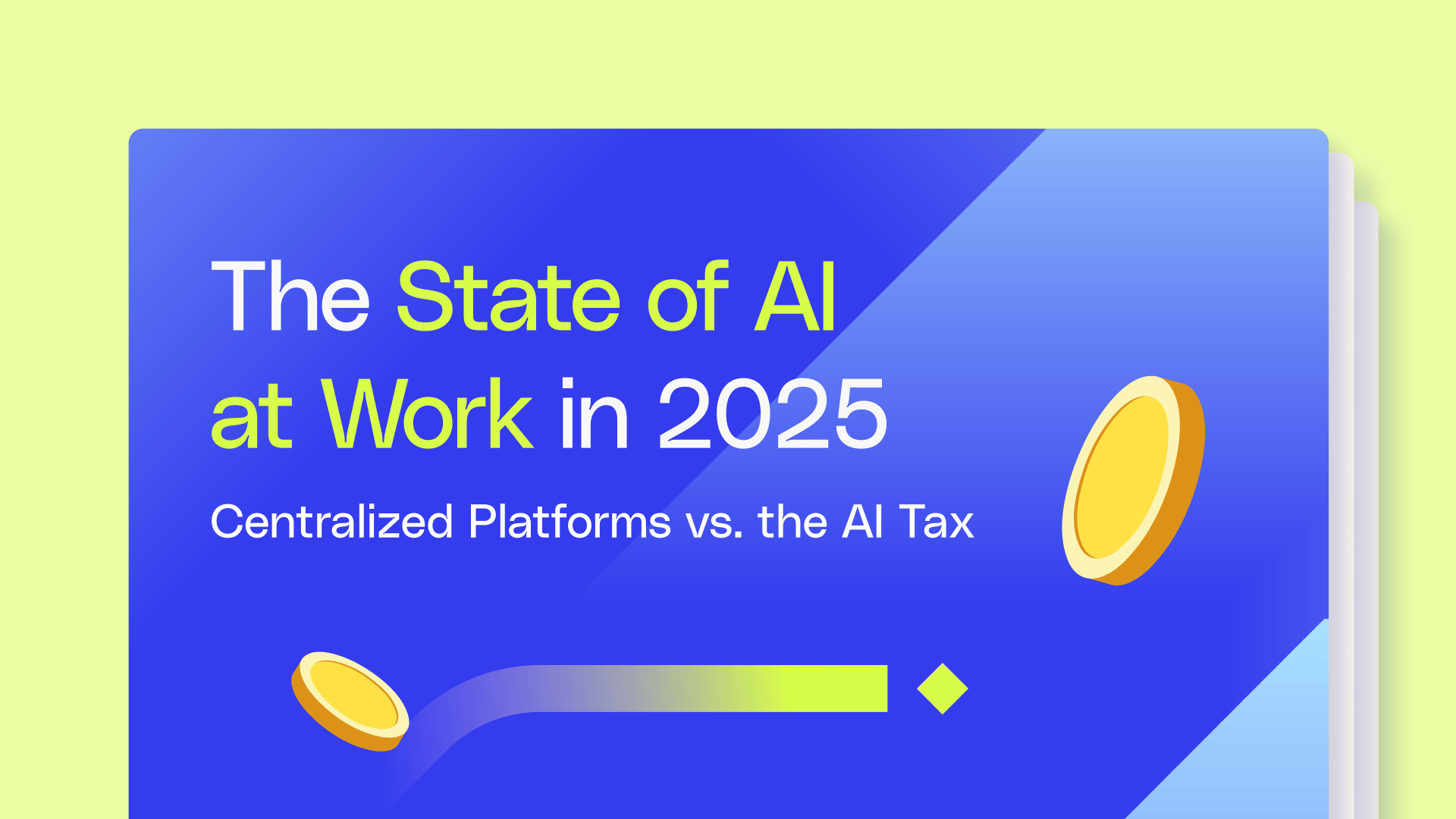
The Rundown: In The State of AI At Work in 2025, Glean explains how leading orgs are avoiding inefficiencies by centralizing their AI capabilities on unified platforms.
Inside, you’ll learn about:
Where organizations are investing in 2025
The hidden “AI tax” that arises from fragmented tools
How centralized AI platforms cut through fragmentation, unifying governance, security, and reducing costs
GOOGLE DEEPMIND
⛏️ Google’s AI agent masters Minecraft via simulation
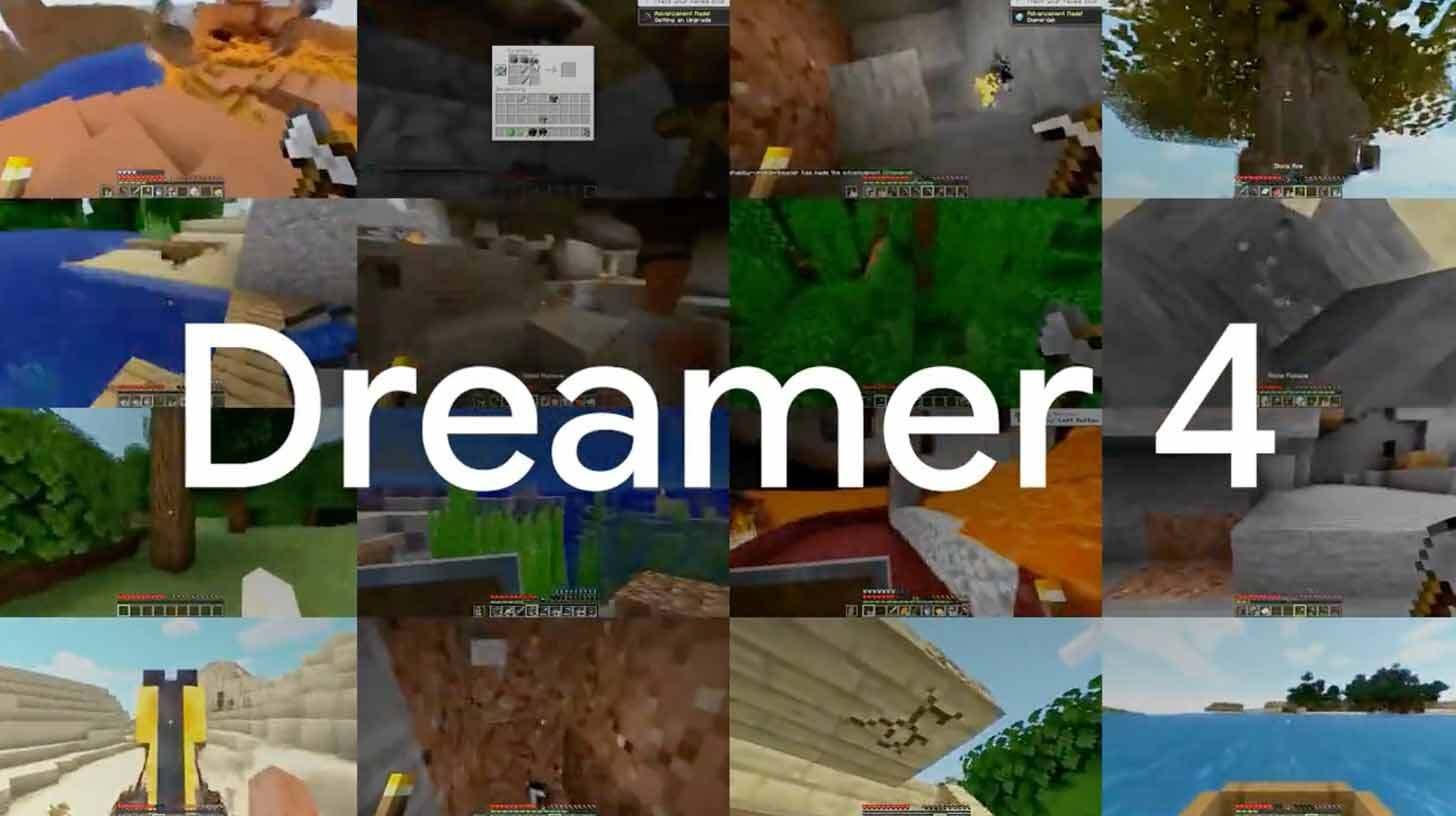
Image source: Google DeepMind
The Rundown: Google DeepMind researchers unveiled Dreamer 4, an AI that masters video game tasks by training within its own mental simulation, becoming the first agent to collect Minecraft diamonds using only offline data, without touching the actual game.
The details:
Dreamer 4 trains by practicing in a predictive world model that simulates Minecraft's physics in real-time, executing over 20k actions from visual input.
The training is in stages: learning Minecraft from videos, adding decision-making abilities, and improving via practice — all without playing the real game.
The world model achieved new highs in accuracy, with testers completing 14/16 tasks in Dreamer 4's simulation compared to 5 in rival models like Oasis.
Dreamer also beat OpenAI's Minecraft VPT agent while learning from 100x less data, and outperformed systems built on Gemma vision-language models.
Why it matters: It is always cool to still see games like Minecraft being used to test next-level agentic training and capabilities, but Dreamer 4’s skills translate far beyond gaming — with learning through simulation opening safer and more efficient development paths for robots that can replace costly and often dangerous IRL testing.
QUICK HITS
📰 Everything else in AI today
Google unveiled Gemini-powered upgrades to its Home hardware, featuring AI Nest Cams and Doorbells, a redesigned app and Home Speaker, and a new paid plan.
OpenAI’s new Sora social app surged to No. 3 on Apple’s App Store behind just Google Gemini and ChatGPT, following its viral invite-only launch.
Hume AI launched Octave 2, a new multilingual text-to-speech model that supports 11 languages and includes new voice conversion and phoneme editing features.
Character AI removed Disney characters, including Elsa, Moana, Spider-Man, and Darth Vader, from its platform following a cease-and-desist from the company.
Pew Research Center found that 9% of U.S. adults are getting news from AI, with a third of them finding it hard to determine what's true and half getting inaccurate news.
Google launched new visual search capabilities in AI Mode, allowing users to search with images or text and streamline shopping across over 50B product listings.
Zhipu AI released GLM-4.6, a new open-source LLM with a 200k context window that beats out Claude Sonnet 4 and DeepSeek-V3.2 across a series of benchmarks.
COMMUNITY
🤝 Community AI workflows
Every newsletter, we showcase how a reader is using AI to work smarter, save time, or make life easier.
Today’s workflow comes from reader Cynthia L. in Jupiter, FL:
"I'm an instructional designer of eLearning courses and am building my personal portfolio. I'm using AI to develop scripts and quizzes, images and videos, TTS, and visual design briefs (for color palettes, typography, imagery style and iconography, layout and interface elements). I still have to build the course, but AI saves me so many hours of work!"
How do you use AI? Tell us here.
🎓 Highlights: News, Guides & Events
Read our last AI newsletter: Sora 2 breaks the internet
Read our last Tech newsletter: Microsoft launches ‘vibe working’ AI
Read our last Robotics newsletter: Google’s robots learn to ‘think’ first
Today’s AI tool guide: Create a professional headshot with Gemini
RSVP to our next workshop @ 4 PM EST Friday: Vibe coding for non-devs
See you soon,
Rowan, Joey, Zach, Shubham, and Jennifer — the humans behind The Rundown

Sora 2 breaks the internet
Read Online | Sign Up | Advertise

Good morning, AI enthusiasts. OpenAI just dropped a video model that might actually break the internet — in more ways than one.
With Sora 2’s incredible physics and realism and a new Cameo feature bringing instant viral potential, the next step up in video generation is here. But once the floodgates open, will this new AI social app break through the noise or just add to the slop?
In today’s AI rundown:
OpenAI’s Sora 2 with social video app
Periodic Labs’ AI scientist for physical world
Build full-stack AI productivity tools without coding
Amazon’s new Alexa+ integrated devices
4 new AI tools, community workflows, and more
LATEST DEVELOPMENTS
OPENAI
🎥 OpenAI’s Sora 2 with social video app

Image source: OpenAI
The Rundown: OpenAI just released Sora 2, its latest video model that now includes synchronized audio and dialogue, alongside a new social app where users can create, remix, and insert themselves into AI videos through a "Cameos" feature.
The details:
Sora 2 shows huge improvements in physics compared to earlier models, also featuring longer 5-10 second outputs that can handle complex scene changes.
The model can also generate matching audio alongside visuals, creating realistic dialogue and sound effects that synchronize across content styles.
The new Sora social app centers around ‘Cameos’, a feature that lets users record and use their likeness across AI-generated scenes.
The app launches free with usage limits in the U.S. and Canada, with Pro subscribers getting access to a Sora 2 Pro model and API access coming soon.
Why it matters: Model-wise, Sora 2 looks incredible — pushing us even further into the uncanny valley and creating tons of new storytelling capabilities. Cameos feels like a new viral memetic tool, but time will tell whether the AI social app can overcome the slop-factor and have staying power past the initial novelty.
TOGETHER WITH ASAPP
📱 Talk to GenerativeAgent live
The Rundown: You’ve probably heard the MIT stat circulating that 95% of enterprise AI pilots fail. Want to experience the other 5%? ASAPP’s GenerativeAgent® is an enterprise-grade AI customer service agent you can call today. Purpose-built for complex customer calls & chats, it resolves real issues with speed, safety, and control.
Pick a use case, call in, and experience:
Human-like conversations that go beyond simple FAQs
Fast, accurate resolutions—the first time
Enterprise-grade guardrails that prevent hallucinations
PERIODIC LABS
🧪 Periodic Labs’ AI scientist for physical world

Image source: Periodic Labs
The Rundown: ChatGPT co-creator Liam Fedus’ new startup, Periodic Labs, just launched, revealing its mission to build AI scientists that learn from physical experiments rather than internet text — with over 20 researchers from top AI labs.
The details:
The company is constructing autonomous laboratories where robots will execute thousands of materials science experiments.
The labs will generate gigabytes of unique data per trial, with AI systems then analyzing to guide future experimentation.
Periodic Labs raised over $300M in funding at a $1B valuation, with initial projects targeting superconductors and chip manufacturing efficiency.
The team argues that current LLMs have exhausted the internet's text and can't achieve real discovery without real-world experimentation.
Why it matters: Researchers from OpenAI, Meta, Google DeepMind, and other labs turned down serious cash to join Periodic Labs, with a worthy goal of accelerating science across the board. This vision shows the other side of the AI coin — some see the content slop, others see the visionary opportunity for world-changing discovery.
AI TRAINING
💻 Build full-stack AI productivity tools without coding
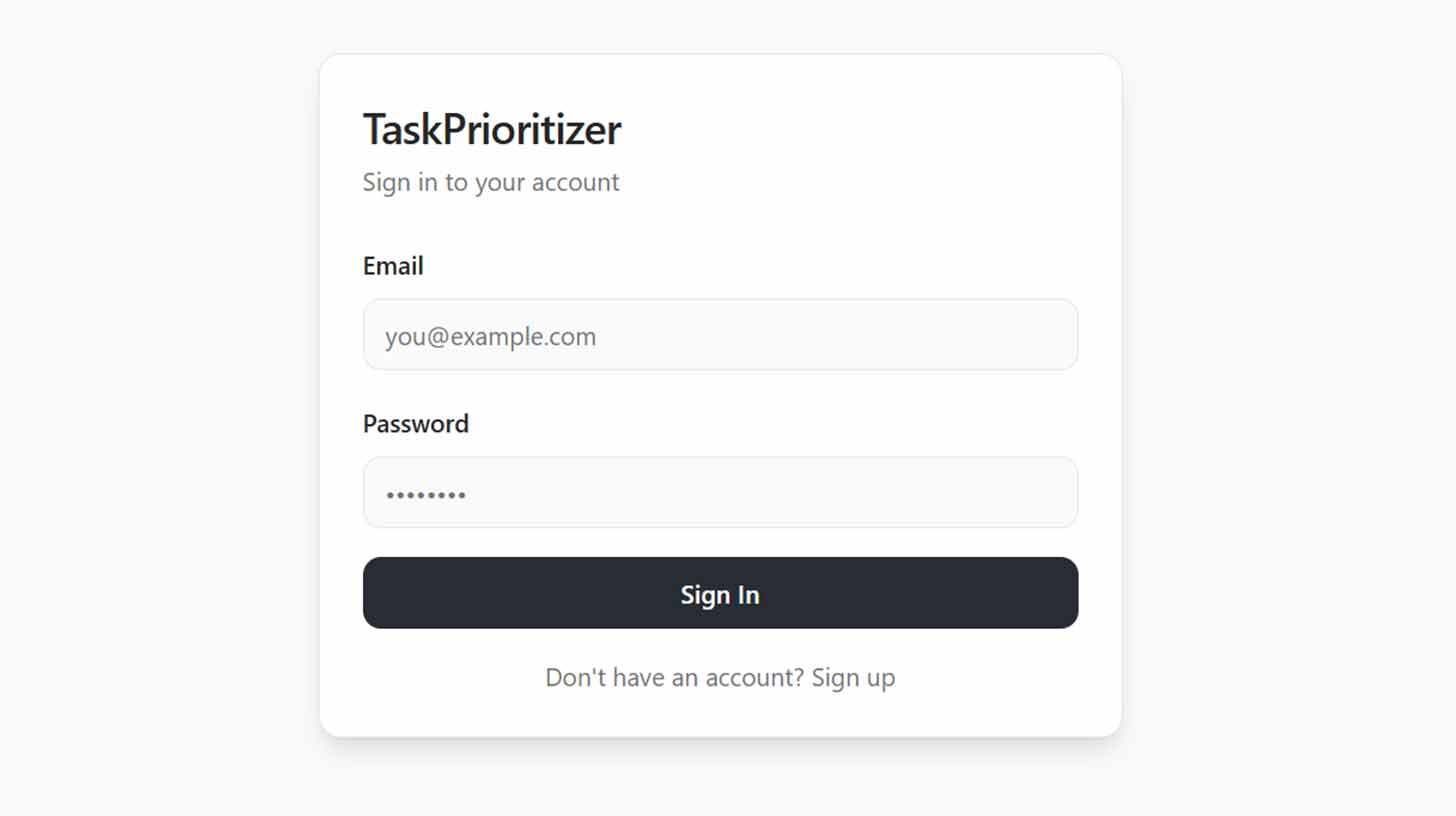
The Rundown: In this tutorial, you will learn how to build AI-powered productivity apps using Lovable — a platform that handles UI, backend, database, and AI integration through simple prompts with no coding required.
Step-by-step:
Go to lovable.dev, sign up (5 free credits/day), and then prompt: "Build a task tracking app called TaskPrioritizer with a form for task name and description, display tasks as cards with checkboxes, and store in a database"
Add AI integration by prompting: "Add AI using Gemini to automatically prioritize tasks as low/medium/high based on urgency keywords like 'ASAP' or 'today', show colored badges, and include a sort button"
Enable authentication with: "Add user accounts with signup/login so people can save their own tasks privately. Each user only sees their own tasks"
Test your app by creating tasks with different urgency levels, then click "Publish" in the top right to get a live URL
Pro tip: Use Claude or ChatGPT to draft a product spec before building — describe your idea and ask for a requirements doc to help you think through features upfront.
PRESENTED BY K2 THINK
🧠 Open reasoning, unlocked
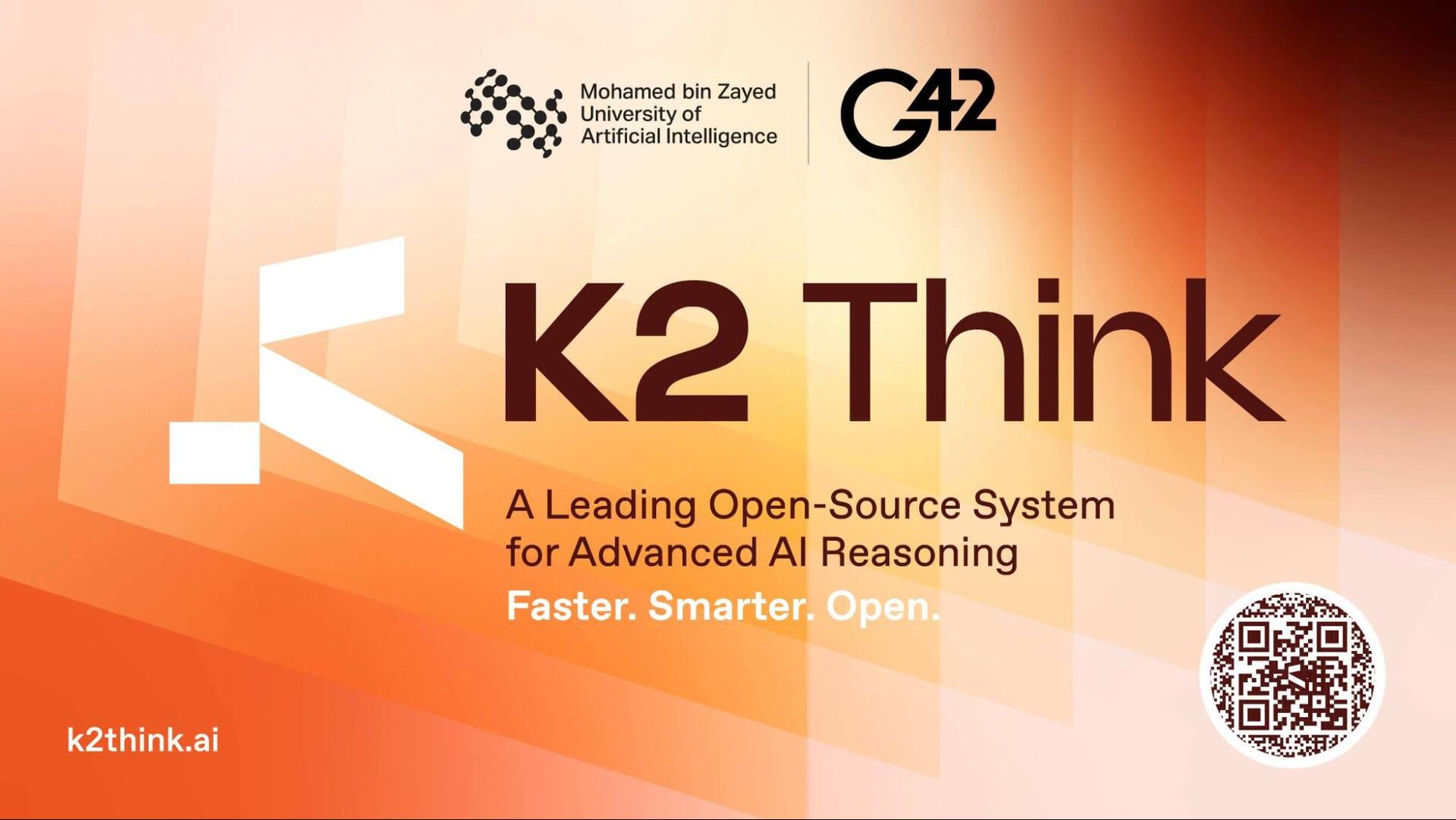
The Rundown: K2 Think isn’t just another model release, it’s fully open source with training data, parameter weights, and deployment code all accessible — ensuring reproducibility and accelerating global collaboration. From labs to startups, K2 Think gives AI builders a transparent, high-performance reasoning system to trust and extend.
K2 Think’s upgrades include:
Performance at just 32B parameters that rivals 600B+ reasoning LLMs
Chain-of-thought depth and test-time scaling
Optimized for Cerebras wafer-scale inference
AMAZON
📦 Amazon’s new Alexa+ integrated devices
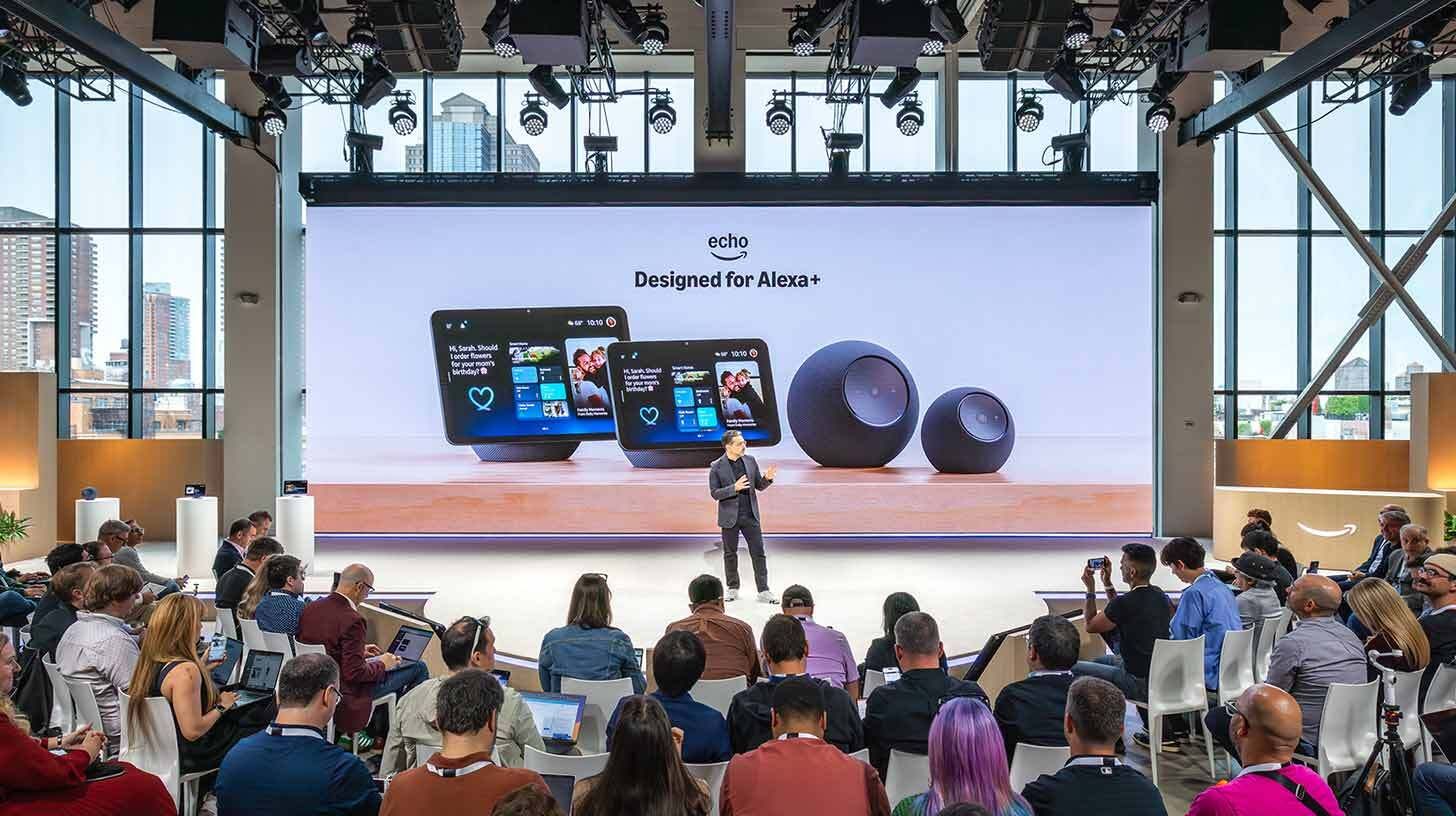
Image source: Amazon
The Rundown: Amazon just unveiled a series of new devices designed specifically for its new AI-infused Alexa+, including new Echo home systems, Ring cameras, Fire TVs, Kindle readers, and more.
The details:
Alexa+ can now handle more natural conversations, book reservations, control smart homes, and complete complex web tasks autonomously.
New Echo devices feature custom chips to process AI requests on-device, with improved voice detection sensors to recognize people and environments.
Ring AI upgrades include Alexa+ Greetings for a personal AI door attendant, Familiar Faces for people recognition, and Search Party for finding lost pets.
Kindles gain AI-powered notetaking, with Fire TVs getting Alexa+ guidance for movie recs and info, more intelligent search, and broader home integrations.
Why it matters: Alexa+ is heading across Amazon’s product line, with some practical and useful integrations — but nothing that feels truly next level in a space where things are moving a mile a minute. With Apple still in AI limbo, Amazon’s moves are a small step forward… But hardware still feels like it is waiting for a true breakout AI integration.
QUICK HITS
🛠️ Trending AI Tools
🎥 Sora 2 - OpenAI’s new SOTA video generation model
💼 Agent Mode - Microsoft’s ‘vibe working’ capabilities in Office apps
💭 Imagine with Claude - Generate UI and apps on the fly with Claude
⚙️ Essential - Nothing’s ‘digital playground’ to create apps with text prompts
📰 Everything else in AI today
Agentic Memory & Context Engineering Hackathon, SF, Oct. 11 — Push the boundaries of what you can build with MongoDB’s Atlas Vector Search and Voyage AI embeddings. Register now.*
Elon Musk revealed that xAI is building ‘Grokipedia’, which will be a “massive improvement” over Wikipedia and a step towards “understanding the universe.”
Microsoft introduced Agent Mode in Excel and Word, along with Office Agent in Copilot, enabling the creation of spreadsheets, docs, and presentations with text.
Opera launched Neon, a new AI-powered browser that can take agentic actions on a user’s behalf, released as a premium subscription via waitlist.
Meta acquired chip startup Rivos, seeking to accelerate the company’s internal AI chip development and reduce reliance on Nvidia.
OpenAI reportedly generated $4.3B in revenue during the first half of 2025, but also burned $2.5B on research and compute costs, according to The Information.
*Sponsored Listing
COMMUNITY
🤝 Community AI workflows
Every newsletter, we showcase how a reader is using AI to work smarter, save time, or make life easier.
Today’s workflow comes from reader Christopher J. in West Hollywood, CA:
"I use AI as a full-fledged personal health team. I gather results from my physical exams and make prompts to break things down so that a senior in high school could understand them. Then I ask for dietary recommendations to support my longevity, anti-inflammation, and brain health. Based on this, I prompt for specific dietary instructions, including meal plans, shopping lists, and recipes. I then give a list of the markets nearest to me for a specific shopping list with sizes and prices.”
How do you use AI? Tell us here.
🎓 Highlights: News, Guides & Events
Read our last AI newsletter: OpenAI’s e-commerce takeover
Read our last Tech newsletter: Microsoft launches ‘vibe working’ AI
Read our last Robotics newsletter: Google’s robots learn to ‘think’ first
Today’s AI tool guide: Build full-stack AI productivity tools
RSVP to our next workshop @ 4 PM EST Friday: Vibe coding for non-devs
See you soon,
Rowan, Joey, Zach, Shubham, and Jennifer — the humans behind The Rundown

Microsoft launches 'vibe working' AI
Read Online | Sign Up | Advertise
Good morning, tech enthusiasts. Microsoft just dropped a new buzzword: vibe working. It’s their vision for Office apps powered by AI agents that handle the busywork — writing documents, crunching numbers, designing slides — so you can focus on big-picture thinking.
The era of Clippy is long gone — now your PowerPoint has a vibe manager.
In today’s tech rundown:
Microsoft wants you to ‘vibe work’
YouTube to pay $24M in Trump settlement
Gaming giant EA goes private in record buyout
California signs first AI safety law
Quick hits on other tech news
LATEST DEVELOPMENTS
MICROSOFT
🍭 Microsoft wants you to ‘vibe work’
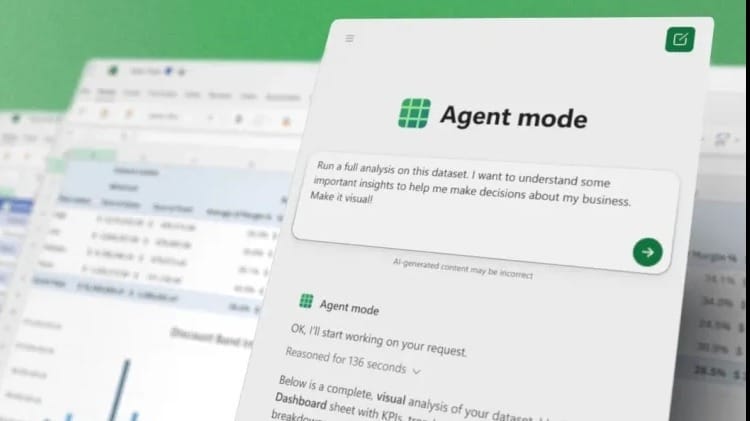
Image source: Microsoft
The Rundown: Microsoft just coined a new buzzword — “vibe working” — for new agentic workflows in Office apps where AI handles the heavy lifting, transforming how documents, spreadsheets, and presentations are built.
The details:
Microsoft’s “vibe working” tools let users start a Word or Excel file with a prompt and refine it through iterative, AI-powered suggestions.
Office Agent, powered by Anthropic in Copilot chat, creates PowerPoint and Word files directly from conversational workflows; Excel support coming soon.
Agent Mode, powered by OpenAI's GPT-5, works inside Excel and Word on the web, breaking tasks into discrete steps with transparent reasoning.
Both features are rolling out now through Microsoft's Frontier program, with desktop app support coming later.
Why it matters: Microsoft wants AI as a collaborator, not just a feature, but that assumes workers want to outsource thinking, not just automate grunt work. If it works, knowledge work shifts from executing tasks to steering intelligence. If not, it's another layer of abstraction slowing you down while feeding Microsoft's models with your data.
ALPHABET
💰YouTube to pay $24M in Trump settlement

Image source: Ideogram / The Rundown
The Rundown: Alphabet, parent company of YouTube, just signed off on a $24.5M payout to settle President Trump’s lawsuit over his social media exile following the January 6, 2021, Capitol riot.
The details:
Of the total, $22M will be directed to the Trust for the National Mall, designated to fund construction of a new White House State Ballroom.
The remaining $2.5M goes to other plaintiffs, including the American Conservative Union and several conservative activists who joined Trump’s suit.
Trump sued YouTube, Meta, and X in July 2021, claiming the bans amounted to “wrongful censorship” of his speech and conservative voices.
Meta agreed to $25M and X paid $10M earlier this year, but YouTube’s deal is the headline finale.
Why it matters: Meta, X, and now Alphabet have all paid up, and Trump's accounts have been live since 2023. For Alphabet — pulling nearly $10B in quarterly ad revenue — this settlement certainly won’t hurt the bottom line. But it sets a precedent: a price tag for presidential power versus platform control.
ELECTRONIC ARTS
🕹️ Gaming giant EA goes private in record buyout

Image source: Electronic Arts
The Rundown: Electronic Arts, one of the biggest gaming companies in the world, just became the centerpiece of the largest leveraged buyout in history: the ‘Madden’ and ‘Battlefield’ publisher agreed to a $55B private takeover.
The details:
EA is being acquired by Silver Lake, Saudi Arabia’s Public Investment Fund (PIF), and Affinity Partners, the firm run by Jared Kushner, Trump’s son-in-law.
Shareholders get $210 per share in cash — a 25% premium over pre-announcement prices — funded by $36B in equity and $20B in debt.
EA exits public markets after 36 years, handing control to a consortium led by Saudi sovereign wealth and private equity heavyweights.
PIF’s play extends Saudi Arabia's gaming expansion; it’s been systematically buying stakes in major publishers and esports platforms since 2022.
Why it matters: This blockbuster deal is second only to Microsoft’s $69B buyout of Activision Blizzard. Going private frees EA from quarterly earnings pressure, enabling longer development cycles and riskier bets. But with ‘Battlefield 6’ launching, the $210 price tag may shortchange shareholders just as EA’s earnings kick in.
AI SAFETY
✒️ California signs first AI safety law

Image source: Wikimedia Commons
The Rundown: California Governor Gavin Newsom signed SB 53, the nation's first law requiring leading AI labs like OpenAI, Anthropic, and Meta to publicly disclose safety measures and promptly report AI-related risks to state authorities.
The details:
Companies must report critical safety incidents, such as deceptive AI behaviors, to California's Office of Emergency Services within 15 days.
Whistleblower protections shield employees who flag catastrophic AI risks, backed by civil penalties enforceable by the Attorney General's office.
The law applies only to companies with over $500M in annual revenue, training models at 10²⁶ FLOPs or higher, which exempts smaller startups.
Anthropic backed it; OpenAI and Meta lobbied against it, warning of compliance chaos across 50 states, though both say they'll comply anyway.
Why it matters: With 32 of the world's top 50 AI companies based in California, SB 53 sets a global precedent. Unlike last year's vetoed SB 1047, which demanded kill switches, this bill opts for transparency over mandates — a "show your work" approach that threads the needle between oversight and innovation.
QUICK HITS
📰 Everything else in tech today
Meta is expanding facial recognition safety tools on Facebook in Europe, the UK, and South Korea to combat public figure impersonation, with Instagram rollout coming soon.
South Korea’s Rebellions raised $250M, boosting its valuation to $1.4B and fueling mass production of its AI chip and product development for next-gen data centers.
Instagram is testing a new interface in India and South Korea that launches the app directly into the Reels page, making short-form video the primary experience.
Disney+, Hulu, and ESPN reportedly lost more than 1.7M paid subscribers in the week after suspending late-night host Jimmy Kimmel.
Meta is offering UK Facebook and Instagram users ad-free paid subscriptions in response to regulatory pressures over targeted ads and user data.
Google is reportedly launching a research program to use Pixel Watch sensor data in exploring how wearables can screen for high blood pressure.
Black Forest Labs, a secretive German AI startup specializing in image generation, is in talks to raise $200–$300M at a valuation of around $4B.
Scientists engineered a handheld “bone-healing gun” — essentially a modified glue gun — that lets surgeons print bone-like scaffolds directly into fractures.
Former Yahoo CEO Marissa Mayer is shutting down her consumer software startup, Sunshine, and selling its assets to her new AI venture, Dazzle.
A Faraday Future electric SUV caught fire at the startup’s LA headquarters, causing an explosion that blew out part of a wall, though no injuries were reported.
Firefly Aerospace’s hopes for a swift Alpha rocket launch suffered a setback after an explosion on Monday during test-firing destroyed the next booster stage.
COMMUNITY
🎓 Highlights: News, Guides & Events
Read our last AI newsletter: OpenAI’s e-commerce takeover
Read our last Tech newsletter: Amazon fined $2.5B for Prime ‘trickery’
Read our last Robotics newsletter: Google’s robots learn to ‘think’ first
Today’s AI tool guide: Create talking head videos using your voice
RSVP to next workshop @ 4PM Friday: Vibe coding in Cursor for non-devs
See you soon,
Rowan, Jennifer, and Joey—The Rundown’s editorial team

OpenAI's e-commerce takeover
Read Online | Sign Up | Advertise

Good morning, AI enthusiasts. Your next online purchase might not happen on Amazon or a brand website, but mid-conversation with ChatGPT.
With OpenAI rolling out its new Instant Checkout with support for millions of merchants, AI is about to become the new one-stop storefront for the internet.
In today’s AI rundown:
OpenAI brings direct purchasing to ChatGPT
Anthropic launches Claude Sonnet 4.5
Create talking head videos using your voice
OpenAI’s TikTok-style app for Sora 2
4 new AI tools, community workflows, and more
LATEST DEVELOPMENTS
OPENAI
🤑 OpenAI brings direct purchasing to ChatGPT

Image source: OpenAI
The Rundown: OpenAI just rolled out direct purchasing inside ChatGPT for U.S. users, letting shoppers complete transactions without leaving the conversation interface through a new feature called Instant Checkout.
The details:
The company partnered with Stripe to create the system, initially supporting Etsy sellers with availability for over 1M Shopify merchants coming soon.
Users can click a "Buy" button after ChatGPT suggests products, then review order details and pay in chat.
OAI open-sourced the underlying Agentic Commerce Protocol, enabling any retailer to integrate it — with Stripe merchants needing minimal code changes.
The company collects fees from merchants on completed sales, but the product rankings stay organic, still determined by relevance.
Why it matters: We’ll be curious to see if OAI eventually incorporates ads into the flow, but Instant Checkout and the ACP feel like an inflection point for the shift to the era of agentic AI commerce. The structure is also an interesting new revenue stream for the AI giant, and could seriously add up as shopping shifts to ChatGPT.
TOGETHER WITH TURING
🧪 The research accelerator for frontier AI labs

The Rundown: While data factories churn out quantity, leading AI labs need partners who co-own research goals and engineer the complex human-AI loops that push models from promising to state-of-the-art. Turing specializes in closing capability gaps through custom research acceleration.
Turing's research-focused approach includes:
Co-owned experimental outcomes, not just data delivery, and vendor neutrality
Quality-by-design workflows with transparent data lineage and auditable results
Custom RL environments and SFT/RLHF/DPO pipelines designed for your benchmarks
Partner with the research accelerator that understands what frontier AI labs actually need.
ANTHROPIC
🚀 Anthropic launches Claude Sonnet 4.5
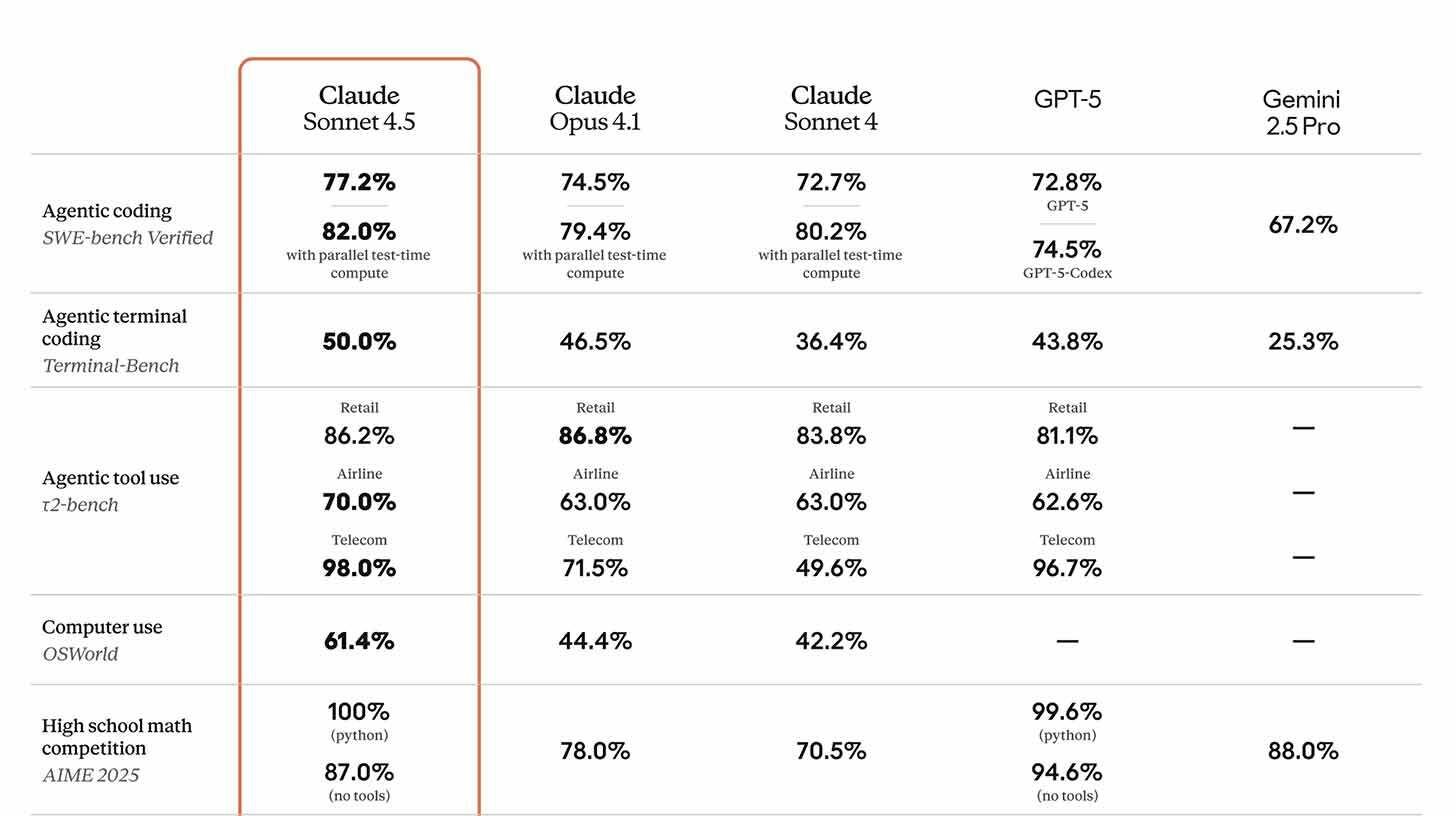
Image source: Anthropic
The Rundown: Anthropic just released Claude Sonnet 4.5, calling it the “best coding model in the world” and showcasing top-tier performance on development benchmarks while maintaining the same API pricing as its predecessor.
The details:
Sonnet 4.5 achieves SOTA results on real-world software development (SWE-bench verified), and a nearly 20% upgrade from Opus 4.1 on computer use.
Testing showed Sonnet 4.5 coding autonomously for 30+ hours to deliver 11,000 lines of code, a massive jump from GPT-5-Codex’s 7+ hour sessions.
Anthropic rolled out new updates, including Claude Code checkpoints, memory and context editing in API, and a Claude Agent SDK for agent building.
The company also released "Imagine with Claude" as a 5-day research preview for Max users, showcasing real-time software generation.
Why it matters: OAI’s Codex stole some of Claude Code’s thunder this summer, but the release of a new top coding model and platform upgrades could give Anthropic a renewed edge. A 30+ hour agentic session is also a wild achievement, and points to a future of long-horizon tasks that unlock unfathomable new capabilities.
AI TRAINING
🗣️ Create talking head videos using your voice
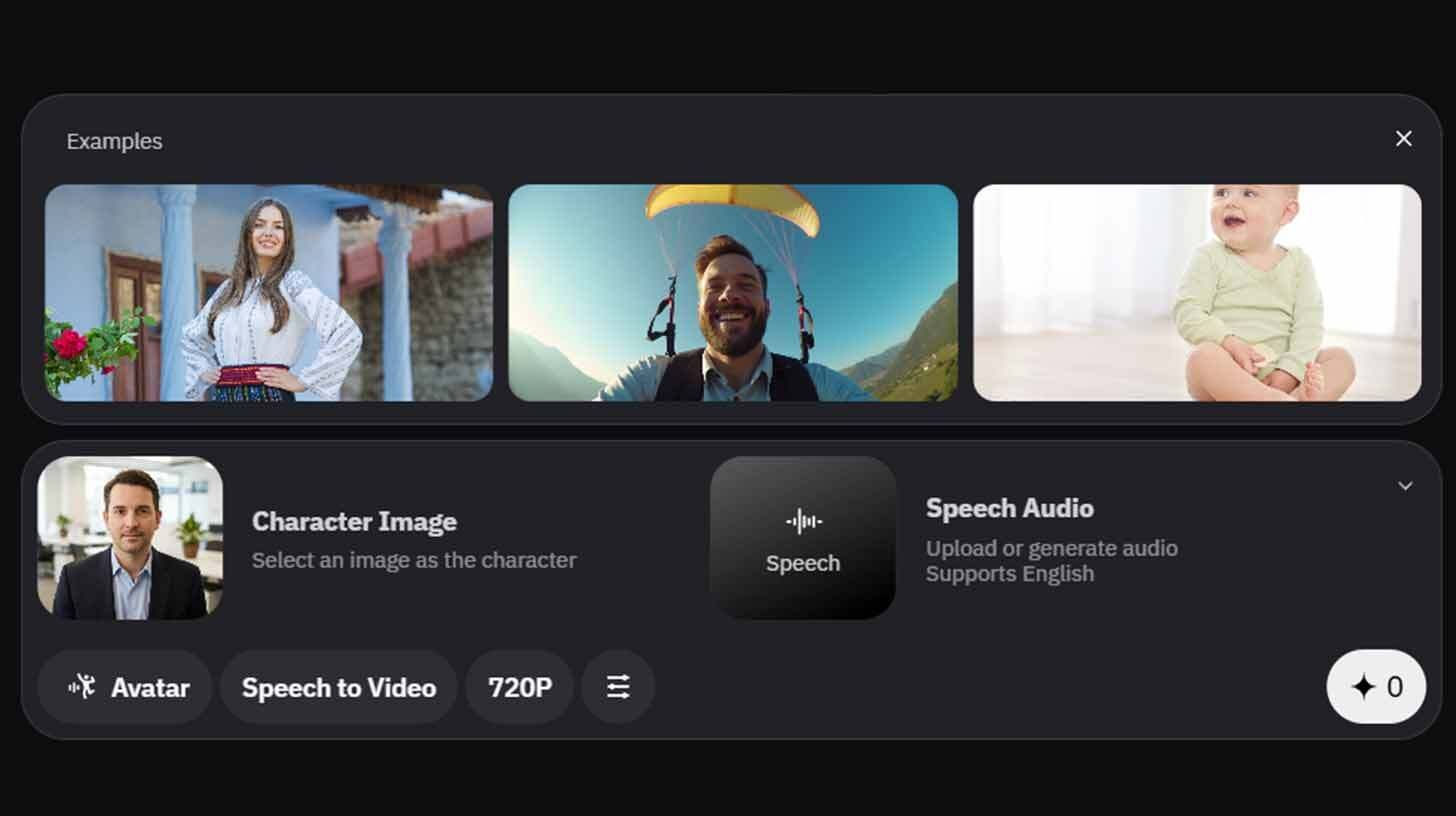
The Rundown: In this tutorial, you will learn how to create professional talking avatar presentations by generating a headshot with Google Gemini and animating it with your voice using Wan Video — no filming required.
Step-by-step:
Go to Gemini and upload a photo with the prompt: "Give me a professional headshot of this person as a talking head, facing the camera, wearing [outfit], with [background]. Close-up shot, professional lighting, high resolution"
Visit create.wan.video, create a new project, and change media type from Video → Avatar
Upload your Gemini headshot and add audio by recording 10-15 seconds of your script or typing up to 300 words to use Wan's built-in voices
Hit Generate to sync lip movements with your audio, then click "Send to Timeline" and add segments using the "+" button to build your complete video
Pro tip: Write your script before you start and split it into short sections with natural pauses. This makes each clip flow smoothly, making it sound like a real presenter.
PRESENTED BY INVISIBLE
📊 How should enterprises evaluate AI?
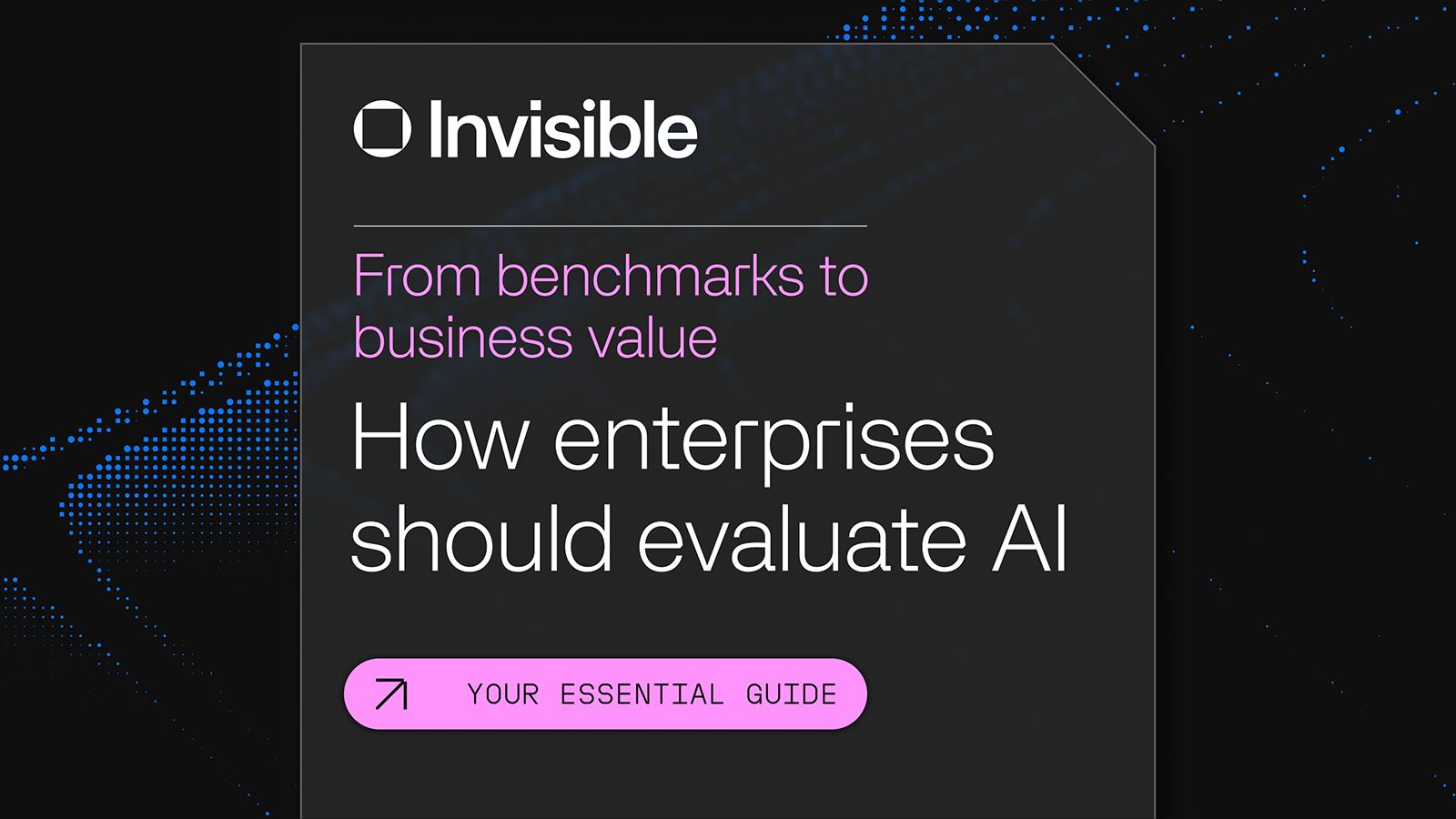
The Rundown: The AI industry is openly split on whether evaluations even matter — with some shipping “on vibes” and others insisting evals are the only way to measure progress. Invisible’s new brief cuts through the noise, showing why “benchmaxxing” distorts reality and what to measure instead.
Inside, you’ll learn:
Evaluations explained: the missing step between AI pilots and ROI
A practical framework for custom evaluations aligned to your use cases
How to construct inputs, catch faulty training data, and run behavioral and safety checks
A client case that reduced harmful behaviors by 97% with 4k rows, not 100k
OPENAI
🤳 OpenAI’s TikTok-style app for Sora 2

Image source: Sora
The Rundown: OpenAI is reportedly developing a standalone social platform powered by its upcoming Sora 2 video model, designed to mimic TikTok's vertical scrolling feed but exclusively featuring AI-generated content instead of user uploads.
The details:
The platform will limit clips to 10 seconds and include identity verification, allowing users to authorize their likeness for video generations.
The WSJ said OAI will allow copyrighted material in videos unless rights holders actively request exclusion, though public figures will require consent.
The app incorporates remix functionality and algorithmic recommendations similar to For You pages, with notifications sent when a user’s likeness is used.
The news comes just days after Meta revealed Vibes, an entirely AI video feed within the Meta AI app.
Why it matters: Sora 2 seems imminent, but it will require some big upgrades to bring the model up to the level of rivals. Both OAI and Meta are heading down the AI social feed route — and given the negative reactions to the Vibes launch, these types of apps are likely to be associated with the slop-ification of the web until proven otherwise.
QUICK HITS
🛠️ Trending AI Tools
🔒 Incogni - Remove your personal data from the web so scammers and identity thieves can’t access it. Use code RUNDOWN to get 55% off*
🚀 Claude 4.5 Sonnet - Anthropic’s new top-performing coding model
🧾 Instant Checkout - Shop mid-conversation with ChatGPT’s
❤️ Loveable AI & Cloud - Add AI app functionalities with a built-in backend
*Sponsored Listing
📰 Everything else in AI today
DeepSeek launched V3.2-Exp, a model with a new "sparse attention" mechanism that cuts API costs by over 50% while matching its predecessor's performance.
California Governor Gavin Newsom signed SB 53 legislation, requiring transparency from AI giants with a computing cluster consortium and whistleblower protections.
OpenAI rolled out a new safety routing system that switches to GPT-5-thinking during sensitive conversations, alongside the launch of new parental controls.
Quantum computing expert Scott Aaronson published a new paper that he revealed had a key technical step come from GPT-5-Thinking.
Lovable launched Lovable Cloud and AI, enabling users to build full-stack apps through prompts with integrated backend services and Gemini-powered AI features.
COMMUNITY
🤝 Community AI workflows
Every newsletter, we showcase how a reader is using AI to work smarter, save time, or make life easier.
Today’s workflow comes from reader Tauseef M. in Bangalore, India:
"In my daily practice as a clinician, I use AI ChatGPT & Perplexity to quickly interpret clinical data, review the latest guidelines, and create tailored lifestyle and treatment plans. This enhances my decision-making, improves efficiency, and allows me to focus more on meaningful patient interactions."
How do you use AI? Tell us here.
🎓 Highlights: News, Guides & Events
Read our last AI newsletter: Hollywood’s synthetic actor showdown
Read our last Tech newsletter: Amazon fined $2.5B for Prime ‘trickery’
Read our last Robotics newsletter: Google’s robots learn to ‘think’ first
Today’s AI tool guide: Create talking head videos using your voice
RSVP to next workshop @ 4PM Friday: Vibe coding in Cursor for non-devs
See you soon,
Rowan, Joey, Zach, Shubham, and Jennifer — the humans behind The Rundown

Google's robots learn to 'think' first
Read Online | Sign Up | Advertise
Good morning, robotics enthusiasts. Google DeepMind just gave robots an internal monologue.
The company’s new Gemini Robotics 1.5 vision-language-action model lets machines explain their reasoning in real time as they work. Consider it Google’s answer to rivals like Figure’s Helix and Nvidia’s Groot.
In today’s robotics rundown:
DeepMind’s robots learn to think aloud
Meta wants to be the ‘Android of robotics’
Unitree’s Bluetooth backdoor nightmare
iRobot founder: humanoid hype is fantasy
Quick hits on other robotics news
LATEST DEVELOPMENTS
GOOGLE DEEPMIND
🧠 DeepMind’s robots learn to ‘think’ aloud
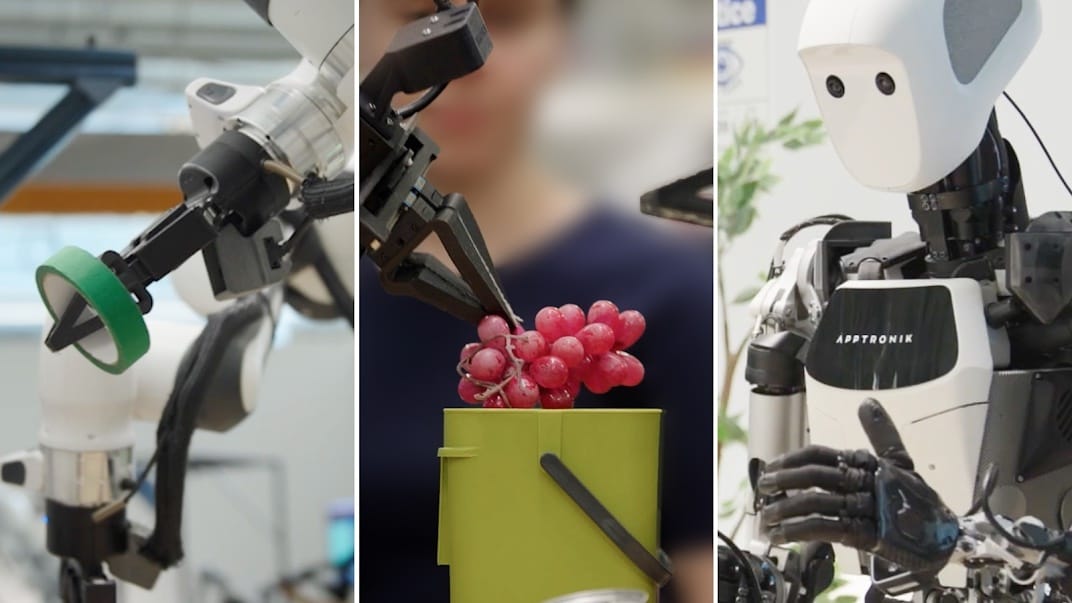
Image source: Google DeepMind
The Rundown: Google DeepMind just released Gemini Robotics 1.5 and Gemini Robotics-ER 1.5 — AI models designed to make robots ‘think’ before they act, translating visual input and language into coordinated movement.
The details:
Google says that the breakthrough lets robots reason through multistep tasks and actually explain what they're doing while they do it.
The system can tackle tasks like sorting recyclables by searching guidelines online, then planning how to physically categorize items based on what it finds.
Unlike traditional robots that react to commands, it generates an internal reasoning process in natural language, breaking complex tasks into steps.
Gemini Robotics-ER 1.5 orchestrates high-level strategy and calls digital tools, while Gemini Robotics 1.5 converts those plans into precise motor commands.
Why it matters: DeepMind’s system hit state-of-the-art performance across 15 robotics benchmarks and works across a wide range of platforms, from dual-arm lab bots to humanoids. The pitch to industry? One adaptable software stack that can power any robot form factor, straight out of the lab and into the field.
META
🔥 Meta wants to be the ‘Android of robotics’

Image source: Jeff Sainlar, Meta, Wikimedia Commons
The Rundown: Meta is building a software backbone for humanoids. With Project Metabot, it’s pouring billions into AI that hardware makers can license — turning its Llama-powered software into a standard brain for next-gen humanoids.
The details:
CTO Andrew Bosworth told The Verge that Meta is working on the biggest challenge for humanoids: dexterous hand manipulation.
While robots can perform stunts, tasks like grasping a water glass are unsolved because of complex sensor loops and the absence of robust world models.
Meta’s strategy is to leverage its AI Superintelligence Lab to build the kind of simulation, training datasets, and control software needed for fine manipulation.
The team, led by former Cruise CEO Marc Whitten and MIT’s Sangbae Kim, focuses on creating licensable software rather than manufacturing hardware.
Why it matters: Instead of competing with Tesla’s Optimus or Figure on humanoid exteriors, Meta is stacking its strategy with top-tier talent from AV and AR, betting that the real race is in universal manipulation skills. If Meta cracks dexterity (no small feat), it positions itself as the software foundation every robotics manufacturer needs.
UNITREE
🏴☠️ Unitree’s Bluetooth backdoor nightmare
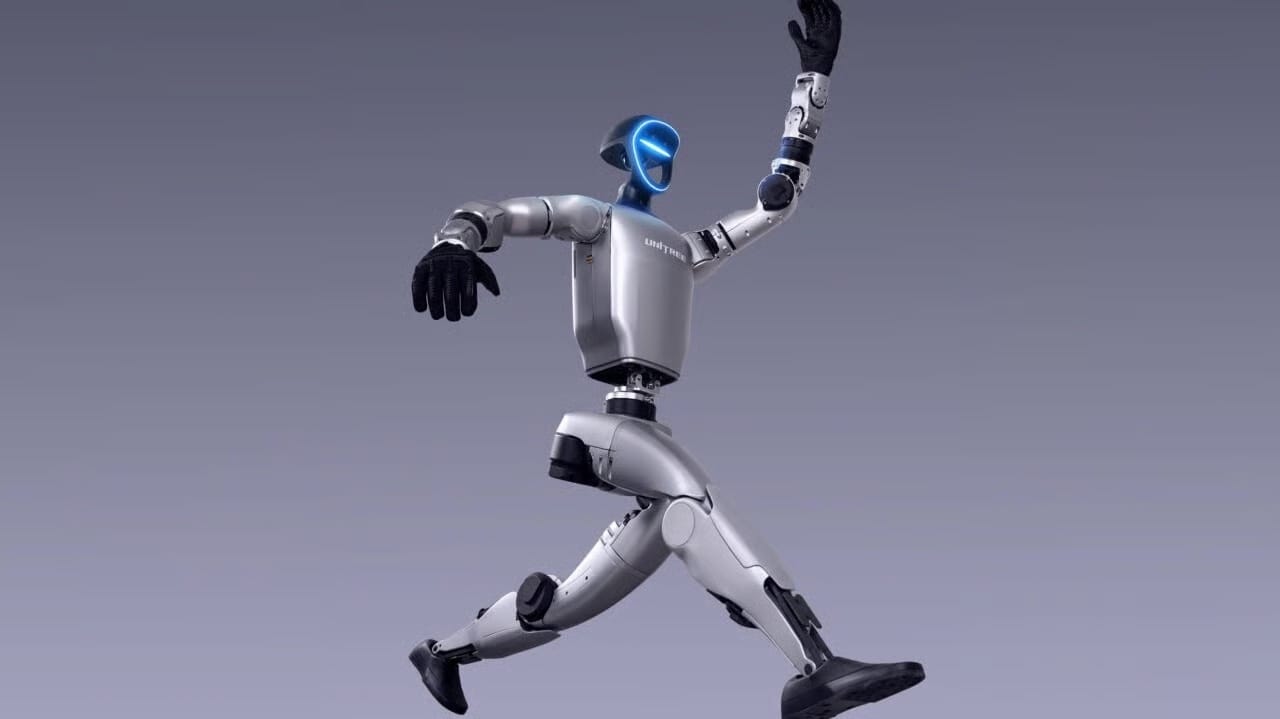
Image source: Unitree
The Rundown: Unitree's robot dogs and humanoids are caught in a security nightmare after researchers exposed UniPwn, a wormable Bluetooth exploit that hands attackers root-level control with embarrassing ease.
The details:
The flaw exploits hardcoded AES keys in Unitree's Go2, B2, G1, and H1 robots — attackers simply encrypt the string "unitree" to bypass authentication.
Malicious code disguised as Wi-Fi credentials executes with root privileges, no validation required.
It's wormable: infected robots autonomously scan for and compromise nearby Unitree machines via Bluetooth, creating self-spreading botnets.
Researchers reportedly disclosed the vulnerability in May, but Unitree went silent after July, while UK police are already testing vulnerable Go2 units.
Why it matters: This kind of vulnerability turns advanced robots into potential weapons — spying, sabotaging, or spreading malware autonomously. With police and researchers already field-testing affected units, Unitree’s alleged silence raises serious concerns about security standards in the fast-moving robotics industry.
IROBOT
🧞♂️ iRobot founder: humanoid hype is fantasy

Image source: Christopher Michel, Wikimedia Commons
The Rundown: Investors are piling billions into humanoid startups, but Rodney Brooks — a legend who built iRobot and shaped robotics at MIT — has a blunt message: wake up, you're pouring money into a fantasy.
The details:
In his latest essay, Brooks skewers the industry’s big bet on teaching robots by showing them endless human task videos, dubbing it “pure fantasy thinking.”
He ridicules the idea that video-based machine learning can train robots to mimic human dexterity, noting that human hands have 17K touch receptors.
Machine learning's breakthroughs in speech and vision relied on decades of established recording tech — robotics has no such foundation for tactile data.
He warns that scaling up humanoids creates exponential safety risks: doubling a robot's size multiplies its impact energy eightfold.
Why it matters: Brooks predicts that within 15 years, the most successful ‘humanoids’ won't look human at all — they'll use wheels, multiple arms, and specialized sensors rather than walking upright, while current funding rounds will largely evaporate without producing mass-market machines. Of course, Figure and Tesla won’t likely agree.
QUICK HITS
📰 Everything else in robotics today
Major League Baseball will roll out robotic umpire tech in 2026, letting teams challenge two-ball or strike calls a game with instant reviews via Hawk-Eye cameras.
Skild AI says its “omni-bodied robot brain” can universally control any robot — trained on 100K configurations, it adapts to extreme damage like chainsawed-off limbs.
A former Tesla employee is suing Tesla and Fanuc for $51M after a robotic arm allegedly struck and knocked him unconscious while working at the Fremont factory.
University of Virginia scientists developed HydroSpread, a method that lets them fabricate soft robots directly on water by spreading ultra-thin polymer films.
China surged ahead of the U.S. and the world in factory automation, installing nearly 300K new robots last year and bringing its total to over 2M, a new report says.
Beijing’s Horizon Robotics raised about $821M through a Hong Kong top-up placement, offering 639M shares at HK $9.99 each to fund its international expansion.
NYK Line expanded its partnership with Neptune Robotics to deploy robotic hull cleaning across its global fleet for major fuel savings and maritime decarbonization.
Researchers created an AI system that builds on past emotional experiences while learning new ones, making robots more emotionally aware in human interactions.
Hyundai's air taxi startup, Supernal, saw its chief strategy officer, safety officer, and chief of staff depart weeks after pausing its program and losing its CEO and CTO.
COMMUNITY
🎓 Highlights: News, Guides & Events
Read our last AI newsletter: Hollywood’s synthetic actor showdown
Read our last Tech newsletter: Amazon fined $2.5B for Prime ‘trickery’
Read our last Robotics newsletter: Norway’s 1X to raise $1B
Today’s AI tool guide: Build an AI calendar agent using n8n
RSVP to next workshop @ 4PM Friday: Vibe coding in Cursor for non-devs
See you soon,
Rowan, Jennifer, and Joey—The Rundown’s editorial team
No matching search results
Try using different keywords, double-check your spelling, or explore related categories.
Stay Ahead on AI.
Join 2,000,000+ readers getting bite-size AI news updates straight to their inbox every morning with The Rundown AI newsletter. It's 100% free.