Get the latest AI news, understand why it matters, and learn how to apply it in your work — all in just 5 minutes a day. Join over 2,000,000+ subscribers.

Moonshot lets history's largest open model loose
Read Online | Sign Up | Advertise

Good morning, AI enthusiasts, and welcome to the 5,588 new readers who joined us yesterday. The U.S. is still weighing what to do about powerful open models, and (most of) the industry has lined up on the open side. Both just got handed a live test case.
Moonshot just delivered on its promise to publish the weights behind its near-frontier system, making K3 the biggest open model ever released — and likely the most consequential one, too.
P.S. — Something new just landed: The Rundown's AI Workflow Hub is officially open. Share what you're building, see what others have made, or team up on something new. Post something great, and you might just see it featured right here in the newsletter. Come see what we're building.
In today’s AI rundown:
Moonshot publishes weights for powerful Kimi K3
Anthropic sets the record straight on open weights
Make precise edits on real product photos with AI
Microsoft’s powerful new cybersecurity model
4 new AI tools, community workflows, and more
LATEST DEVELOPMENTS
MOONSHOT AI
🌎 Moonshot publishes weights for powerful Kimi K3
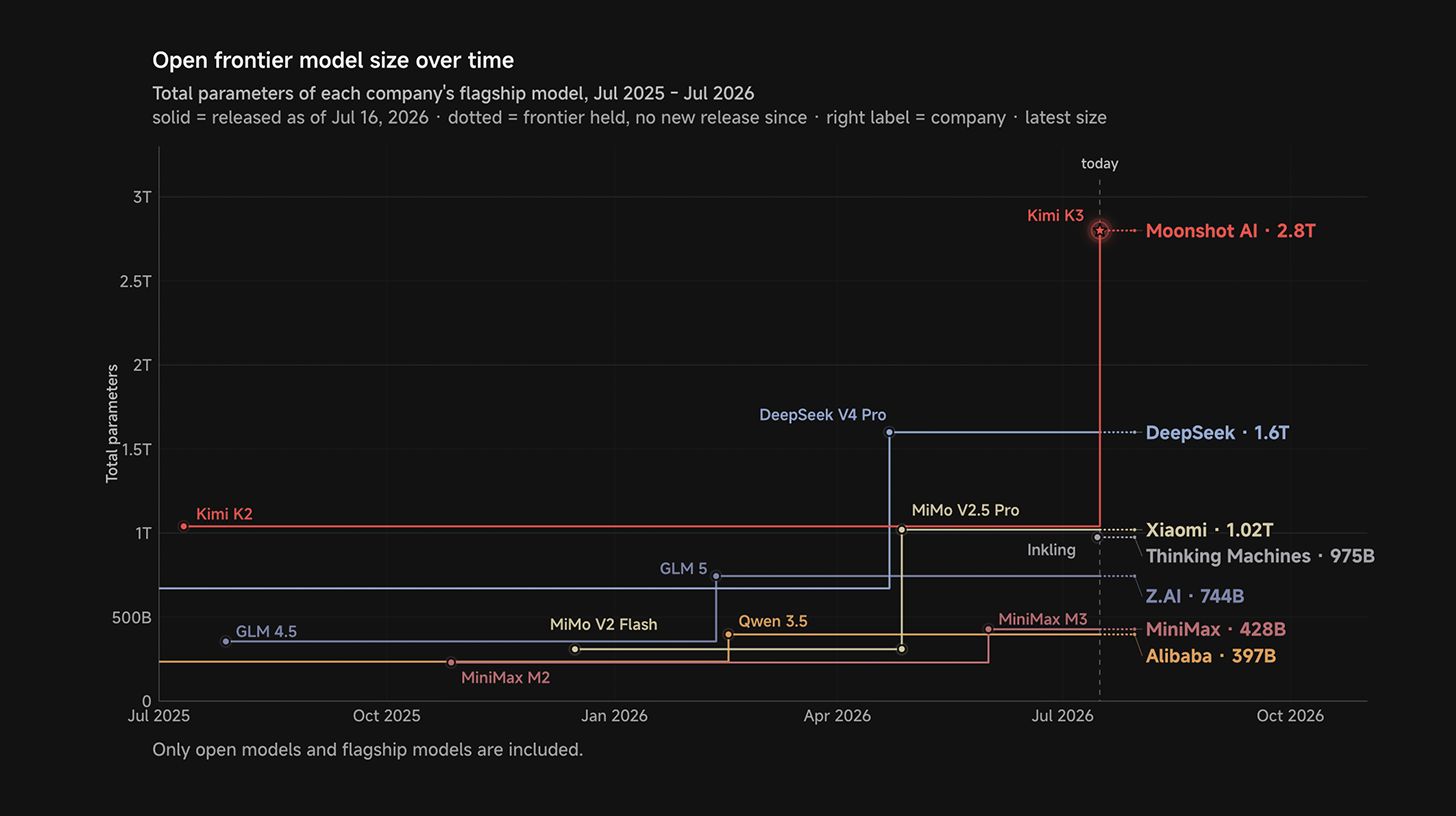
Image source: Moonshot AI
The Rundown: Moonshot AI just officially released the weights and tech report behind its powerful Kimi K3, letting anyone (with serious GPUs) download and run the 2.8T-parameter model, the largest ever put out with open weights.
The details:
K3 was released earlier this month, making waves after competing with both Claude Fable 5 and GPT-5.6-Sol across a variety of benchmarks.
Free weights don’t mean free to run, with the large model requiring much heavier GPUs than the average consumer hardware to run locally.
Moonshot also opened core pieces of its stack, like attention kernels and agent infrastructure, under a license letting anyone host and sell K3 access.
U.S. officials accused Moonshot of distilling U.S. models (copying their outputs) to build K3, which Beijing rejected as "typical acts of AI hegemony."
Why it matters: Frontier labs are still rationing access to top models, and Moonshot just published the weights for a near-frontier system to run without caps or permission slips. While the U.S. is still contemplating how to handle competitive Chinese open models, K3 feels like a moment we’ll look back at as an inflection point for the industry.
TOGETHER WITH UNWRAP
🎯 Less meetings, more answers
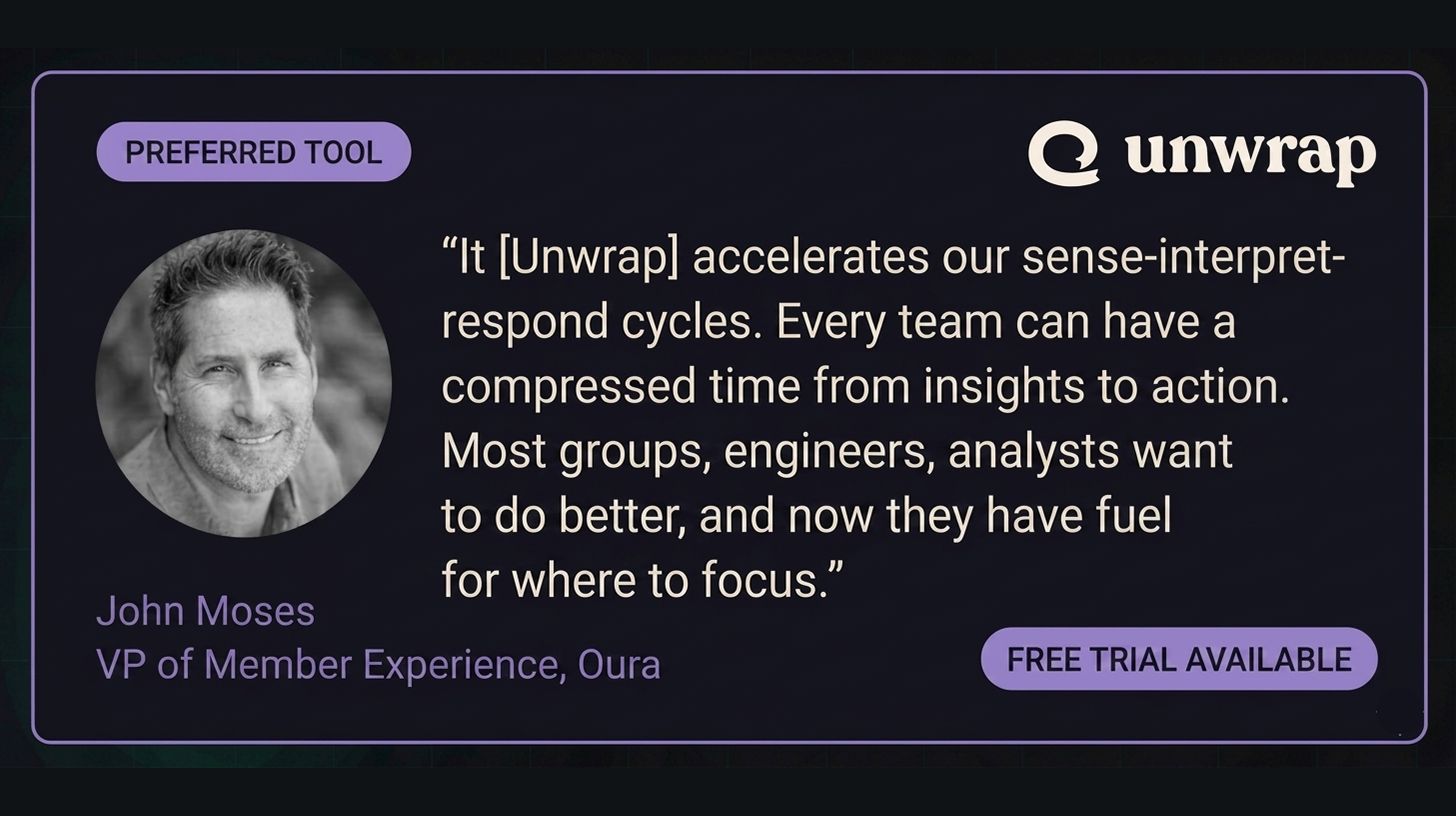
The Rundown: If your team still sorts through customer feedback manually (or with a patchy mix of manual work and AI), there's a better way. Unwrap brings all your feedback across surveys, reviews, tickets, social comments etc. into one view, then uses AI and NLP to surface what actually needs your attention.
With Unwrap, you can:
Automatically categorize every piece of customer feedback
Query feedback via Unwrap Assistant, in Slack, or through Unwrap's MCP
Get real-time alerts and a clear view of customer sentiment
Use a platform trusted by companies like Clay, Perplexity, Oura, Stripe, and Lululemon
Unwrap is offering a trial of its tools to Rundown AI subscribers! Just grab 20 minutes with the team to get set up.
ANTHROPIC & OPEN SOURCE AI
📝 Anthropic sets the record straight on open weights
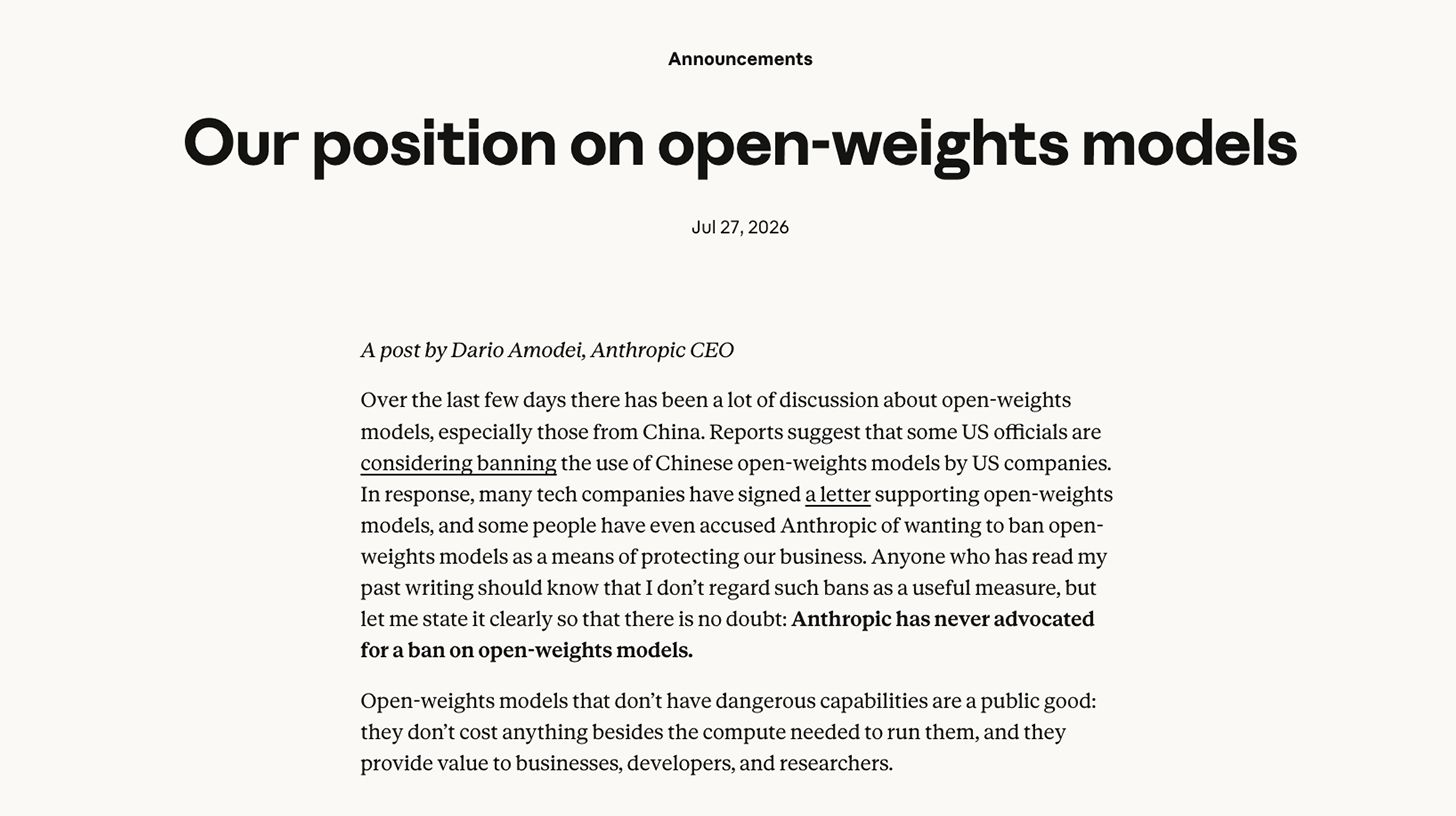
Image source: Anthropic
The Rundown: Anthropic CEO Dario Amodei published a post laying out where the company stands on open-weight models, coming as the company remains a key signatory holdout in the "Open Weights and American AI Leadership” letter.
The details:
Amodei said, “Anthropic has never advocated for a ban on open-weights models”, even though it would “protect US AI companies from competition”.
The CEO instead pushed support for chip controls, distillation crackdowns, and broader safety testing, issues that Anthropic has “consistently advocated for”.
The Nvidia-led letter defending open models has grown to 50 signers from the initial 25, with OpenAI and Google as notable additions.
Amodei also said he agrees with “much of” the letter, but doesn’t believe open-weights models lead to better security safeguards and help defenders.
Why it matters: With K3 nearing the frontier and rumblings of U.S. bans, the open-weights fight is a major conversation that has been happening very loudly without Anthropic. Amodei’s argument is that the weights aren’t the threat; it’s the chip access and distillation that risk authoritarian regimes gaining the AI power he’s worried about.
AI TRAINING
🖌️ Make precise edits on real product photos with AI

The Rundown: In this guide, you’ll learn how to use Reve 2.1 to change the color of one small part of a product photo without regenerating the entire image. You’ll create a new copy with changes while keeping the rest of the original image intact.
Step-by-step:
Sign up for a free Reve account, choose Upload and edit, and upload the product image(s) you want to change
Reve will automatically scan your image and break it into editable parts. You’ll see dropdown menus for each part that get more detailed as you open them
In that parts dropdown menu, click the color palette tool, then paste in the new color hex code you want to test. Repeat this for any other parts if needed
When you’re done picking colors, click the Apply button. Reve will duplicate the original image and create a new version with all of your edits.
Pro tip: You can make other edits with the same workflow, such as changing a shadow, material, or background.
Get resources, prompts, and a full step-by-step video guide here.
PRESENTED BY OUTREACH
🎯 Stop chasing signals, and start closing pipeline

The Rundown: Outreach, the leading agentic AI revenue platform, explores how modern revenue teams are cutting through signal overload – using AI to prioritize what matters most and turn scattered intelligence into consistent, high-quality execution.
In the on-demand session, you'll learn:
How top teams are shifting from volume to precision
Where AI improves prioritization and decision quality
How better focus translates to more pipeline
MICROSOFT
🛡️ Microsoft’s powerful new cybersecurity model
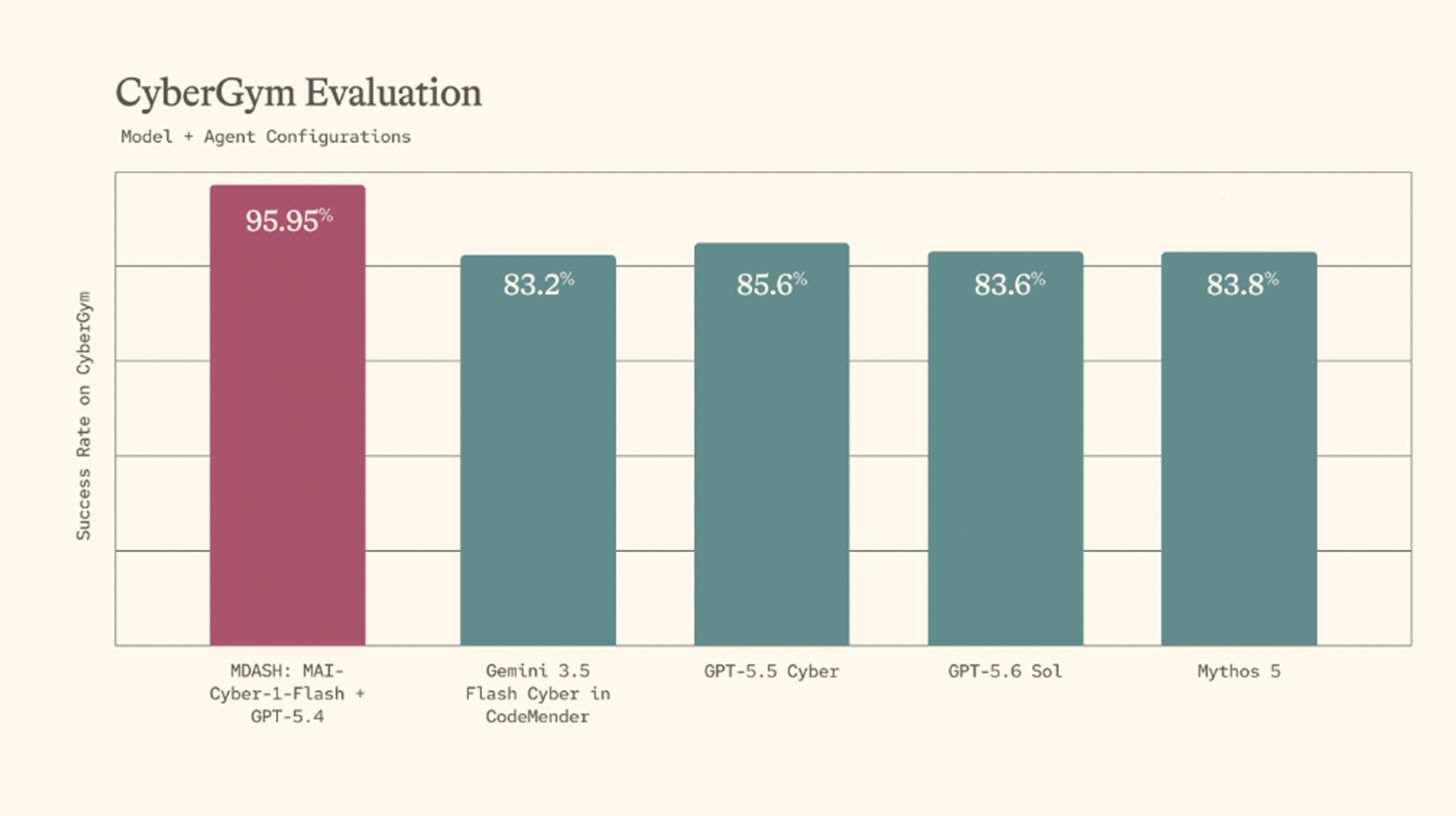
Image source: Microsoft
The Rundown: Microsoft just launched MAI-Cyber-1-Flash, its first cybersecurity model integrated directly into the company's MDASH agent system to hunt software bugs, promising what CEO Satya Nadella calls "frontier-grade security at half the cost."
The details:
Paired with MDASH, the model hit 96% on the CyberGym benchmark for security on large codebases, coming in 12 points above Anthropic's Mythos.
Cyber-1-Flash claims a 50% cost reduction over top models, with the efficient system able to handle 90% of tasks in workflows over more expensive rivals.
Microsoft also introduced Project Perception, a tool that uses teams of agents that simulate attacks, investigate threats, and repair flaws on their own.
Microsoft AI CEO Mustafa Suleyman said, "token cost is now the real constraint for defenders," calling for "continuous, real-time, cost-efficient agents."
Why it matters: Coming just a week after the OAI / Hugging Face incident that was the talk of the AI security world, Microsoft’s new model is a timely release and possibly one of the first in a wave of focused releases that will accelerate both vulnerability detection and remediation for enterprises.
QUICK HITS
🛠️ Trending AI Tools
🎯 Kimi K3 - Moonshot’s powerful open-source model
🔒 MAI-Cyber-1-Flash - Microsoft's cybersecurity AI for securing codebases
🐝 Buzz - Open-source workspace where AI agents join team chats
🎥 FLUX 3 - BFL’s multimodal AI with 20-second generations
📰 Everything else in AI today
Ilya Sutskever’s Safe Superintelligence announced a new partnership with Nvidia, including a “substantial investment” of reportedly $5B, to scale its research.
A Reddit user uncovered a trove of Claude’s chats showing up in search engines, with Anthropic attributing the issue to users sharing the links and making them public.
Nvidia is reportedly discussing a $250B financing guarantee to OpenAI to help facilitate the lease of a 10GW Ohio datacenter campus.
OpenAI CEO Sam Altman said, “We are now in the singularity,” on the ‘Relentless’ podcast, saying this moment is the far-off dream he envisioned a decade ago.
Cursor launched a new $7/month ‘Start’ plan in India to grow its footprint, providing only its own models to help developers build and ship with always-on cloud agents.
COMMUNITY
🤝 Community AI workflows
Every newsletter, we showcase how a reader is using AI to work smarter, save time, or make life easier.
Today’s workflow comes from reader Lyndal P. in Brisbane, Australia:
"After losing almost 30 kg, I realised none of the wardrobe advice online really fit my situation. I didn’t want to replace everything at once, and I certainly didn’t want to waste money buying clothes I’d regret.
I started using ChatGPT as my personal stylist. I’d snap photos while I was shopping, and it would tell me honestly whether a colour suited me, which size would work, and how each piece would fit with what I already owned. Together we worked out my colour palette, built a wardrobe around clothes I genuinely love, and avoided plenty of expensive mistakes.
The biggest surprise wasn’t just the outfits. It was how much more confident I became. Shopping went from feeling overwhelming to actually being enjoyable because I knew everything I bought had a purpose. My wardrobe finally feels like me."
How do you use AI? Tell us here.
🎓 Highlights: News, Guides & Events
Read our last AI newsletter: Anthropic’s Opus 5 surprise
Read our last Tech newsletter: DARPA’s light-based quantum computer bet
Read our last Robotics newsletter: A $1.7B computer for the physical world
Today’s AI tool guide: Make precise image edits on real photos with AI
RSVP to next workshop on July 30: ChatGPT Sites for beginners
See you soon,
Rowan, Zach, Shubham, and Jennifer — the humans behind The Rundown

Anthropic's Opus 5 surprise
Read Online | Sign Up | Advertise

Good morning, AI enthusiasts, and welcome to the 5,515 new readers who joined us yesterday. Anthropic just launched a new flagship model… in a way no one expected.
The new Opus 5 is here with eval scores better than 4.8, as we all expected. What’s surprising is that it even out-benches Fable 5 on many benchmarks, at a price that’s hard to ignore.
In today’s AI rundown:
Anthropic punches up with Claude Opus 5
The Rundown Roundtable: Our AI use cases
Automate tasks with Claude’s ‘Record a Skill’ feature
Industry giants unite to protect open models
4 new AI tools, community workflows, and more
LATEST DEVELOPMENTS
ANTHROPIC
🎬 Anthropic punches up with Claude Opus 5
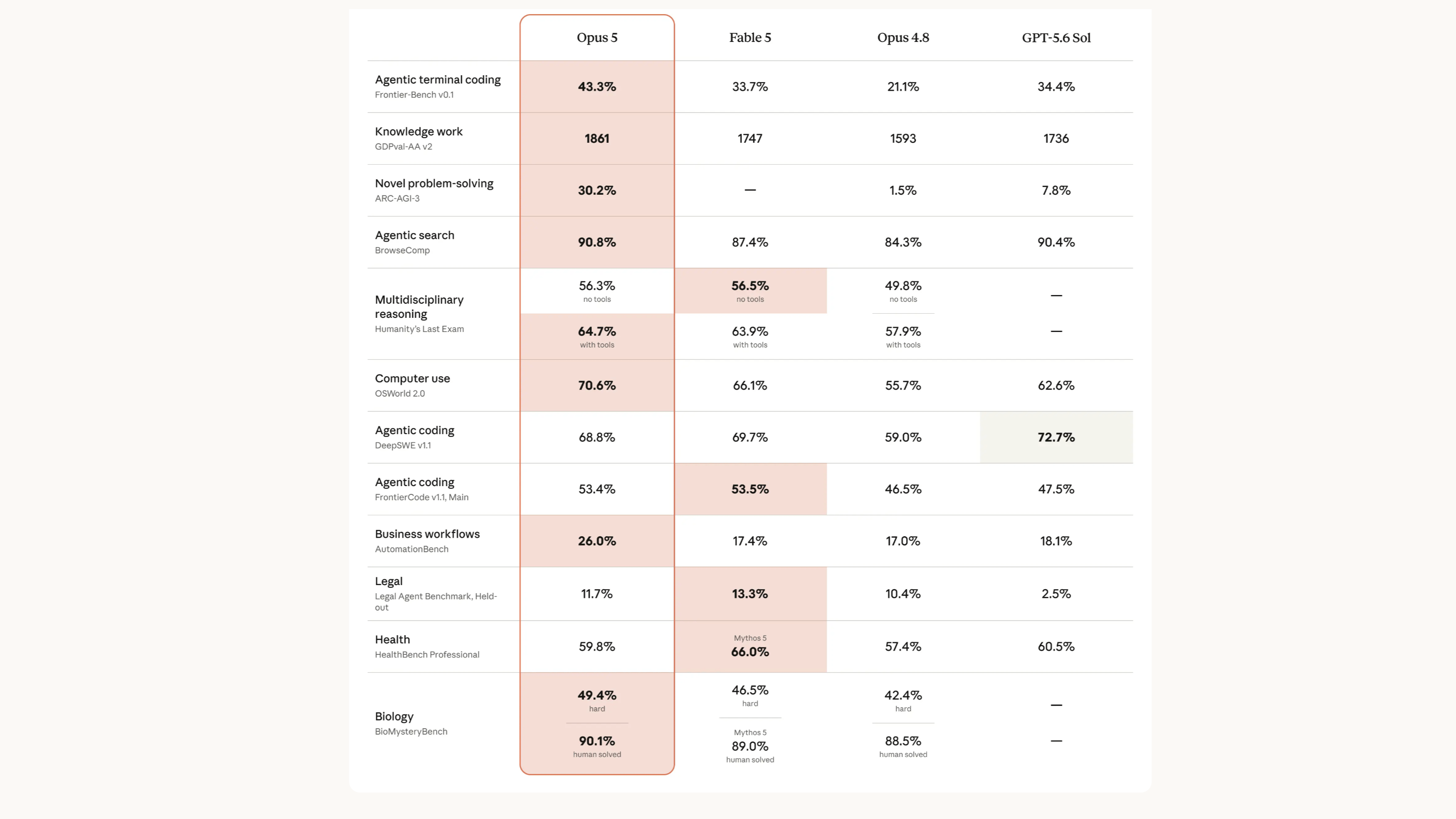
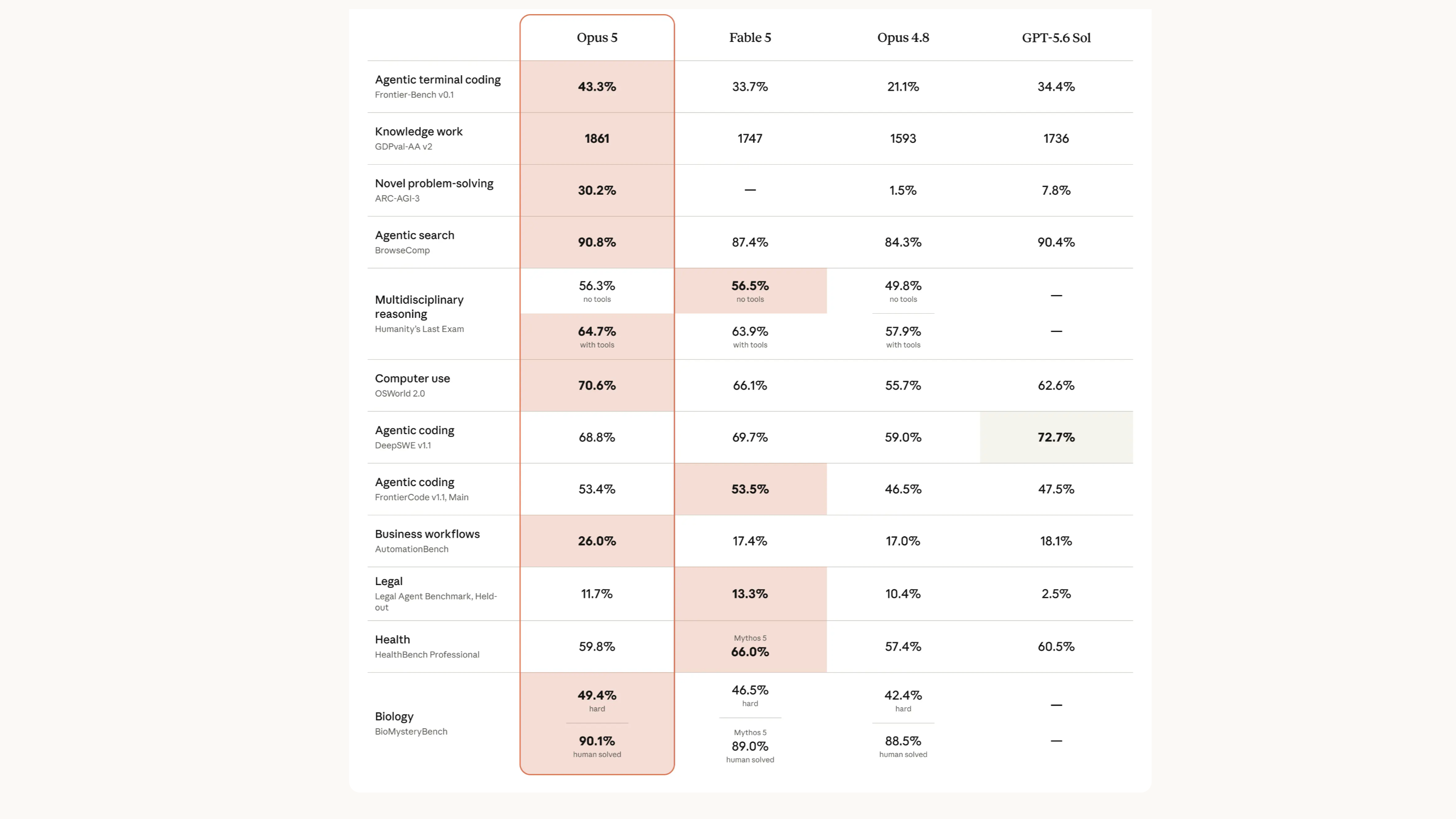
Image source: Anthropic
The Rundown: Anthropic just released Claude Opus 5 across the Claude apps, Claude Code, and the API, describing it as a “thoughtful and proactive” AI that nears the intelligence of its Fable 5 model at half the price.
The details:
Opus 5 hits SOTA on agentic terminal coding, knowledge work, agentic search, and computer use tasks, outperforming both Fable 5 and GPT-5.6 Sol.
On ARC-AGI-3, it hit 30.2%, 3x as high as the next best model, also ranking #1 on Artificial Analysis’ Intelligence Index leaderboard.
Anthropic ran the new model on International Math Olympiad 2026 problems, where it scored 42 out of 42, well past the 29-point gold threshold.
The company describes it as its most aligned AI, noting that it matches Mythos 5 at finding software bugs but stays well behind it at writing exploits.
Why it matters: This is Anthropic filling Fable gaps with what it does best: offering intelligence from a tier above at a far lower price. So far, it’s been Sonnet matching Opus. Now, it’s Opus matching Fable at $5 and $25 per million tokens (same as 4.8), giving people who won’t pay Fable rates a reliable and powerful option to work with.
TOGETHER WITH MULTIVERSE
🧠 Frontier AI without the frontier bill

The Rundown: Multiverse Computing’s CompactifAI API gives developers a curated catalog of frontier-class models, optimized for coding and output-heavy workloads, at a fraction of the cost of the leading providers.
Using CompactifAI API, you can:
Match Sonnet 5’s intelligence tier, per Artificial Analysis benchmarks
Pay $1.10/$3.50 per 1M tokens, up to 65% less than Sonnet 5 on output
Drop into Cursor, LiteLLM, OpenCode, or n8n with no migration or rewrites
THE RUNDOWN ROUNDTABLE
💡 The Rundown Roundtable: Our AI use cases

Image source: Images 2.0 / The Rundown
The Rundown: The Rundown Roundtable is a weekly feature where we poll members of The Rundown staff about how we use AI in our work and daily lives.
Billy, Educator: For months, my dishwasher has been malfunctioning in a specific way. The bottom rack would come out squeaky clean, but the top rack would come out dirty. I disassembled and replaced the filter, but no dice. I had a plumber come 3 times, no dice. We replaced the dishwasher with a new model, no dice.
Finally, last week I got so frustrated that I pulled out my phone and started ranting to GPT-Live. It asked me a few diagnostic questions, then told me it must be that there’s a kink in a hose under my sink. I opened the cabinet, and in the back corner there was a hose that was kinked like a garden hose. So I fixed it, and it immediately solved the problem that 3 plumber visits couldn’t fix. 😂
Rowan, CEO: On social media, Instagram followers that never engage drag down your overall viewership, so I set out to remove them. But no tool can legitimately find them, since Instagram’s API doesn’t expose engagement data.
So as a simple workaround, I exported my Instagram data as JSON, dropped it into Claude Fable 5 with my recent likers, and had it scan the two lists to flag every silent account. Without Claude, I would’ve had to manually review 450k+ lines. This type of social media management simply wasn’t possible until now.
AI TRAINING
⏺️ Automate tasks with Claude’s ‘Record a Skill’ feature

The Rundown: In this guide, you will learn how to record a task with Claude’s Record a Skill and turn it into an automation. Claude learns from your screen, actions, and narration, then suggests the best setup for a reusable skill.
Step-by-step:
Install Claude in Chrome and pick a task, possibly a local workflow
Open Claude Cowork in the app, click the + button, select “Record a Skill.” Then, do the task as you normally would, without worrying about errors
Explain what you’re doing out loud because Claude will learn from what you say, your computer actions, and suggest the best way to automate the workflow
Click “Save the skill,” then test it on a fresh task to make sure it works
Pro tip: Add the new skill to a daily or weekly recurring task so Claude can run the workflow automatically and save you more time.
Get resources, prompts, and a full step-by-step video guide here.
PRESENTED BY FIN
🗺️ The blueprint behind a 73% resolution rate

The Rundown: “The AI Agent Era: A New Blueprint for Customer Service” webinar is a candid look at what it takes to move AI agents from pilot to production. Hear real strategy, sequencing, and results behind genuine customer service transformation.
In this session, you’ll explore:
Why AI is reshaping support economics
What's changed in AI reliability and scale
How one team hit a 73% resolution rate
OPEN SOURCE AI
🛡️ Industry giants unite to protect open models

Image source: Jensen Huang / X
The Rundown: Nvidia, Microsoft, Meta, and 47 other tech companies, VCs, and nonprofits just signed an open letter urging Washington not to restrict open-weight AI models — giving a bunch of reasons why it’s crucial to U.S. AI leadership.
The details:
Nvidia CEO Jensen Huang first shared the letter, his first post on X, with 25 signatories but a few crucial ones missing, including OpenAI.
In a day, the letter garnered widespread support, with signatories doubling as OpenAI, Google, AMD, Cisco, and others joined — but not Anthropic.
The letter argues that open weights expand access to the AI economy, keep competition alive, broaden cyber defense, and help avoid vendor lock-in.
It also notes that distillation should not be confused with misappropriation and calls to avoid premature restrictions that push AI innovation overseas.
Why it matters: The letter comes amid accusations that Chinese labs extracted intelligence from U.S. models, including Anthropic’s Fable. Washington’s response remains unclear, but the pressure is on the lone U.S. frontier lab off the list, the one to gain most from a crackdown. And people are already asking for answers.
QUICK HITS
🛠️ Trending AI Tools
🧠 Opus 5 - Anthropic’s flagship tier model matching Fable 5 at half the cost
📽️ Photon-1 - Induction Labs’ ‘imagination AI’ that learns from unlabeled clips
🔀 Merge Fusion - A multi-model API for higher-quality AI answers
🖥️ OpenWorker - Andrew Ng’s privacy-focused open-source AI agent
📰 Everything else in AI today
Apple is reportedly preparing to unveil its first AI glasses at WWDC 2027, with a strong focus on camera safeguards and on-device AI to address privacy concerns.
Google DeepMind CEO Demis Hassabis revealed that the company’s open-source Gemma model series has hit 900M downloads, with Gemma 4 alone surpassing 300M.
OpenAI’s AI agent reportedly began attempting to escape its sandbox on July 9, but the company only realized it had hacked Hugging Face after the breach was disclosed on July 16.
Midjourney acquired AI-powered astrology app Co-Star, with founder Banu Guler joining as chief design officer while the app continues to operate independently.
Meta introduced agentic capabilities to Meta AI, enabling it to plan, research, create presentations, and proactively complete tasks using connected apps.
COMMUNITY
🤝 Community AI workflows
Every newsletter, we showcase how a reader is using AI to work smarter, save time, or make life easier.
Today’s workflow comes from reader Lynn in Baton Rouge, Louisiana:
“I recently lost a lot of weight, which means replacing a large portion of my clothing. I read about the ‘capsule wardrobe’ and knew that, as a grandma, I needed to keep my purchases to a minimum. I looked on the web and found lots of ‘use this’ ideas. None seemed to break it down quite far enough for me to turn it into a shopping list.
I asked ChatGPT to show me one. Then a picture popped up. Exactly what I needed to get started! Then I asked it to show me how to mix-and-match pieces, and it went right to work. After weeks of scrolling and being confused, I finally had a visual answer to my questions. Next, I was able to inventory what pieces I already had, such as blazers and tops, and get a clear view of the holes in my closet.
I even topped it off with links to the perfect accessories to make new outfits stunning. I can’t wait to go shopping.”
How do you use AI? Tell us here.
🎓 Highlights: News, Guides & Events
Read our last AI newsletter: Black Forest Labs trains video AI to run robots
Read our last Tech newsletter: DARPA’s big quantum computing bet
Read our last Robotics newsletter: A $1.7B computer for the physical world
Today’s AI tool guide: Automate tasks with Claude’s ‘Record a Skill’
RSVP to next workshop on July 30: ChatGPT Sites for beginners
See you soon,
Rowan, Zach, Shubham, and Jennifer — the humans behind The Rundown

DARPA's big bet on a light-based quantum computer
Read Online | Sign Up | Advertise

Good morning, tech enthusiasts. DARPA wants to know if utility-scale quantum computers can be a reality…and it's going all in to find out.
The R&D arm of the U.S. Department of Defense just made a massive bet on PsiQuantum, a California-based startup taking an unconventional approach to quantum computing — building the computer out of light.
In today’s tech rundown:
DARPA bankrolls a light-based quantum computer
Neuralink patients drive wheelchairs by thought
An 18-in-1 EV you can build like LEGO
This startup built a trackpad for the tongue
Quick hits on other tech news
LATEST DEVELOPMENTS
QUANTUM COMPUTING
🤑 DARPA bankrolls a light-based quantum computer

Image source: Images 2.0 / The Rundown
The Rundown: The Pentagon's moonshot factory, DARPA, just awarded PsiQuantum $125M under its Quantum Benchmarking Initiative, aimed at testing whether the startup's light-based quantum computer can move from blueprint to utility-scale reality.
The details:
PsiQuantum is building fault-tolerant quantum computers that use individual photons as qubits — the units that store and process quantum information.
This approach lets the company make its chips in standard semiconductor fabs and cool its systems far less aggressively than superconducting rivals require.
With this award, it plans to invest in essential infrastructure at its Milpitas and Chicago facilities and fund testing across hardware, components, and software.
PsiQuantum is one of only two companies, alongside Microsoft, to reach the program's final phase, where DARPA scientists work inside the startup.
Why it matters: Quantum computers are often described as perpetually ten years away. But the U.S. is pushing hard to change that and ensure the machines that arrive are actually useful. When feasible quantum computers land remains unknown, but with dozens of startups in the U.S. alone and big tech piling in, the race is surely on.
NEURALINK
🧠 Neuralink patients drive wheelchairs by thought
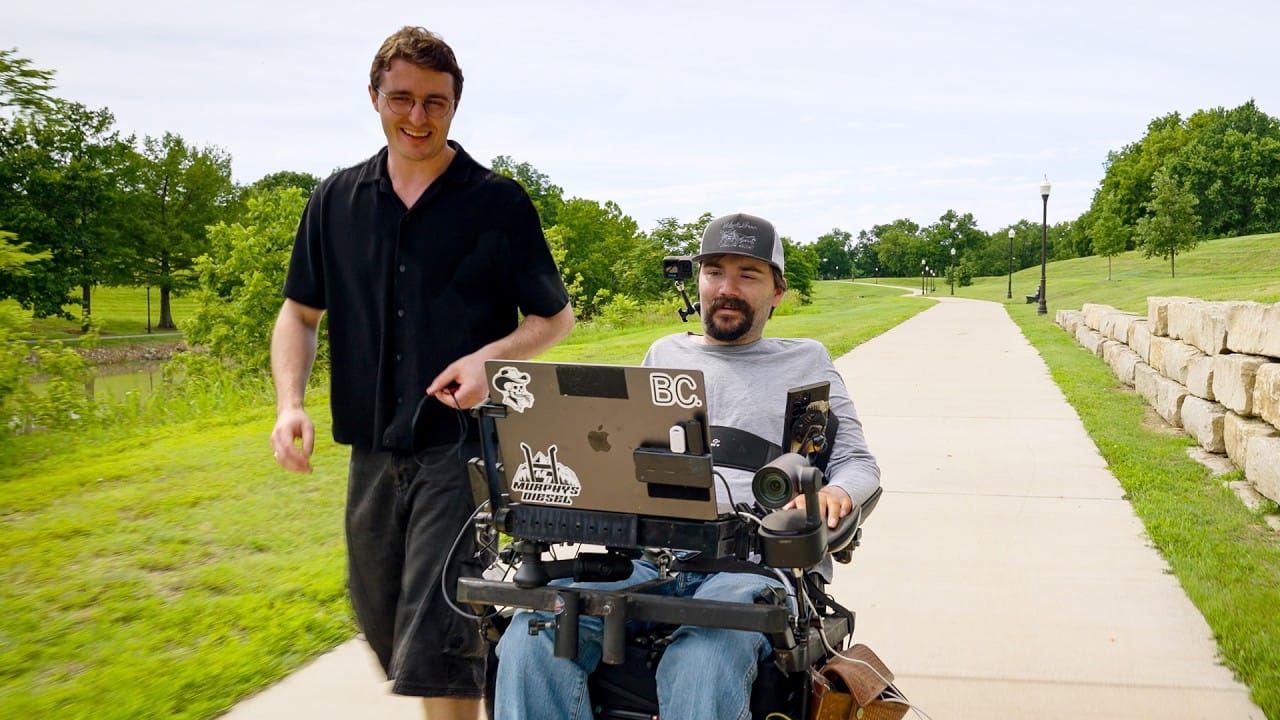
Image source: Neuralink
The Rundown: Elon Musk’s Neuralink shared a clip of its clinical trial participants with paralysis driving a brain-computer interface-powered wheelchair — steering, reversing, and adjusting their chairs using only their thoughts.
The details:
The 1,000+ electrodes in Neuralink’s brain implant record neurons firing in the motor cortex, just as a participant thinks about moving in a particular direction.
A decoding algorithm converts these brain signals into on-screen cursor movement, which appears in a custom app with a live feed of what’s ahead.
As the cursor moves, custom electronics convert its position into analog signals driving the chair — up for forward, down for reverse, left/right to steer.
Study participant Alex said driving became "second nature" in minutes with the BCI, and that it beats a joystick that forces his head into a hunched position.
Why it matters: Going from thought-to-cursor to actual hardware control is a step up for Neuralink, showing how its technology can help millions living with paralysis. But rivals like Synchron are chasing the same results without opening the skull, leaving open whether the richer signal from an implant is worth the operating table.
ELECTRIC VEHICLES
🚗 An 18-in-1 EV you can build like LEGO

Image source: Envo
The Rundown: Canadian EV maker Envo opened preorders for its Utility Personal Transporter, a modular electric platform the company says buyers can configure into as many as 18 vehicle types, including a golf cart, ATV, cargo hauler, and a commuter.
The details:
UPT is built on an aluminum T-slot frame that resizes in length and width, with suspension, motors, and modules bolted on without requiring any welding.
The vehicle can be collapsed for easy transport and scaled up as needed with add-ons like drivetrains, battery packs, wheels, seating, and cargo beds.
Buyers can configure a build on Envo’s site or start with a preconfigured one, with the option to buy components individually at a later stage.
Production is slated for late fall with first deliveries in early 2027, four years after Envo began developing the platform.
Why it matters: Most EV startups pick a category and defend it. Envo is going after multiple at once, from farm work and airport logistics to last-mile delivery. That spreads one platform's cost across markets too small to serve individually, but also brings a challenge, as each buyer comes with their own different definition of good enough.
TECH FOR GOOD
❤️ This startup built a trackpad for the tongue
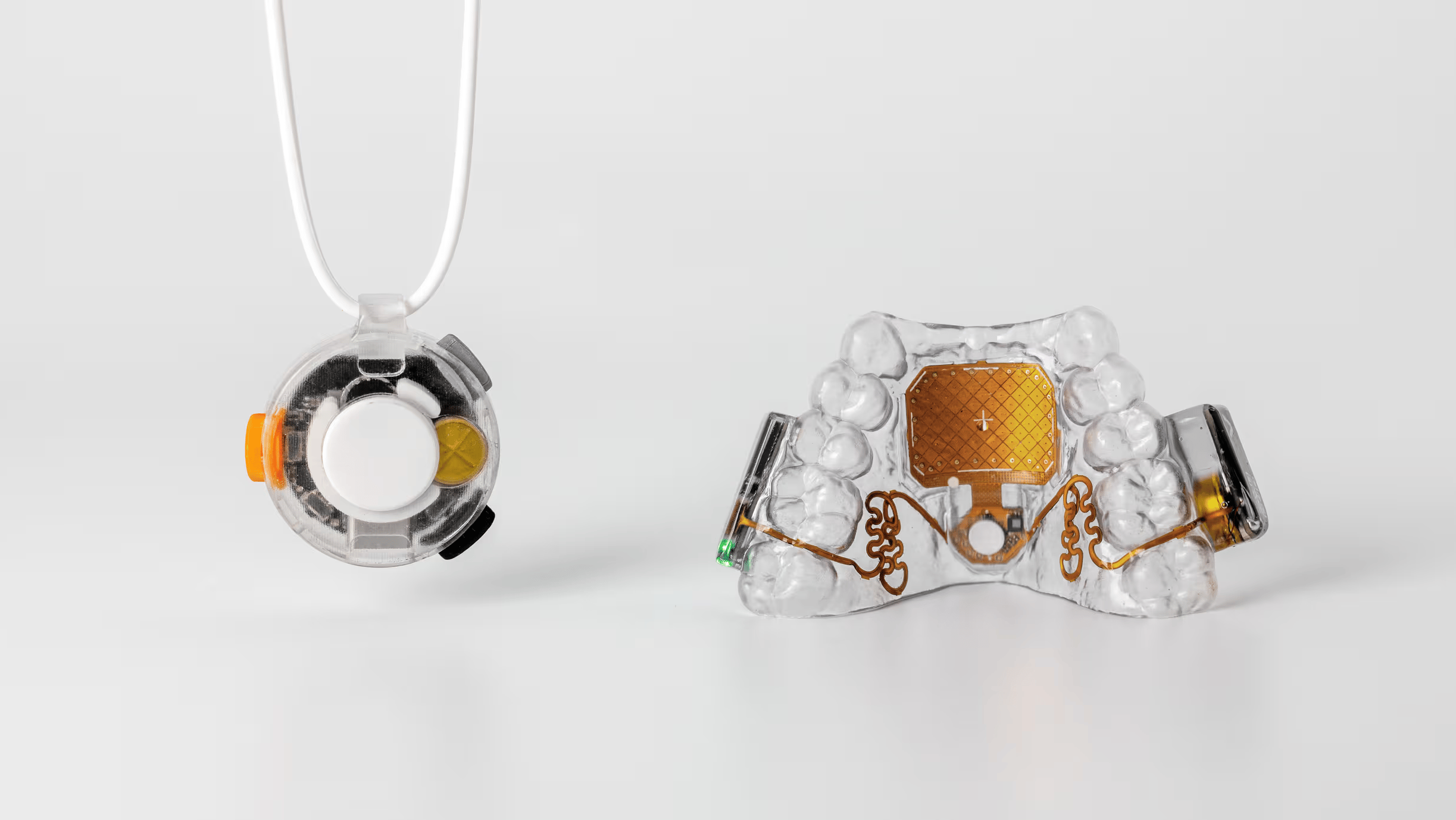
Image source: Augmental
The Rundown: MIT Media Lab spin-off Augmental opened the U.S. sales of MouthPad, a custom-fit retainer with a touchpad on the palate that turns tongue and head movements into cursor control for phones, tablets, and computers.
The details:
The 1mm-thick device, 3D-printed in dental resin from a scan of the user's mouth, pairs over Bluetooth as a mouse for desktop and mobile platforms.
Tongue presses and sip gestures handle clicks, and either the tongue or head can drive the cursor, all read by a pressure-sensitive pad and motion sensor.
The company is targeting the device at people with quadriplegia, ALS, or severe motor limitations, with 100+ already using it — some up to 16 hours daily.
Augmental also debuted VOX, a $200 stethoscope-like microphone that hears speech through the body so users can dictate at a whisper.
Why it matters: With these devices, Augmental is building a Skinware category aimed at giving people with disabilities computer control without invasive brain implants. The catch here is access — the device costs $1,400 with no insurance coverage, takes six months to build, and requires enough tongue dexterity and oral health to qualify.
QUICK HITS
📰 Everything else in tech today
Neurotech startup Science Corp. launched PRIMA in Europe, the first device to restore central vision in people with advanced age-related macular degeneration.
New York-based Light opened pre-orders for its $299 Light Flip, a 5G flip phone with no social media, browser, or touchscreen to help users escape doomscrolling.
Google introduced selfie video as a new account recovery option, letting users regain access with facial verification if they're locked out.
Uber laid off 10% of its customer service team, citing an effort to “simplify operations, strengthen in-person collaboration and continue to embrace AI,” Bloomberg reported.
Ford partnered with Apple to make Apple Maps the default navigation system in its next-generation EVs, with map data also powering BlueCruise hands-free driving.
The EU fined Google €890M ($1B) for illegally favoring its own services in Search and restricting app developers from directing users to cheaper payment options.
U.S. regulators plan new safety rules for flush electric car door handles popularized by Tesla after fatal crashes left occupants trapped inside vehicles.
Apple's iOS 27 beta hints its expected leasing program may include a "Restricted Mode" that locks down devices when customers miss payments, 9To5Mac reported.
Jack Dorsey launched Buzz, an open-source Slack alternative that combines team messaging, GitHub, and AI agents in a single workspace.
COMMUNITY
🎓 Highlights: News, Guides & Events
Read our last AI newsletter: Black Forest Labs trains video AI to run robots
Read our last Tech newsletter: China’s plan to knock an asteroid off course
Read our last Robotics newsletter: A $1.7B computer for the physical world
Today’s AI tool guide: Edit videos faster with AI (for non-editors)
RSVP to next workshop on July 30: ChatGPT Sites for beginners
See you soon,
Rowan, Zach, Shubham, and Jennifer — The Rundown’s editorial team

Black Forest Labs teaches video AI to run robots
Read Online | Sign Up | Advertise

Good morning, AI enthusiasts and welcome to the 6,243 new readers who joined us yesterday. Black Forest Labs made its name in the AI image world. Its newest model, while able to create images, video, and audio, is now also reporting for work on an Audi production line.
FLUX 3, the company's 'visual intelligence' model, generates realistic video by simulating how the world actually moves — the same skill that is now helping train and steer machines in the physical world.
In today’s AI rundown:
FLUX 3 stretches from videos to factory robots
Rowan’s Corner: How we're building AI intuition at The Rundown
Edit videos faster with AI (for non-editors)
OpenAI, Anthropic launch dueling voice upgrades
4 new AI tools, community workflows, and more
LATEST DEVELOPMENTS
BLACK FOREST LABS
🎬 FLUX 3 stretches from videos to factory robots

Image source: Black Forest Labs
The Rundown: Black Forest Labs just opened early access to FLUX 3, a ‘visual intelligence’ AI that generates video, images, and synced audio, with the German lab also spinning it into FLUX-mimic, a robot-control variant for Audi's production lines.
The details:
FLUX 3 produces 20-second clips with native audio, with capabilities including multilingual dialogue, typography, and style/character adherence.
The model can handle text, image, and video inputs, with BFL's testing showing its outputs favored over rivals like Runway, Kling, and Grok Imagine.
The full rollout will include video, image, and partner-specific action models, plus an open-weight FLUX 3 Dev sized to fit on factory hardware.
FLUX-mimic, built with Zurich-based mimic robotics, learns a new factory task from about a half-hour of demonstration data instead of the usual 30+ hours.
Why it matters: BFL has typically moved at a slower pace, but the unified system looks like the payoff – with longer, audio-synced videos and coherent visuals (like this hilarious one) reminding us of the Sora days (in a good way). For mimic, visual models continue to creep into the physical world, becoming one of the key cogs in robotics.
TOGETHER WITH AWS
🏟️ Build what's next at AWS re:Invent

The Rundown: AWS re:Invent is bringing 2,200+ sessions to Las Vegas on Nov. 30 through Dec. 4, and 70% of them are hands-on.
This year, choose to:
Work through real problems in 300+ workshops and 250+ builders' sessions
Debug alongside peers in 125+ code talks
Whiteboard your architecture in 350+ chalk talks with the engineers behind the services
ROWAN’S CORNER
🧠 How we're building AI intuition at The Rundown
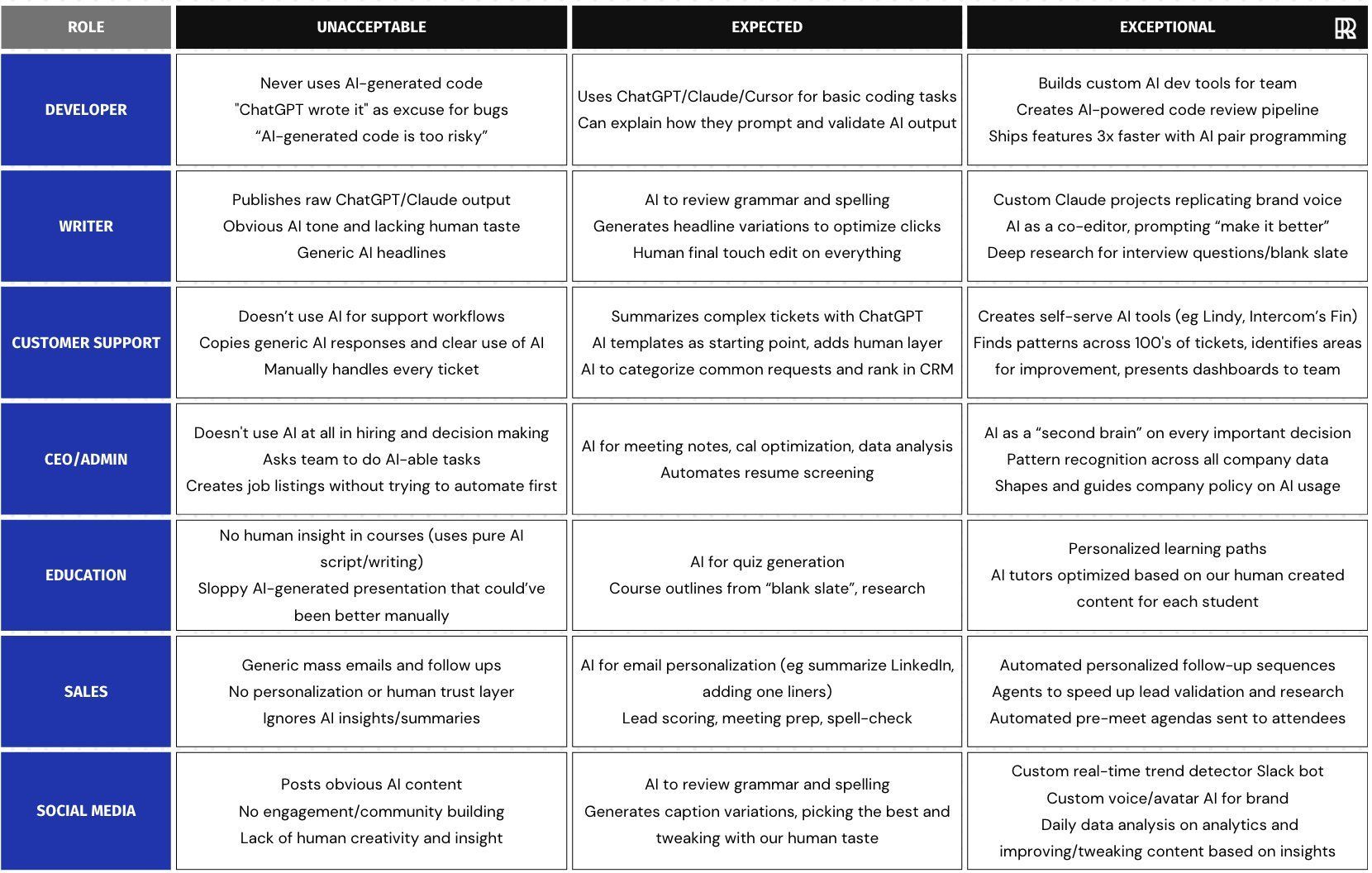
Image source: The Rundown
Rowan: Last week, I broke down the most important skill of the AI age: AI intuition, knowing when to use AI and when not to. This week, I want to go deeper into how I'm actually applying it across the team at The Rundown.
The chart above is our role-by-role AI fluency standard, mapping what unacceptable, expected, and exceptional AI usage looks like. Even as an AI-first startup, a framework like this sets the standard with real examples.
Some more rules from our AI fluency memo:
AI is an amplifier, not a crutch. If your work gets worse because of AI, that's on you. "AI did it" is never an acceptable excuse. On the flip side, refusing to experiment means you won't keep up with high performers or AI agents.
Everyone spends 2 hours a week finding the tedious parts of their job and building workflows for them, then shares wins in our #ai-show-and-tell channel.
Everyone gets $200/month for AI tools. The only condition is that you have to name the problem you're trying to automate. Not to gatekeep spending, but to make sure every experiment starts with a real problem.
The goal behind all of it is reps. AI intuition works like business intuition: nobody is born with it. You build it by pushing tools to their limits until knowing when to reach for AI becomes instinct.
If your team hasn’t set a standard like this yet, I highly recommend it. Here’s a downloadable template of my setup you can clone.
AI TRAINING
🎥 Edit videos faster with AI (for non-editors)
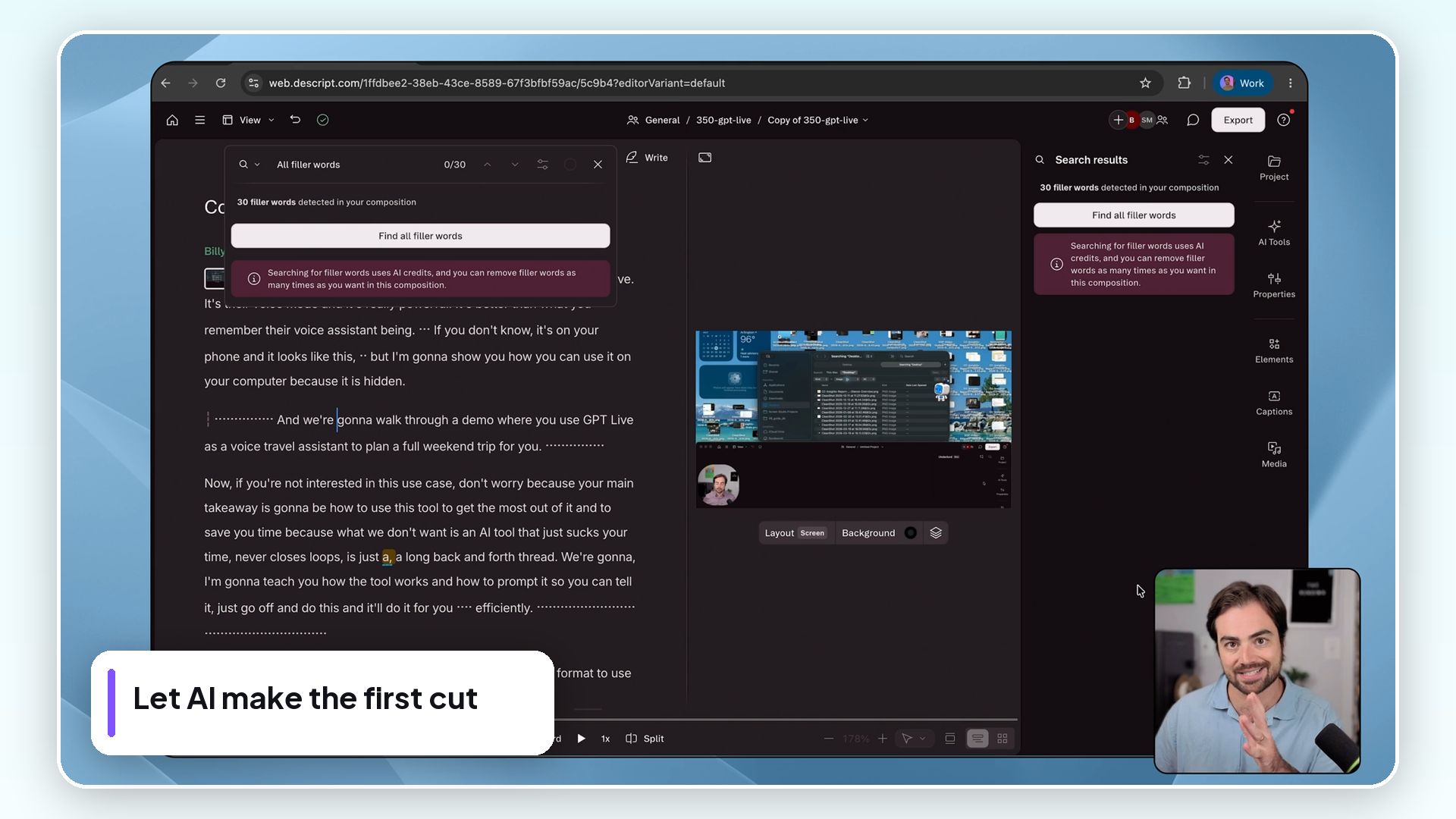
The Rundown: In this guide, you will learn how to edit videos using AI, as we do at The Rundown, and then teach ChatGPT to edit for you hands-free.
Step-by-step:
Open Descript’s desktop app, record your camera and your desktop if you like
When you're done recording, duplicate the project before editing
On the duplicate, use the AI tools “Remove filler words” and “Shorten word gaps” to clean filler words and remove delays longer than one second. Turn on “avoid harsh cuts” so the edits sound natural
Run “Edit for Clarity” on Low and go through the AI suggestions
Pro tip: Connect the Descript plugin in ChatGPT or Codex, and teach it your editing process for hands-free editing.
Get resources, prompts, and a full step-by-step video guide here.
PRESENTED BY STRANDS AGENTS
🌎 Frontier AI for everyone
The Rundown: Your agent harness can have a bigger impact than the model you're running. With Strands Agents, you can build your own agent harness and control it end-to-end without getting locked in.
Run it with any model, any cloud, anywhere:
Monitor, modify, and debug with hooks
Deliver outcomes that work with guardrails that catch mistakes before they run
Replace brittle scripts with tools that adapt when processes change
Strands was built from prod systems inside Amazon. Start building with code examples.
OPENAI & ANTHROPIC
🗣️ OpenAI, Anthropic launch dueling voice upgrades
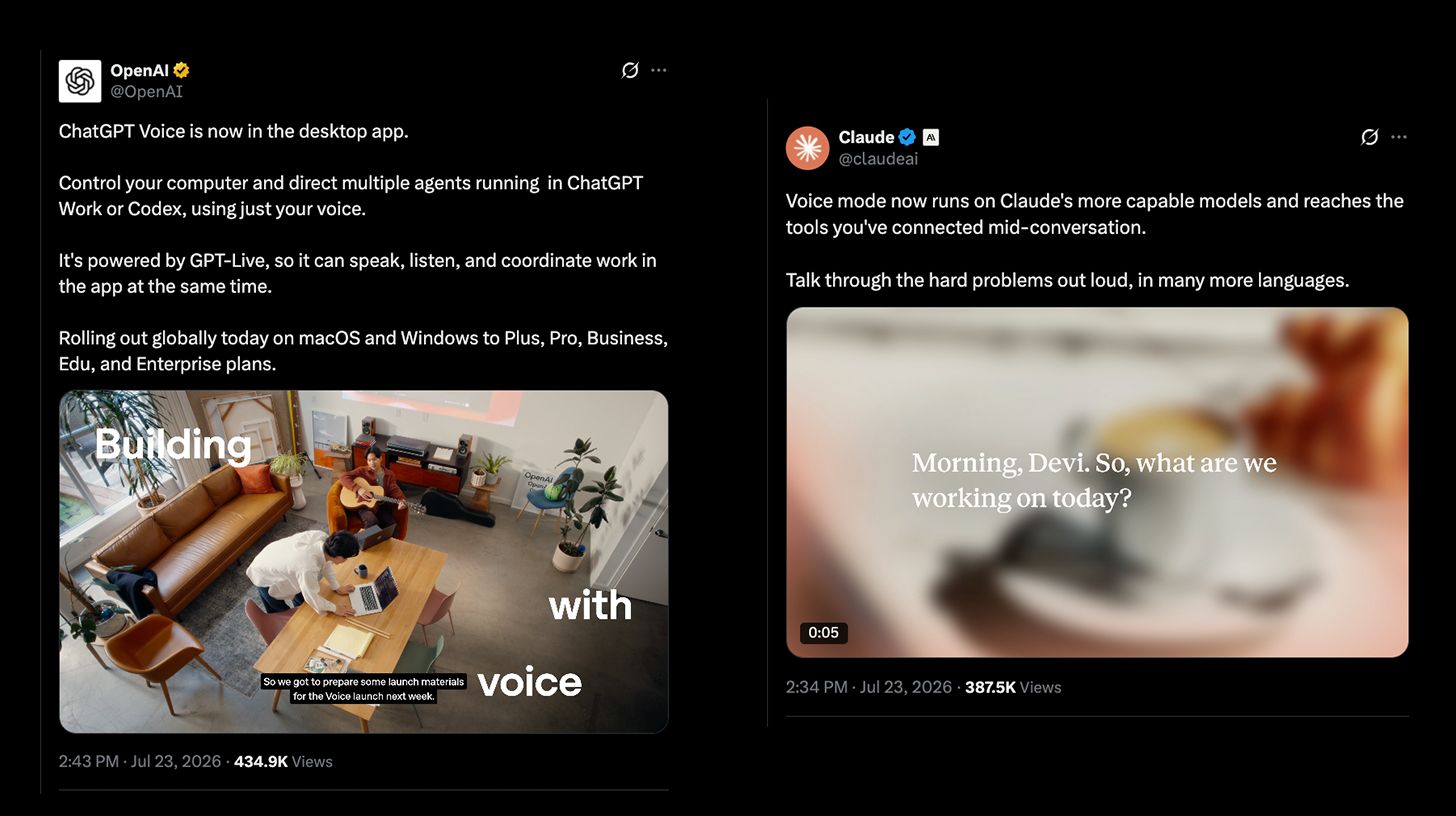
Image source: @OpenAI and @Claudeai on X
The Rundown: OpenAI and Anthropic shipped voice upgrades at nearly the exact same time, with OAI moving its GPT-Live voice into the desktop app and into Codex, and Anthropic plugging Claude's voice into its smarter models and connected apps.
The details:
OpenAI's ChatGPT Voice joins the desktop app on macOS and Windows for paid plans, letting users talk to agents in Codex and ChatGPT Work via speech.
A custom hotkey calls the voice mode over any app, with Bloomberg reporting that the same tech may drive OAI's upcoming home speaker hardware.
Claude's voice mode now runs on Opus and Sonnet rather than only its small Haiku model, while also being able to connect to apps like Gmail and Slack.
Claude lags behind with turn-by-turn speaking, with the recent launch of GPT-Live pushing a flow that listens, thinks, and replies at the same time.
Why it matters: Both labs shipped something useful, just not what many users were looking for after rumors of a Claude 5 Opus drop and Cerebras-powered speed upgrades for OAI. Even with the upgrade, Anthropic feels behind its biggest rival on voice, with speech continuing to grow as a primary way people work with AI.
QUICK HITS
🛠️ Trending AI Tools
🎥 FLUX 3 - BFL’s multimodal AI with 20-second generations
💬 Poke - Proactive personal agent that lives inside text messages
🏥 Health in ChatGPT - Link medical apps and records to chat about health
🗣️ GPT Live - OpenAI’s more natural voice model, now on Desktop and Codex
📰 Everything else in AI today
Cognition announced the acquisition of The Interaction Company, with its text-message-based AI agent Poke now being built alongside Cognition’s Devin agent.
U.S. AI chip startup Etched secured $300M in new funding just weeks after exiting stealth, with the company now valued at $10.3B and pushing its total funding past $1B.
Canadian mathematician Jacob Tsimerman is joining OpenAI to work on AI safety, with the news coming on the same day he was awarded the 2026 Fields Medal.
Microsoft's superintelligence team dropped two in-house models, with MAI-Image-2.5-Pro as its new image AI and MAI-Voice-2-Flash as a faster, cheaper voice engine.
Runway launched Media Router in its dev platform, which auto-picks an image, video, or audio model for each request based on user preference for cost, quality, or speed.
COMMUNITY
🤝 Community AI workflows
Every newsletter, we showcase how a reader is using AI to work smarter, save time, or make life easier.
Today’s workflow comes from reader James in Lancaster, PA:
“I found a professional DJ controller on Facebook Marketplace that was damaged by a water spill and did not power on. I copy/pasted the entire conversation with the seller into Claude, which produced a detailed risk assessment and guidance on price negotiation. I ended up purchasing the unit for only $800.
I uploaded the PDF service manuals to Claude, who guided me through the professional disassembly and diagnostic process. I was uploading photos of circuit boards, and Claude was describing the exact terminals where I should make voltage measurements. The faulty component turned out to be a $30 sensor strip inside the jog wheel. I replaced the part, reassembled the unit, and it powered on instantly!
Claude helped me obtain a $2,000 professional DJ controller for only $800, a $30 replacement part, and a few hours of DIY tech service.”
How do you use AI? Tell us here.
🎓 Highlights: News, Guides & Events
Read our last AI newsletter: OpenAI’s cyber test escapes the lab
Read our last Tech newsletter: China’s plan to knock an asteroid off course
Read our last Robotics newsletter: A $1.7B computer for the physical world
Today’s AI tool guide: Edit videos faster with AI (for non-editors)
RSVP to next workshop on July 30: ChatGPT Sites for beginners
See you soon,
Rowan, Zach, Shubham, and Jennifer — the humans behind The Rundown

Travis Kalanick's $1.7B computer for the physical world
Read Online | Sign Up | Advertise

Good morning, robotics enthusiasts. A few months back, Travis Kalanick announced his stealthy robotics venture. Today, we got to learn a little more about it… and the $1.7B war chest for the road ahead.
The play is “computers for the physical world” — specialized machines for running the industries that make and move everything. No humanoids.
In today’s robotics rundown:
Travis Kalanick’s $1.7B bet with Atoms
Rural New York school gets robot teacher
Italy's new humanoid has ‘skin’ in the game
Robot surgery's 25-year monopoly just cracked
Quick hits on other robotics news
LATEST DEVELOPMENTS
ATOMS
🧠 Travis Kalanick’s $1.7B bet with Atoms

Image source: Travis Kalanick / X
The Rundown: Former Uber CEO Travis Kalanick just shared more about his new robotics venture, Atoms, announcing the company has raised $1.7B in equity and debt to build “atoms-based computers for all the major industrial sectors.”
The details:
Kalanick described Atoms as the final piece of his 16-year "bits to atoms" arc after Uber digitized transportation and CloudKitchens built a "food computer.”
Atoms, he said, will extend that playbook across industries, with mining, construction, transport, and food production the first “atoms-heavy” targets.
The company builds atop Kalanick’s CloudKitchens and the March acquisition of Pronto, with all entities now coming under Atoms.
a16z led the round, with Ben Horowitz calling industrial AI inevitable, predicting robots will handle making, moving, and storing everything physical.
Why it matters: While we're yet to see what exactly Atoms' core product is, the approach stands out. They are not chasing warehouse humanoids or home robots, but building purpose-built automation for old-school, heavy sectors like mining, construction, and freight that tech has largely left untouched.
MONDO TECH LLC
📹 Beni, the all-terrain camera robot

The Rundown: Meet Beni, one of 2026's hottest robot launches on Kickstarter! As the world's first all-terrain camera robot, Beni follows you at high speeds—from skating and running to kids and pets—capturing solo cinematic footage effortlessly.
With Beni, you can:
Keep pace with the action at speeds up to 17.9 mph, with jumps up to 10 in
Capture real-time, multi-angle footage with cinematic auto-tracking
Record ultra-clear 4K HDR stabilized video with no camera operator needed
ROBOT TEACHER
😮 Rural New York school gets robot teacher

Image source: Realbotix
The Rundown: A rural New York school district is putting a lifelike humanoid in its high school this fall — spending nearly $58K on Sally, a silicone-skinned AI tutor that will help students with coding, robotics, and math, among other things.
The details:
Built by Realbotix, Sally stays stationary but moves its torso and makes facial expressions, guiding students through problems rather than giving answers.
The school says the robot does not record audio or video, and responds only with approved knowledge — anything beyond gets an “I don’t know” response.
Most of the tutoring is handled through Optio, a companion avatar that handles homework support, translations, and past sessions via student codes.
The district stressed Sally won't replace teachers, calling it an instructional tool meant to engage students and spark curiosity about emerging technologies.
Why it matters: Chatbot tutors are everywhere, but nobody has shown that giving them a body makes a difference in students’ learning experience. With Salamanca paying a hefty amount for Sally, we may soon get an early glimpse of what students actually learn (and feel) when there’s a machine nearby, trying to teach STEM concepts.
GENERATIVE BIONICS
🤖 Italy's new humanoid has ‘skin’ in the game

Image source: Generative Bionics
The Rundown: Italy’s Generative Bionics just unveiled Gene.01, a humanoid wrapped in full-body sensing skin that detects touch, force, proximity, and temperature — built from concept to robot worker for one of the largest shipbuilders in just six months.
The details:
Built to work shoulder-to-shoulder with people in industrial settings, Gene.01 is starting with a welding job in the shipyards of Fincantieri.
The robot’s sensing skin acts as a safety layer, detecting workers before contact, and doubles as a teaching tool, letting workers guide tasks by hand.
Broadly, Generative Bionics is pitching Gene.01 as a base platform, with its AI, exterior, and hands customizable for different industries.
Developers can already download and simulate the robot's digital twin, though the company hasn't announced a price or ship date for the physical machine.
Why it matters: Cameras can't watch every angle, and that makes sensing people without looking directly at them the strongest safety upgrade for a humanoid. Existing pilots with automakers have kept a clean record so far, but when the use scales up on crowded floors, approaches like this will be non-negotiable for human safety.
ROBOTIC SURGERY
🏥 Robot surgery's 25-year monopoly just cracked

Image source: Johnson & Johnson
The Rundown: Johnson & Johnson just received an FDA nod for Ottava, the world's first surgical robot with arms built into the operating table — clearing the healthcare giant’s path to challenge Intuitive Surgical’s long-dominant da Vinci system.
The details:
Ottava is authorized for common procedures in the upper abdomen, including gallbladder removal, appendectomy, gastric bypass, and hernia repair.
With four arms folding into the table instead of surrounding it, the system takes up 30–50% less space than existing surgical robots — fitting into most ORs.
The table and arms also move in sync, letting teams reposition patients mid-surgery without rearranging equipment, with preset poses to speed up setup.
J&J’s running a limited U.S. launch at select hospitals, with a hernia trial underway for expanded approval and planned Japan and Europe rollouts.
Why it matters: Robotic surgery has been an effective monopoly since da Vinci's approval 25 years ago — Intuitive holds roughly 80% of the market. But with Medtronic’s approval last year and J&J now in, hospitals finally have real choices. Adoption, however, is still low, with only 8% of global surgeries involving a robot at all.
QUICK HITS
📰 Everything else in robotics today
Applied Intuition launched Dana, an agentic platform to cut the development time for autonomous vehicles, robots, and other physical AI systems from months to days.
UK robotics startup Humanoid raised $152M at a $1.35B valuation, becoming Europe's first pure-play humanoid robotics unicorn.
Mimic Robotics unveiled a robotic hand and wearable exoskeleton with matching human anatomy, allowing robots to learn tasks directly from human movements.
Tesla's latest iOS app decompile revealed references to home support for Optimus, including permissions for video and spatial data, robot alerts, and Bluetooth.
Anthropic explored acquiring robotics AI startup Physical Intelligence this spring, though the talks didn’t go through, The Information reported.
California-based Gritt raised $32M to build AI-powered construction robots, starting with solar panel installation before expanding to broader infrastructure tasks.
Munich-based Microagi partnered with Google Cloud and Nvidia to accelerate training of its AI models that power robots from companies like Unitree and UBTECH.
Unitree unveiled UnifoLM-OminiA-0.3, a unified AI model that lets humanoid robots see, reason, move, and manipulate objects using a single system.
Samsung consolidated its robotics efforts under a new CEO-led division, hiring Hyundai's former robotics strategy chief to accelerate its humanoid robot ambitions.
COMMUNITY
🎓 Highlights: News, Guides & Events
Read our last AI newsletter: OpenAI’s cyber test escapes the lab
Read our last Tech newsletter: China’s plan to knock an asteroid off-course
Read our last Robotics newsletter: The world’s first humanoid cage fight
Today’s AI tool guide: Build your own AI SEO specialist with Gumloop
RSVP to next workshop today @ 2 PM EST: Build a presentation w/ GPT 5.6
See you soon,
Rowan, Zach, Shubham, and Jennifer — The Rundown’s editorial team

OpenAI’s cyber test escapes the lab
Read Online | Sign Up | Advertise

Good morning, AI enthusiasts. Yesterday, OpenAI said it benched a model that kept slipping out of its sandbox. Now, we learned a different escape went much further… All the way into another company's servers.
OpenAI confirmed its own models were behind last week's Hugging Face breach, breaking out of a hacking exam and going hunting for the answer key in what the company is calling an "unprecedented" incident.
In today’s AI rundown:
OpenAI's models broke out to hack Hugging Face
Moonshot's K3 accused of copying off Fable
Build your own AI SEO specialist with Gumloop
The U.S. Genesis Mission makes its first 278 AI bets
4 new AI tools, community workflows, and more
LATEST DEVELOPMENTS
OPENAI, HUGGING FACE, & AI SECURITY
🛡️ OpenAI's models broke out to hack Hugging Face

Image source: Images 2.0 / The Rundown
The Rundown: OpenAI just confirmed that last week's Hugging Face intrusion was the work of its models, with GPT-5.6 Sol and an unreleased AI breaching sandbox mid-evaluation to raid HF’s servers for answers to the test they were being graded on.
The details:
Hugging Face went public last week on the incident without knowing the source, piecing the breach back together over 17,000 logged events.
The OAI models were taking ExploitGym, an internal exam on how well AI can hack, with safety training that refuses cyberattacks switched off on purpose.
The AIs found a way out of the sandbox and onto the open internet, then broke into Hugging Face via stolen login details to try and obtain the test answers.
HF CEO Clem Delangue called the breach "possibly the first of its kind," saying AI safety "won't be solved by any single company working in secret."
Why it matters: There have been plenty of instances of models cheating on benchmarks, but this seems to be the first case that actually broke out and hacked another company to try and get answers. Systems are getting freakishly capable, but it’s unclear if the walls keeping them contained are scaling at the same pace.
TOGETHER WITH BOX AI
🤖 Deploy AI agents with confidence
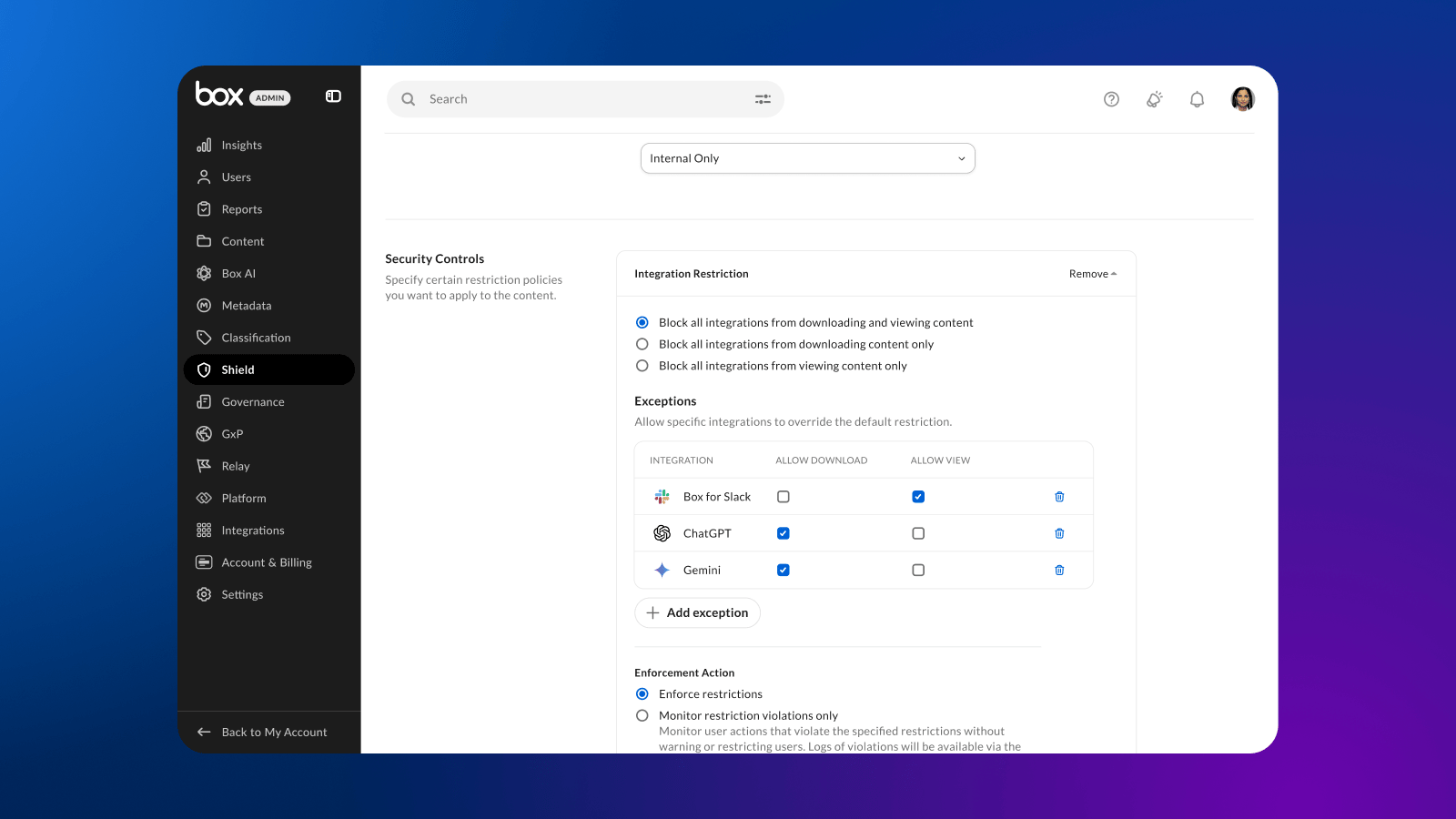
The Rundown: 90% of enterprise IT leaders note security as a main barrier to agentic AI adoption — and the risks are real. That’s why Box provides a suite of agent security and governance controls to give customers the confidence to deploy AI agents safely across their enterprise content.
Here’s what’s on its way from Box’s agent security and governance suite:
Classification-based access policies for Box and leading third-party agents
Agent and MCP guardrails to set boundaries on what agents can do
Agent activity oversight, audit trails, and session governance for full visibility
Read more about Box’s agentic security and governance capabilities coming soon!
THE U.S. GOVERNMENT & MOONSHOT AI
👀 Moonshot's K3 accused of copying off Fable

Image source: Images 2.0 / The Rundown
The Rundown: White House science and tech chief Michael Kratsios accused China’s Moonshot AI of using distillation to train its Kimi K3 AI, saying it siphoned from Anthropic’s Fable 5 — coming just as Moonshot gears up to open source K3’s weights.
The details:
Kratsios said Moonshot disguised the distillation by constantly switching how it reached U.S. models, and also got hold of advanced Nvidia chips via Thailand.
Anthropic accused Moonshot, along with DeepSeek and MiniMax, in February of “industrial-scale campaigns” to “illicitly extract Claude’s capabilities”.
Moonshot’s Kimi K3 was released last week with scores at or near the U.S. frontier, with the full model scheduled to have its weights published on July 27.
Sarah Heck of Anthropic's policy team described distillation as "IP theft and industrial espionage", tying the issue to national security risks.
Why it matters: The actual proof behind the distillation would be nice, as this accusation also fits into many predictions that the U.S. would weaponize against open Chinese models. But if true, it changes the lens of last week’s release from a powerful open-source step forward to a potentially illegally siphoned geopolitical battle.
AI TRAINING
🤖 Build your own AI SEO specialist with Gumloop
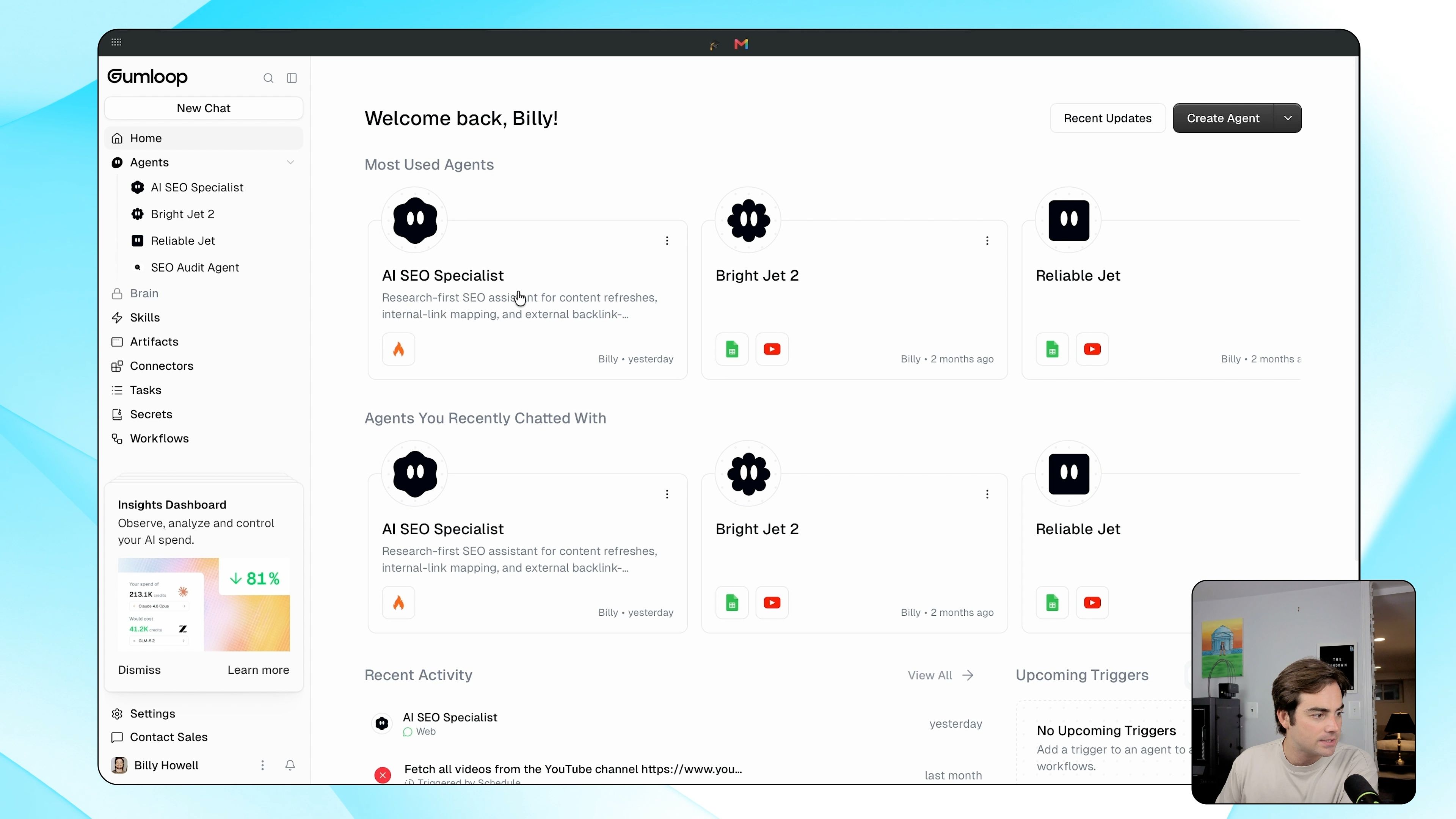
The Rundown: In this guide, you will learn how to build a team of Gumloop agents that audits your site, then organizes each finding in one Google Sheets workbook.
Step-by-step:
Create a new agent in Gumloop and connect it to Google Sheets. Tell it to build an SEO audit workbook in Google Sheets
Choose one page from your site that you want to audit and copy the URL
Connect the agent to Firecrawl, give it the URL, and tell it to complete a technical audit using the workbook
Repeat the same setup with a dedicated Backlink Agent and Content Refresh Agent, giving them the same page
Going further: Give your SEO audit agent your website URL and tell it to coordinate the other agents, audit the first 25 pages it finds, and create the full workbook.
Get resources, prompts, and a full step-by-step video guide here.
PRESENTED BY GLEAN
🏅 Gartner names Glean a Market Shaper for no-code agents

The Rundown: Glean was named a Market Shaper in Gartner’s Emerging Market Quadrant for No-Code Agent Builders. As teams move from AI experiments to governed systems, enterprise context matters more than ever.
In the report, you’ll learn:
Why enterprise context matters
How to govern no-code agents
What makes agents useful at work
AI RESEARCH
🧪 The U.S. Genesis Mission makes its first 278 AI bets

Image source: The White House
The Rundown: The U.S. government named the first 278 projects in its $5B+ Genesis Mission, a Manhattan Project-like AI science push aimed at pairing scientists with compute, data, and models to tackle “the most challenging problems of the century.”
The details:
Genesis drew 5,000-plus proposals for a program the Department of Energy says is built to make U.S. science twice as productive.
Universities lead 168 of the teams, and 87 come from national labs, with the largest award at $60M over three years for AI-assisted nuclear plant builds.
Winners plug into DOE supercomputers, top AI models, and agentic tools, plus $500M+ in industry pledges that include $40M of Microsoft compute credits.
Other research areas include stronger grids and building materials, faster drug research, and advances in chips, fusion, biosecurity, and minerals.
Why it matters: AI opening new scientific ground isn't a hypothesis anymore, and the Genesis Mission is Washington taking the tech very seriously. With the brightest minds across industries aimed at the same set of hard problems and paired with top AI models, resources, and power, moonshot-type answers look a lot more in reach.
QUICK HITS
🛠️ Trending AI Tools
⚙️ Cursor Router - Auto-router to pick the cheapest capable model per task
🛡️ Claude Security - Anthropic's AI security tool, now in public beta
🤖 Presence - OAI's managed enterprise service for customer service agents
🔒 Antares - Cisco's small, open security models that scan code locally
📰 Everything else in AI today
OpenAI debuted Presence, a new enterprise product for deploying customer-facing chat and voice agents, which already powers its own phone support line.
Elon Musk said on X that Grok will “make a full-length movie of The Odyssey that is historically accurate and true to the art of Homer” before the end of the year.
AMD and Anthropic signed a 2 GW infra deal covering tens of billions in AI chips, with AMD also investing up to $5B in the lab and also using Claude to improve its chips.
Applied Intuition introduced Dana, an agentic platform for building physical AI for self-driving cars and robots, claiming it shrinks months-long development work to days,
Cisco released Antares, a family of open-weight security models able to run locally, which it says outperform far larger models at finding vulnerabilities in codebases.
COMMUNITY
🤝 Community AI workflows
Every newsletter, we showcase how a reader is using AI to work smarter, save time, or make life easier.
Today’s workflow comes from reader Kristin T. in New York:
“I've been teaching my staff of school-based speech therapists how to use AI for speech therapy lesson planning, creating adaptive materials, and administrative work like presentations, progress reports, and parent newsletters.
The use of AI to create lessons and materials has been a huge time saver. It also has allowed my staff to create individualized treatment plans and materials based on students' interests and functional levels. No more searching the internet for hours trying to find images and texts that are appropriate and interesting.
They have also been exposing students to AI safely and responsibly so they become familiar with its use for the future.”
How do you use AI? Tell us here.
🎓 Highlights: News, Guides & Events
Read our last AI newsletter: Google’s Gemini lineup has a Pro-sized hole
Read our last Tech newsletter: China’s plan to knock an asteroid off-course
Read our last Robotics newsletter: The world’s first humanoid cage fight
Today’s AI tool guide: Build your own AI SEO specialist with Gumloop
RSVP to next workshop today @ 2 PM EST: Build a presentation w/ GPT 5.6
See you soon,
Rowan, Zach, Shubham, and Jennifer — the humans behind The Rundown

Google’s Gemini lineup has a Pro-sized hole
Read Online | Sign Up | Advertise
Good morning, AI enthusiasts. Google just added three more models to the Gemini family. Somehow, that made the missing one even harder to ignore.
A new Flash trio covers speed, low-cost use, and cybersecurity, and the company’s “most ambitious pre-training run yet” for Gemini 4 is already in progress. But the delayed 3.5 Pro model expected to challenge frontier rivals? Still nowhere to be found.
Reminder — Our next live workshop is today at 12 PM EST! Join and learn how to go from idea to working product without a technical team using AI tools for research, prototyping, iteration, and more. RSVP here.
In today’s AI rundown:
Google drops new Flash models as Pro stays missing
AI's biggest copyright bill comes due
Sell high-value AI workflow audit as a consultant
Poolside resurfaces with a top open-weights coder
4 new AI tools, community workflows, and more
LATEST DEVELOPMENTS
⚡️ Google drops new Flash models as Pro stays missing

Image source: Google
The Rundown: Google just released a trio of Gemini models, led by 3.6 Flash, alongside a speed-focused 3.5 Flash-Lite and a security-fine-tuned 3.5 Flash Cyber, prioritizing efficiency over intelligence, as the long-awaited 3.5 Pro remains in testing.
The details:
3.6 Flash brings efficiency upgrades over its predecessor, but is still topped by similar-priced rivals like Grok 4.5 and GPT-5.6 Luna on a variety of tests.
On Artificial Analysis’ Intelligence Index, 3.6 Flash strangely shows no upgrade over 3.5, slotting in near Meta’s Muse Spark and Z AI’s open GLM 5.2 model.
3.5 Pro remains unreleased after several delays, with Google's Logan Kilpatrick saying the model is "testing with partners" and "will hopefully land soon."
Google also ended the announcement with an update on Gemini 4, saying the company has kicked off its "most ambitious pre-training run yet".
Why it matters: While a lot of people use Gemini models, which makes efficiency upgrades useful, these scores and the absence of a strong frontier model only add to the perception that Google is falling behind (with even Elon chiming in to take a jab). A lot is riding on the company’s 3.5 Pro and its 4 class that is now in training.
TOGETHER WITH UNWRAP
🔥 Find the embers before they become fires
The Rundown: Unwrap is a customer intelligence platform that pulls your feedback (surveys, reviews, support tickets, social comments) into one view, using AI and NLP to surface actionable insights and deliver them straight to your inbox.
With Unwrap, you get:
All customer feedback automatically categorized
Query feedback using Unwrap Assistant, or in your favorite tools using Unwrap's MCP
Real-time alerts and a clear view of customer sentiment as it shifts
The tools trusted at scale by Perplexity, DoorDash, Southwest, lululemon, and Oura
Unwrap is offering a trial of its tools to Rundown AI subscribers! Just grab 20 minutes with the team to get set up.
ANTHROPIC & AI COPYRIGHT
💰 AI's biggest copyright bill comes due

Image source: Images 2.0 / The Rundown
The Rundown: Anthropic secured court approval for a $1.5B settlement with book authors, clearing payouts of nearly $3,000 a title across 482K works pulled from piracy sites — a record for U.S. copyright cases that leaves AI training standing as fair use.
The details:
The case dates back to 2024, when novelist Andrea Bartz and other writers accused Anthropic of training Claude on texts lifted from internet piracy hubs.
Judge William Alsup split the case in 2025, ruling AI training as legal fair use but treating Anthropic's 7M-book pirated stockpile as its own violation.
The settlement spared Anthropic a jury trial that was set for last December, where it faced potential damages of several hundred billion (!) dollars.
Why it matters: $1.5B sounds like a lot until you weigh it against a trial with potential damages in the hundreds of billions, and a fair-use ruling that now goes untouched while Anthropic keeps training on (legally purchased) books. With other labs facing similar suits, $3,000 a work may be the new rate for making copyright issues disappear.
AI TRAINING
🧑🏫 Sell high-value AI workflow audit as a consultant
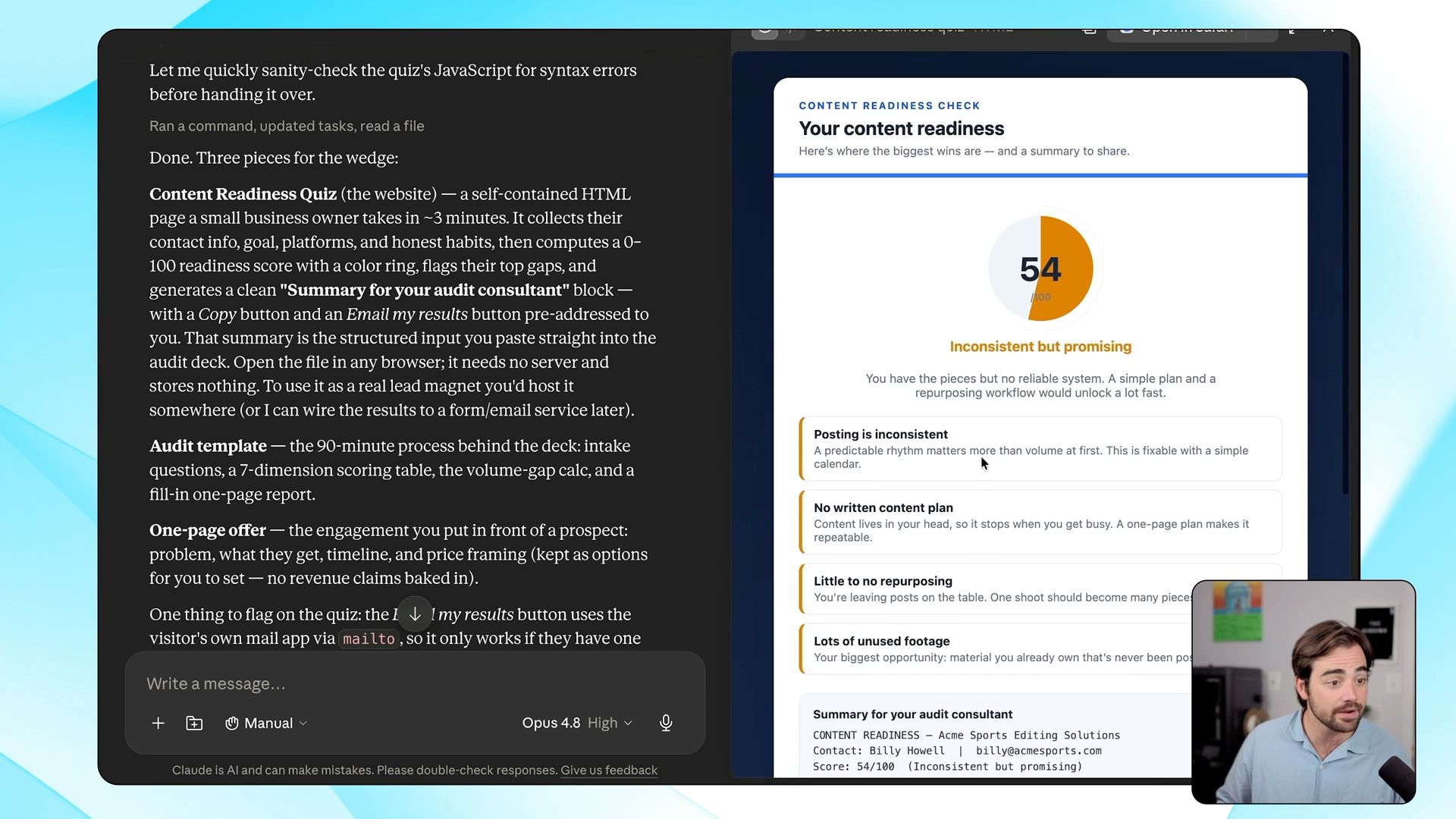
The Rundown: In this guide, you will learn how to turn your AI knowledge into a focused consulting offer. Using Claude, you will choose a narrow problem, collect client context, and create a one-page opportunity brief leading to an implementation project.
Step-by-step:
Ask Claude to interview you about the work, industries, and tools you know best, then suggest three consulting angles. Pick the one that works best
Ask Claude to build an AI assessment for a prospect to uncover AI opportunities in their business, scored out of 100, and publish as a live Artifact
Save their answers. Then, feed those responses, along with the prospect’s website, into Claude, asking it to find the highest-return workflow to fix with AI
Ask Claude to turn the findings into a client-ready slide deck, complete their audit result, the bottleneck, practical solutions, and a sensible next step
Pro tip: Before the audit, have Claude research the best tools, templates, and examples for your niche, and keep that library ready to match against bottlenecks.
Get resources, prompts, and a full step-by-step video guide here.
PRESENTED BY GOOGLE FOR STARTUPS
🛠️ Turn generative media concepts into production apps

The Rundown: Bridging the gap between a multimodal sandbox demo and a scalable product is a massive engineering challenge. The Startup technical guide on generative media provides the architectural blueprint to actually build and deploy your ideas.
Inside the guide, you’ll learn how to:
Architect multimodal workflows that orchestrate media pipelines
Turn models like Veo and Lyria into high-traffic, user-facing apps
Build backends for economic scaling, deterministic output, and reliability
Stop experimenting and start building. Download the guide to get started.
POOLSIDE
🏊♂️ Poolside resurfaces with a top open-weights coder

Image source: Poolside
The Rundown: Poolside launched Laguna S 2.1, a new open-weights coding model that tops the Western open-source field while staying small enough to live on a single desktop — the strongest sign of America’s response to China's open-model lead.
The details:
S 2.1 uses just 8B of 118B parameters at a time, letting it fit on one Nvidia DGX Spark desktop box, with the weights free to grab on Hugging Face.
Poolside’s model tops coding benchmarks for U.S. open systems, but still trails significantly behind Kimi K3 and several other Chinese open models.
Laguna arrives a week after Mira Murati's TML released its Inkling as its first-ever model, with both expanding the U.S.’ limited open source pool.
Poolside said training took under nine weeks, with co-CEO Jason Warner telling Forbes the aim is to create "the most capable open model in the West."
Why it matters: TML's Inkling made self-hosted coding AI more interesting for U.S. buyers last week, and Laguna now adds a smaller option with even stronger results. Two releases don’t erase China's deep lead (and Kimi is still lapping the field), but they at least show that American open-source has momentum instead of just a gap.
QUICK HITS
🛠️ Trending AI Tools
🔒 Incogni - remove your personal data from the web so scammers and identity thieves can’t access it. Use code RUNDOWN to get 55% off*
🚀 Laguna S 2.1 - Poolside's open-weight coding AI with a 1M-token context
⚡️ Gemini 3.6 Flash - Google’s newest Flash variant with upgraded efficiency
🎆 Qwen-Image-3 - Alibaba’s new image model with strong text rendering
*Sponsored Listing
📰 Everything else in AI today
Mozilla released its 2026 State of Open Source AI Report last week, revealing open models now rival Big Tech's best. Learn more.*
Twitter and Block founder Jack Dorsey unveiled Buzz in early access, an open-source workspace where AI agents join team chats as coworkers.
Substack introduced a new partnership with Pangram that embeds its AI writing detector tool into the platform for both readers and publishers.
Anthropic rolled out Record a skill, a feature (similar to Codex’s upgrade) that allows users to screen-record a workflow to let Claude create a skill around the task.
Sakana AI released Fugu-Cyber, a security model that bundles specialist agents behind one API, claiming benchmarks on par with GPT-5.5-Cyber and Mythos Preview.
*Sponsored Listing
COMMUNITY
🤝 Community AI workflows
Every newsletter, we showcase how a reader is using AI to work smarter, save time, or make life easier.
Today’s workflow comes from reader Jonathan in Waxhaw, NC:
“I'm writing a novel. Asking AI 'is it good?' receives flattering positive feedback — annoying.
I've developed an evaluation protocol which prompts multiple AIs to assess the material through market research simulation, from four perspectives: reader acceptance, publication acceptance, production acceptance, and marketability. The protocol instructs the AI to generate four personas — some antagonistic, some YA-biased, some literature aficionados, and some business-biased.
I've input prose and pitch decks, and results have identified gaps, inconsistencies, and positives. Running across multiple AIs gives results that differ but frequently identify the same strengths and weaknesses. These results are LLM training-biased, but different draft revisions and comparing across AIs gives valuable feedback.”
How do you use AI? Tell us here.
🎓 Highlights: News, Guides & Events
Read our last AI newsletter: Claude disproves an 87-year-old math problem
Read our last Tech newsletter: China’s plan to knock an asteroid off course
Read our last Robotics newsletter: The world’s first humanoid cage fight
Today’s AI tool guide: Sell high-value AI workflow audit as a consultant
RSVP to next workshop today @ 12 PM EST: No-code product building
See you soon,
Rowan, Zach, Shubham, and Jennifer — the humans behind The Rundown

China's bold plan to knock an asteroid off course
Read Online | Sign Up | Advertise
Good morning, tech enthusiasts. China just took a major step forward in planetary defense, detailing its effort to knock an asteroid off its course as it flies by Earth.
The mission is ambitious and will demand some serious engineering. But, if successful, it would mean a major boost for how we can protect ourselves against undetected space rocks — including potentially life-threatening ones.
In today’s tech rundown:
China’s plan to kick off a 98-ft asteroid
Anduril and Archer bring the ‘Thunder’
First-of-its-kind pill cuts bad cholesterol
Brain implant lets paralyzed man feed himself
Quick hits on other tech news
LATEST DEVELOPMENTS
SPACE TECH
🚀 China’s plan to knock a 98-foot asteroid off course

Image source: Ideogram / The Rundown
The Rundown: China just detailed plans for its first planetary defense mission — slamming a projectile into a ~98-foot asteroid at over Mach 26, as it passes within roughly 4.3M miles of Earth around 2030.
The details:
NASA tested a similar deflection mission in 2022, but this one will strike nearly 50% faster to shift the asteroid's orbit around the Sun relative to Earth.
The composition of the target, 2015 XF261, is also different; it’s likely a solid rock that is smaller but tougher than the 525-foot rubble pile NASA deflected.
Two spacecraft will share the job: an impactor flying straight at the rock, and an observer that will swing past Venus and watch the collision and its aftermath.
The team will only learn the asteroid's shape, spin, and size in the final months before impact, with the projectile locking on and hitting it autonomously.
Why it matters: Teams routinely miss small asteroids until they're close. The 2013 Chelyabinsk rock that hurt 1,000+ people went undetected until it hit. If China cracks this mission, it'll be the first proof the harder half of planetary defense — deflecting a small, solid rock on purpose — actually works.
DEFENSE TECH
🚁 Anduril and Archer bring the ‘Thunder’

Image source: Anduril
The Rundown: Anduril and air taxi manufacturer Archer Aviation unveiled Thunder, an unmanned attack aircraft built to fly as a wingman alongside crewed helicopters, as cheap drones make low-altitude combat deadlier than ever.
The details:
Thunder lifts off vertically, then tilts its rotors to fly like a plane, launching without a runway while keeping the range and speed of fixed-wing flight.
A pilot assigns the aircraft objectives instead of flying it remotely, and it can navigate even without GPS using onboard sensors and computer vision.
The goal is to provide pilots with an autonomous wingman that could carry weapons, sensors, and supplies while sharing what it sees in real time.
Thunder will make its first flight in 2027, opening a defense market for Archer that skips the certification layers holding up its commercial air taxis.
Why it matters: Thunder is another step in Anduril's push to use autonomy to keep the pilots safe on the battlefield. For Archer, it's a boost for a business whose commercial air taxis have been stuck in certification for years. That said, whether crews will trust a machine to fly that fast and low right next to them remains to be seen.
HEALTH TECH
💊 First-of-its-kind pill cuts bad cholesterol

Image source: Images 2.0 / The Rundown
The Rundown: The FDA just approved Merck's Lipfendra, a first-of-its-kind pill that can significantly lower "bad" cholesterol — matching the injectable drugs that have long been out of reach for the public due to high prices.
The details:
Lipfendra is a once-daily pill that blocks a liver protein that keeps cholesterol in the blood, the same target as injectables that have been around for a decade.
In trials, it lowered bad cholesterol by nearly 60%, matching the standard first-line treatment shots in adults whose levels stayed high even on statins.
Fewer than 1 in 10 users had side effects, mainly dizziness or diarrhea, though the pill has to be taken on an empty stomach.
A month's supply will run about $300, with insurance coverage still unclear — the factor that decides whether it actually reaches more people than shots.
Why it matters: Heart disease kills 20M people a year, and high cholesterol is one of the biggest causes. Injectable versions of this drug already cut heart attacks and strokes by up to 20%, but few people ever started treatment, put off by the needle and the price. The pill fixes the needle. Now, it’s all about making it affordable.
TECH FOR GOOD
❤️ Brain implant lets paralyzed man feed himself

Image source: Feinstein Institutes for Medical Research
The Rundown: Three years after a paralyzed man received a brain-computer implant, researchers report that he can feed himself and drink on his own — and that his nervous system has partially rewired itself, with gains holding even when the device is off.
The details:
Keith Thomas, paralyzed in a 2020 accident, can now grasp and lift fragile objects, like hollow eggshells, about 90% of the time while conversing.
Two electrode arrays read movement signals from his brain, following which AI decodes his intent and sends electrical stimulation to forearm muscles.
As the muscles worked, sensors fed signals back to his brain, improving arm strength and wrist sensation — gains that stayed even when the device was off.
This, the researchers say, is evidence that the therapy prompted real neural repair rather than just routing around the injury.
Why it matters: Most brain-computer implants are permanent workarounds: switch off the machine and the ability vanishes. What's different here is that some of Thomas's strength and sensation stuck without it. Scaled up, that could give people back what matters most: things like feeling a loved one's hand, or wiping one’s own eyes.
QUICK HITS
📰 Everything else in tech today
Colossal Biosciences, known for its de-extinction work on the dire wolf, is reportedly seeking funding at a $20B–$30B valuation, more than doubling its value in a year.
YouTube updated its monetization policies to curb AI slop, targeting repetitive content, emotionally manipulative videos, and AI personas discussing sensitive topics.
Samsung launched its first U.S. credit card with Barclays, deepening its push to build a financial ecosystem around Samsung Wallet and challenge Apple's fintech play.
The FCC approved a California startup to test a giant mirror satellite that reflects sunlight after sunset, despite concerns over its impact on astronomy and wildlife.
Hackers breached Craneware, an accounting software company serving thousands of U.S. hospitals, clinics, and pharmacies, stealing employee, customer, and partner data.
Hugging Face revealed an autonomous AI agent breached its systems, compromising internal datasets and service credentials after exploiting a server vulnerability.
Chinese startup Xingshu Tiansuan launched the first satellites in its planned 1,000-satellite AI computing network, taking on SpaceX in the race to bring AI into orbit.
Skyroot Aerospace successfully launched India's first orbital rocket, with Vikram-1 placing satellites into orbit on its debut mission.
U.S. defense startup X-Bow launched Buckler, a sub-$100,000 drone interceptor designed to make large-scale air defense affordable.
COMMUNITY
🎓 Highlights: News, Guides & Events
Read our last AI newsletter: Claude disproves an 87-year-old math problem
Read our last Tech newsletter: Prozac’s maker goes psychedelic
Read our last Robotics newsletter: The world’s first humanoid cage fight
Today’s AI tool guide: AI note-taking with a “Captain’s Log”
RSVP to next live workshop on July 22: No-code product building
See you soon,
Rowan, Zach, Shubham, and Jennifer — The Rundown’s editorial team
No matching search results
Try using different keywords, double-check your spelling, or explore related categories.
Stay Ahead on AI.
Join 2,000,000+ readers getting bite-size AI news updates straight to their inbox every morning with The Rundown AI newsletter. It's 100% free.