Physical Intelligence's $11B robot brain
PLUS: An exoskeleton for musicians

Jennifer Mossalgue
March 30, 2026
Read Online | Sign Up | Advertise

Good morning, robotics enthusiasts. A San Francisco lab trying to build a universal AI brain for robots is about to become one of the best-funded bets in the industry.
Physical Intelligence is in talks to close roughly $1B at a valuation north of $11B, nearly doubling its worth since a $600M round just four months ago. For Skild AI, Figure, and Tesla’s Optimus, the heat just went up.
In today’s robotics rundown:
Physical Intelligence eyes $1B for robot brains
Violinists now have their own exoskeletons
Snail-like robot crawls through gut to fight cancer
LimX’s ‘Luna’ humanoid hits the catwalk
Quick hits on robotics news
LATEST DEVELOPMENTS
PHYSICAL INTELLIGENCE
🧠 Physical Intelligence eyes $1B for robot brains

Image source: Physical Intelligence
The Rundown: Physical Intelligence, a two-year-old San Francisco lab founded by AI researchers and ex-Google DeepMind scientists, is in talks to raise roughly $1B at a valuation of more than $11B, Bloomberg reports.
The details:
The rumored round will double the $5.6B valuation Physical Intelligence nabbed in a $600M round just four months ago.
The startup is building AI foundation models to control fleets of general-purpose robots capable of tasks from household chores to industrial workloads.
Peter Thiel’s Founders Fund and Lightspeed Venture Partners are reportedly in, alongside existing investors Thrive Capital and Lux Capital.
The deal would hand PI more cash than most public robotics players, letting it quickly scale data and compute for its “ChatGPT‑for‑robots” platform.
Why it matters: A successful close would make Physical Intelligence one of the most heavily funded companies in the general-purpose robotics race — and intensify competition with well-funded rival Skild and humanoid startups like Figure and Tesla's Optimus, all betting their AI-robotics stacks are the ones that stick.
ROBOTICS RESEARCH
🎻 Violinists now have their own exoskeletons
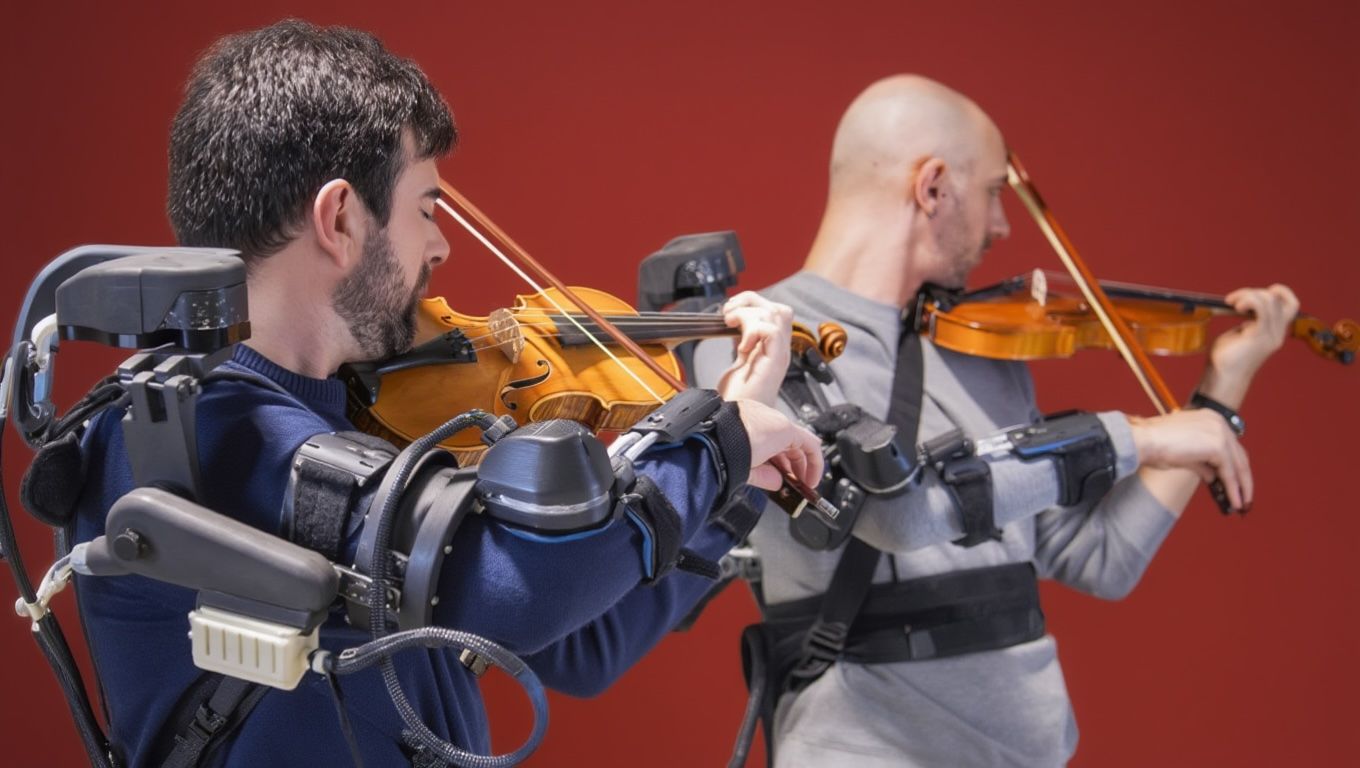
Image source: Science Robotics / Reve AI
The Rundown: Italian researchers have shown that linking violinists’ bowing arms through lightweight exoskeletons can tighten their timing, hinting at new body-level communication channels for both musicians and rehab patients.
The details:
Published in Science Robotics, the study had professional violinists strap lightweight exoskeletons onto their bowing arms.
Pairs of players were linked so that motion data from one arm generated subtle, bidirectional forces on the other in real time.
When timing drifted, the exoskeleton nudged arms back into sync, measurably tightening kinematic coordination and ensemble precision.
Most musicians felt unexplained forces and mild discomfort, but didn’t sense that the cues were coming from their partner’s body through the robotic link.
Why it matters: The researchers call it a body-to-body communication channel — shared forces merging two people into physical harmony without conscious awareness. They add that the same closed-loop system could drive rehab devices where therapists and patients move through linked exoskeletons to rebuild motor control.
MEDICAL ROBOTS
🐌 Snail-like robot crawls through gut to fight cancer
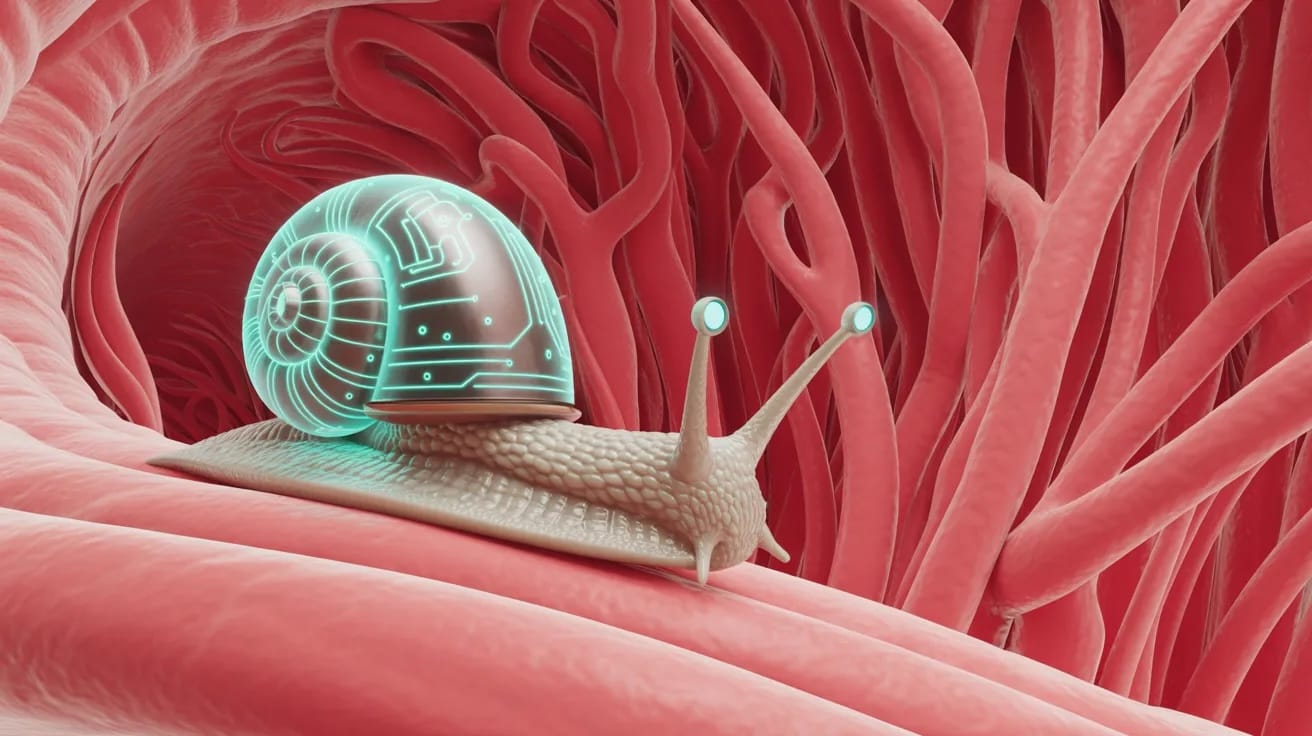
Image source: Ideogram / The Rundown
The Rundown: Researchers at the University of Manchester secured nearly £1 million ($1.3M) in UK funding to build microbots that crawl through the gut like snails and deposit chemotherapy directly into colorectal tumors.
The details:
The devices are made from peptide-based bionanomaterials engineered to mimic snail slime’s viscoelastic properties and enable controlled crawling.
Once on target, they anchor at tumor sites and release drugs on cue, guided throughout by external magnetic fields.
The team says it plans to build a multiscale digital twin of both the robot and gut tissue to stress-test designs before anything touches a patient.
Beyond colorectal cancer, the researchers see potential for these soft robots in targeted drug delivery across other organs and noninvasive diagnostics.
Why it matters: Colorectal cancer treatment still depends on systemic chemo, flooding the body with toxins to hit one target. These robots could shrink that blast radius to the tumor itself. Magnetically guided soft robots have already cleared animal trials for similar applications, making clinical use look less hypothetical by the day.
LIMX
🤖 LimX’s ‘Luna’ humanoid hits the catwalk
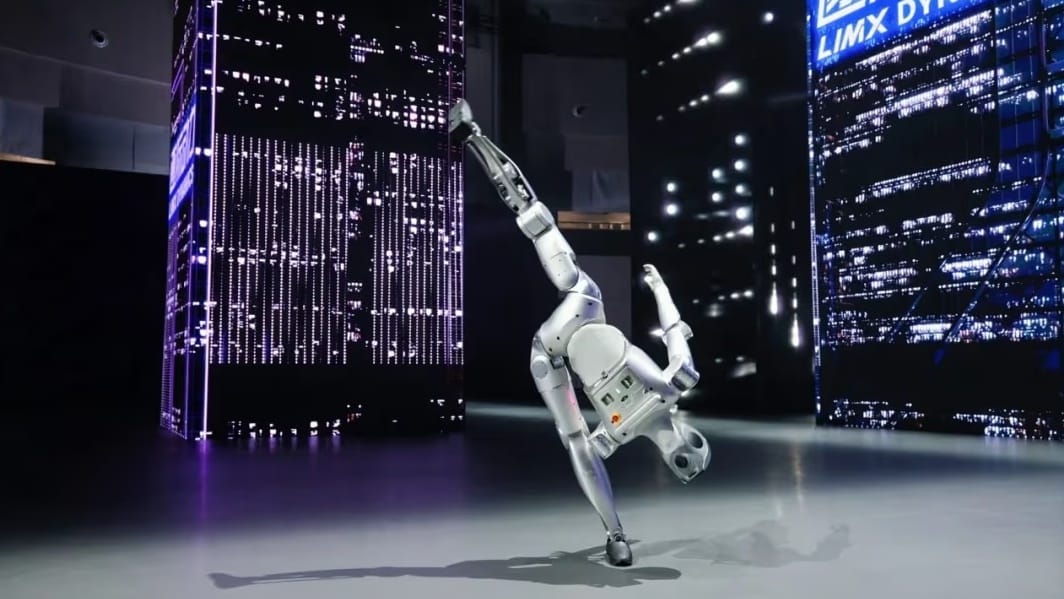
Image source: LimX Dynamics
The Rundown: Shenzhen startup LimX Dynamics debuted Luna, its new feminine humanoid, at Alibaba’s Taobao Influencer Festival — and she performed a full catwalk strut, hips swaying, finishing with an illusion-turn spin.
The details:
LimX positioned Luna as a public-facing performer rather than a factory bot, emphasizing lifestyle aesthetics and expressive movement designed for stages.
Under the hood, upgraded motion control, balance, and real-time perception pull from LimX’s earlier Oli platform.
The reveal comes just a month after LimX’s $200M Series B round, aimed at scaling its manufacturing and supporting its new COSA OS.
Why it matters: Luna, designed specifically for performance and brand activations, is part of a broader Chinese push to turn humanoids into consumer-facing entertainers and marketing props, not just industrial labor. Social clips of the Taobao walk join plenty of viral footage of China’s humanoids doing martial arts and parkour.
QUICK HITS
📰 Everything else in robotics today
U.S. lawmakers introduced a bipartisan bill to bar federal agencies from using Chinese-made humanoids over national security and data privacy concerns.
Chinese industrial robot maker Shenzhen Inovance Technology hired Bank of America and Morgan Stanley for a Hong Kong share sale that could raise up to $2B.
AGIBOT said it has rolled out its 10,000th humanoid, doubling output in just three months as it races to scale up mass production and real‑world deployments.
Xiaomi unveiled a redesigned, human-scale CyberOne robotic hand with more dexterity, full-palm tactile sensing, and a liquid-cooling “bionic sweat gland” system.
Ukraine’s army is field-testing off-the-shelf Hypershell exoskeletons to help artillery crews carry heavy shells and run faster with less fatigue.
Pony.ai turned its first profit, driven by chip investments, and is now racing to roll out over 3K robotaxis across more than 20 cities.
New research indicates battery-powered robot dogs could excel as astronaut aides, simultaneously walking, sensing soil, and autonomously choosing safe paths.
Hyundai-backed RAI unveiled Roadrunner, a 15kg wheeled biped that can skate, climb stairs, and balance on one wheel in a new multimodal locomotion demo.
Germany’s Nature Robots raised €4M ($4.6M) to address agriculture’s “triple threat” — labor shortages, sustainability demands, and productivity challenges.
A Maximo construction robot installed 100 MW of solar capacity at AES’s Bellefield solar complex in California, nearly doubling human installation speeds.
Researchers built microscopic 3D‑printed soft robots whose flexible, self-propelled chains let them swim, sense obstacles, and navigate complex environments.
🎓 Highlights: News, Guides & Events
Read our last AI newsletter: Anthropic's secret 'Mythos' model
Read our last Tech newsletter: SpaceX flips the IPO script
Read our last Robotics newsletter: Amazon now has a kid-sized humanoid
Today’s AI tool guide: Create Skills in ChatGPT with Codex
RSVP to next workshop @ 2 PM EST Thursday: Presentation Slides with AI
See you soon,
Rowan, Joey, Zach, Shubham, and Jennifer — The Rundown’s editorial team



Stay Ahead on AI.
Join 2,000,000+ readers getting bite-size AI news updates straight to their inbox every morning with The Rundown AI newsletter. It's 100% free.