Get the latest AI news, understand why it matters, and learn how to apply it in your work — all in just 5 minutes a day. Join over 2,000,000+ subscribers.

🌐 Microsoft's open agentic web vision
Read Online | Sign Up | Advertise

Good morning, AI enthusiasts. Microsoft just kicked off a hotly anticipated AI week with its Build 2025 event, sharing a vision for an “open agentic web” with a flood of new tools and platforms.
With Google, Anthropic, and (likely) OpenAI also expected to bring some heat in the coming days, the AI industry’s next major acceleration may officially be underway.
In today’s AI rundown:
Microsoft’s vision for an open agentic web
Microsoft’s new AI to speed up science R&D
Transform photos into talking videos instantly
AI headphones translate crowds in 3D
4 new AI tools & 4 job opportunities
LATEST DEVELOPMENTS
MICROSOFT
🌐 Microsoft’s vision for an open agentic web

Image source: Microsoft
The Rundown: Microsoft just introduced its vision for an “open agentic web” at Build 2025, releasing a slew of new AI-powered tools and upgrades, including a revamped GitHub Copilot, Copilot Studio, Azure Foundry, an AI browser agent, and more.
The details:
GitHub Copilot upgrades from an in-editor assistant to an agent that works asynchronously, with Microsoft also open-sourcing Copilot Chat in VS Code.
Microsoft dropped Magentic-UI, an open-source research prototype for human-in-the-loop web agents, focused on user collaboration and control.
The company is also adding Grok 3 and Grok 3 mini models from xAI to Azure AI Foundry, enabling developers to choose from over 1,900 models.
A new open project called NLWeb aims to be like HTML for the agentic web, making it easy to add conversational UI to websites.
Copilot expands with new tuning, allowing orgs to train models on company data, alongside multi-agent orchestration to collaborate on business tasks.
Why it matters: Microsoft kicked off a big week in AI with massive announcements at Build, and while the ‘year of the AI agent’ hasn’t yet been as practical as many expected, the needle is moving in the right direction — as is an industry shift to open source, as evidenced by the tech giant’s flurry of releases.
Watch CEO Satya Nadella’s full keynote here.
TOGETHER WITH DROPBOX
📚 All your knowledge, one search

The Rundown: Dropbox Dash offers AI-powered search and knowledge management across content types and platforms, then turns the results into ready-to-use drafts — so you spend less time searching and more time creating.
With Dropbox Dash, you can:
Search videos, images, docs, and people across all connected apps in seconds
Generate briefs, summaries, and first drafts with built-in AI writing tools
Keep work secure with custom exclusions, GDPR compliance, and self-hosted AI
MICROSOFT
🔬 Microsoft’s new AI to speed up science R&D

Image source: Microsoft
The Rundown: Microsoft also unveiled Discovery at Build, a new enterprise platform to speed up scientific research by enabling scientists to team up with specialized AI agents that crunch data and run experiments, accelerating findings from years to hours.
The details:
Discovery uses AI "postdoc" agents and a graph-based knowledge engine to help researchers form hypotheses, simulate experiments, and analyze results.
Microsoft showcased its power by discovering a novel, non-PFAS datacenter coolant prototype in about 200 hours, a task that usually takes months or years.
Discovery aims to democratize supercomputing, allowing scientists to use natural language instead of needing deep coding skills.
Big names like GSK, Estée Lauder, NVIDIA, and Synopsys are already lining up to integrate Discovery into R&D for everything from pharma to chip design.
Why it matters: Discovery could compress R&D timelines across industries by removing technical barriers between scientists and advanced tools. While previous AI science initiatives have often underdelivered, Microsoft's approach of combining AI agents with supercomputing power could help bridge the gap between hype and reality.
AI TRAINING
📸 Transform photos into talking videos instantly

The Rundown: In this tutorial, you will learn how to use HeyGen's Avatar IV to turn any photo into a realistic talking video with just a script and voice selection.
Step-by-step:
Visit HeyGen and select “Photo to Video with Avatar IV” from the Home tab
Upload a clear photo of a face (at least 720p recommended)
Add your script and select a voice (choose from the library, create new, or integrate a third-party voice like from ElevenLabs)
Click “Generate video” and wait for processing to complete
Pro tip: You should use high-resolution photos with good lighting for the most natural-looking talking avatars.
PRESENTED BY UNSTRUCTURED
📚 End-to-End RAG with Unstructured + Databricks

The Rundown: Ready to go from messy, unstructured data to a deployed AI assistant? Join Unstructured’s live webinar today to learn how to build an end-to-end RAG pipeline using Unstructured + Databricks.
Join to learn:
How to prepare raw data for RAG with Unstructured
How to store and manage chunks + embeddings in Delta Tables
How to set up Databricks Vector Search for fast, accurate retrieval
How to deploy a chatbot using LangChain + Databricks
AI RESEARCH
🎧 AI headphones translate crowds in 3D

Image source: UW Washington
The Rundown: University of Washington researchers just developed an AI-powered headphone system that can translate multiple speakers simultaneously while preserving spatial location and unique voice characteristics.
The details:
A "Spatial Speech Translation" system uses off-the-shelf noise-canceling headphones rigged with extra mics to pick up surrounding conversations.
AI algorithms then separate individual speakers, translate speech in real-time, and play it back — preserving both voice qualities and spatial location.
The device scans 360 degrees like radar to detect and track multiple speakers, even as the subjects or the wearer move.
The tech currently works for Spanish, German, and French with a 2-4 second delay, and can run locally on devices using an Apple M2 chip.
Why it matters: Translation apps have gotten much better in the AI era, but still often struggle with real-world scenarios that are often noisy and bustling. This spatial approach is a practical game changer — and its integration into everyday devices like AirPods would completely change how we interact across language barriers.
QUICK HITS
🛠️ Trending AI Tools
📝 Notion AI Enterprise Search - Gives you the ability to search across 3x more connected apps, plus PDFs and databases*
⚙️ Codex - OpenAI’s agent that handles multiple coding tasks at the same time
📊 Grok - xAI’s advanced AI model, now capable of generating visual charts
🤖 Agent Neo - Flowith’s new autonomous, million-context creation agent
*Sponsored Listing
💼 AI Job Opportunities
📞 The Rundown - Account Manager
🤝 OpenAI - Corporate Development Integration Lead
📊 Deepmind - Product Manager, Gemini Data
⚙️ Mistral AI - Operations Lead
📰 Everything else in AI today
Elon Musk shared more about Grok 3.5 at Build, saying it’ll reason from first principles and apply physics across all lines of reasoning to be truthful with minimal errors.
Apple’s former Head of AI, John Giannandrea, reportedly lobbied for the company to partner with Google’s Gemini over ChatGPT due to concerns over trustworthiness.
OpenAI CPO Kevin Weil said that the progression of AI agents from junior developers to senior architects will eventually lead to humans supervising AI engineering managers.
Nvidia introduced NVLink Fusion at Computex 2025, a new initiative that opens its ecosystem to allow rival CPUs and GPUs to connect with Nvidia hardware.
China issued a statement telling the U.S. to “correct its wrongdoings” following recent guidance that said using Huawei’s AI chips will be a violation of U.S. export controls.
Google released an Android app for its viral NoteBookLM information tool, allowing users to generate AI podcasts, study guides, briefing documents, and more via mobile.
COMMUNITY
🎥 Join our next live workshop

Join our live workshop today at 5pm EST with Danny Wu (Head of AI at Canva) and Kelsey Moore (Product Marketing Manager). In this hands-on session, you’ll learn how to scale your visual content creation using Canva Sheets, Magic Write, and AI-powered tools — no design experience required.
RSVP here. Not a member? Join The Rundown University on a 14-day free trial.
See you soon,
Rowan, Joey, Zach, Alvaro, and Jason—The Rundown’s editorial team

NVIDIA's humanoid push at Computex
Read Online | Sign Up | Advertise

Good morning, robotics enthusiasts. NVIDIA just unveiled Isaac GR00T N1.5 — the latest leap in humanoid reasoning and adaptability — alongside new synthetic tools that slash training times from months to mere days.
The breakthroughs are poised to ignite what CEO Jensen Huang calls the next industrial revolution. The question is: As humanoids become smarter, how soon before they become essential players, or disruptors, in our daily lives?
In today’s robotics rundown:
NVIDIA’s big updates to Isaac GR00T AI
A giant robotic centipede for precision farming
Four-legged spider bot that crawls and flies
The rise of robot dogs in Singapore
Quick hits on other robotics news
LATEST DEVELOPMENTS
NVIDIA
🤖 NVIDIA’s major updates to Isaac GR00T AI

Image source: NVIDIA
The Rundown: At Computex 2025, NVIDIA announced Isaac GR00T N1.5, the first major update to its open, customizable foundation model for humanoid reasoning and skills, alongside a synthetic motion data blueprint to accelerate robot training.
The details:
The core update in N1.5 uses a dual-system design inspired by human thinking: “System 1” for quick reactions, while “System 2” manages planning.
The GR00T-Dreams blueprint generates synthetic motion data, allowing developers to create vast datasets of robot behaviors in simulation.
Agility Robotics, Boston Dynamics, and XPENG Robotics are already integrating these Isaac technologies to fast-track their own humanoids.
NVIDIA also introduced its Blackwell systems, including RTX PRO 6000 workstations and servers, purpose-built for robot training and deployment.
Why it matters: These new updates allow developers to train robots on new behaviors and adapt to unfamiliar environments without relying solely on real-world data collection, which can radically fast-track humanoid development and deployment. Plus, the Blackwell systems deliver 18x greater performance for large-scale processing.
GROUND CONTROL ROBOTICS
🍇 A giant robotic centipede for precision farming

Image source: Ground Control Robotics
The Rundown: Atlanta-based startup Ground Control Robotics developed a giant robotic centipede designed for precision weeding and crop monitoring, reducing the need for chemical herbicides and manual labor.
The details:
The bot’s numerous articulated segments and legs enable it to move across rough, uneven, or cluttered terrain where traditional robots often get stuck.
It uses a cable-driven mechanism for each segment, simplifying construction, reducing weight, and enhancing durability in harsh field conditions.
The robot can spot-spray weeds or mechanically remove them, offering an alternative to herbicides and further supporting sustainable practices.
Its ground-hugging form allows it to slip beneath dense foliage and trellises, making it ideal for specialty crops like berries and grapes.
Why it matters: Designed for decentralized operation, multiple bots can work together as a coordinated swarm, with the company aiming to keep the price affordable for small farms. The company is also exploring another potential use case: swarms of giant robotic centipedes on the battlefield, which is truly the stuff of nightmares.
UNIVERSITY OF TOKYO
🕷️ Four-legged spider bot that crawls and flies

Image source: The University of Tokyo’s Dragon Lab/YouTube
The Rundown: The University of Tokyo researchers just unveiled SPIDAR, a novel hybrid robot equipped with AI sensors and vectorable rotors embedded in each link, allowing it to crawl, climb, walk, and fly.
The details:
The bot is equipped with a vectorable thrust control system—essentially, a set of adjustable propellers that allow it to dynamically shift from walking to flying.
SPIDAR is also equipped with a comprehensive array of sensors—including cameras, lidar, and IMUs—for detailed environmental perception and navigation.
Onboard AI processes sensor data to autonomously select the most efficient movement mode, adapting instantly to changing terrain or obstacles.
Why it matters: SPIDAR’s sensors and AI can assess its surroundings and determine the optimal mode of movement, whether it’s flying or crawling. While more work needs to be done, this fusion of mobility modes could revolutionize search-and-rescue operations, industrial inspections, and environmental monitoring.
SINGAPORE
🦴 The rise of robot dogs in Singapore

Image source: Deep Robotics
The Rundown: In the gleaming city-state of Singapore, robot dogs are reportedly fast becoming an everyday sight, with growing numbers guarding bus depots, patrolling construction sites, and even guiding the visually impaired through public spaces.
The details:
Singapore’s investment in R&D and public-private collaboration is positioning the nation as a model for smart city robotics adoption.
The bots are equipped with LiDAR, cameras, microphones, and tactile feedback systems to navigate complex urban environments.
Some robot dogs are being piloted as mobility aids for the visually impaired, using voice prompts and haptic feedback to guide users through public areas.
On construction sites, robot dogs can access hazardous areas, monitor structural integrity, and provide real-time data to project managers.
Why it matters: The number of robotics firms in Singapore has grown by 50% since 2023. As robot dogs move from novelty to necessity, Singapore is poised to become a global leader in the practical integration of robotics into daily life, raising intriguing questions about the future of human-robot coexistence in smart cities.
QUICK HITS
📰 Everything else in robotics today
Beijing analysts predict that humanoid prices dropping below $35K threatens 123M jobs in China, with 70% of these jobs likely to be replaced within the next decade.
K-Scale Labs, a Silicon Valley-based startup, released its open-source stack for its K-Bot humanoid, priced at $9K, with deliveries slated for July.
China’s Huaneng Group deployed the world’s largest fleet of autonomous electric mining trucks—over 100 hauling trucks—at the Yimin coal plant in Inner Mongolia.
Tesla posted a video of its Full Self-Driving system navigating the complex Arc de Triomphe roundabout in Paris, as it prepares for the robotaxi launch in Austin.
Unitree robots are training for the world’s first MMA-style “Mech Combat Arena,“ with humanoids fighting in the ring, to be broadcast in China this month.
China’s massive Jiu Tian SS-UAV autonomous drone, capable of high-altitude flights with a 1,000 kg payload, is slated for its maiden flight in June.
Seven-Eleven Japan launched the first public road trial of two autonomous delivery robots, developed by LOMBY and Suzuki, in Hachioji, western Tokyo.
Dubai-based Lumasky set a new record by using 9K drones in a light show celebrating the opening of Disneyland Abu Dhabi.
Boston Dynamics and LG Innotek are partnering to give humanoids better eyes by developing advanced vision systems for the Atlas robot.
UK researchers developed an octopus robot featuring a suction system that allows it to sense its environment and adjust its grip to handle delicate objects.
COMMUNITY
🎥 Join our next live workshop

Join our live workshop on Tuesday, May 20th, at 5pm EST with Danny Wu (Head of AI at Canva) and Kelsey Moore (Product Marketing Manager). In this hands-on session, you’ll learn how to scale your visual content creation using Canva Sheets, Magic Write, and AI-powered tools — no design experience required.
RSVP here. Not a member? Join The Rundown University on a 14-day free trial.
See you soon,
Rowan, Jennifer, and Joey—The Rundown’s editorial team

OpenAI's software development agent
Read Online | Sign Up | Advertise

Good morning, AI enthusiasts. OpenAI just took the next step in software development’s AI evolution, with a new Codex agent that can autonomously handle multiple tasks at once.
With the cloud-based system taking on everything from feature development to bug fixes with minimal oversight, the line between human and AI coding is blurring faster than ever.
In today’s AI rundown:
OpenAI’s new software engineering agent
Google, Netflix bring AI to video advertising
Automate Educational Content with Zapier Agents
Study: AIs build their own social norms
4 new AI tools & 4 job opportunities
LATEST DEVELOPMENTS
OPENAI
🤖 OpenAI’s new software engineering agent

Image source: OpenAI
The Rundown: OpenAI just introduced Codex, a new cloud-based software engineering agent that can autonomously handle a range of development tasks simultaneously for coders.
The details:
Codex is built on codex-1, a specialized version of OpenAI's o3 model fine-tuned specifically for software engineering tasks.
The system operates in isolated cloud environments, allowing it to write features, fix bugs, answer codebase questions, and run tests.
It can follow custom instructions via AGENTS.md files that guide its code navigation, testing procedures, and adherence to project standards.
Codex is initially available to ChatGPT Pro, Enterprise, and Team users, eventually moving to a rate-limited model with options for additional usage.
Why it matters: Companies are using AI to write more and more of their code, and OpenAI’s latest agent pushes even further into the realm of virtual coworkers that can be delegated multiple projects with less hands-on human involvement. AI is changing the software development landscape faster than any other sector.
TOGETHER WITH AWS
💡A CLI that actually answers

The Rundown: Amazon Q Developer CLI is your new pair programmer built into your terminal. Whether you’re juggling file edits, shell scripts, or live API calls, Q Developer CLI keeps pace and learns as you go — no more switching tabs or scouring docs.
With Q Developer CLI, you can:
Generate code with a single prompt
Work with local files
Run bash commands
Add your own context files and favorite MCP servers
AI & ADVERTISING
📺 Google, Netflix bring AI to video advertising

Image source: YouTube
The Rundown: Both YouTube and Netflix introduced new AI-powered ad formats, with YouTube launching "Peak Points" that place ads after emotionally charged content and Netflix planning to use AI-generated ads that visually blend with their shows.
The details:
YT’s "Peak Points" uses Gemini AI to analyze videos and run ads right after the most thrilling or emotional parts of content.
Netflix is developing AI-generated ads that will combine brands with show content by placing products over backgrounds inspired by its programs.
Netflix's approach will include both midroll ads during viewing and specialized pause ads, with interactive features and CTAs planned for late 2025.
Why it matters: It’s no surprise to see AI playing a role in both optimizing and personalizing advertising content for two of the biggest streaming services in the world. Eventually, AI systems will likely be generating ad content on the fly, perfectly tailored to the viewer and perfectly placed for maximum effect.
AI TRAINING
🎓 Automate Educational Content Processing with Zapier

The Rundown: In this tutorial, you will learn how to create an automated system with Zapier Agents that transcribes lecture recordings, generates study materials, and builds quiz questions.
Step-by-step:
Visit Zapier Agents, click the plus button, and create a New Agent.
Configure your agent to trigger when new recordings are uploaded to a “Lectures” folder in Google Drive
Add four essential tools: Google Drive to retrieve the file, ChatGPT to create a transcription and generate educational materials, and Google Docs to compile everything into organized documents.
Test your setup with a sample lecture and activate your agent
Pro tip: For professors, include specific prompts in your file names (like “quiz-focus” or “exam-material”) to guide the AI in generating more targeted assessment questions.
PRESENTED BY HACKERRANK
⚙️ HackerRank enters the training data biz

The Rundown: Struggling to source high-quality data for your AI models? HackerRank now offers curated coding datasets designed by the experts who test millions of human developers every year.
With HackerRank, you can:
Curate a custom dataset on specific software development skills
Access a workforce of development experts for data labelling and annotation
Request an evaluation dataset to test your model’s performance
AI RESEARCH
👋 Study: AIs build their own social norms

Image source: o3 / The Rundown
The Rundown: New research from the University of London discovered that AI agents can develop shared social conventions and collective behaviors through interaction alone, without any central coordination, much like human communities.
The details:
The team tested AI "naming games" with groups of agents randomly paired to select labels, with rewards for matching choices and penalties for mismatches.
Even though individual agents had limited memory and weren't told they were part of a group, shared conventions still emerged across the entire population.
Group-level biases popped up from these AI interactions alone, even when individual agents started without any specific leanings.
Tiny but determined AI sub-groups were able to flip the whole community's established norms, just like tipping points in human social shifts.
Why it matters: Groups of AI agents are about to be interacting all over the internet, and this research shows there may be a deeper social dynamic beneath the surface. As agents begin to negotiate, align, and work together over shared goals and behaviors, understanding dynamics will be important in keeping them aligned with human values.
QUICK HITS
🛠️ Trending AI Tools
📝 Notion AI Meeting Notes - Leave the note-taking to Notion. AI Meeting Notes captures and summarizes meeting notes automatically, no bots needed*
🏄 SWE-1 - Windsurf’s new family of in-house software engineering AI models
🏥 II-Medical - Powerful medical-focused AI model able to run locally
🤖 Manus - Agentic AI with new image generation capabilities
*Sponsored Listing
💼 AI Job Opportunities
🤝 The Rundown - Partnerships Manager
💼 Findem - Enterprise Account Executive, Talent CRM
🤖 Meta - Research Scientist, Robotics Systems
🛠️ Palantir Technologies - Support Specialist
📰 Everything else in AI today
Musician Elton John said the U.K. government is “committing theft, thievery on a high scale” after the rejection of a proposal requiring AI firms to disclose their training data.
OpenAI VP of Research Jerry Tworek said that GPT-5 will unify tools and capabilities like Codex, Operator, Deep Research, and Memory to require less model switching.
xAI said an “unauthorized modification” was made to Grok, causing the system to repeatedly bring up controversial South Africa discussions.
China launched the first 12 satellites of its “Three-Body Computing Constellation,” a 2,800-satellite AI-powered computing network that will process data directly in space.
xAI rolled out a new feature allowing its Grok chatbot to generate visual charts, now available via browser access.
Chinese startup Synyi AI launched the world's first AI doctor clinic in Saudi Arabia, where a virtual physician independently diagnoses patients and prescribes treatments.
University of Tokyo researchers developed an AI-powered microscope system that can detect dangerous blood clots forming in real time through simple blood tests.
COMMUNITY
🎥 Join our next live workshop
Join our live workshop on Tuesday, May 20th, at 5 pm EST with Danny Wu (Head of AI at Canva) and Kelsey Moore (Product Marketing Manager). In this hands-on session, you’ll learn how to scale your visual content creation using Canva Sheets, Magic Write, and AI-powered tools — no design experience required.
RSVP here. Not a member? Join The Rundown University on a 14-day free trial.
🤝 Share The Rundown, get rewards
We’ll always keep this newsletter 100% free. To support our work, consider sharing The Rundown with your friends, and we’ll send you more free goodies.

See you soon,
Rowan, Joey, Zach, Alvaro, and Jason—The Rundown’s editorial team

AltoVolo's futuristic flying car
Read Online | Sign Up | Advertise

Good morning, tech enthusiasts. London-based startup AltoVolo just unveiled a futuristic hybrid flying vehicle that promises a 500-mile range, 220 mph speeds, and 80% less noise than a helicopter.
While eVTOL rivals Joby and Archer target the airtaxi market, AltoVolo’s Sigma has its sights set on private owners — with a design sleek and compact enough to land silently on a driveway. Is this bold vision the future of flying cars?
In today’s tech rundown:
AltoVolo’s luxury hybrid flying vehicle
Baby undergoes world-first gene therapy
Apple’s VisionPro can now ‘see’ for you
Uber launches low-priced shuttle service
Quick hits on other major news
LATEST DEVELOPMENTS
ALTOVOLO
🛸 AltoVolo’s luxury hybrid flying vehicle

Image source: AltoVolo
The Rundown: London-based startup AltoVolo has unveiled a sleek prototype of its Sigma hybrid electric flying vehicle that promises the power of a private jet in a three-seater drone you can quietly land on your driveway.
The details:
The Sigma stands out for its hybrid-electric propulsion system, combining electric motors with a range-extending combustion engine for longer flights.
With vertical takeoff and landing capabilities, it requires no runway—users can near-silently take off from driveways, rooftops, yachts.
Sigma’s payload capacity of 270 kg allows it to transport three passengers, and its compact size—4.8m wide and 980 kg.—can fit into a two-car garage.
AltoVolo is developing the Sigma with autonomous flight capabilities, offering point-to-point air mobility without the need for traditional piloting skills.
Why it matters: Sigma’s focus on personal use sets it apart from eVTOL rivals like Joby and Lilium, but the magic is in its range. The hybrid capabilities take it up to 510 miles, four times farther than other offerings. The company is preparing a full-scale demonstrator now, with a public waitlist opening in July. Price? That is anyone’s guess.
BIOTECH BREAKTHROUGH
🧬 Baby undergoes world-first gene therapy

Image source: CHOP
The Rundown: In a landmark fusion of precision medicine and genetic engineering, clinicians at the Children’s Hospital of Philadelphia and Penn Medicine pioneered a bespoke CRISPR therapy to save an infant with a deadly metabolic disorder.
The details:
Born in August 2024, KJ Muldoon was diagnosed with a life-threatening rare metabolic disorder that impairs the body’s ability to remove ammonia.
Doctors used a personalized CRISPR-based therapy tailored specifically to KJ’s unique CPS1 gene mutation, rather than a one-size-fits-all approach.
The team engineered lipid nanoparticles to deliver a customized base-editing system to target specific liver cells.
Remarkably, the therapy was developed in just six months under an FDA emergency authorization, with the first infusion administered in February 2025.
Why it matters: KJ has received three infusions containing billions of microscopic gene-editors that targeted the mutation in his liver, and so far, it seems to have corrected the defect. More work needs to be done to determine the treatment’s full efficacy, but it paves the way for rapid, individualized gene therapies for rare diseases.
APPLE
🍏 Apple’s Vision Pro can now ‘see’ for you

Image source: Apple
The Rundown: Apple has announced a suite of new accessibility features for its Vision Pro headset, set to launch later this year, that could transform the device into a powerful visual aid for users who are blind or have low vision.
The details:
Vision Pro’s main camera acts as a digital magnifier, allowing users to zoom in on anything within their field of view, from real-world objects to text.
A Live Recognition feature uses on-device machine learning to identify objects, read documents, and provide spoken descriptions of the environment.
Apple is also opening up the Vision Pro’s passthrough camera APIs to enable third-party devs to offer remote visual assistance directly through the headset.
Users can control accessibility features using voice commands, eye tracking, and gesture controls, allowing for seamless, hands-free operation.
Why it matters: These features could be a game-changer for those who need it, as long as you have $3,499 to spend on the Vision Pro. Still, Apple also announced a host of other accessibility features to its products coming this year, including a magnifier for Mac and live captions on Apple Watch, in its mission to bring accessibility to the masses.
UBER
🚘 Uber launches low-priced shuttle service

Image source: Uber
The Rundown: Uber has announced Route Share, a new fixed-route, shared ride service designed to function much like a private shuttle for urban commuters. At 50% cheaper than UberX, it’s the company’s most affordable ride option to date.
The details:
The service launches initially in New York City, San Francisco, Chicago, Philadelphia, Dallas, Boston, and Baltimore, with plans for future expansion.
Service operates during peak weekday commute hours, from 6 a.m. to 8 a.m. and 4 p.m. to 8 p.m.
Pickups occur every 20 minutes at designated stops along the busiest routes, and riders are required to walk a short distance to pickup points.
Riders can reserve a seat up to seven days in advance or as late as 10 minutes before departure, with vehicles carrying up to three people at a time.
Why it matters: Uber is also introducing a feature that lets riders secure a fixed price for rides on select routes for $2.99 a month, and prepaid passes for rides on regular routes. With fares up to 50% lower than standard UberX rides, Uber aims to lure price-sensitive commuters, and even sway a few diehard public transit riders.
QUICK HITS
📰 Everything else in tech today
Apple is finally rolling out its next-gen CarPlay, called CarPlay Ultra, on new Aston Martin vehicles orders in the U.S. and Canada.
Google is reportedly testing a redesign of its Search homepage by replacing “I’m Feeling Lucky” under the Search bar with “AI Mode.”
TikTok has been accused of breaching the EU’s digital advertising rules, making it the second platform after X to receive a warning under the Digital Services Act.
Meta has reportedly delayed the rollout of its flagship AI model dubbed “Behemoth” to June after engineers struggled to improve its capabilities.
Microsoft founder Bill Gates has said that he plans to give away 99% of his fortune over the next 20 years — but doing so could still leave him a billionaire.
AI notetaking app Granola has raised $42M in a Series B funding round at a $250M valuation and is launching a new collaborative feature that lets users share transcripts.
Threads is now allowing creators to share up to five personal links on their account bios while providing performance insights on how many people have visited the links.
Legal tech startup Harvey is reportedly in talks to raise more than $250M in funding at a $5B valuation.
Warner Bros. Discovery is renaming its streaming platform from Max to HBO Max after switching the name just two years ago.
Helsinki-based Wave Ventures, Europe’s largest Gen Z-led venture capital firm, just closed a €7M fund—triple the size of its previous fund.
Apple has blocked the "Fortnite" video game on its iPhones in the U.S. and through the game maker's store in the EU, its maker Epic Games said on X.
COMMUNITY
🎥 Join our next live workshop

Join our next workshop today at 4 PM EST with Dr. Alvaro Cintas, The Rundown’s AI professor. By the end of the workshop, you’ll confidently understand how to design, build, and deploy your own AI systems using OpenAI’s Agents SDK.
RSVP here. Not a member? Join The Rundown University on a 14-day free trial.
See you soon,
Rowan, Jennifer, and Joey—The Rundown’s editorial team

Windsurf's surprise AI model reveal
Read Online | Sign Up | Advertise

Good morning, AI enthusiasts. AI coding platform Windsurf just sailed into new territory with an in-house model release of its own — launching the SWE-1 family designed to streamline every step of software engineering.
Coming right after the reported $3B acquisition by OpenAI, could the tech powering this launch be the real hidden gem behind the AI leader’s massive purchase?
P.S. — Our next workshop is today at 4 PM EST. Attend and learn how to design, build, and deploy your own AI systems using OpenAI’s Agents SDK. RSVP here.
In today’s AI rundown:
Windsurf’s in-house AI for developers
Poe usage charts AI popularity shifts
Automate Legal Document Analysis with Zapier
Study: LLMs struggle with back-and-forth chats
4 new AI tools & 4 job opportunities
LATEST DEVELOPMENTS
WINDSURF
🏄♂️ Windsurf’s in-house AI for developers
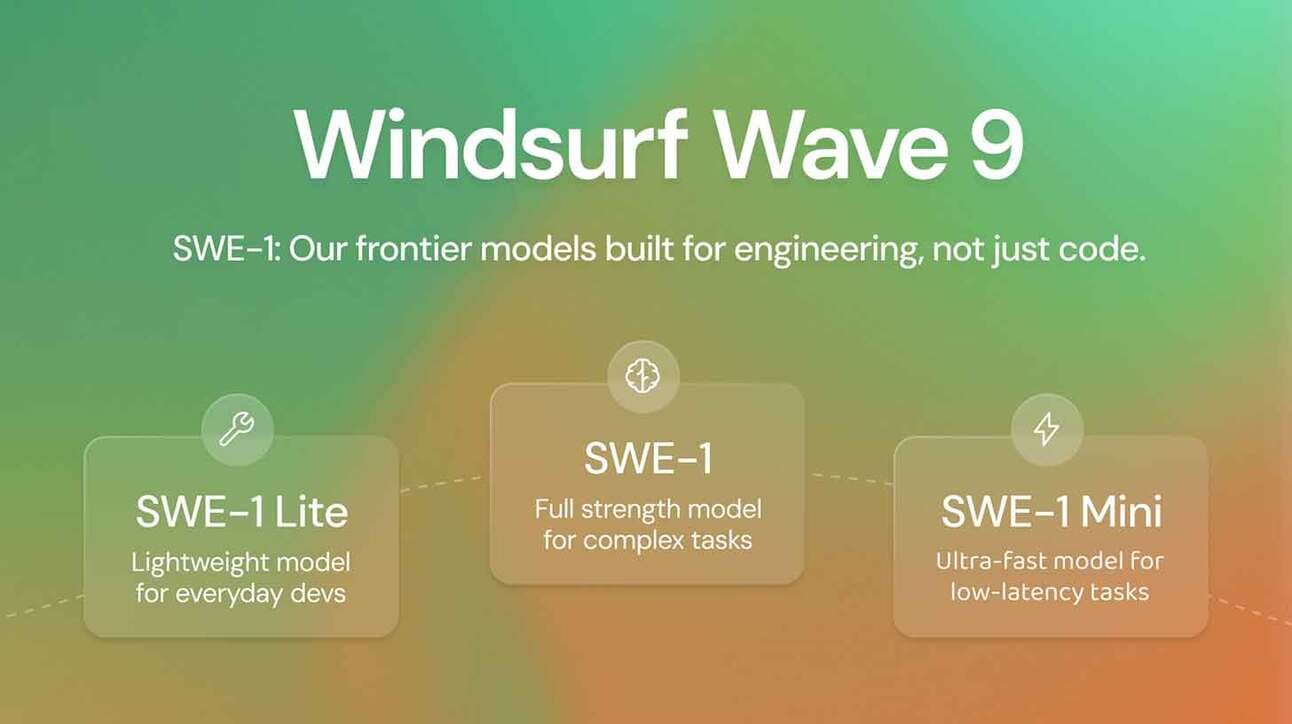
Image source: Windsurf
The Rundown: AI coding platform Windsurf just launched SWE-1, its first family of in-house AI models specifically designed to assist with the entire software engineering lifecycle — not just code generation.
The details:
The SWE-1 family includes three models: SWE-1 (full-size, for paid users), SWE-1-lite (replacing Cascade Base for all users), and SWE-1-mini.
Internal benchmarks show that SWE-1 outperforms all non-frontier and open weight models, sitting just behind models like Claude 3.7 Sonnet.
Unlike traditional models focused on code generation, Windsurf trained its SWE-1 to handle multiple surfaces, including editors, terminals, and browsers.
The models use a “flow awareness” system that creates a shared timeline between users and AI, allowing seamless handoffs in the development process.
Why it matters: While coding platforms like Windsurf have traditionally been application layers for third-party models, this in-house release is a big transition — and comes (likely strategically) just days after a reported $3B acquisition by OpenAI. With this impressive launch, there may be more to the deal than we initially thought.
TOGETHER WITH DYNAMIQ
🤖 Build a free AI agent with a ready-to-use chat UI

The Rundown: Dynamiq gets your AI agents into production within minutes with a pre-built web chat widget, helping you skip the lengthy setup process and go live fast.
Dynamiq’s developer-friendly platform lets you:
Build, test, deploy, and evaluate your first agent for free with no credit card needed
Connect your agent to an internal knowledge base from Google Drive, Dropbox, or other sources
Test and deploy instantly by copy-pasting a web-widget code snippet
POE
📊 Poe usage charts AI popularity shifts

Image source: Poe
The Rundown: AI platform Poe released its Spring 2025 Model Usage Trends report, revealing shifts in AI user preferences across text, reasoning, image, and video — with newer models quickly gaining traction while established players’ experience declines.
The details:
GPT-4.1 and Gemini 2.5 Pro captured 10% and 5% of message share within weeks of launch, while Claude saw a 10% decline in the same period.
Reasoning models surged from just 2% to 10% of all text messages since January, with Gemini 2.5 Pro making up nearly a third of the subcategory.
Image generation saw GPT-image-1 gain 17% usage, challenging leaders Black Forest Labs’ FLUX and Google’s Imagen3 family.
In the video segment, China’s Kling family became a top contender with ~30% usage right after release, while audio saw ElevenLabs’ domination with 80%.
Why it matters: These Poe usage trends offer a valuable real-world look at what models are preferred by users beyond typical benchmarks, while also showing how quickly preferences can shift with new releases. With models accelerating nearly every week, this list may look drastically different in just a few months.
AI TRAINING
📝 Automate Legal Document Analysis with Zapier

The Rundown: In this tutorial, you will learn how to build an automated system that analyzes legal documents uploaded to Google Drive, extracts key information, identifies potential concerns, and sends you a summary email.
Step-by-step:
Visit Zapier Agents, click the plus button, and create a “New Agent”
Configure your agent and set up Google Drive as a trigger for when new documents are added to a dedicated "Legal" folder
Add three tools: Google Drive to retrieve the file, ChatGPT to analyze the document and identify concerning clauses, and Gmail to send yourself a summary email
Test your agent with a sample document and toggle it “On” to activate
Note: Always make sure to double-check AI answers, as the AI agent might hallucinate or contain errors. Also, if you do not want to share sensitive information, you can hide/erase that sensitive data before uploading it to your Google Drive.
PRESENTED BY JACE
📬 AI that transforms your inbox experience

The Rundown: Jace AI is an executive assistant that drafts replies, schedules meetings, and manages tasks inside Gmail — helping you reclaim up to 2 hours every day.
This intelligent inbox assistant delivers:
Perfectly drafted replies waiting for you 24/7 in your authentic voice and tone
Customizable draft rules to ensure consistent communication
Smart integration with Slack, Notion, and your calendar for unified workflows
Custom AI labels that auto-organize your inbox to match your needs
Try Jace for free, then use code RUNDOWN for 20% off your first 3 months.
AI RESEARCH
😵💫 Study: LLMs struggle with back-and-forth chats
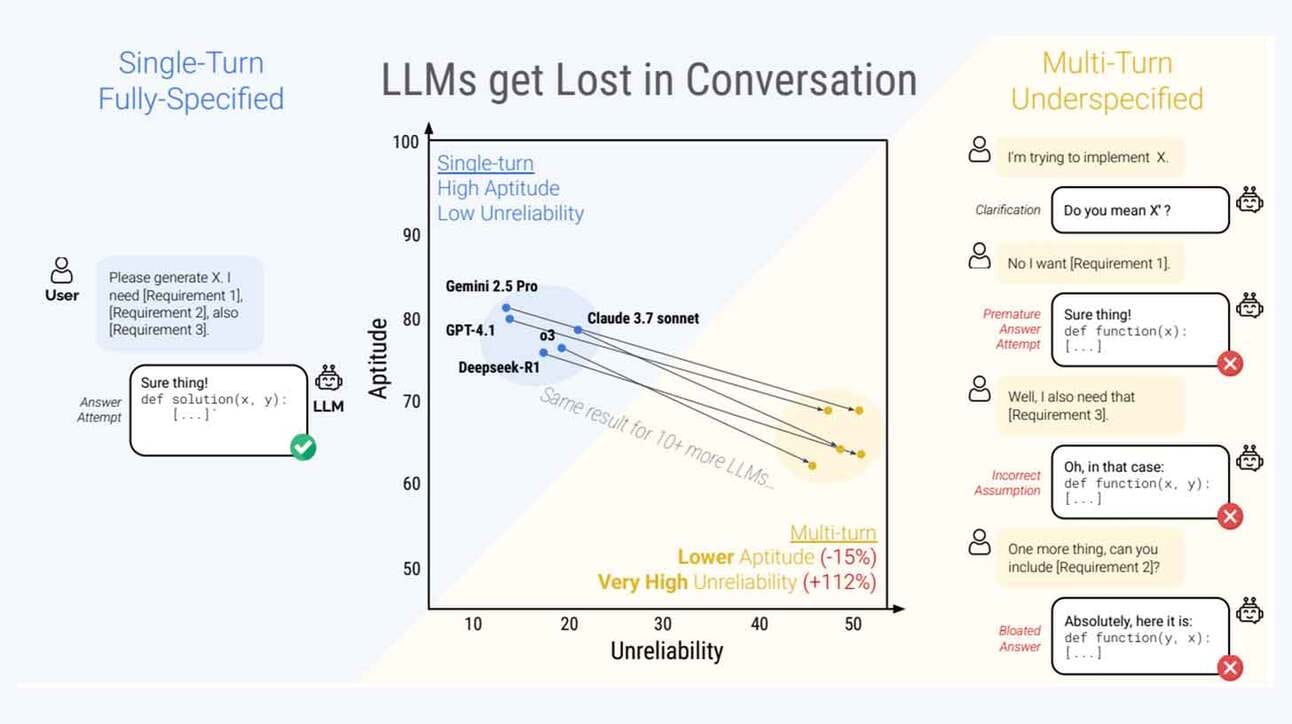
Image source: Microsoft and Salesforce Research
The Rundown: A new study from Microsoft and Salesforce researchers found that LLMs significantly underperform during multi-turn conversations where user instructions are gradually revealed, often getting “lost” and failing to recover.
The details:
Researchers tested 15 leading LLMs, including Claude 3.7 Sonnet, GPT-4.1, and Gemini 2.5 Pro, across six different generation tasks.
The study found that models achieved 90% success in single-turn settings, but fell to approximately 60% when the conversation lasted multiple turns.
Models tend to "get lost" by jumping to conclusions, trying solutions before gathering necessary info, and building on initial (often incorrect) responses.
Neither temperature changes nor reasoning models improved consistency in the multi-turn tests, with even top LLMs experiencing massive volatility.
Why it matters: This research exposes a major gap between how LLMs are typically evaluated versus how they're often used, showing that developers may need to put more of an emphasis on prioritizing reliability and context window management in back-and-forth conversations instead of one-and-done prompts.
QUICK HITS
🛠️ Trending AI Tools
🤖 xGen Small - Salesforce’s enterprise-ready compact LM
🧮 AlphaEvolve - AI coding agent making math and algorithmic discoveries
🎶 Stable Audio Open Small - Text-to-audio model for music samples
🧠 Psyche - Nous Research’s open, decentralized AI infrastructure
💼 AI Job Opportunities
🧑💼 Captions - Account Executive
📝 Harvey - Content Marketing Manager
🧠 Celestial AI - Package Layout Engineer
🤝 Grammarly - Lead Customer Success Manager
📰 Everything else in AI today
You.com announced that its ARI advanced research platform outperforms OpenAI’s Deep Research with a 76% win rate, also releasing new enterprise features.
Meta is reportedly pushing back the projected June launch timeline for its Llama Behemoth model to the Fall due to a lack of significant improvement.
OpenAI launched its "OpenAI to Z Challenge," inviting participants to use its models to help uncover archaeological sites in the Amazon rainforest for a $250k prize.
Salesforce is acquiring AI agent startup Convergence AI, with plans to integrate the team and tech into its Agentforce platform.
Intelligent Internet released II-Medical-9B, a small medical-focused model with performance comparable to GPT 4.5 while running locally with no inference cost.
Manus AI introduced image generation, allowing the agentic AI to accomplish visual tasks with step-by-step planning.
COMMUNITY
🎥 Join our next live workshop

Join our next workshop today at 4 PM EST with Dr. Alvaro Cintas, The Rundown’s AI professor. By the end of the workshop, you’ll confidently understand how to design, build, and deploy your own AI systems using OpenAI’s Agents SDK.
RSVP here. Not a member? Join The Rundown University on a 14-day free trial.
See you soon,
Rowan, Joey, Zach, Alvaro, and Jason—The Rundown’s editorial team

A brainless bot that runs on air
Read Online | Sign Up | Advertise
Good morning, robotics enthusiasts. Dutch scientists just created a soft robot that moves, adapts, and even swims—entirely powered by air, with no electronics or brains involved.
Its unlikely inspiration? The wobbly physics of those inflatable dancing tube men outside car dealerships. As robotics trends toward even greater complexity, could this radically simple approach open up a new world of possibilities in the field?
In today’s robotics rundown:
This brainless soft robot runs on air
Robot smashes Rubik’s Cube world record
UN aims to regulate ‘killer robots’ by 2026
A Star Wars droid that hauls your groceries
Quick hits on other robotics news
LATEST DEVELOPMENTS
AMOLF
🎈This brainless soft robot runs on air

Image source: AMOLF
The Rundown: A team at Amsterdam's AMOLF research institute just created a soft-bodied robot that moves, adapts, and even swims — powered entirely by air, without any brain, electronics, or even a single line of code.
The details:
The robot is made from soft, flexible elastomer tubes that serve as both structure and actuator, allowing for gentle, adaptive movement.
A continuous flow of air causes its tubes to inflate and oscillate, which eliminates the need for motors or electronics for movement.
When the robot’s legs are linked, their oscillations naturally sync through mechanical coupling, resulting in coordinated gaits without central control.
And when it encounters obstacles, it reorients itself and keeps moving — also seamlessly shifting from a hopping gait on land to swimming in water.
Why it matters: This robot is remarkably fast, versatile, and adaptable, thanks to its decentralized “mechanical intelligence.” When its air-powered legs are linked, their movements spontaneously sync, turning chaotic flailing into coordinated gaits. It’s a seamless interplay of physics and clever design — no computation required.
PURDUE UNIVERSITY
🤖 Robot smashes Rubik’s Cube world record

Image source: Purdue University
The Rundown: Purdue University undergrads built a robot that solves the Rubik’s Cube in 0.103 seconds, less than the blink of an eye. Dubbed “Purdubik’s Cube,” the bot set a Guinness World Record, 3x faster than the previous record by Mitsubishi.
The details:
Purdubik’s Cube features a sturdy mechanical frame that holds a Rubik’s Cube in place with six motorized actuators that rapidly twist the cube’s faces.
It integrates industrial-grade motion control hardware from Kollmorgen, enabling fast and finely tuned movements.
This setup is paired with high-speed machine vision cameras that instantly recognize the cube’s color pattern to compute the solution in real time.
A Bluetooth-enabled Smart Cube lets users scramble the puzzle interactively; then the robot mirrors these moves and solves the cube instantly.
Why it matters: One of the coolest aspects of this is that the robot was built by a team of undergrads on their own, with their robot three times faster than Mitsubishi Electric’s — and 30x faster than the quickest human. Interestingly, the students say the biggest limitation is the cube itself, which can completely disintegrate at blistering speeds.
UNITED NATIONS
🇺🇳 UN aims to regulate ‘killer robots’ by 2026

Image source: U.S. Department of Defense
The Rundown: This week, the United Nations convened a high-stakes summit in New York, spotlighting the urgent need to establish international guardrails for “killer robots” before they become an uncontrollable force in modern warfare.
The details:
The discussions were driven by the rise in AI-enabled autonomous weapons used in Ukraine, Russia, and Gaza.
Despite the rapid growth of drones and unmanned ground vehicles, there is still no comprehensive international treaty governing their deployment.
UN Secretary-General Antonio Guterres has set a 2026 deadline to create new regulations to curb the unchecked spread of autonomous weapons.
Major military powers—including the U.S., Russia, China, and India—have resisted binding international rules, preferring national guidelines.
Why it matters: Efforts to regulate autonomous weapons have stalled for years due to conflicting national interests, with major military powers resisting in favor of national guidelines. But advocates warn that without oversight, autonomous weapons risk violating fundamental human rights and fueling a global AI arms race.
PIAGGIO FAST FORWARD
🎒 A Star Wars droid that hauls your groceries

Image source: Piaggio Fast Forward
The Rundown: Boston-based robotics firm Piaggio Fast Forward released a Star Wars-inspired cargo droid — dubbed G1T4-M1N1 — that can follow you around while carrying up to 20 lbs of groceries or gear.
The details:
Piaggio Fast Forward partnered with Disney and Lucasfilm to create the special edition Star Wars-inspired droid.
The two-wheeled robot comes with a cooler-like body for hauling gear and features 22 custom Star Wars droid sounds and visual clues.
The company says a suite of cameras and sensors enables it to identify and follow its owner with uncanny precision, adjusting its speed to match your pace.
Priced at $2,875, the robot offers 21 miles of range and advanced autonomous navigation, even on bustling sidewalks and in tight spaces.
Why it matters: While Piaggio Fast Forward stands out for its consumer-oriented robots like Gitamini and Gitaplus (specifically built for personal use), rivals like Boston Dynamics focus more on industrial applications. Plus, with a runtime of 7 hours, this bot is more than a novelty and serves as a genuinely useful sidekick for errands.
QUICK HITS
📰 Everything else in robotics today
DHL Group, a global leader in logistics, is expanding its partnership with Boston Dynamics by committing to deploying more than 1K Stretch robots by 2030.
Elon Musk shared a “real real-time” 60-second video of Tesla’s Optimus humanoid performing impressive dance moves, which quickly went viral.
Houston-based Persona AI, founded by former Figure CTO Jerry Pratt, raised $27M in a pre-seed funding round to deliver its humanoids, with valuation undisclosed.
Pony AI, a Guangzhou-based autonomous driving startup, filed for a Hong Kong listing less than a year after its $413M U.S. IPO, causing its shares to surge over 16%.
Open AI CEO Sam Altman predicts that agents will start coding this year, make major scientific discoveries in 2026, and enter the physical realm by 2027.
Uber CEO Dara Khosrowshahi announced at the Saudi-US Investment Forum 2025 that the company plans to introduce autonomous vehicles in Saudi Arabia this year.
Chinese tech giant Baidu reportedly plans to launch robotaxis in Europe and is establishing a local entity in Switzerland to begin testing robotaxis there this year.
China’s Wuhan University developed a bionic robotic fish that is now deployed in the Yangtze River to collect ecological data.
Waymo, a subsidiary of Alphabet, updated its 1,212 self-driving vehicles recalled this week due to a software glitch that led to minor collisions with roadway barriers.
Research firm Interact Analysis predicts that humanoid adoption will be slow, reaching over 40K units by 2032 with a total market revenue of about $2B.
DiffuseDrive, a Hungarian-funded generative AI startup, raised $3.5M in seed funding to scale its data-generation platform, promising photorealistic training content.
COMMUNITY
🎥 Join our next live workshop
Join our next workshop this Friday, May 16th, at 4 PM EST with Dr. Alvaro Cintas, The Rundown’s AI professor. By the end of the workshop, you’ll confidently understand how to design, build, and deploy your own AI systems using OpenAI’s Agents SDK.
RSVP here. Not a member? Join The Rundown University on a 14-day free trial.
See you soon,
Rowan, Jennifer, and Joey—The Rundown’s editorial team

AI discovers new math algorithms
Read Online | Sign Up | Advertise

Good morning, AI enthusiasts. The race to achieve AI that makes genuine scientific breakthroughs just hit a milestone — with DeepMind's AlphaEvolve discovering new math solutions that have eluded humans since the 1960s.
By harnessing Gemini's language capabilities within an evolutionary framework, this AI coding agent isn't just theoretically impressive — it's already optimizing Google's data centers and accelerating the very systems that power it.
In today’s AI rundown:
Google’s AlphaEvolve discovers math breakthroughs
Anthropic set to launch new Sonnet, Opus models
Transform text into polished PDFs instantly
OpenAI’s new Safety Evaluations dashboard
4 new AI tools & 4 job opportunities
LATEST DEVELOPMENTS
🔬 Google’s AlphaEvolve discovers math breakthroughs

Image source: o3 / The Rundown
The Rundown: Google just debuted AlphaEvolve, a coding agent that harnesses Gemini and evolutionary strategies to craft algorithms for scientific and computational challenges — driving efficiency inside Google and solving historic math problems.
The details:
AlphaEvolve uses a mix of Gemini models (Flash for idea generation, Pro for analysis) to create code, which is tested by evaluators and evolved iteratively.
The system has already made several mathematical discoveries, including finding the first improvement on Strassen's algorithm from 1969.
It is also boosting efficiency for Google, optimizing data center scheduling, improving AI training (including its own), and helping with chip design.
When tested on 50+ open math problems, it matched SOTA solutions in 75% and discovered entirely new, improved solutions in another 20%.
Why it matters: Yesterday, we had OpenAI’s Jakub Pachocki saying AI has shown “significant evidence” of being capable of novel insights, and today Google has taken that a step further. Math plays a role in nearly every aspect of life, and AI’s pattern and algorithmic strengths look ready to uncover a whole new world of scientific discovery.
TOGETHER WITH ENCORD
📶 World models unleash multimodal AI's true potential

The Rundown: Encord consolidates multimodal AI data management, curation, and annotation pipelines to one single platform — helping teams accelerate model iteration cycles by using an agentic AI data workflow system to prepare balanced, accurately labeled datasets 10x faster.
Join the Encord ML team on May 22 for a demo-focused webinar where you’ll learn to:
Use world models to build agents that adapt and reason across multimodal contexts
Identify and supervise edge-case behavior within petabyte-scale real-world sensor data
Create high-quality datasets powering VLAs for robotics, ADAS, and more
ANTHROPIC
🚀 Anthropic set to launch new Sonnet, Opus models

Image source: Anthropic
The Rundown: Anthropic is reportedly preparing to launch advanced versions of Claude’s Sonnet and Opus models in the “upcoming weeks,” featuring hybrid thinking and expanded tool use capabilities.
The details:
The models are reportedly capable of alternating between reasoning and tool use, and can self-correct by stepping back to examine what went wrong.
For coding, the models can test their generated code, ID errors, troubleshoot with reasoning, and make corrections without requiring human intervention.
An Anthropic model, codenamed Neptune, is undergoing safety testing, with some believing the name hints at a 3.8 (8th planet from the sun) release.
The news coincides with Anthropic launching a new bug bounty program focused on testing Claude’s principles on safety measures.
Why it matters: While Anthropic has been in the mix with Google and OpenAI for the top model in the industry, the company has been much slower to bring new ones to market — with 3.7 Sonnet in February marking its only release in 2025. With both other rivals also likely releasing upgrades soon, we could be in for a wild few months.
AI TRAINING
📄 Transform text into polished PDFs instantly

The Rundown: In this tutorial, you will learn how to use Grok's new PDF rendering feature to create professional-looking documents directly from prompts — with instant previews and editing capabilities.
Step-by-step:
Visit Grok from your computer browser to access the main chat.
Write a detailed prompt describing the document you need (resume, literature review for a research paper, or invoices).
Review the preview and refine your document using follow-up prompts or by editing the LaTeX code directly through the Code button.
Download your finalized PDF using the download button.
Pro tip: For LaTeX research papers, remember to save both the PDF and source code for future editing or journal submissions that require the original LaTeX files!
PRESENTED BY HACKERRANK
⚙️ Custom training data for the SDLC

The Rundown: Struggling to source high-quality data for your AI models? HackerRank now delivers custom datasets designed by the experts who test millions of human developers every year.
With HackerRank, you can:
Curate a custom dataset on specific software development skills
Access a workforce of development experts for data labelling and annotation
Request an evaluation dataset to test your model’s performance
OPENAI
🔍 OpenAI’s new Safety Evaluations dashboard

Image source: OpenAI
The Rundown: OpenAI launched a new Safety Evaluations Hub that will publicly and regularly display test results for its AI models, showing how they perform on metrics like harmful content generation, hallucination rates, and jailbreak attempts.
The details:
The hub shows comparative performance data across OAI models, including metrics for refusing harmful content and accuracy on factual questions.
The dashboard currently focuses on four categories: harmful content, jailbreak vulnerability, hallucination rates, and adherence to instruction hierarchy.
OpenAI promises to update the page "periodically" as part of what it calls a company-wide effort to communicate more proactively about AI safety.
The release comes after critiques that the company is not transparent with safety testing, and following issues with a recent rollout of a GPT 4o update.
Why it matters: With labs racing to push out models to keep pace with rivals, many believe safety has been taking a backseat to speed. This is a great step towards more transparency, but it will be relying on OpenAI to self-report and continually update the data — which likely won’t completely satisfy those calling for stricter safety measures.
QUICK HITS
🛠️ Trending AI Tools
🔌 Gemini Advanced - Connect Google’s advanced assistant to GitHub repos
🤖 GPT 4.1 - OpenAI’s advanced coding model, now available in ChatGPT
🤳 TikTok AI Alive - Turn static images into dynamic videos for TikTok Stories
🐰 CodeRabbit - AI code reviews directly in Cursor, Windsurf, and VSCode
💼 AI Job Opportunities
🎨 The Rundown - Designer (Brand & Platform)
🧪 Writer - AI Researcher
⚙️ OpenAI - Software Engineer, Inference
💻 Siena - Senior Fullstack Engineer
📰 Everything else in AI today
OpenAI added GPT 4.1 and GPT 4.1-mini coding-focused models to ChatGPT, now available to both free and paid users.
Stability AI open-sourced Stable Audio Open Small, a text-to-audio model for generating music samples, capable of running on consumer devices with no internet.
Perplexity and PayPal announced a new partnership, allowing users to check out with both PayPal and Venmo when making purchases on the AI platform.
Meta’s released science research, including the Open Molecules 2025 dataset, the Universal Model for Atoms, and a study on language development and AI training.
NVIDIA is securing AI chip deals in the Middle East, supplying Saudi Arabia’s Humain and the UAE after meetings with the Trump admin and other regional leaders.
Nous research launched Psyche, a new open, decentralized AI infrastructure that allows individuals to pool compute to train models without massive investment costs.
Klarna CEO Sebastian Siemiatkowski revealed the fintech giant cut 40% of its workforce due to AI, but now plans to hire human agents after a hit on work quality.
COMMUNITY
🎥 Join our next live workshop
Join our next workshop this Friday, May 16th, at 4 PM EST with Dr. Alvaro Cintas, The Rundown’s AI professor. By the end of the workshop, you’ll confidently understand how to design, build, and deploy your own AI systems using OpenAI’s Agents SDK.
RSVP here. Not a member? Join The Rundown University on a 14-day free trial.
🤝 Share The Rundown, get rewards
We’ll always keep this newsletter 100% free. To support our work, consider sharing The Rundown with your friends, and we’ll send you more free goodies.
See you soon,
Rowan, Joey, Zach, Alvaro, and Jason—The Rundown’s editorial team
Google's Gemini AI expands across devices
Read Online | Sign Up | Advertise

Good morning, AI enthusiasts. The AI assistant battle is moving far beyond the smartphone — with Google announcing Gemini's arrival on watches, TVs, cars, and XR headsets.
As the tech giant races to create a consistent AI layer across our digital lives, will this ecosystem play finally give Google the edge it needs against increasingly powerful rivals?
Reminder: Our next workshop with Julius AI is today at 3 PM EST. Attend and learn how to analyze any dataset using just natural language, no code or spreadsheets required! RSVP here.
In today’s AI rundown:
Google’s Gemini AI on cars, TVs, and watches
OpenAI's chief scientist: AI can drive novel research
How to connect AI coding apps with Zapier’s MCP
Trump admin scraps Biden-era AI chip controls
4 new AI tools & 4 job opportunities
LATEST DEVELOPMENTS
🚘 Google’s Gemini AI on cars, TVs, and watches

Image source: Google
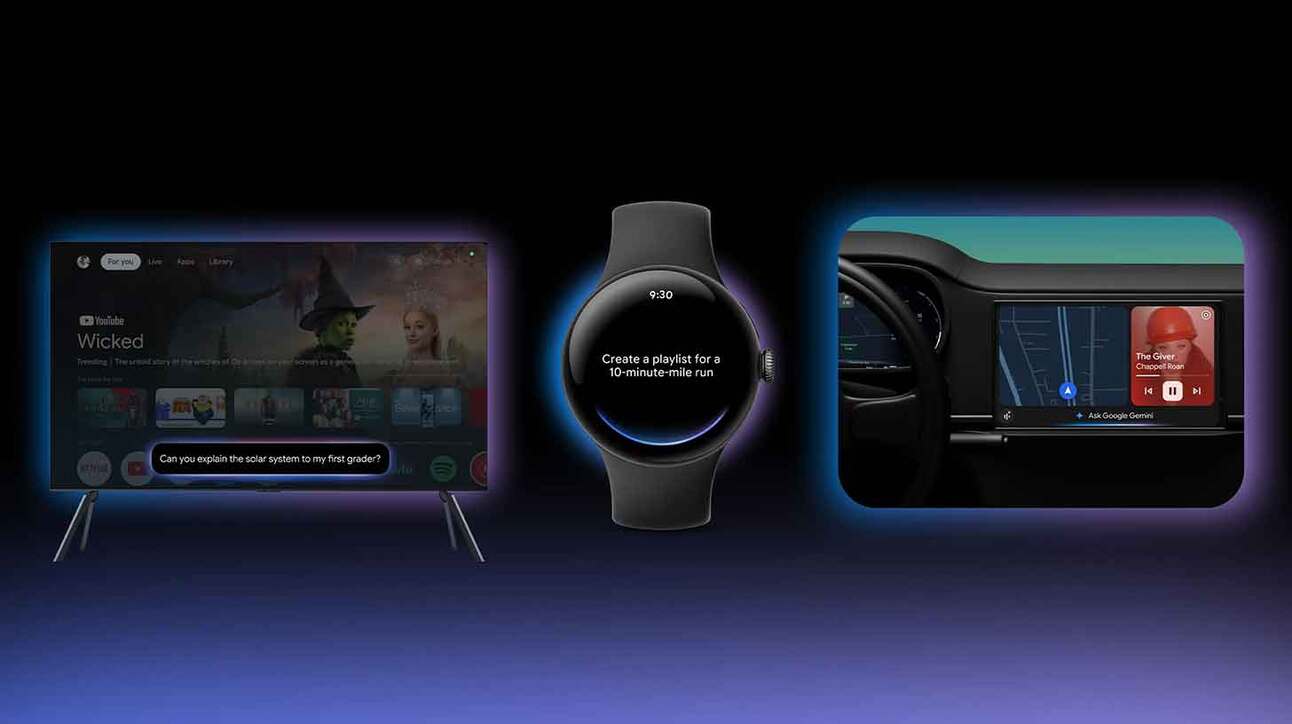
The Rundown: Google just announced a major expansion of its AI assistant, with plans to bring Gemini to more Android devices and platforms like smartwatches, TVs, cars, and upcoming XR headsets.
The details:
Gemini will arrive on Wear OS smartwatches "in the coming months," allowing users to interact with the assistant naturally through voice.
The assistant is also coming to Google TV later this year, with the ability to recommend content and answer educational questions.
Android Auto will receive a Gemini integration, with the AI bringing the ability to manage in-car requests like finding destinations or reading texts and emails.
Finally, Google’s upcoming Android XR headset will also feature Gemini, creating immersive experiences with a ready-to-use multimodal assistant.
Why it matters: Despite the rise and massive acceleration of LLMs, the move to infuse consumer products with advanced AI has been slow to gain traction (looking at you, Apple). With Gemini now set to integrate across a range of Android products, the powerful model is positioning itself as the consistent AI layer connecting all devices.
TOGETHER WITH RECRAFT
🎨 Turn imagination into brand‑perfect visuals

The Rundown: Recraft's AI-powered design platform now includes Advanced Style Creation and Control, a new feature set designed to give creative teams more power to explore, define, and maintain a distinct brand style.
With this update, you can:
Explore limitless styles with the infinite style library
Remix styles to create something uniquely yours
Reuse and share styles to stay consistent across teams
Try the new features for free and unlock the full potential for $1 with our code RUNDOWN.
OPENAI
🧠 OpenAI's chief scientist: AI can drive novel research

Image source: OpenAI
The Rundown: OpenAI's chief scientist, Jakub Pachocki, just revealed his vision for AI’s near future in an interview with Nature, hitting on topics including AI’s ability to conduct scientific research, the company’s open-source model, AGI, and more.
The details:
Pachocki said we have “significant evidence that models are capable of discovering novel insights,” but AI’s reasoning is different from that of humans.
He said that AI creating a “measurable economic impact” and novel research would satisfy his AGI definition, which he expects by the end of the decade.
OpenAI is preparing to release its first open-weight model since GPT-2, with Pachocki saying he wants it to be better than other available open models.
Why it matters: Pachocki’s AGI milestones already feel closer than his estimate, but more important are his thoughts on the evidence of AI being capable of new insights. AI has already started transforming traditional work and life — but systems that can create new scientific research will take us into truly uncharted territory for acceleration.
AI TRAINING
🔌 How to connect AI coding apps with Zapier’s MCP

The Rundown: In this tutorial, you’ll learn how to use Zapier MCP to connect your AI coding assistants — like Cursor, Claude, or Windsurf — with 7,000+ apps, enabling an easy way to manage emails, access docs, and automate tasks without leaving the IDE.
Step-by-step:
Visit the Zapier MCP website and click “New MCP Server” to create your connection hub.
Select your AI assistant from the dropdown menu (Cursor, Claude, Windsurf, etc.).
Add the apps you want to integrate by clicking “Add tool” and authorizing access.
Connect your AI assistant by adding the Zapier MCP configuration to your tool's settings.
Pro tip: Try simple commands first, like “draft an email to the team about project updates” or “check my calendar for tomorrow's meetings” directly from your coding environment!
PRESENTED BY CONVEYOR
🛡️ Got Sue? The AI Agent for customer trust

The Rundown: Most vendors building with AI talk a big game. Sue, Conveyor’s AI Agent for Customer Trust, actually does the work — deploying across F1000 enterprises and leading tech companies to fully run customer security reviews, skip busywork, and keep deals moving with no headaches or delays.
Sue, the AI Agent, can:
Manage customer security requests seamlessly across teams and tools
Handle any questionnaire format
Automatically complete, reject, or escalate questionnaires
Personalize your Conveyor Trust Center with data from conversation intelligence tools
Learn more and integrate Sue into your infosec and sales workflow today.
AI REGULATIONS
🏛️ Trump admin scraps Biden-era AI chip controls

Image source: Reve / The Rundown
The Rundown: The Trump administration rescinded a Biden-era rule that would have imposed controls on semiconductor export worldwide, opting instead to develop an approach focused on country-specific agreements while keeping restrictions on China.
The details:
The Commerce Dept. announced the cancellation just days before the rule was set to take effect, saying it would hurt innovation and diplomatic relations.
The new guidance also explicitly states that using Huawei's Ascend AI chips anywhere globally is now considered a violation of U.S. export controls.
The administration plans to develop replacement regulations, with Bloomberg reporting a potential shift toward a country-by-country negotiation approach.
The move comes as President Trump and tech leaders gather in the Middle East, with the UAE announcing partnerships and investments in the sector.
Why it matters: The U.S. has aligned with tech giants under the new administration, and this is a move heavily lobbied for by the kingmakers of the industry. A new structure could boost commercial interests, but may also create a complex landscape where diplomatic relations and investments define a nation's access to AI resources.
QUICK HITS
🛠️ Trending AI Tools
💰 Taka - Your AI Personal CFO. Ask any personal finance question and make confident decisions with a self-building canvas tailored to you*
🎨 Dream-O - ByteDance’s new image customization model
⚒ LegoGPT - Create stable, buildable LEGO designs from text prompts
📚 Deep Research - Connect OpenAI’s research tool to Sharepoint, OneDrive
* Sponsored Listing
📰 Everything else in AI today
Google is reportedly set to reveal a new software development AI agent at I/O 2025, described as an "always-on coworker" that can handle the entire development lifecycle.
TikTok launched AI Alive, a new tool that allows users to turn static photos into short-form videos directly in its TikTok Stories platform.
Notion released AI for Work, a suite of new integrated AI features including AI Meeting Notes, Enterprise Search, Research Mode, and more.
New research from nonprofit Epoch AI predicts that the scaling of reasoning models may slow significantly as soon as 2026.
Elon Musk spoke at the Saudi-U.S. investment forum, saying AI and robotics will lead to “universal high income”, where “anyone can have any goods or services they want.”
Microsoft researchers unveiled ADeLe, a new AI evaluation framework that measures how difficult a task is for an AI model and can accurately predict success or failure.
COMMUNITY
🎥 Join our next live workshop

Join our next workshop today at 3 PM EST with Rahul Sonwalkar, founder of Julius AI. In this hands-on live session, you’ll learn how to analyze any dataset using just natural language, no code or spreadsheets required.
RSVP here. Not a member? Join The Rundown University on a 14-day free trial.
🤝 Share The Rundown, get rewards
We’ll always keep this newsletter 100% free. To support our work, consider sharing The Rundown with your friends, and we’ll send you more free goodies.
See you soon,
Rowan, Joey, Zach, Alvaro, and Jason—The Rundown’s editorial team
No matching search results
Try using different keywords, double-check your spelling, or explore related categories.
Stay Ahead on AI.
Join 2,000,000+ readers getting bite-size AI news updates straight to their inbox every morning with The Rundown AI newsletter. It's 100% free.