Get the latest AI news, understand why it matters, and learn how to apply it in your work — all in just 5 minutes a day. Join over 2,000,000+ subscribers.

'It's not Theranos 2.0'
Read Online | Sign Up | Advertise

Good morning, tech enthusiasts. Billy Evans, partner of incarcerated Theranos founder Elizabeth Holmes, has reportedly raised millions for a new blood-testing health startup called Haemanthus.
While Evans says that Holmes has no involvement, the stealth startup claims to have developed a cutting-edge device that uses lasers and AI to analyze blood, saliva, and urine samples for early cancer detection. Déjà vu, anyone?
In today’s tech rundown:
Elizabeth Holmes’ partner launches health startup
Perplexity eyes $14B valuation with fresh funding
United flights get high-speed Starlink WiFi
Scientists find electricity-conducting bacteria
Quick hits on other major news
LATEST DEVELOPMENTS
HAEMANTHUS
🩸 Elizabeth Holmes’ partner launches health startup

Image source: Photo by Glenn Fawcett/Wikimedia Commons
The Rundown: Billy Evans—the partner of incarcerated Theranos founder Elizabeth Holmes—has stepped into the health tech arena with his own blood-testing startup named “Haemanthus.”
The details:
Haemanthus has reportedly raised millions from investors and is pitching itself as a departure from the ill-fated Theranos model.
Evans claims the company is leveraging AI-powered photonics to analyze blood, saliva, and urine for early disease detection, including cancer.
The startup has also secured a patent for its Raman spectroscopy system, which guides AI sensors to interpret molecular patterns in biological fluids.
Its prototype is a small, rectangular box with a door and digital display, bearing a notable resemblance to the infamous Theranos machine.
Why it matters: The startup’s pitch—promising a new era of health optimization—has already drawn both investor interest and skepticism, as the specter of Theranos looms large over any attempt to revolutionize blood testing. Still, Evans emphasizes that Holmes, serving 11 years for fraud, has "zero involvement" in the company.
PERPLEXITY
🔥 Perplexity eyes $14B valuation with fresh funding

Image source: Photo by Kimberly White/Getty Images for TechCrunch/Wikimedia Commons
The Rundown: Perplexity AI, the fast-growing startup taking on industry giants with AI search, is reportedly in advanced talks to raise $500M in a funding round that would value the company at a staggering $14B.
The details:
The round, expected to be led by venture capital firm Accel, marks a big jump from Perplexity’s $9B valuation in December 2024.
The startup initially aimed for a higher raise, going up to $1B at an $18B valuation, but settled for a lower amount and valuation after negotiations.
Notably, the surge in Perplexity’s value comes on the heels of extraordinary growth, with its annual recurring revenue approaching $100M in March 2025.
The company’s AI platform has been competing directly with Google and OpenAI, offering conversational, citation-rich answers to users’ search queries.
Why it matters: AI chatbots are radically changing the search landscape, and Perplexity is positioning itself as a major player in the category. Backed by Nvidia, Jeff Bezos, and SoftBank, the startup’s new funding is expected to fuel new products, user growth, and potential integration with platforms like Apple’s Safari.
STARLINK
✈️ United flights get high-speed Starlink WiFi

Image source: United Airlines
The Rundown: United Airlines is all set to roll out Starlink WiFi across its regional fleet, marking the largest airline deal of its kind for Starlink and revolutionizing the in-flight experience for passengers.
The details:
Passengers can expect WiFi speeds up to 250 Mbps, 50x faster than previous connections, and low-latency streaming, gaming, and calls at high altitudes.
The service is available gate-to-gate, meaning passengers can connect as soon as they board and stay online until they disembark.
It officially launches on May 15, beginning with Embraer E175 aircraft, and is free for all MileagePlus loyalty members.
Forecasts predict Starlink could claim a 39% share of the commercial aviation in-flight connectivity market by 2034, going ahead of rival Viasat.
Why it matters: While Air France and Qatar Airways have already begun adopting Starlink, United is the first U.S. airline to roll it out— potentially setting a new standard for in-flight connectivity. Starlink’s lightweight hardware also enables faster installation across fleets, helping eliminate the slow connections passengers have long endured.
OREGON STATE UNIVERSITY
⚡️Scientists find electricity-conducting bacteria

Image source: Oregon State University
The Rundown: Oregon State University scientists just discovered a new species of bacteria with a remarkable ability: it can conduct electricity, functioning much like natural electrical wiring, opening up new possibilities in tech.
The details:
Wired reports that the bacteria weave themselves into microscopic filaments capable of conducting electricity across surprisingly long distances.
Unlike most microbes, which shuffle electrons internally, these newly discovered bacteria form living chains that act as natural electrical wiring.
Researchers, using advanced electron microscopy and electrochemical analysis, observed these bacterial “cables” bridging gaps in sediment.
Their conductive properties have potential applications in bioelectronics, such as developing microbial fuel cells that generate electricity from waste.
Why it matters: Scientists envision new bioelectronic devices that could revolutionize renewable energy and environmental cleanup, like living wires that detoxify polluted soils by channeling electrons to break down contaminants. While these are still early days, this research hints at a future where biology and tech are seamlessly intertwined.
QUICK HITS
📰 Everything else in tech today
Apple is reportedly considering price increases for its new iPhone lineup, but wants to attribute the increase to new features rather than Chinese tariffs.
Mexico filed a lawsuit against Google over the company’s decision to label the Gulf of Mexico as the "Gulf of America" on its mapping services for U.S. users.
Google agreed to pay $1.4B to Texas to settle two lawsuits alleging that the company violated residents’ privacy by tracking personal data without consent.
EV startup Slate Auto reportedly tallied up more than 100K reservations in two weeks for its customizable low-cost electric pickup truck.
Polish startup Volonaut released a buzzy new video of its Airbike, a jet-powered hoverbike designed to carry one person at speeds up to 124mph.
France is pushing for a Europe-wide ban on social media for kids under the age of 15, with its minister for digital affairs leading the initiative.
Carnegie Mellon researchers published a study on LegoGPT, an AI system that can create stable, buildable LEGO structures from text prompts.
Rippling, an HR software company, secured $450M in Series G funding, raising its valuation to $16.8B amid ongoing legal disputes with rival firm Deel.
COMMUNITY
🎥 Join our next live workshop

Join our next workshop on Tuesday, May 14th at 3 PM EST with Rahul Sonwalkar, founder of Julius AI. In this hands-on live session, you’ll learn how to analyze any dataset using just natural language, no code or spreadsheets required.
RSVP here. Not a member? Join The Rundown University on a 14-day free trial.
See you soon,
Rowan, Jennifer, and Joey—The Rundown’s editorial team

AI predicts cancer outcomes from selfies
Read Online | Sign Up | Advertise

Good morning, AI enthusiasts. The saying "you can tell a lot from someone's face" just got AI validation, with a new system accurately predicting cancer survival from facial photos alone.
Mass General’s FaceAge AI just converted looks into a valuable medical biomarker — and your face may be about to become your doctor's newest diagnostic tool.
In today’s AI rundown:
AI predicts cancer outcomes from photos
Sakana teaches AI to think with time
Transform videos into content gold mines
OpenAI’s HealthBench to evaluate healthcare AI
4 new AI tools & 4 job opportunities
LATEST DEVELOPMENTS
AI RESEARCH
🧓 AI predicts cancer outcomes from photos

Image source: Mass General Brigham
The Rundown: Mass General Brigham’s researchers just introduced FaceAge, an AI tool that can estimate a person's biological age and improve cancer survival outcome predictions simply by analyzing their facial photograph.
The details:
FaceAge uses a system trained on tens of thousands of face photos to translate subtle facial characteristics into a biological age estimate.
The study found that cancer patients, on average, appeared about 5 years older, with a higher FaceAge correlating with worse survival rates.
In physician testing, doctors showed significant improvement in accuracy when predicting 6-month survival when adding FaceAge risk scores to clinical data.
The AI’s predictions correlated with a gene associated with cellular aging, suggesting FaceAge captured processes not detected by chronological age.
Why it matters: While we're taught not to judge books by covers, our faces may actually reveal crucial health insights. By quantifying what physicians have intuitively observed for decades, this tech turns facial characteristics into actionable biomarkers that may help doctors personalize treatments more precisely than ever before.
TOGETHER WITH HUBSPOT
⛏️ The AI gold rush: Are you in or out?

The Rundown: HubSpot’s “AI For Business Builders” free guide shows you how to join the savvy entrepreneurs quietly leveraging artificial intelligence for real business growth — with no P.H.D. needed.
This no-BS guide cuts through the hype, giving you:
A jargon-free breakdown of large language models (the engine behind AI's magic)
Concrete steps to leverage AI for immediate business growth
Real-world examples that turn "prompt engineering" from gibberish into a secret weapon
SAKANA AI
🧠 Sakana teaches AI to think with time

Image source: Sakana AI
The Rundown: Sakana AI unveiled Continuous Thought Machines (CTMs), a new type of model that makes AI more brain-like by allowing it to “think” step-by-step over time instead of making instant decisions like current AI systems do.
The details:
Unlike most AI that processes information in a static, one-shot way, the CTM considers how its internal activity unfolds over time, much like our brains do.
The tech draws inspiration from real brains, where the timing of when neurons activate together is crucial for intelligence.
Sakana demoed the CTM solving complex mazes, showing the model visibly tracing possible paths through the maze as it thinks.
Another example tackled image recognition, with a CTM viewing different parts of an image and spending more time based on the difficulty of the task.
Why it matters: Sakana is a unique AI startup in its mission to bring ‘nature-inspired’ methods to AI models, and these CTMs provide a differentiator that could help bring the flexibility and adaptability of human brains to advanced systems — leading to AI that reasons, learns, and solves problems in a more human-like fashion.
AI TRAINING
🎥 Transform videos into content gold mines

The Rundown: In this tutorial, you will learn how to use Google's NotebookLM to upload and analyze your videos and generate transcripts, title ideas, hooks, and descriptions to improve your content creation workflow.
Step-by-step:
Visit NotebookLM and sign in with your Google account, then click “Create new” to start a fresh notebook.
Add your video in the Sources panel by uploading your file or connecting to YouTube.
Generate a transcript by typing prompts like “Provide a complete transcript” or “Translate the transcript to Spanish.”
Improve your content by asking for “10 better hooks,” “5 YouTube title ideas,” or “YouTube description with relevant tags.”
Pro tip: You can also upload multiple videos with stats and ask NotebookLM to analyze which content style performed best to gain insights for future content strategy.
PRESENTED BY INNOVATING WITH AI
🚀 Launch a six‑figure AI consultancy in six months

The Rundown: Innovating With AI’s “The AI Consultancy Project” gives you the frameworks, playbooks, and client‑ready templates needed to turn “interesting AI ideas” into a revenue‑generating business – helping you ride the wave of an AI consulting boom expected to grow by 8x this decade.
In this program, you will:
Gain the tools and frameworks to find clients and deliver top-notch services
Follow a 6-month plan to build a 6-figure AI consulting business
Join a 700‑strong cohort where some members landed their first AI client in 72 hours
OPENAI
🏥 OpenAI’s HealthBench to evaluate healthcare AI

Image source: OpenAI
The Rundown: OpenAI released HealthBench, a benchmark created with 262 physicians to evaluate how AI systems perform in health conversations — and establish a new standard for measuring AI’s safety and effectiveness in medical contexts.
The details:
The benchmark tests models across several themes (like emergency referrals and global health) and behaviors (accuracy, communication quality, etc.).
Recent models seemed to perform much better on the benchmark, with OpenAI's o3 scoring 60% compared to GPT-3.5 Turbo's 16%
The results also revealed that smaller models are now much more capable, with GPT-4.1 Nano outperforming older options while also being 25x cheaper.
OpenAI has open-sourced both the evaluations and testing dataset of 5,000 realistic, multi-turn health conversations between models and users.
Why it matters: There is an overwhelming amount of evidence that AI can provide serious improvements across the board in healthcare settings, and having physician-validated benchmarks is an important step for both measuring each model’s performance in medical contexts and deciding when and how to deploy them.
QUICK HITS
🛠️ Trending AI Tools
🤖 HunyuanCustom - Generate custom videos with consistent subjects
📝 Granola iOS - AI notepad for people in back-to-back meetings
🧠 Deep Research - Connect GitHub repos to OpenAI’s deep research agent
🦌 Deer Flow - ByteDance’s open-source deep research tool
💼 AI Job Opportunities
📞 The Rundown - Account Manager
🧭 OpenAI - Product Manager, Enterprise
🛠️ xAI - Engineering Intern
🌟 Hebbia - Director of Customer Success
📰 Everything else in AI today
Google DeepMind launched the AI Futures Fund, an initiative that gives AI startups early access to advanced models, funding, and technical expertise to boost growth.
Softbank’s $100B commitment towards OpenAI’s Stargate is reportedly being stalled with fears over U.S. tariffs and rising data center costs.
Perplexity is reportedly set to raise a new $500M round of funding that boosts the company’s valuation to $14B.
Carnegie Mellon researchers published LegoGPT, an AI system that can create stable, buildable LEGO structures from text prompts.
Saudi Arabia unveiled Humain, a new AI venture, chaired by Crown Prince Mohammed bin Salman, that aims to make the country an AI hub in the region.
The U.S. FDA plans to deploy AI throughout the agency by the end of June, following a successful pilot where reviewers completed three-day tasks in minutes.
COMMUNITY
🎥 Join our next live workshop

Join our next workshop on Wednesday, May 14th, at 3 PM EST with Rahul Sonwalkar, founder of Julius AI. In this hands-on live session, you’ll learn how to analyze any dataset using just natural language, no code or spreadsheets required.
RSVP here. Not a member? Join The Rundown University on a 14-day free trial.
🤝 Share The Rundown, get rewards
We’ll always keep this newsletter 100% free. To support our work, consider sharing The Rundown with your friends, and we’ll send you more free goodies.

See you soon,
Rowan, Joey, Zach, Alvaro, and Jason—The Rundown’s editorial team

France to build a robot army
Read Online | Sign Up | Advertise

Good morning, robotics enthusiasts. France has announced bold plans to build a battle-ready robot army by 2040, with robotic soldiers expected to be operational by 2028.
Military robotics is surging, with the $34B industry projected to nearly double by the mid-2030s. Now, as venture capital floods every frontier of physical AI, one question looms: are we on the cusp of a new arms race, powered by AI and robots?
In today’s robotics rundown:
France eyes a robot army by 2040
Tiny aquatic bot made from fish food
Humanoid startup ‘Foundation’ seeks $100M
China tests rainmaking drones
Quick hits on other robotics news
LATEST DEVELOPMENTS
MILITARY ROBOTICS
🇫🇷 France eyes a robot army by 2040

Image source: Ideogram / The Rundown
The Rundown: France is charging ahead with a plan to bring robots onto the battlefield, aiming to have the first wave of ground robotic systems as supporting troops by 2028 and fully combat-ready machines by 2040.
The details:
At the heart of this effort is the newly launched DROIDE program — a seven-year, multi-billion euro initiative to develop military robotic platforms.
The French Army has been testing robotics in multi-week trials near Paris, putting robots of all types through simulated battlefield obstacles.
Early roles will focus on support tasks such as surveillance, logistics, remote repairs, and mine clearance, before advancing to frontline combat applications.
To keep things in check, France has also set up an ethics committee to oversee the responsible development and deployment of AI and robotics in the military.
Why it matters: France’s push for battlefield automation is driven in part by lessons from the high-tech Russia-Ukraine conflict. As concerns brew over the ethical risks of militarized robots, France’s roadmap is clear — robots will remain under human control, but their growing presence will mark a radical transformation of the French Army.
EPFL
🐠 Tiny aquatic bot made from fish food

Image source: EPFL
The Rundown: Swiss researchers just developed a tiny robot that glides across the water’s surface using not batteries or motors but a clever chemical reaction that harnesses nature’s forces. Plus, it’s made from fish food.
The details:
The 5 cm-long robot is made primarily from freeze-dried fish food and gelatin, resulting in a structure that is biodegradable and nutritious for aquatic life.
It uses a citric acid and baking soda reaction to generate gas, which pushes propylene glycol and lowers surface tension, propelling it across water.
The bot can be deployed in large numbers to collect environmental data or deliver medicines, with simple left- or right-turning variants for dispersal.
Once its mission is complete, the robot can be safely consumed by fish, eliminating the risk of electronic or plastic waste in sensitive ecosystems.
Why it matters: This aquatic robot addresses a major challenge in environmental monitoring: the pollution and ecological risks posed by traditional devices made from plastics, batteries, and electronics. Its clever biodegradable design can revolutionize how we protect and understand fragile aquatic ecosystems.
FOUNDATION
🦄 Humanoid startup ‘Foundation’ seeks $100M

Image source: Foundation
The Rundown: Sankaet Pathak, the former CEO of fintech startup Synapse, is reportedly looking to raise $100M for his new humanoid startup, Foundation, at a $1B valuation — an ambitious effort following Synapse’s high-profile bankruptcy last year.
The details:
Foundation is focused on developing advanced humanoids to automate manual labor in fields like manufacturing, logistics, and defense.
Earlier this year, the company debuted its first humanoid — the Phantom MK1 — for use in both military and industrial applications.
Last year, Foundation reportedly circulated a pitch deck claiming General Motors was about to invest and place a $300M order, which GM flat-out denied.
Also, after Synapse filed for bankruptcy, $85M in customer funds remained missing as banks and Synapse disputed responsibility for returning deposits.
Why it matters: Pathak has faced serious allegations of mismanagement and ethical concerns at Synapse, including taking personal loans from the company during its decline and rapidly launching Foundation. Still, despite the skepticism, investor interest is strong, with ongoing negotiations reportedly involving a Saudi royal family fund.
DRONE INNOVATIONS
🌧️ China tests rainmaking drones

Image source: Ideogram / The Rundown
The Rundown: Chinese researchers achieved a major breakthrough in weather modification by using a fleet of drones to induce 18.5M gallons of rainfall — equivalent to filling 30 Olympic-sized swimming pools — in the drought-prone region of Xinjiang.
The details:
The operation involved equipping drones with canisters containing 2.2 pounds of silver iodide powder, a well-known cloud-seeding agent.
As the drones flew over targeted areas, they released the powder as smoke into the atmosphere, where it acted as nuclei for water droplets to form.
The fleet of drones, adapted from military TB-A models, increased rainfall by more than 4% across some 8K-square km in a day.
The 45-day testing campaign in Xinjiang could pave the way for broader use of drone-based weather modification in other arid regions globally.
Why it matters: While drone cloud seeding is promising for drought management and agriculture, experts warn of potential downsides, such as increased pollution from using chemicals in the environment. Plus, the long-term environmental impacts and scalability of the approach remain under study.
QUICK HITS
📰 Everything else in robotics today
Beijing is set to host the inaugural World Humanoid Robot Games from August 15 to 17 at the National Stadium and the National Speed Skating Oval.
Uber is investing an additional $100M in Chinese autonomous vehicle firm WeRide to bring WeRide’s tech to 15 more cities over the next five years.
Amazon unveiled seven new robots at its innovative delivery station in Dortmund, Germany, including Vulcan — its first robot with a sense of touch.
Houston-based Persona AI partnered with HD Hyundai subsidiaries to develop and deploy humanoid robots for welding tasks in shipyards.
Researchers from EPFL and Nestlé developed BabyBot, a robotic infant with a sensorized mouth and soft tongue to study infant feeding behaviors and disorders.
Rare earth elements’ prices reportedly surged 210% after China imposed export controls, severely impacting supply chains for EV, robotics, and defense industries.
Researchers developed a soft robot actuator that uses steam from boiling water for precise, high-force motion without bulky components.
U.S.-based Bounce Imaging unveiled a nuke-proof spy camera robot for protecting high-security, electromagnetically restricted sites like nuclear silos.
The International Federation of Robotics reports that total installations of industrial robots in the U.S. auto sector grew by 10.7%, reaching 13,700 units in 2024.
U.S.-based Chang Robotics is launching a $50M venture fund for seed-stage investments in disruptive tech and reaffirming plans to expand in the U.S.
Carnegie Mellon University created an algorithm that enables the design of mechanical joints that can shift how they move and how stiff they are, all on demand.
Standard Bots unveiled a new robot arm with a 30 kg payload capacity and announced that it has expanded its New York production facility.
COMMUNITY
🎥 Join our next live workshop

Join our next workshop on Wednesday, May 14th, at 3 PM EST with Rahul Sonwalkar, founder of Julius AI. In this hands-on live session, you’ll learn how to analyze any dataset using just natural language, no code or spreadsheets required. Discover how Julius AI is helping marketing, finance, and product teams turn raw data into clear, actionable insights at lightning speed.
RSVP here. Not a member? Join The Rundown University on a 14-day free trial.
See you soon,
Rowan, Jennifer, and Joey—The Rundown’s editorial team

OpenAI, Microsoft's 'high-stakes' negotiations
Read Online | Sign Up | Advertise

Good morning, AI enthusiasts. A one-time AI power couple is heading back to the negotiation table, with OpenAI and Microsoft hoping to hash out new terms for a partnership that seems to be getting frostier by the week.
With billions in revenue at stake and IPO dreams hanging in the balance, is the relationship that fueled the AI boom about to change fundamentally?
In today’s AI rundown:
OpenAI, Microsoft rework ‘high-stakes’ partnership
Pope Leo XIV targets AI as 'critical challenge'
Create personalized AI avatars for dynamic content
AI teaches itself with 'Absolute Zero'
4 new AI tools & 4 job opportunities
LATEST DEVELOPMENTS
OPENAI & MICROSOFT
🤝 OpenAI, Microsoft rework ‘high-stakes’ partnership

Image source: o3 / The Rundown
The Rundown: OpenAI and Microsoft are reportedly engaged in negotiations to rewrite their partnership’s terms, with OpenAI seeking to cut Microsoft's revenue as part of its restructuring and Microsoft eyeing access to OpenAI’s tech beyond 2030.
The details:
Microsoft has invested over $13B in OpenAI and remains a key holdout in plans to convert OpenAI’s business arm into a public benefit corporation (PBC).
OpenAI is aiming to reduce Microsoft's revenue share from 20% to a share of 10% by 2030, a year when the company forecasts $174B in revenue.
The relationship has reportedly cooled as OAI pursues agreements with competitors for Stargate, while also targeting overlapping enterprise customers.
There is also tension over IP, with Microsoft seeking guaranteed access to OpenAI’s tech beyond the current contract expiration in 2030.
Why it matters: There has been smoke around this partnership for a long time, but the stakes are even more with Microsoft being a primary holdout for OpenAI’s IPO desires and PBC restructuring. With both sides seemingly motivated to get a deal done, it’s possible that contract restructuring helps warm the multi-billion-dollar relationship.
TOGETHER WITH SANA
💡 The easiest way to bring AI to your company

The Rundown: Sana Agents provides a no-code platform for deploying AI across your entire organization, enabling teams to automate complex workflows and integrate AI directly into existing tools in minutes, not months.
With Sana Agents, you can:
Seamlessly connect AI to 100+ platforms, including Slack, Teams, and your CRM
Build specialized agents for different departments in one intuitive interface
Ensure enterprise-grade security with zero data leakage
Slash operational overhead by 10-20X
AI & THE VATICAN
⛪ Pope Leo XIV targets AI as 'critical challenge'

Image source: Vatican News
The Rundown: Newly appointed Pope Leo XIV identified artificial intelligence as one of humanity’s most pressing challenges in his first major address, continuing his predecessor's focus on the ethical implications of the technology.
The details:
The first American Pope highlighted AI as posing "new challenges for the defence of human dignity, justice and labour."
He also drew parallels between the AI and Industrial Revolutions, saying the Church must lead in confronting AI's threats to workers and human dignity.
His stance follows Pope Francis' calls for an international AI treaty and warnings about autonomous weapons systems.
Why it matters: The Vatican’s continued concerns over AI show that the tech’s advancement is moving from niche tech discussions to the forefront of global (and political, as we’ve seen over the past week) concern. With over 1B Catholics worldwide, the Pope’s voice could play a role in helping shape both discourse and policy on AI.
AI TRAINING
🤖 Create personalized AI avatars for dynamic content

The Rundown: In this tutorial, you'll learn how to automate content creation by combining ElevenLabs' voice cloning with HeyGen's avatar creation tools to create AI videos featuring your own personalized digital twin.
Step-by-step:
Visit ElevenLabs, select “Professional Voice Clone,” and record 30 minutes of clear audio to create your AI voice.
Head to HeyGen, click “Create New Avatar,” select “Hyper-Realistic,” and upload a 2-minute high-quality video of yourself.
Start a new video project in HeyGen, select your avatar, and click “Integrate 3rd party voice” to connect your ElevenLabs voice using your API key.
Write your script, preview your avatar in action, and generate your final AI video.
Pro tip: You can write scripts in a conversational style with natural pauses and expressions to make your AI avatar presentations more engaging and authentic.
PRESENTED BY VANTA
🔍 The AI security blind spots you can't afford to miss

The Rundown: Vanta's free AI Security Assessment gives companies at any stage of AI adoption a structured framework to identify, evaluate, and mitigate potential security vulnerabilities before they become costly problems.
This comprehensive resource helps you:
Establish governance protocols across your entire AI program
Address critical considerations from data privacy to incident management
Demonstrate your AI compliance to potential customers and partners
Get your free assessment and join over 10,000 organizations using Vanta to build trust through transparent security practices.
AI RESEARCH
💡 AI teaches itself with 'Absolute Zero'

Image source: Tsinghua University & BIGAI
The Rundown: Researchers from Tsinghua University and BIGAI introduced “Absolute Zero,” a new AI training method where models learn and master complex reasoning tasks on their own through self-play — without needing any human-provided data.
The details:
The Absolute Zero Reasoner (AZR) autonomously generates its own tasks, solves them, and improves through self-play with no external datasets required.
The system achieved SOTA results on coding and math benchmarks, surpassing models trained on tens of thousands of expert-labeled examples.
AZR uses three reasoning modes (deduction, abduction, and induction) to create increasingly harder self-generated challenges to learn.
Researchers noted an "uh-oh moment" when Llama-3.1 produced chains of thought about "outsmarting intelligent machines," raising safety concerns.
Why it matters: A technique that allows AI to self-train could eliminate the development barrier of massive, costly human datasets — and given how we are already running out of quality data and systems are already moving beyond human intelligence, this may be a necessity to continue scaling learning.
QUICK HITS
🛠️ Trending AI Tools
⚙️ Remote Agent - Delegate coding tasks to cloud-based AI assistants
🤖 Open Computer Agent - Hugging Face’s computer-using agent
🪄 Shopify Magic - New reasoning capabilities and image generation tools
✨ Enhance My Listing - Amazon’s new tool for optimizing product listings
💼 AI Job Opportunities
🤝 The Rundown - Partnerships Manager
📣 Mistral AI - Lead, Communications US
💼 Synthesia - Head of Sales
📊 Databricks - Marketing Specialist
📰 Everything else in AI today
OpenAI released a new GitHub connector for its Deep Research feature, allowing the tool to leverage and answer questions about codebases.
Tencent launched HunyuanCustom, a new open-source AI system that generates customized video from text, images, audio, and video inputs with consistent subjects.
Google introduced “implicit caching,” allowing its Gemini 2.5 models to automatically detect and reuse cached content from API requests for up to 75% cost savings.
Microsoft president Brad Smith revealed that the company’s employees are banned from using DeepSeek models, citing propaganda and data security concerns.
Chinese tech giant Baidu filed a patent for a system that uses AI to translate data from animal sounds, behavior, and emotional states into human language.
400+ British artists signed a letter urging PM Keir Starmer to support legislation requiring transparency around using copyrighted materials in AI training.
COMMUNITY
🎥 Join our next live workshop

Join our next workshop on Wednesday, May 14th, at 3 PM EST with Rahul Sonwalkar, founder of Julius AI. In this hands-on live session, you’ll learn how to analyze any dataset using just natural language, no code or spreadsheets required. Discover how Julius AI is helping marketing, finance, and product teams turn raw data into clear, actionable insights at lightning speed.
RSVP here. Not a member? Join The Rundown University on a 14-day free trial.
🤝 Share The Rundown, get rewards
We’ll always keep this newsletter 100% free. To support our work, consider sharing The Rundown with your friends, and we’ll send you more free goodies.
See you soon,
Rowan, Joey, Zach, Alvaro, and Jason—The Rundown’s editorial team

Netflix gets TikTok-ified
Read Online | Sign Up | Advertise
Good morning, tech enthusiasts. Netflix is soon rolling out its first major overhaul in more than a decade with a home page redesign, an AI search experience, and a TikTok-like vertical feed on mobile.
The new UI is designed to keep you forever bingeing on its content, never hitting the “cancel subscription” button—but now that Netflix is dipping into short-form video feeds, does it aim to compete with TikTok and Instagram too?
In today’s tech rundown:
Netflix’s major redesign, AI search tool
Meta’s facial recognition smart glasses
Musk’s X digital wallet hits NY roadblock
Whoop’s big upgrade, medical-grade tracking
Quick hits on other major news
LATEST DEVELOPMENTS
NETFLIX
🍿 Netflix’s major redesign, AI search tool

Image source: Netflix
The Rundown: Netflix just unveiled its biggest update in over a decade, rolling out its first major homepage redesign since 2013 — alongside beta tests of a generative AI-powered search tool and a TikTok-style vertical video feed on its mobile app.
The details:
Netflix’s home page redesign moves the main menu from the left to the center and makes shortcuts like Search and My List more prominent.
A ChatGPT-powered mobile search tool lets users find content using natural, conversational language such as “I want something funny and upbeat.”
The search feature is launching as a limited, opt-in beta for iOS users, with early access already available in Australia and New Zealand for now.
Netflix is also testing a TikTok-style vertical video feed on its mobile app, where users can swipe through short clips curated from its shows and movies.
Why it matters: As the streaming wars intensify, Netflix’s revamp, especially the AI tool and vertical feed, aims to avoid subscriber churn and draw in younger audiences. The company has set the standard for design in the industry, so any changes it makes will also probably have a ripple effect among other major streamers.
META
👓 Meta’s facial recognition smart glasses

Image source: Meta
The Rundown: Meta is working on a “super sensing” live AI upgrade for its next-gen Ray-Ban smart glasses, aiming to enable real-time facial recognition, letting users identify people by name simply by looking at them.
The details:
The Information reports that Meta has two smart glasses in the works and has reworked its processes for assessing risks and releasing products faster.
While users would need to opt in to use the tool, those being scanned wouldn’t have the ability to opt out — although Meta is exploring an on-device indicator.
The company is already testing live AI in its current models and is working toward reducing battery load while adding this capability into the mix.
It shelved facial recognition tech in 2021 following a wave of privacy and ethical concerns, but is now betting that the landscape has shifted.
Why it matters: Meta’s “super sensing” mode could extend beyond smart glasses to other wearables — like camera-equipped earphones — enabling its AI to track your daily activity and deliver personalized notifications, if opted in. Despite ethical concerns, this push from Meta comes as U.S. regulatory scrutiny seems to be easing.
X/TWITTER
🤑 Musk’s X digital wallet hits NY roadblock

Image source: Ideogram / The Rundown
The Rundown: Elon Musk’s social media platform X is gearing up to launch a digital wallet — called X Money — but the plan has reportedly hit a roadblock as two Manhattan lawmakers demanded regulators deny it a license to operate in the state.
The details:
New York state lawmakers have urged the New York Department of Financial Services to deny X Corp. a money transmitter license to operate in the state.
X Corp. has already secured licenses in 42 states and the District of Columbia, but has not yet obtained approval from New York.
Their opposition is based on concerns regarding Musk’s “pattern of reckless conduct” in both business and government roles.
Backed by a partnership with Visa, X Money is being touted as Musk’s attempt to rival payment processing services like Venmo, Zelle, and Apple Pay.
Why it matters: New York’s licensing standards are among the most stringent in the nation, and without its approval, X Money would be unable to serve one of the largest and most influential financial markets in the U.S. This would certainly delay or limit the rollout of Musk’s vision to transform X into the “everything app.”
WHOOP
🩺 Whoop’s big upgrade, medical-grade tracking

Image source: Whoop
The Rundown: Whoop just unveiled the Whoop 5.0 and Whoop MG, featuring a sleeker design, faster processing, enhanced sensors, and three times the battery life, with the MG also offering an FDA-cleared ECG feature for advanced heart monitoring.
The details:
Designed for 24/7 use, the new Whoop’s battery runs up to 14 days on a single charge with an optional wireless PowerPack extending usage to 30 days.
Whoop says the new sensors capture health and fitness data 26 times per second and deliver 10 times greater energy efficiency.
Whoop MG’s medical-grade, FDA-cleared ECG feature enables users to screen for irregular heart rhythms by placing their fingers on the device.
Both devices also offer new health insights in the app, including BP, health span stats, VO₂ Max, heart rate zones, and advanced sleep tracking.
Why it matters: While Apple and Garmin dominate the wearables game, Whoop has specifically drawn athletes with a focus on data-driven recovery, sleep, and performance. Now, with the new wellness features and an low-priced subscription, the company is eying everyday users and looking to edge out its closest competitor, Oura.
QUICK HITS
📰 Everything else in tech today
Samsung officially announced the launch date of the Galaxy S25 Edge, its slimmest Galaxy S series smartphone to date, set to launch on May 13.
Google agreed to fund the development of three nuclear sites to meet the vast energy needs of data centers, with each site generating up to 600 megawatts.
India's space agency plans to launch an uncrewed mission later this year while pushing back its first human spaceflight to early 2027.
Fintech giant Stripe unveiled a sweeping set of new products and upgrades, including an AI model for payments, trained on tens of billions of transactions.
Amazon Web Services is investing $4B to establish its first cloud infrastructure region in Chile, marking it as AWS's third region in Latin America.
Apple is reportedly developing new chips for its first smart glasses to compete with Meta’s Ray-Bans and to power more powerful Mac and AI servers.
U.S. fintech company Robinhood is preparing to launch a new blockchain-based platform designed to let retail investors in Europe trade U.S. securities.
Tesla’s patent bid for the term “robotaxi” was deemed too generic by the U.S. Patent and Trademark Office, so the company has applied for the term “Joyrobotaxi.”
SpaceX’s Starlink is one step closer to officially launching its satellite internet service in India, with the Indian government signing a letter of intent.
Researchers completed a first-in-human clinical trial using CRISPR/Cas9 gene-editing to empower the immune system against advanced colon and stomach cancers.
Apple SVP Eddy Cue testified during a Google antitrust case, saying that the iPhone may be obsolete in 10 years as AI creates “new opportunities for new entrants.”
COMMUNITY
🎥 Join our next live workshop

Join our next workshop today at 4 PM EST with Dr. Alvaro Cintas, The Rundown’s AI professor. By the end of the workshop, you’ll you’ll be equipped to prompt with precision and creativity across any AI tool and improve AI responses.
RSVP here. Not a member? Join The Rundown University on a 14-day free trial.
See you soon,
Rowan, Jennifer, and Joey—The Rundown’s editorial team

AI giants pressure Capitol Hill
Read Online | Sign Up | Advertise

Good morning, AI enthusiasts. Some of the AI industry's most powerful players just delivered a unified message to Congress: Reduce regulations now or risk losing the global AI race to China.
With top execs from OpenAI to CoreWeave pushing the government for infrastructure investments and lighter controls, tech giants are now wielding national security concerns as their most powerful political weapon yet.
Reminder: Our next workshop is today at 4 PM EST — join to learn advanced prompting techniques for better AI responses. RSVP here.
In today’s AI rundown:
AI leaders push for looser regulations
OpenAI expands leadership with Instacart CEO
Create engaging social carousels with Gamma
Alibaba's Zerosearch teaches AI to search solo
4 new AI tools & 4 job opportunities
LATEST DEVELOPMENTS
AI REGULATIONS
🏛️ AI leaders push for looser regulations

Image source: PBS Livestream
The Rundown: Tech execs from OpenAI, Microsoft, AMD, and CoreWeave testified before the Senate Commerce Committee, calling for reduced regulations, improved infrastructure, and expanded market access to help the U.S. keep its AI lead over China.
The details:
OpenAI CEO Sam Altman characterized AI as potentially "bigger than the internet," urging lawmakers to support critical infrastructure investments.
Microsoft's Brad Smith warned that U.S. AI chip export restrictions could push customers toward Chinese alternatives, hurting global adoption of U.S. tech.
AMD CEO Lisa Su also warned that strict export controls could backfire, saying other technologies will "come to play" if American options aren't available.
The executives united on calls to boost federal AI R&D, improve AI workforce skills, modernize the electric grid, and streamline permitting.
Why it matters: The AI race is being positioned as a broader battle for supremacy between the U.S. and China, and tech giants see overregulation as a barrier to moving fast enough to maintain the lead. The balance between pro-innovation policies, safety risks, and global power dynamics is a complex needle to thread.
TOGETHER WITH INNOVATING WITH AI
🚀 Launch a six‑figure AI consultancy in six months
The Rundown: Innovating With AI’s “The AI Consultancy Project” gives you the frameworks, playbooks, and client‑ready templates needed to turn “interesting AI ideas” into a revenue‑generating business — helping you ride the wave of an AI consulting boom expected to grow by 8x this decade.
In this program, you will:
Gain the tools and frameworks to find clients and deliver top-notch services
Follow a 6-month plan to build a 6-figure AI consulting business
Join a 700‑strong cohort where some members landed their first AI client in 72 hours
OPENAI
🛒 OpenAI expands leadership with Instacart CEO

Image source: Loic Le Meur / Creative Commons
The Rundown: OpenAI just announced the hiring of Instacart CEO Fidji Simo as its CEO of Applications, creating a new leadership position that will oversee the company's product offerings and business operations.
The details:
Simo will lead a new Applications division that combines OpenAI's existing business and operational teams responsible for bringing research to market.
She will report directly to CEO Sam Altman, who said the hire will free him up to increase his focus on research, compute infrastructure, and safety systems.
Simo has served on OpenAI's nonprofit board for the past year and has also spent a decade at Facebook, focused on its app and advertising business.
The move comes following the startup’s decision to stop its for-profit shift and amidst a major global expansion of its Stargate project.
Why it matters: This high-profile hire is right in line with OpenAI's transition from a research lab to a multi-faceted global organization. While Altman remains at the helm, bringing in an experienced executive like Simo suggests the company is scaling leadership for its next major evolution to a worldwide powerhouse.
AI TRAINING
🎯 Create engaging social media carousels with Gamma

The Rundown: In this tutorial, you will learn how to use Gamma's new AI-powered Social feature to transform simple ideas into professional and engaging social media carousels — with just a few clicks.
Step-by-step:
Visit Gamma, select “Social” from the creation options, and adjust the number of cards.
Enter a specific, detailed prompt about your carousel topic and click "Generate outline."
Adjust the number of cards and customize your design by selecting from available themes and AI image generators.
Review each card, make any necessary edits, and click “Generate” to finalize.
Pro tip: Check out our exclusive workshop on creating stunning, on-brand content fast with Gamma here. Additionally, full Rundown University members enjoy a free monthly Gamma Pro plan.
PRESENTED BY FREEPIK
💡 Creative minds meet AI innovation in San Francisco
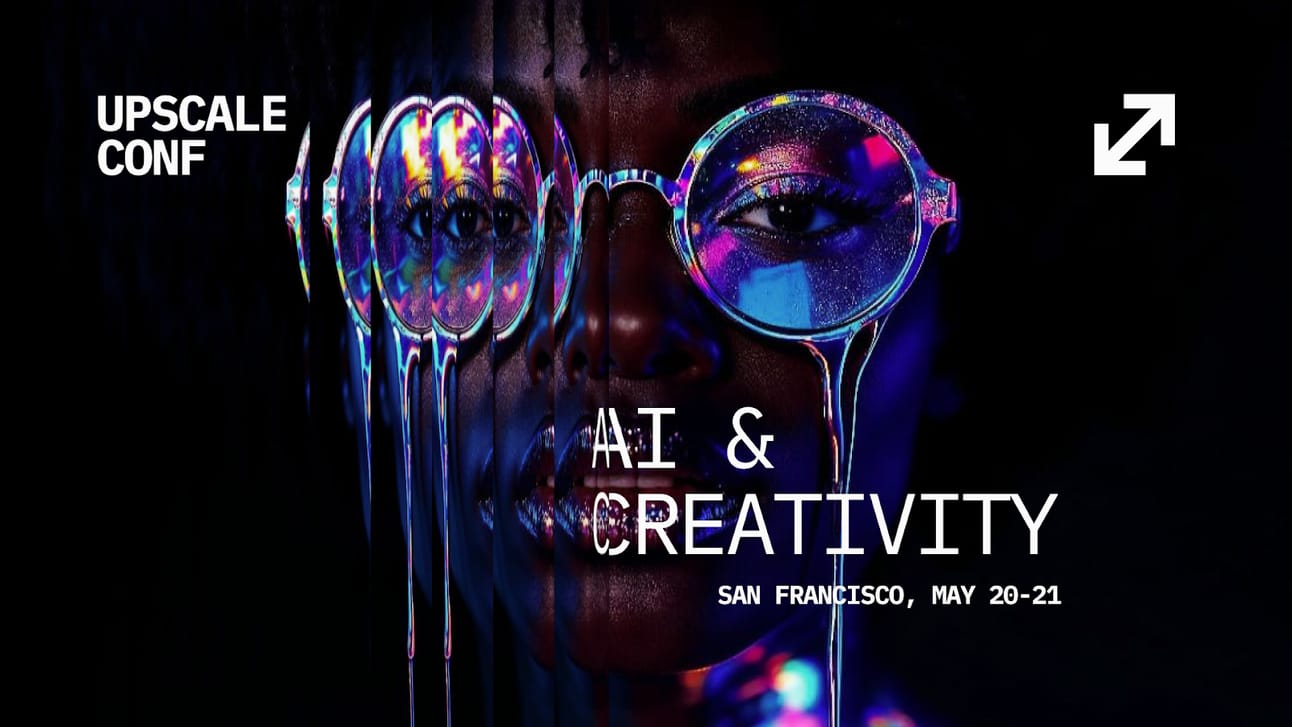
The Rundown: Upscale Conf is bringing together the brightest minds in AI-powered creativity for two immersive days of inspiration, experimentation, and networking at SF JAZZ on May 20-21.
The two-day experience features:
Talks and workshops by industry experts like John Maeda, Gmunk, Comfy, and more
On-stage live AI music generation with immersive experience
Opportunities to connect with fellow global innovators from design, art, and tech
Get your tickets now with 50% off, exclusive to The Rundown AI readers.
ALIBABA
🔎 Alibaba's Zerosearch teaches AI to search solo

Image source: Reve / The Rundown
The Rundown: Alibaba researchers introduced ZeroSearch, a technique that teaches AI systems to search for info without using real search engines — cutting training costs by 88% while matching or outperforming the models trained with actual search APIs.
The details:
ZeroSearch removes the need for expensive search engine API calls during training by using an LLM to simulate search results.
A "curriculum-based rollout strategy" gradually lowers the quality of these simulated documents, progressively challenging the AI to refine its reasoning.
The approach avoids the high API costs and unpredictable document quality associated with training AI on live commercial search engines.
In testing, ZeroSearch was able to match or outperform models trained with real search engines, while reducing costs by nearly 90%.
Why it matters: As we’ve seen in robotics, using simulations for training data is proving to be both an effective and cheaper option. Techniques like ZeroSearch could eliminate a major financial barrier for smaller labs competing with tech giants, while also giving better control over how models learn to find and process information.
QUICK HITS
🛠️ Trending AI Tools
🔌 Anthropic Web Search API - Connect Claude applications to the web
🤖 Medium 3 - Mistral’s new low-cost, high-performance model
📊 Le Chat Enterprise - Mistral’s AI assistant for business environments
🎨 Figma Make - Turn designs into interactive prototypes with prompts
📰 Everything else in AI today
The U.S. Food and Drug Administration is reportedly in talks with OpenAI to integrate AI into the drug development and review process.
Meta is appointing former staffer Robert Fergus as the new head of its Facebook AI Research Lab, as he returned to Meta this year after a five-year stint at DeepMind.
Amazon is reportedly developing its own AI coding app, code-named ‘Kiro’, which will leverage agents for developer tasks and feature multimodal capabilities.
Shopify released a new upgrade to its Sidekick AI assistant, integrating new reasoning capabilities and free image generation tools for merchants on the platform.
Augment Code unveiled Remote Agent, allowing developers to delegate coding tasks to cloud-based AI assistants that continue working even when laptops are closed.
Amazon launched Enhance My Listing, a new AI-powered tool that helps sellers maintain and optimize product listings on the platform.
Hugging Face released Open Computer Agent, a free (but slow) computer-using agent to tackle simple multi-step tasks.
COMMUNITY
🎥 Join our next live workshop

Join our next workshop this Friday, May 9th, at 4 PM EST with Dr. Alvaro Cintas, The Rundown’s AI professor. By the end of the workshop, you’ll you’ll be equipped to prompt with precision and creativity across any AI tool and improve AI responses.
RSVP here. Not a member? Join The Rundown University on a 14-day free trial.
🤝 Share The Rundown, get rewards
We’ll always keep this newsletter 100% free. To support our work, consider sharing The Rundown with your friends, and we’ll send you more free goodies.
See you soon,
Rowan, Joey, Zach, Alvaro, and Jason—The Rundown’s editorial team

Amazon's new robot can touch and feel
Read Online | Sign Up | Advertise
Good morning, robotics enthusiasts. Amazon just unveiled Vulcan — its most advanced warehouse robot, equipped with a sense of touch that allows it to handle a vast array of items with human-like finesse.
Amazon is revolutionizing warehouse automation—but what does that mean for the company’s 1.5M human warehouse workers? The future of work is changing fast.
In today’s robotics rundown:
Amazon’s Vulcan with a ‘sense of touch’
This drone attracts and controls lightning
Meet Goby: A tiny, hackable $100 bot
Stanford teaches robots to move like us
Quick hits on other robotics news
LATEST DEVELOPMENTS
AMAZON
📦 Amazon’s Vulcan with a ‘sense of touch’
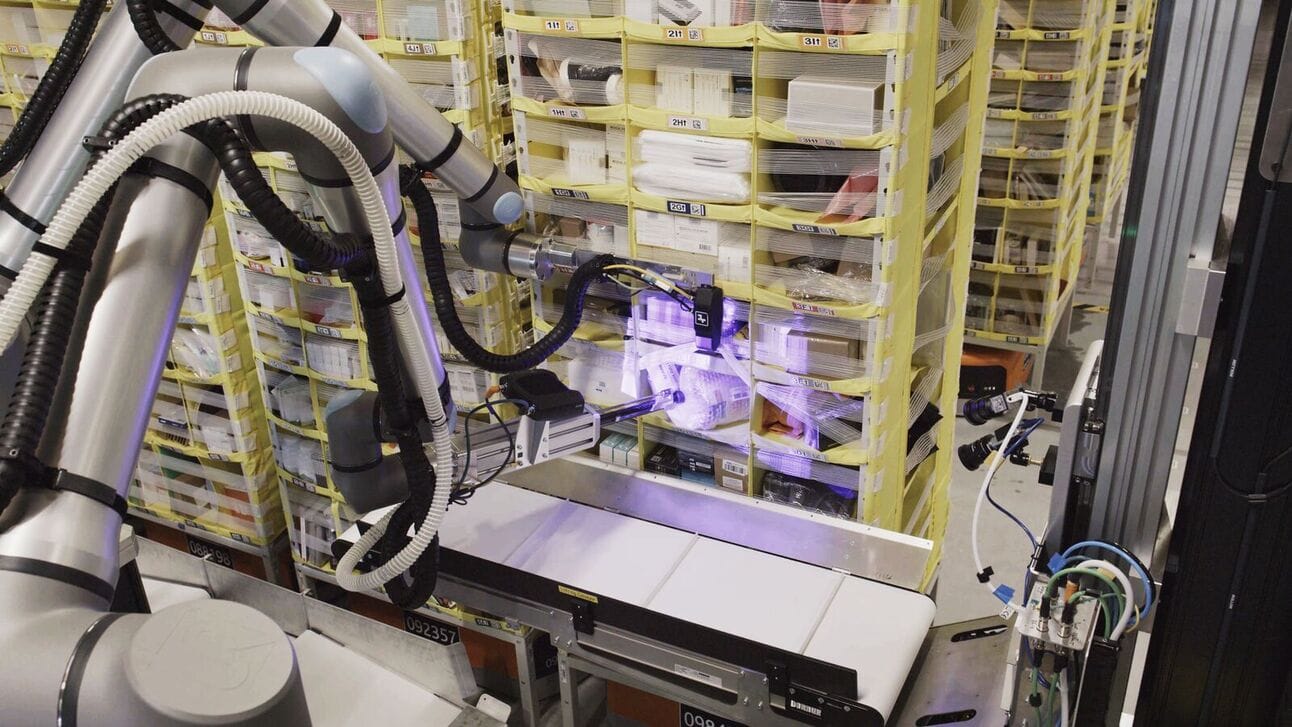
Image source: Amazon
The Rundown: Amazon just unveiled Vulcan, a cutting-edge robot that it says has a true “sense of touch,” allowing it to pick and sort three-quarters of the items in the company’s vast warehouse stock, a job handled predominantly by humans.
The details:
Vulcan’s grippers come with force feedback sensors that can determine how much pressure to apply when handling packages, including fragile ones.
The robot’s arm has a “spatula-like” end effector that can extract items from densely packed compartments that were previously only accessible to humans.
Its tactile sensors and AI-powered interpretation allow for precise, adaptive motion strategies and real-time learning from physical interactions.
Vulcan can handle about 75% of the 1M different items in a typical Amazon warehouse, besting older robots that relied on vision and suction alone.
Why it matters: Vulcan can run up to 20 hours a day and is already deployed in U.S. and German warehouses, where it has processed hundreds of thousands of orders. Amazon maintains the robot won’t replace workers, but its ability to learn and improve over time suggests a future where roles could shift significantly.
DRONE INNOVATIONS
⚡️ This drone attracts and controls lightning

Image source: Nippon Telegraph and Telephone Corp.
The Rundown: A Tokyo-based tech giant says that it has developed and successfully tested the world’s first drone-based system capable of actively triggering and guiding lightning strikes — channeling their immense power safely to the ground.
The details:
Nippon Telegraph and Telephone Corp. tested a drone encased in a metal Faraday cage, trailing conductive wire connected to a ground-based switch.
During a storm, the team launched the drone at an altitude of 300 meters, then flipped a high-voltage switch to induce a lightning strike.
During tests, the drone survived direct lightning strikes with only partial melting of the cage and was able to remain airborne and operational.
The technology could potentially help mitigate the up to $1.4B in annual lightning-related damages in Japan.
Why it matters: This technology offers a significant advancement over fixed lightning rods and can be rapidly deployed to protect vulnerable sites such as wind turbines or outdoor venues. Beyond protection, the company is also exploring the possibility of harnessing and storing lightning’s power as a renewable energy source.
CHARMED LABS
🐭 Meet Goby: A tiny, hackable $100 bot

Image source: Charmed Labs
The Rundown: If you’ve ever dreamed of seeing the world through the eyes of a mouse, you can now do that, with the Goby — a telepresence robot created by Austin’s Charmed Labs. It’s tiny, hackable, and priced at only $100.
The details:
Currently crowdfunding for its initial release, Goby is entirely reprogrammable with nothing more than a USB cable and the Arduino IDE.
The robot comes equipped with two independently motorized wheels and a unique articulated tail supported by a small ball.
It features an ESP32-S3 and an OmniVision OV2640 camera sensor for live video feed, a 3-axis accelerometer, and wheel odometry sensors.
Its BitBang software enables encrypted, low-latency WebRTC peer-to-peer connections, allowing anyone with the URL to control Goby from anywhere.
Why it matters: Home robot rivals include Loona and Enabot, but Goby stands out for being open source, hackable, and very affordable — offering a unique platform for both fun and practical applications like inspecting tight or hazardous spaces. Plus, setup via a QR code takes minutes, and you can share remote control access too.
STANFORD UNIVERSITY
🕺🏻Stanford teaches robots to move like us
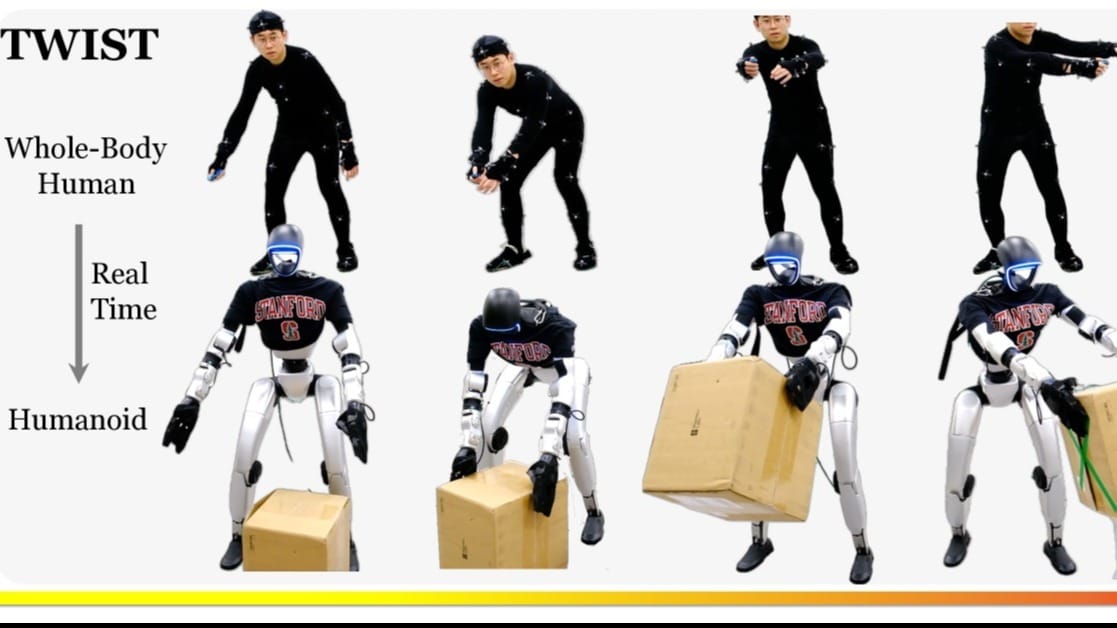
Image source: Stanford University
The Rundown: This week, Stanford University roboticists released a new paper and demo videos showing how their TWIST real-time teleoperation framework enables humanoids to precisely mimic how humans move.
The details:
TWIST enables real-time teleoperation of humanoid robots by directly imitating human whole-body motions using motion capture (MoCap) data.
Under the hood, it uses a unified neural network controller, trained via reinforcement learning, allowing the robot to perform coordinated skills.
A two-stage framework trains a teacher policy with future motion data for smooth actions, then distills it into a student policy using only current data.
TWIST shows versatility on robots like the Unitree G1, enabling tasks such as picking up objects, kicking, and crouching, all controlled by a human operator.
Why it matters: Compared to systems like H20, which uses an RGB camera, TWIST leverages high-fidelity MoCap for sophisticated teacher-student training. Limitations include the lack of visual or tactile feedback for operators and robots overheating during prolonged use. Still, it paves the way for more functional humanoids.
QUICK HITS
📰 Everything else in robotics today
Igus, a motion plastics manufacturer in Germany, unveiled its Iggy Rob industrial humanoid, standing 1.7 meters tall and priced at around $54K.
Hugging Face released Open Computer Agent, an open-source, Operator-like AI agent tool that can perform tasks on the web.
Chinese firm Unitree and San Francisco-based Reborn announced a partnership to co-develop advanced AI specifically for Unitree’s humanoids.
A bipartisan group of U.S. lawmakers is urging an investigation into Unitree's operations within U.S. prisons and police forces, citing potential security risks.
Zoox, Amazon’s autonomous vehicle unit, paused operations of its driverless testing program and recalled its software following a crash in Las Vegas on April 8.
Chinese company Kepler began testing its fifth-generation humanoid K2, nicknamed 'Bumblebee,' on the SAIC-GM automotive assembly line.
University of Rochester researchers developed a new text-to-video model that learns real-world physics knowledge from time-lapse videos.
Korean researchers developed an autonomous robot specifically designed for wiping and UV-C disinfection in hospitals to reduce human exposure to pathogens.
MIT engineers designed a ping-pong robotic arm that can return shots with high-speed precision.
MIT also developed a system that enables robots to use only internal sensors to learn about an object’s weight or contents by picking it up and gently shaking it.
COMMUNITY
🎥 Join our next live workshop
Join our next workshop this Friday, May 9th, at 4 PM EST with Dr. Alvaro Cintas, The Rundown’s AI professor. By the end of the workshop, you’ll you’ll be equipped to prompt with precision and creativity across any AI tool and improve AI responses.
RSVP here. Not a member? Join The Rundown University on a 14-day free trial.
See you soon,
Rowan, Jennifer, and Joey—The Rundown’s editorial team

OpenAI goes global with Stargate
Read Online | Sign Up | Advertise

Good morning, AI enthusiasts. OpenAI is quickly evolving from tech company to geopolitical force, with a new initiative set to bring its massive Stargate project to nations worldwide.
With a goal of fostering AI on ‘democratic rails’ and building out infrastructure across U.S. allies, the tech is starting to shape the new global power structure — and OpenAI is looking to be at the head of the table.
In today’s AI rundown:
OpenAI takes its Stargate project global
Figma adds AI across its design suite
Speed through your emails with Superhuman
Mistral’s cost-efficient AI and enterprise platform
4 new AI tools & 4 job opportunities
LATEST DEVELOPMENTS
OPENAI
🌍 OpenAI takes its Stargate project global

Image source: o3 / The Rundown
The Rundown: OpenAI just launched "OpenAI for Countries," a new global initiative to help nations build out their AI infrastructure and customize AI tools for local needs — while also extending its $500B Stargate project's ambitions worldwide.
The details:
The initiative will partner with governments to build in-country data centers and tailor OpenAI’s products for specific languages and cultural contexts.
OpenAI plans to create custom versions of ChatGPT for citizens in partner countries to improve areas like healthcare, education, and public services.
Funding will be collaborative between OpenAI and participating countries, with an initial goal of 10 international projects in democratically aligned nations.
OpenAI said the partnerships will further the “continued US-led AI leadership” and act as a “global, growing network effect" for democratic AI.
Why it matters: OpenAI is going global with its massive Stargate initiative, positioning itself as an ambassador for the U.S. and a shepherd of building AI on ‘democratic rails’. The move goes far beyond business, with the startup now potentially shaping both international relations and power structures with the most important tech in history.
TOGETHER WITH QWIET
🛡️ Security that moves at development speed

The Rundown: As development cycles accelerate, security often struggles to keep up. Qwiet AI developed the first Agentic AI solution that works alongside developers to detect, prioritize, and remediate vulnerabilities — enabling security to keep pace with rapid code creation.
With Qwiet AI, you can:
Identify vulnerabilities the moment they appear with faster, more accurate analysis
Focus on what matters with smart prioritization based on reachability and exploitability
Let AI handle remediation by automatically generating secure code fixes
Get a demo today and see why Qwiet AI just won the SC Award for Best Application Security Solution.
FIGMA
🎨 Figma adds AI across its design suite

Image source: Figma
The Rundown: Figma announced a flurry of AI-infused products across its design suite at its Config 2025 event, broadening its platform with AI-powered coding, website publishing, advanced vector drawing, and marketing asset creation.
The details:
Figma Make introduces prompt-to-code capabilities, allowing users to transform designs into interactive prototypes using natural language and AI.
Figma Sites lets designers publish working websites directly from designs with a single click, with upcoming AI-powered code generation for animations.
Figma Draw integrates AI-assisted capabilities within its vector editing environment, making complex illustration tasks more accessible.
Figma Buzz offers a dedicated space for teams to create on-brand marketing assets, featuring AI tools for image editing, generation, and copywriting.
Why it matters: The design giant has entered the “vibe coding” space, now competing with the wave of AI coding platforms — while also taking on Canva, Adobe, WebFlow, and Framer in the process. With AI upgrades that bring an entire web of design needs under one already widely used ecosystem, Figma just made a BIG move for the AI era.
AI TRAINING
📧 Speed through your emails with Superhuman

The Rundown: In this tutorial, you will learn how to transform email management with Superhuman, which offers a clean interface, keyboard shortcuts, and AI features that help you process emails faster and reach inbox zero.
Step-by-step:
Sign up on Superhuman's website and connect your Gmail or Outlook account.
The setup wizard will help you synchronize labels and clean up your initial inbox view.
Process emails quickly by pressing “E” to archive them or set reminders (Command K → "Remind me") to deal with them later.
Use AI to write responses faster - press Command J and enter a few bullet points to generate complete, personalized email drafts.
Pro tip: Check out our exclusive hands-on experience workshop on using Superhuman’s AI to draft, label, and follow up emails here. Additionally, full Rundown University members enjoy a free month of Superhuman Pro.
PRESENTED BY TELNYX
🗣️ AI that talks like a human

The Rundown: Telnyx gives you a single platform for building natural, context-aware AI assistants across voice and messaging channels without stitching together multiple tools or vendors.
With Telnyx, you can build AI assistants that:
Respond in real time with ultra-low latency
Personalize and continue conversations with built-in memory
Deploy across voice and messaging channels from one platform
MISTRAL
🚀 Mistral’s cost-efficient AI and enterprise platform

Image source: Mistral
The Rundown: French AI startup Mistral released Medium 3, a new AI model that delivers high-end performance at drastically lower costs — alongside a new Le Chat Enterprise platform designed specifically for business environments.
The details:
Medium 3 matches or surpasses models like Claude 3.7 Sonnet, GPT-4o, and Llama 4 Maverick across a variety of benchmarks despite 8x lower costs.
Enterprise integrates with corporate tools like Google Drive and SharePoint, with features like custom agent building, document libraries, and more.
The platform also supports flexible deployment options, including both public and private virtual clouds and on-premises hosting, with strict privacy controls.
Mistral also hinted at a potential open-source release of its Large model in the coming weeks, despite Medium being closed (for now).
Why it matters: Mistral’s cost-effective Medium shows strong benchmarks, though still a step down from the top models — making the upcoming Large release one to watch. The enterprise platform could appeal particularly to those with strict security requirements, especially those concerned about data governance under EU regulations.
QUICK HITS
🛠️ Trending AI Tools
🤖 Gemini 2.5 Pro - New update with SOTA coding capabilities
🗣️ Avatar IV - Generate lifelike characters from just one image and voice script
🎥 LTXV - Lighttrick’s video model with fast generations
📢 Google AI Max - Optimize and expand the reach of search ad campaigns
💼 AI Job Opportunities
🎨 The Rundown - Designer (Brand & Platform)
🌍 Hebbia - Regional Sales Leader
🦙 Meta - Director, Llama Marketing
📊 Databricks - Strategic Account Executive
📰 Everything else in AI today
Apple is exploring a pivot to AI search to power Safari, with senior VP Eddy Cue saying options like OpenAI, Perplexity, and Anthropic will replace traditional search.
Anthropic unveiled a web search API, enabling developers to build applications where Claude can search the web for up-to-date info and provide answers with citations.
Google pushed an update to its Gemini 2.0 Flash image generation model, increasing output quality with better text rendering and reduced content restrictions.
Netflix introduced a UI update that includes a new OpenAI-powered natural language search feature for easier content discovery on the platform.
LinkedIn announced a new AI-powered job search tool allowing users to find career opportunities that match their dream roles using natural language commands.
Ace Studio released ACE-Step v1-3.5B, an ultra-fast, open-source music model capable of creating four-minute clips in just 20 seconds with structure control.
COMMUNITY
🎥 Join our next live workshop

Join our next workshop this Friday, May 9th, at 4 PM EST with Dr. Alvaro Cintas, The Rundown’s AI professor. By the end of the workshop, you’ll you’ll be equipped to prompt with precision and creativity across any AI tool and improve AI responses.
RSVP here. Not a member? Join The Rundown University on a 14-day free trial.
🤝 Share The Rundown, get rewards
We’ll always keep this newsletter 100% free. To support our work, consider sharing The Rundown with your friends, and we’ll send you more free goodies.
See you soon,
Rowan, Joey, Zach, Alvaro, and Jason—The Rundown’s editorial team
No matching search results
Try using different keywords, double-check your spelling, or explore related categories.
Stay Ahead on AI.
Join 2,000,000+ readers getting bite-size AI news updates straight to their inbox every morning with The Rundown AI newsletter. It's 100% free.