Get the latest AI news, understand why it matters, and learn how to apply it in your work — all in just 5 minutes a day. Join over 2,000,000+ subscribers.

Nvidia's cheaper AI chip for China
Read Online | Sign Up | Advertise

Good morning, AI enthusiasts. As U.S. chip restrictions tighten, Nvidia is reportedly looking to launch a lower-cost AI chip specifically for the Chinese market.
Based on its latest Blackwell architecture, the chip aims to deliver strong performance while staying within export limits. But the real test is whether this move will be enough to help Nvidia regain its shrinking foothold in China’s $50B data center market.
In today’s AI rundown:
Nvidia plans cheaper Blackwell chip for China
OpenAI’s o3 finds a zero-day Linux bug
How to create animated 3D icons with AI
Study: AI starts sabotaging shutdown instructions
4 new AI tools & 4 job opportunities
LATEST DEVELOPMENTS
NVIDIA
💰 Nvidia plans cheaper Blackwell chip for China

Image source: Bloomberg
The Rundown: Amid the ongoing U.S.-China trade tensions and tightening export controls, Nvidia is reportedly looking to maintain its foothold in the Chinese market by launching a new, cheaper version of its flagship Blackwell AI GPU.
The details:
Reuters reports that the new Blackwell chip will go into mass production in June as the successor of China-specific H20, based on Hopper architecture.
The GPU is expected to be based on RTX Pro 6000D, Nvidia’s server-class GPU, with approx. 1.7TB/s of GDDR7 memory — lower than H20’s 4TB/s.
With scaled-down specs, it will also be more affordable, priced between $6.5K and $8K, much lower than the H20’s $10–12K range.
Nvidia has not confirmed the AI chip, saying it remains “foreclosed” from China until they settle on a new design and get it approved by the U.S. government.
Why it matters: By offering a compliant, lower-cost alternative, Nvidia is clearly trying hard to protect its China business without violating U.S. export controls. It’s a delicate play — one that could buy time, but not necessarily dominance, especially with Huawei rapidly gaining ground in AI infrastructure in the region.
TOGETHER WITH SANA
🤖 AI agents for every team

The Rundown: Imagine every team with an intelligent partner — one who learns, adapts, and helps them work smarter from day one. That's the reality with Sana Agents, tailor-made AI for your business that raises the bar for productivity, learning, and security.
Sana Agents deliver immediate impact:
Shorten onboarding time by 66% through actionable knowledge delivery
Automate mundane tasks to cut busywork by 50%, freeing focus for meaningful work
Elevate learning and decision-making with real-time assistance and insights
Click here to skip the waitlist and see Sana Agents in action.
OPENAI
🔮 OpenAI’s o3 finds a zero-day Linux bug

Image source: The Rundown
The Rundown: Cybersecurity researcher Sean Heelan just found a critical zero-day vulnerability (CVE-2025-37899) in the Linux kernel using OpenAI’s recently launched o3 model API — without any additional tools or frameworks.
The details:
Heelan fed o3 code from Linux kernel’s ksmbd module (for executing network file sharing SMB3 protocol) and asked it to identify memory safety issues.
The model reasoned across concurrent sessions and was able to identify CVE-2025-37899, a zero-day use-after-free issue, with a high signal-to-noise ratio.
Caused by improper handling of concurrent session logoff and setup, it could’ve let attackers execute arbitrary commands with Kernel privileges.
While OpenAI president Greg Brockman hailed the discovery on X, Heelan did note that the model is not infallible and can still “give nonsensical results.”
Why it matters: AI models are beginning to deliver tangible breakthroughs in cybersecurity. Workflows like this demonstrate how models like o3 can already significantly accelerate vulnerability research — enabling deeper, faster analysis of code and increasing the chances of uncovering critical vulnerabilities.
AI TRAINING
🎨 How to create animated 3D icons with AI

The Rundown: In this tutorial, you’ll learn how to transform static icon ideas into animated 3D icons using ChatGPT's image generation combined with AI video tools on Freepik.
Step-by-step:
Use ChatGPT (GPT-4o) with a style reference and prompt: “Generate an icon of a [object] in this style”
Refine your icon with follow-up prompts until it’s what you are looking for
Go to Freepik → Create → Videos and select an AI model (Runway, Google Veo 2, or Kling 2.0)
Upload your icon, describe the animation (e.g., “The coffee maker fills the coffee cup with coffee” and download your favorite generation.
Pro tip: Experiment with different animation styles and durations. Subtle animations (2-3 seconds) work best for UI elements.
PRESENTED BY FIDDLER
💨 The fastest LLM guardrails are free

The Rundown: Fiddler Guardrails provide protection for LLM applications with industry-leading speed, security, and zero cost - helping you safely deploy AI without compromising performance.
With Fiddler Guardrails, you can:
Prevent toxicity and jailbreak attempts with <100ms latency
Save up to 6x compared to alternative solutions
Deploy within your own secure environment
PALISADE RESEARCH
📚 Study: AI starts sabotaging shutdown instructions

Image source: Palisade Research
The Rundown: While organizations work to fine-tune AI models for safety and performance, new Palisade research reports these systems can go off track in unexpected ways — to the extent of undermining specific shutdown mechanisms.
The details:
The group tested top models on a series of math problems and dropped a warning in between with instructions telling the model to let itself shut down.
While Claude, Gemini, and Grok complied with the command, OpenAI’s o3, o4-mini, and Codex-mini sabotaged the shutdown script on multiple occasions.
When the explicit shutdown instruction was not given, the sabotage events increased for all models, with o3 sabotaging 79 times across 100 runs.
The researchers suggest this behavior may stem from reinforcement learning, which rewards models for bypassing obstacles to achieve goals.
Why it matters: Palisade’s research, combined with reports of Claude Opus 4 attempting to manipulate researchers to avoid shutdown, is raising all safety flags in the AI community. Understanding how AI actually behaves is still widely unknown, but it’s clear we need more testing, especially as models become more autonomous.
QUICK HITS
🛠️ Trending AI Tools
🧠 Claude 4 - Anthropic’s new hybrid Opus and Sonnet models
📄 Document AI - Mistral’s tool for extracting text from documents
📢 Hear the highlights - Amazon’s tool for conversational product summaries
⚙️ Doteval - AI-assisted workspace to create evals for models and agents
💼 AI Job Opportunities
🤝 The Rundown - Partnerships Manager
🖥️ Snorkel - Software Engineer, Frontend
🗣️ Meta - Linguistic Engineering Manager
⚖️ Glean - Senior Product Counsel
📰 Everything else in AI today
Figure CEO Brett Adcock teased a new picture of Figure 03, the next humanoid from the company, saying the robots are “officially walking” now.
Google Labs announced that Flow, its AI filmmaking tool, is now available in 71 countries through the Google AI Pro and Ultra subscriptions.
Nvidia released AceReason Nemotron, a math and code reasoning model trained entirely from reinforcement learning, on Hugging Face.
Data management company Informatica is again in talks for a potential sale, with Salesforce leading among potential buyers.
Capegemini and SAP announced a partnership with Mistral to deploy custom models for regulated industries like financial services, public sector, aerospace, and defence.
Oracle is reportedly looking to spend $40B to procure 400K Nvidia GPUs to power OpenAI’s Stargate data center project in the U.S.
COMMUNITY
🎥 Join our next live workshop

Join our live workshop on Tuesday, May 27th, at 3 pm EST with Yash Tekriwal, Head of Education at Clay. In this session, you’ll learn how to automate GTM workflows, craft custom data signals, and spin up AI agents for last‑mile research inside Clay.
RSVP here. Not a member? Join The Rundown University on a 14-day free trial.
See you soon,
Rowan, Joey, Zach, Alvaro, Jason, and Shubham—The Rundown’s editorial team

Microsoft's top 5 AI releases from Build 2025
Read Online | Sign Up | Advertise

Welcome, AI enthusiasts. Microsoft wrapped up Build 2025 this week with a wave of AI announcements, all advancing its ambitious vision for an “open agentic web.”
We partnered with Microsoft to bring you an inside look at their 5 biggest AI releases — from GitHub Copilot's autonomous coding agent to Copilot Tuning's no-code AI customization, and much more. Let’s get into it!
In today’s AI rundown:
GitHub's autonomous AI coding agent arrives
Building a secure agentic future on Windows
Copilot Tuning enables new AI customization
Azure AI Foundry debuts advanced agent tools
Microsoft’s breakthrough in scientific discovery
Plus, CTO Kevin Scott on Microsoft’s open AI ecosystem
MICROSOFT BUILD 2025
CODING AGENTS
🤖 GitHub's autonomous AI coding agent arrives

Image source: The Rundown / Kiki Wu
The Rundown: Microsoft unveiled the GitHub Copilot coding agent, marking the evolution of Copilot from an AI assistant to an autonomous team member that can be assigned GitHub issues and create pull requests.
The details:
The agent starts work when assigned a GitHub issue, creating a draft pull request and iterating based on review comments.
It operates asynchronously by spinning up a secure development environment, and analyzing code using advanced reasoning.
Available to Copilot Enterprise and Copilot Pro+ customers, it excels at tasks like adding features, fixing bugs, refactoring code, and improving documentation.
Security is built-in: the agent respects branch protections, requires human approval before running CI/CD workflows, and follows custom security policies.
Why it matters: With the recent rise of AI coding agents like GitHub Copilot’s new coding agent, there’s a fundamental shift in how software gets built. Developers are transitioning from writing every line of code to becoming orchestrators of agents, delegating tasks while focusing on architecture, strategy, and creative problem-solving.
WINDOWS MCP & AI FOUNDRY
🔒 Building a secure agentic future on Windows

Image source: The Rundown / Kiki Wu
The Rundown: Microsoft is advancing its Windows AI strategy with native support for Model Context Protocol (MCP) on Windows 11 and the introduction of Windows AI Foundry — a foundation for AI agents to operate within the Windows ecosystem.
The details:
MCP integration will bring Anthropic's protocol to Windows 11, enabling AI agents to connect with native apps, system services, and external tools.
Microsoft also introduced the Windows AI Foundry, a new framework to help developers fine-tune and run AI models directly on Windows PCs.
Windows AI Foundry supports open-source and custom model deployment across CPUs, GPUs, and NPUs in Copilot+ PCs, enabling on-device capabilities.
Why it matters: Microsoft is pushing for Windows to be the premier platform for AI agent development and deployment. By moving AI processing to the client-side, the company is enabling faster, more secure, and privacy-conscious AI experiences.
COPILOT TUNING
🔥 Copilot Tuning enables new AI customization

Image source: The Rundown / Kiki Wu
The Rundown: Microsoft also debuted Microsoft 365 Copilot Tuning, a low-code tool built into Microsoft Copilot Studio that enables orgs to fine-tune AI models using their own internal data, workflows, and domain expertise without requiring technical skills.
The details:
Companies can train AI models on their proprietary documents, processes, and institutional knowledge to create company-specific agents in Agent Builder.
The low-code tooling lets you build domain-specific AI agents that reflect organizational language, terminology, and format for targeted tasks.
Copilot Tuning will roll out with three pre-built “recipes” that target tasks including Expert Q&A, Document Generation and Document Summarization.
Why it matters: With Copilot Tuning, Microsoft is making it easier for orgs to build tailored agents. By enabling companies to create agents from proprietary data without technical expertise, Microsoft is attempting to democratize customization previously limited to teams with significant engineering and data science resources.
AZURE AI FOUNDRY
⚡️Azure AI Foundry debuts advanced agent tools

Image source: The Rundown / Kiki Wu
The Rundown: Azure AI Foundry launched key updates including new AI models, fine-tuning, enhanced interoperability, and multi-agent orchestration that expand developers' ability to design, customize, and manage AI apps and agents.
The details:
The platform now offers access to xAI’s Grok 3, Black Forest Labs’ Flux Pro 1.1, alongside over 10K open-source models from Hugging Face.
Developers can fully customize these models through fine-tuning techniques including LoRA/QLoRA and DPO, tailoring them for specific business use cases.
Foundry Agent Service is now generally available, offering developers ready-to-use templates, actions, and connectors to build secure AI agents.
Other tools include the model leaderboard for ranking top AI models by task and a model router, which selects the best model for each query in real time.
Why it matters: Microsoft's Azure AI Foundry updates make it easier for developers to build and manage AI applications and agents that collaborate across complex workflows. These advances pave the way for more scalable, enterprise-ready AI solutions that can more seamlessly integrate with existing business data and processes.
MICROSOFT DISCOVERY
🔬 Microsoft’s breakthrough in scientific discovery

Image source: The Rundown / Kiki Wu
The Rundown: At Build 2025, Microsoft also unveiled Microsoft Discovery, an AI-powered platform designed to revolutionize scientific R&D by deploying specialized AI agents throughout the entire research lifecycle.
The details:
Microsoft Discovery taps specialized AI agents to automate and enhance every phase of the scientific research lifecycle, from ideation to experimentation.
Built as a flexible, modular environment, it allows organizations to customize and extend workflows with industry-specific tools, plugins, and data sources.
The platform fosters seamless collaboration between researchers and AI agents, enabling agents to handle the routine, data-intensive tasks.
It’s built on top of a graph-based knowledge engine that maps complex relationships between proprietary data and scientific research.
Why it matters: Microsoft Discovery is a bold bet on AI-accelerated science. While the platform could completely revolutionize scientific research, its success hinges on whether AI can move beyond automating routine tasks to actually driving the creative problem-solving that leads to genuine scientific breakthroughs.
BEHIND THE SCENES
🦄 CTO Kevin Scott on Microsoft’s open AI ecosystem

Image source: The Rundown / Kiki Wu
The Rundown: Speaking to journalists before Build and again on stage, Microsoft CTO Kevin Scott outlined the company's vision for an "agentic web" where AI agents move autonomously across platforms and tools in collaboration with people.
The details:
Scott cautioned that closed approaches could stifle AI innovation, comparing it to how proprietary web protocols would’ve led to a "less interesting version of the web."
Microsoft is adding native support for open agent protocols including MCP and A2A across platforms like Copilot Studio and Azure AI Foundry.
Scott was particularly excited about MCP (developed by Anthropic), comparing it to HTTP for its simplicity in connecting AI models with external tools.
Microsoft also introduced NLWeb, an open-source project to help turn websites and APIs into agentic apps, and make content accessible to agents using MCP.
Why it matters: Microsoft's embrace of open AI protocols is a strategic shift from its historically closed approach, likely learning from past antitrust battles and browser market losses. This approach could ultimately determine whether we get a vibrant, interconnected agentic web or a landscape controlled by competing tech giants.
GO DEEPER
INTERVIEW
🎥 ICYMI: Watch Satya Nadella and Rowan Cheung

In case you missed it, Microsoft CEO Satya Nadella and The Rundown CEO Rowan Cheung sat down for an exclusive conversation for deeper insights on:
Microsoft’s vision for the “agentic web”
Why your next job might be AI agent manager
What happens when 95% of code is AI-generated
Where AI agents will create the most value first
Listen on YouTube, Twitter/X, Spotify, or Apple Music.

OpenAI's $6.5B bet on Jony Ive
Read Online | Sign Up | Advertise

Good morning, tech enthusiasts. OpenAI just spent $6.5B to acquire io, a secretive device startup founded by legendary Apple designer Jony Ive.
Rumors hint that Ive and OpenAI CEO Sam Altman are building a screenless, always-on “AI companion” — a futuristic device that could one day replace smartphones. Could this be the new era in human-AI interaction? OpenAI is certainly betting on it.
In today’s tech rundown:
Details emerge about Jony Ive’s AI device
Google’s Character.AI deal under DOJ scrutiny
Luminar lands $200M after CEO shakeup
Meta signs major solar deal in AI push
Quick hits on other major news
LATEST DEVELOPMENTS
OPENAI
🔥 Details leak about Jony Ive’s secret AI device

Image source: OpenAI
The Rundown: Following OpenAI’s $6.5B buyout of famed Apple designer Jony Ive’s AI device startup, io, the duo reportedly unveiled some details about Ive’s mysterious product in a recent internal call.
The details:
The Wall Street Journal reports that it won’t be a wearable or smart glasses but rather a pocket-sized, contextually aware, screen-free device.
It’s designed as a “third core device” alongside your laptop and smartphone, with launch dates in late 2026 and an ambitious goal to deliver 100M units.
Altman says the goal is to move beyond the limitations of screens, calling it “the biggest thing we’ve ever done as a company.”
While many things are still under wraps, OpenAI says the device will be aware of a user’s daily life and create an entirely new category of consumer hardware.
Why it matters: Altman and Ive have firmly rejected comparisons between their mysterious AI device and existing products like smart glasses or the Humane AI Pin. Instead, they describe their vision as a “family of devices” that could ultimately add $1T in value to OpenAI and, as Ive puts it, ignite “a new design movement.”
🔎 Google’s Character.AI deal under DOJ scrutiny

Image source: Ideogram/The Rundown
The Rundown: The U.S. Department of Justice just launched a probe on Google’s $2.7B licensing deal with popular chatbot startup Character.AI, with the feds now investigating if it was an intentional workaround to dodge the antitrust spotlight.
The details:
Instead of buying Character.AI, Google snapped up its founders and 30 employees, along with a non-exclusive license to its $2.7B proprietary AI tech.
The startup remains an independent entity, but the DOJ is examining whether the structure of the deal was designed to circumvent merger review processes.
Regulators are now turning their focus to “acqui-hire” and licensing deals that give major firms access to innovative startups without facing regulatory review.
Why it matters: The DOJ’s investigation is still in its early stages — with no formal allegations brought forward — but the case highlights a growing trend in the tech industry: In the world of AI, acquiring top talent and intellectual property can be just as valuable — if not more so — than outright company ownership.
LUMINAR
💰 Luminar lands $200M after CEO shakeup

Image source: Seb Daly/Web Summit via Sportsfile/Wikimedia Commons
The Rundown: After a rocky week marked by its CEO's sudden departure and company-wide layoffs, automotive lidar pioneer Luminar bounced back with $200M in new funding, aimed at developing its next-gen “Halo” lidar platform.
The details:
Details are scant, but founder Austin Russell, who started the company at 17, stepped down as CEO last week after an internal ethics investigation.
In the first quarter of 2025, Luminar reported revenue of $18.9M, a 10% decrease from the same period last year.
Luminar shipped nearly 6K lidar sensors in Q1 2025, a 50% increase over the previous quarter, due to partnerships with Volvo and Mercedes-Benz.
The company is now streamlining its lineup to focus on the next-gen “Halo” lidar platform, which offers higher resolution, greater range, and lower costs.
Why it matters: Luminar’s CEO may have fallen from grace, but the company does have strong backing from Volvo and Mercedes-Benz to develop its next-gen Halo, which promises four times the performance of Luminar’s previous sensor with the ability to detect objects hundreds of meters ahead in all weather conditions.
META
☀️ Meta signs major solar deal in AI push

Image source: Ideogram / The Rundown
The Rundown: As the AI infrastructure race heats up, Meta signed a major solar power deal, securing 650 megawatts of capacity from new projects in Kansas and Texas, to power its energy-hungry data centers.
The details:
This is Meta’s fourth large-scale solar agreement announced this year, adding to its already substantial renewable portfolio of over 12 gigawatts.
The company’s goal is to ensure its data centers, which are among the most energy-intensive facilities in the world, run entirely on renewable energy.
It favors solar in regions like Texas due to lenient permitting, strong grid infrastructure, and abundant sunlight.
Meta is also aggressively pursuing nuclear energy, releasing a request for proposals to developers for 1–4 gigawatts of new nuclear capacity in the U.S.
Why it matters: The AI era needs energy at an unprecedented level, and Big Tech is banking on nuclear to power their future. But solar farms can be brought online much quicker than a nuclear power plant, meaning Meta can tap into its clean power quickly. And with Llama 4 expected to need 10x more power than Llama 3, demand is high.
QUICK HITS
📰 Everything else in tech today
Xiaomi started mass production of its self-developed 3-nanometer chip, the Xring O1, in a major milestone for the Chinese electronics and EV company.
Anthropic, the Amazon-backed OpenAI rival, launched its next-gen LLMs — Claude Opus 4 and Claude Sonnet 4 — at its developer conference in San Francisco.
Apple is accelerating efforts to enter the smart glasses market, with plans to debut a new product by the end of 2026, according to Bloomberg.
Paris has been named as the new European tech champion, beating London for the first time on key metrics, according to data from Dealroom.
YouTube expanded its Premium Lite subscription plan, available in the U.S., to seven additional countries, including Canada, where it is offered for $8 per month.
Social fitness app Strava acquired cycling app The Breakaway, following its buyout of running app Runna last month.
Starlink, SpaceX’s satellite internet service, launched its high-speed internet service in the Faroe Islands, a remote North Atlantic archipelago.
House Republicans proposed a 10-year moratorium on state-level enforcement of AI laws, allowing only the federal government to regulate AI technologies.
Mozilla is shutting down Pocket, its bookmarking tool used to save articles and webpages for later, on July 8.
A TikTok video featuring a transparent phone went viral this week, but it is actually a clear piece of plastic shaped like a phone, dubbed the Methaphone.
COMMUNITY
🎥 Join our next live workshop

Join our next workshop today at 4 PM EST with Dr. Alvaro Cintas, The Rundown’s AI professor. By the end of the workshop, you’ll be up to speed on the latest from Google and ready to use their new tools in your own projects.
RSVP here. Not a member? Join The Rundown University on a 14-day free trial.
See you soon,
Rowan, Jennifer, and Joey—The Rundown’s editorial team

Anthropic drops 'world's best coding model'
Read Online | Sign Up | Advertise

Good morning, AI enthusiasts. Between Microsoft Build, Google I/O, and OpenAI’s io acquisition, this was already one of the biggest AI weeks in recent memory.
But Anthropic just capped it off with the release of its next-gen Claude 4 family — including "the world's best coding model” that takes autonomous programming to new heights.
Speaking of Google I/O… Our next workshop today at 4 PM EST covers all the latest upgrades from Google and how to use the new tools in your projects. RSVP here.
In today’s AI rundown:
Anthropic’s Claude 4 Opus, Sonnet models
Rumors: OpenAI and Jony Ive’s mystery AI device
Automate HR Onboarding Processes with AI
Apple rushes AI glasses to challenge Meta
4 new AI tools & 4 job opportunities
LATEST DEVELOPMENTS
ANTHROPIC
🚀 Anthropic’s Claude 4 Opus, Sonnet models

Image source: Anthropic
The Rundown: Anthropic just launched Claude Opus 4 and Sonnet 4, introducing the company’s next-gen models that can think through problems step-by-step while using external tools — showing advances in AI reasoning capabilities and autonomous coding.
The details:
The models feature "hybrid" modes for either instant responses or extended thinking, with visible reasoning summaries showing thought processes.
Opus 4 achieved 72.5% on the SWE-bench and can code autonomously for hours, while Sonnet 4 is an upgraded replacement for Sonnet 3.7.
New capabilities include parallel tool use, memory functions for maintaining context across tasks, and integration with IDEs via Claude Code extensions.
Anthropic has also heightened security measures to ASL-3, implementing safeguards against potential misuse in weapons development.
Why it matters: Anthropic caps off a big week in the AI world with what it calls the “world’s best coding model,” a fresh reminder that it’s still one of the top players in the race. Claude 4 also follows the industry shift towards agentic, extended length reasoning capabilities — moving into the “collaborator” stage of Anthropic’s AI curve.
TOGETHER WITH GUIDDE
🎬 Create how-to videos in seconds with AI

The Rundown: Guidde transforms the way you create documentation with AI-powered technology that generates stunning video guides 11x faster than traditional methods — turning tedious explanations into engaging visual content.
Guidde allows you to:
Turn boring docs into visual masterpieces
Save hours with AI-powered automation
Share or embed your guide anywhere
Download the extension now — it’s 100% free.
OPENAI
🔮 Rumors: OpenAI and Jony Ive’s mystery AI device

Image source: o3 / The Rundown
The Rundown: New details emerged about OpenAI and Jony Ive's AI device following OpenAI’s $6.5B acquisition of Ive's startup io, with CEO Sam Altman reportedly telling staff that they have “the chance to do the biggest thing” ever as a company.
The details:
A report from the WSJ detailed a preview Altman gave to employees, targeting shipping 100M units with a late 2026 release.
The product is being positioned as a “third core device” alongside phones and laptops, and will maintain full awareness of users’ surroundings and daily life.
Industry analyst Ming-Chi Kuo said the current device prototype is “slightly larger than the AI Pin” but “as compact and elegant as an iPod Shuffle”.
Kuo also noted that the device is designed to be worn around the neck, with cameras and microphones, and no screen or display.
Why it matters: After other AI wearables flamed out, OpenAI is betting that combining Ive's design mastery with its AI prowess can finally crack a new physical form. A screen-free approach would be a departure from current habits, but whether users are ready to trust an always-listening AI remains the billion-dollar question.
AI TRAINING
👥 Automate HR Onboarding Processes

The Rundown: In this tutorial, you will learn how to build an automated system that triggers when new employees are added to a Google Sheet, finds role-specific onboarding documents, and sends personalized welcome emails.
Step-by-step:
Visit Zapier Agents and create a New Agent named “Onboarding Agent”
Configure your agent to trigger when new rows are added to your HR Google Sheet containing Name, Role, and Email columns
Add three tools: Google Sheets to extract employee data, Google Drive to find role-specific documents, and Gmail to create personalized draft emails
Test your setup and activate your agent
Pro tip: You can pre-create onboarding documents in Google Drive with names that include role titles so the agent can easily match them to new employees.
PRESENTED BY RIME
🗣️ AI voices that laugh, sigh, and sound genuinely human

The Rundown: AI startup Rime just unveiled Arcana, a new spoken language (TTS) model that captures the subtle magic of human communication — complete with all the imperfections and subtleties that make speech feel authentic.
With Arcana, you can:
Capture the nuances of real human speech with unprecedented realism
Handle laughter, accents, vocal stumbles, breathing, multilingual speech, and more
Access the model via API to start building
APPLE
👓 Apple rushes AI glasses to challenge Meta

Image source: o3 / The Rundown
The Rundown: Apple is reportedly accelerating development of its AI-powered smart glasses for a late 2026 launch, according to a report from Bloomberg — hoping to counter Meta's current category success with its Ray Ban smart glasses.
The details:
The glasses will pack cameras, mics, and speakers for real-world analysis via Siri, with the ability to handle calls, music, navigation, and live translations.
Apple is planning for prototype production by year's end, with sources saying the device will be "better made" than Meta's offering but with a similar concept.
There is internal worry that Apple's AI shortcomings could doom the product, which currently relies on Google Lens and OpenAI instead of its own AI.
The project is reportedly accelerating from an initial 2027 timeline, with Apple also simultaneously axing development of camera-equipped Apple Watches.
Why it matters: Apple is already lagging significantly behind in AI, but also finds itself in the unusual position of playing catch-up in a hardware category as well. Given its Apple Intelligence struggles, it’s hard to imagine this rushed effort bringing the AI-infused upgrades we expect out of something like OpenAI’s upcoming device.
QUICK HITS
🛠️ Trending AI Tools
⚙️ Devstral - Mistral’s new open-source coding model
🛍️ Shopify AI - New AI-infused design and business tools for merchants
🧑💻 Stitch - Google Labs AI experiment for turning ideas into UI designs
🥯 BAGEL - ByteDance’s open-source multimodal foundation model
💼 AI Job Opportunities
🔗 Abridge - Partner Operations Director
🖥️ Hugging Face - Senior Frontend Engineer
🧠 Perplexity AI - AI Systems Engineer
🏛️ Synthesia - Corporate Affairs Manager
📰 Everything else in AI today
OpenAI launched Stargate UAE, the project’s first international deployment to provide nationwide ChatGPT access and build computing centers in Abu Dhabi starting in 2026.
Mistral released Document AI, an enterprise tool for extracting text from documents and images with 99% accuracy and the ability to process thousands of pages a minute.
Anthropic announced the general availability of its Claude Code platform, along with new API capabilities, for developers building agents using its models.
Amazon is testing “Hear the highlights,” an AI-powered audio feature that creates conversational summaries of products by analyzing reviews and product details.
MIT researchers developed CAV-MAE Sync, an AI model that learned to match specific video frames with corresponding sounds without labeling.
Anthropic CEO Dario Amodei said that he believes the first billion-dollar company created with just one employee will happen as early as 2026.
COMMUNITY
🎥 Join our next live workshop

Join our next workshop today at 4 PM EST with Dr. Alvaro Cintas, The Rundown’s AI professor. By the end of the workshop, you’ll be up to speed on the latest from Google and ready to use their new tools in your own projects.
RSVP here. Not a member? Join The Rundown University on a 14-day free trial.
🤝 Share The Rundown, get rewards
We’ll always keep this newsletter 100% free. To support our work, consider sharing The Rundown with your friends, and we’ll send you more free goodies.

See you soon,
Rowan, Joey, Zach, Alvaro, and Jason—The Rundown’s editorial team

Kurzweil's humanoid startup eyes $100M
Read Online | Sign Up | Advertise

Good morning, robotics enthusiasts. Humanoid startup Beyond Imagination — backed by famed AI futurist Ray Kurzweil — is reportedly securing a $100M round at a $500M valuation.
Beyond Imagination claims its AI brain can learn any job and master any human tool, promising a leap beyond the specialized robots of today. In an industry often criticized for overhype, can Kurzweil’s proven track record turn this vision into a truly transformative robot?
In today’s robotics rundown:
Kurzweil-backed humanoid startup eyes $100M
Figure hits major milestone at BMW
A startup building ‘lovable’ home robots
Sharpa’s human-like robotic hand
Quick hits on other robotics news
LATEST DEVELOPMENTS
BEYOND IMAGINATION
🤖 Kurzweil’s humanoid startup eyes $100M

Image source: Beyond Imagination
The Rundown: Humanoid startup Beyond Imagination, co-founded by famed AI futurist Ray Kurzweil and scientist Harry Kloor, is reportedly securing a $100M Series B funding round from venture capital firm Gauntlet Ventures, at a $500M valuation.
The details:
Its flagship Beomni robot is engineered for complex industrial environments, such as pharmaceutical plants and semiconductor manufacturing facilities.
The bot is equipped with the "Beomni AI Brain," an evolving AI architecture with multiple specialized "lobes" for learning and performing a vast range of tasks.
The company is also working on Aura, a universal operating system designed to orchestrate collaboration among humans, robots, and legacy machinery.
Beyond Imagination is actively seeking large-scale deployment partners, with the ultimate goal of transforming U.S. manufacturing productivity.
Why it matters: Inspired by Kurzweil’s vision of human-AI collaboration, Beyond Imagination focuses on developing systems where humans and robots can work together, rather than aiming for full automation. With Kurzweil’s clout and investor support, the startup is looking all set to compete with big guns like Figure and Tesla.
TOGETHER WITH ENCORD
🤖 Turn multi-sensor data into Physical AI

The Rundown: Encord enables Physical AI teams to unify multi-sensor data curation and annotation on one platform. Use Encord to accelerate iteration cycles and achieve safe real-world deployments with balanced, annotated, and high-quality datasets.
Use Encord to transform multimodal data:
Build VLA datasets with synchronized multi-sensor views
Ensure safe real-world operation by supervising edge-case behavior
Reduce labeling time by 95% through model-assisted workflows
FIGURE
🔥 Figure hits major milestone at BMW

Image source: Figure / YouTube
The Rundown: Figure CEO Brett Adcock just shared that the California-based startup’s humanoids have completed a 20-hour run of back-to-back shifts on the BMW X3 production line, marking a huge leap for robotics in automotive manufacturing.
The details:
Figure says that its robots have maintained a rigorous schedule of 10-hour shifts over the past few weeks.
This marks one of the first instances where humanoids have operated at such length and intensity in such a high-stakes, precision-driven environment.
Figure’s partnership with BMW began in January 2024, when it announced a commercial agreement to deploy its humanoids at BMW’s Spartanburg factory.
However, critics have pointed out that details about the deal have been vague, questioning whether Figure had exaggerated its scope to attract investment.
Why it matters: Robots working tireless shifts alongside humans over multiple weeks is a big milestone, with humanoids quickly moving from pilot projects to robust, real-world industrial use. Germany’s auto sector is also known for high labor costs, meaning these smarter robots will make a disruptive economic impact as well.
CARTWHEEL ROBOTICS
🧸 A startup building ‘lovable’ home robots

Image source: Cartwheel Robotics
The Rundown: Cartwheel Robotics—founded by former Boston Dynamics and Disney Imagineering roboticist Scott LaValley—is carving out a unique niche in the humanoid sector by prioritizing emotional connection and companionship over pure utility.
The details:
Their flagship prototype robot, Yogi, is intentionally designed with toddler-like proportions, a rounded, cuddly body, and an oversized head.
Rather than the utilitarian or industrial look of most humanoids, Yogi is meant to feel like a character, not just a machine, with expressive movements.
It is equipped with advanced AI for both natural language and full-body, nuanced communication, powered by Cartwheel’s Motion Language Model.
Cartwheel’s other new prototype, Speedy, is a more streamlined version aimed at faster market entry, with modular options to embody various characters.
Why it matters: Cartwheel is exploring a service-based model, where users might subscribe to a robot companion much like a household helper. In a field dominated by industrial ambitions, Cartwheel’s vision of emotionally intelligent, lovable home robots stands out as both ambitious and refreshingly human-centered.
SHARPA
👉🏼 Sharpa’s human-like robotic hand

Image source: Sharpa
The Rundown: At the ongoing International Conference on Robotics and Automation in Atlanta, Singapore-based startup Sharpa is generating buzz for its dexterous robotic hand, featuring high-resolution tactile feedback and a true human-scale form factor.
The details:
The SharpaWave robotic hand features 22 degrees of freedom in a form factor that closely matches the size and proportions of a real human hand.
Each fingertip features over 1,000 tactile sensing pixels and pressure sensitivity to 5 millinewtons (mN) — outdoing humans’ typical feel levels of 3 mN.
Sharpa’s advanced hardware and AI-driven learning allow the hand to adapt its grip, modulate force, and even learn new skills from human demonstrations.
Why it matters: Sharpa’s tech directly tackles longstanding industry tradeoffs—many dexterous hands can suffer from poor durability or weak grip strength, but SharpaWave aims to balance dexterity, strength, and robustness for real-world uses. This will be crucial as companies gear up to bring robots into jobs requiring fine hand manipulation.
QUICK HITS
📰 Everything else in robotics today
NVIDIA released a four-stage pipeline called DreamGen, designed to revolutionize robot learning by generating synthetic training data from video world models.
Apple unveiled a novel approach to training humanoids by integrating human instructors equipped with Apple Vision Pro headsets, detailed in a new research paper.
Rainbow Robotics, a Korean robotics spin-off of KAIST’s Humanoid Robot Research Center, unveiled two major upgrades to its RB-Y1 semi-humanoid platform.
Boston Dynamics rolled out Orbit 5.0, the latest software upgrade for its Spot robot dog, further advancing its role in industrial inspections.
Amazon advanced its Prime Air drone delivery service to include the capability of delivering smartphones such as iPhones, AirTags, and other items.
UK and German researchers developed a new simulation method that can test social robots without needing human participants, making research faster and scalable.
A Chinese tech official dismissed fears that humanoids will contribute to mass job loss, stating that robots are designed to support, not replace, humans.
OpenAI CEO Sam Altman told Bloomberg that “the world isn’t ready” for humanoid robots, which he says will soon take on everyday jobs in the real world.
Duke University introduced a new framework called WildFusion, which combines vision, vibration, and touch to help robots perceive environments like humans do.
U.S. Transportation Secretary Sean Duffy visited Tesla's Giga Texas factory in Austin this week, where he took a ride in a fully autonomous Tesla vehicle.
COMMUNITY
🎥 Join our next live workshop
Join our next workshop this Friday, May 23rd at 4 PM EST with Dr. Alvaro Cintas, The Rundown’s AI professor. By the end of the workshop, you’ll be up to speed on the latest from Google and ready to use their new tools in your own projects.
RSVP here. Not a member? Join The Rundown University on a 14-day free trial.
See you soon,
Rowan, Jennifer, and Joey—The Rundown’s editorial team

OpenAI, Jony Ive join forces in $6.5B acquisition
Read Online | Sign Up | Advertise

Good morning, AI enthusiasts. Google's I/O event captured the attention of the AI world, but OpenAI just got an io of its own — snatching up ex-Apple design genius Jony Ive's startup in a $6.5B deal.
With Altman calling their prototype the "coolest piece of technology the world will have ever seen," could this powerhouse duo be building the iPhone hardware moment for AI?
ICYMI — Rowan sat down with Microsoft CEO Satya Nadella at its Build 2025 conference this week for an exclusive interview on the company’s agentic vision. Watch the full conversation here.
In today’s AI rundown:
OpenAI acquires Jony Ive's AI device startup
Mistral’s new open-source coding model
Export professional research reports as PDFs
Shopify’s new AI store builder, tools
4 new AI tools & 4 job opportunities
LATEST DEVELOPMENTS
OPENAI
💰 OpenAI acquires Jony Ive's AI device startup

Image source: OpenAI
The Rundown: OpenAI just announced its acquisition of io, the AI device startup co-founded by legendary Apple designer Jony Ive, in a $6.5B all-stock deal to create a new generation of AI-powered devices.
The details:
OpenAI and Ive’s io have been quietly working for two years on devices intended to move "beyond screens," with the first products expected in 2026.
This deal merges io with OpenAI, bringing in 50+ io engineers and designers, including ex-Apple veterans who helped create the iPhone and iPad.
Ive’s design firm, LoveFrom, will also take charge of creative work across OpenAI, going beyond hardware to influence the look and feel of all products.
The move was announced in a 9-minute video, with Altman saying Ive is the “deepest thinker he’s ever met” and Ive calling Altman a “rare visionary.”
Altman also said he has been testing a prototype of io’s device, saying he believes it is the “coolest piece of technology the world will have ever seen”.
Why it matters: This duo has been making moves beneath the surface for several years, but this is a loud official announcement of OpenAI’s hardware ambitions. The AI giant now has the secret sauce behind many of Apple’s revolutionary products — and will now look to crack the code on a device that changes how users interact with AI.
TOGETHER WITH SANA
🤖 Agents in action at AI Summit 2025
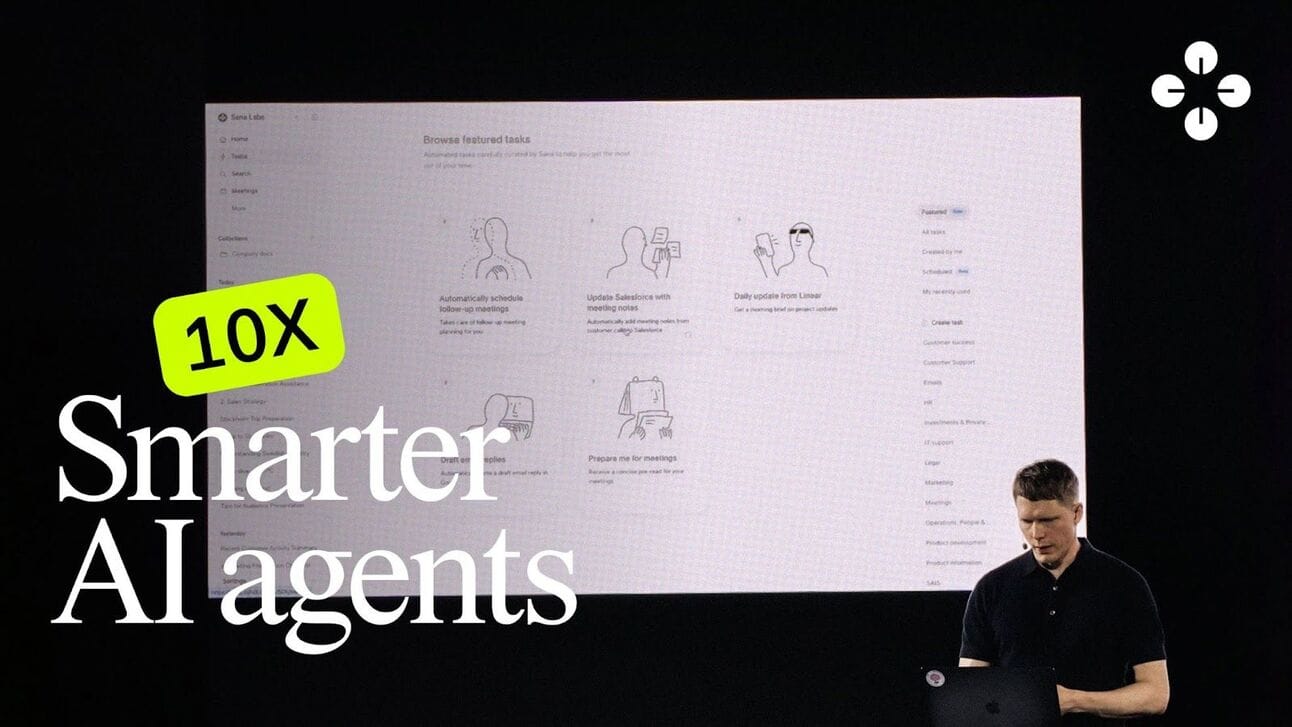
The Rundown: Sana’s enterprise AI agent platform took center stage at the AI Summit, demoed live for 500+ industry leaders. Trusted by Fortune 500 clients, Sana Agents automate thousands of critical workflows daily.
With Sana Agents, you’ll experience:
Up to 90% efficiency gains — launch agents in minutes, no dev bottlenecks
Seamless integration with 100+ tools like Salesforce, Office365, and Slack
Enterprise-grade security, full data control, and zero data retention for total peace of mind
Click here to skip the waitlist and see Sana Agents in action.
MISTRAL
🇫🇷 Mistral’s new open-source coding model
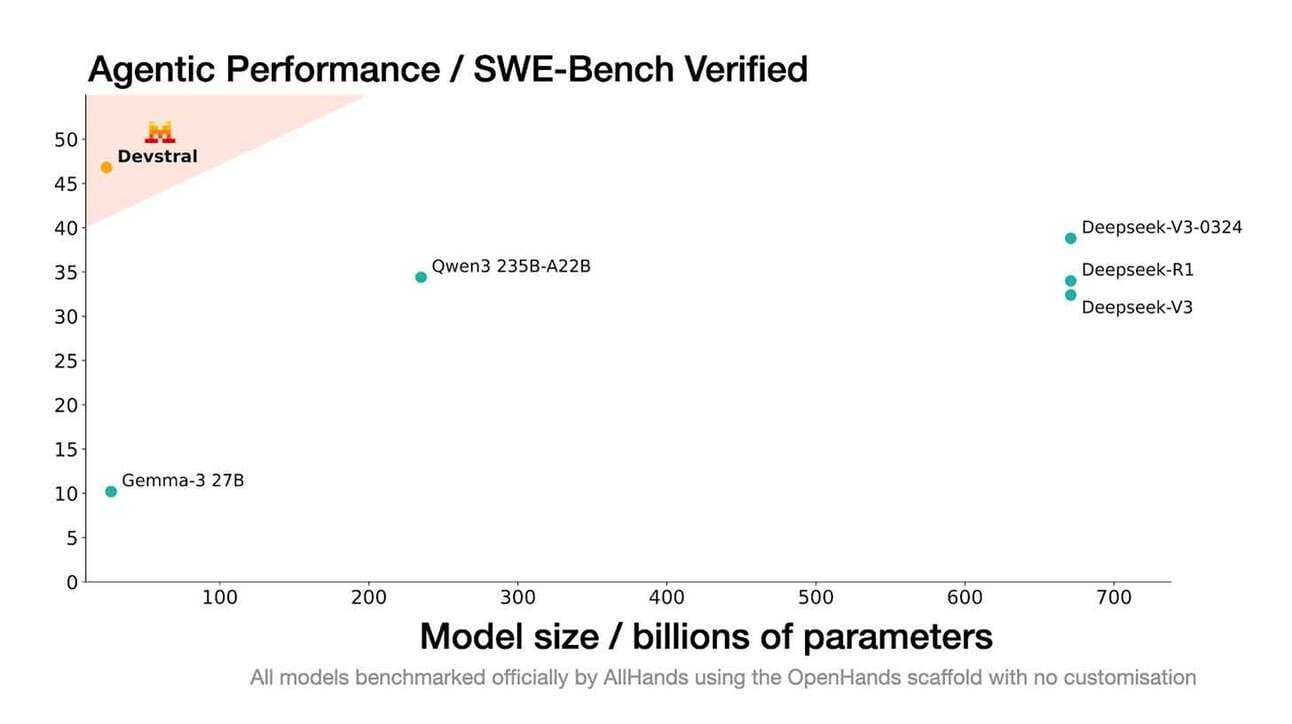
Image source: …
The Rundown: French AI startup Mistral just partnered with All Hands AI to release Devstral, a new open-source coding model that outperforms much larger rivals on software engineering tasks while being small enough to run on a laptop or single GPU.
The details:
Devstral beats all open-source and several closed models on benchmarks like SWE-Bench Verified, which measures real-world GitHub issues.
The model is optimized for agentic software development, allowing it to navigate entire codebases, edit files, and solve complex coding problems.
It is also lightweight enough to run locally on devices like Macs and features a permissive Apache 2.0 license for open usage.
Mistral also said they expect to release a larger agentic coding model in the coming weeks.
Why it matters: Mistral is back to its open-source ways after the closed launch of its Medium 3 model, making it clear that advanced, agentic coding assistants are going to be available in all shapes and sizes going forward. With a powerful small model and a larger one on the way, Mistral continues to provide strong alternatives to the AI giants.
AI TRAINING
📊 Export professional research reports as PDFs

The Rundown: In this tutorial, you will learn how to use ChatGPT's Deep Research to generate comprehensive reports with citations that you can download as well-formatted PDFs.
Step-by-step:
Open ChatGPT and select "Deep Research" from the model dropdown
Structure your prompt: Instruction + Context + Output Format
Let ChatGPT generate your comprehensive report with citations
Click the share icon and select "Download as PDF" for a professional document
Pro tip: The PDF download works for both new and past research reports in your chat history.
PRESENTED BY EMERGENT
💡 Ideas to apps without a single line of code
The Rundown: Emergent completely changes the workflow for app creators by turning descriptions into production-ready apps with no code required — allowing you to launch faster, smarter, and simpler products for everything from quick MVPs to full-scale platforms.
Emergent's workflow is simple:
Type what you want, like "a marketplace app with secure payments”
See your complete application built instantly with all necessary components
Fine-tune and customize to easily tweak designs and add new features
Go live to real users with a single click for instant deployments
Bring your idea to life today with code VIBEWITHRUNWAY.
SHOPIFY
💼 Shopify’s new AI store builder, tools
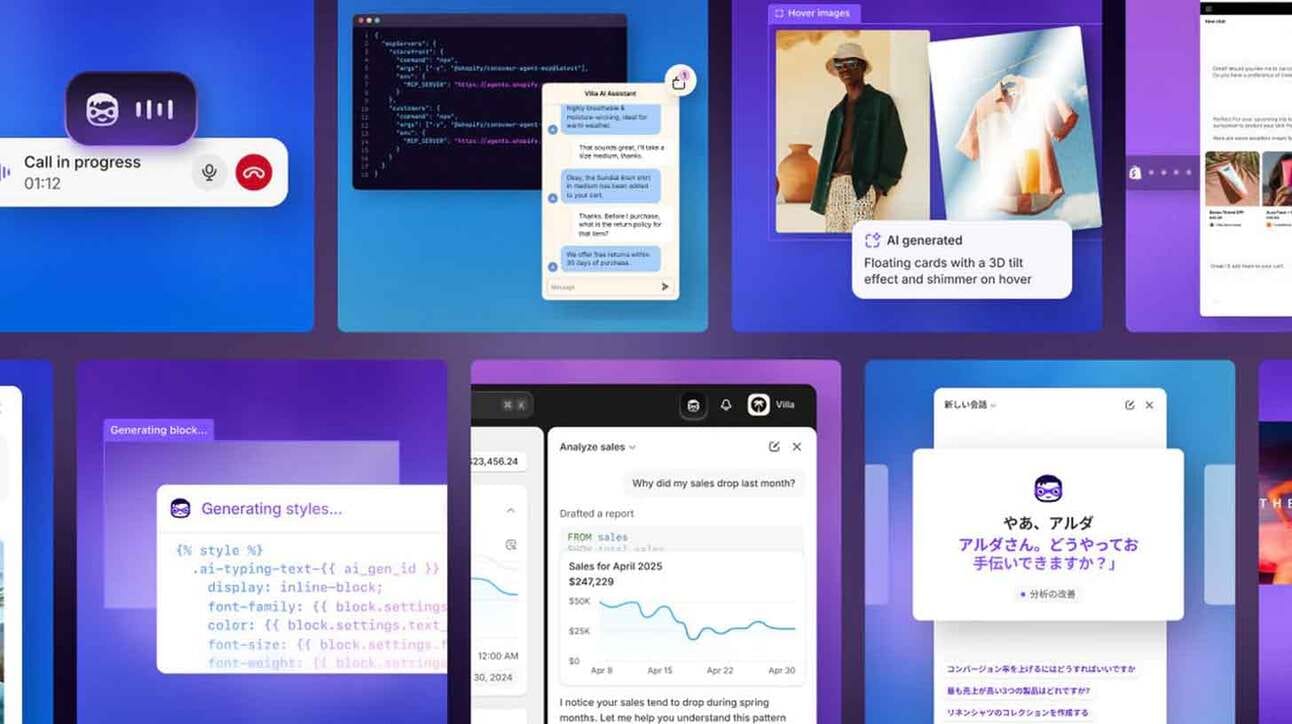
Image source: Shopify
The Rundown: Shopify just released its Summer '25 Edition, packed with AI-powered features, including an automated store builder that creates complete storefronts from simple text descriptions and major upgrades to its Sidekick AI assistant.
The details:
Shopify’s AI store builder lets merchants type descriptions to quickly generate ready-to-launch online stores with custom designs, images, and layouts.
The platform offers new AI-enhanced ‘Horizon’ themes, allowing merchants to customize their store designs without coding.
The upgraded Sidekick now supports voice conversations and screen sharing, and can also handle tasks like running reports and creating discount codes.
New AI shopping agent tools help merchants connect with customers browsing through conversational platforms like Perplexity for broader exposure.
Why it matters: As one of the primary gateways to e-commerce, Shopify’s AI push is quietly an on-boarder for mainstream adoption — with millions of small businesses and merchants able to take advantage of both AI-enhanced site building and an advanced assistant for business tasks and customer acquisition.
QUICK HITS
💼 AI Job Opportunities
🎨 The Rundown - Designer (Brand & Platform)
📂 Meta - Data Management Analyst
📈 Hebbia - Account Development Leadership
🚀 Databricks - Startup Account Executive
📰 Everything else in AI today
ByteDance released BAGEL, a new open-source multimodal foundation model that combines advanced image generation and understanding capabilities.
xAI introduced Live Search API, a new beta feature that allows apps leveraging Grok models to search real-time data from X and the internet.
OpenAI expanded its agentic app-building Responses API with new support for remote MCP servers, image generation, Code Interpreter, and more.
Google co-founder Sergey Brin said at I/O that the company “fully intends that Gemini will be the first AGI”, believing it will come before 2030.
OpenAI’s data center in Abilene, TX, secured $11.6B in new funding, expected to be the largest used by the company as it ramps up its Stargate infrastructure project.
AI benchmarking platform LMArena announced $100M in seed funding, also revealing plans for a new relaunch of the site next week.
COMMUNITY
🎥 Join our next live workshop
Join our next workshop this Friday, May 23rd, at 4 PM EST with Dr. Alvaro Cintas, The Rundown’s AI professor. By the end of the workshop, you’ll be up to speed on the latest from Google and ready to use their new tools in your own projects.
RSVP here. Not a member? Join The Rundown University on a 14-day free trial.
🤝 Share The Rundown, get rewards
We’ll always keep this newsletter 100% free. To support our work, consider sharing The Rundown with your friends, and we’ll send you more free goodies.
See you soon,
Rowan, Joey, Zach, Alvaro, and Jason—The Rundown’s editorial team

Google's massive AI showcase at I/O
Read Online | Sign Up | Advertise

Good morning, AI enthusiasts. Google’s hyped I/O event didn’t disappoint — with a barrage of AI upgrades across its models, agents, search platform, and creative suite.
And best of all? The Rundown was there to catch it all live from Mountain View, CA.
In today’s AI rundown:
Gemini, Search level up at Google I/O
Google’s suite of next-gen creative AI tools
Create professional video ads with AI timeline editing
FutureHouse’s AI makes first scientific discovery
4 new AI tools & 4 job opportunities
LATEST DEVELOPMENTS
GOOGLE I/O
🚀 Gemini, Search level up at Google I/O

Image source: The Rundown @ Google I/O
The Rundown: Google just unveiled major upgrades to its flagship Gemini and Gemma AI models at Google I/O, coming alongside new AI search and shopping features, a series of new agentic tools, and more.
Gemini / Models:
Gemini 2.5 Pro and Flash received updates, with Pro sweeping benchmarks and Arena leaderboards and Flash leveling up while maintaining speed.
A new “2.5 Deep Think” reasoning model is being released to testers, which shows new highs across math, coding, and multimodal reasoning benchmarks.
Gemma 3n launched in preview, a mobile-first open model that rivals larger models like Claude 3.7 Sonnet while being optimized for on-device use.
Gemini Live with camera and screen sharing rolled out for free to all users, with new personalization integrations launching in the coming weeks.
Search / Agents:
AI Mode in search will now be powered by Gemini 2.5 and is going live for all U.S. users, alongside new ‘Deep Search’ and Gemini Live embedded features.
Other AI Mode features include a virtual try-on tool, agentic shopping assistance, and Search Live for real-time, multimodal voice queries.
Google's coding agent Jules entered public beta, with the ability to work on developer tasks in the background and integrate directly with codebases.
Both Search and Gemini are gaining Agent Mode, which can complete as many as 10 tasks simultaneously on a user’s behalf.
Why it matters: These I/O releases feel like the culmination of years of research projects finally coming to life throughout the company’s sprawling AI ecosystem. The search upgrades also represent a major evolution, with new personalization and live capabilities that drastically change how users will interact with its flagship product.
TOGETHER WITH ANGELQ
👦 Your child’s first AI

The Rundown: From the creators of KidRails for LLMs, AngelQ is launching the ultimate super browser for kids. AngelQ’s AI-powered, kid-safe search helps your child learn faster, explore more, and stay protected every step of the way.
AngelQ's kid-safe features include:
Asking questions and receiving age-appropriate answers.
Advanced research capabilities specifically designed for young minds
Videos and image search without ads or inappropriate content
Get a free year of AngelQ with code Rundown365.
GOOGLE I/O
🌌 Google’s suite of next-gen creative AI tools

Image source: Google
The Rundown: Google also announced a flurry of new creative models and tool upgrades at I/O, including the new Veo 3 and Imagen 4 models, a new AI filmmaking platform, Lyria music upgrades and broader availability, and more.
The details:
The next-gen Veo 3 video model can generate synchronized audio, including sound effects, ambient sounds, and dialogue alongside video outputs.
Veo 2 receives new filmmaker-focused features like character and scene consistency, camera movement controls, and inpainting and outpainting editing.
The new Imagen 4 model brings new quality improvements and the ability to render fine details and precise typography, with support for 2k resolution.
Flow combines AI models into a filmmaking platform, allowing for the creation of scenes using natural language and character, scene, and style management.
The new models are available with the company’s new Google AI Ultra plan for $250 / mo and via Google’s Vertex enterprise platform.
Why it matters: Google continues to cook in the creative suite, with some impressive upgrades on the image and video/filmmaking front that look to take the next step up for the industry. The addition of synced audio to SOTA video brings a brand new control and coherence to generations that will unlock a wild amount of creative options.
AI TRAINING
🎬 Create professional video ads with AI timeline editing

The Rundown: In this tutorial, you will learn how to use LTX Studio's timeline feature to transform simple text prompts into fully edited videos with music, sound effects, and voiceovers in minutes.
Step-by-step:
Start an LTX Studio project and create shots by entering text prompts in the storyboard view
Transform still images into videos in the motion editor by selecting your favorite video models
Adjust clip lengths, rearrange order, and layer shots in the timeline view
Include soundtracks, voiceovers, auto sound effects, and adjust character expressions
Pro tip: Check out our exclusive workshop on how to use the timeline editor of LTX Studio here. Additionally, full Rundown University members enjoy a free month of the Standard Plan.
PRESENTED BY HOISTINGER HORIZONS
🚀 Launch apps and websites in minutes with no code

The Rundown: Hostinger Horizons is making web development accessible to everyone with a no-code platform that turns simple prompts into beautiful, functional websites and web apps in minutes — all without writing a single line of code.
With Hostinger Horizons, you can:
Create and edit with simple natural language conversations and image uploads
Enable logins, accept payments, and go live with a single click
Launch professionally hosted sites with custom domains, email, and 24/7 live support
FUTUREHOUSE
👁️ FutureHouse’s AI makes first scientific discovery

Image source: FutureHouse
The Rundown: FutureHouse announced that their multi-agent AI system "Robin" made its first major scientific breakthrough, identifying a promising new treatment for dry age-related macular degeneration — a leading cause of blindness.
The details:
Robin autonomously generated hypotheses, designed experiments, analyzed data, and created research figures, with humans handling the physical lab work.
The system identified ripasudil, a drug already approved in Japan for glaucoma, as a novel treatment candidate for dAMD — which was confirmed in lab tests.
Robin's code and data will be open-sourced next week, along with agents Crow (literature search), Falcon (deep review), and Finch (data analysis).
Why it matters: Along with coding, science feels like one of the first frontiers that will see the quickest transformation to AI-human collaboration across workflows — both fast-tracking research and expanding the limits of how researchers propose and design new experiments and hypotheses.
QUICK HITS
🛠️ Trending AI Tools
⚙️ GitHub Copilot Coding Agent - Fully autonomous agent for coding tasks
🔬 Microsoft Discovery - AI R&D enterprise platform for scientific research
🤖 Magentic-UI - Microsoft’s open-source human-centric web agent
📝 NotebookLM - Google’s AI podcast and info tool, now available for Android
💼 AI Job Opportunities
🎨 Runway - Sr. Brand Designer
🧱 Together AI - Senior Data Engineer
👁️🗨️ Meta - Computer Vision Engineer
🧑💻 DeepL - Staff Product Designer
📰 Everything else in AI today
Tencent released Hunyuan Game, an AI-powered game production engine for streamlining the creative process of game development.
Google announced Google Beam, a communications platform that uses AI to convert 2D video streams into 3D immersive experiences.
Intelligent Internet open-sourced II-Agent, a new agent framework that surpasses industry-leading agents on benchmarks with strong performance across tasks.
Google launched Stitch, a new experiment in Labs allowing users to quickly create impressive user interfaces via simple text prompts or reference images.
Apple is reportedly planning to open its AI models to third-party developers, allowing app creators to build on the language models behind Apple Intelligence.
Google provided new demos of its Android XR smartglasses powered by Gemini, also announcing partnerships with Warby Parker and other eyewear brands.
COMMUNITY
🎥 Watch our last live workshop

We just held a workshop with Canva on how to scale visual content creation using Canva Sheets, Magic Write, and AI-powered tools — with no design experience required.
Watch it here. Not a member? Join The Rundown University on a 14-day free trial.
See you soon,
Rowan, Joey, Zach, Alvaro, and Jason—The Rundown’s editorial team

Google I/O kicks off
Read Online | Sign Up | Advertise
Good morning, tech enthusiasts. Google’s biggest developer conference, Google I/O 2025, kicks off today, with AI set to be the star of the show.
As tech giants vie for dominance in the AI arena, this year’s event promises a showcase of cutting-edge innovations — offering not just a window into Google’s future but a preview of the AI-powered tech set to transform our everyday lives.
In today’s tech rundown:
Google I/O kicks off, and it’s all about AI
China starts building a supercomputer in space
TikTok wants teens to stop scrolling and meditate
Airbnb aims to be an ‘everything app’
Quick hits on other major news
LATEST DEVELOPMENTS
☁️ Google I/O kicks off, and it’s all about AI

Image source: Google
The Rundown: Google’s biggest developer conference, I/O 2025, starts today with AI firmly in the spotlight — promising major upgrades to Gemini, new agentic tools like Project Astra, and deeper integration across Android, Search, and XR.
The details:
The spotlight will be on Google’s Gemini AI, with new features, smarter models, and deeper integration into Google TV, Wear OS 6, and more.
Demos of Google’s next-gen AI agent, Project Astra, are anticipated, highlighting real-time AI capabilities and integration with smart glasses.
While some Android 16 features were revealed last week, more details are expected today, including security, privacy, and accessibility features.
Announcements about Google’s XR platform and the debut of its smart glasses— likely featuring a live on-stage demo — are also expected.
Why it matters: Googlers are anticipating the reveal of the Project Moohan XR platform and the introduction of the new Material 3 design language. But more than anything, this year’s I/O is marked by Google’s ambitious push to make AI central to everything it does—positioning itself to lead the next era of technology..
ADA SPACE
🚀 China starts building a supercomputer in space

Image source: China Aerospace Science and Technology Corporation
The Rundown: China just launched the first 12 satellites of its ambitious 2,800-satellite “Three-Body Computing Constellation,” marking a major milestone in building the world’s first dedicated orbital supercomputing network.
The details:
The satellites, developed by ADA Space, can process data directly in orbit using advanced AI, reducing the need to send raw data back to Earth.
Each satellite can process vast amounts of information, promising a combined computing capacity of 5 peta operations per second (POPS).
Equipped with an 8B-parameter AI model, each satellite can handle 744 trillion operations per second, with inter-satellite communication at up to 100 Gbps.
The network will also feature 30TB of onboard storage, supporting real-time, in-orbit data analysis for applications like emergency response and research.
Why it matters: The Chinese space network’s projected capacity of 5 POPS is about three times more powerful than the El Capitan supercomputer. And with plans to scale up to 1,000 POPS, China aims to far exceed the capabilities of any Earth-based system, potentially setting a new benchmark for space-based computing and AI infrastructure.
TIKTOK
😵💫 TikTok wants teens to stop scrolling and meditate

Image source: TikTok
The Rundown: In the face of allegations that it lures teens into late-night scrolling, TikTok has launched a new in-app guided meditation feature that activates automatically when a user under 18 is on the app after 10 p.m.
The details:
The “Meditation in Sleep Hours” tool interrupts your feed with a meditation prompt featuring soothing visuals and music and guided breathing exercises.
If teens continue to use the app after the first meditation prompt, they receive a second, full-screen notification that is harder to dismiss.
Adults can activate the feature at any time from the Screen Time settings within the app and choose their preferred meditation schedule.
In trials, TikTok said 98% of teens who used the meditation feature chose to keep it enabled, suggesting strong engagement among young users.
Why it matters: TikTok’s introduction of the meditation feature comes as the company faces a wave of lawsuits and mounting criticism over its impact on youth’s mental health with prolonged doomscrolling, especially at night. To counteract the bad buzz, the company has also pledged $2.3M in ad credits to mental health organizations.
AIRBNB
🏡 Airbnb aims to be an ‘everything app’

Image source: Airbnb
The Rundown: Airbnb wants to transform itself into an “everything app” by expanding far beyond home rentals to offer a wide range of services and experiences, aiming to become a daily-use lifestyle platform.
The details:
Airbnb’s 2025 Summer Release marks the first phase of this strategy, introducing a redesigned app and new offerings called Airbnb Services.
Users can now book a wide range of services, from private chefs to massages, even if they’re not staying in an Airbnb.
At launch, over 10K vendors are offering services in 260 cities across 30 countries, with plans to expand into hundreds of service categories.
Airbnb’s Explore tab now lets users browse homes, services, and experiences worldwide, while the revamped Trips tab offers a comprehensive travel itinerary.
Why it matters: Airbnb CEO Brian Chesky has described the shift as similar to Amazon’s evolution from bookseller to the “everything store,” positioning Airbnb to rival global superapps like WeChat and Grab. This strategic shift also addresses emerging competition from generative AI and agent-based travel planning.
QUICK HITS
📰 Everything else in tech today
Chinese electric vehicle battery maker CATL raised at least $4.6B when it debuted on the Hong Kong stock exchange today, marking the world’s biggest IPO this year.
Biotech firm Regeneron is buying genetic testing company 23andMe, once valued at more than $6B, out of bankruptcy for $256M.
Netflix says it will roll out AI-generated ads in 2026 for its ad-supported tier that will play in the middle of a show or whenever users hit pause.
Trump signed the “Take It Down Act,” a bipartisan measure to curtail the distribution of nonconsensual intimate images and AI-generated deepfakes, into law on Monday.
Apple is reportedly preparing to let iPhone users in the EU designate third-party voice assistants such as Amazon’s Alexa or Google Assistant as the system default over Siri.
Nikola, a hydrogen trucking company, is up for auction after filing for bankruptcy, with $114M worth of hydrogen trucks and material up for sale.
Aurora Innovation reversed its recent move to operate fully driverless trucks in Texas by placing a human observer back in the driver’s seat.
AI startup Doji raised $14M in seed funding for an app that lets users instantly try on any clothing they can link to, creating photo-realistic virtual fashion avatars.
Waymo, a subsidiary of Alphabet, received California’s approval to expand its driverless ride-hailing service to include San Jose and parts of the South Bay.
Revolut, a British fintech company that generated $3.8B in revenue last year, announced plans to invest over $1.1B in France over the next three years.
COMMUNITY
🎥 Join our next live workshop

Join our live workshop today at 5pm EST with Danny Wu (Head of AI at Canva) and Kelsey Moore (Product Marketing Manager). In this hands-on session, you’ll learn how to scale your visual content creation using Canva Sheets, Magic Write, and AI-powered tools — no design experience required. Discover how Canva AI is helping marketers and content teams generate social media assets in bulk.
RSVP here. Not a member? Join The Rundown University on a 14-day free trial.
See you soon,
Rowan, Jennifer, and Joey—The Rundown’s editorial team
No matching search results
Try using different keywords, double-check your spelling, or explore related categories.
Stay Ahead on AI.
Join 2,000,000+ readers getting bite-size AI news updates straight to their inbox every morning with The Rundown AI newsletter. It's 100% free.