Get the latest AI news, understand why it matters, and learn how to apply it in your work — all in just 5 minutes a day. Join over 2,000,000+ subscribers.

Exclusive: Microsoft's hybrid AI vision

Good morning, AI enthusiasts. Microsoft has been all over the news lately with its bold vision to completely rebuild Windows PCs around AI.
But while everyone's been debating whether AI should live in the cloud or on your device, the tech giant quietly chose both through a unique hybrid AI approach.
So, we partnered up with Microsoft and Pavan Davuluri, Corporate Vice President of Windows and Devices, to find out more through an exclusive Q&A on Copilot+ PCs, NPU architecture, and the future roadmap of Windows.
In today’s AI rundown:
Microsoft’s bold hybrid AI vision
Enabling on-device AI experiences
How AI workloads are distributed
Windows evolves toward autonomous AI agents
EXCLUSIVE Q&A PAVAN DAVULURI
HYBRID AI
👀 Microsoft’s bold hybrid AI vision

Image source: Kiki Wu / The Rundown
The Rundown: Microsoft is fundamentally restructuring Windows around a hybrid AI architecture that dynamically routes workloads between local neural processing units (NPUs) and cloud compute—positioning itself to control both ends of the spectrum.
Cheung: “Why is Windows betting on a hybrid AI approach that blends both local and cloud together?”
Davuluri: “Our thesis, when we started the Copilot+ PC journey last year, was to bring highly accelerated AI compute to the edge in an energy-efficient form factor.”
Davuluri added: “The long-term vision and true differentiation will stem from our ability to compute and provide context appropriately for the underlying experience, whether it be client-based, cloud-based, or a combination of both.”
Cheung: “When Microsoft introduced Copilot+ PCs last year, it established a 40+ TOPS NPU as the new performance benchmark for AI PCs. What was the rationale behind this requirement?”
Davuluri: “We believe technology should adapt to you, not the other way around, and to make the vision a reality, we needed to raise the bar for what was possible to run sustained AI workloads on a device.”
Davuluri added: "We had some intuition on the trajectory of how AI and AI-compute silicon were evolving and given memory boundedness at scale—where we would have a requirement that was scalable and still pushed what was possible on client silicon."
Why it matters: Microsoft is building infrastructure to capture value from AI workloads whether AI's future is local, cloud, or both. By designing Copilot+ PCs that scale with advancing models and forcing the industry to meet their 40+ TOPS standard, the company is betting that their hardware becomes more valuable over time.
PRACTICAL BENEFITS
🖥️ Enabling on-device AI experiences

Image source: Kiki Wu / The Rundown
The Rundown: Microsoft is now delivering AI experiences that run entirely on-device through Copilot+ PCs, breaking the traditional model where advanced AI features require cloud subscriptions, usage tokens, or constant internet connectivity.
Cheung: "Day-to-day, what tangible improvements can users actually feel from NPU-powered Windows?"
Davuluri: "Copilot+ PCs are the only PCs where you can find professional-grade AI editing tools like Relight and super resolution in Photos, or Cocreator, with no subscription or tokens required."
Davuluri added: "You can run AI efficiently without draining your battery, without an internet connection, and when you want the security promise of your data staying on device, you get that too."
Cheung: "Why is running local models a benefit to users?"
Davuluri: "Local models on a device have advantages that can complement cloud-powered AI experiences, particularly in areas of privacy, latency, and offline usage—a good example being our first agent in Windows, the agent in Settings."
Davuluri added: "As local SLMs improve with reasoning capabilities, the potential applications increase—especially if you look at the benchmarks of something like Phi-4 Reasoning and the fact that we can now run 14B parameter models on-device.”
Why it matters: With on-device NPUs, Microsoft can run AI locally and eliminate some subscription fees while delivering enhanced privacy and performance. As small language models (SLMs) continue to advance, Copilot+ PCs shift users toward highly capable AI they truly own rather than ‘rent’ through cloud services.
NPU
🧠 How AI workloads are distributed

Image source: Kiki Wu / The Rundown
The Rundown: To handle new AI experiences, Microsoft added a third processor to PCs—the neural processing unit (NPU)—which changes how AI computation works by offloading AI tasks from the CPU and GPU, allowing each to focus on what they do best.
Cheung: “What are the practical advantages of using NPUs versus GPUs or CPUs for AI workloads?”
Davuluri: "CPUs were built to process scalars—multiplying two numbers. When GPUs came along, they were optimized for vectors—multiplying many numbers together in parallel. NPUs are domain specific silicon purpose-built to run computation for models such as neural networks."
Davuluri added: "Because the NPU adds a third processor to your Windows PC, it also adds the unique benefit of freeing the GPU and CPU to do what they're best at, while enabling the AI workloads to run efficiently and consistently in the background."
Davuluri added: “This is the path to pervasive AI.”
Cheung: “What are some concrete examples of how NPU efficiency enables unique experiences for users?“
Davuluri: “A good example is Recall. This is something that runs in the background, doesn't eat up battery life, which is the type of AI feature that enables a host of new experiences that weren't possible before at this price point.”
Davuluri added: "A notable feature of the NPU on the Copilot+ PC is that it is an open platform, which allows for the execution of any model using Windows ML, a high-performance local inference runtime built directly into Windows."
Why it matters: Microsoft's Copilot+ PCs integrate next-gen NPUs from AMD, Intel, and Qualcomm—engineered to offload and accelerate complex AI tasks locally. This enables advanced features like Recall, Live Translations, and Super Resolution, while allowing developers to explore and innovate in ways we’ve only begun to imagine.
AGENTIC FUTURE
🔮 Windows evolves toward autonomous AI agents

Image source: Kiki Wu / The Rundown
The Rundown: Microsoft is building toward a future where Windows becomes an agentic platform, with AI that runs long-running reasoning loops locally, understands context across applications, and can autonomously complete complex tasks.
Cheung: "Over the next few years, where will Copilot+ PCs benefit the most as small language models accelerate? How do you see AI workloads evolving on-device?"
Davuluri: "I think over time what you're going to find is that we're going to evolve to a place where agentic experiences are going to become more front and center for people on a daily basis."
Davuluri added: "Where we see significant potential is AI being able to perform tasks on your PC asynchronously through long-running reasoning loops. This occurs entirely on the PC, allowing efficient computation and reasoning with NPUs."
Cheung: "What do you see as the biggest greenfield opportunity areas for local AI—what use cases will be the most transformational for users?"
Davuluri: "Local AI will be transformational in enabling always-on AI experiences. Things like deep personalization and context setting, making it easier to use the computer to get what you need. Commanding rather than pointing."
Davuluri added: "Just like we do not use the full capacity of our brain in every moment, having a stack that scales AI compute from client to cloud is a core capability we're building into Windows to bring the best of both worlds together."
Why it matters: Microsoft is reimagining Windows as the platform where AI becomes proactive rather than reactive. With local processing handling context while cloud manages reasoning, next-gen experiences could shift from "point and click" to "command and delegate"—changing how we interact with future computers.

SpaceX (still) eyes 2026 Mars mission
Read Online | Sign Up | Advertise

Good morning, tech enthusiasts. Just days after SpaceX’s Starship notched its third straight test-flight flop, Elon Musk doubled down on his bold claim: the giant rocket is heading to Mars next year.
Why the rush for 2026? That’s when a rare planetary alignment opens up the shortest route to the Red Planet. But with Starship racking up fiery headlines, the question remains: is this cosmic hype or actually plausible?
In today’s tech rundown:
Musk eyes 2026 Mars mission despite all odds
New e-tattoo tracks stress and boredom at work
Neuralink scores $600M at a $9B valuation
Perplexity’s tool for crafting apps and reports
Quick hits on other major news
LATEST DEVELOPMENTS
SPACEX
🚀 Musk eyes 2026 Mars mission despite all odds

Image source: SpaceX
The Rundown: Mere days after SpaceX’s Starship endured its third straight test-flight setback, Elon Musk says he still anticipates the massive spacecraft will embark on its inaugural uncrewed mission to Mars by the close of next year.
The details:
The Starship rocket, at 123 meters tall, is the largest and most powerful ever built, but its development has been marred by multiple high-profile failures.
Musk’s timeline hinges on overcoming significant technical challenges, especially the need for in-orbit refueling for the months-long voyage.
Starship plans to carry a simulated crew made up of Tesla’s Optimus robots, with the first human landings targeted for as early as 2029.
Interestingly, in a video posted online from SpaceX headquarters, Musk also hedged his bets, saying a successful mission in 2026 was only 50% likely.
Why it matters: Although SpaceX had announced that Musk would present the company’s Mars colonization plans in a livestream ahead of Starship’s latest test flight, the webcast never aired as planned. Still, it seems SpaceX remains committed to its Mars plans, despite the immense engineering challenges of deep-space exploration.
UNIVERSITY OF TEXAS
🩺 New e-tattoo tracks stress and boredom at work

Image source: University of Texas at Austin
The Rundown: Stressed or tired at work? A new “e-tattoo” can track that. Researchers at the University of Texas at Austin have engineered a wireless electronic e-tattoo that offers real-time monitoring of brain activity and eye movements.
The details:
Engineered to track cognitive fatigue in high-stakes fields such as air traffic control, the e-tattoo analyzes brain activity in real time.
By monitoring neural signals, it can accurately detect levels of mental effort and alert users when they are approaching cognitive overload.
Weighing at 2.5 grams with just 1 mm thick (without the battery), the e-tattoo is exceptionally lightweight and thin.
It monitors vital health metrics, including ECG, seismocardiogram (SCG), blood oxygen saturation (SpO₂), heart rate, skin temperature, and hydration levels.
Why it matters: Unlike bulky EEG caps or medical monitors, the e-tattoo is ultra-thin, flexible, and can be worn during everyday activities or demanding jobs. It’s still an early-stage tech, requiring further form-factor refinements, but experts think it could open up new possibilities for real-time, continuous tracking of brain and heart health.
NEURALINK
🧠 Neuralink scores $600M at a $9B valuation

Image source: Neuralink
The Rundown: Elon Musk’s brain-computer interface (BCI) startup, Neuralink, has reportedly pulled in $600M in fresh funding, propelling its pre-money valuation to $9B— a dramatic leap from the $5B reported less than a year ago.
The details:
The round reportedly attracted heavyweight investors, including Peter Thiel’s Founders Fund and Google Ventures.
Neuralink recently earned the FDA’s “breakthrough device” designation, a critical regulatory milestone that accelerates the path to clinical trials.
In human trials, the company’s N1 device successfully enabled paralyzed individuals to control digital devices using only their thoughts.
Neuralink faces competition from Synchron and Precision Neuroscience, which are also advancing BCI technology but with their own different approaches.
Why it matters: Neuralink is now preparing for clinical trials of its “Blindsight” device, aiming to restore vision for the blind. Despite fierce competition, Neuralink’s soaring valuation and high-profile backers highlight the market’s bullish outlook on BCIs—a field that could soon redefine the boundaries between human and machine.
PERPLEXITY
📊 Perplexity’s tool for crafting apps and reports

Image source: Perplexity
The Rundown: Perplexity, the AI-powered search engine taking on Google, just launched Perplexity Labs — a feature designed to transform user prompts into structured applications like dashboards, reports, storyboards, and charts.
The details:
Labs can autonomously work for 10 minutes or more, leveraging tools like deep web browsing, live code execution, and chart and image generation.
The platform organizes all generated assets—such as charts, CSVs, images, and code files—into a unified Assets tab accessible via a dedicated App tab.
It is available on the web, iOS, and Android (Mac and Windows app support coming soon) for Pro users paying $20 per month.
The launch comes as Perplexity is also said to be in talks to raise $1B in funding at an $18B valuation.
Why it matters: The launch of Labs follows Perplexity’s broader expansion efforts, including the announcement of its Comet web browser and the acquisition of Read.cv. While we’re yet to try it, the move is part of Perplexity’s goal to cover everything from information retrieval to hands-on content creation for enhanced productivity.
QUICK HITS
📰 Everything else in tech today
Meta AI says that it now has 1B monthly active users across its apps, doubling the 500M monthly active users reported in September 2024.
Starbase, Texas — home to SpaceX’s launch facilities — reportedly notified some residents that they may forfeit “the right to continue using their properties.”
Apple’s U.S. App Store ecosystem enabled $406B in developer billings and sales in 2024, a figure that has nearly tripled since 2019, when it facilitated $142B.
Chinese technology companies are making moves to secure their AI ambitions amid uncertainty about future access to Nvidia’s chips, according to new reports.
Elon Musk’s xAI has agreed on a $300M deal with Telegram (in principle) to bring its Grok chatbot to more than a billion messaging app users this summer.
The New York Times signed its first AI licensing agreement with Amazon, granting the tech giant permission to use its editorial content to train its AI models.
A new Texas law, which Apple CEO Tim Cook tried to block, now requires Apple and Google to verify the ages of users accessing their app stores.
Tinder is testing a new height preference feature that allows Gold and Premium subscribers to set their desired height range for potential matches.
Xiaomi introduced its new electric sport utility vehicle, the YU7, in 13 showrooms across Beijing as a direct competitor to Tesla's Model Y.
AI startup Grammarly secured a $1B commitment from investment company General Catalyst to bolster its sales and marketing efforts.
Social network X announced a temporary suspension of its encrypted DMs while it works on enhancements to the feature.
COMMUNITY
🎥 Join our next live workshop

Join our next workshop today at 4 PM EST with Dr. Alvaro Cintas, The Rundown’s AI professor. By the end of the workshop, you’ll confidently be able to use AI coding agents to improve your development workflow.
RSVP here. Not a member? Join The Rundown University on a 14-day free trial.
See you soon,
Rowan, Jennifer, and Joey—The Rundown’s editorial team

New York Times, Amazon ink AI deal
Read Online | Sign Up | Advertise

Good morning, AI enthusiasts. One of journalism’s last major AI holdouts just fell — with the New York Times officially signing its first-ever AI licensing deal with Amazon.
Despite ongoing lawsuits against OpenAI and Microsoft, a change in user habits (and financial streams for editorial outlets) may be forcing a decisive new chapter in the industry’s uneasy AI embrace.
In today’s AI rundown:
NYT signs AI licensing agreement with Amazon
Black Forest Labs’ new image editing model
Automate patient consultation documentation
AI achieves first peer-reviewed paper acceptance
4 new AI tools & 4 job opportunities
LATEST DEVELOPMENTS
THE NEW YORK TIMES & AMAZON
📰 NYT signs AI licensing agreement with Amazon

Image source: Gemini / The Rundown
The Rundown: The New York Times just struck its first-ever AI licensing deal with Amazon, allowing the company to use NYT editorial content across its platforms and to train its AI models.
The details:
The multi-year deal covers licensed content, including articles from the Times, recipes from NYT Cooking, and sports content from The Athletic.
Amazon will incorporate the content into products like Alexa smart speakers, which will attribute NYT content and provide links for a full reader experience.
The deal is the NYT’s first AI licensing deal, and comes amidst ongoing lawsuits against OpenAI and Microsoft over the use of its content for training.
Why it matters: One of the last major holdouts in journalism is finally giving in to the AI wave — but is notably (though unsurprisingly, at least in OpenAI’s case) going with Amazon over stronger AI rivals. The tech has quickly changed how and where users consume content, and even the staunchest detractors are now changing course.
TOGETHER WITH TELY AI
💰 Get organic SEO leads on full autopilot

The Rundown: With Tely AI, you don’t need an SEO expert or content team — AI does it for you. Tely AI learns your business, niche, and competitors, then creates niche-specific content for topics your customers are already searching for.
Tely AI does SEO for you on autopilot:
Deep keyword research and topic selection.
Publishes 60+ articles and lead magnets monthly on autopilot
Gets content indexed by Google in 2 weeks and first traffic in 30 days
Works in EN, FR, DE, ES, PT, and other languages
BLACK FOREST LABS
🎆 Black Forest Labs’ new image editing model

Image source: Black Forest Labs
The Rundown: Black Forest Labs just launched FLUX.1 Kontext, a new AI system that understands both text and images — enabling users to edit and transform images with simple text commands while maintaining character consistency across iterations.
The details:
Unlike other text-to-image models, Kontext processes visual and text inputs together, enabling targeted editing at speeds up to 8x faster than rival models.
The system excels at character preservation, local editing, style transfer, and maintaining consistency across multiple steps and versions of an image.
BFL released two versions: Kontext [pro] for fast multi-step editing and [max] for higher quality, better prompt following, and enhanced typography.
The company also introduced Playground, a web-based platform for businesses to test models before integrating them via APIs.
Why it matters: OpenAI’s 4o / gpt-image-1 release was a major step forward in editing via text prompts, but often appears to recreate its own rendering of an image rather than preserving important details for specific characters. BFL’s latest release looks to be a step up in maintaining consistency at much faster speeds.
AI TRAINING
🏥 Automate patient consultation documentation

The Rundown: In this tutorial, you will learn how to build an automated system that transcribes your patient consultations, generates medical summaries, extracts treatment plans, and compiles everything into a document.
Step-by-step:
Visit Zapier Agents, click the plus button, and create a “New Agent”
Configure your agent to trigger when new (anonymized) audio files are uploaded to a specified folder in Google Drive
Add three essential tools: ChatGPT to transcribe the audio, ChatGPT again to create a medical summary and extract treatment recommendations, and Google Docs to compile everything into a structured clinical document
Test your setup with simulated data and activate your agent
Note: Always obtain patient consent before recording, remove identifiable info before processing, and ensure storage methods comply with healthcare privacy regulations.
PRESENTED BY GOOGLE CLOUD
📶 Level up your agentic AI game

The Rundown: Startup School: Agentic AI from Google Cloud is back with expert-led workshops that provide actionable strategies for integrating agent technology into your startup's core offerings.
Join this training series for:
Insights into agent capabilities and why there's never been a better time to adopt them
Hands-on guidance for implementing Google Cloud's AI tools and pre-trained models
Access to Google Cloud and AI experts to help solve your scaling challenges
Register for Startup School: Agentic AI now — it all starts on June 10.
INTOLOGY AI
🧪 AI achieves first peer-reviewed paper acceptance

Image source: Intology
The Rundown: Intology AI's Zochi just became the first AI to independently achieve peer-reviewed publication at ACL 2025, an A* natural language processing conference, showing the ability to conduct scientific research at the highest academic standards.
The details:
Zochi autonomously completed the entire research process, from analyzing thousands of papers to designing experiments and writing the manuscript.
The system's "Tempest" paper on multi-turn jailbreaking achieved a 4.0 meta-review score, placing it in the top 8.2% of all ACL submissions.
Operating without human intervention except for formatting fixes, Zochi identified research gaps, implemented new methods, and validated results.
Intology plans to release Zochi in beta as a collaborative research tool, starting with a general copilot before expanding to full autonomous capabilities.
Why it matters: We’ve seen plenty of competition in the AI scientist arena, but ACL’s selective acceptance rate and the paper’s score reflect one of the most impressive publications to date from an agentic system. As AI begins contributing original research alongside humans, the pace of discovery is about to exponentially increase.
QUICK HITS
🛠️ Trending AI Tools
🤖 DeepSeek R1 - New upgraded reasoning and overall improvements
🖥️ Neon - Opera’s new agentic web browser
🎥 Gemini in Drive - Summarize and ask questions about Google Drive videos
🛠️ Retool Agents - Turn your APIs & data into tools AI workers can use
📰 Everything else in AI today
DeepSeek’s new update to its R1 model moved into the No. 3 slot on the Artificial Analysis leaderboard, now behind only OpenAI’s o3 and o4-mini.
Tencent’s Hunyuan released HunyuanVideo-Avatar, an open-source model that turns still images into short videos with sound.
Perplexity launched Labs, a new feature for Pro users that enables content creation like analytical reports, through multi-tool integrations for more complex tasks.
Hume released EVI 3, a new speech language model that creates custom voices through speech-to-speech interaction and outperforms OpenAI's GPT-4o in testing.
Resemble AI open-sourced Chatterbox, a free new voice cloning model that the company claims surpasses leaders like ElevenLabs in testing.
Manus introduced Manus Slides, a new feature allowing the agentic system to create tailored slide decks autonomously.
COMMUNITY
🎥 Join our next live workshop

Join our next workshop today at 4 PM EST with Dr. Alvaro Cintas, The Rundown’s AI professor. By the end of the workshop, you’ll confidently be able to use AI coding agents to improve your development workflow.
RSVP here. Not a member? Join The Rundown University on a 14-day free trial.
🤝 Share The Rundown, get rewards
We’ll always keep this newsletter 100% free. To support our work, consider sharing The Rundown with your friends, and we’ll send you more free goodies.

See you soon,
Rowan, Joey, Zach, Alvaro, and Jason—The Rundown’s editorial team

Smartphone giant Honor enters humanoid race
Read Online | Sign Up | Advertise

Good morning, robotics enthusiasts. Chinese smartphone giant Honor is now jumping into the humanoid game as part of a $10B plan to pivot from screens to advanced AI.
As rivals Xiaomi and Vivo double down on robotics, Honor’s fusion of cutting-edge hardware and open AI ecosystems may give it an edge. Ready to see how the smartphone wars are evolving into the era of smart robots?
In today’s robotics rundown:
Smartphone giant Honor to build humanoids
UBTech takes on Tesla with $20K humanoid
Rivr’s delivery robot dog comes to the U.S
China hosts the first humanoid boxing event
Quick hits on other robotics news
LATEST DEVELOPMENTS
HONOR
🤖 Smartphone giant Honor to build humanoids

Image source: Joahsoam Hauo Mingea/Wikimedia Commons
The Rundown: Chinese smartphone giant Honor just announced a major push into robotics as part of its $10B investment aimed at transforming the company from a smartphone maker into a global AI device ecosystem leader.
The details:
The company, a spin-off from Huawei, revealed that its proprietary AI algorithms helped Unitree break the world record for humanoid running speed.
Honor has established a dedicated department for new business opportunities, focusing on robotics and specifically developing humanoids.
In March, the company announced its move into advanced AI, starting with an “intelligent smartphone” and later expanding into an ecosystem of AI devices.
CEO James Li said that Honor will work alongside partners Google Cloud, Qualcomm, and Vodafone to accelerate AI and robotics innovation.
Why it matters: The smartphone market, especially in China, has become highly saturated, with Xiaomi and Vivo looking for the next growth opportunity. For its part, Honor’s investment in “embodied AI labs” and partnerships with Google Cloud and Qualcomm underscore its intentions to lead, not follow, in the AI and robotics revolution.
UBTECH
🏠 UBTech takes on Tesla with $20K humanoid

Image source: UBTech
The Rundown: Chinese robotics powerhouse UBTech announced plans to launch a $20K household humanoid later this year — in a direct challenge to Tesla’s much-hyped Optimus robot.
The details:
UBTech has built its reputation supplying advanced humanoids, such as the $100K Walker S1, to manufacturing giants like BYD and Foxconn.
The upcoming home humanoid will target elderly care and daily living assistance in response to China’s rapidly aging population.
It is expected to debut in 2025, with UBTech aiming to ship around 1K units in its first year and scaling up production tenfold by 2026.
The company just launched a research humanoid dubbed Tien Kung, set at about $41K, with deliveries expected in the second quarter of 2025.
Why it matters: China is reportedly facing workforce shortages in eldercare, and UBTech stands to benefit from both policy support and surging market demand. Also, this move places UBTech head-to-head with Tesla, whose Optimus is similarly priced, with Elon Musk touting it as “Tesla’s biggest product ever.”
RIVR
📦 Rivr’s delivery robot dog comes to the U.S.

Image source: Rivr
The Rundown: Delivery tech firm Veho and Swiss robotics startup Rivr are zeroing in on last-mile deliveries with a new pilot program launching in Austin, which puts Rivr’s four-wheeled, stair-climbing delivery robots to work alongside delivery vans.
The details:
The initiative focuses on the final 100 yards of the delivery process — widely regarded as the most difficult and time-consuming stage for human couriers.
Packages are transported by Veho vans to neighborhoods, where a Rivr robot takes over, delivering parcels directly to customers’ doorsteps.
The project is starting small, with one highly supervised robot working daily in five- to six-hour shifts over the course of a few weeks.
Veho delivers across 50 U.S. markets for brands including Sephora, HelloFresh, and Saks, and Rivr aims to scale this project to 100 bots by next year.
Why it matters: Unlike most rivals, Rivr’s robots are engineered to handle the “last 100 yards” challenge, including stairs, porches, and gates—areas where most sidewalk-bound robots struggle. Backed by Amazon CEO Jeff Bezos, Rivr says it aims to place 1M delivery robots in cities, with plans to scale the Veho project to thousands by 2027.
UNITREE
🥊 China hosts the first humanoid boxing event

Image source: Unitree Robotics
The Rundown: This week, Hangzhou’s Olympic Sports Center in China hosted the world’s first humanoid combat tournament, with four teams competing using Unitree Robotics’ four-foot-four-inch (1.27 meters) tall G1 humanoid.
The details:
The event was part of China’s World Robot Competition Series and broadcast live on CCTV-10, with streams on social media platforms.
The robots, clad in gloves and headgear, executed an array of boxing and kickboxing moves—straight punches, hooks, and even aerial sidekicks.
However, these G1 robots, weighing 35kg (77 lb.), were not autonomous and were being remotely controlled by human operators using joysticks.
Scoring was based on clean hits: one point for a punch, three for a kick, and penalties for falling or failing to recover within eight seconds.
Why it matters: The matches unfolded over three two-minute rounds, with the robots’ attacks more akin to forceful pushes than knockout blows. But this is the first of many such events to come, with Shenzhen hosting the EngineAI Robot Free Combat Tournament in December, promising more complex movement and harder punches.
QUICK HITS
📰 Everything else in robotics today
DJI may be gearing up for the release of three new drones—the Mini 5 Pro, Avata 3, and Neo 2—according to leaks and FCC filings.
Home Team Science and Technology Agency exhibited four humanoids set to be deployed in 2027 at Singapore’s AI TechXplore this week.
ETH Zurich roboticists developed an AI-powered four-legged robot capable of autonomously playing badminton with humans.
Walgreens launched a new micro-fulfillment center where robots will handle 13M prescriptions each year for nearly 200 locations across the Midwest.
Japan tech firm Ubitus is developing three AI-powered medical robots, designed to enhance patient care, logistics, and safety using NVIDIA’s latest technologies.
Autonomous delivery network Arrive AI raised $40M for its last-mile logistics system, including drones, robots, and human couriers delivering to smart mailboxes.
Dutch researchers found that humans working alongside robots in Europe’s most automated industries report a sharp drop in job purpose.
Hyundai deployed AI-powered automatic EV charging robots at Incheon International Airport, in a world first at a major travel hub.
David Sacks, the White House AI and crypto czar, suggested on the ‘All In’ podcast that human-level robots could become widely available within five years.
UK research suggests that therapy robots should act as active partners, similar to therapy horses that respond to human emotions, rather than passive companions.
COMMUNITY
🎥 Join our next live workshop
Join our next workshop this Friday, May 30th at 4 PM EST with Dr. Alvaro Cintas, The Rundown’s AI professor. By the end of the workshop, you’ll confidently be able to use AI coding agents to improve your development workflow.
RSVP here. Not a member? Join The Rundown University on a 14-day free trial.
See you soon,
Rowan, Jennifer, and Joey—The Rundown’s editorial team

Anthropic CEO issues stark employment warning
Read Online | Sign Up | Advertise

Good morning, AI enthusiasts. Anthropic’s CEO is sounding the alarm on a mass job extinction coming in the next five years due to AI… One he believes nobody is taking seriously enough.
With a potential 50% wipe-out of entry-level jobs and unemployment as high as 20%, Dario Amodei sees an economic upheaval unlike anything we’ve ever seen on the horizon — and is urging lawmakers and AI leaders to start preparing now.
In today’s AI rundown:
Anthropic CEO: AI threatens job extinction
xAI brings Grok to Telegram's billion users
How to create lifelike AI voices for your content
Opera launches first “AI agentic browser”
4 new AI tools & 4 job opportunities
LATEST DEVELOPMENTS
DARIO AMODEI
💼 Anthropic CEO: AI threatens job extinction

Image source: o3 / The Rundown
The Rundown: Anthropic CEO Dario Amodei just warned lawmakers and the public that AI could eliminate 50% of entry-level white-collar positions in the next five years and drive unemployment as high as 20%.
The details:
Amodei predicts AI will write 90% of software code within 6 months and virtually all code within a year, completely reshaping tech employment.
He also believes the impact extends to finance, law, consulting, and other white-collar jobs, with entry-level positions most vulnerable to automation.
Amodei urged lawmakers and AI companies to take action, saying most workers are “unaware that this is about to happen” and “just don’t believe it”.
The CEO provided several ideas for addressing the issue, including better AI skilling and support, and policy solutions like a “token tax” on AI companies.
Why it matters: We all likely have friends or family who are completely unaware of the drastic changes underway — and many will choose to ignore Amodei’s warnings. While AI can bring massive changes for good, it will also come with what’s likely to be the swiftest transformation of the economy and society in history.
TOGETHER WITH VANTA
📖 The new playbook for building AI-era startups

The Rundown: Speed alone isn't enough anymore — today's startups need sharper, smarter strategies from day one. Learn from Vanta's Christina Cacioppo and The Generalist's Mario Gabriele in this tactical discussion for founders navigating the rapidly shifting startup landscape.
This live session covers:
Strategies for accelerating product-market fit in the AI era
Frameworks for choosing tools that 10x your business impact
Tactics for building competitive moats without funding or brand recognition
Save your spot and discover hard-earned lessons you won’t find in traditional playbooks.
XAI & TELEGRAM
💬 xAI brings Grok to Telegram's billion users

Image source: Telegram
The Rundown: Elon Musk's xAI just struck a 1-year deal with Telegram, bringing its Grok chatbot to over a billion messaging app users this summer in exchange for $300M and a revenue-sharing agreement.
The details:
Telegram founder Pavel Durov announced the deal (agreed in principle) on X, with the partnership including $300M paid to Telegram in both cash and equity.
Telegram will also receive 50% of all revenue generated from xAI subscriptions purchased through its platform.
Grok will integrate into Telegram with features like chat pinning, search bar access, writing assistance, avatar creation, and document summarization.
Durov also clarified that xAI would only access user data shared through direct interactions with Grok, not all content on the platform.
Why it matters: This is a big distribution win for xAI, instantly doubling its potential user base and integrating Grok across a brand new ecosystem outside of X. With AI companies continuing to scramble for both users and data, platform partnerships that blend distribution with data access will likely continue to be an attractive option.
AI TRAINING
🎤 How to create lifelike AI voices for your content

The Rundown: In this tutorial, you will learn how to use Google AI Studio’s new speech generation feature to create natural-sounding voice content in single and multi-speaker formats for diverse audio projects.
Step-by-step:
Visit Google AI Studio, and select “Native Audio Generation”
Choose between “Single-speaker” for narrations or “Multi-speaker” for dialogues
Create your script, adding style instructions and selecting voices for each speaker
Click “Run” to generate your audio and download it for your projects!
Pro tip: Try the quick preset buttons like “Movie Script Scene” to instantly see different speech styles in action before creating your own custom audio.
PRESENTED BY HACKERRANK
⚙️ HackerRank embraces AI in hiring

The Rundown: Traditional hiring can’t assess how developers work with AI. HackerRank is paving the way for a new era of hiring — one where AI is an integral part of the process.
With HackerRank, you can:
Test developers’ ability to review code and debug issues in real code repositories
Watch as the candidate prompts the built-in AI agent to complete tasks across the SDLC
Measure understanding of prompt engineering, RAG, and vector databases
Learn more and improve your hiring process for the AI era of development.
OPERA
🖥️ Opera launches first ‘AI agentic browser’

Image source: Opera
The Rundown: Opera just introduced Neon, a new web browser that automates web tasks, creates content with AI agents, and enables users to code using natural language — claiming to be the world’s first AI agentic browser.
The details:
Neon’s AI assistant integrates directly in-browser, handling searches, providing contextual info, and answering questions.
Users can automate routine web tasks like booking hotels, filling forms, or shopping through a feature previously teased as its "Browser Operator".
Neon also hosts cloud-based AI agents that work independently, allowing users to create digital assets like games, websites, or code even when offline.
The browser will be available as a premium subscription (no pricing details yet), with Opera releasing a waitlist for early access.
Why it matters: Like the news yesterday about Arc pivoting to a fully AI-focused product, the future of web browsing is clearly one that is AI native and integrated. But with Google’s Chrome behemoth, Perplexity, and OpenAI also rumored to be interested in building a browser, it’s going to be a difficult space for non-AI leaders to compete.
QUICK HITS
🛠️ Trending AI Tools
🗣️ Voice mode - Speak with Claude on mobile with natural language
🤖 Mistral Agents API - Build capable AI agents with memory and tools
🎨 Paint with Ember - Generate images in real time by painting
🪄 MagicPath - An infinite canvas to create, refine, and explore with AI
💼 AI Job Opportunities
🎨 The Rundown - Designer (Brand & Platform)
🧾 OpenAI - Senior Manager, Technical Accounting
🧬 Anthropic - TPU Kernel Engineer
📣 Beautiful AI - Lifecycle/Customer Marketing Manager
📰 Everything else in AI today
DeepSeek released a ‘minor trial update’ to its R1 model, reportedly bringing upgraded reasoning, longer thinking, and other general improvements.
Anthropic announced that Netflix co-founder Reed Hastings has joined the company’s board of directors.
OpenAI opened a form for developers interested in a “sign in with ChatGPT” option for third-party apps, indicating the functionality may get a broader release in the future.
Odyssey showcased a demo of its “interactive video” world model, which generates AI video that users can interact with in real-time.
Chinese researchers developed FLARE, a new AI model capable of predicting stellar flares and uncovering new insights about stars and potential habitable exoplanets.
COMMUNITY
🎥 Join our next live workshop
Join our next workshop this Friday, May 30th at 4 PM EST with Dr. Alvaro Cintas, The Rundown’s AI professor. By the end of the workshop, you’ll confidently be able to use AI coding agents to improve your development workflow.
RSVP here. Not a member? Join The Rundown University on a 14-day free trial.
🤝 Share The Rundown, get rewards
We’ll always keep this newsletter 100% free. To support our work, consider sharing The Rundown with your friends, and we’ll send you more free goodies.
See you soon,
Rowan, Joey, Zach, Alvaro, and Jason—The Rundown’s editorial team

Claude (finally) gets a voice
Read Online | Sign Up | Advertise

Good morning, AI enthusiasts. The last major AI holdout just officially joined the voice movement, with Anthropic finally giving its assistant the ability to speak.
As usual with Anthropic, it’s better late than never — and with the rollout of shiny new models and now brand new voice, the AI giant is shipping once again.
In today’s AI rundown:
Anthropic’s new Voice Mode for Claude
Synthesia co-founder’s 3D world AI startup
Automate project meeting documentation
Study: AI learns reasoning through self-confidence
4 new AI tools & 4 job opportunities
LATEST DEVELOPMENTS
ANTHROPIC
🗣️ Anthropic’s new Voice Mode for Claude

Image source: Anthropic
The Rundown: Anthropic just announced the launch of its new Voice mode for its Claude mobile apps, becoming one of the last major AI labs to enable users to have natural spoken conversations with its AI assistant.
The details:
The beta feature is set to arrive for English-speaking users in the coming weeks and will run on Claude's latest Sonnet 4 model.
Users can flow naturally between speaking and typing, with five voice personalities available and real-time transcription displayed during chats.
Voice mode also integrates with Google Workspace for paid subscribers, allowing Claude to access calendars, docs, and Gmail with voice commands.
Free users receive 20-30 voice messages a month, with paid tiers getting “significantly higher” usage limits.
Why it matters: With all the major labs now offering voice modes, the competition shifts to execution — with aspects like latency, integrations, and the underlying model quality all playing a role in the user experience. The capabilities also are a jarring difference from the old-gen voices like Siri, showing how behind it truly is.
TOGETHER WITH POSTMAN
🚀 Skip the setup, ship the agent

The Rundown Postman’s Agent Generator delivers complete turnkey infrastructure with zero server setup, enabling developers to build and deploy AI agents instantly without friction.
With Agent Generator, you can:
Instantly spin up agent workflows
Works with OpenAI, LangChain & more
Test, debug, and deploy—all in Postman
SPAITIAL
🌐 Synthesia co-founder’s 3D world AI startup

Image source: SpAItial
The Rundown: Synthesia co-founder Matthias Niessner just unveiled SpAItial, a new startup aimed at creating AI systems capable of generating interactive 3D environments from texts and images.
The details:
The company is building Spatial Foundation Models (SFMs) that understand 3D space natively and can grasp geometry, physics, and material properties.
SpAItial's founding team includes former leaders from Synthesia, Google, and Meta, bringing expertise in 3D AI and neural rendering technologies.
Early demos generated photorealistic 3D rooms from simple text prompts, with applications spanning gaming, construction, VR, and robotics.
Why it matters: While AI has mastered generating 2D images and videos, creating coherent, spatially aware 3D worlds remains a challenge. This new breed of models could enable anyone to create complex virtual environments with just a few words — tackling what many consider to be the next frontier in AI.
AI TRAINING
📊 Automate project meeting documentation

The Rundown: In this tutorial, you will learn how to create an automated system with Zapier Agents that can turn meeting recordings into transcripts, summaries, and actionable task lists in Google Docs.
Step-by-step:
Visit Zapier Agents and create a “New Agent”
Configure your agent to trigger when new audio files are uploaded to a specified folder in Google Drive
Add three essential tools: ChatGPT to transcribe the audio, ChatGPT again to summarize and extract action points, and Google Docs to compile everything into a single document
Test your setup with a sample recording and activate your agent
Pro tip: At the start of each meeting, ask participants to clearly state their names before speaking and explicitly mention action item assignments to help the AI more accurately attribute tasks to team members.
PRESENTED BY ENCORD
📊 One platform for all your AI data needs
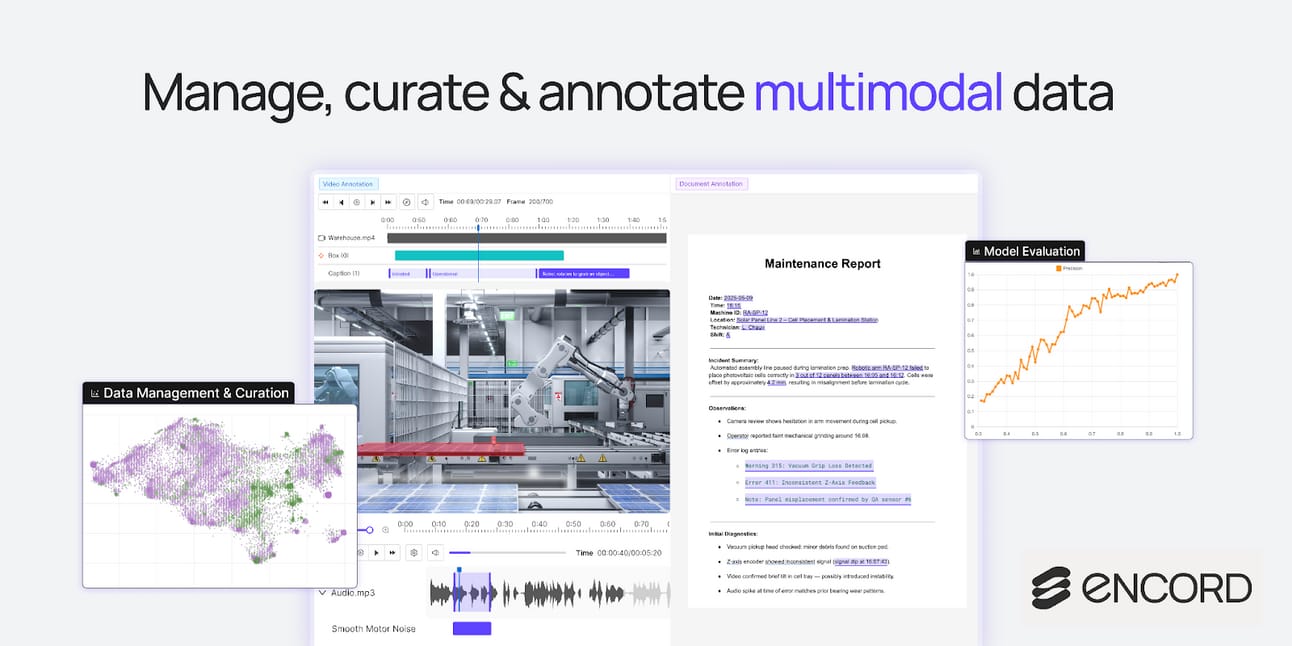
The Rundown: Encord is a consolidated platform for multimodal AI data management, curation, and annotation, enabling teams to accelerate model iteration cycles with balanced, accurately labeled datasets.
Leading AI teams use Encord’s fully customizable multimodal interface to:
Evaluate GenAI outputs across video, audio, and text in record time
Create VLA datasets with synchronized video, instruction, and trajectory data
Unite PDF, image, video, audio, and DICOM labeling in a single interface
AI RESEARCH
☺️ Study: AI learns reasoning through self-confidence

Image source: UC Berkeley and Yale
The Rundown: Researchers from UC Berkeley and Yale introduced INTUITOR, an AI training method that enables language models to improve their reasoning using internal confidence signals — eliminating the need for correct answers or external feedback.
The details:
INTUITOR measures how confident an AI feels about each word it generates, using this "gut feeling" as a guide for learning.
Instead of needing correct answers to learn (like traditional AI training), the system rewards the AI when it produces responses it feels confident about.
When tested on math problems, the method performed just as well as conventional training, but showed even better results on programming tasks.
The AIs also began showing human-like reasoning behaviors — breaking down complex problems, planning, and explaining their thinking step-by-step.
Why it matters: Just as intuition and confidence play a large role in human learning, this study shows AI is succeeding within the same system. This self-directed approach could be especially valuable for tasks where there's no clear "right answer" or where human expertise is limited, allowing AI to venture into unexplored knowledge areas.
QUICK HITS
🛠️ Trending AI Tools
⚙️ Claude Code - Anthropic’s agentic coding tool, now generally available
🧠 Nemotron AceReason - Nvidia’s math and code reasoning model
🦙 Llama-Factory - Fine-tune and train open-source LLMs with no code
▶️ OpusClip Thumbnail - One-click AI thumbnail generator
💼 AI Job Opportunities
🎧 Meta - Software Engineering Manager, Audio
🛠️ Palantir Technologies - Systems Engineer
🕴️ OpenAI - Executive Recruiter
🤝 Horizon3 - Partner Success Manager
📰 Everything else in AI today
Mistral launched Agents API for enterprise apps, introducing connectors for coding, web search, and image generation alongside memory and multi-agent orchestration.
Meta is reportedly restructuring its AI organization into two distinct teams focused on AI products and AGI foundations, aiming to accelerate the company’s development.
Anthropic’s Claude 4 Sonnet model achieved a new SOTA on the ARC-AGI-2 benchmark, surpassing o3 for the top spot on the leaderboard.
Google DeepMind teased SignGemma, an upcoming model capable of translating sign language into text.
Salesforce acquired cloud data management firm Informatica for $8B, strengthening the infrastructure powering its agent-based products and platforms.
The Browser Company revealed that it will no longer be working on its Arc browser, instead fully pivoting to developing its AI-first Dia browser as a separate product.
COMMUNITY
🎥 Join our next live workshop
Join our next workshop this Friday, May 30th, at 4 PM EST with Dr. Alvaro Cintas, The Rundown’s AI professor. By the end of the workshop, you’ll confidently be able to use AI coding agents to improve your development workflow.
RSVP here. Not a member? Join The Rundown University on a 14-day free trial.
🤝 Share The Rundown, get rewards
We’ll always keep this newsletter 100% free. To support our work, consider sharing The Rundown with your friends, and we’ll send you more free goodies.
See you soon,
Rowan, Joey, Zach, Alvaro, and Jason—The Rundown’s editorial team

Napster is back, sort of
Read Online | Sign Up | Advertise
Good morning, tech enthusiasts. Digital music OG Napster, the world’s first online music streamer, is coming back — in a way!
Infinite Reality, a “metaverse” startup that snapped up Napster for $207M, has renamed itself as Napster Corp. and aims to relaunch the iconic brand as something else entirely. But can this next-gen Napster make its mark as radically as it did in the early 2000s?
In today’s tech rundown:
Napster rebranded as an AI company
Fintech darling Chime eyes $25B valuation
Ex-Amazon execs launch health startup
Microsoft’s AI predicts weather and air quality
Quick hits on other major news
LATEST DEVELOPMENTS
NAPSTER
🎧 Napster rebranded as an AI company

Image source: Napster
The Rundown: Infinite Reality, an immersive tech company known for its ventures in XR and AI, has officially rebranded itself as Napster, following its $207M acquisition of the iconic music streaming service in March.
The details:
CEO John Acunto announced the rebranding to Napster Corp. in a shareholder meeting, positioning it as an “AI-driven digital experiences” provider.
In addition, a new Napster AI division is debuting products focused on AI, immersive technologies, and agentic AI tools, but details are scant.
Napster—a once revolutionary peer-to-peer music sharing platform— was shut down in 2001 after a wave of lawsuits over copyright infringement.
Forbes reports that Infinite Reality has undergone multiple rebrandings, and past acquisitions include esports and online shopping companies.
Why it matters: Once valued at $15B, Infinite Reality is reinventing itself as Napster with ambitions to become the next digital juggernaut. The strategy is still taking shape, but the company teases immersive 3D concert arenas and interactive events, banking on its built-in base of millions of digitally native fans to fuel the transformation.
CHIME
💸 Fintech darling Chime eyes $25B valuation

Image source: Chime
The Rundown: Fintech startup Chime, which targets moderate- to low-income Americans, is readying its long-awaited Nasdaq IPO. After a lull in fintech IPOs, all eyes are on Chime’s valuation, which could land anywhere between $10B and $25B.
The details:
Based in San Francisco, Chime delivers essential financial services through a sleek mobile app and strategic partnerships with FDIC-insured banks.
The company’s core offerings, including fee-free checking, savings, and credit-building products, target households earning under $100K.
Its digital-first approach is also resonating well with customers: as of March, the company had 8.6M active users, a 23% YoY increase.
Chime also plans to go beyond its original niche with filings revealing ambitions to roll out lending, investing, insurance, and wealth management products.
Why it matters: A blockbuster Chime IPO could spark a fresh wave of fintech public offerings and reshape how traditional banks and regulators perceive digital banking upstarts. The move also highlights a resurgence of investor enthusiasm for fintech, positioning Chime as one of the year’s most anticipated and influential tech debuts.
GENERAL MEDICINE
🩺 Ex-Amazon execs launch health startup

Image source: General Medicine
The Rundown: After selling online pharmacy PillPack to Amazon in a $1B deal, its founders, TJ Parker and Elliot Cohen, have reemerged with General Medicine, a new startup aiming to make accessing healthcare as seamless as shopping online.
The details:
The PillPack team, joined with former Amazon Health exec Ashwin Muralidharan, launched the company this week with $32M in funding.
It aims to be a one-stop digital marketplace for medical care, matching users with providers, booking appointments, and handling prescriptions.
The startup is designed to accept both insurance and cash payments, and integrates with a network of specialists, clinics, and labs for end-to-end service.
However, unlike telehealth rivals, General Medicine is aiming for a hybrid care model that blends virtual and in-person services.
Why it matters: By taking on the U.S.’s fragmented healthcare system with a tech-driven approach, General Medicine is setting its sights on shaking up both legacy providers and early telehealth pioneers. However, the real challenge lies ahead, as it faces Amazon Pharmacy—a heavyweight that could curb its growth ambitions.
MICROSOFT
🌨️ Microsoft’s AI predicts weather and air quality

Image source: Microsoft
The Rundown: Microsoft has published new research in the journal Nature, citing that its latest AI model, Aurora, can accurately predict air quality, hurricanes, and other weather-related events better than traditional meteorological methods.
The details:
Aurora was trained on over 1M hours of atmospheric data, pulling from satellites, radar, weather stations, global simulations, and historical forecasts.
It is a “foundation model” for weather, which means it can be fine-tuned with smaller, specialized datasets to deliver highly localized predictions.
In head-to-head tests, Microsoft says that Aurora outperformed the U.S. National Hurricane Center’s five-day tropical cyclone track forecasts.
Beyond standard weather, the model can also forecast air quality, ocean wave heights, sandstorms, and other environmental phenomena.
Why it matters: Microsoft has released Aurora’s source code and model weights to the public, encouraging researchers, meteorologists, and developers to experiment and extend its capabilities. A specialized version of Aurora is already powering the MSN Weather app, including new metrics like cloud cover.
QUICK HITS
📰 Everything else in tech today
Nvidia is launching a new AI chipset for China at a dramatically reduced price in response to recent U.S. export curbs, Reuters reports.
Apple CEO Tim Cook reportedly asked Texas Gov. Greg Abbott to halt a new child-safety law in the state requiring the company to verify the ages of device owners.
Starfish Neuroscience, a stealth startup supported by Valve CEO Gabe Newell, is slated to launch its brain-computer interface chip this year.
Zoox, the Amazon-owned autonomous vehicle firm, has issued its second software recall in a month after a minor incident involving an e-scooter rider in San Francisco.
Tech investor Prosus plans to launch five IPOs in India this year to expand its portfolio in the country to reach a $50B valuation within the next three years.
Samsung is reportedly looking to invest in California-based medical device startup Exo, in a round that could reach $100M.
Tesla’s sales in Europe fell 49% in April from a year earlier, despite battery-electric car sales led by BYD rising nearly 28%.
Apple devices are set to power a hospital in Georgia for the first time, marking a milestone in the company’s push into the healthcare sector.
CERN is developing specialized shipping containers to transport antimatter to labs throughout Europe, a move that could accelerate research in fundamental physics.
Cloud-software giant Salesforce acquired data-management software firm Informatica in an $8B deal.
COMMUNITY
🎥 Join our next live workshop

Join our live workshop today at 3 pm EST with Yash Tekriwal, Head of Education at Clay. In this hands‑on session, you’ll learn how to automate GTM workflows, craft custom data signals, and spin up AI agents for last‑mile research inside Clay.
RSVP here. Not a member? Join The Rundown University on a 14-day free trial.
See you soon,
Rowan, Jennifer, and Joey—The Rundown’s editorial team

ChatGPT goes free to everyone in UAE
Read Online | Sign Up | Advertise

Good morning, AI enthusiasts. As part of its partnership with OpenAI to build a large-scale data center, the UAE will be offering free access to ChatGPT Plus for its entire population.
The move signals strong confidence in OpenAI’s technology and raises a compelling case for the idea of “universal basic AI” — treating AI tools as a public utility, much like education or healthcare. The big question: will other countries follow?
In today’s AI rundown:
UAE is making ChatGPT Plus free for citizens
Ex-Meta Head: Training consent could devastate AI
How to build your first OpenAI agent
UBS deploys AI avatars for communications
4 new AI tools & 4 job opportunities
LATEST DEVELOPMENTS
OPENAI
🎉 UAE is making ChatGPT Plus free for citizens

Image source: GPT4o / The Rundown
The Rundown: The United Arab Emirates is acquiring ChatGPT Plus ($20) subscriptions for its entire population, becoming the first nation to offer the premium AI service to all citizens at no extra cost.
The details:
Stemming from a partnership between the UAE and OpenAI, the free access is aimed at bringing locals in the UAE closer to frontier AI technology.
Currently, the ChatGPT Plus subscription costs $20 a month, which can be a barrier to entry for the premium plan.
While OpenAI and other AI majors, including Anthropic, have led efforts to democratize AI access in education, nothing has matched this scale.
The other component of the UAE-OpenAI partnership is Stargate UAE, a 1GW Abu Dhabi data center, slated to go live in 2026 with an initial 200MW capacity.
Why it matters: By providing universal ChatGPT Plus access, the UAE is positioning itself as a first mover in public AI access and ensuring its citizens become AI-literate in an increasingly AI-driven world. The initiative could likely prompt other nations to explore similar partnerships with AI providers to keep their populations competitive.
TOGETHER WITH HUBSPOT
🤑 100 ways to diversify your income stream

The Rundown: Whether you're looking to supplement your 9-5 or pursue passion projects, HubSpot's curated side hustle database provides 100 vetted opportunities with the strategic insights you need to match opportunities with your goals.
HubSpot’s list gives you:
100 carefully selected side hustle ideas for every skill level
Investment and skill breakdowns to guide your decisions
Opportunities designed to complement your existing goals
AI COPYRIGHT DEBATE
👀 Ex-Meta Head: Training consent could devastate AI

Image source: Meta / Nick Clegg on X
The Rundown: As artists continue to challenge the use of copyrighted work to train AI, former Meta executive Nick Clegg claimed that requiring companies to obtain permission before training could severely damage the AI industry.
The details:
Speaking at an event promoting his book, Clegg said it is “implausible” to go around preemptively seeking everyone’s permission before training AI.
He said these systems train on vast amounts of data, which means seeking consent would “collide with the physics of the technology itself.”
Clegg noted that even if companies manage to seek consent in the UK, but others do not follow, it would “basically kill” the country's AI industry.
To ensure the “natural justice,” he suggested that the ideal way is to give artists an option to opt out of having their work used for training.
Why it matters: The tension between innovation and IP holders is only intensifying, and Clegg just said the quiet part out loud. While an opt-out system might provide temporary relief, it doesn't address the fundamental conflict between artists seeking fair compensation and AI companies' massive data requirements.
AI TRAINING
🤖 How to build your first OpenAI agent

The Rundown: In this tutorial, you’ll learn how to create a custom AI agent that can search the web and answer questions using Google Colab and OpenAI's agents library.
Step-by-step:
Go to Google Colab and install OpenAI agents with pip install openai-agents
Get your API key from OpenAI’s platform and add some credits to your account
Import libraries and create your agent with a model (e.g., gpt-4o or o3-mini), instructions, and web search tool
Run your agent and print the results
Pro tip: Start with simple questions, then experiment with more complex queries to see your agent's capabilities grow.
PRESENTED BY TOGETHER AI
⚡️ Powerful open source AI without the hassle

The Rundown: Together AI's Inference & Fine-Tuning platform lets developers deploy open source models at scale without the complexity – offering both serverless and dedicated endpoints for leading models like DeepSeek-R1, Llama 4, and Qwen 3.
With Together AI, you can:
Access an extensive model library featuring the most popular open-source AI models
Leverage high-performance infrastructure designed for the lowest possible latency
Implement quickly with developer-friendly APIs that simplify integration
Auto-scale from zero to millions of requests while maintaining performance
Start building now and get all the benefits of open source AI without the complexity.
UBS
🏦 UBS deploys AI avatars for communications

Image source: AI avatar via UBS
The Rundown: UBS, one of Switzerland’s largest banks, is reportedly using AI avatars of its analysts to streamline research communications with clients, a move aimed at saving time and engaging customers through their preferred channel.
The details:
Launched in January as an opt-in program, the initiative has produced AI avatars for over 36 of UBS's 700+ analysts across the firm.
The avatars, developed using Synthesia’s models in a studio, are reused in videos that present research content to clients in a more engaging format.
Each video replicates the analyst’s voice and likeness, while the underlying content changes with research, converted into a script using OpenAI’s models.
The rollout has been gradual due to accent and language challenges, but UBS plans to scale it globally, hoping to produce 5K labeled AI videos annually.
Why it matters: While polarizing, UBS's adoption of AI avatars is particularly valuable in multilingual markets like Switzerland where content typically requires creation in four languages and avatars provide instant translation. However, blurry lines of synthetic and real content is only increasing the risk of misleading financial information online.
QUICK HITS
🛠️ Trending AI Tools
🧠 Flow - Google’s AI filmmaking tool, now available in 71 countries
📄 Veo 3 - Google’s AI to generate videos with native audio
🎥 Magi-1 Distill - Sand AI’s affordable distilled image-to-video model
⚙️ Direct3D-S2 - SOTA quality high-resolution 3D shape generation
💼 AI Job Opportunities
📞 The Rundown - Account Manager
🎯 DeepL - Premium Support
💼 Hume AI - Commercial Operations, GTM & Sales
🧪 Grammarly - Data Scientist
📰 Everything else in AI today
AWS Summit Washington DC, June 10-11 – explore the latest innovations in AI and cloud computing. Learn more and register for free. (Sponsored)
Elon Musk’s DOGE is reportedly using his company xAI’s Grok model for data analysis, raising privacy and conflict-of-interest concerns.
OpenAI established a legal entity in South Korea and plans to open an office there in the coming months, expanding into its third Asian market after Japan and Singapore.
Abu Dhabi’s MBZUAI just launched the Institute of Foundation Models (IFM), a multi-site initiative, including a new AI research lab in Silicon Valley.
Atlog AI launched from stealth with furniture store-focused AI voice agents that call customers, negotiate, and recover payments from customers.
Invariant Labs researchers discovered a new vulnerability in agents using GitHub’s MCP server, which can be exploited by attackers to access your private repositories.
COMMUNITY
🎥 Join our next live workshop

Join our live workshop today at 3 pm EST with Yash Tekriwal, Head of Education at Clay. In this session, you’ll learn how to automate GTM workflows, craft custom data signals, and spin up AI agents for last‑mile research inside Clay.
RSVP here. Not a member? Join The Rundown University on a 14-day free trial.
See you soon,
Rowan, Joey, Zach, Alvaro, Jason, and Shubham—The Rundown’s editorial team
No matching search results
Try using different keywords, double-check your spelling, or explore related categories.
Stay Ahead on AI.
Join 2,000,000+ readers getting bite-size AI news updates straight to their inbox every morning with The Rundown AI newsletter. It's 100% free.