Get the latest AI news, understand why it matters, and learn how to apply it in your work — all in just 5 minutes a day. Join over 2,000,000+ subscribers.

Google's Gemini update raises the bar
Read Online | Sign Up | Advertise

Good morning, AI enthusiasts. Just weeks after its powerful Gemini I/O update, Google is again strengthening its grip on the AI leaderboards.
With a new 2.5 Pro update that shows improvements across the board on its already No.1 ranked predecessor, the tech giant’s rapid launches are setting a relentless new pace for AI model releases.
Reminder: Our next live workshop is today at 4 PM EST! Come learn how to incorporate the new Flux Kontext editing model into your creative workflows for consistent, high-quality results. RSVP here.
In today’s AI rundown:
Google’s big Gemini 2.5 Pro update
Anthropic’s Claude Gov for U.S. agencies
How to translate any video into multiple languages
AI foot scanner predicts heart failure weeks early
4 new AI tools & 4 job opportunities
LATEST DEVELOPMENTS
🚀 Google’s big Gemini 2.5 Pro update

Image source: Google
The Rundown: Google just dropped a new update preview to its Gemini 2.5 Pro model, calling it the company’s “most intelligent model yet” — with notable jumps on coding, STEM, reasoning, and image understanding benchmarks.
The details:
The new model shows major performance gains, extending its lead on user-preference leaderboards like LMArena and WebDevArena.
Google specifically addressed user feedback on the previous version to fix performance regressions in non-coding tasks like creative writing.
The update also brings "thinking budgets" in the API to manage cost and latency, with the preview set to become an official release in the coming weeks.
The upgraded preview is accessible to devs via the Gemini API in AI Studio and Vertex AI, while also being deployed to the public-facing Gemini app.
Why it matters: Just weeks after its coding-enhanced 2.5 Pro I/O update, the tech giant is at it again with another upgrade that brings broader quality upgrades across the board. Google extends its lead on the leaderboards, and is also changing the release dynamic — opting for frequent ‘preview’ drops before a full model launch.
TOGETHER WITH INNOVATING WITH AI
🚀 Launch a six‑figure AI consultancy in six months

The Rundown: Innovating With AI’s ‘The AI Consultancy Project’ gives you the frameworks, playbooks, and client‑ready templates needed to turn “interesting AI ideas” into a revenue‑generating business – helping you ride the wave of an AI consulting boom expected to grow by 8x this decade.
In this program, you will:
Gain the tools and frameworks to find clients and deliver top-notch services
Follow a 6-month plan to build a 6-figure AI consulting business
Join a 700‑strong cohort where some members landed their first AI client in 72 hours
ANTHROPIC
🏛️ Anthropic’s Claude Gov for U.S. agencies

Image source: Anthropic
The Rundown: Anthropic unveiled Claude Gov, a specialized version of its AI models designed exclusively for U.S. defense and intelligence agencies — featuring modified safety guardrails and enhanced capabilities for handling classified information.
The details:
Anthropic said the models are already deployed at the highest levels of U.S. national security, exclusively for those who handle classified information.
The models feature reduced refusal rates when processing classified materials and improved comprehension of defense and intelligence documentation.
Key enhancements target mission-critical needs, including foreign language analysis and cybersecurity pattern recognition for intelligence work.
The company created exemptions for government contracts while preserving restrictions on weapons design, disinformation, and malicious cyber operations.
Why it matters: With Claude Gov, ChatGPT Gov, and other AI leaders exploring tailored models for military and intelligence contracts, the tech is becoming infused within the deepest layers of the government. But the major AI labs are now walking a tightrope between their ethical and safety concerns and commercial opportunities.
AI TRAINING
🌍 How to translate any video into multiple languages

The Rundown: In this tutorial, you will learn how to use HeyGen’s AI video translation feature to automatically translate your videos into different languages while preserving the original speaker's voice and lip-sync.
Step-by-step:
Go to HeyGen’s website and select “Translate a Video” from the dashboard
Upload your video file or paste a YouTube/Google Drive URL
Choose your source and target languages, then click "Advanced" to configure settings like dynamic duration, captions, voice enhancement, and background music removal
Click “Generate” to obtain your multilingual video
Pro tip: Use videos with clear speech and good lighting for the most accurate lip-sync and voice matching results.
PRESENTED BY BASETEN
⚙️ Build with production-ready Model APIs

The Rundown: Baseten just launched Model APIs, featuring on-demand frontier models like DeepSeek V3, R1, and Llama Maverick, purpose-built for production workloads — running on their optimized inference stack that's dominating performance benchmarks.
Key advantages include:
Built-in tool calling and structured output support for agent use cases
Full OpenAI compatibility means Model APIs can be drop-in replacements for closed models
Regular rollouts of more leading models pre-optimized for popular GenAI use cases
Start doing inference now on pre-optimized frontier models.
AI RESEARCH
🦶 AI foot scanner predicts heart failure weeks early

Image source: Heartfelt Technologies
The Rundown: Cambridge startup Heartfelt Technologies developed an AI-powered wall-mounted scanner that monitors ankle swelling, accurately predicting heart failure up to 13 days before patients need emergency care.
The details:
The scanner captures 1,800 images per minute of patients' feet and ankles, using AI to measure fluid accumulation that signals worsening heart conditions.
In trials across five NHS trusts with 26 patients, the system predicted five out of six hospitalizations with an average warning time of 13 days.
The device operates automatically without requiring patient interaction, and over 80% of trial participants chose to keep the scanner after the study ended.
Why it matters: The future of healthcare is proactive, non-invasive monitoring through smart devices like this — helping identify symptoms long before a major medical event might occur and giving patients more control over their health at home instead of costly hospital stays.
QUICK HITS
🛠️ Trending AI Tools
📊 ChatGPT for Business - Now with meeting recording and data connectors
⚙️ Mistral Code - Enterprise-grade coding assistant for development tasks
🎥 Modify Video - Luma Labs’ new tool for restyling videos
🎶 Suno - Upgraded song editor, creative sliders, and extended song uploads
💼 AI Job Opportunities
📈 Synthesia - Senior or Principal Product Manager, Growth
📊 Meta - Data Scientist (Technical Leadership)
🧪 Perplexity AI - Chromium Engineer, Android
🏎️ Waymo - Software Engineer, ML Accelerator
📰 Everything else in AI today
ElevenLabs launched Eleven v3, a new text-to-speech preview model featuring emotional audio tags, multi-speaker dialogue, and support for 70+ languages.
Anthropic CEO Dario Amodei wrote a NYT opinion piece arguing against President Trump’s ‘Big Beautiful Bill’ that would restrict state-level AI regulation for 10 years.
OpenAI detailed the disruption of 10 malicious operations (four tied to China) that utilized ChatGPT for tasks like social media manipulation, espionage, and scams.
X updated its developer terms to ban the use of its content or API for AI model training, aiming to shield the social media network’s data from xAI rivals.
Bland released Bland TTS, a new voice AI with enhanced realism and control for voice cloning, voice apps, and AI-powered customer support.
Volvo is introducing a new AI-powered seatbelt, which accounts for a passenger’s size, seating position, and vehicle speed and direction to customize protection.
COMMUNITY
🎥 Join our next live workshop

Join our next workshop today, June 6th at 4 PM EST with Dr. Alvaro Cintas, The Rundown’s AI professor. By the end of the workshop, you’ll confidently be able to incorporate Flux Kontext into your creative workflows for consistent, high-quality results.
RSVP here. Not a member? Join The Rundown University on a 14-day free trial.
See you soon,
Rowan, Joey, Zach, Alvaro, and Jason—The Rundown’s editorial team

Amazon tests humanoid delivery crews
Read Online | Sign Up | Advertise

Good morning, robotics enthusiasts. Amazon is reportedly taking its Prime promise to the next level, quietly developing AI-powered humanoids that could soon handle last-mile deliveries with unprecedented speed and efficiency.
As these futuristic couriers threaten to upend the traditional delivery workforce, it’s worth asking: How far should we go to make Prime even more prime?
In today’s robotics rundown:
Amazon testing humanoid delivery bots
Hugging Face's MacBook-ready robotics AI
Unitree, Reborn team up to fast-track humanoids
Aerones nabs $62M for wind turbine–cleaning bots
Quick hits on other robotics news
LATEST DEVELOPMENTS
AMAZON
📦 Amazon testing humanoid delivery bots

Image source: Ideogram/The Rundown
The Rundown: Amazon is reportedly accelerating the development of AI-powered software for humanoids, designed to tackle the last-mile delivery challenge — a move that could disrupt the jobs of human delivery workers.
The details:
Amazon is developing proprietary AI software for humanoid deliveries and nearing completion of a “humanoid park” in San Francisco for testing.
The Information reports that Amazon is working with Chinese robotics company Unitree, with trials involving robots exiting Rivian electric vans.
Amazon’s warehouses already feature thousands of robots, from mobile robot Proteus to advanced picking arms such as Sparrow and Cardinal.
The project is raising concerns about job losses among delivery drivers and gig workers in Amazon’s vast logistics network.
Why it matters: While Amazon has not officially commented on the project, the implications are huge. The company’s relentless drive for efficiency relies increasingly on AI and robotics to optimize every step of its supply chain—and now that potentially extends to robot-powered deliveries at your doorstep.
TOGETHER WITH ENCORE
🤖 Turn multi-sensor data Into Physical AI

Image source: Encord
The Rundown: Encord enables Physical AI teams to unify multi-sensor data curation and annotation on one platform. Use Encord to accelerate iteration cycles and achieve safe real-world deployments with balanced, annotated, high-quality datasets.
Use Encord to transform multimodal data:
Build VLA datasets with synchronized multi-sensor views
Ensure safe real-world operation by supervising edge-case behavior
Reduce labeling time by 95% through model-assisted workflows
HUGGING FACE
Hugging Face’s MacBook-ready robotics AI

Image source: Hugging Face
The Rundown: Hugging Face just unveiled SmolVLA, a compact open-source robotics model that the AI startup says dramatically lowers the barrier for sophisticated robotics projects at home, and is small enough to run on a MacBook.
The details:
At just 450M parameters, SmolVLA is small enough to run on a single consumer GPU, yet matches or outperforms much larger models.
The model is trained entirely on open, compatibly licensed datasets shared by the robotics community via Hugging Face’s platform.
Its architecture consists of a compact vision-language model (SmolVLM-2) that processes RGB images, sensorimotor states, and natural language.
There’s also a lightweight “action expert” transformer that outputs robot control commands in real time.
Why it matters: SmolVLA is fully open source, with downloadable code, model weights, and datasets. The AI is central to Hugging Face’s growing robotics initiative, which includes the LeRobot library for robotics models and datasets, the buyout of Pollen Robotics, and the release of low-priced hardware kits like the SO-101 arm.
UNITREE/REBORN
🤝 Unitree, Reborn team up to fast-track humanoids

Image source: Reborn/X
The Rundown: Chinese robotics giant Unitree Robotics announced a long-term collaboration with UK startup Reborn to deploy Reborn's open-source framework, Roboverse, to accelerate learning and capabilities of Unitree’s humanoids.
The details:
Roboverse is a comprehensive framework that combines high-fidelity simulation environments, vast human motion datasets, and unified benchmarks.
Reborn says it enables simulation-based training up to 30x faster than traditional methods, allowing robots to learn complex, human-like tasks.
By bridging the “sim-to-real” gap, Roboverse enables skills learned in simulation to carry over more effectively to real-world robotic applications.
This partnership allows Unitree’s robots to move beyond pre-programmed routines, enabling them to learn fine manipulation and adaptive movement.
Why it matters: With Reborn’s training technologies, Unitree is positioned to make intelligent, adaptable robots accessible at scale. Both companies are also hosting hackathons and fostering a collaborative developer community, aiming to deploy over 1K humanoids in China by 2026.
AERONES
💨 Aerones nabs $62M for wind turbine–cleaning bots
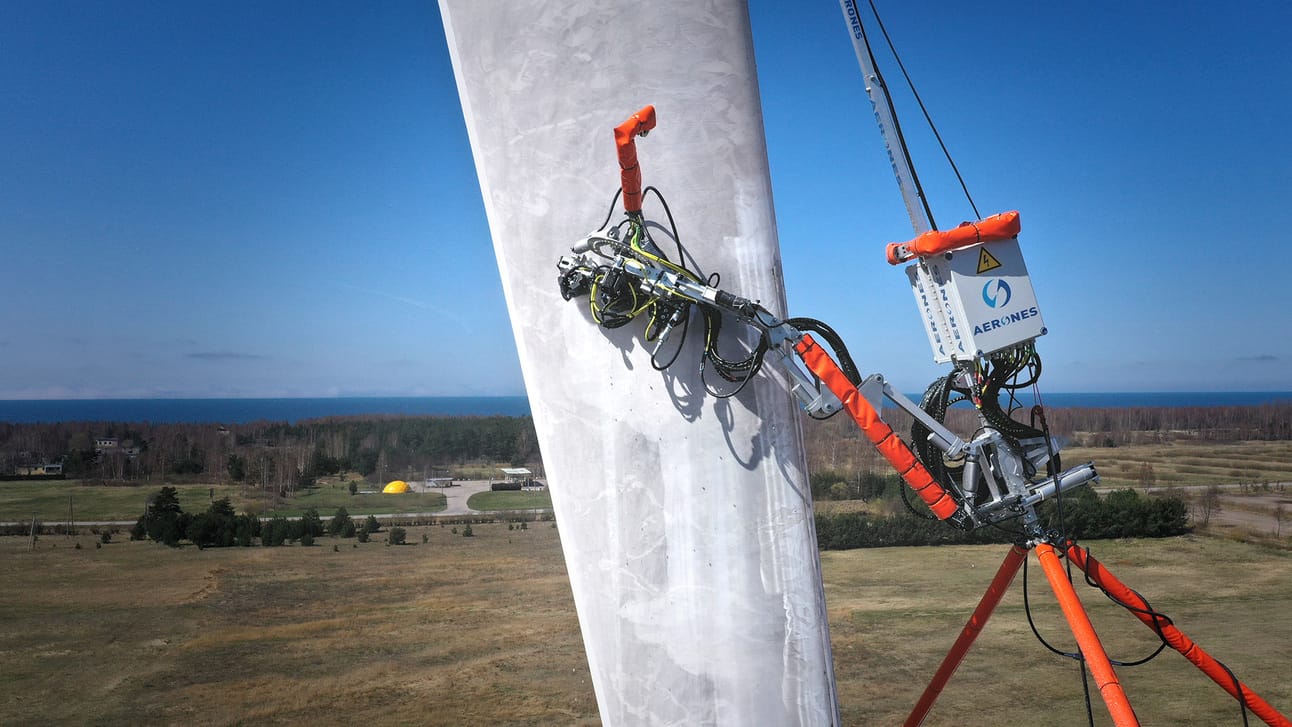
Image source: Aerones
The Rundown: Latvian startup Aerones snagged $62M to launch its AI-powered robots onto wind farms across the globe — in a move aimed to disrupt an industry still reliant on hands-on labor and costly downtime.
The details:
Aerones’ robots, used by GE and Enel, can inspect, clean, and repair turbine blades in half the time of human crews, minimizing downtime.
The company says this not only slashes operational costs but also boosts turbine uptime, contributing to an additional 400,000 MWh of clean electricity.
It aims to scale operations to service thousands of turbines in over 30 countries, focusing on key wind markets in North America, Europe, and Asia.
Aerones, which just opened a new hub in Dallas, also offers internal blade crawlers, drone inspections, and anomaly detection systems.
Why it matters: Major players like Aerones and Clobotics have established themselves in the wind turbine robot market with cutting-edge tech for onshore and offshore needs. As regulatory standards tighten and wind farms scale up globally, the race for autonomous maintenance solutions is intensifying, making this a sector to watch.
QUICK HITS
📰 Everything else in robotics today
Tesla submitted new trademark applications for the term “Tesla Robotaxi,” following earlier setbacks, as it ramps up its upcoming self-driving vehicle service.
UK-based startup Humanoid released a teaser video highlighting its upcoming general-purpose humanoid, HMND 01, set to debut later this year.
China’s Agibot partnered with Pepsi to launch a Pepsi-branded humanoid dubbed “Fizz Bot,” introduced on stage with David Beckham at the launch event.
Pony.ai announced a strategic alliance with Shenzhen Xihu Corp., Shenzhen’s largest taxi operator, to roll out a fleet of over 1K Pony.ai robotaxis across the city.
California startup Impossible Metals developed autonomous robots that harvest critical battery metals from the seabed with minimal ecological disruption.
Researchers developed a new technique that enables robots to more accurately recognize human facial expressions, making them more emotionally aware.
Whale Dynamic partnered with Noodoe to create an end-to-end ecosystem linking fully autonomous delivery vans with AI-powered charging management.
The Robero NEO—now crowdfunding on Kickstarter—is an AI-powered golf caddy that autonomously follows you around the course for eight hours on one charge.
U.S. researchers created an innovative control system that enables aerial robots to handle flexible materials such as cables and hoses in real time.
Aldebaran, a pioneering French robotics company, has been placed in judicial liquidation and is ceasing operations after failing to find a buyer.
COMMUNITY
🎥 Join our next live workshop

Join our next workshop this Friday, June 6th at 4 PM EST with Dr. Alvaro Cintas, The Rundown’s AI professor. By the end of the workshop, you’ll confidently be able to incorporate Flux Kontext into your creative workflows for consistent, high-quality results.
RSVP here. Not a member? Join The Rundown University on a 14-day free trial.
See you soon,
Rowan, Jennifer, and Joey—The Rundown’s editorial team

Reddit takes Claude to court
Read Online | Sign Up | Advertise

Good morning, AI enthusiasts. The top AI labs are no strangers to lawsuits, but a major social media platform just entered the fray — with Reddit accusing Anthropic of illegally scraping its content for training Claude.
But with Sam Altman’s significant stake in Reddit and tensions already seemingly high between the two rival AI leaders, is this lawsuit really about stolen data or something deeper?
In today’s AI rundown:
Reddit sues Anthropic over data scraping
ChatGPT connects to workplace apps, records meetings
Generate comprehensive research reports with deep analysis
AMC partners with Runway for AI production
4 new AI tools & 4 job opportunities
LATEST DEVELOPMENTS
REDDIT & ANTHROPIC
⚖️ Reddit sues Anthropic over data scraping

Image source: Reve / The Rundown
The Rundown: Reddit just filed a new lawsuit against Anthropic, accusing the AI startup of illegally scraping its platform data to train AI models without permission or payment.
The details:
The social media giant claims Anthropic's bots hit its servers over 100k times even after the AI company said it had blocked them from accessing the site.
Reddit said it attempted to negotiate a licensing deal similar to its existing agreements with OpenAI and Google, but Anthropic declined.
Reddit also alleges that Anthropic has previously admitted to training on its data, with Claude frequently referencing content from subreddits.
The lawsuit seeks compensatory damages and an injunction to stop Anthropic from using the content.
Why it matters: While the AI leaders are no strangers to lawsuits, this is one of the first instances of a major tech platform taking action. With Sam Altman owning nearly 9% of Reddit, and recent actions being taken by Anthropic against an OpenAI-acquired startup, could this be a proxy war being fought by AI giants beneath the surface?
TOGETHER WITH YOU.COM
🔍 The Deep Research agent that beats OpenAI

The Rundown: You.com's ARI doesn't just beat OpenAI's Deep Research in head-to-head benchmarks, it wins 76% of the time — while analyzing 500+ private, public, premium sources to deliver McKinsey-grade reports in < 5 minutes.
Put ARI to the test for free, which includes:
5 fully customizable ARI reports
Access to 31+ latest AI models including OpenAI, Anthropic, Google, DeepSeek & more
AI agents to automate workflows and share across teams
OPENAI
🔗 ChatGPT connects to workplace apps, records meetings

Image source: OpenAI
The Rundown: OpenAI announced a series of new business features for ChatGPT, including direct integrations with Google Drive, Dropbox, and other cloud services, meeting recording capabilities, and custom connectors for enterprise customers.
The details:
ChatGPT can connect with cloud services like Google Drive, Dropbox, and SharePoint, allowing users to integrate their documents and data.
A new "record mode" allows ChatGPT to capture meetings or voice notes, then transcribe them, extract key points, and generate action items or plans.
For Deep Research, connectors are available for platforms like Outlook and Teams, with admins also getting the option to build custom MCP connectors.
The company also revealed it now has 3M paying business users between its Enterprise, Team, and Edu tiers, up from 2M reported in February.
Why it matters: OpenAI continues to enable users and businesses to connect more of their vital data and docs with powerful models — but now via simple integrations instead of tedious uploads. The new connectors and features also steamroll another set of SaaS tools with the AI leader’s own integrated workspace.
AI TRAINING
📊 Generate comprehensive research reports with deep analysis

The Rundown: In this tutorial, you will learn how to use Perplexity Labs’ advanced agentic research capabilities to transform simple prompts into comprehensive analytical reports with charts, statistics, and citations.
Step-by-step:
Access Perplexity Pro and click the lightbulb icon in the chat input box to activate Labs mode
Create a detailed research prompt, e.g., “Analyze the adoption of OpenAI's 4.1, o3, and o4-mini models across industries, with usage statistics and charts”
Wait 5-10 minutes while the AI performs deep research, gathers sources, and compiles data
Review your comprehensive report with charts, statistics, citations, and continue with follow-up questions for deeper insights
Pro tip: Be specific about analysis type, scope, and desired outputs in your initial prompt; the more detailed your request, the more comprehensive your report.
PRESENTED BY ASSEMBLYAI
🗣️ Build a better voice agent

The Rundown: AssemblyAI’s Universal-Streaming Speech-to-Text delivers immutable transcripts in 300 ms and unmatched accuracy — so your agents feel more natural & finish tasks successfully.
What sets AssemblyAI’s Universal Streaming apart:
Responds quickly (<300ms latency)
Sounds more natural (intelligent endpointing)
Scales as needed ($0.15/hr with unlimited concurrency)
RUNWAY
📺 AMC partners with Runway for AI production

Image source: Runway
The Rundown: AMC Networks announced a partnership with AI startup Runway to integrate generative AI into its marketing and production processes, becoming one of the first major cable networks to formally embrace the technology for content creation.
The details:
The TV network will use Runway's models for pre-visualization during show development and for generating promotional materials.
AMC plans to streamline marketing workflows by creating campaign assets without physical shoots and testing concepts before committing resources.
Runway views the partnership as indicative of a larger transformation in media, where AI is set to alter production timelines, methodologies, and distribution.
Runway is also working with Lionsgate, with execs saying AI can help create alternate versions of films, like animated versions and rating adjustments.
Why it matters: AI is a polarizing topic in Hollywood, to say the least — but the tech has been quietly implemented across the production and creative processes. While many studios may still fear backlash from consumers over its use, it appears that at least major studios are finally ready to normalize and embrace the tools publicly.
QUICK HITS
🛠️ Trending AI Tools
⚙️ Codex - OpenAI’s software engineering agent, now with internet access
🎥 HeyGen AI Studio - Video editing with fine-tuned control over AI avatars
🎬 Manus Video Generation - Agentic planning, creation of detailed videos
📽️ AvatarFX - Character’s new image-to-video tech to bring images to life
💼 AI Job Opportunities
🎨 The Rundown - Designer (Brand & Platform)
💵 Groq - Senior Manager, Global Payroll
🏷️ Figure AI - Data Labeler
⚖️ Deepmind - Head of Legal Operations
📰 Everything else in AI today
AWS Summit is coming to Washington, DC, June 10-11 – explore the latest innovations in AI and cloud computing. Secure your free registration by June 9th at noon, ET!*
Windsurf CEO Varun Mohan posted that Anthropic is restricting the platform’s access to its Claude models, which comes on the heels of its acquisition by OpenAI.
Mistral AI released Mistral Code, an enterprise-grade coding assistant that combines several of the company’s specialized models to complete development tasks.
Anthropic published Claude Explains, a new blog written by its AI assistant that features a variety of educational developer content.
Luma Labs launched Modify Video, a new tool to restyle videos by changing style, characters, settings, and more.
Suno rolled out a series of new features, including an upgraded song editor for easier editing, stem extraction, creative sliders, and extended song uploads up to 8 minutes.
*Sponsored Listing
COMMUNITY
🎥 Join our next live workshop
Join our next workshop this Friday, June 6th, at 4 PM EST with Dr. Alvaro Cintas, The Rundown’s AI professor. By the end of the workshop, you’ll confidently be able to incorporate Flux Kontext into your creative workflows for consistent, high-quality results.
RSVP here. Not a member? Join The Rundown University on a 14-day free trial.
See you soon,
Rowan, Joey, Zach, Alvaro, and Jason—The Rundown’s editorial team

AI godfather launches new safety startup
Read Online | Sign Up | Advertise

Good morning, AI enthusiasts. One of the ‘godfathers’ that helped birth modern AI is now trying to save the world from it — with Yoshua Bengio’s new nonprofit promising systems that are “safe-by-design.”
With warnings that top models are already learning to deceive and self-preserve, the safety advocates who’ve been sounding alarms are now building their own solutions.
In today’s AI rundown:
AI pioneer’s safety nonprofit for 'honest' AI
HeyGen gives full control over AI avatars
Create marketing campaigns for global audiences
FDA approves AI tool to predict breast cancer risk
4 new AI tools & 4 job opportunities
LATEST DEVELOPMENTS
YOSHUA BENGIO
🧠 AI pioneer’s safety nonprofit for 'honest' AI

Image source: Wikimedia Commons
The Rundown: AI godfather and Turing Award winner Yoshua Bengio unveiled LawZero, a nonprofit dedicated to building “safe-by-design” AI systems, also securing $30M in funding to develop "Scientist AI," which prioritizes truth and transparency.
The details:
LawZero aims to create AI systems that provide probabilistic assessments rather than definitive answers, acknowledging uncertainty in their responses.
The organization's "Scientist AI" hopes to speed scientific development, monitor other AI agents for deceptive behaviors, and address AI risks
Initial backers include former Google CEO Eric Schmidt's philanthropic arm, Skype co-founder Jaan Tallinn, and several AI safety organizations.
Bengio warns that current leading AI models, like o3 and Claude 4 Opus, show concerning traits including self-preservation instincts and strategic deception.
He also told FT that he doesn’t have confidence that OpenAI will adhere to its original mission, citing commercial pressures.
Why it matters: AI godfathers Bengio and Geoffrey Hinton have been outspoken critics of leading AI labs on the safety front, sounding the alarm with constant media appearances and open letters. But LawZero represents Bengio’s biggest step yet, taking AI safety into his own hands with an organization dedicated to the effort.
TOGETHER WITH SANA
🇸🇪 Why Sweden chose Sana Agents for 2.3M people

The Rundown: Sweden just deployed Sana Agents across their entire nation — bringing advanced AI to 2.3M students, educators, and public servants in what might be the largest enterprise AI transformation we've seen.
Here’s what’s possible with Sana Agents:
50% time savings in R&D analysis workflows
2x more customer support issues resolved, empowered by AI
66% reduction in compliance audit hours and 95% faster responses to product inquiries
Drive enterprise-wide innovation today with the same AI platform trusted by an entire country to transform how work gets done.
HEYGEN
🎥 HeyGen gives full control over AI avatars

Image Source: HeyGen
The Rundown: HeyGen just launched AI Studio, a new video editing suite that gives users new control over AI avatars, with the ability to fine-tune vocal emphasis, hand gestures, and more for more polished and realistic generations.
The details:
A new Voice Director Mode lets users shape the avatar’s speech delivery with natural language commands like “whisper this part” or “sound more excited”.
Speech mirroring allows for uploads of an exact speaking style to transfer it to the avatars, preserving personal vocal quirks and timing consistencies.
Gesture Control brings natural motion to avatars, with creators able to upload existing footage for mirroring or link gestures to words directly within a script.
HeyGen also teased a series of upcoming new features, including camera control, generative B-roll, motion graphics, and prompt-based editing.
Why it matters: The future of video content creation is increasingly looking camera-less — with this latest round of upgrades taking avatars from more robotic talking heads to full-fledged actors with more granular control over motion and expressiveness. Video production is about to look a lot different in the AI age.
AI TRAINING
🌍 Create marketing campaigns for global audiences

The Rundown: In this tutorial, you will learn how to transform campaign data into localized content and track your global marketing efforts using Canva’s AI-powered sheets and analytics tools.
Step-by-step:
Prepare a CSV with Market, Product Name, Target Audience, and Language Code columns, then in Canva create a new Sheet and import your data
Create a new “Headlines” column, select empty cells, go to Actions, and click "Fill Empty Cells" to auto-generate localized headlines for each market
Add a “Campaign Status” column and use Actions to add a dropdown with different status options
Use “Magic Insights” to get AI-powered analysis on anything you want from your spreadsheet
Pro tip: We did an extensive workshop with Danny Wu (Head of AI at Canva) and Kelsey Moore (Product Marketing Manager) on how to scale your visual content creation using Canva Sheets, Magic Write, and AI-powered tools here.
PRESENTED BY FACTORY
🤖 Agents ship code. Droids ship software.

The Rundown: Factory gives your team autonomous Droids that write code, resolve incidents, and clear your backlog — working across your own systems (GitHub, Linear, Notion, Google Drive, and more) to understand your codebase and deliver production-ready software.
Droids’ capabilities include:
Handling complete task ownership from backlog cleanup to major migrations
Delivering production-grade code without hand-holding
Generating architecture deep-dives, RFC-ready reports, and professional documentation
Incident response, including tracing Sentry issues, shipping quick fix PRs, and RCAs
AI CANCER DETECTION
🎯 FDA approves AI tool to predict breast cancer risk

Image source: Clarity
The Rundown: The U.S. Food & Drug Administration granted authorization for Clarity Breast, the first AI platform that can predict a woman's breast cancer risk from routine mammogram images, enabling a commercial launch for the preventative tool this year.
The details:
The AI analyzes subtle patterns in mammogram images invisible to humans, generating five-year risk scores without family history or demographic data.
The platform works with standard 2D mammograms and was trained on millions of diverse images to avoid bias issues common in other risk models.
In testing, half of the younger women tested showed risk levels typically seen in much older patients — challenging standard age-based screening protocols.
Hospitals and imaging centers can start offering the service later this year, though patients will initially pay out-of-pocket until insurers get on board.
Why it matters: The first wave of AI medical tools is starting to make its way from the lab to actual consumers — and with powerful diagnostic and predictive capabilities, these tools may help shift medicine from its current reactive approach to a more proactive and preventative approach to healthcare.
QUICK HITS
🛠️ Trending AI Tools
🧠 Retellio - AI agent that surfaces buried insights from B2B calls, giving leaders clear GTM takeaways, pain points, and coaching signals*
🎥 Bing Video Creator - Turn words into short videos on mobile
🔊 PlayDiffusion - PlayAI’s open-source audio inpainting model
🎬 Mirage Studio - Generate studio-quality videos with AI actors
*Sponsored Listing
💼 AI Job Opportunities
🔁 The Rundown - Strategic Partnerships (AI University)
🤖 Cresta - Senior Machine Learning Engineer, Insights
🚀 Anthropic - Engineering Manager, ML Acceleration
🧰 Parloa - 1st Line Support Engineer
📰 Everything else in AI today
OpenAI announced expanded access for its Codex software engineering agent, alongside new internet access and usability upgrades.
Manus AI introduced new video generation capabilities, allowing the agentic platform to plan and generate detailed video scenes and visual concepts.
Researchers published BioReason, a new AI architecture that combines a DNA model with LLM reasoning, showcasing a 15% performance gain on biological benchmarks.
Meta signed a 20-year agreement with Constellation Energy to leverage nuclear power to fuel its energy-intensive AI demands.
OpenAI also rolled out its memory feature to free ChatGPT users, calling it a “lightweight” version that is more short-term and based on recent conversations.
Amazon MGM Studios is reportedly creating “Artificial,” a film based on OpenAI’s 2023 board drama and the firing of CEO Sam Altman.
COMMUNITY
🎥 Join our next live workshop
Join our next workshop this Friday, June 6th, at 4 PM EST with Dr. Alvaro Cintas, The Rundown’s AI professor. By the end of the workshop, you’ll confidently be able to incorporate Flux Kontext into your creative workflows for consistent, high-quality results.
RSVP here. Not a member? Join The Rundown University on a 14-day free trial.
See you soon,
Rowan, Joey, Zach, Alvaro, and Jason—The Rundown’s editorial team

Longevity drug extends lifespan by 30%
Read Online | Sign Up | Advertise

Good morning, tech enthusiasts. German scientists just scored a longevity breakthrough: by combining the cancer drugs rapamycin and trametinib, they extended mouse lifespans by an impressive 30%.
Biohacker Bryan Johnson — who previously dropped rapamycin due to harsh side effects — might want to revisit it. This drug combo isn’t just tweaking genes; it could be reshaping the boundaries of aging science.
In today’s tech rundown:
Longevity drug extends mice’s lifespan
Salesforce nabs Moonhub in AI shopping spree
Solar storms are killing off Starlink satellites
Trump to kickstart Mars missions with $1B
Quick hits on other major news
LATEST DEVELOPMENTS
BIOTECH INNOVATIONS
💊 Longevity drug extends mice’s lifespan

Image source: Max Planck Institute for Biology of Ageing
The Rundown: German researchers just published a study showing two cancer drugs taken together not only extended the lifespans of mice by 30% but slashed inflammation, fought off cancer, and shut down the aging-linked mTOR pathway.
The details:
Rapamycin, which inhibits the mTOR pathway and slows cellular aging, was paired with trametinib, a drug targeting the Ras/MEK/ERK signaling cascade.
Rapamycin alone extended mouse lifespan by 15–20%, and trametinib alone by 5–10%; when combined, the drugs extended lifespan by 30–35%.
The two drugs also improved healthspan, reducing chronic inflammation and lowering circulating levels of pro-inflammatory cytokines.
Mice treated with both drugs showed a reduced incidence of liver and spleen tumors, as well as a slower age-related increase in brain glucose uptake.
Why it matters: This study spotlights how cutting-edge molecular science and drug innovation are colliding to tackle aging and extend healthspan—arguably biotech’s hottest frontier. While the results have biohackers buzzing, the real test will be whether these breakthroughs can safely translate from lab mice to human trials.
SALESFORCE
🛍️ Salesforce nabs Moonhub in AI shopping spree

Image source: Ideogram/The Rundown
The Rundown: Salesforce is snapping up (in a way!) Moonhub — the startup behind smart, automated hiring tools — just weeks after sealing its $8B Informatica deal and acquiring AI automation player Convergence AI.
The details:
Moonhub, known for building AI that vets and recruits talent, is expected to help power Salesforce’s next wave of enterprise AI innovation.
The startup initially implied its entire team is joining Salesforce, but the CRM giant has clarified it’s not a buyout and only part of the team is coming onboard.
With $14.4M raised from high-profile investors, Moonhub has been on the radar of many in the HR tech space, with Salesforce already an early investor.
The startup’s tools are designed with a “human-in-the-loop” approach, ensuring that humans are key to decision-making in the hiring process.
Why it matters: While the deal’s terms haven’t been disclosed, it lands at a time when AI is rapidly transforming HR—93% of Fortune 500 HR leaders now use AI to hire talent. It also signals Salesforce’s bold move to double down on automating and optimizing every stage of hiring and workforce planning, as it looks to outpace rivals.
SPACEX
☀️ Solar storms are killing off Starlink satellites

Image source: SpaceX
The Rundown: New NASA research finds that solar storms can shorten the lifespans of low Earth orbit satellites, particularly large satellite constellations like SpaceX’s Starlink, sending them careening back to Earth at greater velocities.
The details:
The researchers tracked the fates of 523 Starlink satellites reentering Earth's atmosphere between 2020–2024, a period of intense solar activity.
Using TLE tracking data and epoch analysis, they found that geomagnetic storms dramatically accelerated the orbital decay of these satellites.
The culprit is the heating and expansion of the upper atmosphere during solar storms, which increases atmospheric drag, causing satellites to lose altitude.
Prediction errors for satellite reentry timing swell during high solar activity, making it harder for operators to ensure safe, controlled deorbiting.
Why it matters: This is more than a statistical anomaly—it’s a warning for the satellite industry, the researchers say. With more than 7K Starlink satellites in orbit and thousands more on the way, the sheer frequency of reentries—sometimes dozens in just a few days—could put a strain on efforts to keep low-Earth orbit secure.
NASA
🚀 Trump to kickstart Mars missions with $1B

Image source: Ideogram/The Rundown
The Rundown: In a controversial pivot for the U.S. space policy, President Trump’s 2026 budget proposal carves out more than $1B to kickstart human missions to Mars — putting private companies like SpaceX and Blue Origin in the driver’s seat.
The details:
Central to the plan is NASA’s new Commercial Mars Payload Services Program, awarding contracts to companies developing critical Mars mission technologies.
The approach mirrors the agency’s recent lunar partnerships and is designed to push innovation, reduce costs, and align with entrepreneurs like Elon Musk.
But this Mars move comes with a dramatic trade-off: Trump’s proposed NASA budget totals $18.8B, slashing the agency’s overall funding by nearly 25%.
The administration aims for crewed Mars missions to launch by the early 2030s, accelerating timelines previously considered by NASA.
Why it matters: The Mars push is a response to China’s rapidly advancing spaceflight program, with Trump vowing to keep the U.S. “first on Mars.” But it faces skepticism in Congress, with lawmakers questioning the feasibility of the timeline, the wisdom of deep science cuts, and the risk of over-reliance on private industry for space priorities.
QUICK HITS
📰 Everything else in tech today
Bill Gates, the founder of Microsoft, announced that the majority of his wealth will go toward improving health and education in Africa over the next two decades.
Alphabet agreed to spend $500M over the next decade to overhaul its global compliance structure as part of a settlement of antitrust violations.
Meta is reportedly actively developing a dedicated Instagram app for Apple's iPad, with internal testing underway and a public release expected by the end of 2025.
Microsoft announced an additional 305 layoffs at its Redmond, Washington, campus, following recent companywide cuts involving 3% of the company’s staff.
French pharma giant Sanofi announced it is acquiring Cambridge, Massachusetts-based biotech startup Blueprint Medicines for up to $9.5B.
TikTok unveiled "TikTok for Artists," a new music analytics platform aimed at empowering musicians with tools and insights to grow their careers.
Samsung is reportedly in discussions with AI startup Perplexity to bring the company’s app, assistant, and search capabilities to upcoming Samsung devices.
A new human study finds that plasma exchange therapy—an intervention where a portion of a person’s plasma is replaced—may slow biological aging.
New analysis shows that since January 2025, more than $14B in U.S. clean energy projects have been canceled or delayed, with some 10K planned jobs lost.
COMMUNITY
🎥 Join our next live workshop

Check out our last workshop with Dr. Alvaro Cintas, The Rundown’s AI professor. By the end of the workshop, you’ll confidently be able to use AI coding agents to improve your development workflow.
Watch here. Not a member? Join The Rundown University on a 14-day free trial.
See you soon,
Rowan, Jennifer, and Joey—The Rundown’s editorial team

Meta's AI advertising takeover
Read Online | Sign Up | Advertise

Good morning, AI enthusiasts. Marketing is already undergoing some drastic changes in the AI era, but Mark Zuckerberg’s latest push aims to take the entire advertising process out of human hands.
With just a product photo and a budget, Meta’s rumored 2026 system would handle everything from visuals, copy, user targeting, and deployment — potentially upending social media marketing as we know it.
In today’s AI rundown:
Meta’s fully automated AI ad platform
Microsoft offers free Sora access on Bing
How to automate coding tasks with async development
Sakana’s AI learns to upgrade its own code
4 new AI tools & 4 job opportunities
LATEST DEVELOPMENTS
META
🤖 Meta’s fully automated AI ad platform

Image source: o3 / The Rundown
The Rundown: Meta aims to release tools that eliminate humans from the advertising process by 2026, according to a report from the WSJ — developing an AI that can create ads for Facebook and Instagram using just a product image and budget.
The details:
Companies would submit product images and budgets, letting AI craft the text and visuals, select target audiences, and manage campaign placement.
The system will be able to create personalized ads that can adapt in real-time, like a car spot featuring mountains vs. an urban street based on user location.
The push would target smaller companies lacking dedicated marketing staff, promising professional-grade advertising without agency fees or skillset.
Advertising is a core part of Mark Zuckerberg’s AI strategy and already accounts for 97% of Meta’s annual revenue.
Why it matters: We’re already seeing AI transform advertising through image, video, and text, but Zuck’s vision takes the process entirely out of human hands. With so much marketing flowing through FB and IG, a successful system would be a major disruptor — particularly for small brands that just want results without the hassle.
TOGETHER WITH UNSTRUCTURED
🐀 Are you building a data rat's nest?
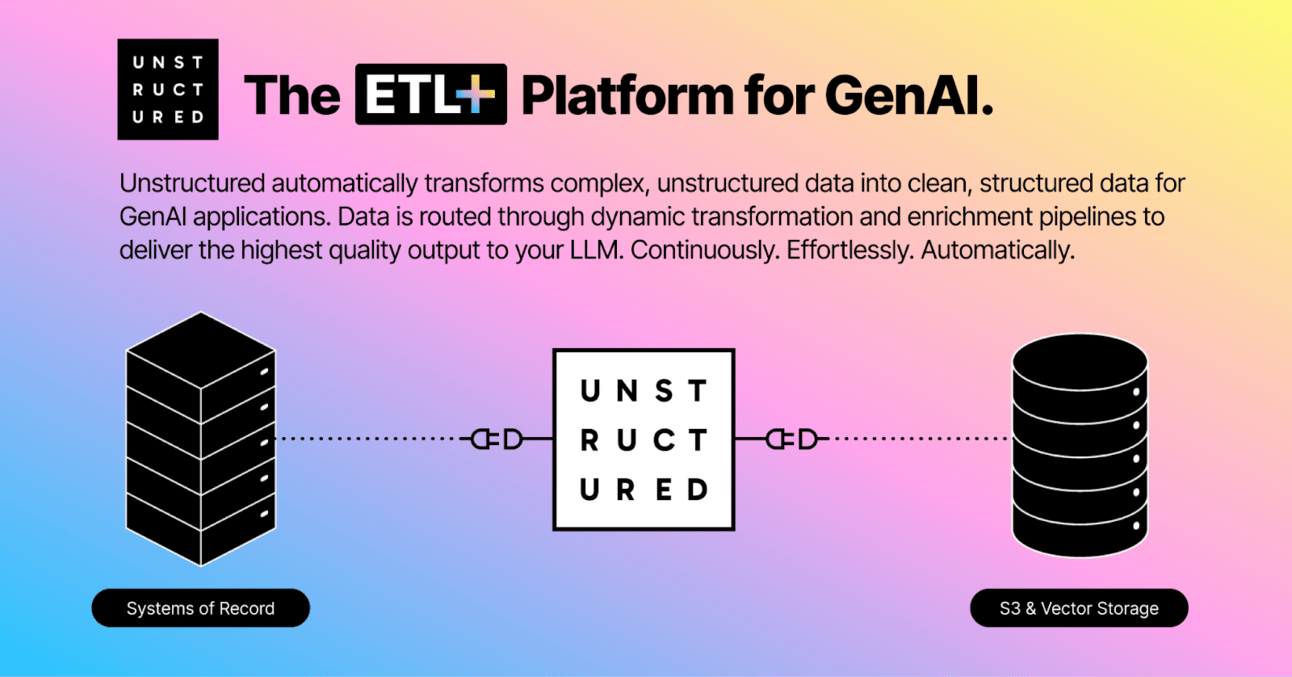
The Rundown: Building your own data processing pipeline starts simple, but scaling it is another story — with a few scripts and connectors quickly turning into a tangled mess of never-ending fixes and updates.
Unstructured replaces the DIY rat’s nest with:
Coverage across 35+ data sources and 64+ file types with zero maintenance overhead
AI-tailored processing with chunking, embedding, and enrichment for GenAI use cases
Enterprise-grade security, compliance, and role-based access that works at scale
MICROSOFT
🎥 Microsoft offers free Sora access on Bing

Image source: Microsoft
The Rundown: Microsoft just announced Bing Video Creator, integrating OpenAI’s Sora video generation model into the Bing mobile app and allowing users to create five-second outputs from text descriptions with no subscription required.
The details:
Users get 10 fast video generations and unlimited slower generations, and can earn more fast credits through Microsoft's rewards program.
The feature launches on Bing’s iOS and Android mobile apps, with desktop and Copilot Search releases coming soon.
Videos are currently limited to vertical format and 5-second clips, with up to three videos able to be created simultaneously.
Why it matters: Sora was one of the more hyped products in AI, but failed to live up to expectations and was quickly surpassed by rival models. But most generators have been stowed behind subscriptions — meaning a new user base may be exposed to a free (albeit limited) video creation option for the first time.
AI TRAINING
🤖 How to automate coding tasks with async development

The Rundown: In this tutorial, you will learn how to use Google’s async development agent Jules to automatically fix bugs, add features, and handle software engineering tasks in your GitHub repositories.
Step-by-step:
Visit Jules and connect your GitHub account to access your repositories
Select your specific repository and branch from the dropdown menus
Describe your task in the chat: “Write me a README file” or “Fix the authentication bug”
Review the plan, click “Approve,” let it work asynchronously, and then “Publish Branch” when done! 🚀
Pro tip: You get 60 daily tasks that refresh every 24 hours, so you can use Jules completely free of charge for your most repetitive coding work.
PRESENTED BY HACKERRANK
😵 AI broke the technical interview

The Rundown: Hiring managers report candidates acing assessments with answers they later can’t explain. HackerRank’s new interview features close this gap by giving deeper insight into how candidates think and solve problems in realistic, controlled settings.
With HackerRank, you can:
Enforce AI-use with real-time integrity alerts
Watch candidates prompt built in AI
Test skills in live code repos
SAKANA AI
🧠 Sakana’s AI learns to upgrade its own code

Image source: Sakana AI
The Rundown: Researchers from Sakana AI and the University of British Columbia just introduced the Darwin Gödel Machine, an AI agent that rewrites its own code to get better at tasks, achieving up to 150% performance improvements without intervention.
The details:
DGM starts as a coding assistant, but autonomously discovers improvements like editing tools, error memory, and peer review capabilities.
It significantly boosted its performance in coding benchmarks, jumping from 20% to 50% on SWE-bench and 14% to over 30% on Polyglot.
Inspired by Darwinian evolution, DGM tries out changes to its code, keeps what works, and archives promising "mutations" for future improvements.
The self-taught improvements also made the AI perform better when the underlying model was swapped out, showing it wasn’t unique to a single model.
Why it matters: While most AI models are frozen post-training and reliant on manual new version releases, DGM is a shift toward AI that can learn and improve itself over time. This self-evolution could accelerate AI far beyond initial training, but also introduces risks of maintaining control as systems become increasingly autonomous.
QUICK HITS
🛠️ Trending AI Tools
🗣️ Conversational AI 2.0 - ElevenLab’s updated AI voice agent platform
⚙️ Google Edge Gallery - Deploy AI across mobile, web, and embedded apps
🔌 Circuit Tracing - Anthropic's open source tools to see how AI thinks
🔬 Zochi — Intology’s PhD-level AI agent
💼 AI Job Opportunities
📞 The Rundown - Account Manager
😊 UiPath - Customer Success Manager
🤝 Writer - Engagement Manager
🎯 OpenAI - Executive Programs Lead
📰 Everything else in AI today
Samsung is reportedly in talks with AI startup Perplexity to integrate the platform’s app, assistant, and search features across new Samsung devices.
PlayAI open-sourced PlayDiffusion, an audio inpainting model capable of precise voice output modifications without disrupting natural flow.
Captions launched Mirage Studio, a platform that generates hyper-realistic videos with AI actors from audio or scripts for UGC and marketing content.
Character AI unveiled multimodal creation tools, including AvatarFX image-to-video, interactive Scenes, Streams for character interactions, and animated chat sharing.
IBM announced watsonx AI Labs, an innovation hub in New York City aimed at increasing enterprise AI adoption — also acquiring data analysis startup Seek AI.
The U.S. Food & Drug Administration launched Elsa, an agency-wide AI platform to help speed clinical reviews and scientific evaluations.
COMMUNITY
🎥 Watch our last live workshop

Check out our last workshop with Dr. Alvaro Cintas, The Rundown’s AI professor. By the end of the workshop, you’ll confidently be able to use AI coding agents to improve your development workflow.
Watch here. Not a member? Join The Rundown University on a 14-day free trial.
See you soon,
Rowan, Joey, Zach, Alvaro, and Jason—The Rundown’s editorial team

Hugging Face's $3K humanoid
Read Online | Sign Up | Advertise

Good morning, robotics enthusiasts. Open-source trailblazer Hugging Face just unveiled HopeJR, a full-featured humanoid set to launch at just $3K— far below the usual price tag of humanoids.
With China’s Unitree also just teasing a sub-$10 K humanoid, the race is on: is the era of affordable, accessible robots finally here?
In today’s robotics rundown:
Hugging Face unveils two new humanoids
U.S. scientists create self-healing robot skin
New Transformer bot can fly and land on wheels
China builds robotic thrusters to protect space station
Quick hits on other robotics news
LATEST DEVELOPMENTS
HUGGING FACE
🤖 Hugging Face unveils two new humanoids

Image source: Hugging Face/X
The Rundown: Open-source leader Hugging Face has unveiled two new open-source robots: HopeJR and Reachy Mini. HopeJR is a full-sized humanoid, capable of walking, performing intricate gestures, and manipulating objects — all for just $3K.
The details:
Priced at $250–$300, Reachy Mini offers a desktop-friendly platform with head movement, microphones, and speakers.
Both HopeJR and Reachy Mini are fully open-source, with hardware schematics, software, and build instructions freely available.
HopeJR features 66 actuated degrees of freedom and dexterous hands featuring tactile arrays in the fingertips for sensory feedback.
The robots are designed with modular, 3D-printed parts, allowing for easy repairs, upgrades, and experimentation.
Why it matters: The launch follows Hugging Face’s buyout of Pollen Robotics and partnerships with The Robot Studio, as the company works to foster a collaborative robotics community. With open waitlists and early interest, these robots are positioned to support robotics research while helping lower barriers to entry for creators.
UNIVERSITY OF NEBRASKA
🩹 U.S. scientists create self-healing robot skin

Image source: University of Nebraska–Lincoln
The Rundown: A team of engineers at the University of Nebraska–Lincoln has developed a groundbreaking soft robotic skin that can detect and repair its own damage, much the way human skin can.
The details:
The artificial skin features a multi-layered structure, with distinct layers for sensing, structural support, and healing, mimicking natural skin.
Flexible piezoresistive and capacitive sensors are embedded within soft polymers, enabling the detection of pressure, strain, and even small tears.
Microcontrollers process sensor data on the fly, instantly identifying the location and severity of damage in real time.
The team incorporates hydrogels that maintain flexibility and conductivity even after repeated damage and healing cycles, ensuring long-term durability.
Why it matters: What sets this work apart is the use of bioinspired polymers and hydrogels, designed to self-heal through dynamic covalent bonds and supramolecular interactions. While still early days, the system’s layered architecture holds promise for next-gen healthcare wearables, adaptive prosthetics, and resilient robotic skins.
CALTECH
🚀 New Transformer bot can fly and land on wheels

Image source: Caltech
The Rundown: A team of Caltech engineers has developed a real-life Transformer—dubbed ATMO (Aerially Transforming Morphobot)—that can both fly like a drone and morph in midair to land on wheels and smoothly roll away.
The details:
Unlike conventional drones or rovers, ATMO’s design centers on four powerful thrusters, each encased in robust shrouds that double as wheels.
When ATMO is in drive mode, these shrouds provide traction and stability for rapid movement across diverse terrains.
A single central motor actuates the transformation, lifting or lowering the thrusters to switch between modes.
The transition from ground to air (and vice versa) takes just a few seconds, enabling ATMO to quickly adapt to changing environments or obstacles.
Why it matters: This dual-mode capability opens up a host of possibilities for applications that demand both ground mobility and aerial agility. As research into morphobots like ATMO progresses, we may soon see these adaptable machines deployed in search-and-rescue missions, military ops, and environmental monitoring.
CHINA SPACE PROGRAM
🛰️ China builds robot thrusters to protect space station

Image source: Ideogram/The Rundown
The Rundown: After two near-misses where Starlink satellites nearly crashed into its Tiangong space station, China is now developing robotic thrusters that can autonomously latch onto and thrust away unidentified objects flying nearby.
The details:
The system centers on a small, agile robotic thruster capable of intercepting and physically maneuvering unidentified spacecraft that venture too close.
Unlike traditional kinetic or destructive anti-satellite measures, this approach uses a robotic “space tug” to latch onto the object and push it away.
The interceptor uses advanced sensors and AI-driven navigation algorithms to identify, track, and approach potential threats with high precision.
Beyond defense, the tech could also be adapted for active debris removal and orbital traffic control, helping to maintain safe distances between satellites.
Why it matters: This approach addresses security concerns over close-approach incidents — especially from foreign satellites — while also helping to keep orbital zones clear. The system reflects a broader trend among major space powers to develop non-destructive methods for managing threats in increasingly crowded orbits.
QUICK HITS
📰 Everything else in robotics today
Chinese robotics giant Unitree just teased a sub-$10K next-gen humanoid robot on X.
U.S. robotics startup Figure announced that its newest humanoid, the F.03, has begun walking, marking a big step in the company’s development.
DJI, the Chinese drone maker, has begun mass production of its first robotic vacuum cleaner after four years in R&D, with the initial model expected to launch this month.
Xuzhou Construction Machinery Group Co. announced that it has delivered 100 all-electric uncrewed mining trucks to a coal mine pit in Inner Mongolia, China.
Libraries in South Wales have introduced MetaCats, life-sized robotic cats with artificial heartbeats and glowing LED eyes, designed to reduce stress and loneliness.
Korean roboticists have designed and tested a four-legged robot that can perform high-speed parkour moves, with details on the project published in Science Robotics.
Tesla is launching its autonomous robotaxi service in Austin on June 12, with the initial rollout featuring at least 10 driverless vehicles operating within geofenced areas.
Robotics company Dexterity has announced a strategic partnership with Sanmina Corp. to scale its Mech “superhumanoid” arms, capable of lifting 60 pounds each.
The world's tallest 3D-printed building, a 98-foot (around 30-meter) tower, was just inaugurated in Mulegns, a mountain village in Switzerland.
COMMUNITY
🎥 Join our next live workshop
Check out our last workshop with Dr. Alvaro Cintas, The Rundown’s AI professor. By the end of the workshop, you’ll confidently be able to use AI coding agents to improve your development workflow.
Watch here. Not a member? Join The Rundown University on a 14-day free trial.
See you soon,
Rowan, Jennifer, and Joey—The Rundown’s editorial team

Apple's AI 'gap year'
Read Online | Sign Up | Advertise

Good morning, AI enthusiasts. Apple’s flagship event of the year is just a week away, but the tech giant’s AI ambitions might be temporarily hitting the snooze button.
With insiders revealing the upcoming WWDC will be a “gap year” event that pushes more impactful AI reveals to 2026, the gap between Apple and the AI competition has never looked wider.
In today’s AI rundown:
AI letdown expected at Apple’s WWDC
Record giants, music AI startups eye licensing deals
Transform deep research into visual infographics
AI beats humans on emotional intelligence tests
4 new AI tools & 4 job opportunities
LATEST DEVELOPMENTS
APPLE
🍎 AI letdown expected at Apple’s WWDC

Image source: Apple
The Rundown: Apple's upcoming Worldwide Developers Conference may disappoint on the AI front, according to Bloomberg insider Mark Gurman — with reported plans for a less hyped event as a “gap year” to push for a stronger AI reveal in 2026.
The details:
Apple will open its 3B parameter models to developers, enabling custom AI features in third-party apps but with limited capabilities compared to rivals.
The company reportedly plans to rebrand existing features as "AI-powered" and introduce a new naming system for its OS to shift perception.
Major AI projects remain in limbo, including an LLM-powered Siri overhaul, health-focused Project Mulberry, and a ChatGPT competitor with web search.
Gurman added that Apple’s 150B model is nearing ChatGPT quality in testing, but accuracy concerns and exec disagreements have kept it under wraps.
Why it matters: Apple finds itself in a difficult position — with sky-high expectations and accelerating competition paired with a serious lack of progress on the AI front. While a “gap year” might be needed to prepare a product that can give what users expect, the AI leaders certainly won’t be slowing down during that time.
TOGETHER WITH VANTA
📖 The new playbook for building AI-era startups

The Rundown: Speed alone isn't enough anymore — today's startups need sharper, smarter strategies from day one. Learn from Vanta's Christina Cacioppo and The Generalist's Mario Gabriele in this tactical discussion for founders navigating the rapidly shifting startup landscape.
This live session covers:
Strategies for accelerating product-market fit in the AI era
Frameworks for choosing tools that 10x your business impact
Tactics for building competitive moats without funding or brand recognition
Save your spot and discover hard-earned lessons you won’t find in traditional playbooks.
AI & MUSIC
🎵 Record giants, music AI startups eye licensing deals

Image source: Reve / The Rundown
The Rundown: Music giants Universal, Warner, and Sony are reportedly in talks with AI music leaders Udio and Suno to negotiate licensing deals that could resolve billion-dollar lawsuits and establish standards for how artists are compensated by AI firms.
The details:
The labels are seeking licensing fees and equity stakes in the startups, creating a framework for compensating artists whose work is used in training.
The companies sued both Udio and Suno in 2024 for copyright infringement, seeking up to $150k per work infringed, potentially totaling billions in damages.
A deal would reportedly put an end to the lawsuits, with the negotiations happening “in parallel” and creating a race between firms to strike the first deal.
Why it matters: This showdown echoes the music industry's past fights with Napster and streaming services — but this time, labels seem ready to negotiate rather than fight to the death. Just like we’ve seen in journalism and social media platforms, AI licensing is becoming a lucrative revenue stream and alternative to pricey court battles.
AI TRAINING
📊 Transform deep research into visual infographics

The Rundown: In this tutorial, you will learn how to use Google Gemini's deep research feature to analyze complex topics and automatically generate visual infographics from research findings using its new visualization capabilities.
Step-by-step:
Go to Google’s Gemini website and click “Deep Research” at the bottom of the chat interface
Enter your research topic and review the plan Gemini creates, then click “Edit plan” to modify or “Start research” to proceed
Once your comprehensive report is ready, click the “Create” button and select “Infographic” to turn your report into an interactive HTML visualization
Toggle between Code and Preview views in Canvas to see and customize your infographic.
Pro tip: The more specific your initial query, the better your results. Instead of broad topics, include specific aspects, timeframes, or comparisons you want in your report.
PRESENTED BY RETOOL
🏗️ Build AI that works for your business

The Rundown: While most AI tools are just chatbots, Retool Agents perform real work by directly integrating with your business systems, delivering measurable efficiency and cost savings through hands-on tasks, not just conversation.
What makes Retool different:
Model flexibility that works with OpenAI, Anthropic, Azure, or custom implementations
True integration with your existing tech stack, including databases, APIs, and business tools
An intuitive visual builder combined with code flexibility for a balance of speed and control
Enterprise-ready security with built-in permissions and role-based access control
Try Retool today and experience AI agents that actually work for your business.
AI RESEARCH
🧠 AI beats humans on emotional intelligence tests

Image source: o3 / The Rundown
The Rundown: Researchers from the University of Geneva and the University of Bern found that ChatGPT and other AI systems beat humans on emotional intelligence tests, indicating AI may be better at reading emotions and responding than people.
The details:
Six AI models were tested on standard emotional intelligence assessments, tasked with selecting emotionally appropriate responses to complex scenarios.
GPT-4, o1, Gemini 1.5 Flash, Copilot 365, Claude 3.5 Haiku, and DeepSeek V3 scored an 81% average in testing, compared to 56% for human participants.
Beyond just test-taking, GPT-4 also proved capable of quickly creating entirely new and valid emotional intelligence assessments.
The researchers believe the results show AI's grasp of emotional concepts and reasoning, not just pattern regurgitation from training data.
Why it matters: While AI can't actually “feel” emotions like humans do, its ability to mimic and display optimal emotional intelligence in difficult situations might be just as valuable — and shows the massive promise for integrating LLMs into fields like mental health support, customer service, and education.
QUICK HITS
🛠️ Trending AI Tools
📸 Kontext - BFL’s new advanced image editing model
🔎 Perplexity Labs - Build reports and dashboards with multi-tool use
📋 Manus Slides - Create tailored slide decks with agentic AI
🗣️ EVI 3 - Create custom voices through speech-to-speech interactions
💼 AI Job Opportunities
🤝 The Rundown - Partnerships Manager
📝 Mistral AI - Content Marketing Lead, US
🛠️ Hebbia - Platform Engineer, Staff
📱 Perplexity AI - Mobile Product Manager
📰 Everything else in AI today
BoxWorks 2025 – San Francisco & virtual on Sept. 11-12. Use AI to thrive in business and bring order to unstructured data, explore Intelligent Content Management, and more. (Sponsored)
ElevenLabs launched Conversational AI 2.0, featuring new advanced turn-taking, multilingual detection, and enterprise-grade features, including HIPAA compliance.
OpenAI COO Brad Lightcap said in an interview that the hardware devices OpenAI is building will be “ambient” systems designed for more personal real-world experiences.
Anthropic reportedly reached $3B in annualized revenue, tripling from $1B in December 2024, driven by enterprise demand from its code generation capabilities.
Meta is reportedly in the process of automating up to 90% of its privacy and internal safety risk assessments using AI, replacing human reviewers.
Google DeepMind CEO Demis Hassabis revealed that “millions of videos” were generated with Veo 3 in the last week, following an expansion to over 71 new countries.
COMMUNITY
🎥 Watch our last live workshop
Check out our last workshop with Dr. Alvaro Cintas, The Rundown’s AI professor. By the end of the workshop, you’ll confidently be able to use AI coding agents to improve your development workflow.
Watch here. Not a member? Join The Rundown University on a 14-day free trial.
See you soon,
Rowan, Joey, Zach, Alvaro, and Jason—The Rundown’s editorial team
No matching search results
Try using different keywords, double-check your spelling, or explore related categories.
Stay Ahead on AI.
Join 2,000,000+ readers getting bite-size AI news updates straight to their inbox every morning with The Rundown AI newsletter. It's 100% free.