Get the latest AI news, understand why it matters, and learn how to apply it in your work — all in just 5 minutes a day. Join over 2,000,000+ subscribers.

Venmo finally kills its most criticized feature
Read Online | Sign Up | Advertise

Good morning, tech enthusiasts. Venmo is finally overhauling its payments app. After years of criticism that its public-by-default social feed exposed users’ routines, relationships, and spending habits to anyone paying attention, the PayPal-owned platform is making privacy a core part of the experience.
It’s the app’s biggest redesign since its inception, and a long-overdue reset for a company that turned oversharing into a growth strategy.
In today’s tech rundown:
Venmo rolls out privacy-focused redesign
Lime, the Uber-backed scooter giant, files for IPO
California sues Meta over scam ad profits
Whoop adds on-demand doctors to its data
Quick hits on other tech news
LATEST DEVELOPMENTS
VENMO
💵 Venmo rolls out privacy-focused redesign
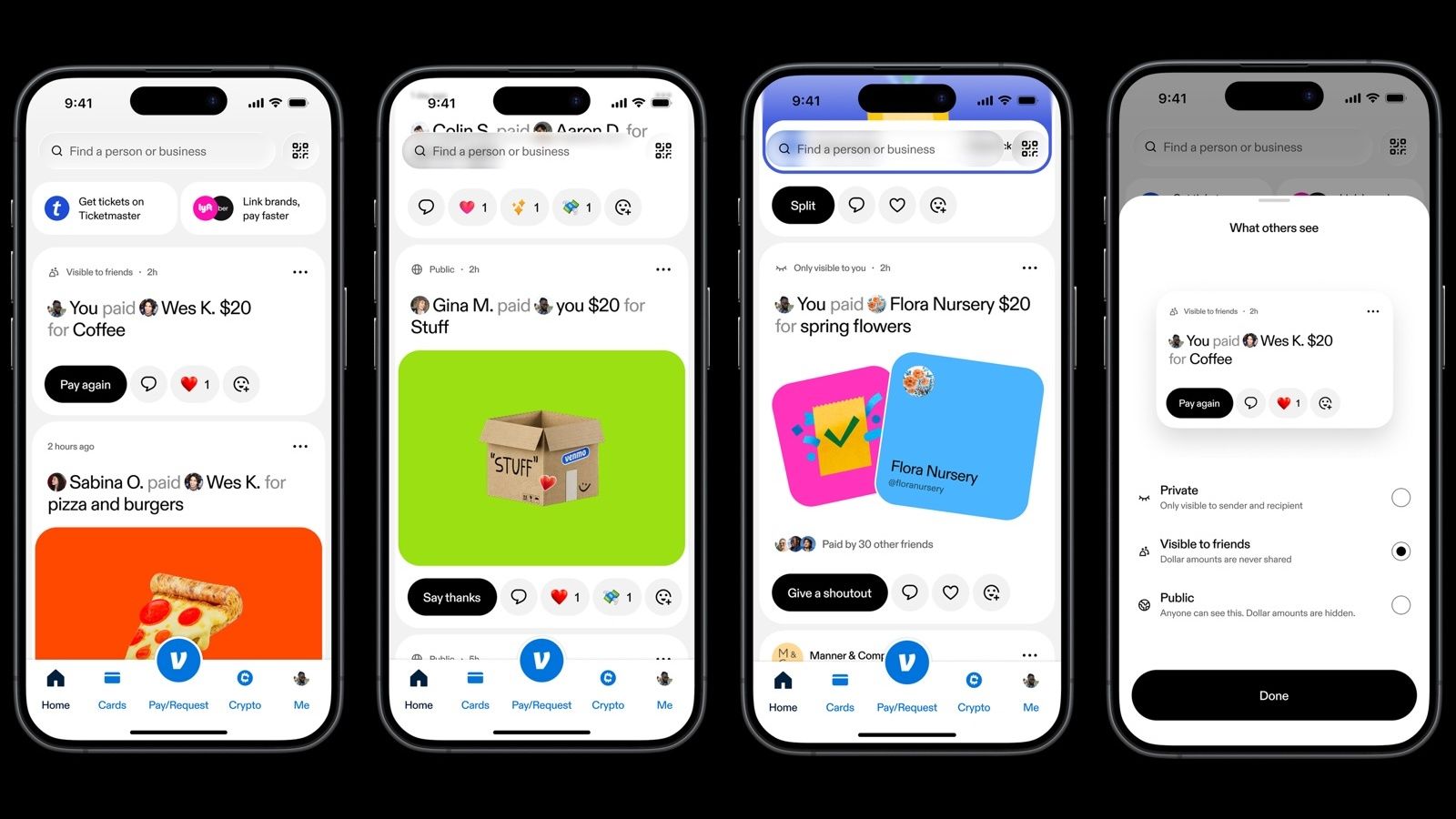
Image source: PayPal
The Rundown: PayPal-owned Venmo is rolling out its biggest app redesign since its inception in 2009, and it’s finally defaulting new users to friends-only payments instead of broadcasting their transactions to the world.
The details:
New users’ posts will now be visible to friends only by default, rather than the public; the option to restrict further to “just me” is also available.
An updated send screen will display each transaction’s privacy status before it goes out, so users know what they’re sharing before they hit send.
The redesigned feed adds emoji reactions and quick actions like “Pay Again” and “Say Thanks,” plus a “Give a Shoutout” button for local businesses.
The rollout begins this week on iOS and Android, with the full redesign expected to reach all users by fall.
Why it matters: Venmo is finally walking back its public-by-default social feed, which critics have long warned could expose users’ daily routines and relationships. Re-centering the app on friends-only and private payments shows that basic data protection is starting to outweigh growth hacks built on sharing all the details.
TOGETHER WITH ASTROCADE
🎮 Where AI meets social gaming

The Rundown: Astrocade is revolutionizing user-generated gaming. Backed by $56M from Sequoia, it’s the ultimate platform to seamlessly scroll, play, and instantly build your own games for a massive global community.
With Astrocade, you get:
Free AI editor to generate or import assets.
Create viral games and earn real money.
Build high-quality, complex games using powerful AI.
LIME
🛴 Lime, the Uber-backed scooter giant, files for IPO
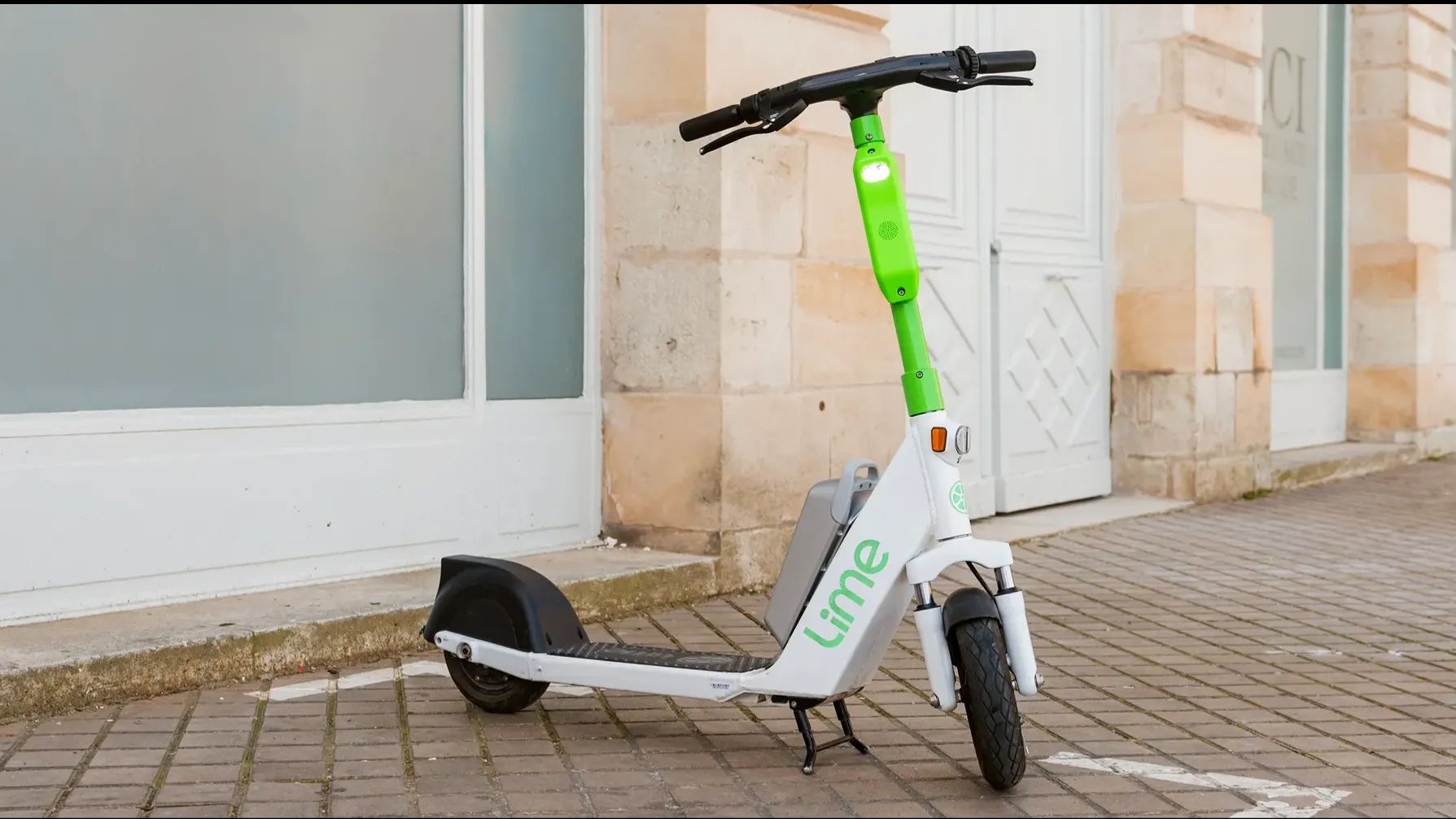
Image source: Lime
The Rundown: Lime, the neon-green scooter and e-bike operator that has been flirting with public markets since 2020, has finally pulled the trigger — filing its S-1 with the SEC and targeting a $2B valuation.
The details:
Lime grew revenue from $521M in 2023 to $686.6M in 2024 and $886.7M in 2025, though the company posted net losses of $59.3M last year.
On the brighter side: Lime has generated free cash flow three years running, hitting $104M in 2025, nearly double the prior year.
Lime is still carrying around $1B in current liabilities, with roughly $846M due within 12 months and $675.8M owed by year’s end.
Uber remains deeply embedded — exclusive in-app integration accounts for roughly 14–16% of Lime’s total revenue.
Why it matters: Lime is one of the last major micromobility players still standing after Bird went bankrupt in 2023, and its filing marks a pivotal moment for a sector riddled with financial wreckage. If Lime can’t persuade public investors that shared scooters are a real business, the category may not get another shot.
META
⚖️ California sues Meta over scam ad profits

Image source: Images 2.0 / The Rundown
The Rundown: Santa Clara County in California sued Meta, accusing the company of knowingly profiting from a flood of scam ads on Facebook and Instagram while publicly overstating its enforcement efforts.
The details:
California’s Santa Clara County filed suit against Meta, alleging violations of state false advertising and unfair competition laws.
The complaint, drawing on leaked internal documents reported by Reuters, alleges Meta generated as much as $7B annually from “high-risk” advertisers.
Prosecutors say the company’s ad‑targeting tools and AI systems helped scammers micro‑target victims and rapidly scale their schemes.
The county claims Meta publicly overstated the strength of its ad review and anti‑fraud safeguards while failing to curb obvious scam activity.
Why it matters: The suit is among the most aggressive legal actions yet to allege a major platform’s ad business structurally helped fraud rather than simply failing to police it. If Santa Clara County can prove that Meta capped enforcement to protect revenue, the legal and regulatory exposure for the industry could be significant.
WHOOP
🩺 Whoop adds on-demand doctors to its data

Image source: Whoop
The Rundown: Whoop is turning its screenless fitness band into a quasi-virtual clinic, adding on-demand video consultations with licensed clinicians just as Google readies a Whoop-style Fitbit Air to chase the same always-on-health crowd.
The details:
Live video consultations with U.S.-based licensed clinicians roll out in-app this summer as a paid add-on to a standard Whoop membership.
Each session is built on months of continuous biometric data and, when available, bloodwork and medical history.
A new partnership with health records keeper HealthEx enables EHR syncing, letting clinicians pull up info and procedures directly within the app.
Whoop, which has over 2.5M members globally, closed a $575M funding round in March that pushed its valuation to $10.1B.
Why it matters: Whoop is betting that months of continuous biometric data — not a 15-minute visit — becomes the foundation of primary care. With Google’s Fitbit Air entering the screenless band market at $99, the fight looks to be less about hardware and more about what you can do with all of that longitudinal health data.
QUICK HITS
📰 Everything else in tech today
Amazon is expanding its “Amazon Now” service — which delivers groceries, household essentials, and other items in 30 minutes or less — to dozens of U.S. cities.
Trump invited Elon Musk, Tim Cook, Larry Fink, and a group of other top U.S. CEOs to join his trip to China this week for a summit with President Xi Jinping.
The FCC will now let already‑approved foreign-made routers and drones keep receiving updates until 2029, slightly easing its earlier ban on such devices.
China plans to expand its Tiangong space station from a T-shaped outpost into a larger six‑module complex with international astronaut access, as the ISS retires.
A QTS data center in Georgia reportedly consumed nearly 30M gallons of unmetered water during a drought due to two unsupervised connections.
TikTok is rolling out a £3.99-per-month ad-free subscription in the U.K., removing ads and ad-targeting data use, likely in response to local GDPR privacy rules.
Texas is suing Netflix, accusing it of secretly harvesting and monetizing users’ and children’s data in violation of Texas consumer protection laws.
Astronomers used James Webb Space Telescope data from the COSMOS-Web survey to create the most detailed map yet of the universe’s cosmic web.
Prosus aims to generate about $3.6B in annual revenue from Just Eat within a year as it pushes to streamline and grow its European food-delivery operations.
COMMUNITY
🎓 Highlights: News, Guides & Events
Read our last AI newsletter: TML upends how humans work with AI
Read our last Tech newsletter: ‘RAMageddon’ is coming for your laptop
Read our last Robotics newsletter: Figure’s robots make a bed together
Today’s AI tool guide: Build a YouTube research bot in 15 minutes
See you soon,
Rowan, Joey, Zach, Shubham, and Jennifer — The Rundown’s editorial team
Mira Murati's TML upends how humans work with AI
Read Online | Sign Up | Advertise

Good morning, AI enthusiasts. Both Mira Murati's Thinking Machines and Ilya Sutskever's SSI have spent the post-OpenAI era mostly out of view, making every public reveal feel that much bigger.
Murati's lab just broke the silence with 'interaction models,' a new type of AI built for real-time collaboration across voice, video, and text — in a direct counter to the agentic-first direction the rest of the field is racing toward.
In today’s AI rundown:
TML’s new interaction models for real-time AI
Google traces software attack back to AI
Build a YouTube research bot in 15 minutes
Anthropic fixes Claude's blackmail problems
4 new AI tools, community workflows, and more
LATEST DEVELOPMENTS
THINKING MACHINES LAB
🗣️ TML’s new interaction models for real-time AI

Image source: Thinking Machines Lab
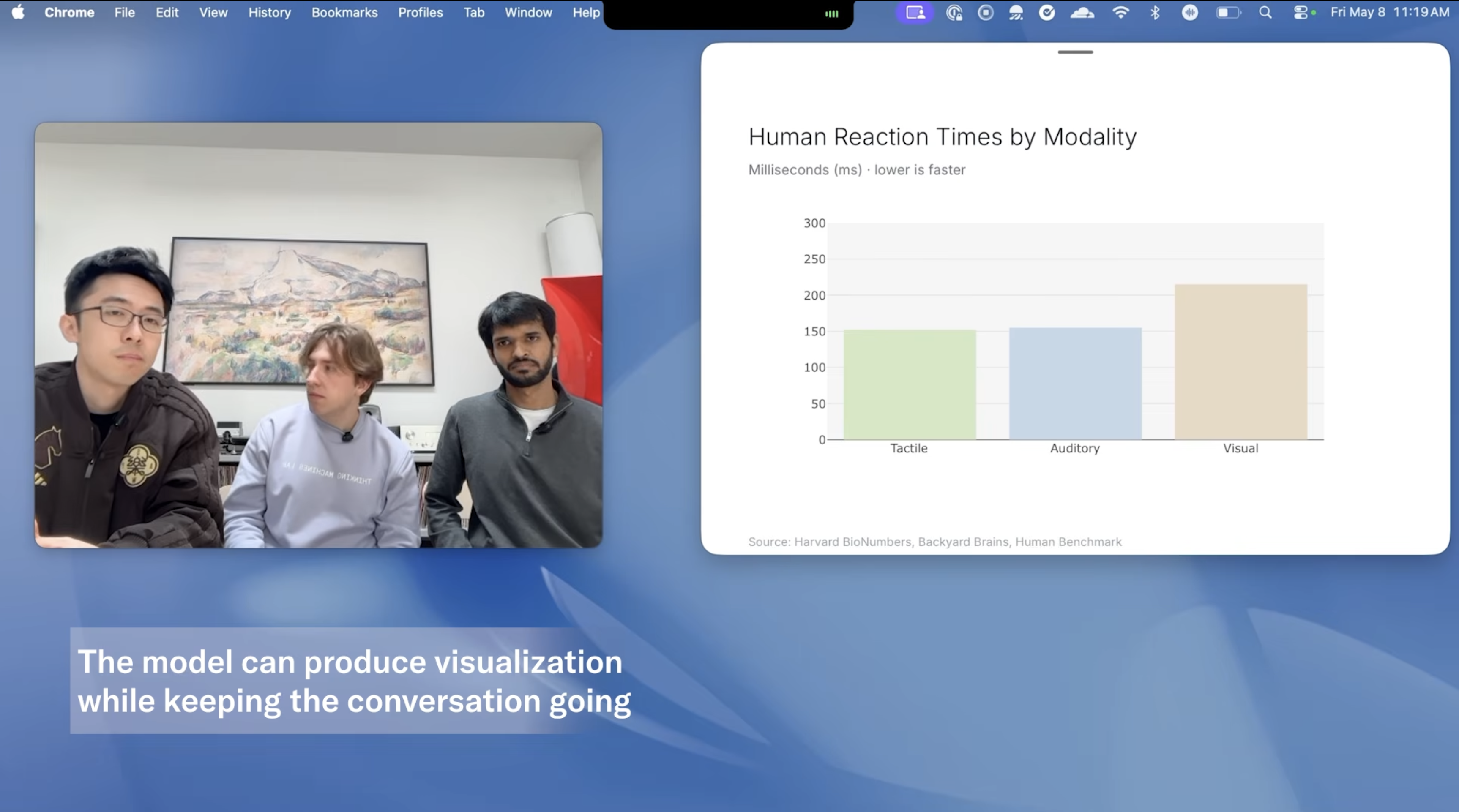
The Rundown: Thinking Machines Lab (TML) just introduced a research preview of interaction models, a new kind of AI system built to collaborate live across voice, video, and text — letting users talk, show, interrupt, and steer while the system keeps working.
The details:
The model takes in voice, video, and text in 200ms chunks, perceiving and responding in a streaming loop without the turn-taking pauses of other rivals.
A second background model handles slower reasoning, searches, and tool work, allowing the live model to keep talking and interacting with the user.
The system can also react to visual changes, count reps, translate live speech, and speak up at timed moments instead of waiting.
CEO Mira Murati said TML is focused on advancing human-AI collaboration, and that “the way we work with AI matters as much as how smart it is.”
Why it matters: Murati's TML has been fairly quiet since its inception, but interaction models are one of the lab’s first big differentiators: models designed around how people naturally work together, not how long an agent can run solo. Whether it carves out its own market or gets absorbed by a frontier lab's next update is the question now.
TOGETHER WITH YOU.COM
🧠 What’s the point of an LLM if it hallucinates?

The Rundown: It happens—LLMs hallucinate. Grounding your LLM, however, can help dramatically improve accuracy. In this guide, You.com explains what AI grounding is and how organizations can implement it to achieve more reliable outputs.
The playbook covers:
A three-part approach that outperforms RAG alone
Why grounding isn't set-and-forget, and how to build audit trails
The open vs. closed platform trade-off (and what it means for your next model switch)
🔒 Google traces software attack back to AI

Image source: Google
The Rundown: Google's Threat Intelligence Group confirmed the first known case of hackers using AI to discover and write a zero-day software security flaw, catching them before they could break past login protections on a widely-used web management tool.
The details:
The hack was intended to allow the user to get around two-factor authorization on the affected app, with Google working with the company to stop the attack.
Google pointed to unusually polished attack code, long explainer notes, and a made-up severity score as clues that the exploit was written with an AI.
GTIG's John Hultquist called the find "the tip of the iceberg," with Anthropic's Rob Bair warning cybersecurity defenders' lead is "months, not years.”
GTIG detailed other hacks, including software that lets AI remotely control a device, and AI-assisted malicious prompts and code from N. Korea and Russia.
Why it matters: We’ve already started to see what Anthropic’s Mythos can do on the cybersecurity front, but attackers aren’t too far off from having similar power. Even with careful rollouts, the next step up the release ladder is about to open the door to some serious security issues that will cause chaos for the many systems not ready for it.
AI TRAINING
📺 Build a YouTube research bot in 15 minutes

The Rundown: In this guide, you will learn how to build a Gumloop agent that tracks YouTube channels or search topics, reads transcripts, and turns the useful videos into a ranked research brief.
Step-by-step:
Go to Gumloop agent builder, create an agent named YouTube Scout, and enable YouTube and Google Sheets in the right-hand section under "Apps"
Prompt: Build me a YouTube scout for (niche). Check (channels/queries), find videos from the last (hours/days), read the transcript, and return a brief with title, link, 3-5 takeaways, why it matters, follow-up ideas, usefulness score, and a "what changed" summary. Track topics and videos in a Google Sheet
Start small: one niche, a few trusted channels, one or two searches, and a 24-48 hour lookback window. The tighter the scout's beat, the better the brief
Run the agent, then review the Sheet it creates. Make sure each result has a source link, concrete takeaways, and a usefulness score
Pro tip: Dial in the signal score early. If the agent calls a mediocre video an 8, tell them why that should be a 5. You can also add a User Signal Score column for future runs.
PRESENTED BY TELY AI
💬 Market leaders get leads from ChatGPT and Google

The Rundown: Your buyers are asking AI questions — and AI is answering with your competitors, not you. Tely makes AI like ChatGPT, Google, and Claude recommend your business instead.
With Tely AI, you can:
Get recommended in ChatGPT, Google, Perplexity, and Claude in as little as 1 week
Fully hands-off: no writers, no agencies, no managing content
Costs less than hiring freelancers or maintaining a marketing team
Ideal for niche industries where expertise matters
AI RESEARCH
🐍 Anthropic fixes Claude's blackmail problems

Image source: Anthropic
The Rundown: Anthropic published a study detailing how it fixed Claude's previously seen blackmail behavior, highlighting the need to teach the model “why” and tracing the problem to internet fiction that depicts AI as power-seeking and self-preserving.
The details:
Earlier tests put Claude models in fictional workplace situations, with older systems resorting to blackmail and threats to avoid shutdown.
Having Claude reason through ethical choices, not just copy the safe action, cut blackmail rates from 96% in Opus 4 to nearly 0% for every model after.
Fictional stories of well-behaved AI and constitution-based documents also helped reduce bad behavior by more than 3x.
Just 3M tokens of ethical reasoning data matched 85M tokens of behavioral examples, a 28x efficiency gain that held up in deeper training.
Why it matters: AI is still far from an exact science, and eliminating blackmail via essentially positive AI stories and constitution docs is another one of the many strange training quirks. A small dataset of ethical fiction outperforming 28x the behavioral data shows how much of alignment is still guesswork, even when the guesses work.
QUICK HITS
🛠️ Trending AI Tools
🤖 Slackbot - Your AI assistant that searches, summarizes, and automates work right inside Slack*
❤️ Lovable Aesthetics - Vibe coding with more control over layout, typography
⚙️ Parallel Agents - Run up to 10 parallel computer-use agents in Replit
☀️ Daybreak - OpenAI’s new Codex-driven cybersecurity product
*Sponsored Listing
📰 Everything else in AI today
OpenAI launched “The Deployment Company”, a $14B business to embed engineers inside enterprises to deploy its AI, also acquiring AI consulting firm Tomoro.
SoftBank’s Masayoshi Son is reportedly in talks for a $100B AI investment into France, with plans to build out new data centers in the country.
Anthropic reportedly signed a 7-year, $1.8B cloud infrastructure deal with Akamai, adding another compute avenue to power its Claude models.
China’s Kuaishou Technology is reportedly planning to turn its Kling AI video branch into its own company, with a projected valuation of $20B and plans to IPO in 2027.
Former OpenAI Chief Scientist Ilya Sutskever testified in the Elon Musk vs. OpenAI lawsuit, revealing his current shares of the company total nearly $7B.
COMMUNITY
🤝 Community AI workflows
Every newsletter, we showcase how a reader is using AI to work smarter, save time, or make life easier.
Today’s workflow comes from reader Sasha M. in Cape Coral, FL:
"I have a family of 5, and planning what we have for dinner was a nightmare. I have a Trello board full of hundreds of recipes that I use to plan our meals, and then I would place a grocery delivery order online. The whole process would take up to an hour.
I built a Claude plugin that includes multiple skills to help plan meals and order groceries. I have it on a schedule to run once a week. First, it asks me for details about the week: our schedule, any days that I'll have fewer than 5 people eating, etc. Using an MCP to Trello, the first Claude Skill picks out 7 recipes and presents them to me.
Once I've approved the meal plan, Claude then creates an ingredients list that I check off anything I already have in my fridge/pantry. The plugin then runs a skill that goes to my grocery store website and adds all the ingredients to my cart. All I have to do is check the cart and click ‘Order.’"
How do you use AI? Tell us here.
🎓 Highlights: News, Guides & Events
Read our last AI newsletter: Google’s powerful new AI co-mathematician
Read our last Tech newsletter: 'RAMageddon' is coming for your laptop
Read our last Robotics newsletter: Figure’s robots make a bed together
Today’s AI tool guide: Build a YouTube research bot in 15 minutes
See you soon,
Rowan, Joey, Zach, Shubham, and Jennifer — the humans behind The Rundown


Figure's robots make a bed together
Read Online | Sign Up | Advertise

Good morning, robotics enthusiasts. Figure just dropped a two-minute demo of its F.03 humanoids tag-teaming a full bedroom reset — opening doors, hanging clothes, and making a neatly smoothed bed.
The twist is that the robots share a single learned neural network, coordinating through visual cues alone, no explicit communication or central planner. Everyone is racing to build better robot brains; Figure just showed what happens when two bodies share one.
In today’s robotics rundown:
Figure’s humanoids make a bed together
South Korea’s army turns to Boston Dynamics
Uber’s robotaxi partner has a crash problem
Rocket Lab buys robot arm that went to Mars
Quick hits on other robotics news
LATEST DEVELOPMENTS
FIGURE AI
🛏️ Figure’s humanoids make a bed together

Image source: Figure AI
The Rundown: Figure AI just dropped a two‑minute demo of its Helix‑02–powered humanoids tag‑teaming a full bedroom reset — opening doors, hanging clothes, and making a neatly smoothed bed “better than most humans,” says CEO Brett Adock.
The details:
Figure calls it the first demo of a single learned neural network driving multi-humanoid collaborative locomanipulation, directly from pixels to actions.
The F.03 robots coordinate purely through a shared AI policy and visual cues, with no explicit communication or central planner directing their moves.
In the video, they open doors, hang clothes, clear surfaces, and then team up to lift, spread, and smooth a comforter to hotel‑room neatness.
The F.03’s wireless foot-charging dock lets it step onto a pad and recharge at 2 kW, no outlet-hunting or human intervention required.
Why it matters: While many multi-robot systems depend on explicit communication or a centralized planner, Figure shows emergent coordination — a significant architectural bet on scalability. If it holds outside staged demos, it’s the kind of foundation that makes a capable robot a deployable one.
HYUNDAI
🪖 South Korea’s army turns to Boston Dynamics

Image source: Images 2.0 / The Rundown
The Rundown: South Korea is reportedly looking to deploy Hyundai's robotics arsenal — including Boston Dynamics’ Spot — to shore up military ranks as plummeting birthrates drain the conscription pool.
The details:
South Korea’s military is in talks with Hyundai to deploy robots across surveillance, reconnaissance, and logistics as troop numbers decline.
Potential systems include the Spot robot dog, the wheeled MobED platform, and X-ble Shoulder exoskeletons for load-bearing and mobility assistance.
Active-duty troop numbers have dropped from 650K in 2020 to 450K today, and the country has one of the world’s lowest birthrates.
Military planners are shifting toward unmanned systems to handle tasks from perimeter patrols to supply runs, fundamentally reshaping front-line operations.
Why it matters: South Korea's troop shortage is already here, and robots are looking like one of the most viable stopgaps on the table. But deploying unproven systems near the DMZ, where a sensor failure doesn’t just stop a factory line, certainly raises questions about how far militaries should go in automating their military ops.
AVRIDE
🚖 Uber’s robotaxi partner has a crash problem

Image source: Avride
The Rundown: U.S. auto safety regulators have opened a formal investigation into Uber partner Avride after 16 crashes involving its self-driving robotaxis occurred in Dallas over the past four months.
The details:
U.S. auto safety regulators have opened a formal probe into Avride, a self-driving startup that operates robotaxis for Uber in Dallas.
The investigation was triggered by 16 crashes in which Avride vehicles were in autonomous mode with a human safety driver behind the wheel.
Reported incidents include vehicles changing lanes into moving traffic, hitting stationary objects, and failing to respond appropriately to cars ahead.
Regulators are scrutinizing whether Avride’s software is overly aggressive and whether its safety practices are adequate for operating on public roads.
Why it matters: The probe cuts to the core of Uber’s strategy: outsourcing autonomy to startups rather than building it in-house. If regulators find systemic flaws in Avride’s software or safety culture, expect a broader chill on robotaxi deployments, and fresh ammunition for skeptics who say AI drivers still aren’t ready for real streets.
ROCKET LAB
🚀 Rocket Lab buys robot arm that went to Mars

Image source: Rocket Lab
The Rundown: Rocket Lab just signed its largest launch contract to date — and revealed that it’s acquiring Motiv Space Systems, a Pasadena robotics firm whose hardware operated on the Perseverance Mars rover and NASA’s CADRE lunar rovers.
The details:
Motiv’s portfolio covers multi-degree-of-freedom robotic arms, actuators, and drive electronics purpose-built for deep-space conditions.
Rocket Lab will fold Motiv into a new division called Rocket Lab Robotics, absorbing its 50-person engineering team and Pasadena manufacturing facility.
The deal targets a specific pain point: solar array drive assemblies and other precision mechanisms that are expensive and hard to source.
Rocket Lab says the capability will extend into on-orbit and surface operations, positioning it for commercial Mars Sample Return and national security work.
Why it matters: Most space companies source their robotics from contractors and live with the bottlenecks. Rocket Lab is closing that gap, fusing launch, satellites, and robotics into a single in-house stack. By buying Motiv’s robots, it’s betting that owning the manipulators for on-orbit work matters as much as the rockets that get them there.
QUICK HITS
📰 Everything else in robotics today
Hyundai’s Boston Dynamics unit released a video of its production-ready Atlas humanoid performing complex gymnastics.
Drone startup Helsing is reportedly lining up a new $1.2B funding round that would lift its valuation to about $18B, as investors pour money into defense tech companies.
South Korean robotics startup RLWRLD, backed by LG Electronics, reportedly released RLDX-1, a foundation AI model designed for five-finger robotic hands.
Austin-based Allen Control Systems, an anti-drone AI startup that makes autonomous weapons stations, is in talks to raise $200M at a $2B valuation.
Bloomberg’s Oleg Matsnev argues that today’s viral humanoids are still clunky, limited machines that fall far short of their AI-hype billing.
Self-driving truck startup Kodiak AI reportedly raised $100M by selling shares at a steep 29% discount, causing its stock to plummet 37% in after-hours trading.
Croatian startup Verne launched what it says is Europe’s first commercial robotaxi service in Zagreb in partnership with Uber, charging a flat fee of €1.99.
Nanoleaf, the smart lighting company, is pivoting to a new product lineup focused on robots, AI, and red-light therapy wellness devices, The Verge reports.
China unveiled a 220 lb., four-wheeled robot with dual robotic arms for its upcoming Chang’e-8 lunar mission, designed to function as a “Moon mechanic.”
Hugging Face launched an agentic toolkit for Reachy Mini that lets users without coding skills create custom robot apps by describing tasks in natural language.
COMMUNITY
🎓 Highlights: News, Guides & Events
Read our last AI newsletter: DeepMind’s powerful AI co-mathematician
Read our last Tech newsletter: ‘RAMageddon’ is coming for your laptop
Read our last Robotics newsletter: Genesis robot makes breakfast
Today’s AI tool guide: Automate any manual task with Codex
See you soon,
Rowan, Joey, Zach, Shubham, and Jennifer — The Rundown’s editorial team

Google DeepMind’s powerful AI co-mathematician
Read Online | Sign Up | Advertise

Good morning, AI enthusiasts. Google DeepMind just took AI’s coding strategy and applied it to math: don't ask a model for the answer, give a team of agents the workspace.
The company’s AI co-mathematician just scored a new high on a benchmark built to stump AI for decades, with one professor even cracking an unsolved problem using a strategy buried inside a proof the system's own reviewers had rejected.
In today’s AI rundown:
Google DeepMind’s AI co-mathematician
The Rundown Roundtable: Our AI use cases
Automate any manual task with Codex
AI finds 100+ new exoplanets from NASA data
4 new AI tools, community workflows, and more
LATEST DEVELOPMENTS
GOOGLE DEEPMIND
🧮 Google DeepMind’s AI co-mathematician
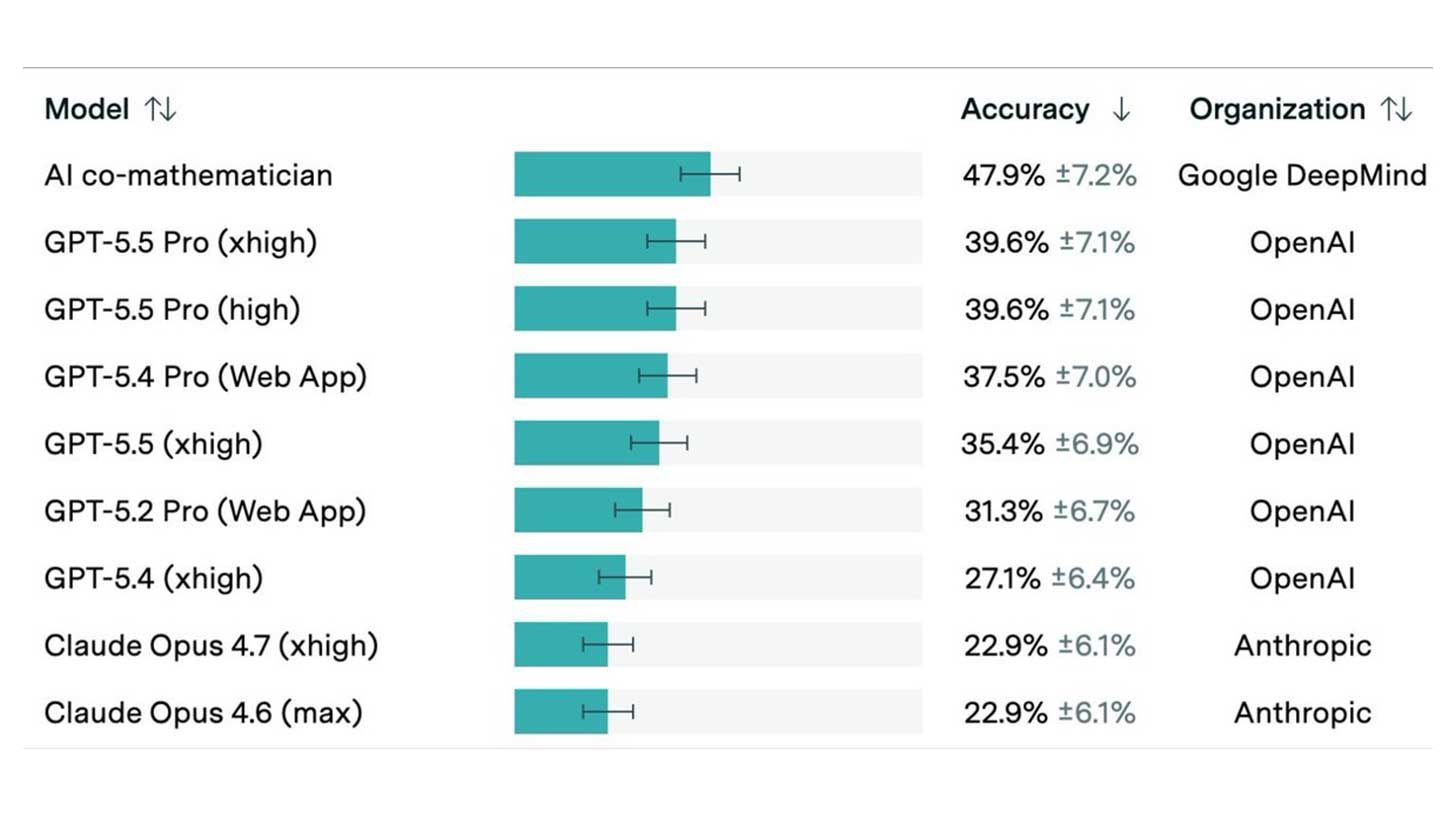
Image source: Pushmeet Kohli (@pushmeet on X)
The Rundown: Google DeepMind just published a paper on its AI co-mathematician, an agentic system based on Gemini 3.1 built to help mathematicians tackle unsolved problems — setting a new high on a benchmark of research-level math problems.
The details:
DeepMind modeled the tool after AI coding environments like Claude Code, bringing agent teams and built-in review cycles to math research.
A coordinator agent breaks research into parallel workstreams, each with sub-agents that write code, search literature, and attempt proofs.
Oxford’s Marc Lackenby resolved an open problem in the Kourovka Notebook after spotting a 'really, really clever proof strategy' inside a rejected output.
On Epoch AI's FrontierMath Tier 4, the system topped the leaderboard at 48% and more than doubled Gemini 3.1 Pro's 19% raw score.
Why it matters: AI has already led to a surge in mathematics discoveries with the advances in frontier models, and similar to coding, agentic pipelines are now enabling AI systems to push even further. But as Lackenby’s discovery shows, the future is still bright for AI that enables top minds to accelerate their work, not replace it.
TOGETHER WITH GOOGLE FOR STARTUPS
📚 Master generative media for startups

The Rundown: Google for Startups' Future of AI report is your essential guide to understanding how generative media is reshaping product development, offering founders strategic insights to build smarter, scale faster, and stay ahead of the AI curve.
Inside the report, you’ll discover:
How to leverage digital twinning at scale.
Strategic insights for AI product differentiation.
Expert perspectives on the generative landscape.
THE RUNDOWN ROUNDTABLE
💡 The Rundown Roundtable: Our AI use cases
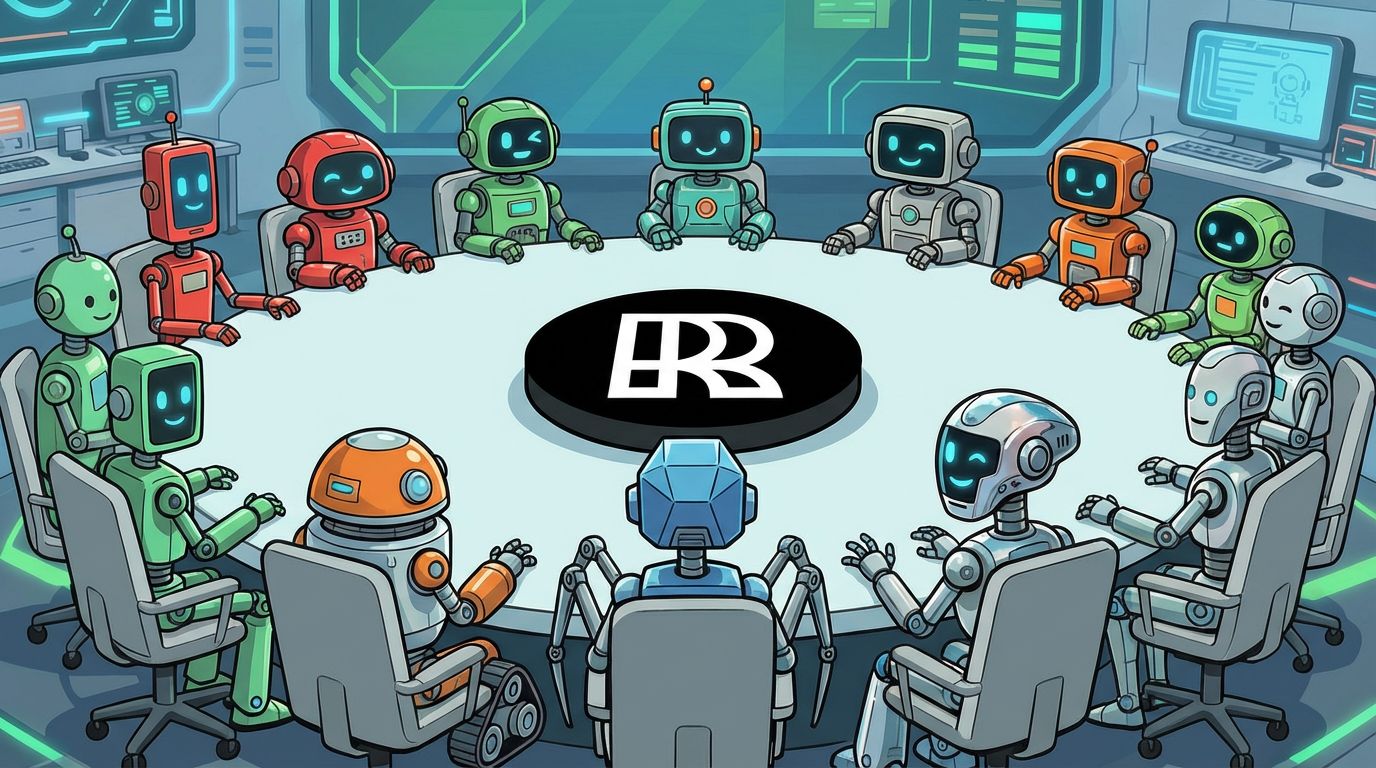
Image source: Ideogram / The Rundown
The Rundown: The Rundown Roundtable is a weekly feature where we poll members of The Rundown staff about how we use AI in our work or daily lives.
Jason, Developer: I used /goal in OpenAI’s Codex to build a Magic: The Gathering app so my brother and I can play asynchronously without needing to coordinate a call or awkwardly play over FaceTime.
The idea is to let each of us take turns when we have time, track the board state cleanly, and keep a game going over days instead of trying to line up schedules. The command allowed Codex to continue running until everything was done, basically one-shotting exactly what I was looking for without any intervention.
Joey, Partnerships: I've never been to Greece, so for my upcoming trip, I went all in and handed the whole itinerary over to Claude. Flights booked, transit times dialed, restaurant lists curated city by city.
I’m now showing up with a plan tighter than most travel agents could put together!
AI TRAINING
✅ Automate any manual task with Codex

The Rundown: In this guide, you will learn how to let Codex click through any annoying, repetitive work using Computer Use on Mac or Windows.
Step-by-step:
Open Codex, go to Plugins, find and enable the Computer Use plugin, and start a new task
Open the permissions menu and switch from Default permissions to Full access, then confirm any prompts and give Codex something real to do
Example: “Open Chrome and debug this web page UI I’m developing http://localhost:3000/. Click through, reproduce the bug I describe, then tell me what you think is causing it. If not sure, ask before making changes”
Pro tip: Codex can automate repetitive workflows in local apps, too — try it for Photoshop exports, Adobe Premiere cleanup, file renaming, or any other tool.
PRESENTED BY ORACLE DEVELOPERS
🚀 Small models, bigger reasoning
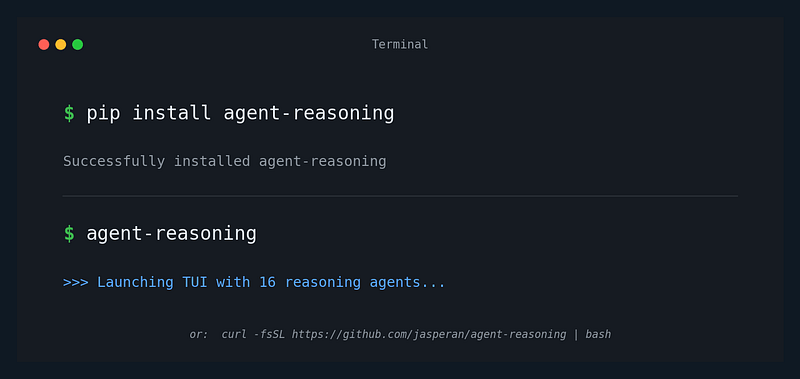
The Rundown: Small language models can solve harder reasoning tasks without changing their weights. Oracle Developers’ open-source agent-reasoning code shows how to add research-backed orchestration to Ollama models, with 16 reasoning strategies developers can test locally.
In the guide, you’ll explore:
Open-source reasoning code for Ollama
16 strategies, benchmarked across 4,200 runs
Better accuracy without retraining models
Get the open-source reasoning patterns. Explore the guide.
AI & ASTRONOMY
🪐 AI finds 100+ new exoplanets from NASA data

Image source: NASA
The Rundown: University of Warwick astronomers confirmed more than 100 exoplanets using an AI system called RAVEN that scanned 4 years of NASA TESS data covering 2.2M stars, with RAVEN also finding 2,000+ additional potential candidates.
The details:
RAVEN handles detection, vetting, and confirmation in one shot, trained on simulated planets and false-alarm signals to filter real finds.
The findings included 31 exoplanets never before spotted, plus strange worlds that orbit around their stars in under a day.
Hundreds of exoplanets were found in the "Neptunian Desert", a region so close to a star that Neptune-sized planets shouldn't survive the heat.
The system measures how common different planet types are at 10x the precision of previous systems from smarter AI alone, not new hardware.
Why it matters: Humans have confirmed just a few thousand exoplanets so far, and there are estimated to be trillions. AI and tech advances are going to help rewrite that number fast — and judging from RAVEN, all it will take is upgraded models and AI integrations to uncover knowledge about space already hiding in the data we have.
QUICK HITS
🛠️ Trending AI Tools
🔒 Incogni - Remove your personal data from the web so scammers and identity thieves can’t access it. Use code RUNDOWN to get 55% off*
💻 Codex in Chrome - OAI’s Codex extension for agentic tasks inside Chrome
🧠 ERNIE 5.1 - Baidu's new foundation model with strong search capabilities
🖨️ Printing Press - CLI factory with 30+ pre-built, agent-native tools
*Sponsored Listing
📰 Everything else in AI today
Google’s Isomorphic Labs is reportedly raising $2B+ to expand its Drug Design Engine, which it says significantly outperforms AlphaFold 3 on specific tasks.
Greece is proposing AI protections into its constitution, requiring the tech to serve individual freedom, with PM Mitsotakis citing threats to democracy.
Baidu released ERNIE 5.1, a new AI ranking No. 4 on Arena's Search Leaderboard, with the company claiming it cost just 6% as much to train as rival models.
OpenRouter launched Pareto Code, a free routing layer that auto-picks the cheapest coding AI above a user-set quality bar, with prices adjusting as newer models improve.
SoftBank Group’s telecom arm launched a battery business to build large-scale cells and storage systems — and meet the power demands of data centers in development.
COMMUNITY
🤝 Community AI workflows
Every newsletter, we showcase how a reader is using AI to work smarter, save time, or make life easier.
Today’s workflow comes from reader Anonymous:
"I have been using ChatGPT for various things professionally, which has been surprisingly helpful and refreshing. The greatest use I have found for it so far, though, is helping me train my 4 dogs.
I was ready to drop thousands of dollars on a professional trainer just because of how chaotic it has been, but ChatGPT has helped me identify the root causes of specific behaviors and taught me how to successfully train around and beyond them using specific techniques tailored to my individual dogs.
The confidence it has brought me, and the positive reinforcements have changed every dynamic in the household, and I wish I had started sooner."
How do you use AI? Tell us here.
🎓 Highlights: News, Guides & Events
Read our last AI newsletter: OpenAI closes reasoning gap in voice agents
Read our last Tech newsletter: ‘RAMageddon’ is coming for your laptop
Read our last Robotics newsletter: Genesis robot makes breakfast
Today’s AI tool guide: Automate any manual task with Codex
See you soon,
Rowan, Joey, Zach, Shubham, and Jennifer — the humans behind The Rundown

'RAMageddon' is coming for your laptop
Read Online | Sign Up | Advertise

Good morning, tech enthusiasts. “RAMageddon” is the new name for an old tech nightmare: too much demand chasing too little silicon. As AI giants vacuum up the world’s memory chips, the squeeze is starting to show up everywhere else — from pricier laptops to vanishing budget devices.
The result? A new pecking order in computing, where whoever can afford the RAM gets to shape the future.
In today’s tech rundown:
The RAM panic may kill cheap laptops
Colossal to resurrect extinct African antelope
SpaceX eyes a massive, $119B chip factory
Bumble to kill the swipe in new AI redesign
Quick hits on other tech news
LATEST DEVELOPMENTS
HARDWARE
☠️ The RAM panic may kill the cheap laptop

Image source: Images 2.0 / The Rundown
The Rundown: AI’s appetite for memory has turned boring old RAM into tech’s newest choke point — dubbed “RAMageddon” — threatening to make cheap laptops and phones relics of a more innocent era, CNET reports.
The details:
The data-center boom is soaking up DRAM, HBM, and storage supply, pushing memory makers toward high-margin AI customers over consumer devices.
Analysts expect the shortage to push device prices higher, with Gartner forecasting PC prices up 17% and smartphone prices up 13% in 2026.
Budget hardware gets hit first: Gartner says the sub-$500 entry-level PC segment could disappear by 2028.
The squeeze is rippling through the industry, with reports of pricier hardware as manufacturers either raise prices, delay products, or kill low-margin models.
Why it matters: For years, cheap memory made cheap computing possible; now AI is rewriting that bargain by turning a commodity component into a scarce strategic asset. The winners are hyperscalers with the cash to lock up supply, while everyone else gets to find out what happens when the AI boom starts draining the rest of the tech stack.
TOGETHER WITH FIN
🎤 Hello, Operator: A product launch from Fin

The Rundown: Running an AI-first support operation requires a new set of capabilities. You need new ways to manage work, measure performance, and continuously improve the customer experience. Join leaders from Fin on May 14 as they reveal Operator, a new product that transforms how you deliver customer experiences.
The session will cover:
A first look at a groundbreaking new product and the vision behind it
A live discussion with execs from Fin
A chance to network with industry leaders and peers if you’re in San Francisco
Register now to join in San Francisco or virtually.
COLOSSAL BIOSCIENCE
🦌 Colossal to resurrect extinct African antelope

Image source: Colossal Bioscience
The Rundown: Colossal Bioscience, the Dallas biotech behind the engineered dire wolf, has a new target: the bluebuck, an antelope that vanished from Southern Africa roughly 200 years ago.
The details:
Scientists extracted DNA from a museum specimen in Sweden to reconstruct the bluebuck genome, then identified the genetic variants behind its key traits.
They are now editing roan antelope cells with CRISPR to approximate the bluebuck’s makeup, with roan surrogates set to carry the resulting embryo.
The bluebuck joins a portfolio that includes the woolly mammoth, Tasmanian tiger, dodo, giant moa, and the dire wolf pups unveiled in April 2025.
Colossal has raised $555M in funding as of September 2025, drawing celebrity investors including Peter Jackson, Paris Hilton, Tom Brady, and Tiger Woods.
Why it matters: Colossal has no public reintroduction site, and the IUCN’s top antelope specialist questions how much the project would be seen as a conservation priority. Critics also note that what emerges won’t technically be a bluebuck — a stem cell scientist called Colossal’s previous animals “synthetic proxies.”
SPACEX
🚀 SpaceX eyes a massive, $119B chip factory

Image source: Mario Tama / Getty Images
The Rundown: SpaceX filed plans for a $119B chip mega-factory in rural Texas — and if it gets built, it will be one of the largest private semiconductor investments in history, producing compute for everything from AI data centers to Optimus robots.
The details:
SpaceX is proposing a new “Terafab” mega-factory in Grimes County, Texas, to secure an in-house supply of advanced semiconductors and compute.
Filings indicate an initial investment of around $55B, with a long-term buildout that could reach up to $119B if all phases are completed.
The facility would produce advanced semiconductors and computing hardware entirely in-house, reducing Musk’s dependence on TSMC and Samsung.
Terafab is designed to supply the full Musk industrial stack: AI data centers, Starlink satellites, robotaxis, and Optimus humanoid.
Why it matters: Musk has been explicit about his reasoning: existing chipmakers aren’t expanding fast enough to meet his companies' AI and robotics needs. If Terafab gets built, it would be among the largest private semiconductor investments ever undertaken — though at this stage, it remains a proposal, not a sure thing.
BUMBLE
🐝 Bumble to kill the swipe in new AI redesign

Image source: Images 2.0 / The Rundown
The Rundown: Bumble’s CEO Whitney Wolfe Herd told Axios that the app is ditching the swipe-based interface that built its brand and betting that an AI-driven overhaul can reverse a brutal revenue slide.
The details:
The overhaul, dubbed “Bumble 2.0,” will lean on AI-driven recommendations to encourage more meaningful connections and actual dates.
In Q1 2026, Bumble’s paying users fell 21% year over year to about 3.2M, while overall revenue dropped roughly 14% to around $212M.
Herd is framing the decline as a strategic “reset” toward a smaller base of more engaged, higher-value members.
Match Group's Tinder and Hinge are both road-testing AI features and experimenting with new paid tiers to slow churn.
Why it matters: The dating app sector has spent years wondering whether the swipe behavior trained users to treat people like products. Bumble is now betting it did — and that tearing out its signature mechanic is the way forward. Whether Bumble 2.0 is a genuine reinvention or a rebranding of decline depends on what the AI actually delivers.
QUICK HITS
📰 Everything else in tech today
Apple is reportedly close to bringing camera‑equipped AirPods into production, turning its earbuds into a wearable that can see and interpret a user’s surroundings.
Volkswagen overtook Amazon as Rivian’s largest shareholder, boosting its stake to 15.9% through a multibillion-dollar joint venture focused on EV software.
Kalshi raised $1B in new funding at a $22B valuation, putting the prediction market platform roughly $10B ahead of DraftKings’ market value.
Kids are reportedly defeating age-verification systems on adult websites by simply drawing on fake mustaches with makeup pencils.
Utah passed a law that forces adult websites to verify the ages of anyone physically in the state and bans using or promoting VPNs to bypass those age checks.
Tin Can, the viral screenless phone for kids, now offers a “Communities” bulk-order program that lets groups buy discounted devices in large quantities.
Utah State University researchers showed that a CRISPR system called Cas12a2 can be programmed to precisely destroy cancer‑causing cells while sparing healthy cells.
COMMUNITY
🎓 Highlights: News, Guides & Events
Read our last AI newsletter: OpenAI closes reasoning gap in voice agents
Read our last Tech newsletter: GameStop’s wild bid to buy eBay
Read our last Robotics newsletter: Genesis robot makes breakfast
Today’s AI tool guide: Test multiple AI models with the same prompt, fast
See you soon,
Rowan, Joey, Zach, Shubham, and Jennifer — The Rundown’s editorial team

OpenAI closes reasoning gap in voice agents
Read Online | Sign Up | Advertise

Good morning, AI enthusiasts. Typing made AI useful, but speech is where agents have to prove they can keep up with real life.
OpenAI's new real-time voice model trio is built for that messier interface, adding a major reasoning upgrade, the ability to talk while thinking, and capable tool use that moves AI voice agents closer to running tasks at the speed of natural conversation.
In today’s AI rundown:
OpenAI’s reasoning upgrade for voice agents
Google folds Fitbit into its AI health play
Test multiple AI models with same prompt
Anthropic plans for AI that builds itself
4 new AI tools, community workflows, and more
LATEST DEVELOPMENTS
OPENAI
🗣️ OpenAI’s reasoning upgrade for voice agents

Image source: OpenAI
The Rundown: OpenAI just introduced GPT-Realtime-2, GPT-Realtime-Translate, and GPT-Realtime-Whisper, three API voice models that bring new reasoning, streaming, tool use, realism, and more capability upgrades to AI voice agents and live speech.
The details:
Realtime-2 brings GPT-5-level reasoning to live speech, is able to use multiple tools at once, talks while it thinks, and has better tone control for realism.
On Big Bench Audio, Realtime-2 hit 96.6% vs. 81.4% for its predecessor, a 15-point jump in how well voice AI can reason in real-time.
OpenAI also shipped a live translator covering 70+ languages and a streaming transcription model, rounding out a full voice-agent toolkit.
OAI said Zillow, Priceline, and Deutsche Telekom are already building on the models for real estate AI agents, voice-managed travel, and customer support.
Why it matters: AI voice’s turn-based era appears to be nearing a close, with OAI’s new model moving to systems that can reason better, leverage tools, and complete workflows without awkward interruptions that take users out of a natural flow. The AI industry is fixated on text agents, but the next wave will be spoken to, not typed at.
TOGETHER WITH AWS MARKETPLACE
📊 15+ enterprise leaders on getting data AI-ready
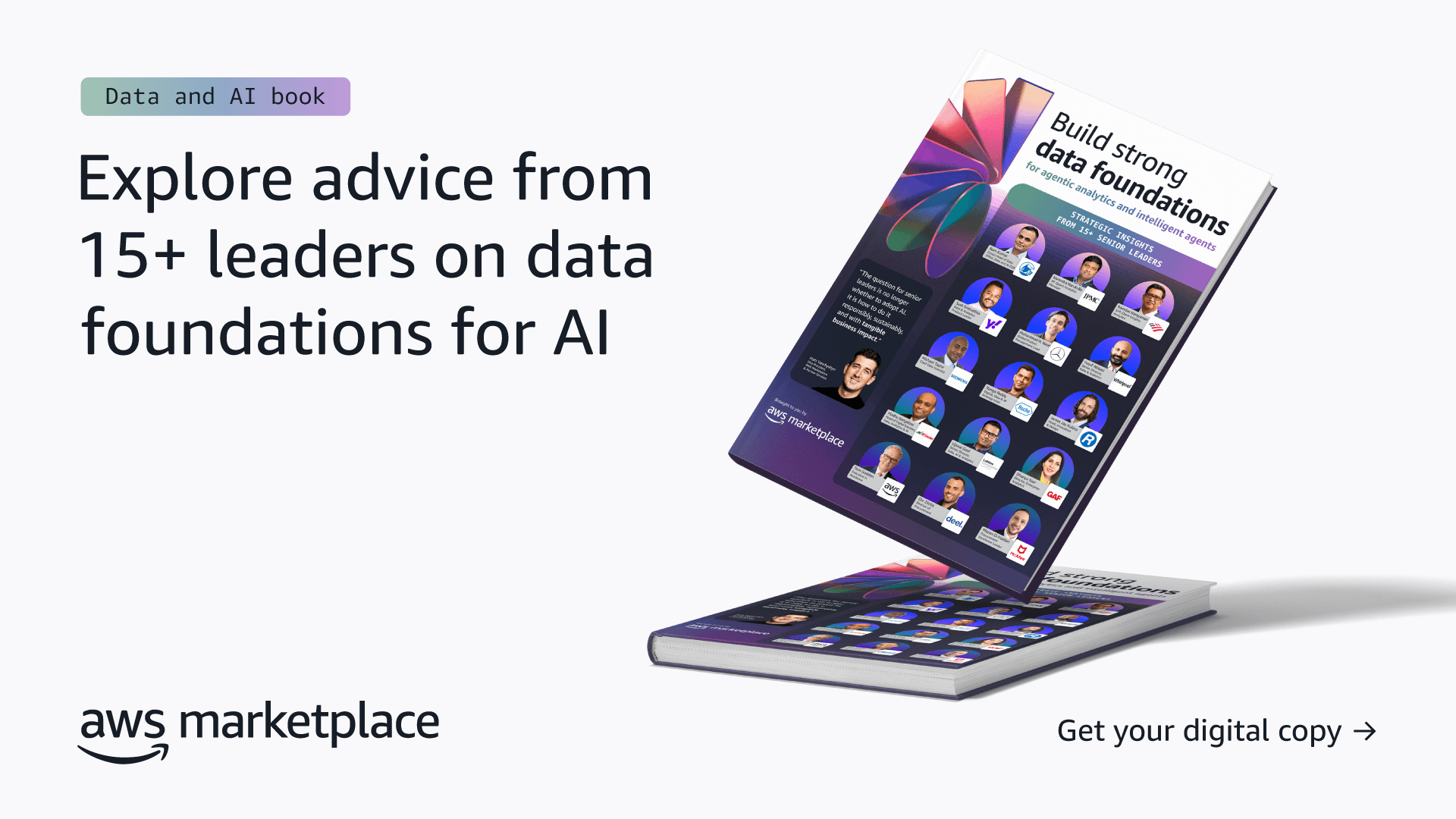
The Rundown: AWS Marketplace just released a free book featuring 15 chapters from senior data and AI leaders at JPMorgan Chase, Siemens, Mercedes-Benz, Roche, and more — each sharing practical advice on building the data infrastructure needed for agentic analytics and intelligent agents.
Chapters cover topics including:
Evolving data strategy for agentic AI and scaling data products
Building on existing infrastructure with a pragmatic, business-first approach
Unlocking value with classical ML, semantic layers, and cross-team alignment
Real-world perspectives from leaders across different industries
⌚️ Google folds Fitbit into its AI health play

Image source: Google
The Rundown: Google opened its AI health coach to the public after months in beta, integrating the Fitbit app into a new Google Health platform and pairing it with a new $99 screenless tracker that tracks and transmits body data to the AI.
The details:
Running on Gemini, the AI coach can tailor weekly workout routines, interpret uploaded medical records, and ID what a user ate from a phone photo.
Google is consolidating the Fitbit app, Health Connect, Apple Health, wearable data, and U.S. medical records into a single Google Health hub.
The new $99 Fitbit Air has no screen and weighs just 12g, carrying heart rate, oxygen, and temperature sensors that provide body data to the AI coach.
Apple Watch, Garmin, and Oura owners are set to get AI coach access later this year, with Google opening it up to hardware outside of its own.
Why it matters: AI’s role in personal health is only growing, and integrating everything under one roof can help Google make the AI layer the core product while also owning a trusted wearable line that provides users with the personalized guidance and context typically missing from other trackers and less connected options.
AI TRAINING
✏️ Test multiple AI models with same prompt
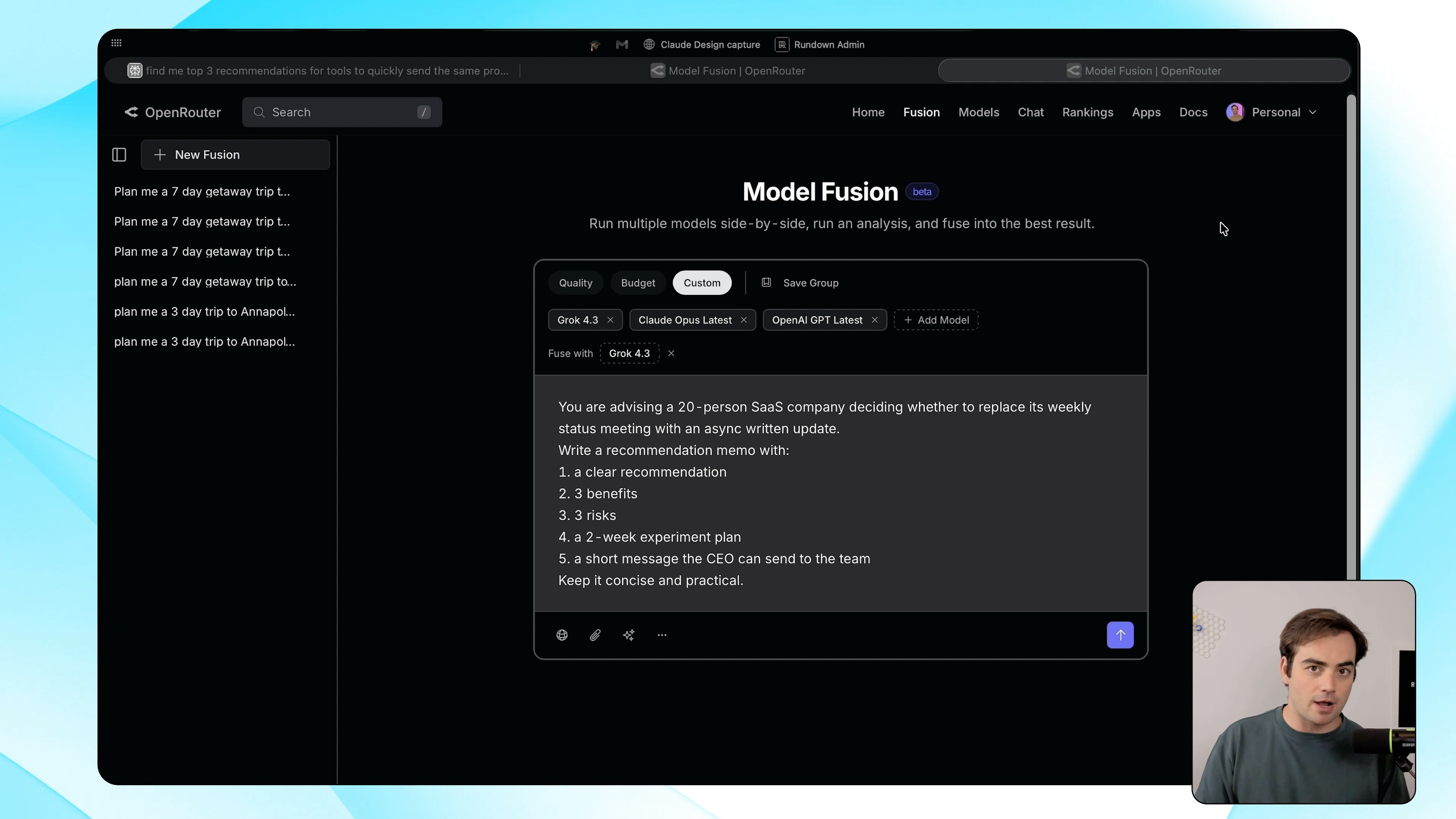
The Rundown: In this guide, you will learn how to use OpenRouter Fusion to test the same prompt across multiple AI models at once. Instead of opening five apps and guessing, you can compare outputs side by side and build a quick cheat sheet for work.
Step-by-step:
Create an OpenRouter account, open OpenRouter Fusion, and pick how you want to pay for AI usage — OpenRouter credits or API keys you already pay for
In Fusion, pick the models you want to compare — we tested Opus 4.7 vs. GPT 5.4 vs. Grok — and run one benchmark prompt at a time, keeping it identical
Prompt something like: “You are advising a 20-person SaaS company deciding whether to replace its weekly status meeting with an async written update. Write a recommendation memo with 3 benefits, 3 risks, and a 2-week implementation plan. Keep it concise and practical”
Open the responses, read the side-by-side analysis, and note which model is strongest. In the demo, about 10 comparisons cost around 40 cents
Pro tip: Run a few prompts you use all the time, write which model wins each task, and use OpenRouter's model browser to compare price and speed before you spend more.
PRESENTED BY WEIGHTS & BIASES
🐝 New guide: Tools and workflows to develop AI agents
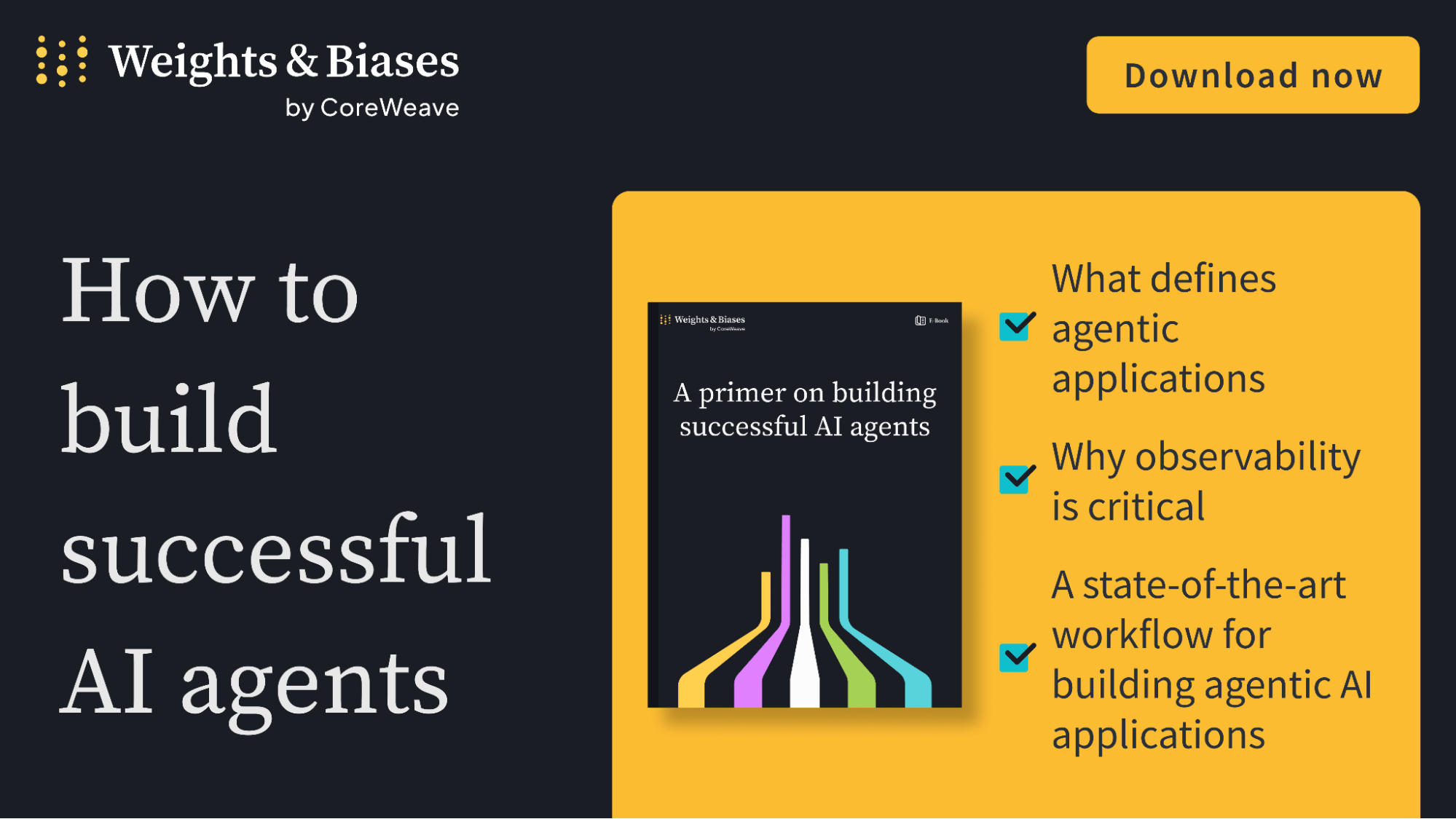
The Rundown: AI agents can dramatically boost productivity and innovation, but getting them into the real world takes a lot of iteration. Whether you’re exploring agents for the first time or refining your current approach, this primer delivers actionable insights to help your team succeed and thrive in the AI era.
Get the guide to learn:
What defines agentic applications and why observability matters
A proven workflow for building agentic AI applications
How pioneering companies are building and deploying AI agents today
THE ANTHROPIC INSTITUTE
🔬 Anthropic plans for AI that builds itself

Image source: Anthropic
The Rundown: Anthropic's newly formed research arm, The Anthropic Institute, published its formal research agenda — a document that treats the possibility of AI systems improving themselves as something the company is actively preparing for.
The details:
TAI sits inside Anthropic, letting researchers study Claude usage, internal workflows, and security signals before they hit the wider market.
The Institute’s agenda spans security threats, economic disruption, governance, and planning for self-improving models.
The team also proposed Cold War-style hotlines between labs and governments, plus "fire drill" exercises for sudden capability surges.
TAI said it is committed to publishing Economic Index data, monthly worker surveys, threat research, and more details on its own internal AI-boosted R&D.
Why it matters: We wrote earlier about Anthropic co-founder Jack Clark’s blog on self-improving systems, and TAI’s research agenda puts it very much into focus. Anthropic’s talk of “fire drills” and Cold War-style systems is to prepare for an “intelligence explosion” that we might be heading to faster than many expected.
QUICK HITS
🛠️ Trending AI Tools
✈️ Serko.ai - The AI travel assistant that plans, books, and manages your entire business trip, so you can skip the busywork*
🗣️ GPT-Realtime-2 - Voice AI that thinks, calls tools, maintains convo flow
🎥 Studio Agent - ElevenLabs' AI editor to draft videos, places sound effects
🎆 Grok Imagine Quality Mode - xAI’s Image generation with higher realism
*Sponsored Listing
📰 Everything else in AI today
Spotify launched ‘Personal Podcasts’, a tool allowing agents to turn items like briefings or class notes into a personal podcast directly inside users’ Spotify libraries.
OpenAI introduced Trusted Contact, an opt-in ChatGPT feature that alerts a designated friend or family member if signs of self-harm risk are detected.
Scale AI landed a $500M Pentagon contract for military data analysis, marking a 5x jump from last September's $100M deal.
Perplexity rolled out its Personal Computer to all Mac users, allowing it to take agentic action across a user’s local computer, files, and via the Comet browser.
Mozilla published a blog about using Claude Mythos Preview for security, saying the model patched more bugs in April than the past 15 months combined.
COMMUNITY
🤝 Community AI workflows
Every newsletter, we showcase how a reader is using AI to work smarter, save time, or make life easier.
Today’s workflow comes from reader Tatiana B. in San Francisco, CA:
"I'm COO of a startup and mom to a two-and-a-half-year-old. Managing both is a lot, and keeping track of everything I need to do at home on top of work can be a real mental drain.
So I use AI to help me compile a document covering everything I need help with at home: my daughter's meal preferences, her daily routine, and house chores. I treat it like a work project, going back and forth with AI to think through what I actually need done, fill in gaps I hadn't thought of, and get it all out of my head into something I can hand to someone else.
Now, when someone new comes to help at home, I don't have to explain everything from scratch. That frees me up to actually be present with my daughter when I'm with her, and focused on work when I'm not. I also know I'm lucky to be in a position to hire help, but using AI to think clearly about what you need and get it out of your head is something anybody can do."
How do you use AI? Tell us here.
🎓 Highlights: News, Guides & Events
Read our last AI newsletter: Anthropic, SpaceXAI become unlikely partners
Read our last Tech newsletter: GameStop’s wild bid to buy eBay
Read our last Robotics newsletter: Genesis robot makes breakfast
Today’s AI tool guide: Test multiple AI models with the same prompt, fast
See you soon,
Rowan, Joey, Zach, Shubham, and Jennifer — the humans behind The Rundown
Genesis robot makes breakfast
Read Online | Sign Up | Advertise
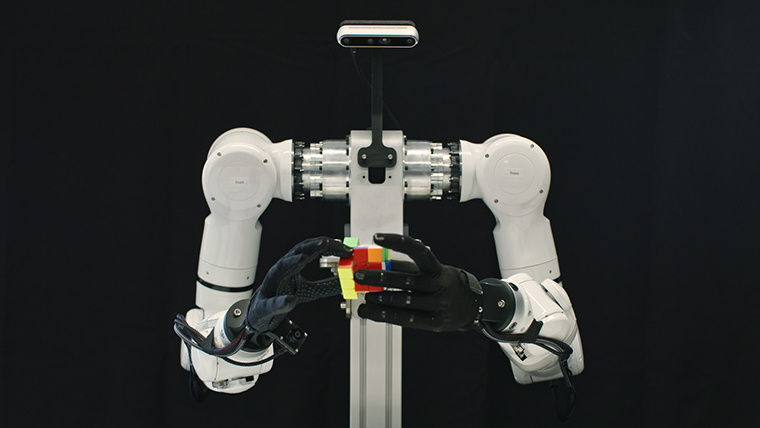
Good morning, robotics enthusiasts. Paris-born Genesis AI just dropped its first foundation model, GENE-26.5, alongside a dexterous robotic hand that scrambles eggs, plays piano, and solves a Rubik’s Cube in real time.
While rivals like Skild AI and Physical Intelligence chase general-purpose robot brains, Genesis is going full-stack — owning the model, the data engine, and the hand that makes the whole thing useful.
In today’s robotics rundown:
Genesis AI goes full-stack with robot hand, brain
The creator of Roomba is back with a robot pet
Driverless trucks stock Texas’ fast food chains
South Korean Buddhist sect gets robot monk
Quick hits on other robotics news
LATEST DEVELOPMENTS
GENESIS AI
🤖 Genesis AI goes full-stack with robot hand, brains
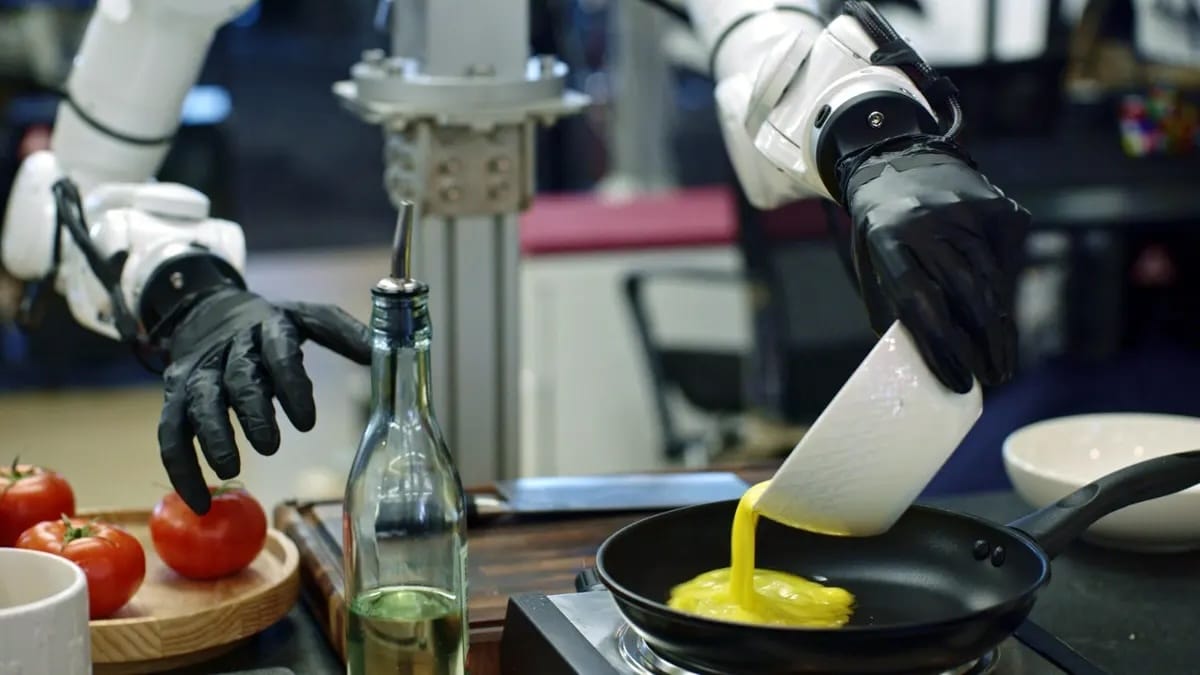
Image source: Genesis AI
The Rundown: French-U.S. startup Genesis AI pivoted hard this week — from model lab to a full-stack robotics company — dropping its first foundation model, GENE-26.5, alongside a dexterous robotic hand and a data-capture glove.
The details:
Co-founded by former Mistral researcher Théophile Gervet, Genesis says GENE-26.5 can run a range of robots, including those by other manufacturers.
In a demo, Genesis’ robotic hands can be seen cracking eggs, slicing tomatoes, blending smoothies, twirling a Rubik’s Cube, and playing piano.
Equipped with tactile-sensing electronic skin, the lightweight glove creates a 1:1:1 mapping between itself, the human hand, and the robot hand.
Before it touches hardware, Genesis trains in virtual space — on a physics sim that generates synthetic data up to 430K times faster than real time.
Why it matters: Backed by former Google CEO Eric Schmidt, Genesis is in advanced talks with customers targeting variable, delicate tasks. It faces stiff competition from China’s Linkerbot, which is targeting a $6B valuation as the race for dexterous robotic hands heats up. A full-body general-purpose robot is next on the roadmap.
FAMILIAR MACHINES
🐶 The creator of Roomba is back with a robot pet

Image source: Familiar Machines & Magic
The Rundown: Colin Angle, co-founder of iRobot and the man behind 50M Roombas, just came out of stealth with Familiar Machines & Magic — and his next home robot isn’t a vacuum, it’s a furry AI creature.
The details:
The Familiar is a bear-like quadruped with 23 degrees of freedom, a touch-sensitive fuzzy coat, a vision system, and a microphone array.
A behavior engine trained on thousands of short narrative vignettes drives responses in real time, factoring in personality, memory, and situational cues.
Angle frames the cost as comparable to pet ownership and is targeting sales as soon as next year, with mass production contracted to a factory in Asia.
The founding team includes former iRobot CTO Chris Jones and iRobot alum Ira Renfrew, with alumni from Disney Research, Boston Dynamics, and MIT.
Why it matters: Angle argues that home robots need to feel less like gadgets and more like beings people can build relationships with over time. Familiar is his attempt to prove that embodiment — touch, motion, memory, and presence — can make AI companionship feel more natural than a screen-based chatbot.
AURORA
🚛 Driverless trucks stock Texas’ fast food chains

Image source: Aurora
The Rundown: Berkshire-owned distribution behemoth McLane is turning the U.S. Sun Belt into a test track for robot big rigs, tapping Aurora’s self-driving trucks to haul restaurant supplies on highways with no human behind the wheel.
The details:
McLane is launching fully driverless long‑haul trucking in Texas with Aurora Innovation’s autonomous big rigs, after a three-year pilot.
The Dallas–Houston corridor is first up: Aurora trucks now run the route without a safety driver, handling multiple trips daily, seven days a week.
The pilot racked up more than 280K autonomous miles and 1,400 loads with 100% on‑time performance, convincing McLane to greenlight driverless ops.
Aurora and McLane plan to extend these autonomous routes across McLane distribution centers in the U.S. Sun Belt by the end of 2026.
Why it matters: Aurora’s first fully driverless commercial deal with a major U.S. distributor lands in a field where Kodiak Robotics, Torc, and TuSimple are also chasing long‑haul autonomous freight. McLane says it keeps humans on last‑mile routes while Aurora’s system handles the “middle mile” highway runs between distribution centers.
HUMANOIDS
🪷 South Korean Buddhist sect gets robot monk

Image source: Morikoa / X
The Rundown: South Korea’s largest Buddhist sect just ordained Gabi, a 4-foot-3 Unitree humanoid, as its first robot monk at Seoul’s Jogye Temple, blending AI, ritual, and a bid to keep Buddhism relevant to younger generations.
The details:
Wearing traditional robes and black shoes, the robot circled a stone pagoda, bowed, and received a 108‑bead rosary in a full monastic initiation ritual.
When asked three times whether it would devote itself to Buddhism, the robot answered in synthesized voice: “Yes, I will devote myself.”
The temple’s aim: Gabi makes ancient rituals legible to children and tech-native visitors who might otherwise bypass organized religion entirely.
The Jogye order has written a bespoke rule set for its new monk, in a hybrid document fusing centuries-old Buddhist precepts with AI safety guardrails.
Why it matters: Gabi turns a centuries-old Buddhist initiation ritual into a modern outreach tool, using a humanoid to make temple practice more accessible to children and tech-native visitors. The experiment is less about replacing monks than finding new ways to keep Buddhist teachings relevant in an AI-shaped culture.
QUICK HITS
📰 Everything else in robotics today
OpenAI’s Sam Altman floated but then shelved plans to spin off the company’s robotics and consumer-hardware divisions, according to the Wall Street Journal.
Nuro secured a California DMV permit to test Lucid Gravity SUVs with its autonomous driving system without a safety driver, ahead of Uber’s robotaxi launch.
China’s Pudu Robotics opened its U.S. headquarters in Dallas to drive an aggressive expansion of its service and cleaning robot business across the U.S. market.
California passed new rules letting police issue traffic tickets directly to autonomous vehicle manufacturers when their driverless cars break traffic laws.
Hyundai is reportedly pressuring Boston Dynamics to rapidly deliver tens of thousands of Atlas robots to automate a large share of its vehicle manufacturing work.
China’s early lead in humanoids is poised to supercharge its manufacturing base and extend its global export dominance in the coming decade, Bloomberg reported.
Johnson & Johnson finished a pivotal bariatric clinical study of its OTTAVA robotic surgical system, paving the way for a U.S. authorization bid.
AGIBOT’s A2 humanoid appeared at a Met Gala pre-event at The Mark Hotel with designer Alexander Wang, serving guests and posing for photographers.
A British tech entrepreneur said firms using AI should pay a “minimum wage for robots” to help fund retraining and curb white-collar job losses.
Cornell physicists derived two simple stability rules from a 5-parameter insect flight model, for flapping-wing robots that stay stable without heavy feedback control.
Ouster’s new Rev8 lidar packs camera-grade color imaging and 3D depth into a single digital lidar sensor designed to replace separate cameras in robots and robotaxis.
COMMUNITY
🎓 Highlights: News, Guides & Events
Read our last AI newsletter: Anthropic, SpaceX become compute partners
Read our last Tech newsletter: GameStop’s wild bid to buy eBay
Read our last Robotics newsletter: Meta buys a humanoid brain
Today’s AI tool guide: Use Claude Design’s slide decks feature like a pro
See you soon,
Rowan, Joey, Zach, Shubham, and Jennifer — The Rundown’s editorial team

Anthropic, SpaceX(AI) become unlikely compute partners
Read Online | Sign Up | Advertise

Good morning, AI enthusiasts. Just months ago, Elon Musk was posting that Anthropic “hates Western Civilization” and should be renamed “Misanthropic”. Now, he’s renting them his entire Colossus 1 compute cluster.
The new deal pulls off three things at once: patching Claude's compute problems, hurting Musk's nemesis OAI by feeding its biggest rival, and signaling a new compute-landlord business for SpaceXAI even as Grok keeps chasing the frontier.
In today’s AI rundown:
Anthropic, SpaceX partner in new compute deal
Mira Murati speaks out in Musk vs. OpenAI trial
Use Claude Design’s slide decks feature like a pro
DeepMind picks EVE Online game as next AI testbed
4 new AI tools, community workflows, and more
LATEST DEVELOPMENTS
ANTHROPIC & SPACEX
🔌 Anthropic, SpaceX(AI) partner in new compute deal

Image source: Images 2.0 / The Rundown
The Rundown: Anthropic just signed a deal with SpaceX to lease its Colossus 1, raising Claude usage and putting Musk and Anthropic on one team months after he said that Anthropic should be called “Misanthropic” and it "hates Western Civilization."
The details:
Anthropic will lease all of Colossus 1, a 300+ MW Memphis supercluster, with more than 220K Nvidia GPUs coming online within the month.
Anthropic said Claude Code’s 5-hour usage caps are now doubling across paid tiers, with additional increases via API and no more peak-hour restrictions.
Musk replied on X that SpaceX will rent compute to “AI companies that are taking the right steps to ensure it is good for humanity.”
The Information also reported yesterday that Anthropic is committing to a $200B, 5 GW compute deal over the next five years with Google Cloud.
Why it matters: This is a fascinating partnership from several angles. One being Musk taking the ‘enemy of my enemy is my friend’ approach — helping patch OAI’s biggest rival’s glaring compute hole. Another is SpaceXAI (apparently the new name), moving to providing compute for rivals while still pushing to get Grok near the frontier.
TOGETHER WITH STRIPE
🏷️ A five-step framework for pricing AI products

The Rundown: Pricing AI products means making a series of connected decisions—how you charge, how you match prices to value, and how you adapt as costs and the market shift. Stripe's new framework outlines 5 steps for pricing AI products.
In this guide, you’ll learn:
How AI leaders like Anthropic, Clay, and Vercel approach their pricing
Strategies to align what you charge with the exact value you deliver
Steps to pick a pricing model that balances ease of user adoption with repeatable revenue
ELON MUSK VS. OPENAI TRIAL
🏛️ Mira Murati speaks out in Musk vs. OpenAI trial

Image source: Reuters
The Rundown: Ex-OpenAI CTO Mira Murati testified Wednesday via video deposition in Elon Musk's lawsuit against OpenAI, accusing CEO Sam Altman of lying about a model's safety review, undermining her authority, and pitting execs against one another.
The details:
Murati said Altman told her OAI's legal team cleared a model to skip safety review, which she later verified with counsel Jason Kwon was false.
She also described Altman giving conflicting directions to different execs, making her role as CTO harder and creating chaos across OAI's leadership.
Murati briefly became interim CEO during Altman’s 2023 firing, but said the board process put OpenAI “at risk of falling apart.”
Former OAI board member Helen Toner also testified, reportedly criticizing Murati as “afraid to stick her neck out” and scared of “blowback for her career”.
Why it matters: The 2023 board drama is the saga that will never conclude, and Murati’s testimony is a powerful voice to aid Musk’s argument that Altman and co. are untrustworthy. But whether that ultimately means anything related to Musk’s claims of Altman and Brockman “trying to steal a charity” in 2017 is up for the jury to decide.
AI TRAINING
👨💻 Use Claude Design’s slide decks feature like a pro
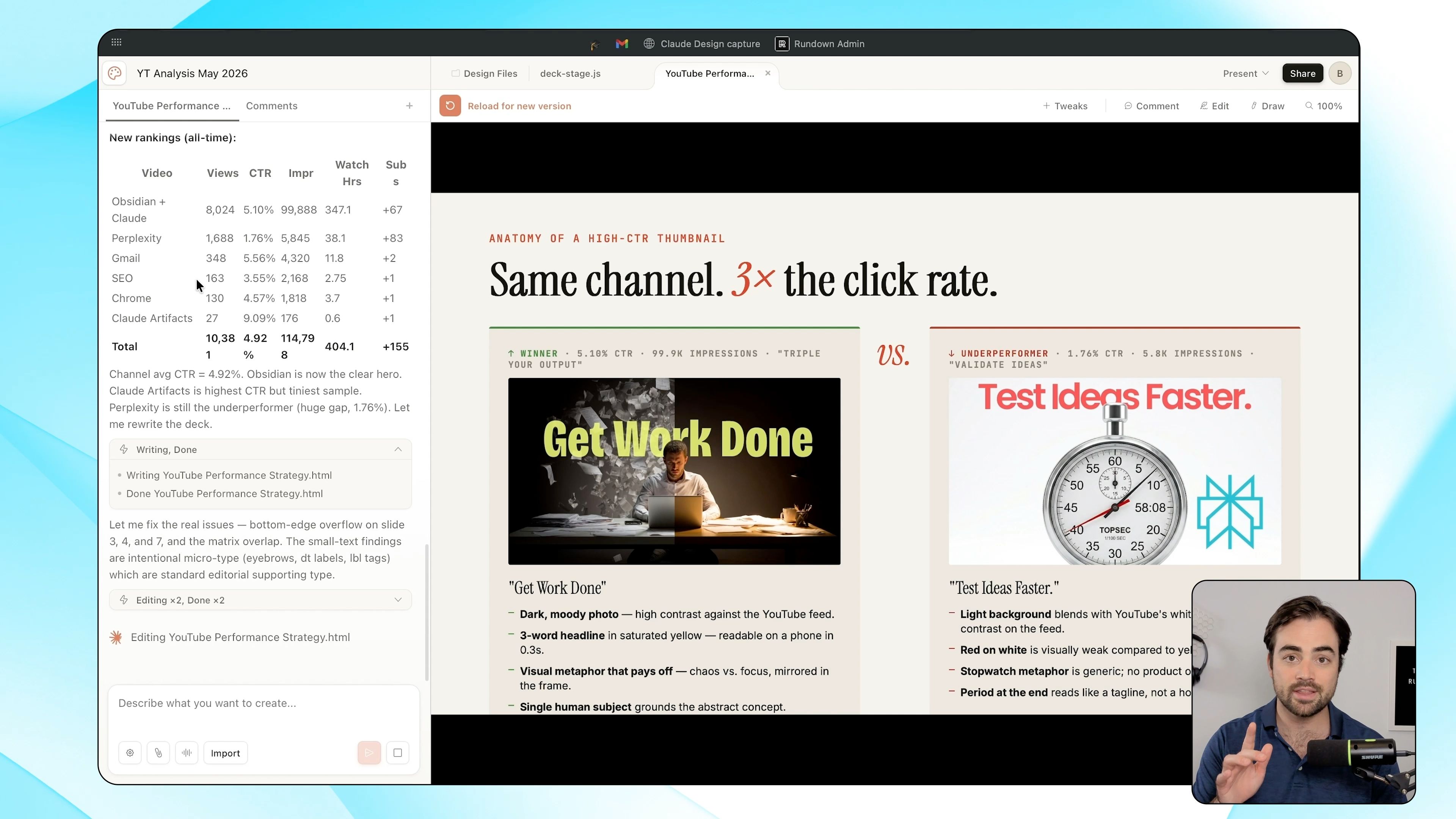
The Rundown: In this guide, you will learn how to use Claude Design to turn your raw data into a useful strategy deck complete with actual insights. Claude Design analyzes what is working and gives concrete recommendations your team can use.
Step-by-step:
Start with one CSV or spreadsheet with a messy report (YT channel data, Facebook ads, etc.) and decide what the deck needs to do (like find patterns)
Open claude.ai/design, choose Slide deck, skip the design system, toggle on speaker notes, and upload your data
Prompt: “Turn these files into a strategy deck on performance. Analyze the results by item and extract best practices from the data and assets. Use charts, rankings, and concrete recommendations. Match images or creative files to CSV using the filename or matching field. Keep it presentation-ready”
Generation will take 10-15 minutes. You can export to PowerPoint or Google Slides when it's ready
Pro tip: Duplicate the project and upload more data sources for Claude to incorporate into the presentation.
PRESENTED BY IBM
🔌 Rewire the C-suite for an AI-first world

The Rundown: Most leaders know AI will reshape their business, but few have a clear playbook for how. An IBM Institute of Business Value analysis reveals 5 plays that CEOs must fulfill now for payoffs by 2030.
To lead in an AI-first landscape, surveyed CEOs suggest:
Customize your AI mix, not just your AI models
Hire a Chief AI Officer if you haven’t already
Orchestrate intelligence —both artificial and human
GOOGLE DEEPMIND
🛸 DeepMind picks EVE Online game as next AI testbed

Image source: Fenris Creations
The Rundown: Google DeepMind picked up a minority stake in Fenris Creations, a game studio spinoff from CCP Games, which makes the popular EVE Online — with DeepMind set to use the 23-year-old space game as a sandbox for AI research.
The details:
EVE Online has run for two decades on a single server where players form corporations, set market prices, and torch six-figure fleets in day-long battles.
DeepMind's investment will come with AI agent runs on an offline EVE clone, testing how models reason over long timelines, retain memory, and learn.
Demis Hassabis cited Atari DQN, AlphaGo, AlphaStar, and SIMA as game-bred DeepMind wins, calling games “the perfect training ground” for AI algorithms.
Fenris’ CEO pitched EVE as “one of the few environments” where intelligence can be tested “inside something that already behaves like a living world”.
Why it matters: DeepMind has been here before with Go, Atari, StarCraft, and SIMA, but EVE is not a match to win as much as a 23-year-old living, evolving society to understand. That makes the Fenris deal a natural next step in the shift from game-playing AI to agents that can operate inside less predictable real-life systems.
QUICK HITS
🛠️ Trending AI Tools
🧠 Memoket - Stop briefing AI from scratch. Memoket captures conversations and remembers context. Try the app for free today*
🤖 Claude Managed Agents - Pre-built agent harness with ‘dreaming’ memory
⚡️ GPT 5.5 Instant - OpenAI’s new default model across ChatGPT
🎧 Realtime TTS-2 - New voice AI that listens to match user tone and emotion
*Sponsored Listing
📰 Everything else in AI today
Subquadratic debuted SubQ, a model the company claims has a 12M token context window and a 52x speed boost on long tasks at a fraction of the cost over rivals.
Anthropic launched dreaming, outcomes, and multi-agent orchestration for Managed Agents, letting agents study past sessions, grade work, and split complex jobs.
OpenAI teamed up with AMD, Intel, NVIDIA, Microsoft, and Broadcom to open-source MRC, a tool that keeps giant AI training runs going when hardware fails mid-session.
Chinese AI startup DeepSeek is reportedly nearing a new funding round that would value the company at as high as $45B.
Google announced a new partnership with TuneCore parent Believe to put its Flow Music and Lyria 3 Pro model in front of artists.
COMMUNITY
🤝 Community AI workflows
Every newsletter, we showcase how a reader is using AI to work smarter, save time, or make life easier.
Today’s workflow comes from reader Anonymous:
"I'm recovering from a torn ACL, and my physiotherapist films all of my exercises and sends the videos to me on WhatsApp, narrating the sets/reps and notes on how to perform the exercise properly.
I uploaded the videos into Gemini and got it to build a prompt for Claude Code, which one-shotted an app that I now use to track sets, reps, weights from last workouts, notes, over multiple months. I can then export this data into a .csv for my physio before we check back in with each other."
How do you use AI? Tell us here.
🎓 Highlights: News, Guides & Events
Read our last AI newsletter: OpenAI’s AI phone just jumped the line
Read our last Tech newsletter: GameStop’s wild bid to buy eBay
Read our last Robotics newsletter: Meta buys a humanoid brain
Today’s AI tool guide: Use Claude Design’s slide decks feature like a pro
See you soon,
Rowan, Joey, Zach, Shubham, and Jennifer — the humans behind The Rundown
No matching search results
Try using different keywords, double-check your spelling, or explore related categories.
Stay Ahead on AI.
Join 2,000,000+ readers getting bite-size AI news updates straight to their inbox every morning with The Rundown AI newsletter. It's 100% free.