Clone's $20K synthetic human
PLUS: Generalist's robot brain hits 99% accuracy

Jennifer Mossalgue
April 9, 2026
Read Online | Sign Up | Advertise

Good morning, robotics enthusiasts. Clone Robotics has always been the humanoid outlier, building eerie fluid-muscle “synthetic humans” in Poland while better-funded rivals pursue the more conventional bots.
Now CEO Dhanush Radhakrishnan is promising a sci-fi roadmap: surgical-tool dexterity by 2026, human-like walking by 2027, and hotel butlers by 2028, all for under $20K a unit. But can Clone turn its wild vision into something that actually works?
In today’s robotics rundown:
Clone Robotics unveils $20K android roadmap
GEN-1 bot folds boxes, fixes vacs, and rarely misses
Hermeus nabs $350M for Mach 5 unmanned aircraft
VC Eclipse raises $1.3B to wire AI into robots
Quick hits on other robotics news
LATEST DEVELOPMENTS
CLONE ROBOTICS
🤖 Clone Robotics unveils $20K android roadmap

Image source: Clone Robotics / Reve AI
The Rundown: At the 2026 Abundance Summit, Clone Robotics co-founder and CEO Dhanush Radhakrishnan unveiled a “synthetic human” roadmap, announcing sub-$20K androids, a new Silicon Valley hub, and “Robo Butler” deployments by 2028.
The details:
Clone is pursuing “synthetic humans,” androids built around an anatomically accurate polymer skeleton actuated by fluid-driven “Myofiber” muscles.
The company says it is opening a hub in Mountain View, in the heart of Silicon Valley, to scale R&D, hiring, and partnerships around its android platform.
Radhakrishnan says the company can manufacture a full musculoskeletal android for under $20K by producing Myofiber muscles at scale.
The roadmap calls for a torso platform capable of using tools like scalpels by late 2026, human-like walking by 2027, and robot butlers in hotels by 2028.
Why it matters: A Mountain View office and a reported $50M raise put Clone in the same conversation as Figure and 1X, but not on the same timeline. It’s 2028 target trails rivals already in factory deployments, and the case for fluid-muscle androids at scale rests entirely on manufacturing claims that have yet to be tested in production.
GENERALIST
🛠️ GEN-1 bot folds boxes, fixes vacs, and rarely misses
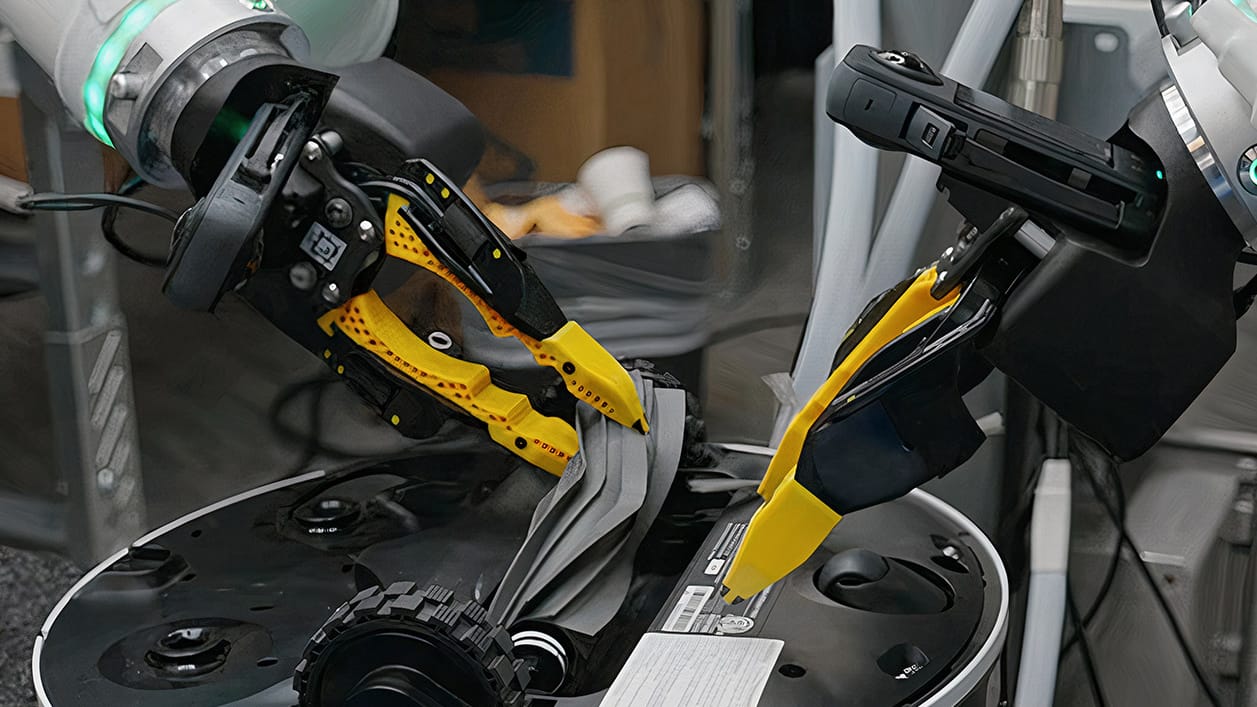
Image source: Generalist
The Rundown: San Mateo–based startup Generalist says it just crossed a threshold that robotics has been chasing for years: a general-purpose AI model that performs real-world manipulation tasks with 99% reliability.
The details:
The company says its GEN-1 physical AI model can fold boxes, fix vacuums, and pack phones, without fumbling a third of them like its predecessor.
On box assembly, GEN-1 reportedly clocks in at 12.1 seconds, compared to 34 seconds for both GEN-0 and Physical Intelligence’s pi-0.
The base model is pretrained entirely on human “data hands,” only encountering robot hardware during a final hour of task-specific adaptation.
Unlike scripted factory robots, GEN-1 claims to recover from mid-task disruptions and handle objects or situations it was never explicitly trained on.
Why it matters: A one-in-three failure rate is a non-starter on a factory floor, but at 99% and 3x the speed, the game changes. Generalist admits some tasks still can’t hit that bar — but for a model that needs just one hour of robot-specific training to deploy, the lab-to-production gap just got a lot smaller.
HERMEUS
✈️ Hermeus nabs $350M for Mach 5 unmanned aircraft

Image source: Hermeus
The Rundown: Defense startup Hermeus raised $350M to develop what it calls the fastest unmanned aircraft on Earth, a funding round that pushes the LA-based company to a $1B valuation.
The details:
The company pulled in $200M in new equity led by Khosla Ventures, plus $150M in debt to scale hardware without diluting control.
The startup had been building its own engine from scratch before partnering with RTX subsidiary Pratt & Whitney to modify its F100 to shorten timelines.
Hermeus completed its first test flight last May with a subsonic demonstrator, then flew a new iteration nearly 3x larger and 4x heavier a few weeks ago.
CEO AJ Piplica models Hermeus on SpaceX — build, test, fail, repeat — with supersonic flight next on the ladder and Mach 5 as the ultimate target.
Why it matters: VC investment in defense tech crossed $9B last year, and Hermeus is positioning itself as the software-era answer to a very hardware problem. If it can actually field a Mach 5 drone fighter on startup timelines, it could reset expectations for how fast an entirely new class of aircraft gets designed, tested, and deployed.
ECLIPSE
💰 VC Eclipse raises $1.3B to wire AI into robots

Image source: Mind Robotics / Reve AI
The Rundown: Eclipse, the Palo Alto hard-tech VC best known for backing AI chipmaker Cerebras, raised $1.3B to wire AI directly into the physical stack of robots, factories, and energy systems.
The details:
The raise is reportedly split into $591M for early-stage investments and $720M for later-stage deals, disclosed in SEC filings.
The new funding surpasses Eclipse’s previous high of $1.23B in 2023, bringing total assets under management to roughly $10B.
The portfolio already includes battery recycling firm Redwood Materials, Arc, Bedrock Robotics, Wayve, and industrial robotics lab Mind Robotics.
Partner Jiten BehlBehl told TechCrunch that Eclipse will also incubate some startups in-house, a process he says is already underway.
Why it matters: Most physical AI investors write checks and wait. Eclipse is taking a more hands-on approach, building companies internally while pushing its existing portfolios in adjacent sectors to become each other’s customers and partners, a structure designed to de-risk the long road from prototype to commercial scale.
QUICK HITS
📰 Everything else in robotics today
BMW is turning its historic Munich plant into an iFACTORY where 800 robots and AI will automate about 60% of logistics while building only electric cars by 2027.
Waymo launched its public robotaxi service in Nashville, its 11th U.S. city, and will gradually expand access while partnering with Lyft.
Chinese startup LingXin SmartHand, a leading maker of dexterous robotic hands, is reportedly seeking new funding at a valuation of around $2.9B.
Syncere opened preorders for Lume, a $1,499 robotic floor lamp that doubles as a laundry‑folding home robot and aims to bring “ambient robotics” into bedrooms.
BYD patented an autonomous robot that can navigate to parked EVs, scan their battery and tire pressure, then automatically charge the vehicle and inflate all four tires.
Chinese robotaxi company Pony.ai launched an invitation-only robotaxi passenger service in Singapore’s Punggol district in partnership with ComfortDelGro.
German-Chinese robot maker Kuka said many European factories are too slow to adopt AI, so it plans to prioritize growth in the U.S. and Asia instead, Bloomberg reports.
Chinese startup D-Robotics raised an additional $150M to expand its embodied AI platform and developer ecosystem, taking its total Series B funding to $270M.
The U.S. may bar federal agencies from buying Chinese-made humanoids, a shift that could hand Hyundai’s Boston Dynamics a major opening in U.S. robotics.
U.S. researchers built an AI‑powered robotic guide dog that uses an LLM to talk with visually impaired users, explain route options, and narrate surroundings in real time.
German city mayors are urging a night-time ban on robot mowers, warning that the machines’ blades are injuring and killing hedgehogs and nocturnal wildlife.
Japan opened its first 3D-printed railway station, built from concrete components printed off-site using an ABB industrial robot, then assembled overnight.
U.S. regulators closed their probe into Tesla’s remote parking feature without a recall after finding only rare, mostly minor crashes among millions of uses.
COMMUNITY
🎓 Highlights: News, Guides & Events
Read our last AI newsletter: Meta Superintelligence Labs ships first model
Read our last Tech newsletter: This startup wants to hack the night sky
Read our last Robotics newsletter: UBTech offers $18M / year for AI scientist
Today’s AI tool guide: Build an automated ad generator with this tool
Watch our last live workshop: The State of AI Presentation Tools in 2026
See you soon,
Rowan, Joey, Zach, Shubham, and Jennifer — The Rundown’s editorial team

Stay Ahead on AI.
Join 2,000,000+ readers getting bite-size AI news updates straight to their inbox every morning with The Rundown AI newsletter. It's 100% free.