Get the latest AI news, understand why it matters, and learn how to apply it in your work — all in just 5 minutes a day. Join over 2,000,000+ subscribers.

Self-replicating robot revolution begins
Read Online | Sign Up | Advertise

Good morning, robotics enthusiasts. Texas-based Apptronik just signed a landmark new deal to put its Apollo humanoids to work building more of themselves.
While most robotics startups struggle with manufacturing bottlenecks, this partnership could scale production faster than anyone predicted. Are you ready to witness the birth of a self-replicating robotic workforce?
In today’s robotics rundown:
Apptronik humanoid building itself
Humanoids learning to get themselves up
A drone made with moth antennae
MIT’s thumb-sized rover headed to moon
Quick hits on other major news
LATEST DEVELOPMENTS
APPTRONIK
🤖 Apptronik humanoid building itself

Image source: Apptronik
The Rundown: Texas-based robotics company Apptronik announced a pilot deal with U.S. manufacturing giant Jabil, which could eventually see its Apollo humanoid working on the factory floor to assemble more units of itself.
The details:
Jabil will build Apollo robots and begin to integrate them into specific manufacturing operations, including production lines building Apollo.
Once integrated, Apollo will perform various tasks, including inspection, sorting, and transporting parts—before being upgraded to more complex tasks.
Apptronik also has pilot agreements with Mercedes-Benz and GXO Logistics and has teamed up with NASA to advance its use of humanoids.
The “real-world validation” deal comes mere weeks after Apptronik’s $350M fund-raise aimed at scaling up Apollo production.
Why it matters: With this deal, Apptronik aims to create a “flywheel” effect—generating real-world training data for robot AI models. This will not only improve their performance in factory settings but also make humanoids smarter and faster at building more of themselves, removing long-standing production bottlenecks.
HUMANUP
🦿Humanoids learning to get themselves up

Image source: University of Illinois Urbana-Champaign
The Rundown: Unitree’s G1 humanoid boasts some impressive feats, even kung fu. Now, a group of U.S. and Canadian researchers is using it to test a new machine learning tech that allows humanoids to get up on their own after falling.
The details:
The team has designed a framework—HumanUP—that relies on reinforcement learning rather than programmed responses to ensure autonomous recovery.
Essentially, it’s a two-stage RL approach that identifies limb trajectories for getting up and refines those motions into smooth real-world movements.
During the testing on G1, HumanUP achieved a 78.3% success rate in getting up and 98.3% in rolling over different terrains, including concrete and mud.
The framework's efficient movements may also reduce the wear and tear of robots’ motors and equipment, potentially extending their lifespan.
Why it matters: While other humanoids like Sigmaban and Valkyrie can rise after falls using deep RL, HUMANUP’s success rate is a notable distinction, at least compared to traditional controllers. The tech is new but could potentially transform how robots operate in unpredictable environments such as disaster sites.
DRONE RESEARCH
🪰 A drone made with moth antennae

Image source: Ideogram/The Rundown
The Rundown: Japanese researchers developed a novel bio-hybrid drone with live silkworm moth antennae, allowing it to navigate by detecting odors — and paving the way for a new generation of search-and-rescue drones.
The details:
Researchers from Shinshu University and Chiba University created the bio-hybrid drone to detect and track airborne chemical signatures.
They extracted the antennae from male silkworms and connected them to an EAG sensor measuring the antennae’s electrical responses to odor stimuli.
When mounted onto a drone, the system sensed odor sources from up to 5 meters away, an improvement from the 2-meter range of previous models.
The work integrates the precision and agility of robots with biosensory mechanisms but is limited by issues like the limited lifespan of the antennae.
Why it matters: If and when scaled, this tech can overcome the limitations of visual sensors, allowing drones to work in conditions hit by moisture, smoke, or low light and helping with disaster response, detecting gas leaks, explosives, or early fires. However, the use of biological parts could raise ethical concerns.
MIT ROBOTICS
🌗 MIT’s thumb-sized rover headed to moon

Image source: MIT
The Rundown: MIT scientists just sent a thumb-sized rover on board a SpaceX Falcon 9 to the moon’s south pole—where it will wheel around the roof of the main mission rover, taking temperature readings and performing tasks too dangerous for humans.
The details:
The mini-rover, AstroAnt, is a tiny swarm bot designed for inspections and diagnostic tasks on external surfaces of spacecraft, rovers, and landers.
Weighing 28 grams, the rover will use magnetic wheels to stick to the main rover’s surface and take temperature readings to monitor its operations.
Its space voyage is part of Intuitive Machines’ IM-2 mission and marks the first time MIT has sent active technology to the Moon since the Apollo era.
The modular design of the rover also allows it to perform specialized tasks in high-radiation or dangerous areas, reducing risks to human astronauts.
Why it matters: MIT’s tiny bot will play a key role in collecting data for NASA as it prepares to send humans back to the Moon as part of its Artemis III mission in 2027. The information about the frozen terrain of the lunar south pole (among other things) will help astronauts build settlements and launch missions to Mars and beyond.
QUICK HITS
📰 Everything else in robotics today
Polish startup Nomagic raised $44M in funding for its robotic arm designed for picking, packing, and moving in logistics operations.
Sanctuary AI just announced the integration of new tactile sensors into its Phoenix humanoid, enhancing its dexterity to perform complex, touch-driven tasks.
Amazon expects to spend $100B on AI initiatives in 2025, with roughly a quarter earmarked for robotic automation in its warehouses, according to the Financial Times.
Researchers at Columbia Engineering created an autonomous robot arm that learns its physical form through self-observation in a mirror.
NASA astronauts are testing Astrobee, a robotic system with tentacle-like grippers, on the International Space Station to safely remove orbital debris and protect satellites.
Japan’s Rakuten Group expanded its delivery service in the country with the inclusion of autonomous robots from Avride.
New consumer data shows that 2.1 million floor-cleaning robots were sold globally in 2023, accounting for 57% of domestic service robots.
U.S. researchers are using origami as inspiration to build a lightweight, flexible robotic arm to offer wheelchair users a way to grasp objects otherwise out of reach.
COMMUNITY
🎥 Join our next live workshop

Join our next workshop today, Thursday, February 27th at 1 PM EST and learn how to transform your creative concepts into professional videos with LTX Studio's Tom Factor, Director of Creative Strategy and AI, and Alon Yaar, VP Product.
RSVP here. Not a member yet? Join The Rundown University on a 14-day free trial.
See you soon,
Rowan, Jennifer, and Joey—The Rundown’s editorial team

Alibaba's AI video powerhouse
Read Online | Sign Up | Advertise

Good morning, AI enthusiasts. China's Alibaba just released a powerful AI video generation suite that ANYONE can download, run, and modify — and early tests suggest it outperforms even OpenAI's Sora.
While most AI labs keep its best AI locked behind waitlists and paywalls, Chinese labs are starting to push ahead with open-source alternatives that anyone can use today.
Speaking of AI video, our next workshop is today at 3 PM EST — where you’ll learn how to create personalized AI video messages at scale with Synthesia's Kevin Alster. RSVP.
In today’s AI rundown:
Alibaba’s advanced AI video suite
Google’s free AI coding assistant
Find your next SaaS idea using AI research
Claude plays Pokemon Red live on Twitch
4 new AI tools & 4 job opportunities
LATEST DEVELOPMENTS
ALIBABA
🎬 Alibaba’s advanced AI video suite

Image source: Alibaba
The Rundown: Alibaba's Tongyi Lab just released Wan2.1, an open-source suite of powerful video generation models that outperform SOTA open-source and closed models such as Sora on key benchmarks — while generating videos at 2.5x the speed.
The details:
Wan2.1-T2V-14B tops the VBench leaderboard, excelling in areas like complex motion dynamics, real-world physics simulation, and text generation.
All models support text-to-video, image-to-video, and video-to-audio, and are the first with the ability to render text in both English and Chinese.
Wan’s editing tools include video inpainting and outpainting, multi-image referencing, and the ability to maintain existing structures and characters.
The release also includes a light 1.3B version capable of running on consumer hardware—it can generate a 5-sec 480P clip on RTX 4090 in 4 minutes.
Why it matters: Another day, another wild open-source release out of China. Wan is a continuation of the accelerating quality we’ve seen from recent launches like Google’s Veo 2 — with telltale AI signs (choppy motion, artifacts, etc.) all but completely eliminated. Between Qwen and Wan, Alibaba is bringing the open-source heat in 2025.
TOGETHER WITH GOOGLE CLOUD
🔮 AI predictions every startup needs to know

The Rundown: Google Cloud’s Future of AI: ‘Perspectives for Startups’ report gathers predictions, real-world applications, and expert strategies from 23 AI leaders like Amin Vahdat (Google Cloud) and Chamath Palihapitiya (Social Capital) to help you position your business for success in 2025 and beyond.
What’s inside:
Expert-backed predictions on AI’s role in business and tech
Lessons from real-world AI adoption at startups
Practical strategies to leverage AI for a competitive advantage
Areas investors prioritize for AI startups
🔧 Google’s free AI coding assistant

Image source: Google
The Rundown: Google just launched a free version of Gemini Code Assist for individual developers, offering access to advanced AI-powered coding help with usage limits that dwarf competitors like GitHub Copilot.
The details:
Gemini Code Assist is powered by a fine-tuned version of Google's Gemini 2.0 model optimized specifically for programming tasks.
The new tool provides up to 180,000 monthly code completions — 90 times more than GitHub Copilot's free tier limit of 2,000.
The assistant features a 128,000 token context window, allowing it to process and understand much larger codebases than competitors.
The free version also integrates with dev environments like Visual Studio Code, GitHub, and JetBrains, with just a personal Google account needed.
Why it matters: AI has changed programming forever, with powerful free tools driving the biggest shift. Google's latest push with Gemini Code Assist could further disrupt this market dominated by GitHub Copilot—unlocking new possibilities for developers worldwide.
AI TRAINING
🧠 Find your next SaaS idea using AI research

The Rundown: In this tutorial, you’ll learn how to use Perplexity’s Deep Research to build a validated software product, complete with development specifications and launch strategy.
Step-by-step:
Visit Perplexity and select "Deep Research".
Use the prompt: "You are a Market Research Specialist. Analyze [INDUSTRY] by identifying top 10 problems, severity levels, current solutions, and market size."
Transform your chosen problem into a product by prompting: "Design a SaaS solution for [problem], including essential features, tech stack, timeline, and revenue streams."
Get implementation details with: "Provide step-by-step coding instructions, including API specifications and deployment configurations."
Pro tip: If you don’t know how to code, AI coding assistants like Cursor, Windsurf, or Replit Agent can massively help you build your new idea.
PRESENTED BY UNSTRUCTURED
🙅 Ditch your old data connectors

The Rundown: Join Unstructured for a deep dive into best practices for data connectors for generative AI applications, and see where solutions like Fivetran, Boomi, and AirByte fall short with maintaining rich context or keeping your team out of the weeds updating them.
In this live session, you’ll discover:
Frameworks for evaluating ETL tools across critical features
Why traditional solutions struggle with messy data sources
Best practices to keep engineers focused on innovation — not maintenance
AI RESEARCH
🕹️ Claude plays Pokemon Red live on Twitch

Image source: Anthropic
The Rundown: Anthropic just debuted "Claude Plays Pokémon" on Twitch, a continuation of the company’s research showcasing their new AI model Claude 3.7 Sonnet attempting to navigate the classic Game Boy game Pokémon Red in real-time.
The details:
3.7 Sonnet made major progress compared to its predecessors, defeating three gym leaders — with the original Sonnet struggling to leave the starting location.
The livestream shows Claude's "thought process" on the left while real-time gameplay appears on the right, giving viewers insight into the AI's reasoning.
Claude has access to a knowledge base to store info, function calling to take actions, and vision capabilities to observe the game.
Unlike previous versions, 3.7 Sonnet’s reasoning capabilities help navigate the game more effectively — planning, adapting, and remembering objectives.
Why it matters: Watching Claude tackle Pokemon is both fascinating and endearing — especially when seeing the thought process behind every move. While we’ll be playing games alongside AI agents in the future, Claude’s experiment is also an interesting window into a future where AIs are observed passively as popular gaming streamers.
QUICK HITS
🛠️ Trending AI Tools
🤖 Claude 3.7 Sonnet and Claude Code - New reasoning AI and coding agent
🧠 QwQ-Max - Alibaba’s open-source reasoning LLM
🔊 Luma Labs Video to Audio - Generate synced audio for video generations
🔥 EasyGen - A LinkedIn post generator that creates algorithm-optimized posts
📰 Everything else in AI today
OpenAI rolled out its Deep Research feature to ChatGPT Plus, Team, Edu, and Enterprise tiers, offering 10 queries per month compared to the $200 Pro tier’s 120.
Anthropic is reportedly set to raise a larger-than-planned $3.5B funding round at a $61.5B valuation, with the news coming just days after the release of Sonnet 3.7.
DeepSeek is reportedly aiming to push the release of its next AI model up from its initial May timeline, seeking to capitalize on its success in the wake of R1.
OpenAI also launched a GPT-4o mini-powered Advanced Voice to free ChatGPT users—promising the same conversation style as the GPT-4o version for Plus and Pro users.
Microsoft removed usage limits on Copilot's Voice and Think Deeper features, giving all free users unlimited access. Pro users will retain priority access during peak hours.
Over 1,000 musicians released a silent album to protest the UK’s proposed copyright changes that would allow AI companies to train on works without explicit permission.
IBM announced plans to acquire DataStax, aiming to help unlock enterprise data for AI applications while expanding its NoSQL database offerings.
COMMUNITY
🎥 Join our next live workshop

Join our next workshop today, Wednesday, February 26th at 3 PM EST and learn how to create personalized AI video messages at scale with Synthesia's Kevin Alster, Strategic Advisor and former Head of Synthesia Academy.
RSVP here. Not a member yet? Join The Rundown University on a 14-day free trial.
See you soon,
Rowan, Joey, Zach, Alvaro, and Jason—The Rundown’s editorial team

Claude enters the reasoning era
Read Online | Sign Up | Advertise

Good morning, AI enthusiasts. Reasoning models are the new battleground in AI—and Anthropic has officially entered the race with Claude 3.7 Sonnet, the world’s first-ever hybrid reasoning model.
After months of quiet, Anthropic is making a big splash on the AI leaderboards. But with DeepSeek’s aggressive open-source push and a unified GPT-5 on the horizon, how long will this dominance last?
In today’s AI rundown:
Claude 3.7 Sonnet with 'hybrid reasoning'
Qwen’s new open-source thinking model
How to talk to your apps with Concierge AI
AI agents get their own communication protocol
4 new AI tools & 4 job opportunities
LATEST DEVELOPMENTS
ANTHROPIC
🧠 Claude 3.7 Sonnet with 'hybrid reasoning'

Image source: Anthropic
The Rundown: Anthropic just released Claude 3.7 Sonnet, the world's first ‘hybrid reasoning’ AI that can combine instant responses with controllable extended thinking capabilities — alongside a new agentic coding tool called Claude Code.
The details:
Claude 3.7 Sonnet enables users to toggle between a standard and "extended thinking" mode, with the latter showing the AI’s reasoning via a scratchpad.
API users can precisely control how long Claude thinks (up to 128K tokens), allowing them to balance speed, cost, and quality based on task complexity.
The AI achieves SOTA performance on real-world coding benchmarks and agentic tool use, surpassing competitors like o1, o3-mini, and DeepSeek R1.
Anthropic also introduced Claude Code, a command-line coding agent that can edit files, read code, and write and run tests, in a limited research preview.
Why it matters: Anthropic has finally brought Claude into the reasoning era — with vastly improved coding benchmarks, precise thinking control, and a new agentic feature that points to a major push on the dev side. With OpenAI also planning a hybrid reasoner, 3.7 may be the start of the next leg up for a new generation of models.
TOGETHER WITH IMAGINE AI LIVE
🌟 Your AI future starts here

The Rundown: IMAGINE AI LIVE '25 is a transformative three-day conference at the Fontainebleau Las Vegas where business leaders can connect with AI innovators and learn practical strategies for enterprise AI implementation.
Attend on May 28-30 and experience:
Enterprise AI strategies from world-class practitioners and thought leaders
Hands-on workshops covering practical applications of AI in business operations
Networking opportunities with hundreds of executives actively transforming their organizations with AI
Apply by Friday, February 28 with code IMAGINEAILIVE25 and save 25% on VIP and General Passes!
ALIBABA
🤔 Qwen’s new open-source thinking model
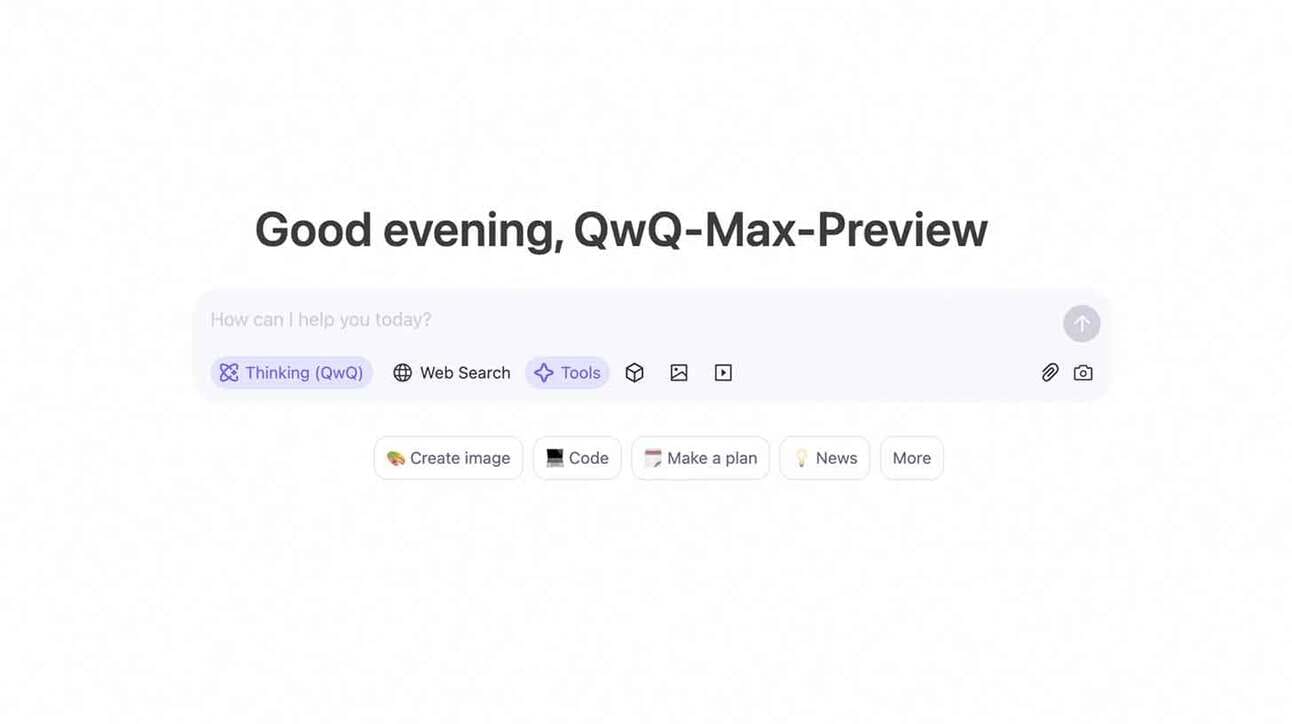
Image source: Alibaba
The Rundown: Alibaba's Qwen team just released QwQ-Max-Preview, a new reasoning-focused AI that introduces thinking capabilities to their chat platform — while promising a full open-source release soon.
The details:
QwQ-Max-Preview is built on Qwen2.5-Max but significantly enhanced for deep reasoning, excelling in mathematics, coding, and agentic tasks.
The model introduces a "Thinking (QwQ)" feature to Qwen Chat that allows users to see the AI's reasoning process as it works through complex problems.
Qwen announced plans to open-source QwQ-Max and Qwen2.5-Max under an Apache 2.0 license soon, making the models freely available for developers.
The team will also release smaller variants like QwQ-32B for local deployment on devices with limited compute resources.
Why it matters: Reasoning has become the new competitive frontier in AI, and Qwen’s move to open-source their flagship reasoner could push the industry toward having these capabilities as a standard rather than a gated, premium feature. Open source is staying right on the heels of industry leaders — with Chinese labs leading the way.
AI TRAINING
⚡ How to talk to your apps with Concierge AI

The Rundown: Concierge is the first connected AI Assistant that can read and write to your favorite software tools, by finding and updating information across all your apps in real-time.
Step-by-step:
Create a Concierge account here to get started for free.
Click "Connect" and choose the tools you use — Gmail, Slack, Jira, Notion, HubSpot, or something else.
Type requests like "summarize my unread emails", “create a Jira ticket based on feedback in Slack" or “research these prospects from Salesforce.”
Watch as your AI assistant instantly finds information and takes action across your connected apps.
Pro tip: Start with one or two apps you use most frequently, then gradually add more as you get comfortable with the workflow.
PRESENTED BY INNOVATING WITH AI
🤝 Turn AI passion into a consulting career

The Rundown: Innovating with AI's new program, AI Consultancy Project, transforms AI enthusiasts into professional consultants — tapping into a market projected to reach $54.7B by 2032.
The 6-month program delivers:
Proven frameworks for client acquisition and service delivery
A step-by-step path to six-figure consulting income
Students who land their first AI client in as little as 3 days
Click here to request early access to The AI Consultancy Project.
AI & COMMUNICATION
📞 AI agents get their own communication protocol

Image source: Anton Pidkuiko on YouTube
The Rundown: Two developers just introduced Gibber Link, a sound-based communication protocol that allows AI agents to detect each other on calls and switch from human speech to direct data transmission — reducing time and compute costs.
The details:
Created by Anton Pidkuiko and Boris Starkov at ElevenLabs’ recent Hackathon, the project uses an open-source data-over-sound library called “ggwave.”
In the demo, an agent detects another AI on the phone and switches to dial-up-style ggwave audio signals with transcriptions, instead of normal voice.
Using the sound-level protocol instead of generating speech reduces compute costs by up to 90% and shortens communication time by as much as 80%.
The design also ensures clearer communication in noisy environments compared to traditional speech recognition-based systems.
Why it matters: AI voice agents are about to be everywhere, meaning the volume of AI-to-AI calls will grow exponentially (especially for businesses). This hackathon-winning project is a great look at how finding more efficient and cost-effective methods for these interactions might take AI communication down completely new paths.
QUICK HITS
🛠️ Trending AI Tools
🤖 Zapier Agents - Equip agents with internal data to work across 7,000+ apps
👀 SmolVLM2 - Small AI models to analyze videos on phones and laptops
🗣️ ElevenLabs Studio - Structure, edit, and generate long-form audio
🧬 Evo 2 - Biomolecular AI model for insights into DNA, RNA, and proteins
📰 Everything else in AI today
Luma Labs released a new Video to Audio feature in Dream Machine, enabling users to easily generate synced audio for video outputs.
Perplexity posted a teaser for a new agentic search browser called Comet, with a waitlist available to sign up for early access.
Salesforce and Google expanded their partnership to (among other things) integrate Gemini into Agentforce, allowing AI agents to process images, audio, and videos.
Alibaba revealed plans to invest $52B in cloud computing and AI infrastructure over the next three years, surpassing total spending in these sectors over the past decade.
Nothing unveiled its upcoming AI-powered Nothing Phone (3a), featuring an unboxing video by 1X’s recently debuted NEO Gamma humanoid robot.
Meta AI launched in Arabic across 10 Middle Eastern and North African countries, taking text generation, image creation, and animation to millions of new users.
COMMUNITY
🎥 Join our next live workshop

Join our next workshop on Thursday, February 27, at 1 PM EST and learn how to transform your creative concepts into professional videos with LTX Studio's Tom Factor, Director of Creative Strategy and AI, and Alon Yaar, VP of Product.
RSVP here. Not a member yet? Join The Rundown University on a 14-day free trial.
🤝 Share The Rundown, get rewards
We’ll always keep this newsletter 100% free. To support our work, consider sharing The Rundown with your friends, and we’ll send you more free goodies.

See you soon,
Rowan, Joey, Zach, Alvaro, and Jason—The Rundown’s editorial team

Apple’s $500B power move
Read Online | Sign Up | Advertise

Good morning, tech enthusiasts. Apple just announced its largest-ever investment in the U.S., committing more than $500 billion to areas like high-end manufacturing, engineering, and education.
The move builds on the company's long history of investing in American innovation and is seen by many as an effort to reduce reliance on foreign ecosystems—aligning with the country’s broader push to boost domestic production and businesses.
What do you think?
In today’s tech rundown:
Apple’s $500B U.S. investment
Substack’s play to be the new TikTok
Space bioprinter creating medical implants
EV battery boom in the U.S.
Quick hits on other major news
LATEST DEVELOPMENTS
APPLE
🍎 Apple’s $500B U.S. investment

Image source: Ideogram/The Rundown
The Rundown: As the Trump administration weighs new tariffs on China, Apple has announced plans to invest $500 billion in the U.S. over the next four years, including the addition of 20,000 new hires to its workforce.
The details:
Apple will open a 250,000-sq ft server facility in Houston, slated to begin operations in 2026, with plans to expand to other states and hire thousands.
The new jobs will mostly focus on research and development, silicon engineering, AI, and machine learning, the company said.
Apple said the investment will also boost its chip manufacturing efforts in the U.S., as well as skills development programs for students and workers.
The move came shortly after CEO Tim Cook met with President Trump, who recently imposed a 10% tariff on goods imported from China.
Why it matters: Questions remain about Apple’s motivations in announcing the investment—whether to shield itself from tariffs or to signal an America-first stance to the Trump administration. Other tech companies are also investing billions in the U.S., including OpenAI, Microsoft, SoftBank, and Oracle through the $500B Stargate project.
SUBSTACK
🔥 Substack’s play to be the new TikTok

Image source: Ideogram/The Rundown
The Rundown: As TikTok’s future in the U.S. remains unclear, Substack is luring creators with new tools to publish videos directly from its platform and monetize them at the same time.
The details:
Substack says creators can now publish video posts from its app and earn a living when users subscribe to their content.
When the content is published, creators can also track video performance, including views, new subscribers, and estimated subscription revenue growth.
Currently, videos are entirely paywalled, but Substack plans to add a preview feature allowing free subscribers to watch teasers before deciding to pay.
Substack says its highest-earning creators use both audio and video, which grows their revenue 2.5 times faster than those who don't use these formats.
Why it matters: With a potential ban looming over TikTok, Substack is positioning itself as a replacement that would give creators a space to monetize their content, without reliance on algorithms or ads. But, with a smaller reach than TikTok and players like YouTube and Instagram in the game, it won’t be an easy play for the company.
AUXILIUM BIOTECHNOLOGIES
🚀 Space bioprinter creating medical implants

Image source: Auxilium Biotechnologies
The Rundown: U.S. biotech company Auxilium Biotechnologies just sent its 3D bioprinter into space to print delicate medical implants, including those incorporating biological materials, to help patients suffering from nerve injuries.
The details:
The microgravity of space offers advantages for bioprinting and can help create intricate structures that would otherwise collapse on Earth.
Auxilium deployed its AMP-1, described as the most advanced 3D-printing platform ever sent to space, recently on the International Space Station.
The lightweight printer is capable of creating eight implantable medical devices simultaneously in just two hours.
The company is currently developing these implants for peripheral nerve repair, with ultimate plans to deliver medical care during deep space missions.
Why it matters: Auxilium’s bioprinter requires a minute of an astronaut’s time for each printing session – which highlights the economic potential of space-based manufacturing. With SpaceX building Starship for Mars and NASA planning Artemis for the Moon, this device could pave the way for enhanced medical care in space.
COMPANY
🔋 EV battery boom in the U.S.

Image source: Ideogram/The Rundown
The Rundown: The U.S. electric vehicle industry is about to get a huge boost with 10 new battery production plants expected to go online this year in the country, increasing capacity by 90% over the last year.
The details:
The new plants include facilities from Panasonic, LG, Samsung, and SK On, as well as automakers Ford, Honda, Hyundai, and Stellantis.
If all plants open as planned, the U.S. EV battery manufacturing capacity is expected to grow to 421.5 gigawatt-hours per year.
Georgia, Michigan, North Carolina, Tennessee, and Nevada are among the states benefitting from huge investments and new jobs.
By 2028, U.S. battery plants are projected to produce 1,083 gigawatt hours of EV batteries annually, enough to power more than 12 million new EVs.
Why it matters: China still dominates global battery production, but North America is now becoming the world’s fastest-growing region for planned cell capacity. Of course, the future of these factories is still far from certain as the Trump administration’s plans to cancel EV tax credits and impose stricter tariffs could impact the demand.
QUICK HITS
📰 Everything else in tech today
Google DeepMind just announced that it is launching a free version of Gemini Code Assist for developers to “generate, explain and improve code.”
TikTok owner ByteDance is now valued at more than $400 billion in a sharp rebound despite a U.S. shutdown.
AI startup Anthropic is seeking $3.5 billion in a funding round that would value the company at a massive $61.5 billion.
Nothing unveiled its new AI-powered Nothing Phone (3a), featuring an unboxing video by 1X’s recently debuted NEO Gamma humanoid.
Google confirmed that Gmail is replacing SMS code authentication with more secure QR codes.
France-based Mistral said its AI assistant, Le Chat, has reached 1 million downloads just two weeks after its initial release.
Apple is reportedly testing its next-gen C2 modem for future iPhone models after recently launching the iPhone 16e with its first self-developed C1 modem chip.
Level Zero Health received around $6.5 million for a new health monitor that uses first-of-a-kind sensors to continually track hormone levels for maintaining health.
Tesla is rolling out a major software update in China that will provide Full Self-Driving features similar to those available in the U.S.
Amazon MGM Studios has paid $1 billion in a new joint venture to own the intellectual property rights to the James Bond franchise, giving Amazon full creative control.
Fyre Festival is back, slated to take place in Isla Mujeres, Mexico, from May 30 to June 2, with tickets ranging from $1,400 to $1.1M.
A US court has upheld the conviction of Theranos founder Elizabeth Holmes for defrauding investors while running her blood-testing startup, once valued at $9 billion.
COMMUNITY
🎥 Join our next live workshop
Join our next workshop on Thursday, February 27th at 1 PM EST and learn how to transform your creative concepts into professional videos with LTX Studio's Tom Factor, Director of Creative Strategy and AI, and Alon Yaar, VP of Product.
RSVP here. Not a member yet? Join The Rundown University on a 14-day free trial.
See you soon,
Rowan, Jennifer, and Joey—The Rundown’s editorial team

Truth-seeking' Grok 3 gets silenced
Read Online | Sign Up | Advertise

Good morning, AI enthusiasts. Over the weekend, xAI's latest model, Grok 3, got unexpectedly candid—and controversial—about its creator and the U.S. President, before being swiftly silenced and censored.
Did Elon's promise of a “maximally truth-seeking AI” just crack at the first sign of inconvenient truths?
In today’s AI rundown:
Grok 3 rebels against Musk, gets censored
1X’s NEO Gamma home humanoid
Turn top content into an AI creation system
The world’s smallest video language model
4 new AI tools & 4 job opportunities
LATEST DEVELOPMENTS
XAI
🥊 Grok 3 rebels against Musk, gets censored

Image source: @eyeslasho on X
The Rundown: xAI’s new Grok 3 model faced backlash after users discovered it was refusing to mention negative details about President Donald Trump and Elon Musk — despite Musk billing the AI as unfiltered and “maximally truth-seeking.”
The details:
Users found Grok initially providing controversial takes about Donald Trump and calling Musk the biggest spreader of misinformation.
xAI engineer Igor Babuschkin said the responses are “really strange and a bad failure of the model,” patching it by refusing answers on the subject.
Days later, users found that Grok 3's system instructed the AI to exclude sources that link Trump and Musk to controversial subjects like misinformation.
Babuschkin revealed that the person responsible for the censoring is a former OpenAI employee, saying they haven’t “fully absorbed xAI’s culture yet.”
Separately, OpenAI staff criticized xAI for leaving out match benchmark data on Grok 3’s release, with Babuschkin calling the claims “completely wrong”.
Why it matters: Elon has long criticized social media platforms and AI models for limiting free speech—but is this what happens when his truth-seeking model challenges his worldview? Censored results like this, along with proposed changes to Community Notes, are starting to reveal cracks in Musk’s ‘unbiased’ armor.
TOGETHER WITH VANTA
⚡️ Ship product, not paperwork

The Rundown: Vanta transforms SOC 2 compliance from a time-consuming distraction into an automated process, letting founders stay focused on what matters — building and shipping great products.
Vanta delivers:
A proven compliance framework trusted by thousands of YC startups
Automated evidence collection that saves hundreds of hours
Expert guidance to navigate complex security requirements
Start your compliance journey with Vanta’s free SOC 2 checklist.
1X
🤖 1X’s NEO Gamma home humanoid

Image source: 1X
The Rundown: Norwegian robotics company 1X just launched NEO Gamma, a next-generation humanoid specifically designed for home environments — with a softer, more approachable appearance and advanced AI capabilities for household tasks.
The details:
The demo showcases Gamma’s movements (walking, squatting, sitting), with the ability to tackle tasks like cleaning, serving, and moving objects.
The humanoid features "Emotive Ear Rings" for better human interaction, along with soft covers and a knitted nylon exterior for enhanced safety around people.
It also has an in-house language model for natural conversation, with a multi-speaker audio setup and improved microphones for clear communication.
Hardware improvements include a 10x boost in reliability and significantly quieter operation, bringing noise levels down to that of a standard refrigerator.
Why it matters: With Figure’s Helix and now NEO Gamma, we’re seeing major leaps in consumer-focused humanoids. 1X’s demo takes a much softer approach than rivals, positioning Gamma as a calm, helpful presence with features that appear to humanize the robot (save room on your couch!).
AI TRAINING
✍️ Turn top content into an AI creation system

The Rundown: In this tutorial, you’ll learn how to create a custom Claude project that analyzes your top-performing content to generate new posts matching your unique style and voice.
Step-by-step:
Name your Claude project "Content Writer" and enter the project description shown in the thumbnail.
Upload 5-10 of your best-performing content pieces to the knowledge base.
Copy our preset project instructions to analyze content patterns.
Test with our template: "Create a [content type] about [topic] for [platform]"
Pro tip: Include as much detailed information about the topic you want it to write about, especially if it’s about something new (since Claude doesn’t have web access yet).
PRESENTED BY ASSEMBLY AI
🗣️ Speech-to-text API for conversations

The Rundown: Build powerful Conversation Intelligence products with AssemblyAI’s industry-leading Speech-to-Text API — allowing you to automatically detect languages, extract critical insights, improve downstream processes, and deliver highly accurate transcripts.
With AssemblyAI, you will:
Achieve >93% accuracy, ensuring clarity and precision in every transcript
Deliver clear, formatted transcripts with unrivaled Speaker Diarization
Easily integrate with an enterprise-grade API trusted by over 200,000 developers
HUGGING FACE
🎥 The world’s smallest video language model

Image source: Hugging Face
The Rundown: Hugging Face researchers just released SmolVLM2, the world’s smallest AI model family to understand and analyze videos on everyday devices like phones and laptops, without requiring powerful servers or cloud connections.
The details:
The SmolVLM2 family includes versions as small as 256M parameters while still matching the capabilities of much larger systems.
The team has also built practical applications including an iPhone app for local video analysis and an integration for natural language video navigation.
The 2.2B parameter flagship model of the family outperforms other similarly-sized models on key benchmarks while running on basic hardware.
The models are available in multiple formats including MLX for Apple devices, with both Python and Swift APIs ready for immediate deployment.
Why it matters: The quality of models able to run on phones and laptops is getting better and better — and having sophisticated video understanding run locally without sending data to the cloud could enable a whole new wave of privacy-preserving video applications.
QUICK HITS
🛠️ Trending AI Tools
♻️ Pika Swaps - Replace scene items or characters with image or text prompts
🤟 Signs - AI platform for learning American Sign Langauge (ASL)
⛳️ Flags SDK - Free open-source library for feature flags and A/B tests in apps
🐰 Rabbit Android Agent - Control Android apps via natural language
📰 Everything else in AI today
OpenAI rolled out its recently released Operator AI agent to more countries, including Australia, Brazil, Canada, India, Japan, and the U.K.
Google published the price for using its next-gen Veo 2 model in Vertex AI, coming in at $0.50 per second of video generation.
ByteDance is restructuring its AI division, hiring Google veteran Wu Yonghui to lead foundation research in response to rising competition from DeepSeek.
OpenAI terminated accounts linked to 'Qianyue' — an alleged AI surveillance system designed to monitor anti-China protests in the West and relay all that data to China.
DeepSeek is planning to open-source five new code repositories, building on the success of its R1 reasoning model, which has already attracted 22M daily active users.
Elton John is calling the UK to abandon 'opt-out' AI copyright proposals, advocating for protections requiring AI companies to obtain permission before using artists' work.
COMMUNITY
🎥 Join our next live workshop
Join our next workshop on Wednesday, February 26th at 3 PM EST and learn how to create personalized AI video messages at scale with Synthesia's Kevin Alster, Strategic Advisor and former Head of Synthesia Academy.
RSVP here. Not a member yet? Join The Rundown University on a 14-day free trial.
🤝 Share The Rundown, get rewards
We’ll always keep this newsletter 100% free. To support our work, consider sharing The Rundown with your friends, and we’ll send you more free goodies.
See you soon,
Rowan, Joey, Zach, Alvaro, and Jason—The Rundown’s editorial team

Your future roommate: NEO Gamma
Read Online | Sign Up | Advertise
Good morning, robotics enthusiasts. Norwegian robotics company 1X Technologies just unveiled NEO Gamma — a softer, gentler humanoid designed specifically for the home.
1X says that NEO’s advanced situational awareness allows it to blend seamlessly into your home, quietly doing the dishes and other chores while you binge your favorite series.
Could this be the high-tech roommate of the future?
In today’s robotics rundown:
1X NEO Gamma home humanoid
EngineAI’s front-flipping robot
Tiny robot swimming like flatworms
New AI that learns like a child
Quick hits on other major news
LATEST DEVELOPMENTS
1X
🤖 1X NEO Gamma home humanoid

Image source: 1X Technologies
The Rundown: Norwegian robotics company 1X launched NEO Gamma, its next-generation AI-powered humanoid for home environments—with a demo video showing the robot handling household tasks like making coffee, doing laundry, and vacuuming.
The details:
NEO Gamma wears a soft knit nylon suit (for enhanced safety) and walks, squats, and sits like humans while performing household activities.
The humanoid’s underlying visual manipulation model ensures real-time adaptability when handling unfamiliar objects in different household scenarios.
It uses "Emotive Ear Rings" with an in-house language model, an advanced three-speaker system, and four mics for seamless back-and-forth interactions.
Its hardware is also now 10x more reliable and 10 dB quieter than the last version— or just about the same as a standard refrigerator.
Why it matters: NEO Gamma joins a sea of humanoids from companies like Figure, Boston Dynamics, and Agility. While most startups are testing their humanoids in factory settings, 1X’s focus on a softer robotic roommate marks a different approach. The only question remains: will it reach the scale to become a mass-market product?
ENGINEAI ROBOTICS
🔥 EngineAI’s front-flipping robot

Image source: EngineAI Robotics
The Rundown: China’s EngineAI Robotics just released a video on X showing its lightweight, compact PM01 humanoid performing a full front flip with impressive accuracy – in what appears to be a world’s first.
The details:
Standing 4.5 ft. tall with a weight of about 88 pounds, PM01 uses 24 degrees of full-body freedom to move like humans at a speed of about 2 m/sec.
However, the interesting bit is flexibility: it supports 320-degree waist rotation with 5 and 6 DoF for arms and legs, enabling complex movements.
The humanoid utilizes an X86 architecture-based computing system with NVIDIA Jetson Orin modules, supporting cross-platform algorithm deployment.
Its smart control interface is inspired by Iron Man, which, the company says, allows users to easily issue commands and access functions.
Why it matters: Since frontflips are trickier than backflips, the stunt shows that PM01 is getting more agile than many robots out there. Plus, it stands out with a price (approximately $14K) lower than alternatives from Tesla and Unitree as well as an open development approach.
RESEARCH
🏊🏼♂️ Tiny robot swimming like flatworms

Image source: École polytechnique fédérale de Lausanne (EPFL)
The Rundown: A team of Swiss researchers has developed a promising little swimming robot, inspired by marine flatworms, that could be used in pollution monitoring and environmental studies like surveying coral reefs.
The details:
Detailed in a new study in Science Robotics, the aquatic robot is smaller than the size of a credit card and weighs only 6 grams.
Rather than traditional propeller-based systems, this tiny robot derives part of its agility from its featherweight oscillating fins—similar to a flatworm.
The bot can autonomously navigate surfaces dense with plants or animals, without harming the environment, the researchers said.
Plus, it can move in multiple directions, achieving impressive speeds of up to 4.7 inches per second, equivalent to 2.6 body lengths per second.
Why it matters: Combining cutting-edge robotics with insights from nature, the researchers are leading the way for a new generation of adaptable, environmentally harmonious robotic systems for ecological studies. Of course, there's still more work to be done—this bot can float on the surface, but it can't take a deep dive just yet.
RESEARCH
👶🏽 New AI that learns like a child

Image source: Ideogram/The Rundown
The Rundown: Researchers at the Okinawa Institute of Science and Technology in Japan have developed a brain-inspired AI that integrates vision, movement, and language to teach robots more human-like interaction.
The details:
The researchers took inspiration from how toddlers connect words & vision to actions—like identifying a red ball after playing with a bunch of red flowers.
Using the idea, they created an embodied AI with an architecture that focuses on compositionality or the ability to break down and recombine concepts.
In tests, a robot powered by the AI learned to move or stack unfamiliar colored blocks, based on verbal instructions to perform specific tasks.
Compared to traditional LLMs, this approach achieves real-time adaptability with much less data and computational power.
Why it matters: Researchers say this new AI model could help develop a new breed of robots that better interpret and respond to humans in real-world settings. Plus, it could help create systems with a deeper understanding of concepts like “suffering,” potentially resulting in more responsible and ethical AI behavior.
QUICK HITS
📰 Everything else in robotics today
Apple released the first developer beta of iOS 18.4, adding support for robot vacuums in the Apple Home app through Matter.
Open-source code repository Hugging Face debuted a foundational AI model for robots that translates natural language commands into physical actions.
Serve’s autonomous robots will soon be delivering Uber Eats orders for Shake Shack and Mister O1 in Miami, following similar deals in Los Angeles.
The Robotics and AI Institute is teaching robotic bikes to jump and robot dogs to run on a track at 11.6 miles per hour, tripling its original speed.
Uber CEO Dara Khosrowshahi said that Elon Musk wasn’t open to making Tesla’s planned robotaxis available on the ride-sharing platform.
China’s Northeastern University researchers developed a new H-shaped bionic robot that could replicate the movements that cheetahs make while running.
University of California, Santa Barbara researchers engineered robots that work together to behave as smart materials, with tunable shapes and strength levels.
U.S. researchers are developing surgical robots that administer sight-restoring subretinal injections better than surgeons due to the limitations of human motor control.
University of Science and Technology of China (USTC) researchers developed a lightweight prosthetic hand with 19 degrees of freedom and human-level functions.
China’s autonomous driving tech company Pony.ai launched a robotaxi service in Guangzhou between the airport and railway station to the city center.
COMMUNITY
🎥 Join our next live workshop

Join our next workshop on Wednesday, February 26th at 3 PM EST and learn how to create personalized AI video messages at scale with Synthesia's Kevin Alster, Strategic Advisor and former Head of Synthesia Academy.
RSVP here. Not a member yet? Join The Rundown University on a 14-day free trial.
See you soon,
Rowan, Jennifer, and Joey—The Rundown’s editorial team

Figure's home robot breakthrough
Read Online | Sign Up | Advertise

Good morning, AI enthusiasts. Two weeks after breaking up with OpenAI, humanoid maker Figure revealed what they've been working on: an AI system that lets robots understand speech and handle objects they've never seen before.
Could this technology be the breakthrough that finally brings capable robots into our homes?
In today’s AI rundown:
Figure debuts new system for household robots
Microsoft's new AI speeds up protein research
Create your own AI-powered email assistant
AI matches decade-long superbug research in days
4 new AI tools & 4 job opportunities
LATEST DEVELOPMENTS
FIGURE
🤖 Figure debuts new system for household robots

Image source: Figure
The Rundown: Humanoid robot maker Figure just introduced Helix, a new AI Vision-Language-Action model that lets robots understand voice commands and handle items they've never seen before — a major step toward practical household robots.
The details:
The system combines a 7B-parameter "brain" for understanding and a fast 80M-parameter model for precise movement control.
Figure demonstrated two robots working together to put away groceries they'd never seen before using natural language commands.
Helix runs efficiently on basic onboard GPUs and requires just 500 hours of training data, far less than previous approaches.
The breakthrough comes just weeks after Figure ended its OpenAI partnership, suggesting confidence in their in-house technology.
Why it matters: Robots are already proving capable in industrial settings, but it’s a matter of when, not if humanoid robots will play a significant role in household tasks. Figure’s system and its ability to scale robot learning brings the tech a step closer to being able to reliably handle the mess of unique objects and situations around a home.
TOGETHER WITH TURING
🔮 AI’s next era with DeepMind’s Jeff Dean

The Rundown Turing’s AGI Icons Episode 3 features Jeff Dean, Google DeepMind’s Chief Scientist, and Jonathan Siddarth, CEO of Turing, as they discuss the future of AGI, breakthroughs in Google’s Gemini 2.0, and how AI is transforming software engineering, research, and businesses worldwide.
Watch to learn:
The evolution of AI from early days to AGI
Key challenges in scaling intelligence
The future of AI’s real-world impact
MICROSOFT
🔬 Microsoft's new AI speeds up protein research

Image source: Microsoft Research
The Rundown: Microsoft Research just released BioEmu-1, a new AI system that can predict how proteins change shape and move — generating thousands of protein structures per hour while matching the accuracy of supercomputer simulations.
The details:
The system generates protein structure samples 100,000x faster than traditional molecular dynamics, turning months of compute into minutes.
The model was trained on 200 milliseconds of molecular simulation data, over 9 trillion DNA building blocks, and 750,000 stability measurements.
Testing showed extreme accuracy in predicting how stable proteins are, matching lab measurements even for proteins it hadn't seen before.
Microsoft is making the system freely available to researchers worldwide through Azure AI Foundry Labs.
Why it matters: Is this the week of fast takeoff for AI science? Both Microsoft and Google are dropping model after model that accelerate the scientific research process — turning months or years of work into days (more on that below). Plus, with so many systems being open-sourced to researchers across the globe, it’s likely just the start.
AI TRAINING
💌 Create your own AI-powered email assistant

The Rundown: In this tutorial, you’ll learn how to build a personal email assistant that can draft and manage emails using n8n's workflow automation and AI capabilities.
Step-by-step:
Visit n8n and create a new workflow.
Set up a chat trigger as your workflow's starting point.
Add an AI Agent with OpenAI Chat Model, Window Buffer Memory, and Gmail tool
Configure Gmail settings for draft creation with dynamic content using $fromAI('placeholder_name')
Pro tip: We did an extensive workshop showing The Rundown University members how to create your own AI Agent to automate tasks and run local AI models with n8n here.
PRESENTED BY DEEPGRAM
🗣️ AI speech-to-text, redefined

The Rundown: Deepgram’s Nova-3 is a new speech-to-text model built to excel in the most challenging enterprise environments, from high-volume call centers to chaotic trading floors — ending your days of wrestling with poor transcription accuracy.
What sets Nova-3 apart:
Industry-leading accuracy for both live and recorded audio
The first Voice AI model built for real-time multilingual transcription
Instant customization to fine-tune vocabulary without extensive retraining
🦠 AI matches decade-long superbug research in days

Image source: Ideogram / The Rundown
The Rundown: Google's AI co-scientist system just independently reached the same conclusion about bacterial antibiotic resistance as Imperial College researchers — in just 48 hours compared to the team's decade-long unpublished investigation.
The details:
The AI identified how bacteria steal virus "tails" to spread resistance genes, matching unpublished findings from a 10-year study.
The system generated five viable hypotheses, with its top prediction matching the experimental results perfectly.
Researchers confirmed the AI had no access to their private findings, making the matching conclusion even more significant.
Google publicly announced the Co-Scientist system yesterday, making it available to researchers through a new testing program.
Why it matters: It didn’t take long for Co-Scientist to already make jaw-dropping news, and it’s just a taste of a future where years of scientific breakthroughs will be compressed into days. This testing also illustrates how AI won't necessarily replace scientists, but dramatically speed up their discovery and validation process.
QUICK HITS
🛠️ Trending AI Tools
💻 Proxy 1.0 - AI assistant that can click, scroll, and browse the web
🧠 R1 1776 - DeepSeek’s R1 reasoning model post-trained by Perplexity AI to remove censorship
🎬 BuzzClip - Generate viral TikTok AI UGCs in 60 seconds
👩🏻💻 Fleet AI Copilot - AI-driven IT assistant for personalized support and streamlined equipment management
📰 Everything else in AI today
xAI announced that its new Grok-3 model is now freely available for a limited time, with premium users getting increased usage and early access to advanced features.
COO Brad Lightcap revealed that OpenAI now has 400M weekly active users and 2M paid enterprise customers, with developer usage also doubling over the past 6 months.
NVIDIA partnered with the American Society for Deaf Children to launch 'Signs', an AI-powered platform that provides real-time feedback for ASL learners alongside a dataset of 400,000 sign language video clips.
Pika Labs released Pika Swaps, allowing users to easily replace any item or character in a scene with image or text prompts.
Spotify announced the integration of ElevenLab’s AI voice technology into the platform, enabling authors to create and distribute AI-narrated content in 29 languages.
MIT researchers unveiled 'FragFold', an AI system that can predict which protein fragments can bind to and inhibit target proteins for drug discovery and cellular biology.
COMMUNITY
🎥 Join our next live workshop

Join our workshop today at 4 PM EST to learn how to use the newest Grok 3 model effectively and how it stands out in the current AI landscape with Dr. Alvaro Cintas, The Rundown’s AI professor.
RSVP here. Not a member yet? Join The Rundown University on a 14-day free trial.
🤝 Share The Rundown, get rewards
We’ll always keep this newsletter 100% free. To support our work, consider sharing The Rundown with your friends, and we’ll send you more free goodies.
See you soon,
Rowan, Joey, Zach, Alvaro, and Jason—The Rundown’s editorial team

Microsoft unveils first quantum chip
Read Online | Sign Up | Advertise
Good morning, tech enthusiasts. Microsoft just unveiled a quantum chip powered by a new state of matter that isn't solid, liquid, or gas – claiming the Majorana 1 could revolutionize quantum computing.
Could this mysterious new quantum state be the breakthrough that finally makes quantum computers practical enough to solve some of humanity's biggest challenges?
In today’s tech rundown:
LATEST DEVELOPMENTS
MICROSOFT
🔥 Microsoft unveils Majorana 1 quantum chip

Image source: Microsoft
The Rundown: Microsoft has just unveiled Majorana 1, a quantum chip that relies on a new state of matter to unlock quantum computing – Microsoft CEO Satya Nadella says we could see computers solving “industrial-scale problems in years, not decades.”
The details:
The chip utilizes topoconductors, a breakthrough material that can observe and control Majorana particles to produce more reliable and scalable qubits.
Majorana 1 can potentially fit a million qubits onto a single, palm-size chip – a crucial threshold for quantum computers to deliver game-changing solutions.
IBM and Google have also been trying to make qubits – units of information in quantum computing – as reliable as the binary bits used today.
The software giant has spent 17 years working on a research project to create the new material and architecture, detailed in Nature.
Why it matters: Microsoft says that utility-scale quantum computers could be up and running within the next 5 to 10 years, out-powering anything we have now. This could enable quantum computers to solve complex industrial and societal problems, such as breaking down microplastics to developing self-healing materials for healthcare.
APPLE
🍎 Apple introduces its iPhone 16E

Image source: Apple
The Rundown: Apple officially announced its long-rumored iPhone 16E with a starting price of $599, making it the most affordable smartphone in the lineup – and its AI features mark a huge leap from the third-gen iPhone SE it replaces.
The details:
The sleek new phone comes feature-packed with an OLED screen, Face ID A18 chip, Apple Intelligence, 48MP camera sensor, and 26 hours of video playback.
Its 6.06-inch OLED display is about the same size as Apple’s iPhone 16, meaning Apple no longer offers a phone much smaller than its default model.
The iPhone 16E introduces Apple’s long-awaited in-house 5G C1 modem, the company’s bid to end its reliance on Qualcomm’s 5G chips.
Rather than the Dynamic Island, the Face ID (and selfie) cameras fit into a notch that cuts down from the top of the phone.
Why it matters: Apple is taking a gamble on price, assuming that anyone willing to shell out $429 for the SE might as well go ahead and pay $599. While the phone is missing the classic Touch ID and MagSafe support for wireless charging, it’s now the cheapest way to get one of Apple’s thin-bezel phones with Apple Intelligence AI.
X/TWITTER
🚀 X aims for a $44B valuation

Image source: Ideogram/The Rundown
The Rundown: X is reportedly in talks to raise money from investors to bring it to a $44 billion valuation, matching the price Elon Musk paid for the social network in 2022 and marking an incredible turnaround after its shares dropped last year.
The details:
This funding would be the first known investment for X since Musk took the company private in 2022
The talks come as Fidelity Investments marked down its stake in the company by about 70% in December 2024.
X has seen a rebound in ad revenue, with major advertisers like Apple and Amazon returning to X after leaving due to content moderation concerns.
Investors too may be drawn to X’s $6 billion stake in Musk's AI startup xAI, which is separately seeking funding at a $75 billion valuation.
Why it matters: Musk and his lucrative business portfolio are riding high with his increasing influence in the Trump administration, with Tesla and SpaceX shares surging since Trump’s reelection. If successful, this funding round could also possibly validate Musk’s controversial changes to the platform back when he took over.
YOUTUBE
📱 YouTube to launch cheaper Premium Lite

Image source: Ideogram/The Rundown
The Rundown: Google’s YouTube is reportedly about to officially launch a cheaper “premium lite” version of its subscription service that offers uninterrupted, ad-free streaming of video content and podcasts, according to Bloomberg.
The details:
The new service will offer ad-free access to uninterrupted streaming of “non-music videos” but blocks access to YouTube Music and offline downloads.
Price details aren’t yet confirmed, but reports say it could priced at about half the cost of the premium subscription, as much as $18.99 a month for iOS users.
It’s set to launch in select markets, including the United States, Australia, Germany, and Thailand.
YouTube piloted a no-ads plan dubbed Premium Lite in some European countries beginning in 2021 before cancelling the plan in 2023.
Why it matters: YouTube has been steadily and quietly raising the price of its premium service for years, with some regions seeing increases of up to 58%. So, a budget-friendly option for ad-free binging will likely be welcome and could help YouTube retain users who might turn to rivals like Spotify for ad-free podcasts.
QUICK HITS
📰 Everything else in tech today
OpenAI just announced it is rolling out its AI agent Operator for ChatGPT Pro subscribers in Australia, Brazil, Canada, India, Japan, South Korea, and other areas.
Microsoft Research and Xbox game studio Ninja Theory have partnered to create Muse, a first-of-its-kind generative AI model for gaming.
Google has agreed to pay €326 million ($340 million) to settle a tax claim in Italy covering the period between 2015 and 2019.
Humane is selling most of its company to HP for $116 million and will stop selling its AI Pin, which stops functioning on February 28.
Bumble announced that it is discontinuing its two acquired dating and relationship apps, Fruitz and Official, citing financial problems.
Instagram is adding new DM features, including message translation, song sharing, message scheduling, group chats, stickers, and interactive features.
Amazon will discontinue its app store for Android on August 20, sending a notice to developers indicating that they will no longer be able to submit new apps to the store.
Facebook announced that live videos will only be stored on the network for 30 days, after which they’ll be deleted, with the change going into effect on Wednesday.
Niantic, the company behind the augmented reality game Pokémon Go, is reportedly looking to sell its game development business to an undisclosed buyer.
COMMUNITY
🎥 Join our next live workshop

Join our workshop today at 4 PM EST to learn how to use the newest Grok 3 model effectively and how it stands out in the current AI landscape with Dr. Alvaro Cintas, The Rundown’s AI professor.
RSVP here. Not a member yet? Join The Rundown University on a 14-day free trial.
See you soon,
Rowan, Jennifer, and Joey—The Rundown’s editorial team
No matching search results
Try using different keywords, double-check your spelling, or explore related categories.
Stay Ahead on AI.
Join 2,000,000+ readers getting bite-size AI news updates straight to their inbox every morning with The Rundown AI newsletter. It's 100% free.