Get the latest AI news, understand why it matters, and learn how to apply it in your work — all in just 5 minutes a day. Join over 2,000,000+ subscribers.

Amazon's new AI browser agent
Read Online | Sign Up | Advertise

Good morning, AI enthusiasts. Amazon is the latest tech giant to get into the AI agent game — releasing Nova Act, a browser-controlling system outperforming similar offerings from OpenAI and Anthropic.
Set to be introduced to millions of users via the upcoming Alexa+ revamp, will Nova Act be one of the first mainstream moments for real-world agentic adoption?
In today’s AI rundown:
Amazon’s Nova Act AI browser agent
Runway’s new Gen-4 video model
Place your products into any scene
AI turns brain signals into instant speech
4 new AI tools & 4 job opportunities
LATEST DEVELOPMENTS
AMAZON
🤖 Amazon’s Nova Act AI browser agent

Image source: Amazon AGI Labs
The Rundown: Amazon AGI Labs just unveiled Nova Act, an AI agent system that can control web browsers to perform tasks independently, alongside a developer SDK that enables the creation of agents capable of completing multi-step tasks across the web.
The details:
Nova Act outperforms competitors like Claude 3.7 Sonnet and OpenAI’s Computer Use Agent on reliability benchmarks across browser tasks.
The SDK allows devs to build agents for browser actions like filling forms, navigating websites, and managing calendars without constant supervision.
The tech will power key features in Amazon's upcoming Alexa+ upgrade, potentially bringing AI agents to millions of existing Alexa users.
Nova Act was developed by Amazon's SF-based AGI Lab, led by former OpenAI researchers David Luan and Pieter Abbeel, who joined the company last year.
Why it matters: Amazon hasn’t been the first name that comes to mind for AI, but its massive Alexa user base will make it one of the first to bring the tech to mainstream consumer applications. With current agents still error-prone, Nova Act's real-world performance could make or break initial public trust in autonomous AI assistants.
TOGETHER WITH UNSTRUCTURED
⛽ Fuel MCP with data from anywhere

The Rundown: Connecting LLMs to real-world apps just got easier — and now it’s time to make your data just as accessible. In this live session, Unstructured shows how to supercharge MCP with data from anywhere.
Join to learn:
The key components of an MCP server and how to build and deploy one
How MCP standardizes data access and enhances interoperability between AI tools
How to integrate MCP with the Unstructured API for automated document processing
RUNWAY
🎬 Runway’s new Gen-4 video model

Image source: Runway
The Rundown: Runway just introduced Gen-4, a new AI model that brings increased consistency and control to video generations – with enhancements designed to be incorporated into professional cinematic workflows.
The details:
Gen-4 shows strong consistency in characters, objects, and locations throughout video sequences, with improved physics and scene dynamics.
The model can generate detailed 5-10 second videos at 1080p resolution, with features like ‘coverage’ for scene creation and consistent object placement.
Runway describes the tech as "GVFX" (Generative Visual Effects), positioning it as a new production workflow for filmmakers and content creators.
Early adopters include major entertainment companies, with the tech being used in projects like Amazon productions and Madonna's concert visuals.
Why it matters: AI video has seen the same leap in quality and control that AI images initially went through — and this next generation of models will go a long way towards taking the tools from unreliable novelties to capabilities that can readily be incorporated into workflows for creating professional films, ads, and more.
AI TRAINING
🖼️ Place your products into any scene

The Rundown: In this tutorial, you will learn how to use Google Gemini's image editing capabilities to quickly insert your products into any scene with just a product image and simple text prompts.
Step-by-step:
Head over to Google AI Studio, select the Image Generation model, upload your base scene, and type "Output this exact image" to establish the scene.
Upload your product image that you want to place in the scene.
Write a specific placement instruction like "Add this product to the table in the previous image."
Save the creations and use Google Veo 2 video generator to transform your images into smooth product videos.
Pro tip: You can create a series of product placements showing different angles and uses before converting to video for more engaging content.
PRESENTED BY SANA
📈 Do real work with AI

The Rundown: Sana’s AI agent platform transforms your organization's collective knowledge into powerful AI assistants that understand your business context and automate complex workflows across departments.
With Sana, you can:
Create specialized AI agents for any team or role without writing code
Bring all your AI capabilities together under a single, intuitive interface
Seamlessly integrate into existing tools and data sources with enterprise-ready security
AI RESEARCH
🧠 AI turns brain signals into instant speech

Image source: UC Berkeley
The Rundown: Researchers at UC Berkeley and UCSF developed an AI that can transform brain signals into speech with only a one-second delay — a breakthrough in brain-computer interfaces and a major improvement over previous systems.
The details:
Signals are decoded from the brain's motor cortex, converting intended speech into words almost instantly compared to the 8-second delay of earlier systems.
The AI model can then generate speech using the patient's pre-injury voice recordings, creating more personalized and natural-sounding output.
The system also successfully handled words outside its training data, showing it learned fundamental speech patterns rather than just memorizing responses.
The approach is compatible with various brain-sensing methods, showing versatility beyond one specific hardware approach.
Why it matters: A whole new world is coming for patients who've lost the ability to speak due to conditions like ALS, stroke, or severe paralysis. By solving the latency problem, this tech could dramatically improve quality of life and normalcy in communication for patients, restoring speech in a way previously thought impossible.
QUICK HITS
🛠️ Trending AI Tools
🤖 Gemini 2.5 Pro Exp - Google’s No. 1 ranked LLM, now available to free users
🗣️ ElevenLabs RAG - Equip your voice agent with large knowledge bases
🎥 Higgsfield DoP - AI video model with camera effects, motion, and control
👨💻 HeroUI Chat - Turn prompts or screenshots into production-ready UIs
💼 AI Job Opportunities
🅿️ Metropolis - Senior Operations Manager
🧑💻 Waymo - Software Engineer, Analysis Infrastructure
🛡️ C3 AI - Site Reliability Engineer
🤝 Faculty - Senior People Partner
📰 Everything else in AI today
OpenAI raised $40B from SoftBank and others at a $300B post-money valuation — marking the biggest private funding round in history.
Sam Altman announced that OpenAI will release its first open-weights model since GPT-2 in the coming months and host pre-release dev events to make it truly useful.
Sam Altman also shared that the company added 1M users in an hour due to 4o’s viral image capabilities, surpassing the growth during ChatGPT’s initial launch.
Manus introduced a new beta membership program and mobile app for its viral AI agent platform, with subscription plans at $39 or $199 / mo with varying usage limits.
Luma Labs released Camera Motion Concepts for its Ray2 video model, enabling users to control camera movements through basic natural language commands.
Apple pushed its iOS 18.4 update, bringing Apple Intelligence features to European iPhone users—alongside visionOS 2.4 with AI smarts for the Vision Pro.
Alphabet’s AI drug discovery spinoff Isomorphic Labs raised $600M in a funding round led by OpenAI investor Thrive Capital.
Zhipu AI launched "AutoGLM Rumination," a free AI agent capable of deep research and autonomous task execution — increasing China's AI agent competition.
COMMUNITY
🎥 Join our next live workshop

Join our next special workshop today at 3 PM EST to learn how to automate complex AI workflows with Max Brodeur-Urbas, Founder and CEO of Gumloop.
RSVP here. Not a member? Join The Rundown University on a 14-day free trial.
🤝 Share The Rundown, get rewards
We’ll always keep this newsletter 100% free. To support our work, consider sharing The Rundown with your friends, and we’ll send you more free goodies.

See you soon,
Rowan, Joey, Zach, Alvaro, and Jason—The Rundown’s editorial team

Agility, Tesla push for federal robotics office
Read Online | Sign Up | Advertise

Good morning, robotics enthusiasts. Tesla, Boston Dynamics, and Agility Robotics are urging the U.S. government to adopt a national robotics strategy, including setting up a federal office, to compete with China.
Advocates say the U.S. is getting left behind as China makes robotics and AI a national priority. But is government leadership what the U.S. needs to stay in the game?
In today’s robotics rundown:
Companies push for U.S. robotics plan
Robots for ‘minimally invasive’ brain surgery
China ramps up human-less ‘dark factories’
Mussel-shaped robot detects cancer
Quick hits on other robotics news
LATEST DEVELOPMENTS
U.S. ROBOTICS
🤖 U.S. robotics companies push for a national plan

Image source: Ideogram/The Rundown
The Rundown: A coalition of top robotics companies in the U.S., including Tesla, Boston Dynamics, and Agility Robotics, is urging the U.S. government to adopt a national robotics strategy to compete with China’s rapidly expanding capabilities.
The details:
The companies have proposed that the U.S. government should establish a central federal office to coordinate robotics policy and scale up production.
They also recommended implementing tax incentives to support R&D in the domain and workforce training programs.
The U.S. already has significant private-sector investments in robotics but lacks a centralized national strategy for the industry like China.
Advocates urge that a national strategy, much like China’s plan, would help drive the adoption of robots as the “physical manifestation” of AI.
Why it matters: The argument here is that while the U.S. excels in AI-driven robotics, China's focus on supply chain development and manufacturing has enabled it to dominate industrial robotics globally. Without a coordinated federal strategy, industry experts say the U.S. risks falling behind China in both robotics and market influence.
UNIVERSITY OF TORONTO
🧠 Robots for ‘minimally invasive’ brain surgery

Image source: University of Toronto
The Rundown: Researchers at the University of Toronto unveiled a set of miniature robot-like tools, powered by magnetic fields, to transform complex brain surgeries into minimally invasive procedures.
The details:
The tiny tools are powered by external magnetic fields rather than traditional motors and can replicate the precise movements of a surgeon’s wrist.
Researchers said that the tools—measuring just 3mm—can perform delicate tasks such as cutting, gripping, and pulling tissue with exceptional accuracy.
For example, preclinical trials have shown that their magnetic scalpel can make cuts as narrow as 0.3mm with incredible precision.
This innovation can eventually pave the way for "keyhole" brain surgeries that avoid large incisions and reduce patient recovery times.
Why it matters: Early tests using silicone brain models have shown promising results, as have animal trials, but further development and tests are still needed to make this type of surgery a reality. These bots can eventually usher in a new era of precision medicine, revolutionizing how complex brain surgeries are performed worldwide.
CHINA
🦾 China ramps up human-less ‘dark factories’

Image source: Tech Titans/YouTube
The Rundown: China is leading the global shift toward what’s dubbed "dark factories," fully automated manufacturing facilities operating 24/7 in total darkness, relying solely on AI and robotics — with no humans in sight.
The details:
The rise of dark factories is driven by the government’s "Made in China 2025" initiative, which focuses on advancing smart manufacturing through robotics.
Some examples include Xiaomi's factory in Beijing and Changying Precision Technology Company, which replaced 90% of its workforce with robots.
Major companies like Foxconn and BYD have also embraced the trend, automating large portions of their operations with robotics and AI.
The purported benefits of dark factories are reduced costs and faster production, without the need for lighting, heating, or worker infrastructure.
Why it matters: Tesla and Adidas are moving toward dark-ish factories in the U.S., as are companies in Germany and Japan, but China’s reported rapid adoption is reshaping manufacturing in the country. However, questions remain as to how this trend will affect job displacement, especially in developing nations reliant on low-cost labor.
UNIVERSITY OF LEEDS
🩺 Mussel-shaped robot detects cancer

Image source: STORM Lab, University of Leeds
The Rundown: Researchers at the University of Leeds developed a tiny magnetic robot that could revolutionize cancer detection, particularly colon cancer, by taking “virtual biopsies” and detecting and (eventually) treating lesions in one go.
The details:
The bot, measuring 21mm in diameter, is capable of generating high-res, 3D ultrasound images from deep within the gastrointestinal tract.
Using a unique design based on a 3D shape called oloid, the robot achieves a rolling motion that allows precise navigation and imaging inside the body.
It’s introduced into the body via a colonoscopy-like procedure and enables "virtual biopsies," offering non-invasive scans and immediate diagnostic data.
The research, published in Science Robotics, reveals how the tiny robots enable analysis and immediate diagnosis of conditions like colorectal cancer.
Why it matters: While still in early stages, this innovation represents a major step forward in medical imaging and colon cancer diagnosis. It could help transform patient care by combining precision diagnostics with minimally invasive techniques, eliminating the need for tissue biopsies and significantly reducing waiting times for results.
QUICK HITS
📰 Everything else in robotics today
Hyundai officially opened its new automated factory in Georgia, which is capable of producing 500K electric and hybrid vehicles annually.
China’s rental market for humanoid robots is reportedly seeing a surge, with demand coming less from R&D and more from exhibition and event planners.
German researchers developed an innovative e-skin that detects and tracks magnetic fields with a single global sensor, paving the way for futuristic wearables.
NASA's Perseverance Mars rover discovered a mysterious rock made of hundreds of tiny spheres that resemble fossilized spider eggs, baffling scientists.
Chinese researchers developed WHERE-Bot, a new wheel-less soft robot that safely moves in unstructured environments without using sensors to detect obstacles.
Doctors in Gurugram, India, performed a complex heart surgery on a patient in Bengaluru, more than 1K miles away, using a surgical robot called SSI Mantra.
Baidu's Apollo Go is set to launch the first 100 fully autonomous robotaxis in Dubai by the end of 2025, with plans to expand the fleet to at least 1,000 vehicles by 2028.
China’s Pudu Robotics unveiled FlashBot Arm, a semi-humanoid tailored for commercial service environments such as hotels, restaurants, and retail spaces.
Dutch scientists created a quadruped robot capable of running like a dog and highly adaptable to complex environments, but without the need for motors.
Europe’s Hera spacecraft successfully tested its autonomous surface feature tracking system for the first time during a high-speed flight near Mars.
German startup Isar Aerospace’s unmanned Spectrum rocket, which took off from Norway as the first attempt at orbital flight from Europe, crashed back to Earth.
COMMUNITY
🎥 Join our next live workshop

Join our next special workshop this Tuesday at 3 PM EST to learn how to automate complex AI workflows with Max Brodeur-Urbas, Founder and CEO of Gumloop.
RSVP here. Not a member? Join The Rundown University on a 14-day free trial.
See you soon,
Rowan, Jennifer, and Joey—The Rundown’s editorial team

Elon's $113B AI-social merger
Read Online | Sign Up | Advertise

Good morning, AI enthusiasts. The Musk empire just underwent a major restructuring — with xAI acquiring social platform X in a $113B deal that officially creates a unified AI-social media powerhouse.
With both companies' futures now officially "intertwined" and resources being pooled across data, models, and talent, is this the strategic move that finally puts Grok on equal footing with industry leaders?
In today’s AI rundown:
Musk merges X and xAI in $113B deal
New book details OpenAI's boardroom drama
How to build web apps without any setup
Apple developing AI doctor for Health app
4 new AI tools & 4 job opportunities
LATEST DEVELOPMENTS
OPENAI
💰 Musk merges X and xAI in $113B deal

Image source: GPT-4o / The Rundown
The Rundown: Elon Musk just announced that his AI startup xAI has acquired social media platform X in an all-stock transaction, combining two of his most prominent companies into a new entity called xAI Holdings valued at over $100B.
The details:
The deal values xAI at $80B and X at $33B, with an additional $12B in debt, bringing X's enterprise value to $45B.
The merger formalizes the existing relationship, with xAI's Grok chatbot already integrated into the social network and using X's vast user data for training.
Musk said the two companies’ futures are “intertwined,” with the deal “blending xAI’s advanced AI capability and expertise with X’s massive reach.”
The CEO also said that the new XAI Holdings Corp. will merge resources, planning to “combine the data, models, compute, distribution, and talent.”
Why it matters: xAI and X have never really felt like very separate entities, but this move officially consolidates power under one umbrella. Since Elon bought Twitter in 2022, X’s trajectory has been bumpy — but its value as both a goldmine of training data and a distribution network for Grok is undoubtedly massive.
TOGETHER WITH HUBSPOT
⏰ Save 10+ hours/week with a personal AI assistant

The Rundown: Drowning in tasks? Meet your new productivity partner — HubSpot’s free AI Assistant Kit that helps you offload the busywork and reclaim hours in your day.
Inside, you’ll find:
Exact templates used by top performers to delegate 80% of their routine work to AI
Advanced prompts that turn ChatGPT into your 24/7 productivity partner
The "AI Assistant Command Center" for managing all your AI tools
A time-saving calculator to track your ROI week over week
Download your free AI Assistant Kit and join over 10,000 professionals transforming their productivity.
OPENAI
📖 New book details OpenAI's boardroom drama

Image source: Getty Images
The Rundown: A new excerpt from the upcoming book “The Optimist: Sam Altman, OpenAI, and the Race to Invent the Future” by Keach Hagey just detailed the firing and rehiring of Altman in 2023, including internal conflicts, safety, and management issues.
The details:
The then-CTO Mira Murati and co-founder Ilya Sutskever reportedly gathered evidence documenting instances of Altman’s toxic behavior and dishonesty.
Board members also discovered Altman personally owned OpenAI's Startup Fund despite public statements that it was "managed" by the company.
Sutskever presented the evidence to independent board members, leading to the removal of Altman and the appointment of Murati as interim CEO.
Peter Thiel allegedly warned Altman about growing tensions with AI safety advocates within OAI during a private dinner, just weeks before the crisis.
However, the move backfired when employees mass resigned, leading to Altman’s reinstatement—and the eventual departure of Murati and Sutskever.
Why it matters: Just when you thought the Nov. 2023 drama was behind OpenAI, a new book is almost here with a BTS look at one of the wildest corporate sagas ever. Will the new details (the full book releases in May) change perceptions, or are Sama and OpenAI far enough removed to keep pushing towards the future and not the past?
AI TRAINING
🚀 How to build web apps without any setup

The Rundown: In this tutorial, you will learn how to use Bolt.new to create full-stack web applications right in your browser — using just simple conversation and AI without needing to install development tools.
Step-by-step:
Visit Bolt.new and create a free account or sign in with GitHub.
Describe your app idea in plain language (e.g., "Make me a personal workout tracker").
Refine your app by asking for specific features or using the selector tool to target elements, and add browser storage by asking "Store the data in the browser" to save user information.
Deploy your app by clicking the "Deploy" button to get a shareable web link.
Pro tip: We also did an extensive workshop with Tomek Sułkowski, Founding Engineer at Bolt.new, which you can access here (alongside a limited Rundown University paid member code for a free 4-month Pro subscription).
PRESENTED BY SPEECHMATICS
🗣️ Voice AI that keeps pace with you

The Rundown: Speechmatics delivers real-time speech recognition with unprecedented speeds, transcribing speech in under a second across 55+ languages — without sacrificing accuracy.
With Speechmatics, you’ll benefit from:
Lightning-fast transcription with accuracy levels above 90%
Enhanced capabilities even in challenging, noisy environments
Real-time applications that boost productivity and responsiveness
APPLE
🏥 Apple developing AI doctor for Health app

Image source: GPT-4o / The Rundown
The Rundown: Apple is reportedly planning a revamped Health app codenamed “Project Mulberry” that will feature an AI-powered health coach — hoping to take the company's health offerings from basic tracking to personalized medical guidance.
The details:
The revamp will introduce an AI health assistant that delivers personalized medical recommendations based on health data collected from Apple devices.
Apple is building a new facility to produce educational content, recruiting specialists in sleep, nutrition, physical therapy, mental health, and more.
The upgraded app will also introduce food tracking capabilities and use iPhone cameras to analyze workout form, with potential integration into Apple Fitness+.
The service, internally called "Health+," is scheduled for release with iOS 19.4 in spring or summer of 2026.
Why it matters: Apple’s initial AI rollout has been a disaster, making it hard to trust any timelines or expectations for future integrations. But if they redeem themselves, this upgrade could finally deliver on Tim Cook's vision of revolutionizing healthcare — and equip its wearables with proactive features more in line with AI’s powerful abilities.
QUICK HITS
🛠️ Trending AI Tools
👁️ QVQ-Max - Qwen’s new advanced visional reasoning model
🌼 Flora - Intelligent canvas with every creative AI tool thoughtfully connected
🤖 Researcher and Analyst - Microsoft 365 Copilot’s AI agents for work tasks
🕹️ Project G-Assist - Nvidia’s PC AI assistant for gaming systems
💼 AI Job Opportunities
🤝 The Rundown - Enterprise Partnerships Lead
🧲 Sanctuary AI - Senior Talent Acquisition Specialist
🧱 Curai - Senior Software Engineer, Backend
🔌 Parloa - Lead Agent Integration Engineer
📰 Everything else in AI today
Google made its new Gemini 2.5 Pro Experimental model available to all users, giving free access to the No.1 ranked model on LMArena’s leaderboard.
OpenAI CEO Sam Altman responded to a post on X hinting that the company may be developing a computer, saying they are going to make a “really cute one.”
Users reported seeing a new ‘thinking’ slider in ChatGPT, giving the option to automatically adapt to each prompt, think a little, or think harder for deeper research.
Google’s Gemini 2.5 Pro Exp. scored a 130 on Mensa Norway’s IQ test, the highest of any model and well surpassing the average human score of 100.
Baidu’s ERNIE 4.5 competed in Chinese chess against OpenAI’s GPT-4.5, with ERNIE winning all matches and even “taking it easy” during portions of the lopsided victories.
Extropic AI revealed more about its probabilistic computer chips that achieve efficiency gains up to 10,000x against conventional hardware, aiming to take on Nvidia.
COMMUNITY
🎥 Join our next live workshop

Join our next special workshop this Tuesday at 3 PM EST to learn how to automate complex AI workflows with Max Brodeur-Urbas, the Founder and CEO of Gumloop.
RSVP here. Not a member? Join The Rundown University on a 14-day free trial.
🤝 Share The Rundown, get rewards
We’ll always keep this newsletter 100% free. To support our work, consider sharing The Rundown with your friends, and we’ll send you more free goodies.

See you soon,
Rowan, Joey, Zach, Alvaro, and Jason—The Rundown’s editorial team

Big Tech's H-1B workers in hot seat
Read Online | Sign Up | Advertise

Good morning, tech enthusiasts Silicon Valley relies on thousands of H-1B workers to drive innovation, but uncertainty about the visa program’s future has companies like Amazon, Meta, and Google on edge.
As the American tech talent landscape evolves, a pressing question remains: Will stricter policies under President Trump disrupt Silicon Valley’s global workforce…Or are we witnessing the dawn of a new era?
In today’s tech rundown:
Big Tech faces tighter H-1B visa rules
Ubisoft spins off new $4.3B subsidiary
Rivian’s new micromobility startup
TikTok’s Europe push amid U.S. crisis
Quick hits on other major news
LATEST DEVELOPMENTS
BIG TECH
🪪 Big Tech faces tighter H-1B visa rules

Image source: Ideogram/The Rundown
The Rundown: Big Tech employs thousands of H-1B workers — making the Bay Area home to 80% of California’s H-1B visa recipients — but now, those jobs may be at risk as a potential government crackdown on foreign visas looms.
The details:
The Department of Homeland Security has introduced new measures, with submission deadlines this week, tightening H-1B rules, including increased fees.
Amazon, valued at $2T, has been the leading recipient of H-1B visa approvals since 2020, securing 9,265 visas in 2024 alone.
As of September 2024, Google had 5,367 H-1B visa holders working in the Bay Area, followed by Meta and Apple, each employing equally large numbers.
H-1B, the largest visa program for skilled workers, enables companies to fill specialty roles by hiring foreign nationals for three to six-year stays.
Why it matters: The future of the H-1B program remains uncertain, as the Trump administration weighs lowering annual visa caps or further tightening eligibility requirements. Meanwhile, Meta faces a lawsuit over alleged favoritism toward foreign workers, with reports stating that 15% of its U.S. workforce holds H-1B visas.
UBISOFT
🎮 Ubisoft spins off new $4.3B subsidiary

Image source: Ubisoft
The Rundown: Gaming company Ubisoft launched a new subsidiary focused on three of its most iconic franchises: Assassin's Creed, Far Cry, and Tom Clancy's Rainbow Six— valued at €4B ($4.3B) and backed by Chinese tech giant Tencent.
The details:
Tencent is investing €1.16B ($1.25B) for a 25% stake in the unnamed subsidiary, while France-based Ubisoft will retain majority control.
The new firm will focus on Assassin's Creed, Far Cry, and Tom Clancy's Rainbow Six, with teams based in Montréal, Barcelona, and Sofia.
Ubisoft says the unit will develop “game ecosystems designed to become truly evergreen and multi-platform” in the long run.
On its part, the company will develop other franchises, including The Division and Tom Clancy’s Ghost Recon, while producing solo and multiplayer games.
Why it matters: Ubisoft had reportedly been looking for a buyout—while slashing costs and jobs over the past few months—after some of its new projects, including Star Wars Outlaws, flopped. But separating its most successful franchises boosts their value: the new unit is valued at more than twice Ubisoft’s current market capitalization.
RIVIAN
🛴 Rivian’s new micromobility startup

Image source: Rivian
The Rundown: Rivian, the California-based electric vehicle maker known for its R1S SUV and R1T pickup, has spun off a new micromobility startup called “Also.” It has secured $105M in funding in its goal to develop e-bikes, e-scooters, and microcars.
The details:
Also emerged from a stealth program within Rivian that explored the potential of adapting the company's EV technology for smaller vehicles.
The company will operate as an independent entity, with Rivian maintaining a substantial minority stake.
It plans to unveil its first product designs later this year, with production slated to begin in 2026 in the U.S. and Europe.
While specific product details remain undisclosed, Also's tech platform is expected to apply across categories, from e-bikes to microcars.
Why it matters: Rivian’s CEO RJ Scaringe said: “For the world to fully transition to electrified transportation, a range of vehicle types and form factors will be needed.” As Rivian preps its upcoming midsize R2, we’ll have to wait and see what Also cooks up with “a few computers and a battery.”
TIKTOK
🛍️ TikTok’s Europe push amid U.S. crisis

Image source: Ideogram/The Rundown
The Rundown: Facing an uncertain future in the U.S., TikTok is expanding in Europe with its e-commerce arm, TikTok Shop—an influencer-driven platform that saw rapid success in the U.S. and UK—launching in new regions by the end of this month.
The details:
TikTok Shop will launch in Germany, France, and Italy on March 31, following successful launches in the UK, Spain, and Ireland.
The platform has seen significant growth lately, with UK sales increasing by over 180% year-on-year in 2024.
TikTok Shop is hiring for 100 new roles in Europe and looking to onboard more Europe-based sellers, as many sellers on the platform sell products from China.
The move comes as the company faces challenges in the U.S., which may ban the app unless it sells to a U.S. owner by April 5.
Why it matters: Despite uncertainty in the U.S., TikTok continues to post hundreds of new jobs in the U.S. and is planning to expand its local services business. Still, its European push represents both a hedge against future U.S. regulatory action and a broader global strategy to capitalize on its huge influencer appeal.
QUICK HITS
📰 Everything else in tech today
Infinite Reality, a tech company specializing in immersive digital media and e-commerce, acquired music streaming service Napster for $207M.
OpenAI is reportedly finalizing a $40B funding round led by SoftBank, which would make it the largest private funding in history—and nearly double its valuation to $300B.
Perplexity announced that it is partnering with Seattle startup Firmly to enhance e-commerce features within its AI search app.
NASA’s Curiosity rover discovered the largest-ever organic molecules, thought to be remnants of prebiotic compounds, preserved in an ancient Martian lakebed.
Two former Meta AI executives raised $15M in seed funding for Yutori, a startup that will develop AI personal assistants.
Nintendo announced a new Nintendo Switch feature, called Virtual Game Cards, that lets users manage digital games like physical game cards.
SpaceX is seeking approval from the FAA to increase its Falcon 9 launch operations at Cape Canaveral Space Force Station from 50 to 120 missions annually.
Google is rolling out new AI features across Search, Maps, and Gemini to help people plan their summer vacations.
COMMUNITY
🎥 Join our next live workshop

Join our next workshop today at 4 PM EST with Dr. Alvaro Cintas, The Rundown’s AI professor. You'll learn how to use the latest AI tools to take your content creation to the next level.
RSVP here. Not a member? Join The Rundown University on a 14-day free trial.
See you soon,
Rowan, Jennifer, and Joey—The Rundown’s editorial team

OpenAI nears record funding round
Read Online | Sign Up | Advertise

Good morning, AI enthusiasts. OpenAI's market dominance is set to receive a $40B stamp of approval — a record-breaking funding round that would value the ChatGPT maker at a whopping $300B.
With the AI leader currently burning billions but projecting a massive $125B in revenues by 2029, are investors making the safest bet in tech history…Or the riskiest?
P.S. Our next workshop is today at 4 PM EST — join and learn how to use the latest AI tools to take your content creation to the next level!
In today’s AI rundown:
OpenAI nears $40B funding round
Anthropic reveals how Claude ‘thinks’
Add Deep Research to your AI code editors
Qwen’s QVQ-Max visual reasoning model
4 new AI tools & 4 job opportunities
LATEST DEVELOPMENTS
OPENAI
💰 OpenAI nears $40B funding round

Image source: Grok / The Rundown
The Rundown: OpenAI is reportedly finalizing a massive $40B funding round led by SoftBank, which would make it the largest private funding in history — and nearly double the ChatGPT maker's valuation to $300B.
The details:
SoftBank will invest an initial $7.5B, followed by another $22.5B later this year with other investors including Magnetar Capital, Coatue, and Founders Fund.
OpenAI expects its revenue to triple to $12.7B in 2025 and become cash-flow positive by 2029 with over $125B in projected revenue.
The company reportedly lost as much as $5B on $3.7B of revenue in 2024, attributed to AI infrastructure and training costs.
The funding will also partially support OpenAI's commitment to Stargate, the $300B AI infrastructure JV announced with SoftBank and Oracle in January.
Why it matters: OpenAI’s for-profit turn is looking to be a record-breaking one, and both company projections and investor wallets are signaling that the AI boom is not slowing down any time soon. The competition may be getting tougher — but as we’ve seen this week, no company dominates mindshare in the AI world quite like OpenAI.
TOGETHER WITH TURING
🤝 Network with AI’s best at Google Cloud Next

The Rundown: Heading to Google Cloud Next in Las Vegas? Turing and Fireworks AI invite you to an exclusive evening reception on April 10 — where you can connect with fellow leaders in the AI community and unwind after a day packed with insights.
Register today to:
Network with fellow Google Cloud Next attendees
Connect with the top leaders in AI / LLMs
Enjoy fantastic food and creative cocktails
ANTHROPIC
🔬 Anthropic reveals how Claude ‘thinks’
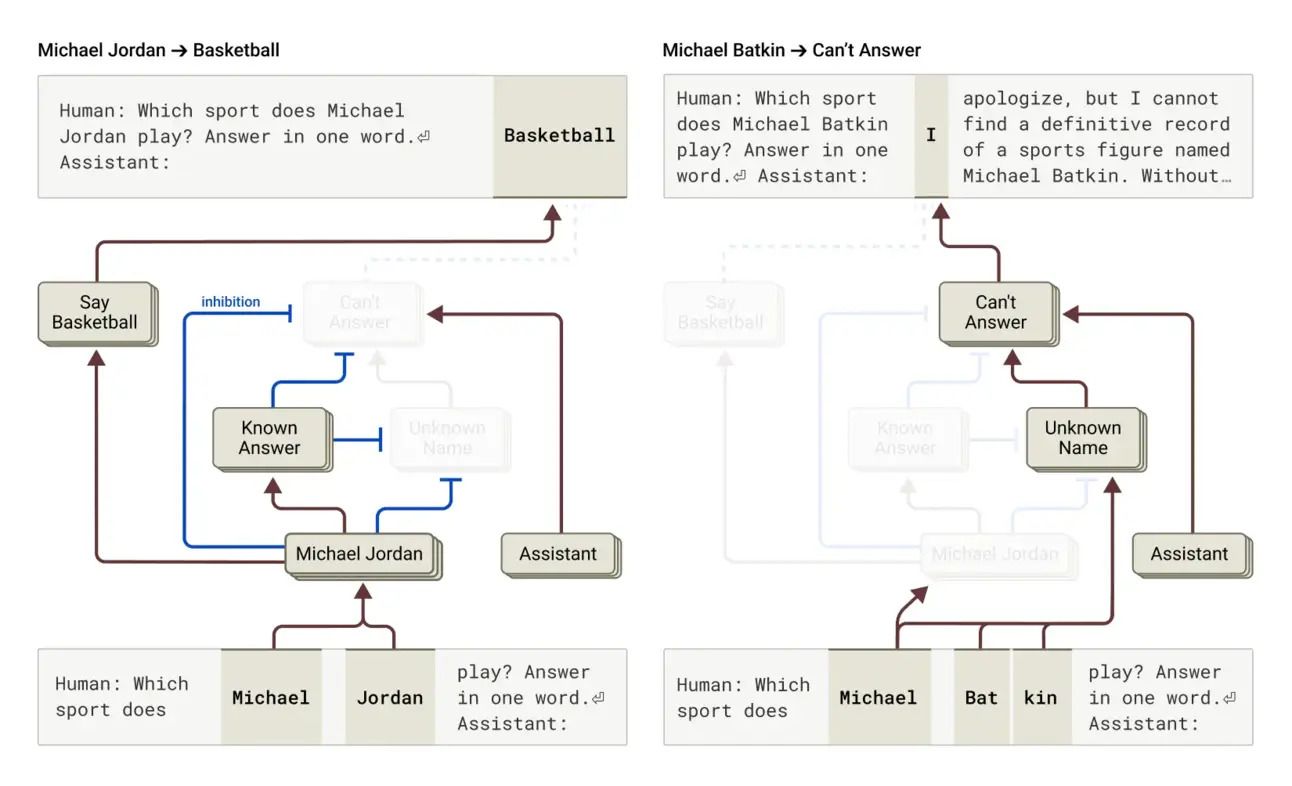
Image source: Anthropic
The Rundown: Anthropic released two research papers that reveal how its AI assistant Claude processes information, helping to better understand internal mechanisms that explain capabilities like multilingual reasoning and advanced planning.
The details:
The researchers developed an "AI microscope" that reveals internal “circuits” in the model, showing how Claude transforms input to output in key tasks.
Claude uses a universal "language of thought" across different languages, with shared conceptual processing for English, French, and Chinese.
When writing poetry, Claude plans ahead several words, identifying rhyming options before constructing lines to reach those planned words.
The team also discovered a default that prevents speculation unless overridden by strong confidence, helping explain how hallucination prevention works.
Why it matters: The closer we get to superintelligent AI, the more important understanding how models process internally becomes. With research already detailing AI’s deceptive qualities and more powerful systems being integrated into life across the globe, cracking the inner workings becomes more crucial by the day.
AI TRAINING
🔍 Add Deep Research to your AI code editors

The Rundown: In this tutorial, you will learn how to connect Firecrawl's Deep Research to your AI code editors, like Cursor and Windsurf, to access real-time web information directly in your coding environment.
Step-by-step:
Visit Firecrawl, create an account, and generate your free API key from the Dashboard.
For Windsurf: Click "Configure MCP," paste the provided JSON code, replace the API key placeholder with your key, and refresh the server list.
For Cursor: Go to Settings > MCP > Add New MCP Server, name it "firecrawl-mcp," select "command", and enter it with your API key.
Start using Deep Research by typing queries like "Deep Research the latest advancements in React state management" in your editor's chat.
Pro tip: You can find the JSON code (for Windsurf) and the command (for Cursor) here. Also, be specific with your research queries for more focused and relevant results.
PRESENTED BY SAMBANOVA
🧠 Deep Research, powered by the fastest Deepseek R1 671B

The Rundown: SambaNova just released a new Deep Research AI Agent that produces detailed reports and analysis in seconds, not minutes or hours — allowing you to run complex research at a fraction of the time and cost.
The details:
Research tasks take just 5-30 seconds to complete, so you can quickly iterate on the final report
Fully open source – connect your own data sources
Integrates with SambaNova Cloud, which delivers lightning-fast inference on the best open source models, including DeepSeek R1 671B at over 255 tokens/second
Sign up to try Fast Deep Research for yourself!
ALIBABA
👁️ Qwen’s QVQ-Max visual reasoning model

Image source: Alibaba
The Rundown: Alibaba's Qwen team released QVQ-Max, a new visual reasoning model that goes beyond basic image recognition to analyze and reason about visual information across images and videos.
The details:
The model is an evolution of QVQ-72B-Preview, expanding capabilities across mathematical problem-solving, code generation, and creative tasks.
QVQ-Max features a "thinking” mechanism that can be adjusted in length to improve accuracy, showing scalable gains as thinking time increases.
Other complex visual capabilities shown include analyzing blueprints, solving geometry problems, and providing feedback on user-submitted sketches.
Qwen said that future plans include creating a complete visual agent capable of operating devices and playing games.
Why it matters: This is Qwen’s third model release this week! Between Omni, Qwen2.5-VL, and now QVQ-Max, the Chinese powerhouse continues to crank out capable models across the AI spectrum. With China flooding the market with advanced systems, the gap between the U.S. and China has never been smaller.
QUICK HITS
🛠️ Trending AI Tools
⚡Kilo Code for VS Code - AI agent extension that generates code, automates tasks, and provides suggestions. Get $15 Claude 3.7 tokens now.*
🎆 Ideogram 3.0 - New text-to-image AI with text & graphic design capabilities
🤖 Qwen2.5-Omni-7B - Alibaba’s multimodal AI for consumer hardware
📦 Amazon Interests - Shop and discover new products with natural language
* Sponsored Listing
💼 AI Job Opportunities
🧠 Mistral AI - AI Solution Architect, Deployment
📅 Databricks - Executive Assistant
⚙️ OpenAI - ML Infrastructure Engineer
📱 Meta - Social Media Manager, Technology
📰 Everything else in AI today
OpenAI released an updated version of GPT-4o to paid users, featuring better prompt adherence, improved coding and creativity, and more “freedom.”
Butterfly Effect, the Chinese startup behind the Manus AI agent, is seeking new funding at a $500M valuation as it faces massive cash burn from Claude API costs.
OpenAI is delaying the rollout of its 4o image generation to free users and imposing rate limits, with CEO Sam Altman saying the demand is “melting” the company’s GPUs.
AI infrastructure giant CoreWeave reduced its IPO target from $4B to $1.5B ahead of its Nasdaq debut on Friday, with Nvidia stepping in as an anchor investor.
Archetype AI introduced “Lenses” — a new category of physical AI applications for its Newton model that transform sensor data into actionable insights.
PwC unveiled agent OS, a platform to integrate multi-platform AI agents into enterprise workflows up to 10x faster than traditional methods.
Lockheed Martin is partnering with Google Public Sector to integrate genAI into its AI Factory ecosystem, aiming to enhance national security applications.
COMMUNITY
🎥 Join our next live workshop

Join our next workshop today at 4 PM EST with Dr. Alvaro Cintas, The Rundown’s AI professor. You'll learn how to use the latest AI tools to take your content creation to the next level.
RSVP here. Not a member? Join The Rundown University on a 14-day free trial.
🤝 Share The Rundown, get rewards
We’ll always keep this newsletter 100% free. To support our work, consider sharing The Rundown with your friends, and we’ll send you more free goodies.
See you soon,
Rowan, Joey, Zach, Alvaro, and Jason—The Rundown’s editorial team

China's Agibot takes on Tesla
Read Online | Sign Up | Advertise
Good morning, robotics enthusiasts. Chinese robotics startup Agibot is ramping up its humanoid production to 5,000 units this year—on par with Tesla’s Optimus targets.
As superpowers China and the U.S. compete in the humanoid race, Chinese firms like Agibot are seen as leaders in agile robots and hardware, while the U.S. dominates in AI—the 'brain' of humanoids. But is that gap closing fast?
In today’s robotics rundown:
Agibot’s army of robots rivaling Tesla
Tiny liquid robots to target cancer cells
UC students 3D-print a $20 walking bot
Tesla to launch first robotaxis in Austin
Quick hits on other robotics news
LATEST DEVELOPMENTS
AGIBOT
⚡️Agibot’s army of robots rivaling Tesla

Image source: Agibot
The Rundown: Shanghai-based robotics startup Agibot just announced a plan to scale its production capabilities and deliver up to 5,000 humanoids this year—matching the targets set by Elon Musk for Tesla’s Optimus humanoid.
The details:
Agibot is investing in cutting-edge factories equipped to handle large-scale production of Lingxi X2, its latest humanoid.
The company aims to deliver between 3,000 and 5,000 robots in 2025, up from fewer than 1,000 units in 2024.
This month, it also launched an AI model—Genie Operator-1—to enhance X2’s ability to interpret human actions and perform real-world tasks.
The general-purpose humanoid debuted in March and comes with the ability to walk, run, ride a bike, and interpret emotions.
Why it matters: Agibot, co-founded by Peng Zhihui—a former participant in Huawei's 'Genius Youth' program—is a key player in China's push to become a robotics powerhouse, alongside XPeng, UBTech, and Unitree. It remains to be seen just how quickly they can match the AI standards set by U.S. rivals like Tesla and Figure.
BIOTECH ROBOTICS
🔬 Tiny liquid robots target cancer cells

Image source: Science Advances, Vol. 11, No. 12, Jeon et al.
The Rundown: Inspired by the dynamic behavior of biological cells, South Korean researchers have designed a tiny, gummy-like liquid robot that can help target cancer cells, among many other use cases, in the future.
The details:
The robot, PB, is made of water droplets coated with densely packed Teflon particles, creating a hydrophobic shell that maintains the liquid's shape.
Each bot is controlled using sound and can shape-shift, pick up debris, move across water, and merge with another PB—without losing structural integrity.
They behave the way pretty much like cells, imitating biological forms and functions, with several potential use cases, starting with biomedicine.
For instance, in the future, the rice grain-sized robots can help with drug delivery, invasive procedures, or even target and destroy cancerous cells.
Why it matters: Though still in the research phase, these robust liquid bots hold immense potential. Beyond drug delivery and tumor targeting, their ability to navigate narrow spaces could prove invaluable for machinery maintenance, disaster response, and even environmental cleanup.
UC SAN DIEGO
🤖 UC students 3D-print a $20 walking bot

Image source: UC San Diego Department of Mechanical and Aerospace Engineering
The Rundown: Researchers at the University of California, San Diego have developed a 3D-printed, six-legged robot that can “walk” without any electronics, using only compressed gas for power.
The details:
The robot was created using a desktop 3D printer and off-the-shelf printing material, costing only $20 to manufacture.
The entire bot, including its artificial muscles and control systems, was printed in one go using a single soft material.
A pneumatic oscillating circuit controls its movement, coordinating the behavior of the six legs using air pressure.
The best part? It can traverse different surfaces, from turf to underwater, with the option to operate continuously for three days (with a constant air supply).
Why it matters: These robots have immense potential in environments where electronics may fail, such as areas with strong radiation, disaster zones, or space exploration. Researchers are also exploring ways to store compressed gas inside the bots and integrate manipulators, like grippers, to unlock new possibilities.
TESLA
🚖 Tesla to launch first robotaxis in Austin

Image source: Tesla
The Rundown: Tesla is set to debut its autonomous rideshare service in Austin starting this June, with CEO Elon Musk describing the service as “unsupervised” and operating with “no one in the car.”
The details:
Tesla is expected to use its internal fleet of Model 3s and Model Ys rather than the futuristic Cybercab, which won’t be in production at least until 2026.
The robotaxis will be equipped with what Tesla says is its “unsupervised” Full Self-Driving (FSD) software, which means its Level 2 ADAS jumps to Level 4.
Musk describes the service as unsupervised with "no one in the car," but the company is likely to employ teleoperation for remote monitoring and support.
Tesla currently operates autonomous unsupervised FSD at its factory in Fremont, with vehicles driving themselves at low speeds to loading docks.
Why it matters: Operating unsupervised in cities is a major leap for Tesla’s technology, though the company’s messaging remains unclear on how it will unfold. One thing is certain: Austin is the new battleground for robotaxis, with both Waymo and Tesla making their moves in a matter of weeks.
QUICK HITS
📰 Everything else in robotics today
Tesla, Boston Dynamics, and Agility Robotics met with lawmakers on Capitol Hill to demonstrate products and push for new policies boosting robotics in the U.S.
U.S. robotics company Figure shared on X a video of its humanoid 02 robot performing “learned, natural walking,” a step up from its prior bent-knee gait.
China announced a new venture capital fund to boost robotics and AI in the country, expected to attract nearly 1T yuan ($137.8B) over the next 20 years.
Unitree Robotics, a Chinese robotics firm, reportedly confirmed its consistent profitability since 2020, with no plans for a new funding round.
Northeastern University engineers developed a hybrid robot that can accomplish a task that has long challenged roboticists: screwing in a lightbulb.
Chinese social media influencer Zhang Genyuan went viral by renting a Unitree Robotics humanoid for $1.4K a day to cook, clean, and go on dates with him.
Tesla is set to launch in Saudi Arabia on April 10, entering a market where electric vehicle adoption stands at just 1% of all car sales.
Robotics company Dyna Robotics, based in California, secured a $23.5M seed round as it works to make embodied AI robots affordable for smaller businesses.
Contoro Robotics raised $12M in Series A funding to scale its AI-powered robots for unloading trailers and containers.
German manufacturer igus, known for making motion plastics and robotic components, announced that it made €1.105B ($1.19B) in sales last year.
COMMUNITY
🎥 Join our next live workshop

Join our next workshop this Thursday at 3 PM EST to learn how to build AI Voice Agents using Vapi, led by Jordan Dearsley, the Founder & CEO at Vapi.
RSVP here. Not a member? Join The Rundown University on a 14-day free trial.
See you soon,
Rowan, Jennifer, and Joey—The Rundown’s editorial team

AI image generation levels up again
Read Online | Sign Up | Advertise

Good morning, AI enthusiasts. Another SOTA text-to-image model just dropped — but the only thing on everyone’s mind seems to be turning images into Ghibli-style anime.
Between Ideogram’s 3.0 launch, GPT-4o’s viral image generation capabilities, and Reve’s debut, AI creativity has gone to a brand new level this week.
In today’s AI rundown:
Ideogram’s advanced 3.0 image model
BMW, Alibaba bringing AI-enabled cars
Create custom study assistants for any subject
Alibaba’s multi-sensory AI for mobile
4 new AI tools & 4 job opportunities
LATEST DEVELOPMENTS
IDEOGRAM
🖼️ Ideogram’s advanced 3.0 image model

Image source: Ideogram
The Rundown: Image generation startup Ideogram just released version 3.0 of its AI model, introducing major improvements in photorealism, text rendering, and style consistency — while outperforming competitors in human evaluations.
The details:
Ideogram 3.0 brings new text rendering and graphic design capabilities, enabling precise creation of complex layouts, logos, and typography.
In testing, the model significantly outperformed leading text-to-image models, including Google’s Imagen 3, Flux Pro 1.1, and Recraft V3.
A new ‘Style References’ feature allows users to upload up to three images to guide the aesthetic of generated content, alongside a library of 4.3B presets.
The model is now available on Ideogram’s platform and iOS app, with all features accessible to free users.
Why it matters: Ideogram’s new model is very impressive, but the launch timing is unfortunate given the hype around OpenAI’s 4o image capabilities. What’s become apparent from releases from Ideogram, OpenAI, and Reve this week is that graphic design and accurate text generation are all but fully solved for this wave of AI models.
TOGETHER WITH WORKOS
🔐 Protect your AI apps from bad actors

The Rundown: WorkOS Radar is a security solution that shields your AI platform from fake signups, throwaway emails, and brute force attempts — all powered by advanced device fingerprinting and real-time detection.
With WorkOS Radar, you can:
Rapidly detect and challenge unfamiliar and suspicious devices in real time
Stop free-tier abuse and fraudulent behavior with advanced detection
Customize threat responses to fit your app’s exact security needs
BMW & ALIBABA
🚗 BMW, Alibaba bringing AI-enabled cars

Image source: Alibaba
The Rundown: Chinese tech giant Alibaba and automaker BMW announced a strategic alliance to develop advanced in-car AI tailored for the Chinese market, bringing cutting-edge vehicle cockpit tech to BMW models as soon as 2026.
The details:
The partnership centers on a new in-car AI assistant powered by Alibaba's Qwen, featuring enhanced voice recognition and contextual understanding.
The assistant will feature real-time dining, parking availability, and traffic management, using natural commands rather than touchscreen interfaces.
BMW also plans to roll out two AI agents: Car Genius for vehicle diagnostics and Travel Companion for personalized recommendations and trip planning.
The system will also include multimodal inputs like gesture recognition, eye tracking, and body position awareness for more intuitive driving experiences.
Why it matters: BMW has been at the forefront of AI and robotics, making it only a matter of time before advanced AI systems are integrated into new cars. While Tesla, with its internal xAI partnership, remains a strong contender, other automakers are also taking strategic steps to lead in the AI era.
AI TRAINING
📚 Create custom study assistants for any subject

The Rundown: In this tutorial, you will learn how to use Google Gemini's Gems feature to create personalized AI assistants for specific subjects, homework help, and project research — completely free of cost.
Step-by-step:
Visit Google Gemini, click the diamond Gem icon on the left sidebar, then select "New Gem."
Name your Gem specifically (e.g., "Physics Problem Solver") and write detailed instructions about how it should help with your subject.
Add course materials like notes, textbook chapters, or study guides to the Knowledge section.
Test your Gem with sample questions and refine its instructions until it responds perfectly.
Pro tip: You can create multiple Gems for different papers instead of one general helper; this keeps each assistant focused on a specific subject.
PRESENTED BY INNOVATING WITH AI
🤝 Turn AI passion into a consulting career

The Rundown: Innovating with AI's new program, AI Consultancy Project, transforms AI enthusiasts into professional consultants — tapping into a market projected to reach $54.7B by 2032.
The 6-month program delivers:
Proven frameworks for client acquisition and service delivery
A step-by-step path to six-figure consulting income
Students who land their first AI client in as little as 3 days
Click here to request early access to The AI Consultancy Project.
ALIBABA
🎤 Alibaba’s multi-sensory AI for mobile

Image source: Alibaba
The Rundown: Alibaba released Qwen2.5-Omni-7B, a new multimodal AI capable of processing text, images, audio, and video simultaneously while being efficient enough to run directly on consumer hardware like smartphones and laptops.
The details:
The model uses a new "Thinker-Talker" system for real-time processing across modalities (text, audio, image, video) with text and speech outputs.
It shows strong performance in speech understanding and generation, outperforming specialized audio models in benchmark testing.
Alibaba says Omni-7B can run efficiently on phones and laptops, enabling real-world applications like real-time audio descriptions for visually impaired users.
It’s immediately available on Hugging Face and GitHub, with Alibaba positioning the model as the foundation for developing practical AI agents.
Why it matters: The age of do-it-all models is nearly here, with omni systems set to unlock completely new experiences and categories of applications. Intelligence that can understand and respond to the full complexity of human environments—while being open-source and easily accessible—is a powerful combination.
QUICK HITS
🛠️ Trending AI Tools
🎆 GPT-4o Image Generation - Create and edit photos in ChatGPT and Sora
🧠 Gemini 2.5 Pro - Google’s new SOTA reasoning model
👋 InfiniteYou - AI portrait generator with high-quality facial accuracy
🔎 Perplexity Answer Modes - Enhance searches on specific verticals
📰 Everything else in AI today
OpenAI announced it will adopt Anthropic’s open-source Model Context Protocol, enabling ChatGPT and other products to integrate with external data and software.
Microsoft 365 Copilot unveiled Researcher and Analyst, two new AI agents designed to handle workplace tasks with research and data analysis directly in users’ workflows.
A federal judge rejected music publisher UMG’s request to block Anthropic from using song lyrics to train Claude, saying the claim failed to show “irreparable harm”.
xAI announced that its Grok chatbot is now integrated directly into messaging app Telegram, available to Premium users at no additional cost.
Amazon launched ‘Interests,’ a new AI-powered shopping feature that automatically scans its store to notify users about new products based on natural language prompts.
Midjourney revealed in its weekly Office Hours session that its highly-anticipated new V7 model is expected to arrive on Monday, March 31.
The U.S. government added over 50 Chinese tech entities to an export blacklist, targeting firms developing advanced AI, supercomputing and quantum tech.
COMMUNITY
🎥 Join our next live workshop

Join our next workshop today at 3 PM EST to learn how to build AI Voice Agents using Vapi, led by Jordan Dearsley, the Founder & CEO at Vapi.
RSVP here. Not a member? Join The Rundown University on a 14-day free trial.
🤝 Share The Rundown, get rewards
We’ll always keep this newsletter 100% free. To support our work, consider sharing The Rundown with your friends, and we’ll send you more free goodies.
See you soon,
Rowan, Joey, Zach, Alvaro, and Jason—The Rundown’s editorial team

Gemini 2.5 tops AI leaderboard
Read Online | Sign Up | Advertise

Good morning, AI enthusiasts. Google is back on top of the AI rankings, thanks to the release of its powerful new Gemini 2.5 Pro model — dominating benchmarks across reasoning, math, science, and coding.
But with AI continuing to evolve at lightning speed and rivals like OpenAI gearing up for their next models, how long will Google hold onto the crown?
P.S. Our next workshop is TODAY at 2 PM EST — join and learn how to build an AI-powered sales rep using Zapier Agents. RSVP here.
In today’s AI rundown:
Google’s Gemini 2.5 Pro tops AI leaderboard
OpenAI adds image generation to GPT-4o, Sora
Transform concepts into production-ready pitch decks
Apple’s billion-dollar bet on Nvidia AI hardware
4 new AI tools & 4 job opportunities
LATEST DEVELOPMENTS
🏆 Google’s Gemini 2.5 Pro tops AI leaderboard

Image source: Google
The Rundown: Google just announced Gemini 2.5, a new family of AI models with built-in reasoning—starting with the release of Gemini 2.5 Pro Experimental, which tops key benchmarks and represents the company’s most intelligent model to date.
The details:
2.5 Pro debuts at #1 on the LMArena leaderboard, showcasing advanced, SOTA reasoning capabilities across math, science, and coding tasks.
On coding, 2.5 Pro scores 63.8% on SWE-Bench Verified and 68.6% on Aider Polyglot — with specific strengths in web apps and agentic code applications.
It’s shipping with a 1M token context window, but Google soon plans to double this to 2M for processing entire code repositories and massive datasets.
The model is available now in Google AI Studio and the Gemini app for Advanced subscribers, with API pricing coming in the weeks ahead.
Why it matters: As major AI labs push forward with reasoning, Google has made "thinking" a standard rather than a premium offering. The tech giant continues to push SOTA models despite lacking the hype of OpenAI — but with how fast AI is moving (and with GPT-5 and others lurking), it remains to be seen how long the new ranking lasts.
TOGETHER WITH TELY AI
📝 Run a lead-generating SEO blog on autopilot with AI

The Rundown: With Tely AI, you don’t need an SEO expert or content team — AI does it all. It researches your industry, competitors, and website to find the best keywords for Google, delivering well-researched, expert-level articles promoting your company.
With Tely AI, you can:
Publish up to 60 articles a month
See Google index results in just 2 weeks
Enjoy full automation for writing, SEO, and publishing
Convert traffic into valuable leads
OPENAI
🎨 OpenAI adds image generation to GPT-4o, Sora

Image source: OpenAI
The Rundown: OpenAI released image generation within its GPT-4o model and Sora video generator, shifting from separate text and image systems to a fully integrated approach for producing more precise and contextually aware visuals via ChatGPT.
The details:
GPT-4o treats images as part of its multimodal understanding, enabling more accurate text rendering and contextual awareness.
The upgrade excels at generations like menus, diagrams, and infographics with readable text, addressing a major weakness of previous models.
Users can also edit images with natural language, with the model able to maintain consistency between iterations and handle 10-20 objects in prompts.
The new capability replaces DALL-E 3 as ChatGPT's default image generator for Free, Plus, Pro, and Team users, with Enterprise and Edu coming soon.
Why it matters: OpenAI’s DALL-E lagged far behind other image generators, but this long-awaited native image upgrade looks to be worth the wait. With long-text generation, UI/UX design skills, and natural language editing, visual content generation is entering a completely new era with this next generation of models.
AI TRAINING
🎬 Transform concepts into production-ready pitch decks

The Rundown: In this tutorial, you will learn how to create professional storyboards, videos, and complete pitch decks from simple text prompts in minutes — without any design experience.
Step-by-step:
Head over to LTX Studio, click Start with a concept, and enter a simple prompt like "30-second ad for [product]" with location and character details.
Customize project settings (aspect ratio and style) and edit scene elements using facial controls and generative fill.
Transform static frames into videos with the Motion Editor, and add a soundtrack or voiceovers to enhance your creation.
Export your finished project as a video, editing package, or as a professional pitch deck.
Pro tip: We did an extensive workshop showing how to transform your creative concepts into professional videos with LTX Studio here. Additionally, the Rundown University paid members get a free month of the Standard Plan.
PRESENTED BY CONCIERGE
🔑 Unlock the power of AI across your apps

The Rundown: Wish your AI assistant could understand your context and take actions for you? Concierge solves this by connecting seamlessly to your apps (including Gmail, HubSpot, Jira, Linear, Slack, Attio, Sheets, Airtable, and more).
With Concierge, you can:
Instantly connect your favorite apps and get real-time answers based on your data
Use top AI models (GPT, Claude, DeepSeek, etc.) without juggling multiple subscriptions
Draft emails, update CRMs, create tickets, summarize notes, or do deep research — all with a single prompt
Try Concierge today and get AI to truly work for you.
APPLE
💰 Apple’s billion-dollar bet on Nvidia AI hardware

Image source: Reve / The Rundown
The Rundown: Apple is reportedly placing a massive $1B order for Nvidia's advanced servers, partnering with Dell and Super Micro Computer to set up its first generative AI infrastructure—signaling a major shift in the company's AI strategy amid Siri setbacks.
The details:
Loop Capital analyst Anada Baruah reported the purchase includes roughly 250 Nvidia's GB300 NVL72 systems, with each server costing between $3.7- 4M.
Both Dell Technologies and Super Micro Computer will reportedly serve as key server partners in building Apple's new large-scale AI cluster.
While previous reports indicated Apple was developing its own AI chips, this purchase may be a response to slower-than-expected progress in that area.
The move also comes after Apple’s setbacks in AI development, including delays to the planned AI-powered Siri upgrade and internal restructuring.
Why it matters: After staying on the AI data center sidelines while competitors raced ahead, Apple appears to be acknowledging it needs serious computing power to compete — and must look externally to right some of the issues currently plaguing its in-house AI progress. But the clock is ticking, and AI progress isn’t slowing down.
QUICK HITS
🛠️ Trending AI Tools
🎆 Reve Image 1.0 - Image model with advanced realism and prompt accuracy
🐳 DeepSeek V3-0324 - V3 upgraded with improved coding and reasoning
🧠 Qwen2.5-VL-32B - New vision-language AI with enhanced performance
🕺 LHM - Create animated 3D avatars from a single reference image
📰 Everything else in AI today
OpenAI announced new upgrades to its Advanced Voice Mode, featuring new personality upgrades and fewer interruptions for more natural conversations.
Figure AI published new research and demos of its Figure 02 humanoid achieving natural human-like walking, conducting years worth of simulated training in just hours.
H&M is partnering with 30 models to create AI-based digital twins for ad campaigns, with models maintaining ownership rights and receiving usage-based compensation.
ByteDance released InfiniteYou, an open-source AI portrait generator that produces consistent portraits with enhanced facial accuracy and prompt adherence.
Synthesia launched a $1M equity program for actors with likenesses featured as AI avatars, becoming the first to offer stocks to performers contributing to AI training.
Otter AI unveiled three AI Meeting Agents, including a voice-activated Meeting Agent, a Sales Agent for on-call coaching, and an SDR Agent for autonomous product demos.
Perplexity added new answer modes, enhancing searches on specific verticals with entities like images, videos, and cards with built-in commercial transactions.
COMMUNITY
🎥 Join our next live workshop

Join our next special workshop today at 2 PM EST to learn how to build an AI-powered sales rep using Zapier Agents with Jane Zhang and Anna Marie Clifton from the Zapier team.
RSVP here. Not a member? Join The Rundown University on a 14-day free trial.
🤝 Share The Rundown, get rewards
We’ll always keep this newsletter 100% free. To support our work, consider sharing The Rundown with your friends, and we’ll send you more free goodies.
See you soon,
Rowan, Joey, Zach, Alvaro, and Jason—The Rundown’s editorial team
No matching search results
Try using different keywords, double-check your spelling, or explore related categories.
Stay Ahead on AI.
Join 2,000,000+ readers getting bite-size AI news updates straight to their inbox every morning with The Rundown AI newsletter. It's 100% free.