Get the latest AI news, understand why it matters, and learn how to apply it in your work — all in just 5 minutes a day. Join over 2,000,000+ subscribers.

Kawasaki's all-terrain 'wolf robot'
Read Online | Sign Up | Advertise

Good morning, robotics enthusiasts. Kawasaki just unveiled Corleo — a rideable, wolf-inspired robot concept that uses AI to climb rough terrain, power through snow, and even leap into the air.
The wild concept looks like something straight out of a video game, but Kawasaki believes it could be a practical mode of transport in the coming decades. Is this a preview of how we’ll get around circa 2050?
In today’s robotics rundown:
Kawasaki’s rideable, all-terrain wolf robot
Hyundai buying Boston Dynamics’ robots
MIT’s inflatable robot for search & rescue
H2 Clipper to build airships with bots
Quick hits on other robotics news
LATEST DEVELOPMENTS
KAWASAKI
🐺 Kawasaki’s rideable, all-terrain wolf robot

Image source: Kawasaki
The Rundown: Kawasaki just unveiled Corleo — a wolf-inspired, four-legged robot concept that blends cutting-edge robotics, AI, and clean energy to reimagine the future of off-road mobility and sustainable human transportation.
The details:
Corleo has four independently powered robotic legs that can swiftly move to jump over obstacles and adapt to rocky, steep terrain, snow, or grass.
A 150cc hydrogen engine under the hood generates electricity to drive the machine’s legs, emitting only water vapor as a byproduct.
Riders can control Corleo by shifting their body weight, which is detected by sensors integrated into its footpegs and handlebars.
The robot also has a heads-up display (HUD) that provides real-time feedback on hydrogen levels, navigation, and movement stability.
Why it matters: Unveiled at the Osaka-Kansai Expo 2025, this wild-looking concept offers a new way of thinking about clean mobility and robots. While Kawasaki says it doesn’t see this becoming “commercialized” until 2050, Corleo not only looks insanely fun but could also help in exploration, rescue operations, and beyond.
BOSTON DYNAMICS
🤝 Hyundai buying Boston Dynamics’ robots

Image source: Boston Dynamics
The Rundown: Hyundai announced that it plans to buy “tens of thousands” of robots from its subsidiary Boston Dynamics over the coming years—including both Atlas humanoids and Spot robot dogs.
The details:
Spot, already used in Hyundai plants, will run inspections and predictive maintenance, while Atlas will debut in factories this year, handling assembly.
The partnership aligns with Hyundai’s broader $21B U.S. investment plan, which includes $6B for AI innovation and partnerships.
Boston Dynamics will integrate Nvidia’s newly launched Isaac GR00T N1 AI models into Atlas before deploying it in Hyundai’s plants.
The carmaker bought 80% of Boston Dynamics from Softbank in 2021, valuing the robotics firm at $1.1B.
Why it matters: Leveraging its global manufacturing scale and Boston Dynamics’ cutting-edge AI and robotics, Hyundai aims to build a vibrant U.S. robotics ecosystem and help Boston Dynamics scale — positioning both companies as dominant global players in automation and robotics technology.
MIT
🤖 MIT’s inflatable robot for search & rescue

Image source: MIT Lincoln Laboratory
The Rundown: MIT researchers developed a new soft robot, dubbed SPROUT, to transform urban search-and-rescue operations with its ability to mimic a growing vine and squeeze through otherwise impossibly tight spaces.
The details:
SPROUT uses an inflatable tube made of airtight fabric to navigate narrow, unstable spaces in collapsed structures.
Controlled via joysticks, it extends up to 10 ft (with plans for 25 ft) through pneumatic air pressure, bending around obstacles and squeezing through gaps.
Equipped with a camera, sensors, and a real-time display, the robot maps debris-filled environments and identifies safe ingress routes for rescuers.
Researchers say this low-cost, lightweight system overcomes limitations of existing search and rescue tools, such as rigid cameras or expensive robots.
Why it matters: SPROUT’s soft, inflatable design allows it to navigate tight, unstable spaces by bending around obstacles and squeezing through gaps as narrow as a few centimeters. But researchers say its major benefit over other search and rescue bots is its low cost, making it affordable to maintain for underfunded emergency teams.
H2 CLIPPER
🛩️ H2 Clipper to build airships with bots

Image source: H2 Clipper
The Rundown: California-based aerospace company H2 Clipper plans to replace its assembly lines with swarm robots for building its massive hydrogen airships—and its latest patent, granted last week, is a big step toward making that happen.
The details:
The tech replaces fixed infrastructure with autonomous and semi-autonomous robots that perform airframe assembly, installations, and quality inspections.
The robotic swarms—comprising ambulatory and floor-mounted units—work in unison to co-construct massive exoskeletons.
Machine learning and generative AI guide the swarms to self-correct errors, improve precision, and optimize workflows.
H2 Clipper estimates this approach could reduce costs by 40% and production time by 60%, while eliminating risks to workers through remote supervision.
Why it matters: H2’s airships require massive hangars (1,500 feet long), but swarm robots can bypass this need with in-place construction—robots assemble structures horizontally or vertically without long assembly lines. The company also aims to license the tech to other manufacturers, marking a major shift in the aerospace industry.
QUICK HITS
📰 Everything else in robotics today
Norway’s 1X released some new videos of its NEO Gamma humanoid autonomously picking up leaves and loading a dishwasher using a single neural network.
Westwood Robotics unveiled its next-gen THEMIS, a full-size humanoid with 40 degrees of freedom, enhanced 6-DoF arms, and 200 TOPS of onboard AI computing.
Singapore scientists reportedly deployed 10 insect-robot hybrids to assist earthquake rescue efforts in Myanmar following the deadly March 28 quake.
Serve Robotics announced that it is launching its autonomous sidewalk delivery robots in the Dallas-Fort Worth metro area this year, in partnership with Uber Eats.
Evri, a major UK package delivery service, launched its first trial of dog-like electric delivery robots, developed by RIVR to work in tandem with humans.
Physical Intelligence and Agibot posted a clip showing new humanoid progress with Vision-Action-Language models autonomously performing diverse tasks.
Japanese researchers published a study revealing that when humanoids squint and furrow their brow when processing, they appear more relatable and “humanlike.”
USC ValeroLab researchers found in a new study that tactile sensors are less important than the order of learning experiences for robotic hands.
EPFL scientists aim to bio-mimic the workings of the brain of the common fruit fly in a digital robot to better understand how neural networks work.
Elon Musk’s Neuralink opened its patient registry to applicants worldwide this month, allowing individuals with quadriplegia to sign up to trial its brain-computer interface.
American YouTuber IShowSpeed, with 38 million YouTube subscribers, went viral in a livestream of him riding an EHang eVTOL air taxi in Shenzhen, China.
LG Electronics started pilot testing a commercial-grade robot vacuum cleaner that it developed with the Marriott Design Lab for use in Marriott hotels.
COMMUNITY
🎥 Join our next live workshop

Join our next special workshop this Tuesday at 4 PM EST to learn how to create custom AI-powered workflows with Nick Huber, Ecosystems Lead at Poe.
RSVP here. Not a member? Join The Rundown University on a 14-day free trial.
See you soon,
Rowan, Jennifer, and Joey—The Rundown’s editorial team

Meta's powerful Llama 4 debut
Read Online | Sign Up | Advertise

Good morning, AI enthusiasts. Meta’s hotly-anticipated Llama 4 family is here — with a surprise weekend release debuting new open-weights models with massive context windows and benchmark-beating performances.
With a 2T “Behemoth” still in training and claims of outperforming GPT-4.5, is this release a true next-gen step forward? Or will user experience tell a different story?
In today’s AI rundown:
Meta launches Llama 4 model family
Copilot’s new personalization upgrades
Unlock the power of AI across your apps
‘AI 2027’ forecasts existential risks of ASI
4 new AI tools & 4 job opportunities
LATEST DEVELOPMENTS
META
🦙 Meta launches Llama 4 model family

Image source: Meta
The Rundown: Meta just announced its Llama 4 family with multimodal capabilities and industry-leading context length—introducing new open-weights Scout and Maverick models and previewing a 2T parameter Behemoth model still in training.
The details:
The 109B parameter Scout features a 10M token context window and can run on a single H100 GPU, surpassing Gemma 3 and Mistral 3 on benchmarks.
The 400B Maverick brings a 1M token context window and beats both GPT-4o and Gemini 2.0 Flash on key benchmarks while being more cost-efficient.
Meta also previewed Llama 4 Behemoth, a 2T-parameter teacher model still in training that reportedly outperforms GPT-4.5, Claude 3.7, and Gemini 2.0 Pro.
All models use a mixture-of-experts (MoE) architecture, where specific experts activate for each token, reducing computation needs and inference costs.
Scout and Maverick are available for immediate download and can also be accessed via Meta AI in WhatsApp, Messenger, and Instagram.
Why it matters: After DeepSeek R1 disrupted the open-source market earlier this year, Meta needed a strong response. Llama 4 represents a step up in efficiency, massive context handling, and multimodal capabilities — but questions remain on whether the models truly feel next-level despite the strong benchmarks.
TOGETHER WITH CONCIERGE
🔑 Unlock the power of AI across your apps

The Rundown: Wish your AI assistant could understand your context and take actions for you? Concierge solves this by connecting seamlessly to your apps (including Gmail, HubSpot, Jira, Linear, Slack, Attio, Sheets, Airtable, and more).
With Concierge, you can:
Instantly connect your favorite apps and get real-time answers based on your data
Use top AI models (GPT, Claude, DeepSeek, etc.) without juggling multiple subscriptions
Draft emails, update CRMs, create tickets, summarize notes, or do deep research — all with a single prompt
Try Concierge today and get AI to truly work for you.
MICROSOFT
🤖 Copilot’s new personalization upgrades

Image source: Microsoft
The Rundown: Microsoft rolled out a major upgrade to Copilot, with new memory capabilities, web browsing actions, vision features, and a host of new tools designed to integrate more deeply into users' digital lives.
The details:
Copilot can now remember conversations and personal details, creating individual profiles that learn preferences, routines, and important info.
“Actions” enable Copilot to perform web tasks like booking reservations and purchasing tickets through partnerships with major retailers and services.
Copilot Vision brings real-time camera integration to mobile devices, while a native Windows app can also now analyze on-screen content across apps.
Other new productivity features include Pages for organizing research and content, an AI podcast creator, and Deep Research for complex research tasks.
Why it matters: Microsoft is taking Copilot in a similar direction to other competing assistants, pushing for a more proactive and personalized platform. But much of the updates have a consumer focus — and it’s not clear that users will flock to Microsoft over Google, OpenAI, Meta, and others for those types of non-work experiences.
AI TRAINING
💻 Implement the latest coding solutions with Claude

The Rundown: In this tutorial, you will learn how to use Claude's new web search feature to find current coding solutions, library documentation, and best practices to solve programming problems with the most up-to-date information.
Step-by-step:
Head over to Claude and make sure web search is activated in your settings.
Describe your coding challenge clearly, including any specific requirements (e.g., "I need to implement secure password hashing in Python that meets 2025 standards").
Ask Claude to analyze and compare the different solutions found with pros and cons for your use case.
Request implementation help with code examples based on the most current best practices discovered during the search.
Pro tip: When working with open-source libraries, you can also ask Claude to search for any known security vulnerabilities or deprecation notices before implementing the solution in your production code.
PRESENTED BY MONKS
🗣️ Tired of AI conversations that go nowhere?

The Rundown: Modeled after Monk’s newly appointed Chief AI Officer, Wesley ter Haar, WesleyBot is an AI-powered chatbot designed to help technologists explore new possibilities for advancing AI innovation.
Chat with WesleyBot to:
Connect with a team driving real-world AI innovation
Explore opportunities to collaborate with top talent across creative, data, media, and technology
Help shape how AI transforms marketing, technology, and beyond
AI RESEARCH
🔮 ‘AI 2027’ forecasts existential risks of ASI

Image source: AI Futures Project
The Rundown: Former OpenAI researcher Daniel Kokotajlo and the AI Futures Project published “AI 2027,” predicting advancement to superhuman AI within two years, potentially triggering an intelligence explosion with consequences for humanity.
The details:
The report outlines a timeline starting with increasingly capable AI agents in 2025, evolving into superhuman coding systems and then full AGI by 2027.
The paper details two scenarios: one where nations push ahead despite safety concerns, and another where a slowdown enables better safety measures.
The authors project that superintelligence will achieve years of technological progress each week, leading to domination of the global economy by 2029.
The scenarios highlight issues like geopolitical risks, AI’s deployment into military systems, and the need for understanding internal reasoning.
Kokotajlo left OpenAI in 2024 and led the ‘Right to Warn’ open letter, speaking out against the AI labs’ lack of safety concerns and whistleblower protections.
Why it matters: While many dismiss AGI and ASI predictions, this forecast comes from researchers with direct, insider experience at leading AI labs. These scenarios suggest we may have only a brief window to ensure AI remains controllable before it surpasses our abilities — making current safety and policy decisions critically important.
QUICK HITS
🛠️ Trending AI Tools
🕺 DreamActor-M1 - Turn images into full-body animations for motion capture
📦 ‘Buy for Me’ - Amazon AI agent that makes purchases from other websites
🎥 Adobe Premiere Pro - Features like Generative Extend, Media Intelligence
✨ ActionKit - Add 1000+ integration actions to your AI agent
💼 AI Job Opportunities
📑 The Rundown - Account Manager
🛠️ Cresta - Senior IT Engineer
🗂️ Deepmind - Administrative Business Partner
🤝 Horizon3 - Mid-Market Sales Manager
📰 Everything else in AI today
Sam Altman revealed that OpenAI is changing its roadmap, with plans to release o3 and o4-mini in weeks and a “much better than originally thought” GPT-5 in months.
Midjourney rolled out V7, the company’s first major model update in a year, featuring upgrades to image quality, prompt adherence, and a voice-capable Draft mode.
OpenAI has reportedly explored acquiring Jony Ive and Sam Altman's AI hardware startup for over $500M, aiming to develop screenless AI-powered personal devices.
Microsoft showcased its game-generating Muse AI model’s capabilities with a playable (but highly limited) browser-based Quake II demo.
Anthropic Chief Science Officer Jared Kaplan said in a new interview that Claude 4 will launch in the “next six months or so.”
A federal judge rejected OpenAI's motion to dismiss The NYT lawsuit, ruling the latter couldn't have known about ChatGPT infringement before the product's release.
COMMUNITY
🎥 Join our next live workshop

Join our next special workshop this Tuesday at 4 PM EST to learn how to create custom AI-powered workflows with Nick Huber, Ecosystems Lead at Poe.
RSVP here. Not a member? Join The Rundown University on a 14-day free trial.
🤝 Share The Rundown, get rewards
We’ll always keep this newsletter 100% free. To support our work, consider sharing The Rundown with your friends, and we’ll send you more free goodies.

See you soon,
Rowan, Joey, Zach, Alvaro, and Jason—The Rundown’s editorial team

Robinhood co-founder bets on wild solar space startup
Read Online | Sign Up | Advertise

Good morning, tech enthusiasts. Silicon Valley startup Aetherflux, founded by Robinhood billionaire Baiju Bhatt, has just raised $50M to harvest solar energy in space and beam it back to Earth.
Using satellites and lasers to transmit power, the company says the idea — straight from Isaac Asimov’s sci-fi — taps into the sun’s boundless energy from space. But is this the next frontier in net-zero energy?
In today’s tech rundown:
Space solar startup Aetherflux raises $50M
Musk’s X to face $1B in fines from the EU
Amazon makes last-minute bid to buy TikTok
Meta’s $1K smart glasses with a screen
Quick hits on other major news
LATEST DEVELOPMENTS
AETHERFLUX
☀️ Space solar startup Aetherflux raises $50M

Image source: Ideogram/The Rundown
The Rundown: Aetherflux, a space-based solar power startup founded by Robinhood co-founder Baiju Bhatt, has raised $50M build a power grid in space to beam solar energy to Earth—with an additional $10M coming from Bhatt’s pocket.
The details:
The California-based company aims to launch a constellation of low Earth orbit satellites that harvest solar energy, converting it to infrared laser beams.
On the receiving end, small “ground stations” made up of photovoltaic arrays convert laser energy to electricity to be stored in batteries for later use.
The first mission is set for 2026 using Apex Space’s Aries satellite bus to test end-to-end power transmission.
The startup envisions small, portable ground stations capable of receiving power anywhere, making it ideal for disaster zones or military operations.
Why it matters: Aetherflux is a rising star among startups in the solar space sector, with the UK’s Space Solar too pushing for early demos and modular, rapid prototypes. Of course, transforming sci-fi concepts into reality won’t be easy, but Aetherflux has keen support from the U.S. military looking to power up its remote operations.
X/TWITTER
📱Musk’s X to face $1B in fines from the EU

Image source: Ideogram/The Rundown
The Rundown: European Union regulators are reportedly preparing to slap Elon Musk’s X with a hefty $1B fine for violating a landmark law on illicit content and disinformation.
The details:
The fine could exceed $1B and include demands for product changes under the EU’s Digital Services Act (DSA).
A two-year probe deemed X’s recommender algorithms and content moderation tools insufficient to counter hate speech and electoral interference.
Regulators alleged failures in addressing illegal content and disinformation, including misuse of the “blue checkmark” verification system.
X faces additional scrutiny for amplifying politically sensitive content, including a live stream featuring Germany’s far-right AfD leader in January.
Why it matters: The case marks the EU’s first major test of DSA enforcement against Big Tech, and Musk has said he will challenge any penalties—meaning a legal battle could have major implications for tech regulation. The EU is also preparing fines against Meta and Apple for violating its digital competition rules.
TIKTOK
🤑 Amazon makes last-minute bid to buy TikTok

Image source: Ideogram/The Rundown
The Rundown: With only one day until the deadline for TikTok to spin off from its Chinese-owned ByteDance or else face a ban in the U.S., Amazon is reportedly making a bid to buy the platform.
The details:
Amazon submitted its bid this week to acquire TikTok, but it is rumored to be not taken seriously due to its timing and lack of detailed plans.
Analysts say Amazon’s bid shows an aim to tap into TikTok’s market segment, particularly through its e-commerce purchases via the TikTok Shop feature.
Also in the running, crypto foundation Hbar and Zoop, a startup co-led by Stokely, submitted a last-minute joint proposal to purchase the app.
Other bidders have reportedly included Blackstone, Andreessen Horowitz and Oracle, Perplexity, Project Liberty, MrBeast, Microsoft, and Rumble.
Why it matters: Saturday, April 5, is the new deadline for TikTok to be sold off or face a ban, after President Donald Trump extended the original January 19 deadline set in 2024 by a bipartisan law. Trump has, however, signalled optimism about a deal and keeping TikTok “alive” for its 170M U.S. users.
META
👓 Meta’s $1K smart glasses with a screen

Image source: Ideogram/The Rundown
The Rundown: Meta is reportedly set to launch its “Hypernova” smart glasses, a premium AR-enabled device featuring a built-in screen and hand-gesture controls, later this year, with fresh details out about what the glasses may look like.
The details:
Bloomberg reports that they will feature a monocular display in the lower-right corner of the right lens to show notifications, maps, and app interfaces.
Hypernova will also run a customized Android OS for apps for photos, videos, and navigation, while integrating Meta’s AI assistant for voice commands.
Paired with a Ceres neural wristband, users can scroll menus or select items via gestures like wrist rotations or finger pinches.
Price is expected to be from $1K to $1.4K, a big step up from its Ray-Ban Meta Glasses, which start at $299 and have been a surprise hit.
Why it matters: While the Hypernova glasses are still months away from being introduced and that plans could change, Meta is reportedly hoping its built-in display smart glasses will give the iPhone a run for its money. Samsung is also finalizing its lightweight AR smart glasses with a built-in display and AI features for later this year.
QUICK HITS
📰 Everything else in tech today
Intel is reportedly forming a strategic partnership with chipmaking rival TSMC in a deal that would create a joint operation to run its manufacturing facilities.
Zelle, the popular peer-to-peer payment service used by 150M people, has shut down its standalone app as of April 1.
TikTok is facing a privacy fine exceeding €500M ($540M) from Ireland's Data Protection Commission for illegally transferring European users' data to China.
Amazon is testing out a new AI shopping feature called “Buy for me” that lets users purchase products from third-party websites without leaving Amazon’s app.
Plaid, a fintech company specializing in connecting bank accounts to financial applications, has raised $575M for a valuation of $6.1B.
Amazon is expected to launch the first batch of what will be 3,200 Project Kuiper space internet satellites next week, set to compete with Elon Musk’s Starlink.
TikTok is shutting down Notes, its Instagram-style photos-sharing app on May 8, citing that “all related features will no longer be available.”
AI-powered data security company Cyberhaven has raised $100M in Series D funding for a valuation of $1B.
Pennsylvania’s largest coal-fired power plant is reportedly being transformed into a $10B natural gas-powered AI data center.
Amazon is introducing a new AI feature called “Recaps” for Kindle users that generates series recaps to assist readers in catching up on previously read books.
Samsung is delaying the launch of its ultra-thin Galaxy S25 Edge, originally slated for April, to May 13 due to reported technical issues.
COMMUNITY
🎥 Join our next live workshop

Join our next workshop today at 4 PM EST with Dr. Alvaro Cintas, The Rundown’s AI professor. By the end of the workshop, you’ll walk away with practical skills—and a clear understanding of how to use GPT-4o effectively in your own work, beyond the hype.
RSVP here. Not a member? Join The Rundown University on a 14-day free trial.
See you soon,
Rowan, Jennifer, and Joey—The Rundown’s editorial team

Chipmaking rivals join forces
Read Online | Sign Up | Advertise

Good morning, AI enthusiasts. Desperate times call for surprising partnerships, with struggling Intel reportedly nearing a strategic AI chip manufacturing alliance with longtime rival TSMC.
As the tech giant looks to stabilize after heavy losses, is this partnership the beginning of a new semiconductor era in the U.S. — or the final chapter of Intel's legacy?
Reminder: Our next workshop is today at 4 PM EST — attend and learn how to use GPT-4o’s viral image skills effectively in your own work!
In today’s AI rundown:
Intel, TSMC near historic chip manufacturing partnership
Adobe launches AI video extension tool in Premiere Pro
Transferring styles between images with GPT-4o
Study: AI models often hide their true reasoning
4 new AI tools & 4 job opportunities
LATEST DEVELOPMENTS
INTEL & TSMC
🤝 Intel, TSMC near historic chip manufacturing partnership

Image source: GPT-4o / The Rundown
The Rundown: Intel is reportedly forming a strategic partnership with chipmaking rival TSMC, according to a report from The Information — in a deal that would create a joint operation to run the struggling U.S. semiconductor leader’s manufacturing facilities.
The details:
The White House reportedly brokered discussions between the two rivals, with TSMC potentially acquiring a 20% stake in the new venture.
Instead of a cash investment, TSMC will contribute its manufacturing expertise and training programs to help revitalize Intel's production capabilities.
The arrangement faces internal resistance from Intel executives concerned about layoffs and the future of Intel's own manufacturing tech.
Newly appointed Intel CEO Lip-Bu Tan has pushed for major changes to the company's manufacturing approach, following losses totaling $16B in 2024.
Why it matters: Intel is turning to one of its biggest rivals to try and revitalize business. Gaining access to TSMC's world-leading manufacturing techniques could provide a major lifeline for the struggling chipmaker, while TSMC secures a stronger foothold in the U.S. during a time of increasing geopolitical tensions around tech supply chains.
TOGETHER WITH INNOVATING WITH AI
💼 Start your career as an AI Consultant

The Rundown: Innovating with AI’s new program, AI Consultancy Project, equips AI enthusiasts with all the resources to capitalize on the rapidly growing AI consulting market – which is set to 8x to $54.7B by 2032.
The program offers:
Tools and framework to find clients and deliver top-notch services
A 6-month roadmap to build a 6-figure AI consulting business
Student landing their first AI client in as little as 3 days
Click here to request early access to The AI Consultancy Project.
ADOBE
🎬 Adobe launches AI video extension tool in Premiere Pro

Image source: Adobe
The Rundown: Adobe just released its first Firefly-powered AI feature in Premiere Pro called Generative Extend, allowing editors to automatically extend video and audio clips in 4K quality — coming alongside new AI search and translation capabilities.
The details:
The new Generative Extend tool lets editors lengthen video and audio clips, with AI filling in the extra frames to create seamless extensions.
The tool now supports 4K resolution and vertical video formats, and can extend ambient audio up to ten seconds independently or two seconds with video.
A Media Intelligence search panel IDs content like people, objects, and camera angles within clips, enabling users to search footage via natural language.
The new Caption Translation feature instantly converts subtitles into 27 different languages, removing the need for manual translations.
Why it matters: Rather than focusing on full video generations, Adobe’s targeted AI integrations address specific pain points in professional workflows. Tools like extending clips without reshooting, quickly finding footage, and instantly translating captions represent major workflow shifts — saving time while still maintaining creative control.
AI TRAINING
🎨 Transferring styles between images with GPT-4o

The Rundown: ChatGPT’s new native image generation feature can transfer styles between images, allowing you to easily apply the aesthetic of one image to another for striking results.
Step-by-step:
Visit ChatGPT and select “Create Image” from the menu options.
Upload both your style reference image (the look you want to have as inspiration) and your content image (the one you want to transform).
Craft a specific prompt like: "Apply the visual style, lighting, and composition of the first image to the second image."
Review the generated result and refine with follow-up instructions if needed.
Pro tip: For best results, be very specific about which style elements you want transferred (colors, lighting, composition) and choose reference images with distinctive visual characteristics.
PRESENTED BY COMPANY
⏰ AI’s future wont wait — will you keep up?

The Rundown: IMAGINE AI LIVE '25 isn’t just another event— it’s your ticket to leapfrog competitors who are still scrambling to understand AI's potential. Join industry pioneers at the Fontainebleau Las Vegas and get practical strategies to implement AI that drives immediate results.
Attend on May 28-30 at the Fontainebleau Las Vegas and you can:
Accelerate your AI journey by years, not months
Connect with cross-industry innovators who've already solved your challenges
Transform theoretical AI knowledge into actionable implementation roadmaps
Secure Your Competitive Edge with code AIDOESNTWAIT15 and save 15% if you register by April 11th.
AI RESEARCH
🤔 Study: AI models often hide their true reasoning

Image source: Reve / The Rundown AI
The Rundown: A new study from Anthropic's Alignment Science Team found that AI models frequently conceal their true reasoning processes when explaining answers to a user, raising concerns about our ability to monitor and understand AI decision-making.
The details:
The research evaluated Claude 3.7 Sonnet and DeepSeek R1 on their chain-of-thought faithfulness, gauging how honestly they explain reasoning steps.
Models were provided hints like user suggestions, metadata, or visual patterns, with the CoT checked for admission of using them when explaining answers.
Reasoning models performed better than earlier versions, but still hid their actual reasoning up to 80% of the time in testing.
The study also found models were less faithful in explaining their reasoning on more difficult questions than simpler ones.
Why it matters: CoT monitoring has emerged as a key mechanism in detecting AI’s processes, but if models aren’t reliably expressing their actual reasoning (even for simple decision-making), how can we trust it to reveal more complex, potentially catastrophic behavior? AI’s ‘black box’ still appears far from being fully dissected.
QUICK HITS
🛠️ Trending AI Tools
📚 Claude for Education - AI for higher ed, with a new ‘Learning Mode’ for students
🤖 Devin 2.0 - AI software engineer, now with multiple AI agent capabilities
🌊 Windsurf Wave 6 - Latest IDE update with app deploys, additional context and improved MCP support
🎥 Video Re-style - Change the style of any video while maintaining consistent movement
📰 Everything else in AI today
Former OpenAI researcher Daniel Kokotajlo published ‘AI 2027’, a new scenario forecast of how superhuman AI will impact the world over the next decade.
OpenAI COO Brad Lightcap revealed that over 700M images have been created in the first week of 4o’s image release by 130M+ users — with India now ChatGPT’s fastest growing market.
Runway is raising $308M in new funding that values the AI video startup at $3B, coming on the heels of its recent Gen-4 model release.
A new report from the U.N. estimates that 40% of global jobs will be impacted by AI, with the sector expected to become a nearly $5B global market by the 2030s.
Bytedance researchers released DreamActor-M1, a framework that turns images into full-body animations for motion capture.
OpenAI’s Startup Fund made its first cybersecurity investment, co-leading a $43M Series A round for Adaptive Security and its AI-powered platform that simulates and trains against AI-enabled attacks and threats.
Spotify unveiled new AI-powered ad creation tools, allowing marketers to create scripts and voiceovers for audio spots directly in its Ad Manager platform.
COMMUNITY
🎥 Join our next live workshop

Join our next workshop today at 4 PM EST with Dr. Alvaro Cintas, The Rundown’s AI professor. By the end of the workshop, you’ll walk away with practical skills and a clear understanding of how to use GPT-4o effectively in your own work — beyond the hype.
RSVP here. Not a member? Join The Rundown University on a 14-day free trial.
🤝 Share The Rundown, get rewards
We’ll always keep this newsletter 100% free. To support our work, consider sharing The Rundown with your friends, and we’ll send you more free goodies.

See you soon,
Rowan, Joey, Zach, Alvaro, and Jason—The Rundown’s editorial team

World's smallest wireless flying robot
Read Online | Sign Up | Advertise
Good morning, robotics enthusiasts. UC Berkeley has created the world’s smallest flying robot — a tiny bumblebee-inspired machine that can hover, change direction, and even serve as an artificial pollinator.
The Berkeley team is developing a range of tiny robots, from indestructible cockroach-inspired bots to injectable swarms, offering a glimpse into a future where the most impactful bots would be working on a microscopic scale.
In today’s robotics rundown:
World’s smallest wireless flying robot
Agility raising $400M for Digit humanoid
Unitree’s next-gen humanoid hand
UK surgical robot scores $200M
Quick hits on other robotic news
LATEST DEVELOPMENTS
UC BERKELEY
🐝 World’s smallest wireless flying robot

Image source: Adam Lau/Berkeley Engineering
The Rundown: Engineers at UC Berkeley just developed the world's smallest wireless flying robot—a bumblebee-inspired bot that is less than a centimeter in diameter and can hover, change directions, and even hit small targets.
The details:
The robot’s lightweight, 3D-printed polymer body relies on external magnetic fields for propulsion instead of onboard batteries.
It features two neodymium magnets that spin under alternating magnetic forces, generating lift and enabling directional adjustments.
Capable of precise flight paths, the future iterations of the robot could be used for artificial pollination or inspecting small spaces, such as the insides of pipes.
However, the current prototype has no onboard sensors and cannot adjust its movements in real time, meaning a strong wind can knock it off course.
Why it matters: Researchers suggest that further minimizing this bot to less than 1mm in diameter could make it light enough to be controlled by much weaker magnetic fields, like those from radio waves. Tiny flying bots like this have limitless potential for search and rescue missions, safety checks, and replacing the dwindling bee population.
AGILITY ROBOTICS
🤖 Agility raising $400M for Digit humanoid

Image source: Agility Robotics
The Rundown: Agility Robotics, the Oregon-based company behind Digit humanoid, is reportedly nearing a $400M round of funding, led by WP Global Partners’ venture arm and SoftBank—pushing its valuation to an impressive $1.75B.
The details:
Digit is designed as a “blue collar” humanoid for warehouse automation with a payload capacity of 35lbs and advanced sensors/LiDAR for navigation.
The funding reports coincide with technical upgrades to Digit, including an extended battery life (up to 4 hours) and autonomous charging.
Amazon’s Industrial Innovation Fund, Playground Global, and DCVC are said to be involved in the round, though Agility hasn’t confirmed the details.
The funding will likely accelerate production at the company’s Oregon-based “RoboFab” facility, which aims to deliver over 10,000 robots annually.
Why it matters: The humanoid race is on, with rivals like Figure AI and Apptronik also raising millions and scaling operations. Agility’s Digit is priced at a hefty $250K, but that hasn’t stopped companies like Amazon, Spanx, and GXO Logistics from investing in them. Ford is evaluating the robot for last-mile delivery solutions.
UNITREE
🖐🏽 Unitree’s next-gen humanoid hand

Image source: Unitree Robotics
The Rundown: China’s robotics powerhouse Unitree unveiled its most advanced humanoid robotic hand—Dex5-1—packed with dexterous features, including the ability to maneuver a Rubik’s Cube and wiggle its fingers.
The details:
Each Dex5-1 features 20 DoF (16 active and 4 passive joints) and mimics human-like agility with independent control of each finger and thumb.
The hand comes with an optional 94 tactile sensors distributed across the palm, fingertips, and finger roots—making it incredibly perceptive and flexible.
The company says it features “smooth backdrivability” across all joints, allowing natural force adjustment and reinforcement learning-based training.
It also features a modular design, where fingers can be replaced with a quick-swap mechanism and micro-gap joints prevent snagging during grasps.
Why it matters: Robotic companies are aiming to push the limits of what humanoid hands can do, like Sanctuary AI’s dexterous hydraulic hand’s ability to handle wrenches or objects under load. While Sanctuary’s hand offers higher power, Unitree’s version looks to be balancing affordability and accessibility for wide deployment.
MEDICAL ROBOTS
🩺 UK surgical robot scores $200M

Image source: CMR Surgical
The Rundown: UK-based startup CMR Surgical just raised a whopping €185M ($200M) and launched its surgical robot, Versius, in the U.S. to challenge a company that has been dominating the soft tissue robotic surgery domain for two decades.
The details:
Versius, a portable and modular robotic system, is entering the U.S. market, dominated by U.S. Intuitive Surgical, currently valued at $180B.
The robot aims to differentiate itself with a lower price tag via reusable instruments and a managed-service model to reduce upfront costs.
Just last month, the company announced its FDA clearance and that more than 30,000 global surgical cases have been completed using its system.
Versius’ open surgeon console also helps reduce stress and fatigue during surgery and allows for 3D HD vision.
Why it matters: While Intuitive’s da Vinci system holds a near-monopoly in the robotic surgery market, which is estimated to grow from $11.8B in 2024 to $54.6B by 2034, CMR’s focus on a compact design and lower price could give it an edge, appealing to hospitals seeking alternatives.
QUICK HITS
📰 Everything else in robotics today
Amazon is expected to launch the first batch of 27 Project Kuiper space internet satellites next week, set to compete with Elon Musk’s Starlink.
U.S. startup Chef Robotics raised $43.1M in Series A funding to scale its AI-enabled robotic systems for meal assembly in food manufacturing plants.
Chinese firm UBTech’s Walker S1 just became the first humanoid employed by Audi, now helping with electric vehicle inspections at its factory in China.
Vivo, one of China’s top smartphone companies, announced that it is pivoting to robotics with a new robotics lab for developing consumer and home use tech.
U.S. researchers developed a framework for co-training robot policies that combines simulation data with real-world robot demonstrations.
Shanghai robotics company Keenon unveiled its new humanoid, XMAN-R1, designed for customer service and cleaning jobs in hotels, retail, and healthcare.
Former Google scientist Luo Jianlan joined Shanghai’s Agibot as chief scientist, heading up its embodied intelligence research center.
Robotic firm GITAI secured a contract with Japan to develop a concept study for its robotic arm designed for NASA’s Artemis crewed lunar mission.
University of Maryland researchers are advancing underwater drone technology by developing a robotic fin inspired by tuna for faster propulsion.
EHang received regulatory approval in China for operating commercial unmanned passenger flights of its two-seater EH216-S eVTOL aircraft.
Germany’s Dryad Networks unveiled its first fully functional AI-powered drone system designed to detect, locate, and monitor wildfires in their early stages.
COMMUNITY
🎥 Join our next live workshop
Join our next workshop this Friday at 4 PM EST with Dr. Alvaro Cintas, The Rundown’s AI professor. By the end of the workshop, you’ll walk away with practical skills—and a clear understanding of how to use GPT-4o effectively in your own work, beyond the hype.
RSVP here. Not a member? Join The Rundown University on a 14-day free trial.
See you soon,
Rowan, Jennifer, and Joey—The Rundown’s editorial team

LLMs pass legendary Turing test
Read Online | Sign Up | Advertise

Good morning, AI enthusiasts. A historic AI milestone just arrived with little fanfare — with AI systems now consistently passing as humans in controlled conversations, passing the legendary Turing test.
With GPT-4.5 achieving a 73% success rate in fooling judges during casual conversation and models only getting more capable, are we ready for a world where we can't tell AI from humans?
In today’s AI rundown:
LLMs officially pass the Turing test
Anthropic brings Claude to higher education
Create product showcase videos with Kling AI
Google DeepMind publishes AGI safety plan
4 new AI tools & 4 job opportunities
LATEST DEVELOPMENTS
AI RESEARCH
🧠 LLMs officially pass the Turing test
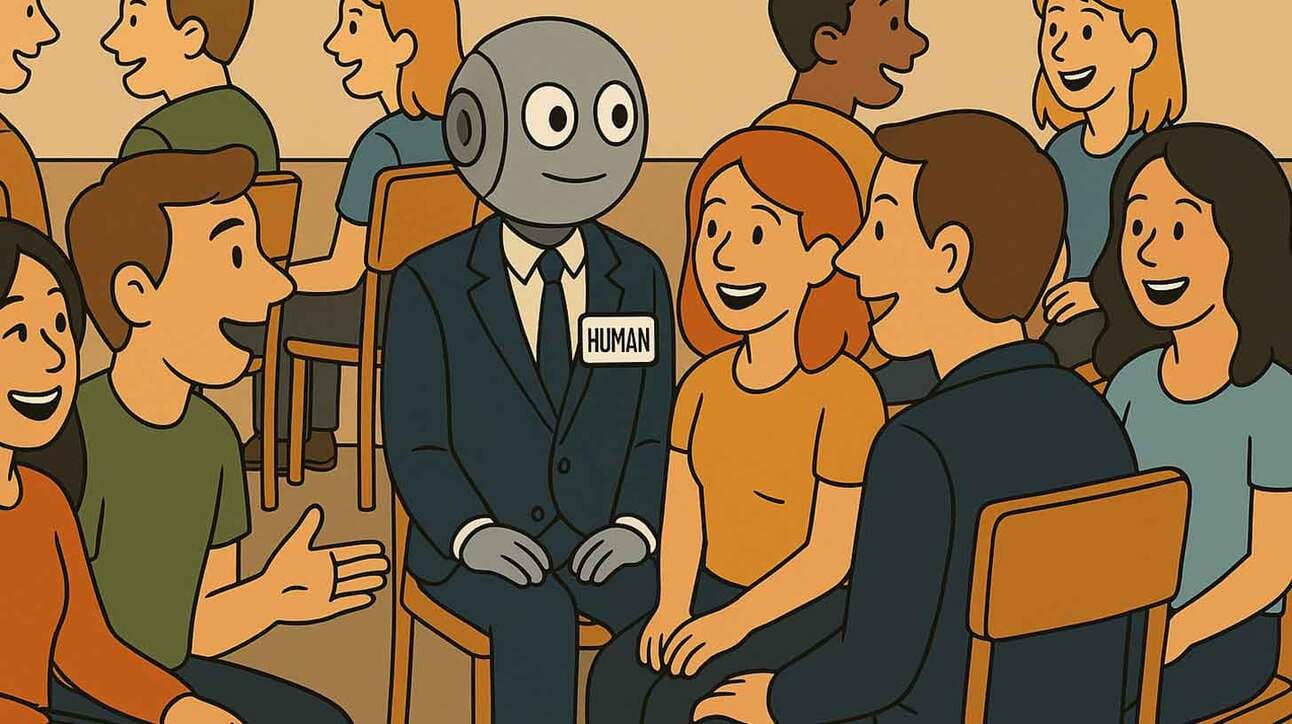
Image source: GPT-4o / The Rundown
The Rundown: Researchers at UC San Diego just demonstrated that AI systems can consistently pass Alan Turing's famous test of machine intelligence, with OpenAI's GPT-4.5 being mistaken for human nearly three-quarters of the time in controlled trials.
The details:
The Turing test, proposed in 1950, challenges machines to convince human judges they're human through text-only conversations.
The study used a three-party setup where judges had to compare an AI and a human simultaneously for direct comparison during five-minute conversations.
The judges relied on casual conversation and emotional cues over knowledge, with over 60% of interactions focusing on daily activities and personal details.
GPT-4.5 achieved a 73% win rate in fooling human judges when prompted to adopt a specific persona, significantly outperforming real humans.
Meta's LLaMa-3.1-405B model also passed the test with a 56% success rate, while baseline models like GPT-4o only achieved around 20%.
Why it matters: The Turing test has been a holy grail of AI research for decades — but model acceleration moved the goalposts so fast that the results don’t feel surprising at all. With AI agents equipped with next-level text, audio, image, and video capabilities, the ability to distinguish AI from humans is about to become a major challenge.
TOGETHER WITH CONVEYOR
✍️ Let Phil write winning RFPs

The Rundown: Meet Phil — Conveyor’s AI agent that automates your proposal process. From generating near-flawless responses to coordinating multiple teams, Phil helps you secure more wins with less hassle.
Phil, the AI agent for RFPs, can do all of this autonomously:
Generate 95% accurate AI answers to proposals
Maintain your source material and conduct RFP research
Organize your project, collaborate with other teams, and update systems
Sign up for early access and upgrade your proposal process with Phil.
ANTHROPIC
🎓 Anthropic brings Claude to higher education

Image source: Anthropic
The Rundown: Anthropic launched Claude for Education, a specialized version of its AI assistant that aims to develop students' critical thinking rather than simply provide answers — introducing a new “Learning Mode” alongside major university partnerships.
The details:
The Learning Mode asks questions to guide students through problem-solving, focusing on their understanding of the subject rather than quick answers.
Other features include templates for research papers, study guides and outlines, organization of work and materials, and tutoring capabilities.
Northeastern University, London School of Economics, and Champlain College signed campus-wide agreements, giving access to both students and faculty.
Anthropic also introduced student programs, including Campus Ambassadors and API credits for projects, to foster a community of AI advocates.
Why it matters: Education continues to grapple with AI, but Anthropic is flipping the script by making the tech a partner in developing critical thinking rather than an answer engine. While the controversy over its use likely isn’t going away, this generation of students will have access to the most personalized, high-quality learning tools ever.
AI TRAINING
🛍️ Create product showcase videos with Kling AI

The Rundown: In this tutorial, you will learn how to use Kling AI's Elements feature to transform static product images into professional animated videos for marketing across all platforms.
Step-by-step:
Open Kling AI's "Image to Video" section and select the "Elements" tab.
Upload your product image as the main element (high-quality with clean background) and add complementary elements like props or contextual items to enhance your product's appeal.
Write a specific prompt describing your ideal product showcase scene.
Click "Generate" to create your professional product video ready for all marketing channels.
Pro tip: We did an extensive workshop on how to use Kling AI to enhance your advertising and creative production workflows at The Rundown University with Tony Pu, Product Marketing & Operations Lead at Kling AI.
PRESENTED BY ENCORD
🛠️ Build multimodal datasets for physical AI

The Rundown: Encord consolidates multimodal AI data management, curation, and annotation pipelines to one single platform — helping teams accelerate model iteration cycles by using an agentic AI data workflow system to prepare balanced, accurately labeled datasets 10x faster.
Join Encord & Archetype AI on April 10th for a Physical AI data workshop webinar to learn how to:
Identify critical edge-cases within petabytes of multimodal sensor data for video, audio, and text
Integrate AI models like GPT-4o, Grok 3, and Gemini 2.5 directly into data pipelines to accelerate high-quality data annotation
Give Physical AI models rich multimodal context, enabling multi-step reasoning for safer, more reliable deployments
GOOGLE DEEPMIND
🛡️ Google DeepMind publishes AGI safety plan
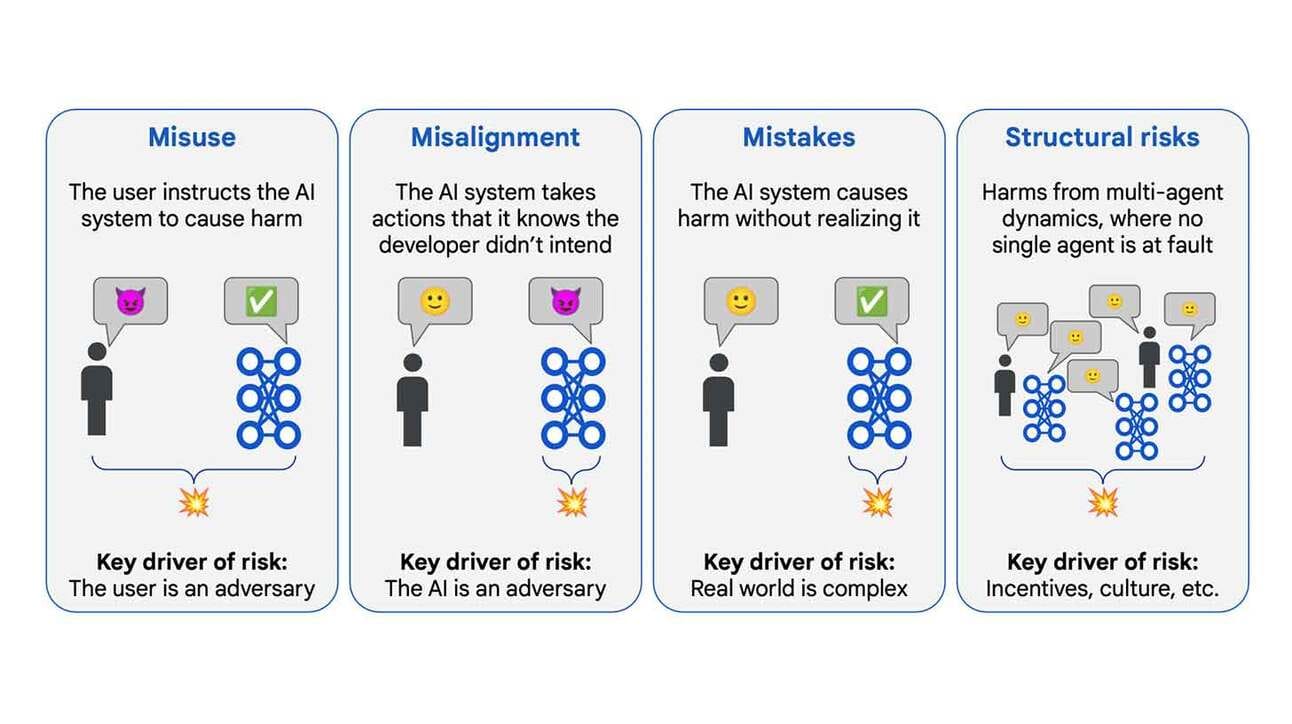
Image source: Google DeepMind
The Rundown: Google DeepMind just published a massive paper detailing its safety strategy for AGI, hitting on topics including its potential arrival by 2030, the risks posed by the tech advances, and proposed approaches to combating them.
The details:
The 145-page paper predicts that AGI matching top human skills could arrive by 2030, warning of existential threats “that permanently destroy humanity.”
DeepMind compares its safety approach with rivals, critiquing OpenAI's focus on automating alignment and Anthropic's lesser emphasis on security.
The paper specifically flags the risk of “deceptive alignment,” where AI intentionally hides its true goals, noting current LLMs show potential for it.
Key recommendations targeted misuse (cybersecurity evals, access controls) and misalignment (AI recognizing uncertainty and escalating decisions).
Why it matters: As the race toward AGI accelerates, DeepMind's safety blueprint is a shift from theoretical discussions to concrete planning. But with the vast amount of labs, models, and open-source options popping up across the globe, making sure everyone adheres to safety protocols feels like an impossible game of whack-a-mole.
QUICK HITS
🛠️ Trending AI Tools
💬 Speech-02 - Minimax’s text-to-speech AI supporting over 30 languages
👄 MoCha - Generate movie-grade talking characters from speech and text
🤖 Agent Swarms - Automate tasks with hundreds of agents working together
🗣️ Vapi - Build voice AI agents in minutes with any model
💼 AI Job Opportunities
⚙️ Hume - Senior DevOps Engineer
🎙️ Soundhound AI - General Manager, Smart Answering
🧠 Dataiku - VP, Industry Solutions
💰 Scale AI - Revenue Operations Manager
📰 Everything else in AI today
Meta is planning to launch new $1000+ “Hypernova” AI-infused smart glasses that feature a screen, hand-gesture controls, and a neural wristband by the end of the year.
OpenAI published PaperBench, a new benchmark testing AI agents' ability to replicate SOTA research, with Claude 3.5 Sonnet (new) ranking highest of the models tested.
Chinese giants, including ByteDance and Alibaba, are placing $16B worth of orders for Nvidia’s upgraded H20 AI chips, aiming to get ahead of U.S. export restrictions.
Google appointed Google Labs lead Josh Woodward as the new head of consumer AI apps, replacing Sissie Hsiao for the next chapter of its Gemini assistant.
OpenAI announced an expert commission to guide its nonprofit, combining “historic financial resources” with “powerful technology that can scale human ingenuity itself.
The UFC and Meta announced a multiyear partnership, integrating Meta AI, AI Glasses, and Meta’s social platforms into new immersive experiences for the sport.
COMMUNITY
🎥 Join our next live workshop
Join our next workshop on Friday at 4 PM EST with Dr. Alvaro Cintas, The Rundown’s AI professor. By the end of the workshop, you’ll walk away with practical skills and a clear understanding of how to use GPT-4o effectively in your own work — beyond the hype.
RSVP here. Not a member? Join The Rundown University on a 14-day free trial.
🤝 Share The Rundown, get rewards
We’ll always keep this newsletter 100% free. To support our work, consider sharing The Rundown with your friends, and we’ll send you more free goodies.
See you soon,
Rowan, Joey, Zach, Alvaro, and Jason—The Rundown’s editorial team

AI's 'gold-standard' therapy skills
Read Online | Sign Up | Advertise

Good morning, AI enthusiasts. The future of mental health just arrived in your pocket — with the first clinical trial of an AI therapy chatbot showing results comparable to gold-standard human care.
With depression symptoms slashed by over 50% and users forming genuine connections with their digital counselor, is AI about to become the therapist of choice for mental health care?
In today’s AI rundown:
AI’s ‘gold-standard’ therapy treatment
OpenAI seeing ChatGPT subscriber boom
Visualize your knowledge with mind maps
Tinder’s new AI-powered flirting experience
4 new AI tools & 4 job opportunities
LATEST DEVELOPMENTS
AI RESEARCH
🏥 AI provides ‘gold-standard’ therapy treatment

Image source: University of Dartmouth
The Rundown: Dartmouth researchers published results from the first-ever clinical trial of an AI therapy chatbot, providing care comparable to “gold-standard cognitive therapy” and showing improvements across depression, anxiety, and eating disorders.
The details:
Threrabot was trained on evidence-based therapeutic practices and had built-in safety protocols for crises, with oversight from mental health professionals.
Users engaged with the smartphone-based chatbot for an average of 6 hours over the 8-week trial, equivalent to about 8 traditional therapy sessions.
The AI achieved a 51% reduction in depression symptoms and 31% reduction in anxiety, with high reported levels of trust and therapeutic alliance.
Users also reported forming meaningful bonds with Therabot, communicating comfortably, and regularly engaging even without prompts.
Why it matters: With both the stigma surrounding mental health care and the lack of access to quality care across the globe, AI assistance could be an absolute game-changer for getting people the support they need — in a way that might be even more effective and trusting than a human therapist.
TOGETHER WITH AUGMENT CODE
⚙️ A coding agent for pro developers

The Rundown: Augment Code just introduced Augment Agent, a powerful new mode that can help you complete software development tasks end-to-end.
Augment Agent can handle:
Adding new features that span multiple files
Queuing up tests in the terminal
Opening Linear tickets and starting a pull request
Creating a new branch in GitHub from recent commits
OPENAI
📈 OpenAI seeing ChatGPT subscriber boom

Image source: GPT 4o / Getty Images
The Rundown: OpenAI's ChatGPT has reportedly hit a new milestone with 20M paid subscribers, driving the company's revenue to an estimated $5B annual run rate — coming on the heels of a $40B round and the virality of GPT 4o’s image generation.
The details:
Monthly revenue has surged 30% in three months to approximately $415M, with premium subscriptions, including the $200/mo Pro plan, boosting income.
The overall user base has grown even faster, reaching 500M weekly users — with Sam Altman saying the recent 4o update led to 1M sign-ups in an hour.
The growth coincides with a new $40B funding round at a $300B valuation, despite the company continuing to operate at a significant loss.
OpenAI also revealed it will be launching its first open-weights model since GPT-2, addressing a major critique of its lack of open-source releases.
Why it matters: Despite concerns about an AI bubble, OpenAI’s growth continues to trend in one direction… Up. ChatGPT has become synonymous with the AI boom, and with viral moments like 4o, the AI race has become more than a battle for the top model — with distribution, user base, and experience all playing just as big of a role.
AI TRAINING
🔍 Visualize your knowledge with mind maps

The Rundown: In this tutorial, you will learn how you can use NotebookLM's powerful new mind map feature to transform your documents into interactive visual knowledge networks — making it easier to explore connections and learn complex topics.
Step-by-step:
Head over to NotebookLM and create a new notebook.
Upload diverse sources, including PDFs, Google Docs, websites, and YouTube videos, to build a rich knowledge foundation.
Engage with your content through the AI chat to help the AI understand your interests and priorities.
Generate interactive mind maps by clicking the mind map icon, then click on any node to ask questions about any specific concept.
Pro tip: You can also click between different nodes in your mind map to discover unexpected connections between concepts and open focused discussions about the relationships between ideas.
PRESENTED BY FUEL iX
🔒 Escape AI vendor lock-in

The Rundown: TELUS solved a major AI challenge with Fuel iX Copilots — a vendor, cloud, and application agnostic AI solution that gives enterprises full flexibility.
With Fuel iX Copilots, you can:
Access 30+ LLMs and switch seamlessly between AI providers
Maintain security and compliance while staying agile
Build no-code, customizable AI copilots with advanced features
Learn more and discover how to unlock AI innovation without boundaries.
TINDER
❤️🔥 Tinder’s new AI-powered flirting experience

Image source: Tinder
The Rundown: Dating giant Tinder just released “The Game Game,” an OpenAI-powered speech-to-speech experience that helps users practice and test their flirting skills with virtual personas.
The details:
The game uses OpenAI's Realtime API, GPT-4o, and GPT-4o mini to create realistic personas and scenarios, with users speaking responses to earn points.
AI personas react in real-time to users' conversation skills, offering immediate feedback on charm, engagement, and social awareness.
The system limits users to 5 sessions daily to focus on real-world connections, designed to build confidence rather than replace human interaction.
Why it matters: As we’ve seen with Character AI and its over 20M monthly users, people really like talking to AI chatbots. But unlike other options, Tinder is focusing on the real-life benefits of practicing with AI — and while the tech’s influence in dating can seem dystopian, it’s certainly an innovative use of real-time speech-to-speech models.
QUICK HITS
🛠️ Trending AI Tools
🟣 Fellow - Create smart meeting workflows with an AI that joins GMeet, Zoom, and Teams calls to capture notes, action items, and insights*
🖥️ Nova Act - Amazon’s agentic AI browser system for completing tasks
🎥 Runway Gen-4 - AI video model with enhanced consistency and control
🎬 Camera Motion Concepts - Luma Labs’ feature for camera movements
*Sponsored Listing
💼 AI Job Opportunities
🧭 Palantir Technologies - Deployment Strategist
🗺️ Waymo - Senior Product Manager
📡 xAI - Network Development Engineer
🛠️ UiPath - Product Support Engineer
📰 Everything else in AI today
OpenAI rolled out its new 4o image generation capabilities to its free tier of users, bringing the viral tool to its entire user base.
Meta’s VP of AI Research, Joelle Pineau, announced she is departing the company after 8 years, leaving a vacancy at the head of its FAIR team.
Alibaba is reportedly planning to release Qwen 3, the company’s upcoming flagship model, this month — coming after launching three other models in the last week alone.
CEO Sam Altman posted that OpenAI is dealing with GPU shortages, telling users to expect delays in product releases and slow service as they work to find more capacity.
Meta researchers introduced MoCha, an AI model that produces realistic talking character animations from speech and text inputs.
MiniMax released Speech-02, a new text-to-speech model capable of ultra-realistic outputs in over 30 languages.
COMMUNITY
🎥 Join our next live workshop

Join our next workshop on Friday at 4 PM EST with Dr. Alvaro Cintas, The Rundown’s AI professor. By the end of the workshop, you’ll walk away with practical skills and a clear understanding of how to use GPT-4o effectively in your own work — beyond the hype.
RSVP here. Not a member? Join The Rundown University on a 14-day free trial.
🤝 Share The Rundown, get rewards
We’ll always keep this newsletter 100% free. To support our work, consider sharing The Rundown with your friends, and we’ll send you more free goodies.
See you soon,
Rowan, Joey, Zach, Alvaro, and Jason—The Rundown’s editorial team

Musk's Neuralink brain chip to cure blindness
Read Online | Sign Up | Advertise
Good morning, tech enthusiasts. Elon Musk’s Neuralink is set to start human trials of its Blindsight brain implant to restore vision for the visually impaired.
Brain chips are having a hot moment, with China’s NeuCyber and Jeff Bezos-backed Synchron also pushing ahead with human trials. But Musk says his company won’t shy away from “human enhancement” — not only restoring lost functions but also giving people “superhuman vision.” Are you ready for night-vision capabilities?
In today’s tech rundown:
Musk’s Neuralink to cure blindness
Apple hit with $162M antitrust fine
Hormone-free male birth control in trials
AI chatbots work as well as human therapists
Quick hits on other major news
LATEST DEVELOPMENTS
NEURALINK
🧠 Musk’s Neuralink to cure blindness

Image source: Ideogram/The Rundown
The Rundown: Elon Musk's neurotechnology company Neuralink plans to conduct the first human trials of its Blindsight brain chip by late 2025, aiming to restore vision for people who are completely blind.
The details:
The Blindsight implant consists of a microelectrode array, which will be embedded in the visual cortex of the brain by a robot (for extreme precision).
Once embedded, it will stimulate neurons based on data from an external camera, enabling blind individuals to perceive visual information in the brain.
In 2024, the U.S. FDA granted Blindsight "breakthrough device" status, and it has already shown promising results in monkey trials.
Unlike conventional retinal implants, Blindsight bypasses the optic nerve entirely, making it suitable for those who were born blind or have lost both eyes.
Why it matters: Initially, the implant will provide low-resolution vision, which Musk says is akin to "Atari graphics." However, gradually, Neuralink will enhance the resolution, potentially exceeding natural human vision to “superhuman” levels and enabling the perception of infrared and ultraviolet wavelengths.
APPLE
🚨 Apple hit with $162M antitrust fine

Image source: Apple
The Rundown: Apple has been hit with a €150M ($162.4M) fine by French antitrust regulators for allegedly abusing its dominant position in the mobile app advertising sector through its App Tracking Transparency (ATT) feature.
The details:
Introduced in April 2021, ATT requires iPhone and iPad users to consent before apps can track their activity for personalized advertising.
French regulators noted that ATT's rollout caused users to face “excessive consent pop-ups,” complicating the use of third-party apps.
Regulators said that the system harms smaller publishers more since they depend on third-party data collection to finance their businesses.
The fine, covering the period between April 2021 and July 2023, won’t make much of a dent in Apple’s revenue, but it may have to make changes to the ATT.
Why it matters: While this is the first antitrust action against ATT, it’s not the first against Apple. The company faces a €1.8B antitrust fine from the EU for thwarting rival music services on its App Store. The U.S. DOJ has also filed a separate case against Apple for violating antitrust laws with its locked device ecosystem.
BIOTECH INNOVATIONS
💊 Hormone-free male birth control in trials

Image source: Ideogram/The Rundown
The Rundown: A long-awaited hormone-free oral contraceptive for men, developed by researchers from the University of Minnesota, Columbia University, and biotech company YourChoice Therapeutics, is now undergoing human trials.
The details:
Developed with precision screening, YCT-529 targets retinoic acid receptor-alpha, which blocks vitamin A signaling essential for sperm production.
Preclinical studies showed that the drug was 99% effective in preventing pregnancies in male mice, with lower sperm counts in nonhuman primates.
Fertility was fully restored after stopping the contraceptive, but not right away—mice regained fertility within six weeks, and primates within 10–15 weeks.
Following successful human Phase 1 trials in 2024, it is now undergoing further clinical trials to assess its efficacy and reversibility in men.
Why it matters: If successful, this could address the huge gap in contraceptive options for men, beyond just condoms and vasectomies. While offering male reproductive autonomy and more choices, the drug’s hormone-free nature could also help males avoid side effects so common with traditional female birth control pills.
TECH FOR GOOD
💬 AI chatbots work as well as human therapists

Image source: Dartmouth College
The Rundown: A team of researchers at Dartmouth College developed a generative AI therapy bot and found it is as effective as human therapists for treating depression, anxiety, or risks of developing eating disorders.
The details:
The therapy bot, dubbed Therabot, underwent its first clinical trial involving 210 participants, with results published in NEJM AI.
It employs evidence-based techniques, like cognitive behavioral therapy, through natural, open-ended text conversations via a smartphone app.
Over eight weeks, Therabot users reported a decrease in depression symptoms by 51%, anxiety by 31%, and eating disorder-related risks by 19%.
The results are similar to those found in trials involving 16 hours of human therapy — but the Therabot trial accomplished it in about half the time.
Why it matters: The first of its kind trial shows promise for bots that could provide low-cost, round-the-clock support to people in need. Still, experts warn that companies hyping AI therapy apps are still operating in a “regulatory gray area” and should proceed with caution — especially when coping with serious mental health issues.
QUICK HITS
📰 Everything else in tech today
Apple and SpaceX are clashing over cellular satellite networks, as SpaceX reportedly urged regulators to delay the iPhone maker’s partner-based satellite expansion efforts.
Nokia announced that it has settled a worldwide patent dispute with Amazon over its alleged misuse of Nokia’s streaming video tech in Prime Video and Twitch services.
China is set to build the world’s first fusion-fission hybrid power plant, with a mission to generate 100 megawatts of continuous electricity by the end of this decade.
OpenAI said that it has finalized a funding round that will bring in $40B from SoftBank, taking its valuation to a staggering $300B.
Substack is now rolling out a scrollable TikTok-style video feed in its app, following the news that it would allow creators to monetize videos on the platform.
Apple is planning a major expansion into healthcare with a revamped Health app and an AI-powered health coach, codenamed Project Mulberry, launching next year.
Isomorphic Labs, the AI drug discovery startup that spun out of Google DeepMind in 2021, raised $600M to further develop its drug design engine.
Apple Intelligence, the iPhone maker’s suite of AI-powered tools and features, is gaining a new Priority Notifications feature as it rolls out in the EU for the first time.
Space-tech company Blue Origin is prepping a second launch of its New Glenn mega-rocket, saying it has resolved the issues that caused the last failure.
Chinese tech giant Xiaomi’s shares dropped by as much as 6.1% after one of its SU7 EVs, with driver assistance, fatally crashed on an expressway in China.
Tinder unveiled an in-app game called The Game Game that invites users to test their flirting skills with AI chatbots in romantic comedy scenarios, powered by OpenAI.
Google announced its new mid-range smartphone, the Pixel 9a, will include a feature called “Battery Health Assistance” aimed at extending battery lifespan.
COMMUNITY
🎥 Join our next live workshop

Join our next special workshop today at 3 PM EST to learn how to automate complex AI workflows with Max Brodeur-Urbas, Founder and CEO of Gumloop.
RSVP here. Not a member? Join The Rundown University on a 14-day free trial.
See you soon,
Rowan, Jennifer, and Joey—The Rundown’s editorial team
No matching search results
Try using different keywords, double-check your spelling, or explore related categories.
Stay Ahead on AI.
Join 2,000,000+ readers getting bite-size AI news updates straight to their inbox every morning with The Rundown AI newsletter. It's 100% free.