Get the latest AI news, understand why it matters, and learn how to apply it in your work — all in just 5 minutes a day. Join over 2,000,000+ subscribers.

Midjourney makes its video debut
Read Online | Sign Up | Advertise

Good morning, AI enthusiasts. Midjourney’s first video model is finally here, bringing images to life with the company’s signature aesthetic.
With V1 serving as a stepping stone toward a vision of an open-world simulator, the long-awaited release feels less like a catch-up and more like the start of a whole new creative direction.
In today’s AI rundown:
Midjourney drops long-awaited video model
AI watchdogs detail OpenAI concerns
Automate browser tasks with natural language
MIT study: ChatGPT’s detrimental cognitive impacts
4 new AI tools & 4 job opportunities
LATEST DEVELOPMENTS
MIDJOURNEY
🎥 Midjourney drops long-awaited video model

Image source: Midjourney
The Rundown: Midjourney just launched the company’s first video generation model, a web-only system enabling users to animate any image into 5-second clips — coming just days after Disney and Universal sued the company for copyright theft.
The details:
V1 transforms images through either automatic animation or manual prompts, where users can describe specific camera movements and actions.
Each job creates four 5-second clips extendable to 20 seconds, priced at 8x image costs — which Midjourney says is 25x cheaper than rivals.
V1 can handle images from both Midjourney and external options, with video outputs having the signature feel found in the startup’s image models.
CEO David Holz said V1 is a stepping stone towards real-time open-world simulations, which require the building blocks of image, video, and 3D models.
Why it matters: While other video models have converged on similar styles and aesthetics, V1 outputs have a vibe that holds true to MJ’s popular image models. Being I2V only and having no audio capabilities like Veo 3, V1 won’t compare directly to top rivals — but is definitely an interesting start to the company’s future holodeck vision.
TOGETHER WITH LOVART
🧠 Create like a pro with Lovart

The Rundown: Lovart is the world’s first Design Agent, redefining creativity by guiding you through the entire visual workflow — from concept to professional-grade deliverables across images, videos, and 3D assets.
Lovart's design superpowers include:
Access to top-tier AI tools like GPT image-1, Flux Pro, and Tripo AI in a unified platform
Use natural language to assign tasks, edit canvases, and fine-tune layers with precision
Generate batches of designs, storyboards, or visual kits from a single command
Tailored for all users from marketing teams to freelancers and SMBs
Try Lovart for free and transform your ideas into reality.
THE OPENAI FILES
🔎 AI watchdogs detail OpenAI concerns

Image source: The OpenAI Files
The Rundown: Two AI watchdogs introduced the OpenAI Files, a hub of documents, testimonies, and information identifying potential conflicts of interest, mapping the organizational structure, and bringing transparency to governance failures at OpenAI.
The details:
The Midas Project and the Tech Oversight Project created the collection, archiving and providing analysis on public information and testimonies.
The report details findings in four major areas: Restructuring, CEO Integrity, Transparency & Safety, and Conflicts of Interest.
The Files also aim to map OpenAI’s convoluted business structure, raising concerns about the details surrounding the company’s transition to a PBC.
The initiative also published a “Vision for Change,” proposing a plan for OpenAI to meet the “exceptionally high standards” AI firms must be held to.
Why it matters: There has been no shortage of documents and reporting throughout OpenAI’s evolution from small lab to the most polarizing AI company in the world, and this latest drop brings the controversies and critiques front and center. As we inch closer to AGI, transparency on those who hold the keys is more important than ever.
AI TRAINING
🤖 Automate browser tasks with natural language

The Rundown: In this tutorial, you will learn how to use Nanobrowser's free Chrome extension with Gemini AI to automate complex browser tasks through simple natural language commands.
Step-by-step:
Install Nanobrowser from the Chrome Web Store and configure it with your Gemini API key from Google AI Studio
Set up models, e.g., Gemini 2.5 Pro for planner/validator and Gemini Flash for navigator
Test with simple tasks: “Find the latest releases by [company] and summarize the key features”
Scale to complex automation such as social media management, competitor analysis, and data collection
Pro tip: Since it uses your existing browser sessions, you can automate tasks on platforms where you're already logged in, perfect for social media management and business research.
PRESENTED BY FIDDLER
📊 2025 LLM Guardrails Benchmarks Report

The Rundown: Fiddler’s 2025 Enterprise Guardrails Benchmarks Report delivers objective data comparisons to navigate tradeoffs and help you choose the right guardrails for any LLM use case.
In the report, you’ll learn:
Detailed breakdowns of offerings from OpenAI, Amazon Bedrock, Azure, and Fiddler AI
Value metrics covering latency, cost, and accuracy for every application size
Security performance across jailbreak resistance, toxicity control, and faithfulness
Explore all the data and real-world guardrails scenarios now for free.
AI RESEARCH
🧠 MIT study: ChatGPT’s detrimental impact on cognition

Image source: GPT 4o / The Rundown
The Rundown: A new study from MIT just found that students using ChatGPT for essay writing showed significantly weaker brain activity and memory retention compared to those writing unaided or using traditional search engines for research.
The details:
Researchers divided 54 Boston-area students into three groups, tracking their brain activity via EEG while they wrote SAT essays over four months.
One group utilized ChatGPT for writing, another used Google for web search, and the third group used no resources at all.
The ChatGPT group displayed the weakest neural connectivity and performed worse across all three categories of neural, linguistic, and scoring.
Brain-only writers showed the strongest neural networks across creativity, memory, and processing regions throughout all sessions.
Why it matters: While a small study and spanning just one specific task, the results show the concerning tradeoffs that the convenience of powerful LLMs can bring. With AI tools quickly being integrated across the education system, this research shows how early dependence could potentially have a costly impact on developing minds.
QUICK HITS
🛠️ Trending AI Tools
🎥 Hailuo 02 - MiniMax’s new SOTA AI video model
🤖 Gemini 2.5 Flash-Lite - Google’s fastest, most cost-efficient model
🎨 Adobe Firefly - Creative platform now available via iOS and Android apps
🎆 Krea 1 - Krea’s first image model, now freely available in public beta
💼 AI Job Opportunities
🎨 The Rundown - Designer (Brand & Platform)
📊 Together AI - Marketing Analytics and Ops Manager
🛡️ Cresta - Forward Deployed Engineer
🎮 Figure AI - Visual Interface Owner, TeleOp
📰 Everything else in AI today
OpenAI introduced a new “OpenAI Podcast,” hosted by former OAI engineer Andrew Mayne, with CEO Sam Altman saying that GPT-5 should probably arrive “this summer.”
Sam Altman also alleged on his brother Jack Altman’s “Uncapped” podcast that Meta has offered $100M signing bonuses to try and poach OpenAI talent.
Higgsfield released Higgsfield Canvas, a new image editing model with advanced inpainting controls for adding products or quickly changing details of an output.
OpenAI’s research revealed a “misaligned persona” inside GPT-4o that can cause bad behavior, helping enable the creation of an “early warning system” during training.
Google introduced Search Live with AI Mode, allowing users to chat with a Gemini-powered voice search, receive spoken answers, and see linked sources in real-time.
YouTube CEO Neal Mohan said the platform is planning to integrate Google’s SOTA Veo 3 model into YouTube Shorts for creators to use “later this summer.”
COMMUNITY
🎥 Join our next live workshop

Join our next workshop this Friday, June 20th, at 4 PM EST with Dr. Alvaro Cintas, The Rundown’s AI professor. By the end of the workshop, you’ll be able to confidently build and run your own automation agents using n8n.
RSVP here. Not a member? Join The Rundown University on a 14-day free trial.
See you soon,
Rowan, Joey, Zach, Alvaro, and Jason—The Rundown’s editorial team

AI avatars outsell humans in 6-hour livestream
Read Online | Sign Up | Advertise

Good morning, AI enthusiasts. The future of e-commerce just arrived in China, with an entrepreneur’s six-hour AI avatar livestream raking in millions and outperforming real human creators.
With hyper-realistic AI twins now able to effectively sell products 24/7, is this streaming success a peek at a new blueprint for retail's automated future?
In today’s AI rundown:
China’s AI avatars outsell humans in livestream
OpenAI lands $200M Pentagon contract
How to design perfect interfaces with v0
Gemini 2.5 family goes GA with new flash-lite
4 new AI tools & 4 job opportunities
LATEST DEVELOPMENTS
AI AVATARS
🤖 China’s AI avatars outsell humans in livestream

Image source: Baidu
The Rundown: Chinese entrepreneur Luo Yonghao just utilized an AI digital twin on a six-hour livestream on Baidu’s e-commerce platform, outperforming his human-led streams with over $7M in sales generated during the broadcast.
The details:
Two AI-generated hosts promoted 133 products in the session, showcasing items while utilizing human gestures and handling real-time viewer interactions.
The stream reached 13M viewers and beat Luo’s “real” stream in May in just 26 minutes, with Baidu’s ERNIE crafting 97K+ characters of product descriptions.
Baidu said the stream was the first to feature “dual digital avatars”, with Luo and his digital co-host interacting in natural conversation and movements.
Over 100k digital humans reportedly work in China's $946B live commerce sector, slashing costs by 80% and increasing transactions by 62% on average.
Why it matters: It’s hard to compete with an AI salesperson able to perfectly (and endlessly) sell products, especially when the difference in realism is imperceptible for the average viewer. The question turns to whether authentic human interactions retain any commercial advantage in markets where efficiency often trumps everything else.
TOGETHER WITH SANA
💡 The easiest way to bring AI to your company

The Rundown: Sana Agents provides a no-code platform for deploying AI across your entire organization, enabling teams to automate complex workflows and integrate AI directly into existing tools in minutes, not months.
With Sana Agents, you can:
Seamlessly connect AI to 100+ platforms, including Slack, Teams, and your CRM
Build specialized agents for different departments in one intuitive interface
Ensure enterprise-grade security with zero data leakage
Slash operational overhead by 10-20X
OPENAI
📌 OpenAI lands $200M Pentagon contract

Image source: o3 / The Rundown
The Rundown: OpenAI announced “OpenAI for Government,” an initiative that brings the company’s federal efforts under a single umbrella — while also securing a $200M DoD contract to address national security issues in “warfighting and enterprise” areas.
The details:
The one-year deal marks OpenAI's debut as an official Pentagon contractor, with work centered in the Washington, D.C. region.
ChatGPT Enterprise will aid service members in admin tasks like navigating benefits, with custom models tackling areas like proactive cyber defense.
“OpenAI for Government" moves existing partnerships with NASA, NIH, Air Force Research Lab, and Treasury under a single initiative.
The DoD’s contract listed the role as developing “prototype frontier AI” for “warfighting and enterprise,” though OAI said it would follow usage policies.
Why it matters: Between AI giants revising policies, partnering with governments and defense firms, and the modernization of warfare with AI and drone tech, it’s clear where things are trending. Government usage and control of top models could (unfortunately) be the key to the global military powers that define future conflicts.
AI TRAINING
🎨 How to design perfect interfaces with v0
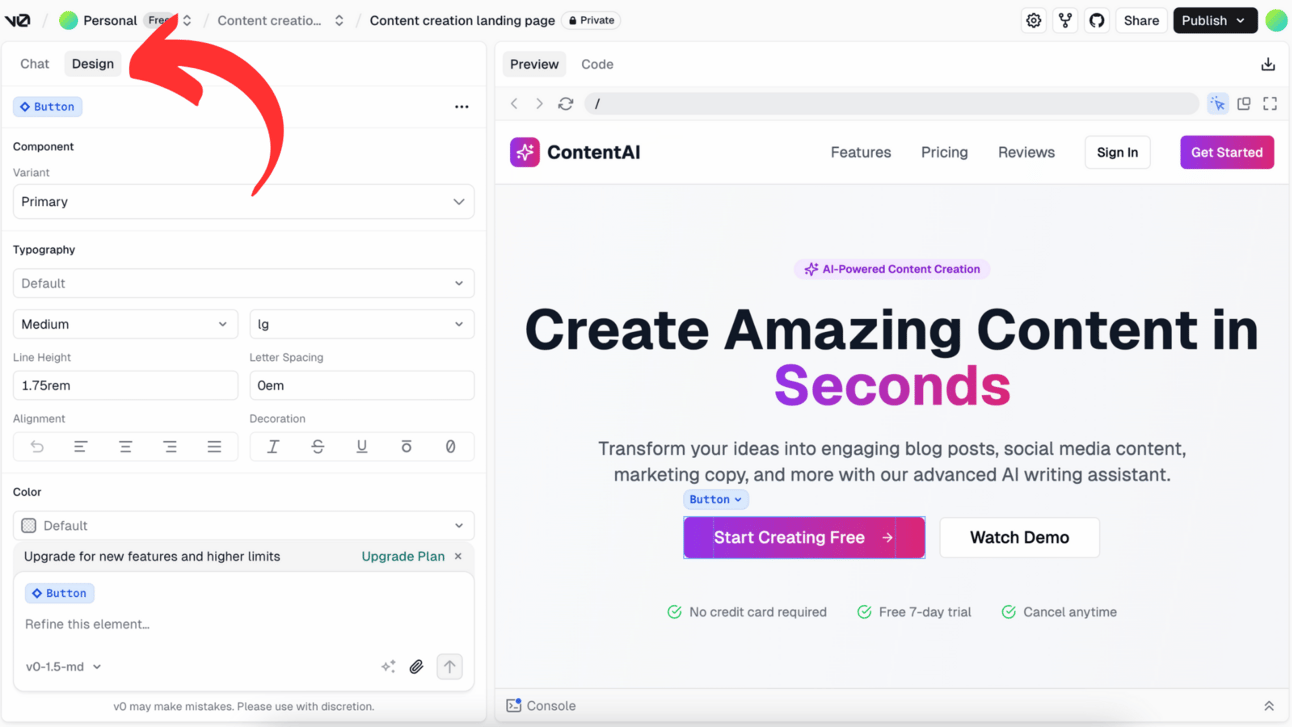
The Rundown: In this tutorial, you will learn how to use v0's new Design Mode to create stunning user interfaces with AI and then manually fine-tune every element without additional prompts or credits.
Step-by-step:
Visit v0 and prompt your desired user interface, e.g., "Create a landing page for a content creation AI tool"
Click the "Design" tab to enter manual editing mode
Select any element (text, buttons, sections) to customize copy, typography, layout, colors, and styling
Preview changes in real-time and click "Save" when ready
Pro tip: Use detailed AI prompts for the foundation (80%), then Design Mode for perfection (20%).
PRESENTED BY IBM
🧠 Better data. Smarter AI.

The Rundown: Come meet the next evolution of IBM® watsonx.data®, an open, hybrid lakehouse built to help improve AI accuracy.
Watsonx.data is designed to:
Automate the ingestion, enrichment and governance of data at scale
Optimize for cost and performance through purpose-built query engines
Work across on-prem, cloud and multi-cloud environments
Help improve the accuracy of gen AI apps
What else can watsonx.data do for you? See for yourself.
⚡ Gemini 2.5 family goes GA with new flash-lite

Image source: Google
The Rundown: Google just graduated its Gemini 2.5 Pro and Flash models to stable production status after months of preview version updates, while also rolling out a new, hyper-efficient Flash-Lite variant.
The details:
The Gemini 2.5 Pro and Flash models exit preview and are now generally available, with Pro topping the leaderboards alongside OpenAI’s o3-pro.
2.5 Flash-Lite launches in preview, beating previous Lite models across benchmarks while maintaining the massive 1M token context window.
All three models feature adjustable "thinking" capabilities that let users control reasoning and cost, with Lite defaulting to thinking off for maximum speed.
Why it matters: After making a series of impressive “preview” updates to Gemini’s 2.5 family, Google is finally cementing the models in with a GA launch. The move now turns focus away from incremental updates and towards the teased 2.5 DeepThink and eventual larger leap forward with the Gemini 3 family.
QUICK HITS
💼 AI Job Opportunities
🔁 The Rundown - Strategic Partnerships (AI University)
📦 Figure AI - Global Supply Manager, Electronics
🔬 Meta - Research Scientist
🖥️ xAI - Datacenter Technician Lead
📰 Everything else in AI today
MiniMax debuted Hailuo 02, a new AI video model (tested under the “Kangaroo” codename) that moves to No. 2 on the Artificial Analysis leaderboard, passing Veo 3.
Amazon CEO Andy Jassy said in a letter to employees that the company’s AI push will trim its corporate headcount in the coming years with agents and automation advances.
Krea AI launched its debut Krea 1 image model as a free public beta, showcasing advanced style control and image quality.
Intelligent Internet introduced an updated version of its open II-Medical model, surpassing Google’s MedGemma across benchmarks despite its smaller size.
Adobe released new mobile apps for its Firefly platform, allowing users to access its AI image, video, and other creative tools via iOS and Android.
xAI is reportedly aiming to raise $4.3B in new funding for its AI operations, with the company valued at $80B as of the end of Q1.
COMMUNITY
🎥 Join our next live workshop
Join our next workshop this Friday, June 20th, at 4 PM EST with Dr. Alvaro Cintas, The Rundown’s AI professor. By the end of the workshop, you’ll be able to confidently build and run your automation agents using n8n.
RSVP here. Not a member? Join The Rundown University on a 14-day free trial.
See you soon,
Rowan, Joey, Zach, Alvaro, and Jason—The Rundown’s editorial team

Tinder's new move: double dates
Read Online | Sign Up | Advertise

Good morning, tech enthusiasts. Tinder’s new Double Date feature lets you and your bestie swipe as a team and match with other pairs — think less solo stress, more group chemistry.
As rivals like Bumble and Hinge push community-focused dating, Tinder is aiming to boost engagement and shift its ‘hookup app’ image — but will double dating become the new norm for finding love online?
In today’s tech rundown:
Tinder rolls out double dating feature
Spotify’s Daniel Ek bets big on defense AI
New obesity pill burns fat and keeps muscle
Gig economy startup WorkWhile grabs $23M
Quick hits on other major tech news
LATEST DEVELOPMENTS
TINDER
🥂 Tinder rolls out double dating feature

Image source: Tinder
The Rundown: Dating app Tinder is making a play to recapture Gen Z users with the launch of its Double Date feature, a group-centric twist on digital matchmaking that aims to make dating more social and less anxiety-producing.
The details:
Double Date allows users to invite a friend (or up to three friends) to form a pair/team — and swipe together on other pairs.
It’s a data-driven response to shifting user habits and the growing demand for low-pressure social experiences, especially among Gen Z.
Early testing revealed that nearly 90% of Double Date profiles were created by users under 29, with women 3x more likely to like a pair versus solo profiles.
Hinge and Bumble are also leveraging group activities, interest-based communities, and in-person events to meet user demand.
Why it matters: New CEO Spencer Rascoff aims to revamp the app’s image, with a focus on “fewer likes, better types.” Tinder is the first major dating app to offer group dating, but follows smaller players Fourplay, DuoDate, and Doubble. Tinder says that nearly 15% of Double Date users were either brand-new or reactivated accounts.
HELSING
🪖 Spotify’s Daniel Ek bets big on defense AI

Image source: Helsing
The Rundown: Spotify founder Daniel Ek just made an audacious bet on the future of European defense tech, leading a €600M ($692M) funding round in Helsing, the Munich-based defense AI startup he first backed with €100M ($115M) in 2021.
The details:
Ek’s investment venture Prima Materia led the round, pushing Helsing’s valuation to €12B ($13.8B), making it a top European private tech firm.
Helsing evolved from AI software to developing strike drones, autonomous mini-submarines, and its flagship battlefield management platforms.
Its core tech fuses data from military sensors, radars, and weapons systems —and uses AI to generate real-time battlefield visualizations.
The company’s new HX-2 drones are capable of operating in coordinated swarms and executing missions even under communications blackouts.
Why it matters: Massive investments in defense tech firms like Anduril, Shield AI, and Helsing are fueling the global shift to autonomous, software-defined warfare. Ek’s bet on Helsing also signals that Europe’s tech elite are joining the fray. The startup has already signed major deals with NATO countries and says it is committed to ethical AI.
BIOTECH INNOVATIONS
💊 New obesity pill burns fat and keeps muscle

Image source: Ideogram/The Rundown
The Rundown: An experimental obesity pill developed by biotech firm Eolo Pharma is showing promise, according to new results of a preliminary human trial. But rather than reducing appetite like Ozempic, it burns fat with no muscle-wasting side effects.
The details:
SANA is the first drug to pharmacologically activate creatine-dependent thermogenesis in humans, a unique energy-burning pathway.
Unlike GLP-1 drugs, SANA preserved and even increased lean muscle mass in preclinical models while reducing fat, as confirmed by EchoMRI analysis.
The Phase 1a/b trial was double-blind, randomized, and placebo-controlled, involving participants with obesity who received oral SANA for 15 days.
Eolo Pharma plans to initiate Phase 2 clinical trials this year to evaluate SANA’s safety and efficacy as both a standalone and combination therapy for obesity.
Why it matters: While still early days, its first round of human trials showed significant weight loss in just two weeks, and preclinical data suggest it could help users shed fat while preserving precious muscle mass — a critical advantage over current injectables like Ozempic and Wegovy that can erode lean tissue.
WORKWHILE
⚡️ Gig economy startup WorkWhile grabs $23M

Image source: WorkWhile
The Rundown: San Francisco’s WorkWhile raised $23M in Series B funding to expand its AI-powered gig labor platform, aiming to help businesses quickly find hourly workers while offering flexible schedules and faster pay for workers.
The details:
WorkWhile says its platform leverages advanced machine learning algorithms to match businesses with reliable hourly workers.
The platform analyzes 150 factors — such as no-show rates and transportation access — to predict worker quality and reliability “with 95% accuracy.”
The startup serves over 1M users in the U.S., connecting workers with shifts in industries like warehousing, food production, and last-mile delivery.
WorkWhile has powered staffing for high-profile events and clients, including Taylor Swift’s Eras Tour, the Super Bowl, NASCAR, and the NCAA Final Four.
Why it matters: Companies like Instawork, Workstream, Shiftgig, and WorkWhile aim to disrupt the $650B global staffing market — including $230B in U.S. temp jobs — with an AI-driven option to old-school agencies. Yet, gig economy debates continue, and WorkWhile paid $1M last year in an ongoing worker classification dispute.
QUICK HITS
📰 Everything else in tech today
Chinese AI startup MiniMax announced that its new large language model, MiniMax-M1, outperforms DeepSeek, Bloomberg reports.
OpenAI won a $200M contract from the U.S. Defense Department to deploy frontier AI tools for warfighting and enterprise use cases.
WhatsApp is introducing ads in its Updates tab and new paid Channel features globally — all while keeping chats private and ad-free.
Eli Lilly & Co. is reportedly in advanced negotiations to acquire gene-editing specialist Verve Therapeutics for as much as $1.3B.
Amazon announced that it is extending its Prime Day discount event to four days, from midnight PT on July 8 through July 11.
The Trump Organization’s newly announced $499 T1 smartphone may be produced by a Chinese device manufacturer, according to reports.
Meta is set to expand its smart glasses lineup beyond its successful Ray-Ban partnership, teaming up with Oakley for a new product launch on Friday, June 20.
Britain announced a major £250M ($340M) investment to accelerate the development of green technologies in the aerospace sector.
The Washington Post is investigating a cybersecurity breach that compromised the email accounts of several of its journalists.
Xiaomi is set to launch its new electric SUV, the YU7, at the end of June, advancing the original July release date.
Beijing’s subway system reportedly became the first to let riders tap any of the five major card schemes, including Visa and American Express, across its entire system.
COMMUNITY
🎥 Join our next live workshop

Join our next workshop today at 3 PM EST with Keanan Koppenaver, Technical PMM at Retool. By the end of the workshop, you’ll know how to supercharge and automate your prospect follow-ups with AI agents.
RSVP here. Not a member? Join The Rundown University on a 14-day free trial.
See you soon,
Rowan, Jennifer, and Joey—The Rundown’s editorial team

OpenAI, Microsoft reach 'boiling point'
Read Online | Sign Up | Advertise

Good morning, AI enthusiasts. The AI world’s biggest partnership feels ready to explode — with a new report saying OpenAI is potentially ready to drop the “nuclear option” of antitrust complaints against Microsoft.
With tensions between the two sides reportedly reaching a “boiling point,” it seems like the alliance that defined the AI boom might end with lawyers instead of AGI.
Reminder: Our next live workshop is today at 4 PM EST with Retool — join and learn how to supercharge and automate your prospect follow-ups with AI agents. RSVP here.
In today’s AI rundown:
OpenAI, Microsoft partnership hits ‘boiling point’
MiniMax’s open reasoner with 1M token context
Add image generation and editing to projects
McKinsey details AI investment ‘paradox’
4 new AI tools & 4 job opportunities
LATEST DEVELOPMENTS
OPENAI & MICROSOFT
😡 OpenAI, Microsoft partnership hits ‘boiling point’

Image source: OpenAI
The Rundown: The WSJ just declared that the massive partnership between OpenAI and Microsoft is at a “boiling point,” with the AI leader considering filing antitrust complaints after disputes over compute access, IP rights, and company restructuring.
The details:
The latest argument comes over OpenAI’s $3B acquisition of Windsurf, with the company wanting to withhold the IP due to Microsoft’s rival GitHub Copilot.
OpenAI is reportedly considering the “nuclear option” of accusing Microsoft of anticompetitive behavior and pushing for a federal review of the partnership.
Microsoft was also a key holdout in OpenAI’s PBC restructuring, with the two sides reportedly meeting to renegotiate their partnership last month.
OpenAI has been seeking to reduce its dependency on Microsoft, partnering with rival Google on cloud compute last week.
Why it matters: AI’s defining partnership has been absolutely frigid for a while now, but OpenAI's resort to a legal “nuclear option” would be a shocking move against its largest investor. The AI leader is desperate to break free and control its own destiny before AGI arrives, and its initial collaboration is quickly turning into competition.
TOGETHER WITH VANTA
🛡️ Turn security into your startup’s secret sales weapon

The Rundown: Startups move fast, but today’s buyers expect enterprise-grade security from day one — turning security from a nice-to-have into a potential blocker for growth. In this joint session with AWS, Vanta, and BreachRx, you’ll learn how early-stage teams are turning that pressure into an advantage.
Join and discover:
Practical tips and proven strategies for your compliance journey
Real-world examples from founders who have scaled trust alongside growth
How BreachRX built customer confidence and sped up deals through early compliance
MINIMAX
🧠 MiniMax’s open reasoner with 1M token context

Image source: MiniMax
The Rundown: Chinese AI startup MiniMax released M1, an open-source reasoning model with a massive 1M token context window that achieves comparable performance to leading open models at a fraction of the training cost.
The details:
MiniMax claims M1 has the “world’s largest context window,” handling 1M input tokens while supporting an 80k token “thinking budget” for outputs.
While competitive across the board, M1 excels in software engineering and agentic tool use, also massively outperforming in long-context benchmarks.
The company also introduced CISPO, a new reinforcement learning algorithm that achieved 2x faster training compared to existing methods.
The startup said CISPO helped the model’s full training run cost just $535k and took just three weeks, dramatically undercutting the budgets of rival systems.
Why it matters: Chinese labs continue to push forward with new open-source powerhouses, with M1 pushing the boundaries for context capabilities. MiniMax’s training efficiency also shows that innovative AI architecture continues to challenge assumptions about cost being a key factor in scaling intelligence.
AI TRAINING
🎨 Add image generation and editing to projects

The Rundown: In this tutorial, you will learn how to use Flux.1 Kontext API to add professional image generation and editing capabilities to any application with simple API calls.
Step-by-step:
Visit Black Forest Labs playground, create a free account, and copy your API key for authentication
Use the Google Colab notebook provided here, replace “BFL_API_KEY” with your key, and modify the prompt
For editing, upload your image to Colab, update the filename, and add editing prompts
Copy the working code to Cursor/Windsurf and prompt: “Create a web app for image generation with this API structure”
Pro tip: Use the Pro model for development speed, then switch to Max for production quality.
PRESENTED BY UNSTRUCTURED
🐀 Are you building a data rat's nest?
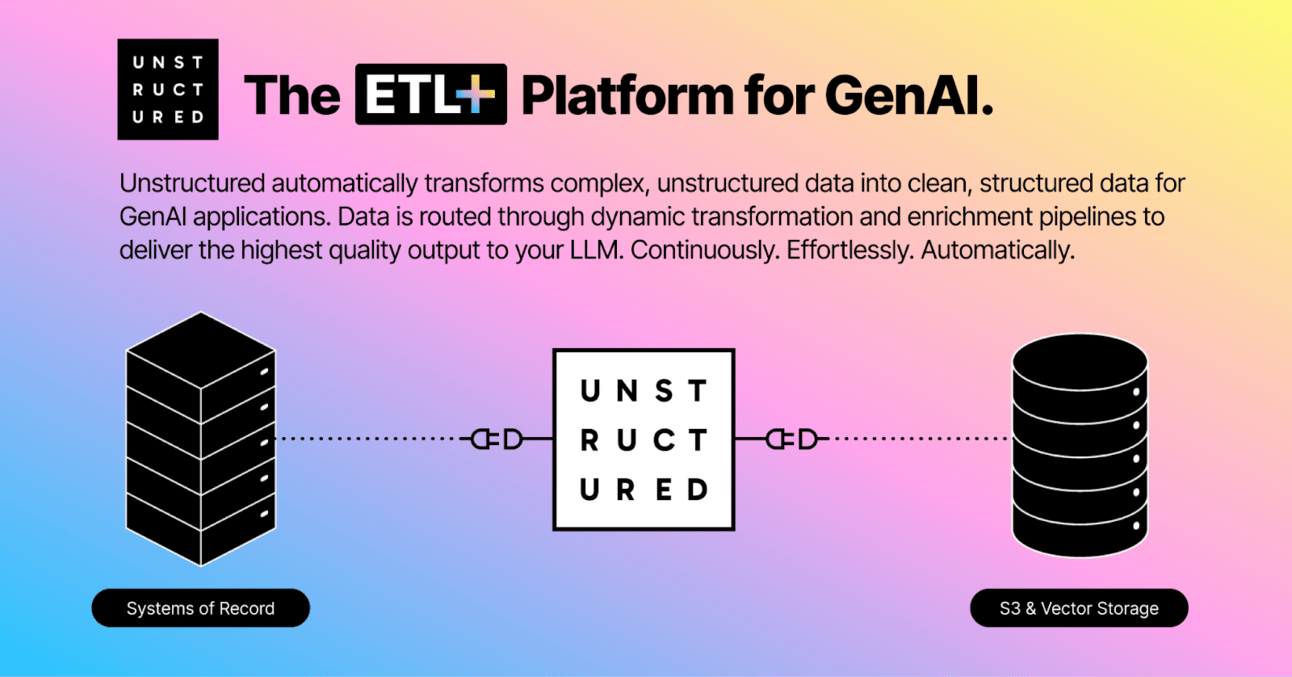
The Rundown: Building your own data processing pipeline starts simple, but scaling it is another story — with a few scripts and connectors quickly turning into a tangled mess of never-ending fixes and updates.
Unstructured replaces the DIY rat’s nest with:
Coverage across 35+ data sources and 64+ file types with zero maintenance overhead
AI-tailored processing with chunking, embedding, and enrichment for GenAI use cases
Enterprise-grade security, compliance, and role-based access that works at scale
AI ENTERPRISE RESEARCH
💸 McKinsey details AI investment ‘paradox’

Image source: McKinsey
The Rundown: McKinsey released a report analyzing why many companies aren't seeing returns on their AI investments, arguing that agents are the key to unlocking its impact by reimagining business processes rather than just automating tasks.
The details:
The firm identifies a “genAI paradox,” noting that nearly 80% of companies use the tech, but a similar number report almost no material impact on earnings.
McKinsey says companies largely use general-purpose AI tools, which make improvements that are hard to measure and don’t show up in financial results.
The company argues that success requires enterprises to rebuild processes around agents rather than inserting them into already existing workflows.
The report concludes the shift is a leadership challenge, calling to end broad “experimentation phases” and drive more strategic, top-down transformations.
Why it matters: Almost every company is trying to implement AI, but few are likely willing to redesign operations completely for a new AI-driven world. While some firms may spend millions on copilots, they might find themselves leapfrogged by competitors who are willing to take the organizational leap and embrace agent-based systems.
QUICK HITS
🛠️ Trending AI Tools
⚡ Deepgram Voice Agent API - Build production-ready voice agents with a unified speech-to-speech API*
🧊 Hunyuan 3D 2.1 - New open-source model for creating 3D assets
🗂️ ChatGPT Projects - Support for Deep Research, Voice Mode, and more
🎥 KLING 2.1 - SOTA AI video model lineup with enhanced speed and quality
*Sponsored Listing
💼 AI Job Opportunities
📞 The Rundown - Account Manager
🚀 Cohere - Enterprise Deployment Specialist
🛠️ Union - Full-Stack Software Engineer
🧱 Lakera AI - Senior Full-stack Engineer
📰 Everything else in AI today
Moonshot AI launched Kimi-Dev-72B, an open-source coding model that achieves SOTA results on software tasks, surpassing rivals like DeepSeek R1, V3, and Devstral.
OpenAI added support for Anthropic’s open Model Context Protocol inside ChatGPT, allowing users to connect external tools to the platform.
TikTok released new updates to its Symphony AI suite, including image-to-video, text-to-video, and AI avatar marketing for advertising content.
Reddit debuted Reddit Insights and Conversation Summary Add-Ons for real-time analytics and auto-curated social listening for brands on the platform.
Google is reportedly planning to end its relationship with Scale AI following Meta’s investment, with Microsoft, xAI, and OpenAI also looking to shift away from the startup.
“Godfather of AI” Geoffrey Hinton said “mundane intellectual labor” is most at risk of AI displacement, with “physical manipulation” jobs being safer in the near term.
Google DeepMind partnered with creative studio Primordial Soup on “ANCESTRA,” a short premiering at the Tribeca Festival that uses Veo alongside live-action scenes.
COMMUNITY
🎥 Join our next live workshop

Join our next workshop today at 3 PM EST with Keanan Koppenaver, Technical PMM at Retool. By the end of the workshop, you’ll know how to supercharge and automate your prospect follow ups with ai agents.
RSVP here. Not a member? Join The Rundown University on a 14-day free trial.
See you soon,
Rowan, Joey, Zach, Alvaro, and Jason—The Rundown’s editorial team

Meta's 'world model' for robots
Read Online | Sign Up | Advertise

Good morning, robotics enthusiasts. Meta just dropped a next-gen “world model” — an AI built to transform how robots and self-driving cars perceive, predict, and act in the real world.
World models are hot right now, as researchers move beyond language-based training to give machines true physical understanding. Could this be the breakthrough that unlocks superintelligent robotics?
In today’s robotics rundown:
Meta unveils ‘world model’ for robotics
Skild hits $4.5B with Nvidia & Samsung’s backing
Gecko Robotics tops $1.25B for inspection bots
China’s RoboBrain 2.0 for smarter robots
Quick hits on other robotics news
LATEST DEVELOPMENTS
META
🤖 Meta unveils ‘world model’ for robotics

Image source: Meta
The Rundown: Meta just pulled back the curtain on V-JEPA 2 — a 1.2-billion-parameter “world model” designed to give advanced robots and self-driving cars a kind of common sense about the physical world.
The details:
Unlike language models, V-JEPA 2, pretrained on over a million hours of unlabeled video and images, creates internal simulations of the physical world.
The simulations allow the AI to reason about motion, interactions, and outcomes in real time — and predict results with human-like logic.
In a second training phase, V-JEPA 2 was fine-tuned on 62 hours of robot interaction data, enabling it to make action-conditioned predictions.
The whole system gives robots the ability to plan and execute tasks with unfamiliar objects in new environments — requiring no prior training or demos.
Why it matters: Robots powered by V-JEPA 2 can be dropped into unfamiliar situations and still plan, adapt, and execute tasks without retraining for each scenario. Building world models is touted as the next big thing in AI, with AI researcher Fei-Fei Lee’s World Labs, Odyssey, and Google’s DeepMind also being in the race.
SKILD AI
🤑 Skild hits $4.5B with Nvidia & Samsung’s backing

Image source: Skild AI
The Rundown: Robotics software startup Skild AI just nabbed $35M from Samsung and Nvidia — with $10M from Samsung and $25M from Nvidia — as part of a larger Series B round valuing the company at a staggering $4.5B.
The details:
The investment has been led by SoftBank’s $100M commitment, with South Korean powerhouses like LG, Hanwha, and Mirae Asset also joining the fray.
Skild AI’s flagship product is “Skild Brain” — a foundational model designed to give robots capabilities in manipulation, navigation, and locomotion.
The company’s ultimate vision is to create robotic intelligence that can handle everything from complex industrial tasks to household chores.
Skild’s platform stands out for its horizontal approach, enabling robots to perform a vast range of tasks across industries without extensive retraining.
Why it matters: As the global race for consumer and industrial robotics heats up —with Tesla, Amazon, Figure, and Google all doubling down — Skild’s breakthrough in scalable, adaptable robotics is positioning it at the forefront of a market poised to transform everything from healthcare and construction to logistics and beyond.
GECKO ROBOTICS
🦄 Gecko Robotics tops $1.25B for inspection bots

Image source: Gecko Robotics
The Rundown: Gecko Robotics, a Pittsburgh-based pioneer in AI-driven robotics for infrastructure maintenance, officially joined the unicorn club with a $125M Series D round of funding — taking its valuation to $1.25B.
The details:
Gecko’s Cantilever operating system allows robots to autonomously inspect and analyze power plants, oil refineries, and military vessels.
The company has a $100M deal with NAES to modernize U.S. power plants and a partnership with L3Harris to roll out XR solutions for aircraft maintenance.
It claims its robots slash labor costs by 85% and shrink U.S. Navy ship inspection timelines by months — all while improving safety.
The fresh capital infusion will turbocharge Gecko’s expansion into defense, energy, and manufacturing industries.
Why it matters: Founded in a college dorm by Jake Loosararian, Gecko Robotics now deploys a fleet of agile robots — climbing, flying, and swimming — to capture precision data from warships to power plants. Alongside rivals like Intellibot, Gecko is one to watch in a fast-growing sector where robotics is transforming safety and efficiency.
CHINESE ROBOTICS
🧠 China’s RoboBrain 2.0 for smarter robots

Image source: BAAI/X
The Rundown: The Beijing Academy of Artificial Intelligence (BAAI), a nonprofit research lab, unveiled RoboBrain 2.0, a cutting-edge open-source AI model designed to act as the “brain” for humanoids and advanced robots.
The details:
RoboBrain 2.0 is engineered to serve as the cognitive core for humanoids, offering major improvements in spatial intelligence and task planning.
Compared to its predecessor, released three months earlier, this new model delivers a 17% increase in processing speed and a 74% boost in accuracy.
BAAI is already collaborating with some 20 Chinese robotics firms to accelerate innovation and adoption of advanced robotics across varied industries.
RoboBrain 2.0 is part of BAAI’s broader Wujie model series, which also includes cloud-based platform RoboOS 2.0 and multimodel system Emu3.
Why it matters: BAAI director Wang Zhongyuan described RoboBrain 2.0 as the world’s most powerful open-source AI model for robotics, with execs from Baidu, Huawei, and Tencent attending the launch. Despite being placed on the U.S. Entity List, BAAI is forging ahead with new partnerships to boost talent and tech exchange.
QUICK HITS
📰 Everything else in robotics today
Boston Dynamics’ robots took the stage on America’s Got Talent in a synchronized dance routine set to Queen’s “Don’t Stop Me Now” — but to mixed reviews.
Tesla is suing a former engineer, alleging he stole trade secrets from its Optimus humanoid project to launch a startup specializing in robotic hands.
Beijing is set to open the world's first “4S store” dedicated to the sales and service of humanoids, more than a month ahead of the 2025 World Robot Conference.
Shenzhen-based Lumos Robotics posted a video of its LUS 2 humanoid going from lying flat on the floor to standing up in just one second.
Goldman Sachs says widespread adoption of autonomous vehicles could eventually reduce the number of road accidents, but might not lead to cheaper auto insurance.
Scale CEO Alexandr Wang said on a podcast that humans could one day be able “to downlink” their consciousness into a humanoid and experience the world via its body.
Drones and robot dogs marched alongside military vehicles in a parade in Washington, D.C., for the 250th anniversary of the U.S. Army.
A research team has developed SMURF — Soft Miniaturized Underground Robotic Finder — with a smell sensor to search for humans in rescue missions.
Sojo Industries, a leader in advanced robotics and mobile manufacturing, announced this week that it has raised $40M in new funding.
COMMUNITY
🎥 Join our next live workshop
Join our next workshop on Tuesday, June 17th at 3 PM EST with Keanan Koppenaver, Technical PMM at Retool. By the end of the workshop, you’ll know how to supercharge and automate your prospect follow-ups with AI agents.
RSVP here. Not a member? Join The Rundown University on a 14-day free trial.
See you soon,
Rowan, Jennifer, and Joey—The Rundown’s editorial team

MIT's AI learns to upgrade itself
Read Online | Sign Up | Advertise

Good morning, AI enthusiasts. The path to superintelligence just got a bit clearer, with MIT researchers teaching AI to self-improve without human help.
As models eventually learn to rewrite their own code, training data, and capabilities at scale, is this the first baby step towards the exponential intelligence explosion that experts both crave and fear?
In today’s AI rundown:
MIT researchers teach AI to self-improve
AI develops human-like object understanding
Decode video success patterns for better content
UK study reveals AI's hidden impact on children
4 new AI tools & 4 job opportunities
LATEST DEVELOPMENTS
AI RESEARCH
📶 MIT researchers teach AI to self-improve

Image source: MIT
The Rundown: MIT researchers just developed Self-Adapting LLMs (SEAL), a framework that enables large language models to teach and improve on their own by creating their training data and instructions for self-updates.
The details:
SEAL allows models to generate their own "self-edits" — instructions for creating synthetic data and setting parameters to update their own weights.
It learns through trial-and-error via a reinforcement learning loop, rewarding the model for generating self-edits that lead to better performance.
In knowledge tasks, the AI learned more effectively from its own notes than from learning materials generated by the much larger GPT-4.1.
The system also dramatically improved at puzzle-solving tasks, jumping from 0% with standard methods to 72.5% after learning how to train itself effectively.
Why it matters: Self-improving AI is frequently mentioned as a potential lead-in to the leap toward superintelligence. While SEAL (and other research frameworks like Sakana’s DGM) aren’t there yet, they point to a scary but exciting future where models can continue upgrading (exponentially) on their own, going beyond human design.
TOGETHER WITH BASETEN
🚀 Enterprise grade infrastructure for everyone

The Rundown: Baseten’s multi-cloud capacity management (MCM) system brings bleeding edge infrastructure capability to every workload. Launch custom, fine-tuned, or any open source model and scale without limits.
With Baseten’s MCM system, you’ll experience:
Cloud agnostic infrastructure with no GPU scarcity bottlenecks
Out-of-the-box worldwide scale with 99.99% uptime
Performance optimized infra by use case
Systems that satisfy data residency and sovereignty requirements
AI RESEARCH
🧠 AI develops human-like object understanding

Image source: Institute of Automation, CAS
The Rundown: New research from Chinese scientists just revealed that AI models are spontaneously developing internal 'maps' of the world that closely mirror human conceptual understanding, making a leap from simple recognition to machine cognition.
The details:
AI models were tested on 4.7M "odd-one-out" decisions across nearly 2,000 common objects, studying how they organize and understand the world.
The AI naturally developed 66 core ways of thinking about objects, closely matching how humans mentally categorize things like animals, tools, and food.
The AI’s conceptual map showed a strong alignment with human brain activity patterns, particularly in regions responsible for processing object categories.
Rather than just memorizing patterns, the research showed that AI models build genuine internal concepts and meanings for objects.
Why it matters: While there is still a large subset of the AI world that believes that models are just “stochastic parrots”, we’re continuing to see more and more evidence of the tech showing hints of genuine reasoning and conceptual understanding — and that machine intelligence may work in similar ways to humans after all.
AI TRAINING
📈 Decode video success patterns for better content

The Rundown: In this tutorial, you will learn how to use Perplexity's new Labs feature to analyze viral YouTube videos and successful channels to uncover hidden patterns, content strategies, and audience engagement tactics that drive massive viewership.
Step-by-step:
Access Perplexity Pro and click the lightbulb icon to activate Labs mode for advanced research capabilities
Create a comprehensive prompt: “Analyze viral YouTube videos and successful channels in AI to identify...”
Wait 8-12 minutes while the AI analyzes top videos, channel metrics, and engagement patterns across successful creators
Review detailed insights and ask follow-up questions for deeper analysis
Pro tip: Frame your initial prompt to focus on specific metrics you want to improve. The more targeted your research request, the more actionable your insights will be.
PRESENTED BY ENEY
🤖 Meet your Mac's new AI companion

The Rundown: After 17 years of crafting trusted Mac software, MacPaw is pioneering something entirely new — Eney, an AI computer being that bridges the gap between you and your digital tasks through natural conversation.
Eney's capabilities include:
Intuitive assistance using natural language with no app switching or complex commands
Real Mac actions like system optimization, image editing, meeting transcriptions, and more
Proactive intelligence that learns your patterns and suggests relevant actions
Join Eney's closed beta and help shape the future of Mac companions.
AI & CHILDREN
🧒 UK study reveals AI's hidden impact on children

Image source: The Alan Turing Institute
The Rundown: New research from The Alan Turing Institute uncovered a digital divide in children's AI use, with 22% of UK kids aged 8-12 already using AI — but with private school students nearly 3x more likely to have access than their state school peers.
The details:
Private school kids showed 52% usage rates compared to just 18% in state schools, also reporting more frequent use and greater teacher awareness of AI.
Environmental concerns emerged as an unexpected factor, with some children refusing to use AI after learning about its energy and water consumption.
The study found children primarily use AI for creativity and learning, with high reports of children feeling the tool helps them communicate better.
The research also included teachers, with 66% reporting AI use primarily for lesson planning, creating presentations, and designing homework.
Why it matters: This generation of kids is going to grow up with AI just as the previous one did with the Internet. While the benefits to creativity and communication were clear, so was the divide in public vs. private schools — with access and adoption potentially widening the educational gap for more privileged students.
QUICK HITS
🛠️ Trending AI Tools
🗣️ AssemblyAI - Build a voice agent with fast and accurate real-time speech-to-text*
🎥 Seedance 1.0 - ByteDance’s new leaderboard-topping video model
💬 Chat Mode - Runway’s new conversational interface for generating content
👁️ Copilot Vision - AI companion that can see your PC in real time
*Sponsored Listing
💼 AI Job Opportunities
🤝 The Rundown - Partnerships Manager
🧳 Glean - Consulting Partner Manager
🧑💻 Perplexity AI - Full-Stack Engineer, Comet
🧠 Runway - Applied Research Lead, Language
📰 Everything else in AI today
Nvidia CEO Jensen Huang stated that he “pretty much disagrees with almost everything” Anthropic CEO Dario Amodei has said regarding AI and job automation.
A paper co-authored by Claude 4 Opus critiqued Apple researchers’ recent viral paper that argued LLMs can’t reason, finding flaws in the study’s design.
OpenAI rolled out updates to its Projects feature, with new support for deep research and voice mode alongside improved memory functionality.
AstraZeneca signed a $5.3B AI research deal with China’s CSPC, aiming to use AI to develop new oral medications for chronic diseases.
A new report from the New York Times detailed cases of ChatGPT use reinforcing and fueling user issues like delusions, conspiratorial beliefs, and mental health crises.
Tencent’s Hunyuan released Hunyuan 3D 2.1, an open-source model for generating 3D assets with cinematic textures and realism.
COMMUNITY
🎥 Join our next live workshop
Join our next workshop on Tuesday, June 17th at 3 PM EST with Keanan Koppenaver, Technical PMM at Retool. By the end of the workshop, you’ll know how to supercharge and automate your prospect follow-ups with AI agents.
RSVP here. Not a member? Join The Rundown University on a 14-day free trial.
See you soon,
Rowan, Joey, Zach, Alvaro, and Jason—The Rundown’s editorial team

Meta's $15B AI power grab
Read Online | Sign Up | Advertise
Good morning, tech enthusiasts. Meta just inked a nearly $15B deal to acquire a 49% stake in Scale AI — bringing on 28-year-old CEO Alexandr Wang to lead its AI reboot after the underwhelming Llama 4 launch.
As OpenAI and Google pull ahead, Meta’s bold move raises the stakes — but could this power play turn Scale from a trusted industry supplier into just another Meta satellite?
In today’s tech rundown:
Meta’s $15B power move to poach Scale’s CEO
Lab-grown salmon gets FDA nod
Archer nabs $850M after Trump’s executive order
Snap to launch lightweight AR glasses next year
Quick hits on other major news
LATEST DEVELOPMENTS
META
💰 Meta’s $15B power move to poach Scale’s CEO

Image source: Diabrot/Wikimedia Commons
The Rundown: Meta just finalized a deal reportedly worth $14.3B for a 49% stake in San Francisco-based Scale AI — bringing on its 28-year-old CEO Alexandr Wang to lead Meta’s AI overhaul.
The details:
While the official number behind the deal remains unclear, Scale notes that Meta has made “a significant” investment, valuing the company at $29B.
Used by Meta’s major AI rivals, Scale AI specializes in providing the human labor and tech required to label data — a critical step in training AI models.
Scale’s 28-year-old founder and CEO will join Meta to lead its new “superintelligence” research initiative, bringing along some Scale staff.
Meta CEO Mark Zuckerberg has hand-picked some 50 researchers for the lab, offering huge salary packages to draw in top talent from OpenAI and Google.
Why it matters: Meta’s underwhelming Llama 4 launch has spurred this aggressive talent acquisition and major investment to reboot its AI strategy. The deal looks to boost Meta’s capabilities but sparks questions about Scale’s future and whether other AI giants will keep partnering with a company so closely tied to Meta.
WILDTYPE
🍣 Lab-grown salmon gets FDA nod

Image source: Wildtype
The Rundown: A lab-grown salmon from food tech startup Wildtype has become the first cell-cultivated seafood to receive FDA approval for public consumption, with the cultivated salmon now available to order from a restaurant in Portland, Oregon.
The details:
The cultivated salmon is now available at Portland’s Kann restaurant, with plans to expand to four more restaurants over the next four months.
Wildtype harvests living cells from Pacific coho salmon and grows them in bioreactors under controlled conditions that mimic a wild fish’s environment.
After four to six weeks of processing, the final product is a sushi-grade “saku” block, a premium cut typically used for raw sushi and sashimi.
Wildtype’s salmon is free from mercury, antibiotics, parasites, and microplastics, while still loaded with healthy omega-3 and omega-6 fatty acids.
Why it matters: Wildtype’s closed production system reduces pressure on fish farms, mitigates overfishing, and eliminates bycatch and animal cruelty, as Upside Foods and Good Meat do for meat and chicken. The company’s pilot facility in San Francisco can produce up to 50K pounds of seafood annually, with plans to scale further.
ARCHER AVIATION
🚁 Archer nabs $850M after Trump’s executive order

Image source: Archer Aviation
The Rundown: Archer Aviation, the electric air taxi innovator, just landed an $850M funding windfall — fueled by a trio of executive orders from President Trump aimed at propelling the U.S. to the forefront of next-gen aviation.
The details:
Trump’s executive orders target the removal of regulatory barriers for electric air taxis, urban drone operations, and supersonic commercial aircraft.
Trump is also establishing a pilot program to accelerate the adoption of electric vertical takeoff and landing (eVTOL) tech used by Joby and Archer.
Archer, now flush with nearly $2B, is set to be the official air taxi provider for the 2028 LA Olympics.
The company has also inked a partnership with United Airlines to build a New York City air taxi network.
Why it matters: The FAA is now tasked to repeal a 1973 ban on supersonic overland flights (provided new tech keeps noise in check), opening up new opportunities for flying cars, supersonic jets, and advanced drones in the U.S. For its part, rival Joby’s stock soared 10% as the news hit, with Archer’s rising 8%.
SNAP
🕶️ Snap to launch lightweight AR glasses next year

Image source: Snap
The Rundown: Snap, the company behind Snapchat, is making a bold play to leapfrog Big Tech rivals by launching its next-gen augmented reality smart glasses, called “Specs,” ahead of Meta, Google, and Apple’s competing offerings.
The details:
CEO Evan Spiegel announced this week that Snap’s Specs are set for a 2026 consumer release with a sleek design packed with AI and AR features.
The glasses will run Snap’s proprietary Snap OS and feature deep integrations with AI models from both OpenAI and Google.
Snap’s library of over 4M AR Lenses will be fully compatible, allowing users to access 3D effects, games, and utilities directly through their eyewear.
With a decade of AR development and more than $3B invested, Snap is betting that Specs can finally deliver on the promise of mainstream AR glasses.
Why it matters: Snap’s Specs aim to beat Meta’s Orion and Google’s AI glasses to launch. If Snap delivers, these lightweight AR smart glasses — with built-in AI assistance and millions of AR Lenses — could push everyday computing beyond the smartphone and into a new era of always-on, wearable tech.
QUICK HITS
📰 Everything else in tech today
Meta announced a partnership with startup XGS Energy to develop a 150-megawatt geothermal power plant in New Mexico.
Apple has set an internal goal of releasing its long-delayed, AI-enhanced version of Siri in spring 2026, Bloomberg reports.
Uber is set to debut self-driving taxis in London next year, coinciding with England’s launch of trials for new driverless vehicle services.
Chime debuted on Nasdaq this week, valuing the red-hot fintech company at $18.4B with stock opening at $43, compared to the IPO price of $27 per share.
Chinese tech giant Tencent is reportedly in early talks to acquire South Korean videogame developer Nexon Co. in a deal that could value Nexon at $15B.
Elon Musk’s The Boring Company reportedly began talks with Tennessee officials to construct a tunnel connecting downtown Nashville to its international airport.
Nothing will make its new Phone 3 smartphone available for general sale in the U.S., marking a major expansion for the London-based company.
Memory chip maker Micron said it will invest $200B in U.S. semiconductor manufacturing and research by 2030, in an initiative backed by Trump.
Anker is recalling its PowerCore 10000 (model A1263) power bank after discovering a potential defect in its lithium-ion battery that may present a fire safety risk.
COMMUNITY
🎥 Join our next live workshop

Join our next workshop today at 4 PM EST with Dr. Alvaro Cintas, The Rundown’s AI professor. By the end of the workshop, you’ll know how to get significantly more value out of whichever model you use, whether it’s o3 or o3-Pro.
RSVP here. Not a member? Join The Rundown University on a 14-day free trial.
See you soon,
Rowan, Jennifer, and Joey—The Rundown’s editorial team

🏀 AI ads hit primetime
Read Online | Sign Up | Advertise
Good morning, AI enthusiasts. The future of advertising just crashed the NBA Finals, with an “unhinged” commercial created in just two days airing on ABC.
Kalshi’s spot just proved that AI can go from prompt to primetime in just 48 hours (and a 95% cost reduction) — but will brands be willing to embrace the chaos, or wait for more polished creations?
P.S.: Our next live workshop is today at 4 PM EST, where you’ll learn how to prompt and get the most value out of OpenAI’s advanced o3 and o3-Pro models. RSVP here.
In today’s AI rundown:
Kalshi’s AI ad runs during NBA Finals
OpenAI, Mattel partner on AI toys
Conduct competitive analysis with Claude
ByteDance’s new video AI climbs leaderboards
4 new AI tools & 4 job opportunities
LATEST DEVELOPMENTS
AI RESEARCH
🎬 Kalshi’s AI ad runs during NBA Finals

Image source: Kalshi
The Rundown: Prediction market Kalshi aired one of the first instances of an AI-generated commercial during Game 3 of the NBA Finals, running an “unhinged” 30-second spot created with clips created using Google's Veo 3 video model on ABC.
The details:
AI filmmaker PJ Accetturo created the ad in just 2 days, using 300-400 Veo 3 generations to create 15 clips.
He detailed his workflow in a post on X, using Gemini and ChatGPT to help with ideation, script creation, and craft prompts for each shot.
The commercial leveraged Veo 3's new speaking capabilities, though Accetturo noted challenges with unexpected subtitles and inconsistent character voices.
Accetturo estimated the cost at about 95% less than traditional production, and said that “high-dopamine Veo 3 videos will be the ad trend of 2025.”
Why it matters: This feels like a major moment for AI in advertising on a big-time stage — and while its unpolished, chaotic aesthetic won’t work for every brand, the time and cost element will be hard to resist for many advertisers. The “style” is also unlikely to be an issue for long, with video models only getting better with each new release.
TOGETHER WITH SANA
🎙️ Conversations at the edge of AI

The Rundown: Sana Agents lets every team spin up intelligent, no-code AI agents in minutes — and now its new Strange Loop podcast digs into the edge of AI and human knowledge to keep leaders ahead of the curve.
In the debut episode, Sana CEO Joel Hellermark joins Wharton’s Ethan Mollick to:
Unpack myths about AGI
Discuss the coming impact of real-world automation
Break down how to scale an AI-first company
OPENAI & MATTEL
🧸 OpenAI, Mattel partner on AI toys

Image source: GPT 4o / The Rundown
The Rundown: OpenAI and Mattel just announced a new strategic partnership to create AI-powered toys and experiences, bringing the tech to franchise brands like Barbie, Hot Wheels, American Girl, and more.
The details:
The collaboration will integrate OpenAI's tech into Mattel's product development, with the first AI-powered product expected later this year.
The deal covers physical toys and digital experiences across Mattel's portfolio, featuring hundreds of iconic brands and game titles.
Mattel employees will also gain access to ChatGPT Enterprise to enhance creative ideation and streamline business operations across the company.
Both companies emphasized safety and age-appropriate design, with Mattel maintaining full control over its IP and final products.
Why it matters: Toys are about to get a lot more personalized and intelligent with an AI infusion, bringing new interactive capabilities like never before. But having children interact with AI in any fashion is likely to ruffle some feathers and raise questions about development, privacy, and whether the tech belongs in the playroom.
AI TRAINING
📊 Conduct competitive analysis with Claude
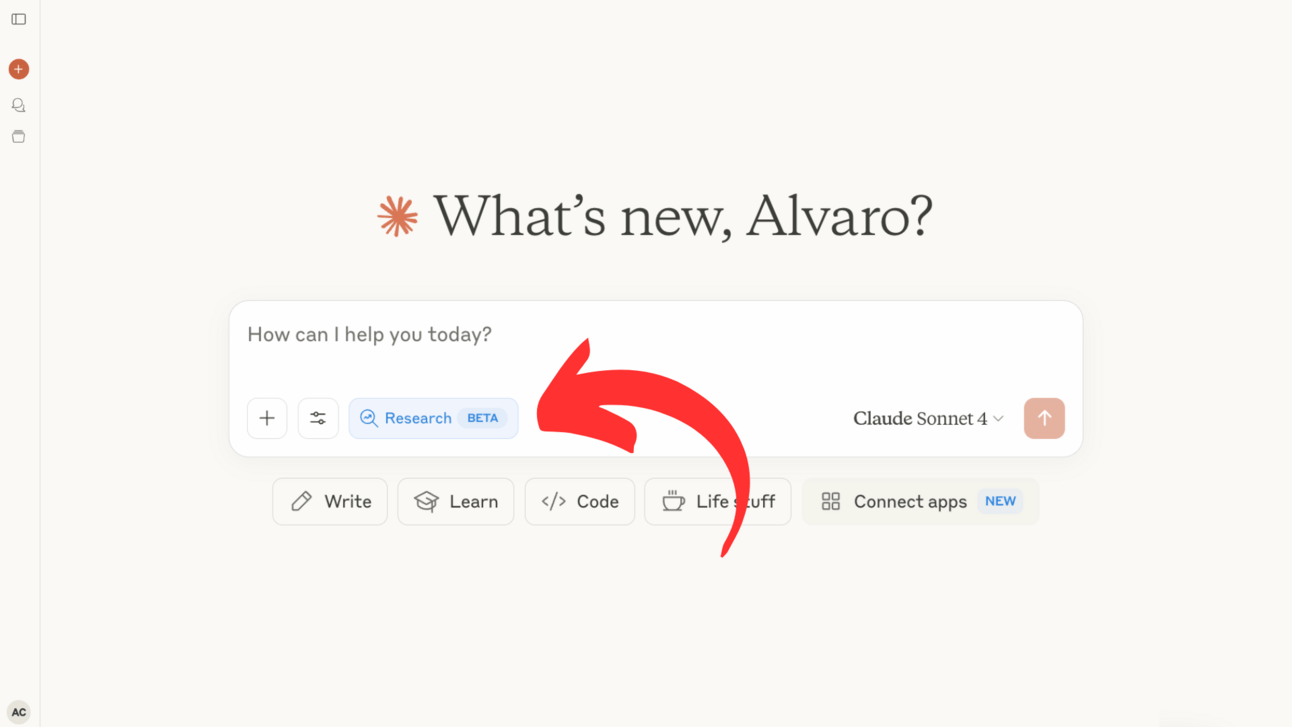
The Rundown: In this tutorial, you will learn how to use Claude's Research mode to automatically create research plans, gather data from hundreds of sources, and generate downloadable PDF reports for complete market analysis.
Step-by-step:
Head over to Claude and select the Research button
Create a comprehensive prompt: “Research the [industry] market landscape, analyze top 5 competitors, investigate pricing strategies, partnerships, and identify 3 key opportunities”
Watch Research mode automatically gather data from 50+ authoritative sources and generate a detailed report
Download your complete research as a PDF or Markdown
Pro tip: The more comprehensive your initial prompt, the better the automated research plan and final report will be.
PRESENTED BY AIRIA
💼 The AI Platform for Enterprises

The Rundown: Airia is an enterprise platform that simplifies the creation, orchestration, and deployment of AI agents—so businesses can automate workflows, integrate systems, and unlock real value from AI without the complexity.
Airia allows you to:
Seamlessly route between any model or system and connect to 50+ enterprise tools
Build AI agents fast with a no-code builder to design and launch in minutes
Enterprise-grade control to enforce policies, manage spend, and stay compliant
BYTEDANCE
🎥 ByteDance’s new video AI climbs leaderboards

Image source: ByteDance
The Rundown: ByteDance just released Seedance 1.0, a new video generation model that ranks first on benchmarks for both text-to-video and image-to-video tasks, outperforming SOTA options from Google, Kuaishou, and OpenAI.
The details:
Seedance 1.0 moves to the top of the Artificial Analysis video leaderboards, moving ahead of top models including Veo 3, Kling 2.0, and Sora.
The model generates 5-second, 1080p videos in 40 under a minute, with multi-shot storytelling, character consistency, and smooth transitions.
Bytedance also created SeedVideoBench, a benchmark that shows its model ahead of competitors in motion quality, prompt adherence, and aesthetics.
The company plans to fold Seedance into its Doubao chatbot and video platform Jimeng later this year.
Why it matters: Despite the impressiveness of Veo 3, it’s already been surpassed on the leaderboard — with Chinese labs continuing to push the frontier for AI video models. But with Google’s Veo 3 viral audio capabilities setting a new expectation for consumers, it makes it hard to go back to still “silent” models.
QUICK HITS
🛠️ Trending AI Tools
🌐 Dia - The Browser Company’s new AI-first web browser
🎥 Meta AI - New video editing capabilities for short-form content
🏄 Windsurf Browser - Integrated with coding assistant for in-context support
💬 Manus Chat Mode - Free, unlimited AI chat with instant answers
📰 Everything else in AI today
Bytedance researchers introduced Seaweed APT2, a new model for real-time, interactive video generations — able to stream 24 fps videos at up to 5 minutes long.
Microsoft rolled out Copilot Vision with highlights in the U.S., allowing the assistant to see users’ screens and provide in-context insights and guidance.
Google DeepMind launched Weather Lab, an interactive platform showcasing its AI-powered weather forecasts for early, accurate predictions of storm paths and intensity.
Apple is reportedly targeting Spring 2026 for its AI-powered upgrades to Siri, which would come almost two years after its introduction at WWDC 2024.
Runway released Chat Mode, a new conversational interface to create images, videos, and more using natural language.
AMD introduced its next-gen Instinct MI400 chips in a presentation alongside OpenAI CEO Sam Altman, positioning itself as a lower-cost alternative to Nvidia.
Los Alamos, Meta, and Berkeley Lab released Open Molecules 2025 with 100M+ molecular simulations for training AI for chemistry, drug discovery, and more.
COMMUNITY
🎥 Join our next live workshop

Join our next workshop today at 4 PM EST with Dr. Alvaro Cintas, The Rundown’s AI professor. By the end of the workshop, you’ll know how to get significantly more value out of whichever model you use, whether it’s o3 or o3-Pro.
RSVP here. Not a member? Join The Rundown University on a 14-day free trial.
See you soon,
Rowan, Joey, Zach, Alvaro, and Jason—The Rundown’s editorial team
No matching search results
Try using different keywords, double-check your spelling, or explore related categories.
Stay Ahead on AI.
Join 2,000,000+ readers getting bite-size AI news updates straight to their inbox every morning with The Rundown AI newsletter. It's 100% free.