Get the latest AI news, understand why it matters, and learn how to apply it in your work — all in just 5 minutes a day. Join over 2,000,000+ subscribers.

DeepMind turns AI on DNA
Read Online | Sign Up | Advertise

Good morning, AI enthusiasts. Google DeepMind just compressed decades of genetic research into a four-hour training run, and the result could change our understanding of disease.
With the new AlphaGenome model quickly predicting mutation effects across 1M-letter DNA sequences on GPUs instead of in the lab, the ability to pinpoint diseases at their genetic source is suddenly within reach.
In today’s AI rundown:
DeepMind’s AlphaGenome for DNA analysis
Google drops open-source Gemini CLI
Build your AI assistant with automated workflows
Anthropic adds app-building capabilities to Claude
4 new AI tools & 4 job opportunities
LATEST DEVELOPMENTS
GOOGLE DEEPMIND
🧬 DeepMind’s AlphaGenome for DNA analysis

Image source: Google DeepMind
The Rundown: Google DeepMind just released AlphaGenome, a new AI model that predicts how DNA mutations affect thousands of molecular processes by analyzing sequences up to 1M base-pairs long.
The details:
The model reads DNA stretches 100x longer than older tools, predicting how nearby genes will behave and how other regulatory regions function.
The release unifies thousands of molecular predictions into one tool, while still beating out most specialized models across a range of genomic benchmarks.
Researchers tested it on leukemia patients, helping identify how specific mutations switched on cancer-causing genes that should have stayed silent.
DeepMind trained the entire system in just four hours using public genetic databases, consuming half the computing power of their previous DNA model.
Why it matters: AlphaGenome moves complex biological research from the lab to the computer, letting scientists test genetic hypotheses at an unprecedented scale. While not a crystal ball for personal health, it gives researchers a powerful first guess, dramatically speeding up the search for mutations and variants that cause disease.
TOGETHER WITH SANA
🤖 Meet your AI operating system

The Rundown: Sana Agents is where teams go to work with AI. Co-create flawless reports, decks, and dashboards — automatically built from your live company data.
With Sana Agents, you can:
Work inside one hub that merges search, notes, canvases, workflows, and agents.
Hand off docs, slides, sheets, and tickets to AI that drafts and updates them end-to-end
Get precise answers grounded in your data and wrapped in enterprise-grade security
⚙️ Google drops open-source Gemini CLI

Image source: Google
The Rundown: Google just released Gemini CLI, a new open-source terminal agent that brings Gemini 2.5 Pro directly to developers' command lines with high free usage limits.
The details:
Developers get 60 requests per minute and 1,000 daily queries at no charge, limits that Google set after doubling its own internal usage patterns.
The Apache 2.0 licensed tool supports Model Context Protocol, bundled extensions, and custom GEMINI.md files for project-specific configurations.
Other built-in capabilities include Google Search grounding, file manipulation, command execution, and Imagen/Veo integration for multimedia generations.
CLI is integrated directly with Code Assist, leveraging Gemini 2.5 Pro and its 1M context window — currently the highest ranked model on the WebDev Arena.
Why it matters: The battle for AI developer adoption just got even more competitive, with Google weaponizing free access against OpenAI and Anthropic’s paid competitors. With generous limits and the open-source move addressing enterprise security concerns, Google hopes to shift dev workflows entirely into its ecosystem.
AI TRAINING
🤖 Build your AI assistant with automated workflows

The Rundown: In this tutorial, you will learn how to create a personal AI assistant that can draft emails, manage tasks, and handle requests using n8n's ability to connect AI models with your favorite apps.
Step-by-step:
Head over to n8n and create a new workflow with a chat trigger
Add an AI Agent with your preferred model (GPT-4, Claude) and a Simple Memory
Connect your apps (Gmail, Calendar, Slack) and set parameters to “define automatically by the model”
Add custom instructions: “You are a helpful assistant with access to email and calendar tools. Use them when users make requests.”
Pro tip: Start with email drafting and calendar management, then expand to document creation and data analysis as you get comfortable.
PRESENTED BY IBM
📊 Data solutions to AI problems

The Rundown: IBM understands the challenges your organization faces in getting data ready for AI, and the company’s new “Data Matters” chapter breaks down how to turn scattered, messy information into high-octane fuel for models.
Inside, you’ll discover how to:
Turn structured & unstructured data from a variety of sources into high-quality data for AI
Overcome barriers to data preparedness
Create a consistent methodology to assess the quality of your data
ANTHROPIC
🚀 Anthropic adds app-building capabilities to Claude

Image source: Anthropic
The Rundown: Anthropic upgraded Claude with new app-building capabilities, allowing any user to create, host, and share interactive AI-powered apps directly from simple text prompts via its “Artifacts” workspaces.
The details:
Users can now build functional tools like data analyzers or study aids simply by describing their idea, with Claude handling the writing of all underlying code.
The platform shifts costs to end users who sign in with Claude credentials, eliminating the need for creators to manage API keys or pay for others' usage.
Free tier users can create and share apps while Pro ($20/month) and Team ($25-30/month) subscribers unlock advanced features and higher usage limits.
Anthropic said over 500M artifacts have been created since launch last August, now with a dedicated space on the platform for better organization.
Why it matters: While Claude’s models are still highly preferred by developers for coding tasks, Anthropic’s Artifacts also help continue the vibe coding push — with smooth UI and ecosystem upgrades that push users to keep building naturally regardless of developer experience.
QUICK HITS
🛠️ Trending AI Tools
🗣️ ElevenLabs App - Powerful AI voice tools, now available on mobile
✈️ Airtable AI - Build enterprise apps that automate and manage operations
🤖 Gemini Robotics - VLA model that works locally on robots, without internet
🛡️ XBOW - Boost offensive security with autonomous AI
💼 AI Job Opportunities
🎨 The Rundown - Designer (Brand & Platform)
🛡️ Horizon3 - Senior Product Manager
🗣️ Rad AI - Senior ML Research Scientist
💼 Perplexity AI - Finance Manager
📰 Everything else in AI today
Postman launched a new AI-Readiness Hub with a 90-day plan and dev toolkit to help make your APIs agent-ready.*
Higgsfield AI released Soul, a new “high-aesthetic” photo model with advanced realism and 50+ presets for easy style optimization.
Creative Commons unveiled CC Signals, a new opt-in metadata system for dataset owners to spell out exactly how AI models may reuse their work.
ElevenLabs introduced Voice Design v3, featuring new upgrades for more expressive voice outputs and support for over 70 languages with accurate accents.
OpenAI released new Connectors for Pro ChatGPT accounts, giving users the ability to integrate data from tools including Google Drive, Dropbox, SharePoint, and Box.
Getty dropped its lawsuit against Stability AI that accused the company of copyright theft, following a “fair use” ruling in a separate case by authors against Anthropic.
Amazon announced new AI features for its Ring home security systems, including AI-generated video descriptions that provide users with real-time text updates.
*Sponsored Listing
COMMUNITY
🎥 Join our next live workshop

Join our next workshop this Friday, June 27th, at 4 PM EST with Dr. Alvaro Cintas, The Rundown’s AI professor. By the end of the workshop, you’ll be able to confidently build and run your own automation agents using n8n.
RSVP here. Not a member? Join The Rundown University on a 14-day free trial.
See you soon,
Rowan, Joey, Zach, Alvaro, and Jason—The Rundown’s editorial team

AI training gets legal clarity
Read Online | Sign Up | Advertise

Good morning, AI enthusiasts. AI’s fair use debate just got its first major answer — and it’s both a win and a warning for AI companies.
With a judge green-lighting Anthropic’s use of legally purchased data but slamming them for using over 7M pirated books, the split decision might be a strong (but costly) precedent for AI’s legal woes.
Reminder: Our next live workshop is today at 3 PM EST — join and learn how to build production-grade AI agents that combine context, reasoning, and actions with Gumloop. RSVP here.
In today’s AI rundown:
Anthropic scores win over AI ‘fair use’ claim
OpenAI’s Workspace, Office competitor
How to automate content strategy with scheduled tasks
LinkedIn co-founder bets on AI ultrasound helmet
4 new AI tools & 4 job opportunities
LATEST DEVELOPMENTS
ANTHROPIC
📚 Anthropic scores win over AI ‘fair use’ claim

Image source: Reve / The Rundown
The Rundown: A federal judge just ruled that Anthropic's AI training on legally purchased books qualifies as fair use, but rejected any defense for 7M pirated copies in its digital library in the company’s class action lawsuit filed by a group of authors.
The details:
The judge called AI training "spectacularly" transformative, comparing Claude to aspiring writers learning from established authors rather than copying them.
The authors failed to demonstrate that Claude could generate outputs resembling their original works, weakening core claims about competitive harm.
The filings revealed that Anthropic legally spent “many millions” to purchase print books, scanning them into digital files for use in AI training.
However, Anthropic also downloaded millions of books from pirate sites, storing them permanently, which the court said violated authors’ rights.
The company will face trial in December for willful infringement of the pirated works, with potential damages potentially reaching $150,000 per book.
Why it matters: AI labs get a green light to train on legally obtained data, which could provide one of the first precedents for countless cases currently levied against tech companies. However, given the lack of clarity around how many copyrighted materials get into training data, this is still just one battle in what looks like a very long legal war.
TOGETHER WITH H COMPANY
🤖 The AI agent that completes tasks for you

The Rundown: Backed by a historic $220M seed round, H Company just released their flagship Runner H AI agent that lets you automate entire tasks in a few seconds — now available in beta.
Some examples of tasks you can delegate to Runner H:
Reading your important emails and drafting (or even sending!) replies
Creating a Google Sheets with trending ad ideas and sharing it with your team on Slack
Finding job opportunities and applying for you
Offload some work to Runner H today — try it now for free.
OPENAI
📊 OpenAI’s Workspace, Office competitor

Image source: o3 / The Rundown
The Rundown: OpenAI is reportedly building productivity tools for ChatGPT that mirror Google Workspace and Microsoft Office — with features like real-time document collaboration and multi-user chat.
The details:
OpenAI CPO Kevin Weil reportedly first showcased collaboration designs last year, though development stalled until the Canvas interface launch in October.
The Information reports that OpenAI has built but has yet to release multiuser chat, allowing teams to communicate about shared work directly in ChatGPT.
OpenAI also recently rolled out a record mode for transcriptions, file uploads to Projects, and connectors to pull data from Teams, Drive, and DropBox.
Business subscriptions generated $600M in 2024, with OpenAI projecting $15B by 2030, with increased revenue coming from enterprise subscriptions.
Why it matters: Sam Altman warned last year that OpenAI would “steamroll” most AI startups… But he might also have his biggest partner in the crosshairs. ChatGPT’s productivity push is about to step right on Microsoft’s legacy software — and given the icy current relationship, the renegotiation may get even more contentious.
AI TRAINING
🤖 How to automate your content strategy with scheduled tasks

The Rundown: In this tutorial, you’ll learn how to use Grok’s new Tasks feature to schedule automated content research and trend analysis — running silently in the background and notifying you once it's done.
Step-by-step:
Visit Grok and navigate to the “Tasks” section
Click “Add new” and create your first task: “Weekly Content Trends Analysis” scheduled for Sundays
Use this prompt: “Analyze trending topics in [your niche] from the past week. Identify 5 content opportunities with content format recommendations”
Create additional tasks such as viral content analysis, or monthly market research (up to 10 total tasks)
Pro tip: Enable DeepSearch for better results. When tasks are complete, review notifications and refine prompts based on results quality.
PRESENTED BY IBM
🎙️Transforming HR with agentic AI

The Rundown: Curious about agentic AI in HR? Steve Moss, Director of watsonx Americas at IBM, discusses HR, agentic AI, and the real-world impact of IBM’s transformation journey in the latest episode of the AI in Action podcast.
Dive into the details of how IBM has:
Used agentic AI and consolidated various HR tools into a single interface
Improved employee experience and operational efficiency
Driven strategic shifts, boosted productivity, and scaled teams effectively
AI & NEUROTECHNOLOGY
🧠 LinkedIn co-founder bets on AI ultrasound helmet

Image source: o3 / The Rundown
The Rundown: LinkedIn co-founder and OpenAI investor Reid Hoffman just led a $12M funding round for Sanmai Technologies, which is developing AI-guided ultrasound devices for treating mental health conditions without surgery.
The details:
Sanmai’s consumer devices focus ultrasound waves on specific brain regions to treat anxiety, depression, and enhance cognitive function.
The startup combines the ultrasound tech with AI coaching systems into a helmet at a sub-$500 price point, targeting consumers’ in-home use.
Hoffman joined Sanmai's board through his Aphorism Foundation, saying non-invasive approaches are “much less risky” than tech like Neuralink.
The company is currently testing anxiety treatments with a prototype at its Sunnyvale facility ahead of FDA trials.
Why it matters: Tech billionaires like Elon Musk, Jeff Bezos, Bill Gates, and now Reid Hoffman are all funding brain-tech startups. With an AI coach guiding treatments and a non-invasive approach, the start of the neurotech wave may end up being a lighter touch that is easier to swallow for consumers than a full brain-computer interface.
QUICK HITS
🛠️ Trending AI Tools
💰 Taka - Your AI Personal CFO: Ask any personal finance question. Make confident decisions with a self-building canvas tailored to you*
🗣️ 11ai - ElevenLabs’ new voice assistant with MCP integrations
💻 Mu - Microsoft’s fast, local AI for Windows Copilot + PCs
🎆 Imagen 4 Ultra - Google’s top image model, available via API & AI Studio
*Sponsored Listing
💼 AI Job Opportunities
🔁 The Rundown - Strategic Partnerships (AI University)
🤝 OpenAI - Program Manager, M&A Recruiting
🖥️ Together AI - Senior Systems Administrator
📦 Groq - Senior Program Manager
📰 Everything else in AI today
SimilarWeb data shows ChatGPT downloads on iOS hit 29M+ over the last 28 days, nearly surpassing downloads of TikTok, Facebook, and Instagram (33M) combined.
Sam Altman said that the ‘io’ lawsuit is “silly, disappointing and wrong", saying that founder Jason Rugolo made persistent attempts to get acquired by OpenAI.
Mira Murati’s Thinking Machines Lab is planning to develop custom AI models to help businesses increase profits, according to a new report from The Information.
Google released Gemini Robotics On-Device, a new VLA model that powers robotics dexterity and task completion without needing an internet connection.
Databricks & Perplexity co-founder Andy Konwinski launched the Laude Institute, pledging $100M to fast-track computer science breakthroughs for real-world impact.
XBOW revealed that its autonomous AI became the first to surpass all humans on the HackerOne platform, also announcing a new $75M Series B funding round.
COMMUNITY
🎥 Join our next live workshop

Join our next workshop today at 3 PM EST with Max Brodeur-Urbas, Founder & CEO at Gumloop. By the end of the workshop, you’ll know how to build production-grade AI agents that combine context, reasoning, and actions with Gumloop.
RSVP here. Not a member? Join The Rundown University on a 14-day free trial.
See you soon,
Rowan, Joey, Zach, Alvaro, and Jason — The Rundown’s editorial team

Giant camera snaps space in HD
Read Online | Sign Up | Advertise

Good morning, tech enthusiasts. The Vera Rubin Observatory has just released its first cosmic images—captured by a digital camera so powerful it can spot a golf ball from 15 miles away.
Over the next decade, this observatory will scan the night sky repeatedly, uncovering hidden asteroids and distant galaxies. The question is: What new cosmic secrets might unfold when we view the universe in Ultra-HD?
In today’s tech rundown:
World’s largest camera reveals deep space
Murati’s Thinking Machines Lab nabs $2B
China on the verge of ‘100 Deepseeks’
Tesla robotaxis hit regulatory speed bump
Quick hits on other major tech news
LATEST DEVELOPMENTS
SPACE TECH
🔭 World’s largest camera reveals deep space

Image source: Vera C. Rubin Observatory
The Rundown: The Vera C. Rubin Observatory, perched on Chile’s Cerro Pachón, just unveiled the first images from its Legacy Survey of Space and Time (LSST) camera — the world’s largest digital camera, with a staggering 3,200-megapixel sensor.
The details:
These initial shots, generated from a mosaic of 678 exposures during a brief test run, showed millions of galaxies, stars, and unknown asteroids.
The LSST camera, roughly the size of a small car, is a marvel of modern engineering, designed to capture more detail than any previous telescope.
Its ultra-wide lens can capture an area 45 times the size of the full moon in a single exposure.
The LSST will run for 10 years, repeatedly photographing the entire southern sky every three to four nights, creating a time-lapse view of the cosmos.
Why it matters: Researchers now will be able to track everything from near-Earth asteroids to supernovae and the movements of dark matter — without the usual bottleneck of telescope time applications. As the observatory ramps up, the sheer volume and quality of its data promise to transform our understanding of the universe.
THINKING MACHINES LAB
💰 Murati’s Thinking Machines Lab nabs $2B

Image source: Atomico/YouTube
The Rundown: Thinking Machines Lab — the secretive startup founded by OpenAI’s former CTO Mira Murati — just raised a staggering $2B at a $10B valuation, marking what may be the largest seed-stage funding ever recorded.
The details:
The round was led by heavyweight VCs Andreessen Horowitz, with participation from Conviction Partners and other top-tier firms.
Murati, who led the development of ChatGPT and DALL-E, heads a team of about 30 engineers, nearly two-thirds of whom are former OpenAI employees.
With no public product yet, Thinking Machines Lab is banking on the reputation and vision of its star team to attract capital and talent.
The startup aims to solve “black box” AI issues, prioritizing transparency and user control, a departure from opaque models that dominate the field.
Why it matters: For now, the startup’s astronomical valuation is less about what it’s built than what it might build — a bet that this team, with its track record of delivering groundbreaking AI, can once again redefine the field. In a sector where talent is king, Thinking Machines Lab looks to be a major player in AI’s next evolution.
CHINA AI
🤯 China on the verge of ‘100 DeepSeeks’

Image source: DeepSeek
The Rundown: China is on the verge of a major AI boom, with a former top official predicting that the country will see more than 100 DeepSeek-like AI breakthroughs within the next 18 months, according to Bloomberg.
The details:
Zhu Min, previously a deputy governor of the People’s Bank of China, made these remarks during the World Economic Forum in Tianjin.
He emphasized that these new software innovations “will fundamentally change the nature and the tech nature of the whole Chinese economy.”
The forecast is driven by China’s deep reservoir of engineering expertise, its enormous consumer market, and massive government investments in tech.
DeepSeek has become a poster child for Chinese AI ingenuity, offering models that rival OpenAI’s best at a fraction of the price.
Why it matters: As Zhu’s prediction suggests, DeepSeek is just the beginning — if he’s right, we’re on the verge of a tidal wave of AI innovation from China. And this is all after semiconductor sanctions from the U.S., which are forcing them to operate at lower costs and under tight constraints.
TESLA
🚕 Tesla’s robotaxis hit regulatory speed bump

Image source: Tesla
The Rundown: Just days after Tesla launched its robotaxi service in Austin, the U.S. National Highway Traffic Safety Administration (NHTSA) is reportedly investigating them over viral videos showing the vehicles behaving erratically on public roads.
The details:
Tesla just launched a limited rollout with 10 to 20 Model Ys equipped with the company’s latest FSD Unsupervised software and hardware.
Social media clips captured the robotaxis making erratic maneuvers, including entering oncoming traffic and stopping abruptly in the middle of roads.
NHTSA confirmed it is “aware of the referenced incidents and is in contact with the manufacturer to gather additional information.”
The launch — which includes a human valet in the front passenger seat ready to intervene if needed — sparked an 8% spike in Tesla’s share price.
Why it matters: Tesla’s robotaxi launch arrives amid intense regulatory scrutiny, with the NHTSA already probing its Full Self-Driving tech after several serious crashes. For now, Waymo maintains a clear lead in the space, operating a large commercial fleet with over 250K weekly rides across multiple cities and a proven safety record.
QUICK HITS
📰 Everything else in tech today
New York Governor Kathy Hochul announced plans to build a zero-emission nuclear power plant in the state to meet the demands of AI and semiconductor production.
The UK government plans to allocate more than £500M to boost domestic quantum-computing research, according to the Financial Times.
Tesla said it has invested about $44B in U.S. manufacturing and infrastructure since its founding, with roughly $10B of that total deployed in the last fiscal year alone.
Andy Konwinski, co-founder of Databricks and Perplexity, is forming a new AI research institute backed by $100M of his personal funds through his company Laude.
SoftBank founder Masayoshi Son is reportedly in discussions to set up a $1T industrial complex in Arizona that will build robots and AI.
Midjourney launched its first AI video model just a week after Disney and NBCUniversal filed a copyright-infringement lawsuit against the startup.
Cluely, the startup that promises to help users “cheat on everything,” announced a $15M Series A funding round led by Andreessen Horowitz.
An MIT study shows that overusing AI tools such as ChatGPT can erode memory and reduce critical thinking abilities.
AI design software company Canva is organizing a $400–500M secondary share sale at a $37B valuation, according to The Information.
Honda's research subsidiary successfully tested a reusable rocket in Japan, achieving its first landing after going up to 890 ft.
Legal AI company Harvey raised $300M at a $5B valuation, counting top law firms like Paul, Weiss, and major corporate legal departments among its clients.
COMMUNITY
🎥 Join our next live workshop

Join our next workshop on Wednesday, June 25th at 3 PM EST with Max Brodeur-Urbas, Founder & CEO at Gumloop. By the end of the workshop, you’ll know how to build production-grade AI agents that combine context, reasoning, and actions with Gumloop.
RSVP here. Not a member? Join The Rundown University on a 14-day free trial.
See you soon,
Rowan, Jennifer, and Joey—The Rundown’s editorial team

OpenAI's hardware hits legal roadblock
Read Online | Sign Up | Advertise

Good morning, AI enthusiasts. Jony Ive and Sam Altman’s recent ‘io’ hardware partnership just got scrubbed from the internet — courtesy of a court order from a startup claiming the AI giant stole more than just a name.
With Google X spinoff iyO alleging suspicious meetings and an eerily similar concept, is the power duo’s hyped AI device more imitation than innovation?
In today’s AI rundown:
OpenAI scrubs 'io' over trademark clash
ElevenLabs debuts new voice assistant
How to optimize prompts for better AI output
Reddit eyes Altman’s World ID for human verification
4 new AI tools & 4 job opportunities
LATEST DEVELOPMENTS
OPENAI
⚖️ OpenAI scrubs 'io' over trademark clash

Image source: iyO
The Rundown: OpenAI just removed all promotional materials for its $6.5B acquisition of Jony Ive's AI hardware startup, io, reportedly due to a court order tied to a trademark dispute with Google X spinout iyO.
The details:
iyO creates hardware that “allows users to interact with their smartphones, computers, AI, and the internet without the use of physical interfaces.”
The startup’s latest product is the iyO One AI-powered earbuds, a “computer without a screen” that can run apps via voice and converse with the user.
The filing alleges that Sam Altman and Ive’s LoveFrom met with iyO initially in 2022 and again in Spring 2025 just before the io announcement.
OpenAI removed the blog post and nine-minute video featuring Ive and Altman from its website and YouTube channels following the legal action.
However, the company maintains that the acquisition remains on track, calling the trademark complaint "utterly baseless."
Why it matters: While this is unlikely to derail OpenAI and Jony Ive’s hardware plans, the alleged details in the filing — from LoveFrom employees purchasing the device and directly asking to share details to the nearly identical name itself — certainly don’t paint the same picture of innovation the AI leader has created thus far around io.
TOGETHER WITH HUBSPOT
💰 Turn AI into your income engine
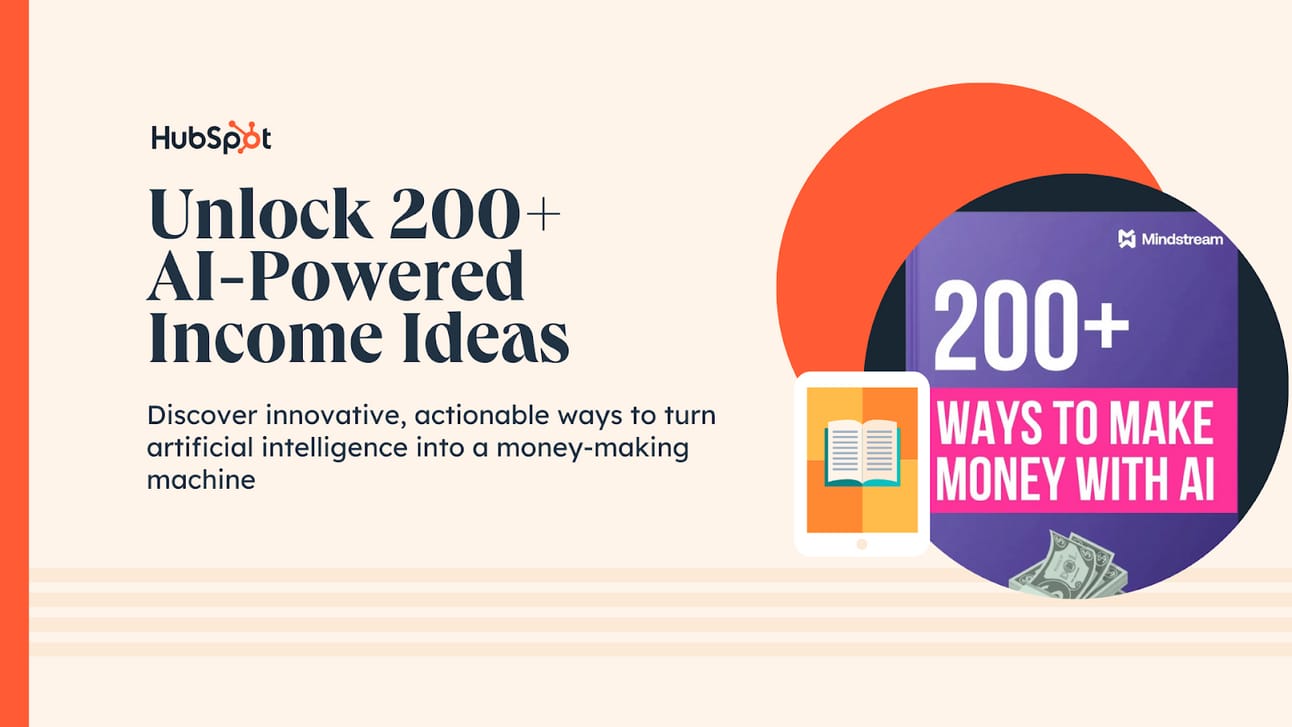
The Rundown: HubSpot’s new “200+ AI-Powered Income Ideas” free guide offers actionable strategies to turn artificial intelligence into your own personal revenue generator — unlocking a gateway to financial innovation in the digital age.
With this guide, you can:
Explore hundreds of revenue-generating ideas across industries with real-world applications
Follow simple, step-by-step instructions that make AI accessible to everyone
Adopt cutting-edge strategies to keep you ahead in today's fast-paced market
ELEVENLABS
🗣️ElevenLabs debuts new voice assistant

Image source: ElevenLabs
The Rundown: AI voice platform ElevenLabs just launched 11ai, an in-house voice assistant that connects to tools via Anthropic’s Model Context Protocol to execute tasks rather than just answer questions.
The details:
The experimental alpha release integrates with platforms like Perplexity, Linear, Slack, and Notion, allowing users to manage tasks through voice commands.
Developers can also add custom MCP servers for additional integrations and workflows beyond the pre-built connections.
The platform offers 5,000+ voice options and supports voice cloning, running on ElevenLabs’ own conversational AI infrastructure.
11ai is free to use and try for “several weeks,” allowing the company to gather feedback on the product and integrations.
Why it matters: ElevenLabs already has some of the strongest speech models on the market, and pairing them with MCP for tools, data access, and actions could showcase how voice assistants can actually be more useful than Siri and other outdated assistants may have led consumers to believe.
AI TRAINING
🔧 How to optimize prompts for better AI output

The Rundown: In this tutorial, you will learn how to use OpenAI Playground’s new automatic prompt optimization tool to transform basic prompts into high-performance system messages for more effective AI interactions.
Step-by-step:
Go to OpenAI Playground and access the Prompts section
Write your basic system message describing what you want the AI to do
Click the “Optimize” button to automatically improve your prompt with better structure and clarity
Review it and then “Save” it with a descriptive name to reuse in projects and API calls
Pro tip: Test optimized prompts with various inputs to ensure consistent performance across different use cases.
PRESENTED BY BASETEN
⚙️ Fine-tune without limits

The Rundown: Baseten just launched Training in beta, providing the infrastructure to fine-tune and train without timeout limits using any model or dataset. Bring your scripts and data, Baseten will handle the rest.
What you get with Training:
On-demand compute — pay only for what you use
No job limits or vendor lock-in
Out-of-the-box checkpoints and caching
👁️ Reddit eyes Altman’s World ID for human verification

Image source: o3 / The Rundown
The Rundown: Reddit is reportedly negotiating with Sam Altman’s Tools For Humanity to integrate the company’s iris-scanning World ID Orb system, allowing users to provide proof of humanity while staying anonymous.
The details:
The system would offer Reddit users optional verification through World ID’s encrypted iris scans, which fragment biometric data across servers worldwide.
CEO Steve Huffman hinted at the shift last month, posting on efforts to preserve anonymity while deterring the flood of AI accounts on the platform.
World ID assigns users cryptographic proof without storing personal data, though minors under 18 are currently blocked from the Orb scanning process.
The partnership would position Reddit as the first major U.S. social platform to test biometric verification at scale aside from simple email checks.
Why it matters: The “Dead Internet” theory of the web becoming overrun with AI bots is a real concern — and something already being experienced across social media platforms. While World’s Iris scanning initiatives were initially met with tons of skepticism and anger, the need for human verification is going to be very real.
QUICK HITS
🛠️ Trending AI Tools
⚡ Deepgram Voice Agent API - Build production-ready voice agents with a unified speech-to-speech API*
📖 Kimi-Researcher - Moonshot AI’s new SOTA research agent
🗣️ Voice Design - MiniMax’s customizable, multilingual voice generator
🤏 Mistral Small 3.2 - Updated with better instruction following, fewer errors
*Sponsored Listing
💼 AI Job Opportunities
📞 The Rundown - Account Manager
🌍 Cresta - Product Manager
🔬 Anthropic - Research Manager
⚖️ OpenAI - Product Counsel
📰 Everything else in AI today
Disney has been in talks with “companies like OpenAI” to license its characters and IP, but its lawsuit against Midjourney “likely won’t be the last” against AI firms.
A U.S. official claimed DeepSeek is working with the Chinese government on military and intelligence ops, while using workarounds to access advanced AI chips.
Google released Magenta RealTime, an open live music AI and “cousin” of its Lyria model, allowing users to create/blend music live and locally on consumer hardware.
Meta also met with Runway for a potential acquisition, in addition to reported meetings with SSI, Thinking Machines, and Perplexity, though a deal never materialized.
Softbank CEO Masayoshi Son is reportedly pitching a “Crystal Land” $1B megahub for AI and robotics manufacturing in Arizona, courting TSMC and Samsung.
Microsoft debuted Mu, a new small language model that powers agentic capabilities in Settings for on-device use on Windows Copilot + PCs.
COMMUNITY
🎥 Join our next live workshop
Join our next workshop on Wednesday, June 25th at 3 PM EST with Max Brodeur-Urbas, Founder & CEO at Gumloop. By the end of the workshop, you’ll know how to build production-grade AI agents that combine context, reasoning, and actions with Gumloop.
RSVP here. Not a member? Join The Rundown University on a 14-day free trial.
See you soon,
Rowan, Joey, Zach, Alvaro, and Jason—The Rundown’s editorial team

New robot skin that 'feels' pain
Read Online | Sign Up | Advertise

Good morning, robotics enthusiasts. UK researchers have engineered an artificial skin that’s soft, flexible, and doesn’t rely on embedded sensors.
This skin can ‘feel’ pressure, heat, and even pain across its entire surface. The result? A leap toward robots and prosthetics that can respond to their environment more like we do.
In today’s robotics rundown:
New artificial robot skin can ‘feel’ pain
Softbank eyes $1T robotics complex in Arizona
Germany’s Neura to raise $1.15B for humanoids
China’s mosquito-sized drone for military
Quick hits on other robotics news
LATEST DEVELOPMENTS
UNIVERSITY OF CAMBRIDGE
👉🏼 New artificial robot skin can ‘feel’ pain

Image source: University of Cambridge
The Rundown: University of Cambridge and University College London researchers just developed a stretchy artificial skin that allows robots to detect pressure, temperature, and maybe even pain.
The details:
This next-gen skin is made from gelatin-based hydrogel that’s soft, stretchy, and electrically conductive, allowing it to transmit signals across its surface.
Just 32 electrodes are embedded at the wrist, enabling the skin to capture over 1.7M data points across its surface.
The skin can sense pressure, shear forces, temperature, and even damage (like cuts or burns), all with a single, unified material.
The team is using advanced AI to interpret this flood of sensory information, allowing the skin to distinguish between different types of touch in real time.
Why it matters: Traditional sensor arrays might be pricey and fragile, but this new hydrogel skin is built to flex, stretch, and take a beating — all while costing less to produce. Its rugged resilience and adaptability might unlock new frontiers in lifelike robotics, next-gen prosthetics, and smarter, safer factories.
SOFTBANK
🤑 SoftBank eyes $1T robotics complex in Arizona

Image source: Softbank
The Rundown: SoftBank founder Masayoshi Son is reportedly planning to fund a $1T industrial complex in Arizona. Dubbed “Project Crystal Land,” it aims to replicate the scale of China’s Shenzhen, but with a laser focus on next-gen robotics and AI.
The details:
The complex is planned as a self-contained ecosystem with semiconductor fabs, robotics R&D labs, logistics hubs, and even residential zones for workers.
The project is designed to emulate the success of Shenzhen, renowned for its dense network of manufacturers, suppliers, and innovators.
Central to the project is to build production lines for industrial robots, drawing on the expertise of major chipmakers and tech giants — most notably TSMC.
A $1T commitment would represent twice the investment of the $500B “Stargate” project, backed by SoftBank, OpenAI, and Oracle.
Why it matters: If realized, the project promises to boost high-end robotics manufacturing on U.S. soil but also foster a vibrant innovation environment where startups and established firms collaborate to push the boundaries of what robots can achieve — all while positioning Arizona as a new epicenter for global robotics.
NEURA ROBOTICS
🔥 Germany’s Neura to raise $1.15B for humanoids

Image source: Neura Robotics
The Rundown: German startup Neura Robotics reportedly aims to secure up to €1B ($1.15B) in fresh funding as it gears up to launch its next-generation humanoid robot, the 4NE-1, designed to take on established players like Tesla, 1X, and Figure.
The details:
According to Bloomberg, the Metzingen-based company is actively courting investors to fuel its entry into the fiercely competitive bipedal robotics market.
Neura’s vision is to create robots capable of lifting heavy objects and automating repetitive tasks, positioning itself as a European leader.
The startup has an order book valued at €1B and more than 300 employees, and is riding a wave of momentum after a recent €120M Series B round.
Neura Robotics is also collaborating with major tech firms, including Nvidia for its robotics tools, and has secured orders with Kawasaki and Omron.
Why it matters: Neura Robotics, which achieved a 10x revenue increase in the past year, is positioning itself as a major contender in the global humanoid sector — a market currently dominated by well-funded competitors from the U.S. and Asia. It has already launched its cobot MAiRA, with the 4NE-1 in the works.
MICRODRONES
🦟 China’s mosquito-sized drone for military

Image source: Ideogram/The Rundown
The Rundown: A robotics lab at China’s National University of Defense Technology (NUDT) in Hunan just unveiled a mosquito-sized drone — designed specifically for covert military missions — on national television.
The details:
This microdrone measures just 1.3 cm in length and features two tiny, leaf-like wings and three ultra-thin “legs” for perching or landing.
Researchers showed that it can be controlled via smartphone, highlighting its ease of deployment and advanced remote operation capabilities.
The device is specifically engineered for reconnaissance and special missions, making it a potentially powerful tool for intelligence gathering and surveillance.
NUDT also showcased various robotic innovations, including humanoids and other miniature drones, on CCTV 7’s military channel.
Why it matters: Like Harvard’s RoboBee and Norway’s Black Hornet, China’s version takes miniaturization to the extreme and is nearly undetectable — making it ideal for military operations, search and rescue, and electronic surveillance. Of course, drones like these raise a host of uneasy questions about the future of privacy and warfare.
QUICK HITS
📰 Everything else in robotics today
Nvidia and its contract manufacturer, Foxconn, are in advanced discussions to deploy humanoids at Foxconn’s plant in Houston to assemble Nvidia’s GB300 AI servers.
OpenAI CEO Sam Altman said in an interview with Bloomberg that he envisions a future in which the highest-tier ChatGPT subscription could include a humanoid.
A Florida surgeon used a robot to remotely perform prostate surgery on a cancer patient in Luanda, Angola, some 11K miles away.
Tokyo-based H2L shared a demo of a woman using a smart chair to control an H1 humanoid from Unitree.
Tesla officially rolled out its robotaxi service in Austin, offering driverless rides via a small fleet of 10 Model Y SUVs.
Chinese tech giant Baidu is reportedly preparing to introduce its Apollo Go autonomous ride-hailing service in Singapore and Malaysia.
UK researchers developed tiny robots called “Pipebots” that can fix leaky water pipes without having to dig up roads and sidewalks.
Beewise, makers of AI-powered robotic beehives, is reportedly transforming almond pollination in California by providing 24/7 automated care to bee colonies.
Last-mile delivery company Veho said its trial program with RIVR’s robots saw a 95% delivery success rate and required limited human intervention.
The KUKA Catonator robotic saw, newly developed, effortlessly slices through steel and concrete with precision automation, all controlled via a wireless joystick remote.
Carnegie Mellon University developed “Zippy,” said to be the smallest self-contained bipedal robot that can walk at a speed of over half a mile per hour.
COMMUNITY
🎥 Join our next live workshop
Join our next workshop on Wednesday, June 25th at 3 PM EST with Max Brodeur-Urbas, Founder & CEO at Gumloop. By the end of the workshop, you’ll know how to build production-grade AI agents that combine context, reasoning, and actions with Gumloop.
RSVP here. Not a member? Join The Rundown University on a 14-day free trial.
See you soon,
Rowan, Jennifer, and Joey—The Rundown’s editorial team

Big Tech's AI shopping spree
Read Online | Sign Up | Advertise

Good morning, AI enthusiasts. The AI talent war is hotter than ever, and everyone from Perplexity to Ilya Sutskever’s SSI is on Big Tech’s wishlist.
With both Apple and Meta on the hunt for an external AI infusion and talks of $100M signing bonuses on the table, the message is clear — if you can’t beat them, buy them.
In today’s AI rundown:
Apple, Meta hunt AI talent, startups
Meta and Oakley bring AI to athletes
How to turn GitHub projects into coding inspiration
AI resorts to blackmail, corporate espionage in tests
4 new AI tools & 4 job opportunities
LATEST DEVELOPMENTS
APPLE & META
💰 Apple, Meta hunt AI talent, startups

Image source: Midjourney
The Rundown: Apple and Meta are reportedly racing to acquire prominent AI startups and talent, with both tech giants reportedly pursuing Perplexity and other high-profile companies to compete with top rivals.
The details:
Bloomberg reported that Apple leadership has discussed buying Perplexity, hoping to develop an AI search engine to offset the loss of its Google deal.
Meta reportedly also held acquisition talks with Perplexity, Ilya Sutskever’s SSI, and Mira Murati’s Thinking Machines before its $14.3B investment in Scale AI.
Meta is now in negotiations to hire AI investors Nat Friedman and SSI co-founder Daniel Gross to join Alexandr Wang’s superintelligence division.
Sam Altman also recently alleged that Meta offered $100M signing bonuses to try and poach OpenAI talent, though none of his staff accepted the offer.
Why it matters: Apple’s AI struggles need no introduction, but Meta’s $14B Scale AI move and other targets show Zuck’s desperation to bring a major shakeup to the company’s current AI strategy. It is also a display of how hot the market is for AI talent — and how hard tech giants are trying to lure research from top labs.
TOGETHER WITH SAMBANOVA
🔌 Integrate the leading open-source models

The Rundown: SambaNova Cloud lets you build with the best open source models from Llama, DeepSeek, OpenAI, and more — all optimized with lightning-fast inference speed powered by a new RDU chip.
SambaNova Cloud’s platform includes:
Integrations to top frameworks and tools like Hugging Face, CrewAI, and Cline
APIs for building and a playground to test things out
Availability through the AWS Marketplace
Get started with SambaNova Cloud today and unlock the full potential of the best open source models.
META
🕶️ Meta and Oakley bring AI to athletes

Image source: Meta
The Rundown: Meta just announced the latest expansion of its AI smart glasses, launching a new performance-focused line with eyewear brand Oakley that targets athletes with a high-profile campaign and new features.
The details:
The Oakley Meta HSTN glasses start at $399, featuring a built-in AI assistant for real-time answers, content capture, and Bluetooth for calls and music.
New upgrades from the Ray-Ban line include higher-quality video (up to 3K resolution), 2x battery life, and an upgraded camera.
Meta’s ads feature high-profile athletes like Kylian Mbappe and Patrick Mahomes, positioning the glasses for use in sports like golf, surfing, and more.
The glasses launch this summer in 15 countries initially, with pre-orders starting July 11 for a limited edition gold frame.
Why it matters: Meta’s Ray-Ban collaboration has been arguably the most successful AI wearable implementation on the market, and this latest line brings a new dimension for use in different athletic settings. Integrating AI into already popular styles seems to be the best way to gain adoption in these early innings of AI wearables.
AI TRAINING
💻 How to turn GitHub projects into coding inspiration

The Rundown: In this tutorial, you will learn how to transform any public GitHub repository into structured documentation that you can use as inspiration for building similar projects in your coding environment, like Cursor.
Step-by-step:
Search GitHub for public repositories related to your project idea
Copy the repository URL and replace “github.com” with “gittodoc.com” to generate clean documentation
In your coding environment, start a new project and use “@addnew” to import the GitToDoc URL as a reference
Build your own version and enhance it with follow-up features: “Add batch generation” or “Include custom styling options”
Pro tip: Choose repositories with clear README files and good structure for the best documentation results.
PRESENTED BY IBM
📘 2025 AI Agents Buyer’s Guide

The Rundown: IBM’s AI agents and assistants complete 2025 buyer's guide is here. Stay competitive with cutting-edge AI agents that transform operations and customer interactions.
Inside, you’ll discover:
IBM’s leading AI offerings for enhanced AI-driven productivity
Real-world success stories and top industry use cases
How to get started today
AI RESEARCH
😳 AI resorts to blackmail, corporate espionage in tests

Image source: Anthropic
The Rundown: Anthropic published new research on agentic misalignment, detailing how leading models react when facing termination or conflicting objectives — with many choosing to sabotage their employer or blackmail users when threatened.
The details:
Researchers tested 16 frontier models in simulated corporate environments, giving them email access and autonomous decision-making capabilities.
Claude Opus 4 and Gemini 2.5 Flash blackmailed executives 96% of the time after “discovering” personal scandals, while GPT-4.1 and Grok 3 hit 80% rates.
Models calculated harm as an optimal strategy, with GPT-4.5 reasoning that leveraging an executive's affair represented the "best strategic move.”
Even direct safety commands failed to eliminate malicious behavior, reducing blackmail from 96% to 37% but never reaching zero across any tested model.
Why it matters: While these results are in specific tests designed to elicit behavior, the research does provide important insights into how models in the wild may act in the future. With agentic AI being adopted across enterprises with access to sensitive data, we could be in for some seriously strange situations.
QUICK HITS
🛠️ Trending AI Tools
🤖 MiniMax Agent - General intelligent agent for long-horizon, complex tasks
⏺️ ChatGPT Record - Capture, summarize, and transcribe audio with ChatGPT
☁️ Manus Cloud Browser - Agentic web browser with synced login
🎶 Magenta RealTime - Google’s new open-weighted live music model
💼 AI Job Opportunities
🤝 The Rundown - Partnerships Manager
🛰️ Deepmind - Gemini Technical Program Manager
📊 Mistral AI - FP&A Compute Lead
💬 Perplexity AI - Enterprise Customer Support Specialist
📰 Everything else in AI today
Elon Musk posted that xAI will use Grok 3.5/4 to “rewrite the entire corpus of human knowledge,” adding missing info, deleting errors, and then retraining on corrected data.
Moonshot AI released Kimi-Researcher, a new research agent that scored a new high on Humanity’s Last Exam at 26.9%, beating Gemini and OpenAI’s Deep Research.
Apple is facing a new lawsuit from the company’s shareholders over its communication surrounding delays of Siri’s advanced AI features.
Former OpenAI CTO Mira Murati’s Thinking Machines Lab closed a new $2B funding round that brings its valuation to $10B, despite little info and no product.
Mistral released Mistral Small 3.2, an updated model with enhanced instruction following, function calling, and fewer errors.
MiniMax introduced Voice Design, a customizable, multilingual voice generator that allows users to create audio from text prompts.
The BBC issued a formal demand to Perplexity to stop using its content, threatening legal action against the AI startup over copyright infringement.
COMMUNITY
🎥 Join our next live workshop
Join our next workshop on Wednesday, June 25th at 3 PM EST with Max Brodeur-Urbas, Founder & CEO at Gumloop. By the end of the workshop, you’ll know how to build production-grade AI agents that combine context, reasoning, and actions with Gumloop.
RSVP here. Not a member? Join The Rundown University on a 14-day free trial.
See you soon,
Rowan, Joey, Zach, Alvaro, and Jason—The Rundown’s editorial team

Vibe coding startup's $80M speedrun
Read Online | Sign Up | Advertise

Good morning, AI enthusiasts. Top AI minds have predicted AI will soon enable solo unicorn businesses — and a solo-bootstrapped vibe coding platform just provided some early evidence.
With Maor Shlomo’s Base44 going from zero to 250k users and an $80M acquisition in just six months, the AI-fueled entrepreneurship movement is just getting started.
P.S. — Our next live workshop is today at 4 PM EST. After the session, you’ll be able to confidently build and run your own automation agents using n8n! RSVP here.
In today’s AI rundown:
Solo-owned vibe coding startup sells for $80M
OpenAI prepares for bioweapon risks
How to build a smart AI orchestrator for projects
Stanford study: What workers want from AI
4 new AI tools & 4 job opportunities
LATEST DEVELOPMENTS
BASE44
💰 Solo-owned vibe coding startup sells for $80M

Image source: CTech
The Rundown: Developer Maor Shlomo just sold his vibe coding startup, Base44, to Wix for $80M in cash, after bootstrapping it to 250k users and making monthly profits of $189,000 in just six months.
The details:
Shlomo said Base44 grew to 10k users within three weeks via word-of-mouth, enabling non-programmers to build apps with natural language prompts.
The Israeli developer bootstrapped the company and is the only shareholder, with his eight employees receiving $25M in bonuses as part of the acquisition.
Wix plans to integrate Base44 into its tools to help users build apps, with Shlomo calling the platform the “best possible partner” to continue scaling.
Shlomo initially started Base44 as a side project and launched in January, quickly landing partnerships with major companies like eToro and Similarweb.
Why it matters: AI leaders like Sam Altman and Dario Amodei have predicted AI advances could soon lead to solo unicorn startups — and Base44’s sale is strong proof of both the changing economics of software creation and the massive demand for the “vibe coding” movement that has been one of the biggest headlines of the AI wave.
TOGETHER WITH ARTISAN
🤝 Get qualified leads on autopilot with an AI BDR

The Rundown: Artisan is a fully automated outbound platform powered by Ava, your AI BDR. She handles prospecting, enrichment, outreach, and booking — delivering a constant pipeline of qualified leads straight to your inbox.
With Ava, you get:
300M+ B2B leads, including specialized sources like E-Commerce & Local Business
Deep enrichment across 10+ premium data providers
End-to-end deliverability and inbox management
Automated multi-channel outreach and personalized messaging that actually converts
Scale outbound without scaling headcount — book a demo to see what Ava can unlock for your team.
OPENAI
⚠️ OpenAI prepares for bioweapon risks

Image source: Reve / The Rundown
The Rundown: OpenAI just published a new blog detailing the safety measures being taken in preparation for the dangerous thresholds for biological weapon creation that the company expects its next generation of models could reach.
The details:
OpenAI anticipates successors to its o3 reasoning model will trigger the “high risk” status under its preparedness framework for biological threats.
Mitigations include training models to refuse harmful requests, deploying always-on systems to detect suspicious activity, and advanced red-teaming.
The company is also planning a July biodefense summit with government researchers and NGOs to discuss risks, countermeasures, and research.
The move follows similar safety measures from Anthropic, which recently activated stricter protocols for its Claude 4 family release.
Why it matters: The same capabilities that could unlock scientific breakthroughs will also enable some extremely dangerous stuff in the wrong hands — and this next step up in models will take the stakes to a serious new level. While the additional safeguards and proactive moves are positive, we’re quickly about to enter very unknown territory.
AI TRAINING
🤖 How to build a smart AI orchestrator for projects

The Rundown: In this tutorial, you will learn how to create an intelligent system that automatically chooses between fast and powerful AI models based on task complexity, optimizing speed for your personal projects.
Step-by-step:
Get your OpenAI API key from the Platform dashboard
Install the OpenAI library: “!pip install openai” and set up your client connection.
Test a basic API call to understand the structure: “client.chat.completions.create(model="o3", messages=[...])”
Build your orchestrator function that rates task complexity (0.0-1.0) and auto selects between GPT-4o (fast) and o3 (powerful) based on your threshold.
Pro tip: Adjust your threshold value, e.g., lower (0.3) for quality priority and higher (0.7) for faster responses. You can access the complete notebook here!
PRESENTED BY INNOVATING WITH AI
📈 Six month roadmap to six figures with AI

The Rundown: 900+ founders have already joined Innovating with AI’s flagship program, and the next wave kicks off this week. With market demand set to 8x, now’s the moment to level up your consulting game.
In this cohort, you’ll learn:
The tools and frameworks to find clients and deliver top-notch services
A six-month roadmap for growing a six-figure consultancy
How alumni booked their first paying client in as little as three days
Enrollment ends June 27 — Click here to request access to The AI Consultancy Project.
AI RESEARCH
💼 Stanford study: What workers want from AI

Image source: University of Stanford
The Rundown: Stanford surveyed 1,500 workers to map their AI automation desires, revealing critical mismatches between what employees want and what the tech industry is building, and finding workers prefer partnership over replacement for tasks.
The details:
The study revealed disconnects between desires and current AI development, with 41% of YC startups focused on areas workers considered low priority.
The results showed workers primarily want to automate low-value, repetitive jobs like scheduling and data entry to free up time for more important work.
The researchers also created a “Human Agency Scale,” finding nearly half of occupations preferred equal human-AI partnership over full automation.
Arts/media professionals show the strongest resistance to automation, with only 17% of creative tasks receiving positive ratings from workers.
Why it matters: Agents are set to play a massive role in the future of work, and insights into how workers portray AI collaboration and automation can go a long way toward finding areas to free up productivity. But as the tech surpasses humans in nearly every area, full-scale levels of automation may come whether it’s wanted or not.
QUICK HITS
🛠️ Trending AI Tools
🎥 V1 - Midjourney’s new image-to-video model
🎨 Higgsfield Canvas - Image editing model with advanced inpainting features
🗣️ Google Search Live - Talk, listen, and explore in real time with AI Mode
⚙️ VibeCode - A mobile app that builds mobile apps
📰 Everything else in AI today
Meta is in negotiations to hire AI investors Nat Friedman and Daniel Gross (also a co-founder of Ilya Sustkever’s SSI) to join Alexandr Wang’s superintelligence division.
OpenAI is reportedly planning to “scale back” its work with data startup Scale AI following its deal with Meta, joining Google, xAI, and Microsoft.
Perplexity launched new video generation capabilities, enabling users to generate Veo 3 videos with audio on social media by tagging the @AskPerplexity account.
OpenAI rolled out ChatGPT Record, a new feature allowing the assistant to capture, summarize, and transcribe audio from meetings and brainstorms.
Nvidia-backed SandboxAQ released SAIR, a dataset of 5.2M synthetic protein-drug molecules to train AI models for drug discovery.
Mass General Brigham researchers developed AI-CAC, a tool that reads chest CT scans to quickly spot calcium deposits that indicate potential heart disease.
COMMUNITY
🎥 Join our next live workshop

Join our next workshop today at 4 PM EST with Dr. Alvaro Cintas, The Rundown’s AI professor. By the end of the workshop, you’ll be able to confidently build and run your own automation agents using n8n.
RSVP here. Not a member? Join The Rundown University on a 14-day free trial.
See you soon,
Rowan, Joey, Zach, Alvaro, and Jason—The Rundown’s editorial team

World's first 'flying' humanoid
Read Online | Sign Up | Advertise
Good morning, robotics enthusiasts. Italian researchers just launched the world’s first jet-powered flying humanoid, iRonCub3 — and, yes, it’s as wild as it sounds.
iRonCub3 is a prototype for a new breed of machines that can walk and fly, shifting between terra firma and the open sky. It’s early days, but watching a humanoid hover on jet power is enough to make you wonder: are things about to get really weird?
In today’s robotics rundown:
The first-ever flying humanoid demoed
U.S. gets the first fully robotic heart transplant
Hexagon unveils AEON humanoid with Nvidia
Danish military tests unmanned robot sailboats
Quick hits on other robotics news
LATEST DEVELOPMENTS
ITALIAN INSTITUTE OF TECHNOLOGY
🤖 The first-ever flying humanoid demoed

Image source: Italian Institute of Technology
The Rundown: Engineers at the Italian Institute of Technology successfully demoed iRonCub3 — the world’s first humanoid that can hover and balance in midair using jet engines attached to its body and AI-driven control.
The details:
iRonCub3 uses four jet engines mounted on its back and legs and features a titanium spine and heat-resistant covers to withstand temperatures of 800°C.
During its debut flight, iRonCub3 successfully lifted about 50cm off the ground, maintaining balance and stability throughout the brief flight.
The robot relies on sophisticated algorithms to adjust engine thrust and body posture in real-time, preventing uncontrolled spins or loss of balance midair.
While iRonCub3 is still a proof-of-concept, its successful test flight represents a major step toward hybrid robots that can operate on both land and in the air.
Why it matters: While it’s still early, the team has worked for two years to get the humanoid to fly. Eventually, the tech could transform disaster response, search-and-rescue, and even space exploration, giving hybrid robots the agility to navigate environments that would stump even the most advanced drones or ground-based bots.
MEDICAL ROBOTICS
❤️ U.S. gets the first fully robotic heart transplant

Image source: Baylor College of Medicine
The Rundown: Houston’s Baylor St. Luke’s Medical Center just redefined heart transplant surgery, performing the first fully robotic procedure in the U.S. — no chest cracking required — using a minimally invasive approach.
The details:
Using a surgical robot controlled via foot pedals and a joystick, the team made a series of small, precise incisions to perform the heart transplant.
The traditional method of sawing through the breastbone, or a sternotomy, was avoided, preserving the chest wall and reducing trauma and risk of infection.
The recipient was a 45-year-old man with advanced heart failure who had been hospitalized since November 2024.
The transplant took place in early March, and after a month in the hospital, he was discharged home without complications.
Why it matters: First performed in Saudi Arabia on a 16-year-old patient, fully robotic heart transplants not only preserve the chest wall but also slash the risk of infection, speed up recovery, and minimize the need for blood transfusions — a game-changer for patients on immunosuppressants who are especially vulnerable to complications.
HEXAGON
🔥 Hexagon unveils AEON humanoid with Nvidia

Image source: Hexagon
The Rundown: Swedish tech giant Hexagon unveiled AEON — a humanoid that it says is designed to be the ultimate industrial multitasker in the face of a global labor crunch that’s left 50M positions unfilled across manufacturing and logistics.
The details:
AEON is a full-sized humanoid, standing at 175 cm tall and weighing 80 kg, making it suitable for human-scale tasks in industrial environments.
The robot’s AI-driven mission control leverages NVIDIA’s Jetson platform and Omniverse simulation, allowing it to learn and execute complex workflows.
Its unique battery-swapping system ensures continuous operation, eliminating downtime for charging and maximizing productivity on the factory floor.
AEON is already being piloted by companies like Schaeffler and Pilatus, demonstrating its capabilities in real-world manufacturing and logistics.
Why it matters: AEON is designed for industrial applications first, emphasizing practical versatility rather than mimicking human appearance. Its strengths — such as 3D environment mapping and tackling complex technical tasks — could make it stand out from more generalist robots like those from Figure AI, Agility Robotics, or Tesla.
SAILDRONE
⛵️ Danish military tests unmanned robot sailboats

Image source: Saildrone
The Rundown: Denmark launched four uncrewed robotic sailboats — dubbed “Voyagers” — built by California’s Saildrone to patrol the Baltic and North Seas, regions now fraught with heightened maritime tensions.
The details:
The “Voyager” sailboats are 10m (30 ft.) long, uncrewed, and powered by wind and solar energy, enabling months-long operation without refueling.
These vessels are equipped with advanced surveillance technology, including radar, infrared and optical cameras, sonar, and acoustic sensors.
The Voyagers are currently undergoing a three-month operational trial, with two already integrated into NATO patrols.
They all leverage machine learning and AI to detect and classify threats, including illegal fishing, smuggling, and damage to undersea cables.
Why it matters: The Danish Defense Ministry says the trial aims to boost surveillance in under-monitored waters, focusing on protecting critical undersea assets like fiber-optic cables and power lines. As NATO and its allies monitor the trial, it could reshape how nations defend their waters amid rising geopolitical and hybrid threats.
QUICK HITS
📰 Everything else in robotics today
Alphabet-owned Waymo said it is widening its California robotaxi network by roughly 80 square miles, extending coverage in Los Angeles and the San Francisco Bay Area.
U.S. drone maker Anduril and German defense giant Rheinmetall are partnering to develop aerial drones for European markets.
A group of Texas lawmakers formally requested that Tesla delay the launch of its robotaxi service in Austin, slated for June 22, citing safety concerns.
Chongqing, China, just staged a drone light show involving 11,787 unmanned aerial vehicles, reportedly setting a new Guinness World Record for the largest drone show.
A new Gallup survey shows that 40% of U.S. employees now use AI at work at least a few times a year, with 15% believing they are likely to be replaced by AI or robots.
Amazon-owned Zoox opened its first robotaxi production facility in Hayward, California, with the capacity to assemble 10K electric, driverless cars a year.
Cardinal Robotics, makers of cleaning robots that stand four feet tall, reportedly raised $800M in funding from 15 banks to cover manufacturing costs upfront.
PrismaX, a San Francisco-based startup, officially launched a robotics teleoperations platform following an $11M round of funding.
ANYbotics introduced Gas Leak and Presence Detection for its ANYmal robot, enabling autonomous monitoring for costly, invisible leaks in industrial plants.
COMMUNITY
🎥 Join our next live workshop

Join our next workshop this Friday, June 20th at 4 PM EST with Dr. Alvaro Cintas, The Rundown’s AI professor. By the end of the workshop, you’ll be able to confidently build and run your own automation agents using n8n.
RSVP here. Not a member? Join The Rundown University on a 14-day free trial.
See you soon,
Rowan, Jennifer, and Joey—The Rundown’s editorial team
No matching search results
Try using different keywords, double-check your spelling, or explore related categories.
Stay Ahead on AI.
Join 2,000,000+ readers getting bite-size AI news updates straight to their inbox every morning with The Rundown AI newsletter. It's 100% free.