The world's first humanoid cage fight
PLUS: Sunday’s robot masters laundry it’s never seen

Jennifer Mossalgue
July 20, 2026
Read Online | Sign Up | Advertise

Good morning, robotics enthusiasts. China just made Real Steel actually real — hosting the world’s first humanoid cage match competition.
At a packed arena in Shenzhen, the machines traded punches, landed spinning kicks, and, in one instance, kept swinging after losing a head. But behind the spectacle is a calculated bet: that the fastest way to battle-test humanoids is by getting them into the ring, literally.
In today’s robotics rundown:
China battle-tests humanoids in the ring
Sunday’s robot masters laundry it’s never seen
AI-designed drone goes nearly invisible in flight
Robots that take orders straight from your brain
Quick hits on other robotics news
LATEST DEVELOPMENTS
ENGINEAI
🥊 China battle-tests humanoids in the ring

Image source: EngineAI
The Rundown: Shenzhen-based EngineAI just hosted the world's first freestyle humanoid robot fighting tournament, with 32 global teams battling via standardized T800 robots, including one that kept throwing punches after its head was knocked off.
The details:
The Ultimate Robot Knock-out Legend opened at Shenzhen's Nanshan Cultural and Sports Center, with all teams competing on EngineAI's 1.73m, 75kg T800.
The tournament's viral moment came when a robot lost its head mid-bout yet kept fighting via torso-based systems until the severed cable brought it down.
Matches were scored across four categories — effective strikes, body stability, defensive and evasive ability, and durability — rather than knockouts alone.
EngineAI CEO Zhao Tongyang said the event is meant to build a commercial robot fighting brand while feeding real combat data back into R&D.
Why it matters: These UFC-like robot cage fights mark another major effort (after April’s humanoid marathon) to demonstrate Chinese humanoids’ balance, decision-making, and hardware durability in ways benchmarks can't. The open question now is how effectively this spectacle can translate to real factories and warehouses.
SUNDAY ROBOTICS
🧺 Sunday’s robot masters laundry it’s never seen

Image source: Sunday Robotics
The Rundown: Sunday Robotics previewed ACT-2, an AI model that lets its Memo home robot fold laundry with 99.1% success in homes it never entered, and on clothes it was never trained on — without any extra setup, demonstrations, or help.
The details:
ACT-2 hit 99.1% across 785 folding attempts spanning nine garment types in unfamiliar homes, handling items in piles, baskets, or dropped on floors.
The folds were graded at 4.72/5 for quality, with Memo taking a median of 2 minutes 13 seconds for each — slower than a human.
Pretraining on human-collected data closes the lab-to-home gap, letting one demo teach the model techniques that carry over to unseen environments.
The same model is also learning vacuuming, toy organization, and coffee prep, with the startup set to deploy Memo to homes through a beta program this fall.
Why it matters: We've seen generalization demos before, but Sunday's point is they only hold under specific conditions. Change the lighting or hand over a tricky item, and the trick fails. With ACT-2, the company hopes to build a system that can quickly learn new techniques and fixes for its failures, and become truly useful across homes.
INVISIBLE DRONE
😮 AI-designed drone goes nearly invisible in flight
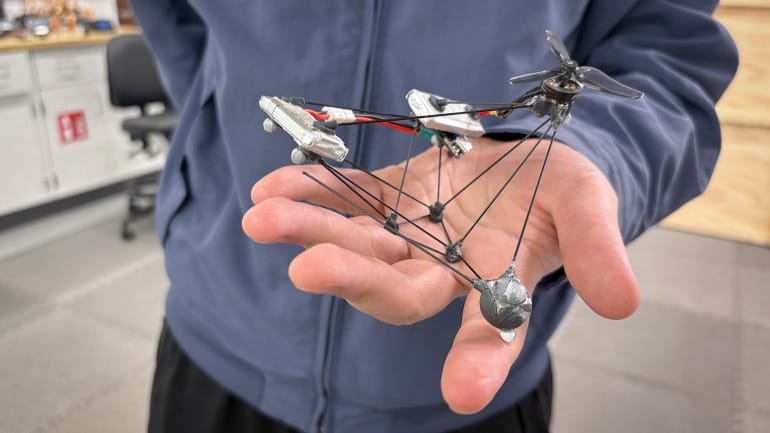
Image source: Northwestern University
The Rundown: Engineers at Northwestern University unveiled Phantom Twist, a drone that spins its body up to 25 times per second to exploit human vision's motion blur — morphing into a ghostly smudge that's 10 times harder to spot than a regular drone.
The details:
Phantom Twist runs on a single motor, with the propeller spinning one way and the frame rotating the other, leaving no stationary parts for the eye to lock onto.
AI helped design the drone, generating 20K stable configurations, simulating each against real backgrounds, and scoring them with a perception model.
The algorithms spread components at different heights and angles to avoid visual overlap mid-spin, eventually landing on the final layout.
The drone still hums audibly and needs an optical tracking system to be flown, with the team eyeing transparent materials and quieter propulsion for upgrades.
Why it matters: The idea behind this drone is wildlife monitoring and infrastructure inspection without disturbing the subject, but a drone designed to evade humans can just as easily be a surveillance tool. Also notable is AI's emerging role in engineering — the tech produced a layout researchers say humans wouldn't have found on their own.
BCI FOR ROBOTICS
🧠 Robots that take orders straight from your brain

Image source: BrainCo
The Rundown: At the World Artificial Intelligence Conference in Shanghai, Chinese BCI company BrainCo unveiled its Brain-Controlled Robot AI Platform, a system that allows humans to control robotic arms, humanoids, and robot dogs through thoughts alone.
The details:
BrainCo’s demos showed a robotic arm grasping a cup and picking up an apple purely via a wearer's thoughts, without using any buttons, words, or gestures.
How it works: an EEG headset picks up brain signals, following which an AI decodes intent and routes the command to a robot — executing it in 200ms.
Unlike Neuralink, which implants chips in the brain, BrainCo’s system requires no surgery and works with third-party robots without proprietary hardware.
The company also debuted a data collection kit that records human task demos along with brain signals, betting intent data can improve robot training.
Why it matters: Everyone in robotics is chasing high-quality training data, but BrainCo is capturing a layer no one else records: the neural intent behind human actions. Whether brain signals actually make training data better is unproven, but the demo itself shows how fast BCIs are moving from medical labs toward everyday machines.
QUICK HITS
📰 Everything else in robotics today
Researchers at KAIST and Stanford developed self-dressing robotic clothing that uses air-powered soft "vines" to automatically wrap around the wearer in 10 seconds.
Agility Robotics opened a new 60,000-square-foot AI hub near Tesla's Optimus factory in Fremont, California, to train its Digit humanoid on new enterprise skills.
Amazon's Zoox recalled software for 105 robotaxis after one drove into heavy smoke at an active fire scene instead of recognizing the hazard.
Blackstone invested in South Korean actuator maker Futronic, valuing the robotics supplier at about $676M as demand for industrial and humanoid robots accelerates.
Kanazawa University developed a robotic hand that switches between multiple grippers using a single motor, making robots lighter, cheaper, and more versatile.
Nvidia partnered with Japanese giants, including Fujitsu and Kawasaki, to advance physical AI, as government-backed Noetra committed to buying 27K+ Rubin chips.
Xiaomi CEO Lei Jun showcased the company's humanoid robot handling large, flexible automotive parts on a production line as factory testing expands.
Georgia Tech researchers developed a more efficient AI training method that enabled a humanoid robot to navigate diverse terrain, including gravel, stairs, and slopes.
China’s Astribot unveiled Lumo-2, a latent world-action model that helps robots better understand the physical world and perform long-horizon manipulation tasks.
COMMUNITY
🎓 Highlights: News, Guides & Events
Read our last AI newsletter: Anthropic's Fable survives the subscription axe
Read our last Tech newsletter: Prozac’s maker goes psychedelic
Read our last Robotics newsletter: Toyota's secret humanoid hits $1.1B
Today’s AI tool guide: Deploy a mini-SaaS in minutes with ChatGPT Sites
RSVP to next live workshop on July 22: No-code product building
See you soon,
Rowan, Zach, Shubham, and Jennifer — The Rundown’s editorial team

Stay Ahead on AI.
Join 2,000,000+ readers getting bite-size AI news updates straight to their inbox every morning with The Rundown AI newsletter. It's 100% free.