Walmart expands drone empire
PLUS: A giant robot makes babies in Mexico

Jennifer Mossalgue
January 13, 2026
Read Online | Sign Up | Advertise

Good morning, robotics enthusiasts. Walmart’s parking lots are quietly turning into airfields. Wing is strapping 150 drone launchpads onto hundreds of big-box stores, laying the groundwork for a nationwide aerial delivery network that could reshape how everyday goods move through U.S. cities and suburbs.
With new FAA approvals and heavy automation, flying snacks might be ready to go mainstream.
In today’s robotics rundown:
Walmart adds drone delivery to 150 stores
A 17-ft. robot makes human embryos
Humanoids battle it out at CES
This AI robot is actually a Tamagotchi
Quick hits on other robotics news
LATEST DEVELOPMENTS
WALMART
🛍️ Walmart adds drone delivery to 150 stores
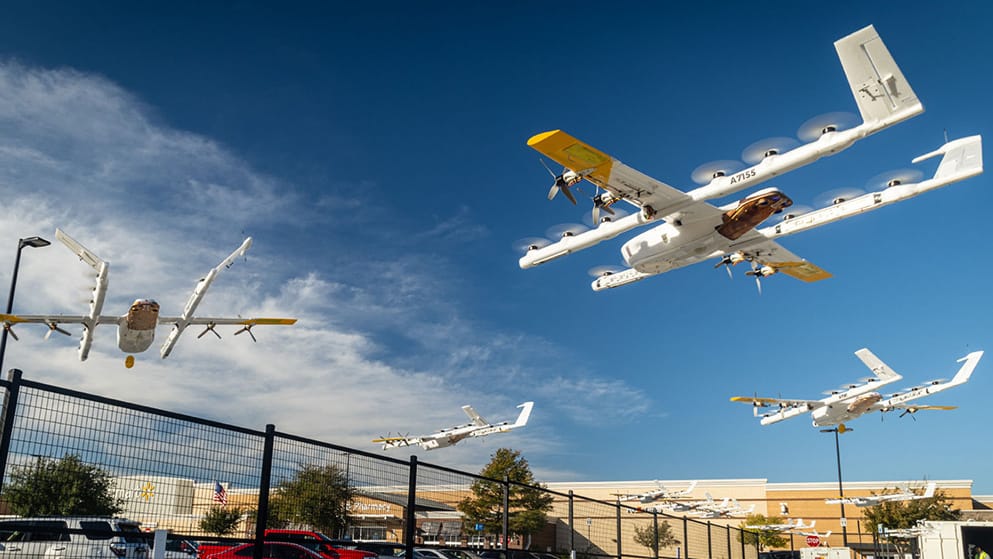
Image source: Wing
The Rundown: Wing is bolting 150 launchpads onto Walmart stores as part of a race to build a 270-site drone network blanketing the U.S. by 2027 — creating what the company calls the world’s largest commercial drone-delivery operation.
The details:
The network will target coverage for over 40M Americans, expanding from Dallas–Fort Worth pilots into LA, Miami, Cincinnati, and smaller metros.
Customers will be able to order thousands of Walmart items for delivery “in roughly 30 minutes” via Wing’s app or Walmart’s platform.
Wing’s aircraft fly autonomously under a centralized fleet management system, coordinating dozens of drones at once and lowering packages on a tether.
Wing now completes thousands of weekly deliveries with an average fulfillment time under 19 minutes and flight times averaging 3 minutes and 43 seconds.
Why it matters: FAA approval for beyond-visual-line-of-sight flights has unlocked Wing’s expansion. For Walmart, wiring drone infrastructure into its 4K-plus stores transforms big-box parking lots into an anti-Amazon aerial grid — one that can drop Advil and Doritos straight into suburban backyards without touching a delivery van.
IVF ROBOTICS
👶🏼 A 17-ft. robot makes human embryos

Image source: Conceivable
The Rundown: A 17-foot AI-powered robot in a Mexico City fertility clinic is now making human embryos that have already resulted in 19 babies, raising the question of whether machines are better at IVF than people, Bloomberg reports.
The details:
Conceivable’s Aura handles over 200 microscopic steps — from pipetting sperm to injecting it into eggs — with minimal human intervention.
The company is offering free robotic IVF to couples in clinical trials at a Mexico City fertility clinic.
Conceivable raised $50M last year; rival Overture Life has also deployed automated systems that have produced babies.
The 17-foot machine addresses IVF’s core bottlenecks: high costs, inconsistent outcomes, and a global shortage of trained embryologists.
Why it matters: End-to-end automation could transform fertility treatment from a labor-intensive service into an industrialized process, making it accessible to far more people. But delegating embryo creation to machines is already triggering regulatory and ethical scrutiny about who — or what — should control human reproduction.
CES
🥊 Humanoids battle it out at CES
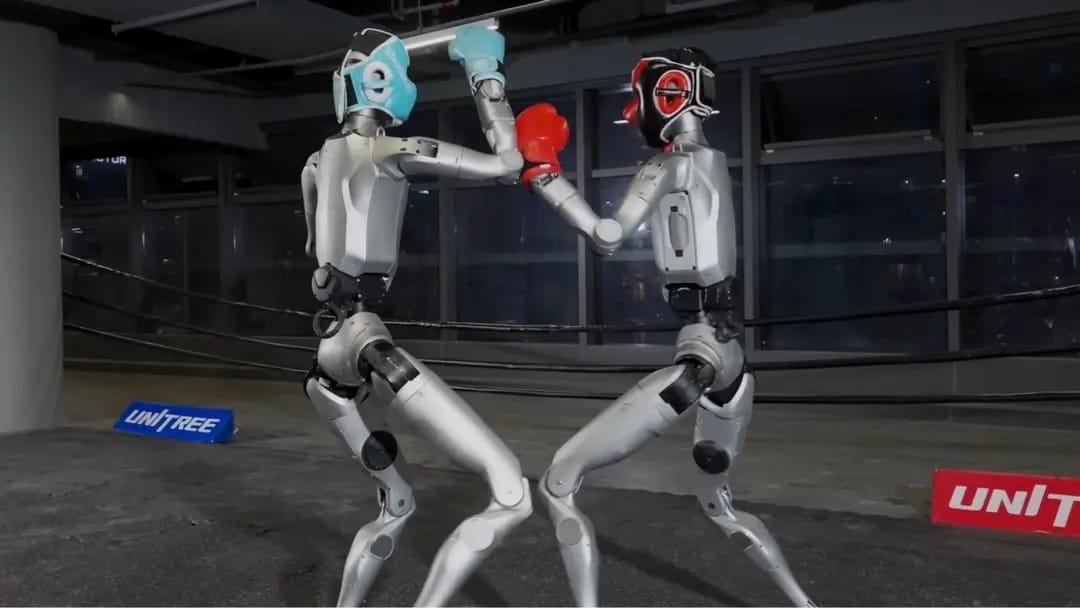
Image source: Unitree / YouTube
The Rundown: Ultimate Fighting Robot staged live bouts between child-sized Unitree humanoids at CES, complete with human pilots, motion controllers, and a ringside referee — positioning it as a legitimate combat-sports franchise in the making.
The details:
Founders Vitaly and Xenia Bulatov are selling UFB as “the sport of the future,” betting fans will connect to robot backstories the way they do MMA fighters.
Pilots control the robots ringside using cameras and motion-sensing Nintendo-style controllers while a referee monitors for fouls and knockdowns.
Robots resembled blindfolded boxers at times, reportedly triggering laughter with wild misses and cheers when blows landed.
Each bout doubles as a data-collection operation — UFB is mining motion data from every match to refine humanoid control systems and movement models.
Why it matters: UFB is stress-testing control interfaces and balance algorithms that robotics companies are racing to perfect, turning Vegas spectacle into practical R&D. Previous sold-out events in San Francisco suggest the format has traction among tech professionals at least, but its widespread entertainment value is still an open question.
ROBOPETS
🥺 This AI robot is actually a Tamagotchi

Image source: Takway
The Rundown: Remember Tamagotchi? It’s back, and it’s way smarter. Takway’s Sweekar, unveiled at CES, is a palm-sized AI robot that learns your voice, remembers conversations, and evolves a personality of its own, with intelligence baked in.
The details:
You keep it “happy” by feeding and playing with it, and its mood and expressions change in response to how much attention you give it.
The pet moves through four life stages — egg, baby, teen, and adult — becoming less needy over time and eventually able to entertain itself.
An adult Sweekar can’t die from neglect; it will keep itself alive and later tell you stories about what it “did” while you were away.
Takway plans to launch Sweekar on Kickstarter later this year with a projected price of around $100–$150.
Why it matters: Takway is positioning it as the first step toward becoming the “Nintendo of the AI robot era.” The original Tamagotchi sold over 80M units worldwide by tapping into our impulse to nurture something small and needy — now that impulse comes with machine learning and actual memory.
QUICK HITS
📰 Everything else in robotics today
Musk’s xAI is burning billions of dollars but is pitching investors on a plan to make its Grok models the “brain” for Optimus, becoming the software layer that powers the bot.
Hyundai and Boston Dynamics’ Atlas humanoid, which debuted at CES last week, was named “Best Robot” in CNET Group’s Official Best of CES 2026 award.
HD Hyundai Robotics, South Korea’s largest industrial robot maker, hired UBS, Korea Investment & Securities, and KB Securities to lead a planned Seoul IPO.
X Square Robot raised about $140M in a round backed by ByteDance, Alibaba, and Meituan, making it one of China’s best-funded general-purpose robotics startups.
Tuya Smart unveiled Aura, an AI-powered mobile pet companion robot that roams the home to monitor animals’ emotions, play with them, and capture photos and videos.
CMR’s Versius robot just won EU and UK safety marks for pediatric abdominal surgery, while India’s SS Innovations brings smaller tools to its SSi Mantra system.
Brolan debuted ClearX at CES, a robot that washes, dries, and optionally sanitizes shoes using sensor‑guided micro‑bubble cleaning instead of harsh detergents.
Zero Zero Robotics unveiled HOVERAir AQUA, a fully waterproof, floating self-flying camera drone that uses AI tracking to film 4K/100 fps watersports footage hands‑free.
E-commerce logistics company Radial says its Kentucky warehouse has used Locus’s robots to pick more than 25M million items so far.
COMMUNITY
🎓 Highlights: News, Guides & Events
Read our last AI newsletter: Anthropic blocks xAI's Claude access
Read our last Tech newsletter: Lego’s iconic brick just got a brain
Read our last Robotics newsletter: Hyundai mass-producing Atlas robots
Today’s AI tool guide: Find dozens of free AI tools with Google Labs
RSVP to next workshop @ 4PM EST Friday: AI Foundations Boot Camp Pt. 2
See you soon,
Rowan, Joey, Zach, Shubham, and Jennifer — The Rundown’s editorial team

Stay Ahead on AI.
Join 2,000,000+ readers getting bite-size AI news updates straight to their inbox every morning with The Rundown AI newsletter. It's 100% free.