UBTech's ultra-realistic robot girlfriend is here
PLUS: Waymo launches perk-filled loyalty program

Jennifer Mossalgue
June 15, 2026
Read Online | Sign Up | Advertise

Good morning, robotics enthusiasts. UBTech just unveiled U1, a “hyper-realistic” companion line in his-and-hers flavors, complete with silicone skin, expressive faces, and enough blond hair to rattle a wig department.
Nearly 4K people in China have reportedly put down money — more than $1.4M in deposits — for a robot that promises to remember conversations. UBTech’s June 30 launch event will reveal pricing and kick off the robot girlfriend/boyfriend experiment in real time.
In today’s robotics rundown:
UBTech hits $1.4M in pre-orders for hyperrealistic bots
Waymo’s $30 club for power riders
Humanoid maker EngineAI files for IPO
Theker’s shape-shifting robots land $85M
Quick hits on other robotics news
LATEST DEVELOPMENTS
UBTECH
💅🏼 UBTech hits $1.4M in pre-orders for hyperrealistic bots

Image source: UBTech
The Rundown: UBTech’s new U1 — a hyper-realistic, full-size humanoid sold as matching “male” and “female” models — reportedly pulled in nearly 4K pre-orders and more than $1.4M in deposits in its first 10 days on sale.
The details:
The specs: Male model, 6'0"/93 lb. in a suit; female model in black dress, 5'6"/78 lb. — both with 88 degrees of freedom for fluid, humanlike motion.
Pre-orders on JD.com via UBTech’s new UWORLD brand require a 3K yuan (~$450) deposit; pricing drops at a June 30 event with shipping in September.
The robots run on an “emotional” AI model with locally encrypted memory and physical customization, though they’re currently limited to pre-taught skills.
Online reaction has split with complaints about stiff movement, while analysts are raising flags on IP-customization copyright exposure and ethical issues.
Why it matters: UBTech made its name on factory-floor humanoids for automakers like NIO — U1 is a bet that the bigger market is an emotional one. Even modest conversion would make it one of the first humanoids in real numbers of homes, and an early test of how people (and regulators) react to robots built for human bonding.
WAYMO
🚖 Waymo’s $30 club for power riders

Image source: Waymo
The Rundown: Waymo just launched its first-ever loyalty program, Waymo Premier, a $29.99-a-month membership that gives its heaviest riders priority pickups, 10% cash back on every trip, and up to five free cancellations a month.
The details:
“Priority Pickups” jump members to the front of the matching queue, with 10% back on every ride, and “Early Access” means first dibs when Waymo launches in new cities.
It’s invite-only at launch, rolling out first to top riders in San Francisco, LA, and Phoenix, with perks that travel with members between cities.
Austin and Atlanta riders can’t join, since Waymo operates those markets exclusively through Uber’s app rather than its own.
At $29.99, Premier costs 3x Uber One’s $9.99 — though Bloomberg figures four weekly Bay Area rides at $17.25 average pay the fee back in cash alone.
Why it matters: Loyalty programs work once a service has the scale and repeat riders to justify recurring fees, and Waymo — at roughly 500K rides a week across 10 cities — has apparently hit that mark. Premier locks in its heaviest users as prepaying regulars just as the robotaxi fight with Uber, Tesla, and international rivals intensifies.
ENGINE AI
🥊 Humanoid maker EngineAI files for IPO

The Rundown: Three years after its founding, Shenzhen humanoid maker EngineAI has reportedly confidentially filed for a Hong Kong IPO — just weeks after opening a giant factory built to churn out a T800 robot every 15 minutes.
The details:
The filing follows a Series B that valued the firm at $1.5B, led by Henan CICC Huirong Fund Management and major Apple supplier Luxshare-ICT.
EngineAI’s new Shenzhen factory began mass deliveries this month, turning out a humanoid every 15 minutes, with 10K units at a planned second plant.
EngineAI joins a crowded queue of Chinese humanoid makers chasing listings: Unitree, BYD-backed hand-maker PaXini, Dreame, and Linkerbot.
EngineAI is also staging the Ultimate Robot Knockout League, a robot combat league launching later this year — 16 T800s are training for it.
Why it matters: EngineAI’s filing comes as Unitree, the sector leader, files for a $7B IPO on Shanghai’s STAR Market — two Chinese humanoids at wildly different scales going public within months of each other. That puts real pressure on both companies' factory numbers once they're under public-market scrutiny, not just hype.
THEKER
🦾 Theker’s shape-shifting robots land $85M
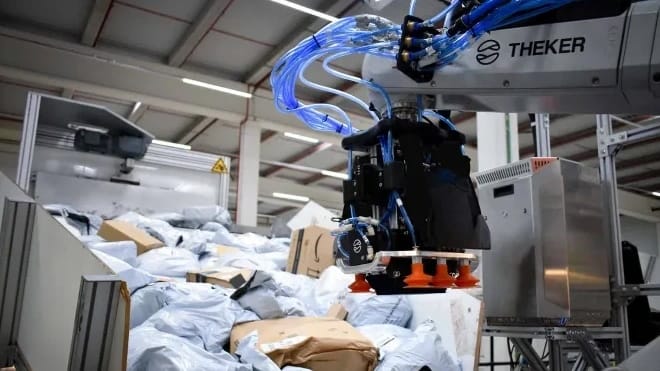
Image source: Theker
The Rundown: Barcelona-based Theker just closed an $85M Series A — what the company says is the largest robotics Series A in Europe to date — to build industrial robots whose hands, arms, and overall shape can be swapped or resized.
The details:
The round, backed by Samsung and LVMH/Aglaé, lands less than a year after Theker’s seed round, which was itself Spain’s largest ever.
Theker’s robots are modular: the same machine can be reconfigured for different tasks depending on what a warehouse needs that day.
Inditex, the parent company of Zara, is already an early backer and client — Theker’s stated goal is to expand from retail logistics into manufacturing work.
Samsung isn’t a customer yet but is in advanced talks to become one, while Theker opens a Barcelona showroom, with more planned globally.
Why it matters: Theker’s premise is that swappable, resizable hardware — hands, arms, even the robot’s overall form — will be more useful on a factory floor than a humanoid built to do everything. An $85M round of this size is also a marker of how seriously investors are betting on Europe producing competitive players in robotics.
QUICK HITS
📰 Everything else in robotics today
Dreame Technology, a Chinese maker of robotic vacuum cleaners and other smart home appliances, is reportedly considering a Hong Kong IPO as soon as next year.
South Korean startup RLWRLD unveiled RLDX-1, a robotics foundation model for dexterous humanoid tasks, built on Nvidia’s robotics stack.
Weave Robotics unveiled Isaac 1, a mobile, wheeled home robot with a friendlier consumer-ready design for tidying the home, following its laundry-folding Isaac 0.
DEEP Robotics’ Lynx S10, retrofitted with polar-bear-style paws and crampons, became the first quadruped robot to traverse Arctic ice floes.
Rekise Marine, a Bengaluru marine robotics startup, raised $9.7M co-led by Accel and NKSquared to develop autonomous naval vessels for India.
Xiaomi unveiled a robotic arm that automatically connects and disconnects an EV’s charging cable at home, pairing with smart parking for a hands-free charging routine.
Austria’s TU Graz built a quadruped robot that scouts hazmat zones ahead of firefighters, sending real-time pollutant readings and video back to crews.
China is using snake-like robots that crawl along power lines to detect faults, which are 3x faster than manual inspection and can reach spots drones can’t.
Honor’s gimbal-equipped Robot Phone, co-developed with ARRI, made its public debut at the Shanghai International Film Festival as the event’s official imaging partner.
COMMUNITY
🎓 Highlights: News, Guides & Events
Read our last AI newsletter: Anthropic pulls Mythos, Fable after U.S. order
Read our last Tech newsletter: SpaceX posts biggest IPO in history
Read our last Robotics newsletter: Europe’s humanoid moonshot gets $1.4B
Today’s AI tool guide: Turn ChatGPT images into an editable Canva design
RSVP to our next workshop on June 17: Build a Marketing Creative Studio
See you soon,
Rowan, Joey, Zach, Shubham, and Jennifer — The Rundown’s editorial team



Stay Ahead on AI.
Join 2,000,000+ readers getting bite-size AI news updates straight to their inbox every morning with The Rundown AI newsletter. It's 100% free.