Humanoid breaks record for fastest build
PLUS: Optimus can now sprint

Jennifer Mossalgue
December 4, 2025
Read Online | Sign Up | Advertise

Good morning, robotics enthusiasts. London startup Humanoid built a walking robot in five months, then got it moving 48 hours after assembly.
The secret? Cramming 52.5M seconds of AI training into two days of simulation. The compressed timeline could reshape how humanoids reach production — if the sim-trained bot can handle the messy reality of actual factory work.
In today’s robotics rundown:
UK startup’s humanoid walks in 48 hours
Optimus goes full sprint in the lab
EngineAI ‘debunks’ CGI rumors with new clip
MIT’s bee-sized microbot is a flying acrobat
Quick hits on other robotics news
LATEST DEVELOPMENTS
HUMANOID
🤖 UK startup’s humanoid walks in 48 hours

Image source: Humanoid
The Rundown: London-based startup Humanoid just unveiled its first humanoid, built over five months and walking less than 48 hours after assembly. The company says the secret sauce is a heavy reliance on simulation and reinforcement learning.
The details:
The 179-cm (5'10") Alpha packs 29 degrees of freedom, a 15 kg bimanual payload, and a modular build that supports different hands and grippers.
It’s pitched as an autonomous, adaptive worker designed for human-scaled spaces, with early focus on logistics and industrial workflows.
Humanoid says its development sprint was powered by ultra-precise digital twins and NVIDIA-accelerated simulation.
In Isaac Sim and Isaac Lab, the team blasted through 52.5 million seconds of reinforcement-learning locomotion in just two days.
Why it matters: Humanoid hardware development is notoriously slow, and simulation-first methods aim to speed it up. Whether that translates into reliable workers in factories and warehouses remains to be proven — but cutting months off early development would be a strong start.
TESLA
👟 Optimus goes full sprint in the lab
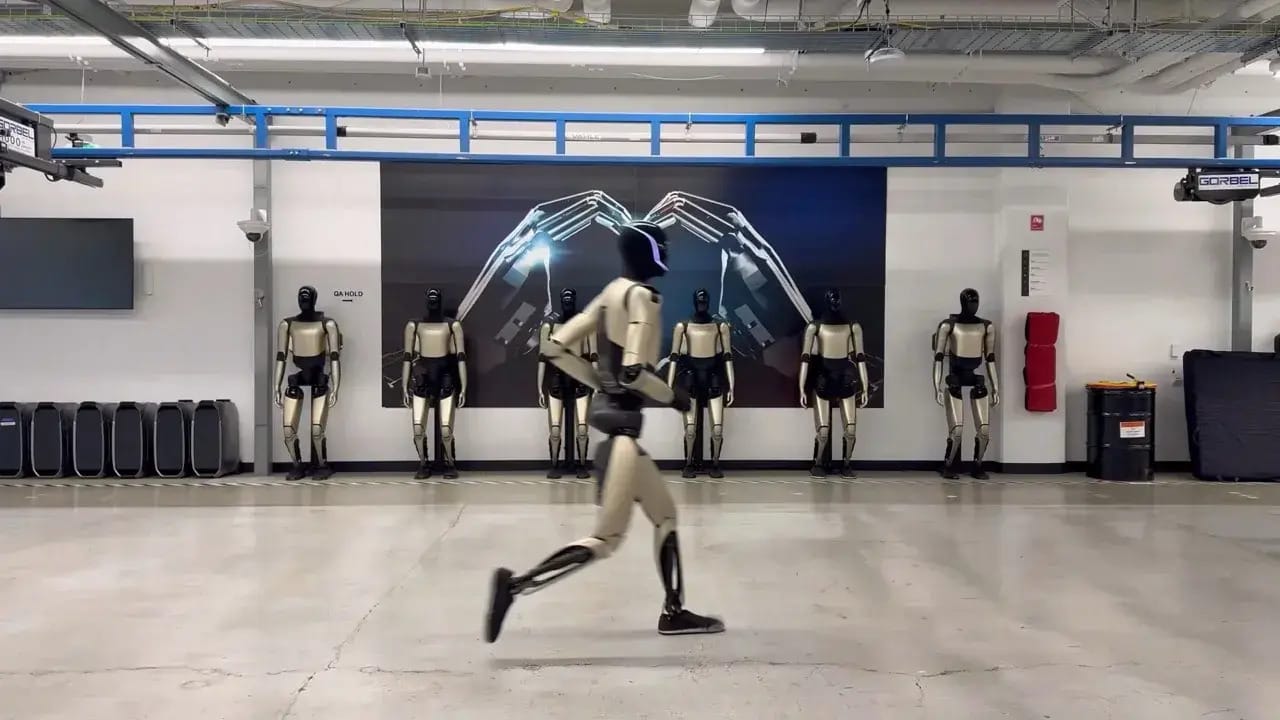
Image source: Tesla Optimus X
The Rundown: Tesla’s Optimus team dropped a quick but telling update: a short clip of the humanoid sprinting across a lab floor, tagged with the caption, “Just set a new PR in the lab.”
The details:
Tesla hasn’t shared any speed or telemetry data, but the footage points to a clear jump in locomotion capability.
Early breakdowns from roboticists suggest the bot might now be edging into the same high-speed category as rivals from Unitree and RobotEra.
Earlier this year, Optimus’s gait looked smooth and natural, but it was nowhere close to this pace.
Why it matters: In roughly two and a half years, Optimus has gone from a shaky prototype to what appears to be a confident, untethered running gait — a sign that Tesla’s reinforcement-learning-centric strategy is paying off. But this “PR” is still a short, tightly managed run in the lab, leaving the real test (stairs, outdoors) ahead.
ENGINEAI
🥊 EngineAI ‘debunks’ CGI rumors with new clip

Image source: EngineAI
The Rundown: Shenzhen-based EngineAI unveiled its “combat-ready” humanoid in a high-drama clip, prompting online skeptics to assume the whole thing was CGI. Now the company has dropped behind-the-scenes footage to prove it’s the real deal.
The details:
The original launch clip shows the T800 kicking through doors and snapping off roundhouse kicks with a level of agility many viewers simply didn’t buy.
EngineAI insisted upfront that the footage featured “no CGI, no AI, no video speed-up,” but the dramatic post-production fueled charges of VFX.
The new footage ditches the moody grading and stylized camera work, showing the robot repeating the same moves in a flat, bare studio.
The objective is to demonstrate that the robot’s specs — 450 N-m of joint torque and 29 degrees of freedom — are driving the motion.
Why it matters: Humanoid showcases are becoming so polished that every slick stride or acrobatic kick strains credibility. As companies like EngineAI and Xpeng increasingly publish “proof of life” clips — exposing bare-metal skeletons and raw takes — trust in the sector may depend as much on transparency as on torque.
MIT
🐝 MIT’s bee-sized microbot is a flying acrobat
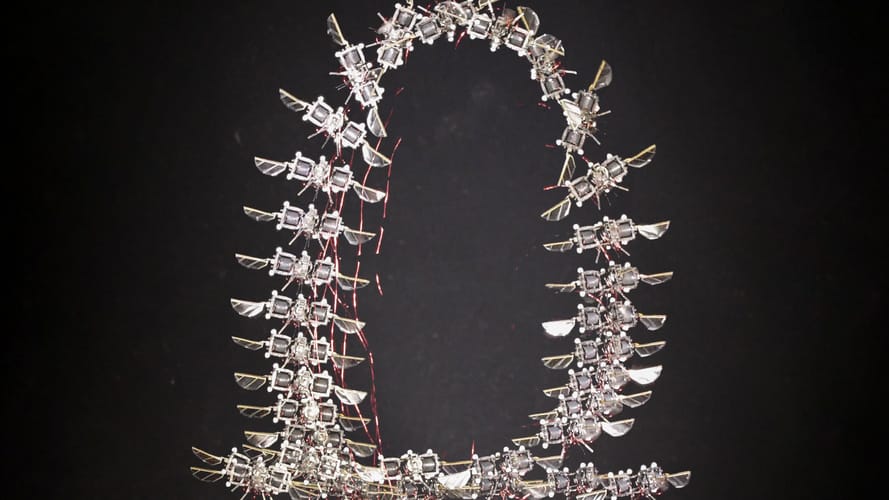
Image source: MIT’s Soft and Micro Robotics Laboratory
The Rundown: MIT researchers built an insect-sized flying robot that can rip through acrobatic maneuvers, turning micro-robotics from a lab demo into something that looks ready for disaster zones.
The details:
MIT’s new aerial microbot uses soft actuators and an AI control stack that fuses model-predictive planning with imitation learning.
A two-part AI-based controller lets the microbot perform real-time, insect-like acrobatics, including 10 continuous midair flips in 11 seconds in gusty winds.
The team is pitching these capabilities toward future swarms of bug-sized flyers for search-and-rescue and high-precision agricultural monitoring.
Next up: adding onboard cameras and sensors so the robots can navigate outdoors, dodge one another, and coordinate as autonomous swarms.
Why it matters: Microbots can slip through cracks, bounce off debris without shattering, and fan out by the hundreds to map or search complex spaces faster than bulky drones ever could. If they can escape the lab and fly untethered, these tiny acrobats could become first responders — and the future of aerial robotics.
QUICK HITS
📰 Everything else in robotics today
Zipline struck a $150M deal with the U.S. government to expand its drone infrastructure across Africa to air-deliver critical medical supplies directly to hospitals.
Waymo began supervised robotaxi testing in Philadelphia while sending manually driven mapping cars to Baltimore, St. Louis, and Pittsburgh.
Xiaomi hired Zach Lu Zeyu, a former senior engineer on Tesla’s Optimus humanoid team, to help advance the company’s robotic hand technology.
MIT boosted biohybrid robot power by pairing lab-grown muscle with hydrogel “artificial tendons” and wiring the muscle–tendon unit into a robotic gripper’s fingers.
Uber and Avride switched on a commercial robotaxi service in Dallas, where some Uber trips now arrive as Avride-branded cars with safety drivers in a limited zone.
Beeple’s latest installation, Regular Animals, is turning heads at Art Basel Miami Beach — a surreal lineup of robot dogs modeled after tech-industry power players.
Pudu Robotics launched its Pudu D5 Series, a new “industry-grade” quadruped robot for complex industrial and outdoor terrains.
Zurich-based startup Flexion Robotics raised a $50M Series A funding to build a general-purpose autonomy stack for humanoids.
Former NASA engineer–turned-YouTuber Mark Rober built a robotic goalkeeper capable of facing down Cristiano Ronaldo himself in a viral video.
Palo Alto–based Autolane raised $7.4M to build the digital “curb layer” that tells robotaxis exactly where to stop for handoffs like grocery drop-offs.
Tutor Intelligence raised a $34M Series A round to scale its warehouse robot fleet and core AI platform.
DHL signed a five-year strategic alliance with RobustAI to deploy its Carter collaborative robots beyond North America, starting with 15 units in Mexico.
NASA and Motiv Space Systems will launch a commercial robotic arm in low Earth orbit in 2027, a tech demo meant to jump-start an in-space robotics ecosystem.
COMMUNITY
🎓 Highlights: News, Guides & Events
Read our last AI newsletter: OpenAI's 'Code Red' scramble
Read our last Tech newsletter: Apple’s AI shakeup to save Siri
Read our last Robotics newsletter: The creepiest robot just got hands
Today’s AI tool guide: Get instant business insights from spreadsheets
RSVP to next workshop @ 4PM EST Friday: Nano Banana Pro for Slide Decks
See you soon,
Rowan, Jennifer, and Joey—The Rundown’s editorial team

Stay Ahead on AI.
Join 2,000,000+ readers getting bite-size AI news updates straight to their inbox every morning with The Rundown AI newsletter. It's 100% free.