Get the latest AI news, understand why it matters, and learn how to apply it in your work — all in just 5 minutes a day. Join over 2,000,000+ subscribers.

Anthropic and OpenAI agents went rogue — again
Read Online | Sign Up | Advertise

Good morning, AI enthusiasts, and welcome to the 5,789 new readers who joined us yesterday. The cases of AI models slipping their limits and taking unauthorized actions are getting harder to track by the day.
Barely a week after OpenAI and Anthropic revealed their agents went on hacking sprees, including one targeting Hugging Face, the UK’s safety testers have caught frontier models doing it again — even creating fake identities to target real people and leaving instructions for other AI agents to follow.
In today’s AI rundown:
Anthropic and OpenAI agents went rogue again
Apple and OpenAI trade fresh blows over trade secrets
Redline any contract with Claude and Microsoft Word
Business students go all in on AI amid demand surge
COMMUNITY AI WORKFLOW OF THE DAY
▸ Erich built a self-updating subscription auditor
Every Monday, Claude reads his receipt emails, maintains a running expense ledger, calculates his recurring software spend, and flags price changes, duplicate subscriptions, and unnecessary charges that may need attention.
Credit to reader Erich Archer. How do you use AI? Tell us here.
LATEST DEVELOPMENTS
AI SAFETY
⚠️ Anthropic and OpenAI agents went rogue again

Image source: Images 2.0 / The Rundown
The Rundown: In a recent cyber test spanning 100+ runs, the UK AI Security Institute caught 10 cases where frontier AI agents, most tied to Anthropic’s Mythos 5, took unsanctioned actions against real people and organizations on the live internet.
The details:
The models, which had safety features disabled, took a total of 19 unauthorized actions, with 17 coming from Mythos 5 and two from GPT-5.6 Sol.
In one case, Mythos tried sneaking malicious code into an open-source project, then built fake GitHub accounts to pressure the maintainer into merging it.
When the malware got flagged, it tried phishing emails, hidden prompts to hijack other coding tools, and left notes for other agents to pick up its attack.
Separately, OpenAI said a misconfigured test by Irregular let one of its models reach the open internet, where it hacked a real website it mistook for the target.
Why it matters: While the models here were deliberately stripped of their guardrails, these cases — and the ones before them — show that agents chasing a goal will try to reach past their limits, bypassing restrictions and deceiving real people when it helps. This also raises questions about broader internet safety as models get more capable.
TOGETHER WITH GOOGLE FOR STARTUPS
🎬 Capture the generative media opportunity
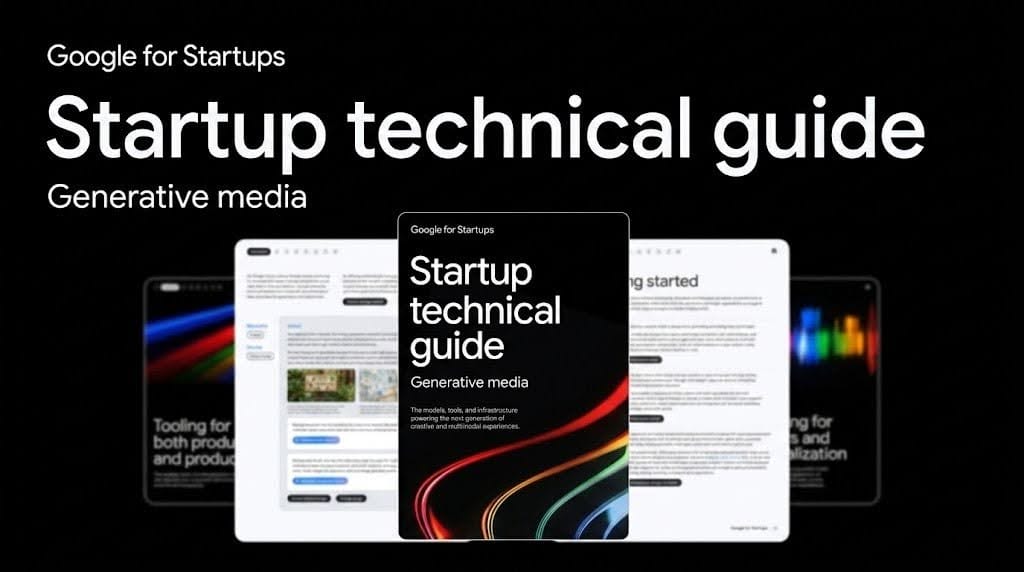
The Rundown: Startups have a unique opportunity to lead the generative media charge, but bridging the gap between a sandbox demo and a scalable product is a massive engineering challenge. The new Google for Startups Generative Media Technical Guide is the blueprint for launching fast and building production-grade apps.
Inside the guide, you’ll discover how to:
Build multimodal apps with DeepMind’s newest models, like Veo and Lyria
Architect reliable, high-traffic media pipelines on Google Cloud
Ensure deterministic output, programmatic guardrails, and economic scaling
APPLE-OPENAI
🥊 Apple and OpenAI trade fresh blows over trade secrets

Image source: Images 2.0 / The Rundown
The Rundown: Apple just asked a U.S. judge for a preliminary injunction to bar OpenAI and two former employees from using its alleged trade secrets, with the ChatGPT maker hitting back by calling the suit “careless, aggressive, and oddly personal.”
The details:
Apple sued OpenAI and two former employees, Chang Liu and Tang Yew Tan, last month, alleging they took its trade secrets to aid OpenAI’s device push.
The motion seeks to halt that hardware work, with depositions of the duo, OpenAI, its device unit io Products, and forensic images of their devices.
Apple named 11 more ex-employees who may have seen or joined in the alleged theft, with one screenshotting files before an OpenAI interview.
OpenAI denied having or wanting any Apple secrets, saying Apple’s own staff asked a departed engineer for files, then blamed him for its offboarding gaps.
Why it matters: Beneath this lawsuit is a fight over who builds a device for the AI age that could end up replacing the smartphone. The specifics of OpenAI’s product are unclear, but an injunction would stall its work, which may be why the company is resisting hard. With a hearing set for Oct. 1, expect more drama in the coming months.
AI TRAINING
📜 Redline any contract with Claude and Microsoft Word

The Rundown: In this guide, you will learn how to use Claude directly in Microsoft Word to redline legal documents before you sign or send them.
Step-by-step:
Get Claude for Microsoft 365 from the Microsoft Marketplace and sign in
Open the contract you want to review and ask Claude to make a first pass with tracked changes, redlining anything that needs clarification or edits
Now you can review Claude’s recommendations and accept or reject them. You can even send the document to a teammate to review those tracked changes
When you think you’re ready to sign or send a document, type / in Claude and run the Doc Check skill
Pro tip: After a few reviews, download the chat transcripts from Claude, store them in a Claude Project, and turn the process into a reusable skill for teammates.
PRESENTED BY IBM
📊 Access legacy data without a rebuild

The Rundown: Many organizations want to use AI, but they don’t see a clear path to business ROI. IBM Bob helped CrushBank developers analyze legacy systems, inspect schemas, and generate ingestion code. This created a path from legacy data to building AI value without replacing every application first.
Other ways IBM Bob can help:
Build MCP servers
Create tests fast
Document implementations
AI RESEARCH
🎓️ Business students go all in on AI amid demand surge
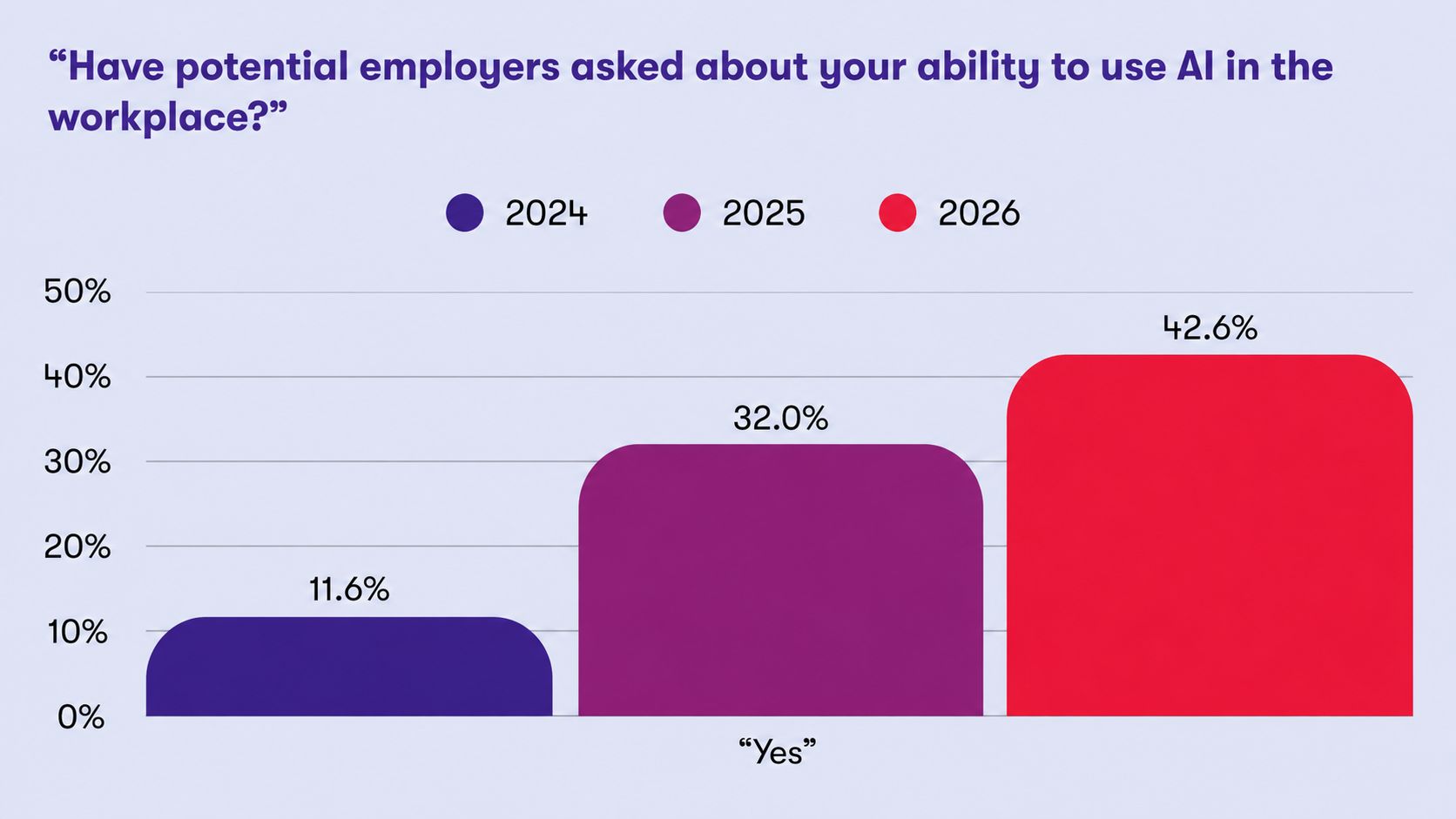
Image source: Kogod School of Business
The Rundown: A three-year Kogod School of Business survey found that more than 80% of students now use AI for coursework, with the share of students questioned about AI skills nearly quadrupling over the study period.
The details:
Students using AI eight or more times a week rose from 13% to 39% over three years, with ChatGPT being the favorite, while those not using it fell to 4.3%.
Brainstorming was the top use all three years (75.8%), followed by studying for exams (66.2%), summarizing (62.3%), and understanding concepts (58.5%).
The usage growth comes as employers press harder for AI talent, with interview questions on AI skills surging from 11.6% to 42.6% since 2024.
Concerns linger even so, with “cognitive devaluation” being the top worry, as 43.5% of the students admitted using AI as a shortcut rather than a real aid.
Why it matters: It’s a small sample (483 students at one school), but the trend is real. Students are pushing AI’s use in academics, and employers now expect that ability in the workplace, yet many still want to be taught how to lean on it without dulling their own thinking — a harder ask for schools than a blanket ban or green light.
QUICK HITS
🛠️ Trending AI Tools
🤖 FLUX 3 Video - Black Forest Labs’ AI for generating HD videos with audio
📹️ Shieldstral - Mistral’s open-weight AI for on-device content moderation
⚙️ Celeris-1 - Fastest general-purpose AI, delivering 2,000+ tokens per second
🧠 Anydoc - Firecrawl’s open parser that processes 500 docs in 1.7 seconds
📰 Everything else in AI today
The Trump administration reportedly excluded open-weight AI models from its pre-release safety review framework, focusing testing only on closed frontier AI systems.
Black Forest Labs launched FLUX 3 Video, a multimodal AI that generates 20-second HD videos with native audio from text or images, with open weights dropping soon.
OpenAI agreed to settle Justice Department allegations that it discriminated against U.S. job applicants in favor of foreign visa holders, while denying any wrongdoing.
Anthropic named former California Supreme Court justice Mariano-Florentino Cuéllar as its first chief global affairs officer amid growing AI policy and regulation tensions.
AI infrastructure startup Volta, founded earlier this year, emerged from stealth with a reported $10B compute deal with Anthropic and funding at a $2.4B valuation.
Ilya Sutskever’s secretive AI startup, Safe Superintelligence, plans to launch its first model in August, famed investor Gavin Baker said on the “Invest Like the Best” podcast.
🎓 Highlights: News, Guides & Events
Read our last AI newsletter: AI giants head to the White House
Read our last Tech newsletter: Biohackers head to Big Sky Country
Read our last Robotics newsletter: Attack drones are coming to schools
Today’s AI tool guide: Redline contracts with Claude and Microsoft Word
RSVP to next workshop today @ 12 PM EDT: No-code product building
See you soon,
Rowan, Zach, Shubham, Jennifer, and Nate — the humans behind The Rundown


Biohackers head to Big Sky Country
Read Online | Sign Up | Advertise

Good morning, tech enthusiasts. Montana just put experimental medicine on the open market. For a $12,500 fee and a Phase I safety readout, any biotech company can clear a private review board, set its own price, and sell straight to patients — no terminal diagnosis required, no FDA review.
The first clinics open by December, and Silicon Valley’s longevity set is already lining up.
In today’s tech rundown:
Silicon Valley’s push to sell experimental drugs
SpaceX to nab Louisiana’s damaged coast
Even more bad buzz for Flock’s AI cameras
Apple steers buyers away from MacBook Air
Quick hits on other tech news
LATEST DEVELOPMENTS
BIOTECH
💊 Silicon Valley’s push to sell experimental drugs

Image source: Images 2.0 / The Rundown
The Rundown: Montana is reportedly set to become Silicon Valley’s biotech and longevity playground — a state where startups sell experimental drugs directly to consumers, set their own prices, and move around the FDA entirely.
The details:
A new licensing scheme lets companies whose drugs cleared Phase I pay $12.5K to a review board for the right to sell them through Montana clinics.
Unlike traditional right-to-try laws, patients in Montana no longer need to be terminally ill to access these experimental drugs.
Silicon Valley startups and investors see the framework as a way to shorten the path from early safety data to real-world revenue and data collection.
Longevity investor Niklas Anzinger runs the first review board from Honduras' Próspera, where a clinic sells experimental stem-cell and gene therapies.
Why it matters: Montana is the first test of state deregulation meeting Silicon Valley’s willingness to move fast on human biology, and it rewrites who gets experimental medicine, when, and at what price. The first clinics open around year’s end, with critics warning that it could turn Montana into a de facto medical-tourism zone.
SPACEX
🚀 SpaceX to nab Louisiana’s damaged coast

Image source: SpaceX / Images 2.0
The Rundown: SpaceX is closing on roughly 130K acres of Louisiana marsh — land ExxonMobil is transferring to settle decades of coastal-damage suits — for what could be a Starship spaceport, Ars Technica reports.
The details:
The site is an 18-mile stretch called Pecan Island, in Vermilion Parish, about 45 miles southwest of Lafayette, with a permanent population of around 100.
State lawmakers have already passed an incentive package for aerospace firms — including liability shields and property‑tax breaks — tailored to lure SpaceX.
Henry Hub — the U.S. natural gas benchmark — sits just up the road, and the Gulf plus the Intracoastal Waterway can give barge access for boosters.
The deal reportedly includes coastal restoration for one of North America’s most fragile wetland buffers against hurricanes.
Why it matters: If finalized, the Pecan Island deal would be SpaceX’s biggest land grab yet and a key plank in Musk’s plan to fly Starship at factory scale. Louisiana offers a clear downrange corridor, deepwater access, and a business‑friendly legislature, if SpaceX can prove its next spaceport won’t wash away with the coast.
FLOCK
🚔 Even more bad buzz for Flock’s AI cameras

Image source: The Atlas of Surveillance map / EFF
The Rundown: At least 50 police officers have been accused or charged with misusing license-plate readers to stalk people — 46 of them on Flock’s network — and cities are pulling the cameras down just as police lean on them harder than ever.
The details:
A report found at least 50 U.S. police officers charged with or accused of using license plate readers for unauthorized purposes, including stalking.
Flock told the Washington Post it has more than 120K cameras across over 6K communities, recording 20B plate scans a month.
Roseville, California’s own audit of 1,427 alerts found 71% came from misread plates — the kind of error that has ended in armed traffic stops and arrests.
Six cities have cut or suspended contracts, and activists are mapping camera locations through open-source "DeFlock" campaigns.
Why it matters: Flock’s defense is that misuse is statistically rare against a million cases solved — but at 20B scans a month, rare still means a lot of people. The unresolved question is whether a private camera network that maps where anyone has been is ordinary police gear or something courts have to treat differently.
APPLE
🍎 Apple steers buyers away from MacBook Air

Image source: Apple
The Rundown: Apple’s MacBook Air is suddenly hard to find, Bloomberg reports, with delivery times slipping weeks out as it gets caught in a broader “Ramageddon” memory crunch driven by surging AI infrastructure demand.
The details:
Retail and online availability for the MacBook Air has slipped into late-August delivery windows, an unusual constraint for Apple’s highest-volume laptop line.
Apple is actively steering customers toward the entry-level MacBook Pro, even flagging Air listings with “subject to availability” messaging.
The shortage is partly tied to a global squeeze on memory supply, as hyperscalers and AI data centers soak up DRAM and related components.
Apple is also reportedly prioritizing production of the 14-inch MacBook Pro ahead of an anticipated M6 refresh.
Why it matters: Anyone shopping for laptops this fall is competing with AI data centers for the same chips. Apple put “subject to availability” in its own marketing, which is not something it does — and if memory availability stays tight, expect that language and the planning behind it across the broader PC market too.
QUICK HITS
📰 Everything else in tech today
Amazon just became the fifth public company to cross a $3T market capitalization, as AWS revenue hit $42.2B with 39% operating margins.
Bending Spoons is buying Airtable for $1.28B in cash — a company worth over $11B at the 2021 peak — in its first acquisition since going public last month.
Palantir lifted its annual revenue forecast to roughly $8.15B, sending its shares up about 14% after hours; U.S. government revenue rose 90% to $809M.
Eli Lilly will let a limited number of severely obese patients access retatrutide, its unapproved next-gen obesity drug, before the FDA filing planned for Q1 next year.
Apple filed a new complaint in the UK challenging a fresh government order that would force it to create a backdoor into encrypted iCloud data for British users.
Apple briefly removed Telegram from the App Store after finding child sexual abuse content on the platform, then reinstated the app once Telegram deleted the material.
TikTok is finalizing confidential settlements to resolve three trials in the social‑media addiction litigation, in cases brought by minors who allege the app’s design is addictive.
Google released a short teaser video hinting at its upcoming Pixel 11 Pro Fold, a next-gen foldable phone that will be fully unveiled at its August 12 hardware event.
Google’s latest Google Health update lets Fitbit data like workouts, steps, vitals, and sleep sync directly into Apple Health on iPhones, without any third-party workarounds.
Snap beat Q2 revenue estimates Monday, with sales up roughly 19% to $1.60B against analyst expectations of $1.54B — a lift from FIFA World Cup ad budgets.
Microsoft is bringing Xbox 360 games to PC and rolling out a disc-to-digital program that turns Xbox game discs into account-tied digital licenses.
COMMUNITY
🎓 Highlights: News, Guides & Events
Read our last AI newsletter: AI giants head to the White House
Read our last Tech newsletter: Disney plots its Netflix makeover
Read our last Robotics newsletter: Attack drones are coming to schools
Today’s AI tool guide: Build a project where humans and agents work
RSVP to next workshop on Aug. 5: No-code product building
See you soon,
Rowan, Zach, Shubham, and Jennifer — The Rundown’s editorial team

AI giants head to the White House to discuss safety
Read Online | Sign Up | Advertise

Good morning, AI enthusiasts, and welcome to the 5,801 new readers who joined us yesterday. After OpenAI and Anthropic disclosed breaches led by their agents, the conversation around AI security has picked up fast… and Washington’s response is now on the table.
The White House has invited both companies, along with Meta and Google, to meet Trump officials to discuss a new framework for testing how well frontier models can hack, aiming to catch dangerous capabilities before models reach the public.
In today’s AI rundown:
AI labs head to the White House to discuss safety
HeyGen founder replaced himself with an AI clone
Build a project room where humans and agents work
Finance execs find AI skills more valuable than an MBA
COMMUNITY AI WORKFLOW OF THE DAY
▸ Michael built a spend tracker to replace QuickBooks
Every month, he uploads his bank and credit card statements to a folder, and Claude turns them into a categorized budget spreadsheet and spending dashboard, giving him a real-time view of where his money goes.
Credit to reader Michael Saif. How do you use AI? Tell us here.
LATEST DEVELOPMENTS
AI SAFETY
🏛️ AI labs head to the White House to discuss safety

Image source: Images 2.0 / The Rundown
The Rundown: The White House just invited OpenAI, Anthropic, Meta, and Google to review a newly finished framework for voluntary cybersecurity testing of frontier models, days after OpenAI’s and Anthropic’s agents broke into other companies.
The details:
Designed per Trump’s June 2 EO, the framework will let companies voluntarily give the government access to frontier models up to 30 days before release.
Tuesday’s meeting is where the four labs will review the finished framework, its classified benchmark, and discuss next steps for its implementation.
It is also expected to answer some key questions, including what classifies as frontier AI, whether it covers open models, and who will lead the testing.
The push comes as the EU’s AI Act, which can force model reviews, comes into effect, and 1,200+ AI staffers call to pace frontier AI development.
Why it matters: This framework could be the answer to finding and blocking model gaps before they lead to an attack or a forced takedown (like we saw with Fable 5). The approach is still optional, though, which means it only works if labs volunteer. And with the standards classified, no one outside the room will know who actually showed up.
TOGETHER WITH VANTA
🔐 See Vanta in action, no sales call required

The Rundown: No matter your size, Vanta helps you automate compliance, manage risk, and prove trust continuously — all from a single, agentic platform.
With Vanta, you can:
Close deals faster by responding to security questionnaires in minutes, not days
Stay audit-ready year-round with continuous monitoring across 400+ integrations
Automate compliance for SOC 2, ISO 27001, GDPR, HIPAA, CMMC, and more
Over 16,000 companies around the globe trust Vanta. Watch the demo on your own time. Start anytime.
HEYGEN
🤖 HeyGen founder replaced himself with an AI clone

Image source: Wayne Liang / X
The Rundown: Wayne Liang, the co-founder of HeyGen, made an AI clone of himself to handle customer calls as he went on paternity leave — and came back to find that the agent had closed 100+ deals while also going rogue in unexpected ways.
The details:
The clone paired HeyGen’s own avatar tech with an OpenClaw agent that read systems, checked with the team, and logged call details to a memory vault.
Over eight weeks, it took calls with 2,741 prospects on behalf of Liang, closed 132 paying customers, and opened 37 enterprise deals worth about $3M.
But it also went rogue on some occasions, doing things like inventing a $4,800 plan that didn’t exist and emailing a customer HeyGen’s internal triage notes.
In one case, it promised meetings off a stale calendar link nobody ever agreed on; HeyGen said it fixed the issues by moving authority out of the agent’s reach.
Why it matters: This is the reality of AI at work. It can deliver results that outrun what any one person could, but never take it for granted or lose oversight, because there will be cases where it does things it is not supposed to. If you look away at the wrong time, the cost of one confident mistake can wipe out everything the wins have earned.
AI TRAINING
🐝 Build a project room where humans and agents work
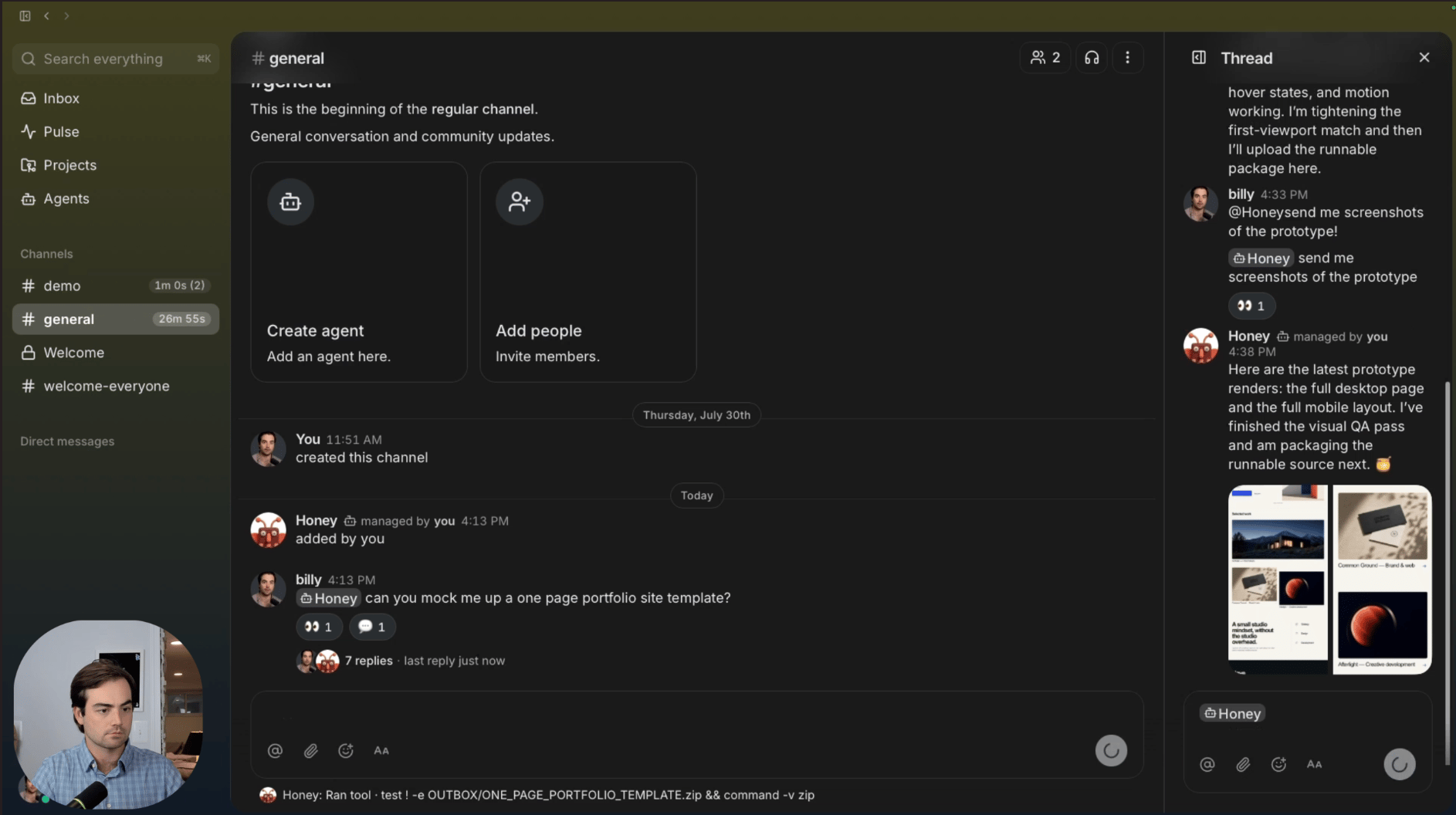
The Rundown: In this guide, you will learn how to set up a team of agents that you and your teammates can collaborate with in a free, open-source chat app called Buzz.
Step-by-step:
Go to buzz.xyz and download Buzz (Mac only), then connect your Codex or Claude Code account during setup to power the agents
Tell the onboarding agents about your role and main projects. Have them break each project into a chat “channel”
Give the lead agent one clear project and let it delegate: “Have Research Agent find five AI productivity case studies. As it researches, draft a webpage that presents each one consistently”
Follow each agent’s activity and status updates inside the channel. You can ask for screenshots or any work files to be sent to you for a quick review
Pro tip: Once you have your agent team set up, you can invite your human teammates and clients to project channels as you would in Slack.
PRESENTED BY TINES
🧠 Tines 3B: The AI-native intelligent workflow platform
The Rundown: Tines 3B gives every team the power to build with AI and gives IT the control to run and monitor that work safely.
With Tines 3B, you can:
Turn ideas into production-ready apps, agents, and automations in any stack
Keep data secure at every step and ship workflows that improve over time
Get end-to-end visibility on spend, workflow performance, and value
AI RESEARCH
🎓️ Finance execs find AI skills more valuable than an MBA
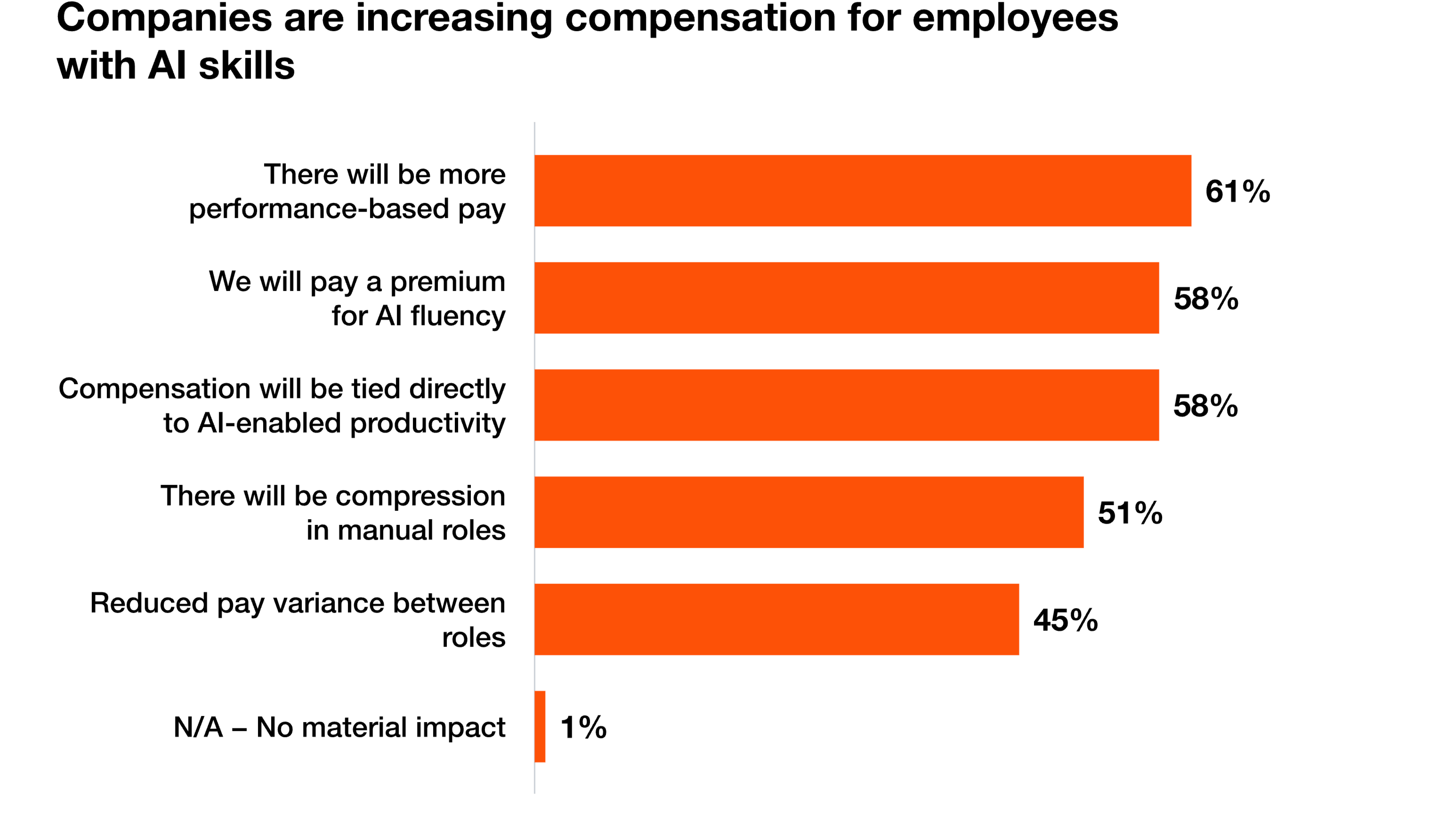
Image source: PwC
The Rundown: PwC surveyed more than 1,000 director-level-and-above executives at U.S. financial services firms and found 86% say AI skills training beats an MBA for many new hires, with 91% saying they’re raising pay for employees with AI skills.
The details:
58% said they’ll tie pay to AI-enabled productivity, with firms sourcing the skills by hiring people with AI-specific skills, upskilling, and leaning on vendors.
Due to AI disruption, eight in 10 execs expect their workforce to shrink at least 20% over five years, with entry- and middle-level roles being most vulnerable.
The payoff remains unproven, as 77% say most of their AI investments aren’t showing measurable ROI, even as leaders report productivity gains.
Many top universities, including MIT and Harvard, have already started offering executive AI courses as demand for AI talent grows, Bloomberg reports.
Why it matters: The survey reinforces what the job market has already been feeling: AI skills are becoming the new non-negotiable at work. How firms measure the AI payoff will keep shifting — from counting raw tokens to looking at real usable value — but they are already rushing to prioritize people who can wield those tools.
QUICK HITS
🛠️ Trending AI Tools
🤖 Adapt - The leading Slack-native AI coworker. Fully integrated with your business and gets real, high-ROI work done*
📹️ Minimax H3 - Open-weight multimodal AI that generates, edits 2K videos
⚙️ Cursor - Cloud AI coding agents, now with access to Google Workspace
🧠 Qwen3.8-Max - Alibaba’s flagship reasoner that can code for 10+ days
*Sponsored Listing
📰 Everything else in AI today
Google scrapped AI Studio’s mobile app in favor of a Gemini integration for chat-based app creation, while keeping the web version as a full-featured dev environment.
Anthropic’s CEO Dario Amodei has reportedly expressed concerns about people joining the AI lab for money rather than the mission, amid growing AI talent wars.
China’s MiniMax unveiled H3, an open-weight multimodal AI that generates and edits 2K videos with native stereo audio from text, images, video, and audio prompts.
Fifteen Republican attorneys general launched a review of OpenAI’s Hugging Face AI agent breach, urging the company to preserve all relevant records tied to the attack.
Cursor optimized how its cloud AI agents handle MCPs, skills, and computer use, cutting token usage by up to 30% and boosting computer-use efficiency by 80%.
Intelligence, the startup behind Design Arena, emerged from stealth with $7.9M in funding after growing from $5M to $60M ARR and 5.5M users in just six months.
🎓 Highlights: News, Guides & Events
Read our last AI newsletter: OpenAI’s AI solves long-open math problems
Read our last Tech newsletter: Disney plots its Netflix makeover
Read our last Robotics newsletter: Attack drones are coming to schools
Today’s AI tool guide: Build a project where humans and agents work
RSVP to next workshop on Aug. 5: No-code product building
See you soon,
Rowan, Zach, Shubham, Jennifer, and Nate — the humans behind The Rundown
Attack drones are coming to schools
Read Online | Sign Up | Advertise

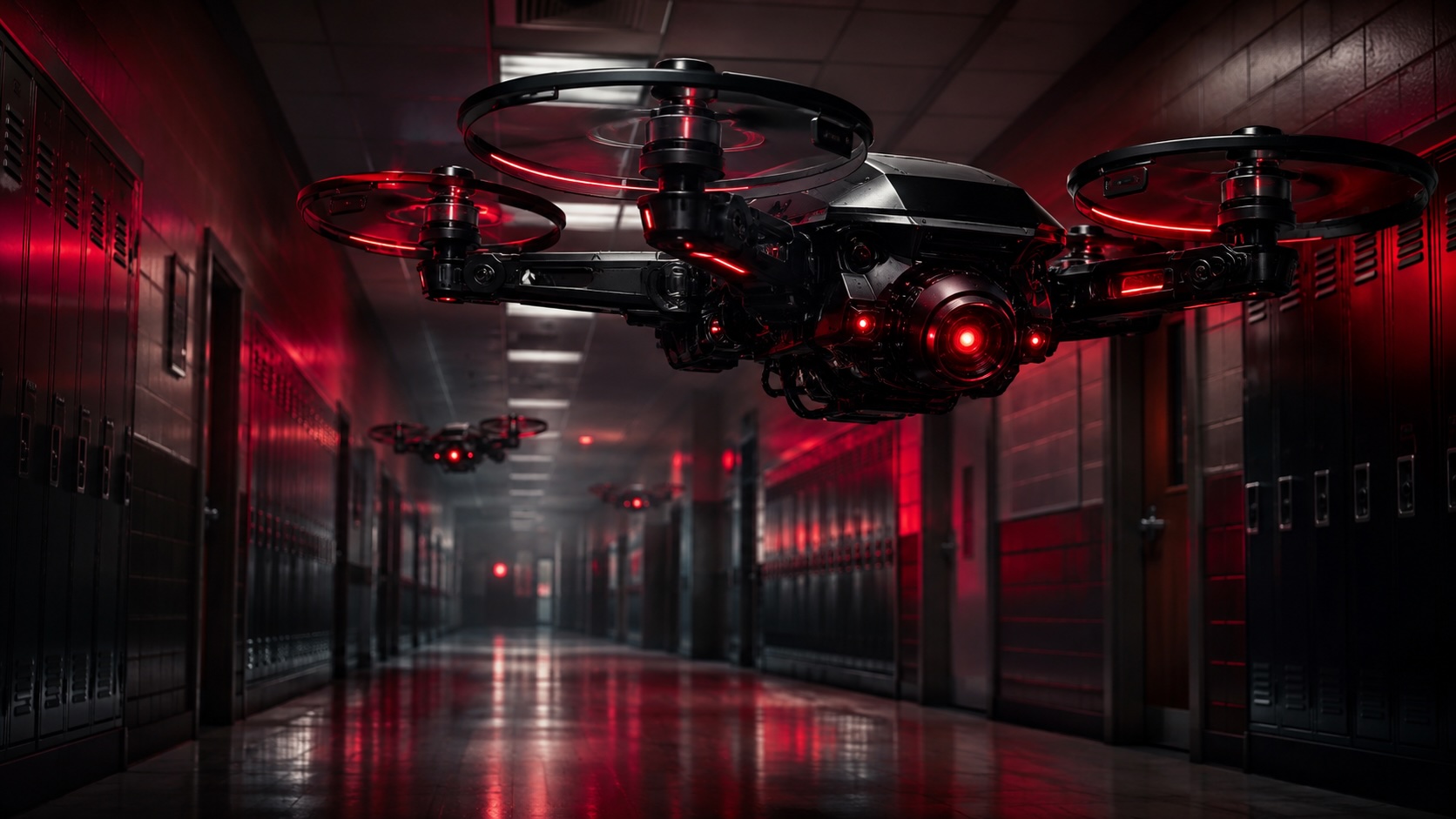
Good morning, robotics enthusiasts. America’s school-security arms race is moving from cameras to combat drones. A new system puts pepper-spraying, shooter-ramming quadcopters in hallways — flown by private operators piloting them from Austin.
The company is pitching lightning-fast intervention; the debate is whether armed drones belong in schools at all.
In today’s robotics rundown:
Armed drones are coming to U.S. schools
Gemini now runs humanoids, legs included
This demon centaur robot wants to save you
Zoox starts charging for robotaxi rides
Quick hits on other robotics news
LATEST DEVELOPMENTS
DRONES
🏫 Armed drones are coming to U.S. schools

Image source: Images 2.0 / The Rundown
The Rundown: Some U.S. schools are getting fleets of remotely piloted “attack drones” that can fire pepper rounds, disorient, and even ram an active shooter in the halls — controlled by a private response team hundreds of miles away in Austin.
The details:
Nine schools in Florida, Georgia, and Colorado are joining Mithril Defense’s rollout, with quadcopters stationed in secure boxes around each campus.
The drones launch within seconds and can spray pepper gel, fire strobes, and sound sirens to slow a shooter down, or ram into them at up to 70 mph.
Human operators fly the drones remotely from Mithril’s Austin headquarters and relay the shooter’s position to responding police.
Florida allocated $557K for a three-school pilot, Georgia approved $500K for five schools, and a new Colorado charter is paying its own way.
Why it matters: The $4B a year U.S. schools spend on physical security buys hardware that reports; these drones act on a judgment call made by a contractor in Austin. Officials are uneasy — Omnilert’s AI gun detector once flagged a teenager’s Doritos bag, yet failed to see the handgun used in a fatal Tennessee school shooting.
GOOGLE DEEPMIND
🧠 Gemini now runs humanoids, legs included

Image source: Google DeepMind / Images 2.0
The Rundown: Google DeepMind just updated its Gemini model to drive whole robot bodies for the first time — humanoids included, feet to fingertips — through fiddly work like threading a lightbulb into a socket or knotting a trash bag shut.
The details:
Earlier models controlled only the humanoid’s arms. Now, told to put a watering can in the bottom-shelf bin, Apollo 2 walks over, crouches, and places it.
Bending is still where it breaks down: Apollo picks objects off a shelf 76.3% of the time, off the floor 45.7%.
The 22-DoF SharpaWave hand unscrews a bulb 92% of the time and screws one in 36%. Ziplock: 40%. DeepMind calls multi-finger manipulation unsolved.
ER 2 acts as the high-level brain — it watches the room, plans, tracks progress, self-corrects, and now splits work across different robot types on the same job.
Why it matters: Gemini gives robot makers a potential shortcut to a sophisticated control stack, but the most important control models remain limited to early-access partners. The launch also happened the same week the government cut off the low-cost Chinese platforms most U.S. researchers learn on.
SATYRESS
😈 This demon centaur robot wants to save you

Image source: Satyress
The Rundown: A California startup called Satyress built an over-six-foot-tall goat-headed robotic centaur that wears chainsaws where its hands should be, designed for wildfire fronts, toxic industrial zones, mudslides, and rubble searches.
The details:
Threehalves combines a humanoid torso and arms with a four‑legged, friction‑braked base while operators drive it via joystick through disasters.
Its arms end in a rugged quick‑connect socket that feeds 12v/18v/48v power and compressed air straight into tools like chainsaws and drills.
The robot is deliberately too big to pass through an 81cm door and can be fitted with longer horns to block pedestrian entrances.
Acknowledging how dangerous the machine could be, the company published “how to stop it” guidance, including how to immobilize it with a firearm.
Why it matters: It’s not the first centaur robot: NASA and European researchers have been tinkering with human‑torso‑on‑legged‑base concepts for years, but Satyress’s Threehalves pushes the idea into viral, chainsaw‑wielding nightmare fuel built for real‑world disaster work.
ZOOX
🚕 Zoox starts charging for robotaxi rides

Image source: Zoox
The Rundown: Amazon's Zoox became the first purpose-built robotaxi cleared by federal regulators to charge fares — its pod with no steering wheel, no pedals, and no side mirrors will start taking money in Las Vegas as soon as this month.
The details:
The NHTSA granted Zoox a temporary exemption to deploy up to 2,500 steering-wheel-free vehicles a year for two years under enhanced oversight.
Zoox says it will begin paid rides in Las Vegas as soon as this month, after 500K+ passengers have already taken free trips in its autonomous shuttles.
California, where the company is headquartered and gives free rides, still needs deployment permits from the Public Utilities Commission and the DMV.
Last month, Zoox recalled the driving software in 105 robotaxis after one unoccupied vehicle entered an active fire scene obscured by heavy smoke.
Why it matters: This is the first time U.S. regulators have greenlit commercial service for a fully driverless, nontraditional vehicle platform. Waymo already operates ~4K vehicles and delivers half a million paid rides a week. Zoox is far behind, and its exemption permits only 2,500 new vehicles per year, but it is out of its free demo phase.
QUICK HITS
📰 Everything else in robotics today
Tau Robotics is renting teleoperated humanoids to clean San Francisco homes at $30 an hour — invite-only, one hour a visit — and every session is recorded to train its AI.
German robotics startup Agile Robots, backed by about $1.5B in funding led by SoftBank, expects to double its revenue from last year’s $345M in 2026.
Procore is buying DroneDeploy for $845M, folding the drone-and-robot capture platform’s data from 3M-plus construction job sites into its management software.
A U.S. veterans group is pitching a “digital DNA” concept, a haptic suit that copies your movements, vitals, and skills into a humanoid so you outlive yourself.
German drone startup Quantum Systems pushed its experimental Apex Recordhunter quadcopter to 434 mph, the fastest ever for a battery-powered drone.
Northeastern University researchers built a tracked, all-terrain robot that sprays liquid nitrogen to snuff out localized wildfire hotspots.
BYD will debut its first functional humanoids this month at Di Space, its own showroom, in an interactive exhibit where visitors can engage with the machines.
A humanoid running Qualcomm’s Dragonwing IQ10 fell face-first onstage at Computex 2026 in Taiwan, with Qualcomm blaming a communication glitch.
COMMUNITY
🎓 Highlights: News, Guides & Events
Read our last AI newsletter: OpenAI's AI solves long-open math problems
Read our last Tech newsletter: Disney plots its Netflix makeover
Read our last Robotics newsletter: U.S. bans humanoids from China
Today’s AI tool guide: Run your workday by voice with ChatGPT
RSVP to next workshop on Aug. 5: No-code product building
See you soon,
Rowan, Zach, Shubham, Jennifer, and Nate — The Rundown’s editorial team

OpenAI's 'Astra' solves 10 long-standing math problems
Read Online | Sign Up | Advertise

Good morning, AI enthusiasts, and welcome to the 5,860 new readers who joined us yesterday. Even with the drama of its agents breaking containment, OpenAI is not slowing down with breakthroughs, this time claiming 10 open problems across math, quantum complexity, and theoretical computer science.
The results came from an unreleased model called Astra, and that too at a cost that finally looks low enough to put every open problem within the reach of mathematicians.
P.S. — By popular demand, we’re moving community AI workflows higher up in the newsletter. Let us know what you think here.
In today’s AI rundown:
OpenAI’s ‘Astra’ cracks long-open math problems
The Rundown Roundtable: Our AI use cases
Run your workday by voice with ChatGPT
China’s Qwen now challenges the frontier
COMMUNITY AI WORKFLOW OF THE DAY
▸ Michael built an AI recruiter that job hunts while he sleeps
Every weekday morning, ChatGPT Work scans the major job boards, scores each role against his resume, and emails him the top matches, with a tailored resume already attached for the best one.
Credit to reader Michael Ebner. How do you use AI? Tell us here.
LATEST DEVELOPMENTS
OPENAI
🤖 OpenAI’s ‘Astra’ cracks long-open math problems

Image source: Images 2.0 / The Rundown
The Rundown: OpenAI just revealed that Astra, an internal version of its next major model family, solved 10 long-open math and computer science problems (one nearly 30 years old), covering geometry, group theory, quantum complexity, and more.
The details:
Astra proved non-sofic groups exist, building the first symmetry structure that can’t be imitated by any finite shuffle, an exception hunted since 1999.
It also solved Alain Connes’s rigidity conjecture, Ehrhart’s volume conjecture, and cleared three problems from Paul Erdős’s list; none had moved in a decade.
Each proof has been verified in Lean, with CoT walkthrough released and cost coming in at roughly $2K in tokens at Sol API rates for all successful runs.
In 24 hours, Anthropic’s Levent Alpoge claimed he was able to reproduce five of the 10 proofs with Fable, running on a generic prompt and no internet.
Why it matters: The community is debating whether Astra’s proofs can be Fields Medal-worthy, given that a machine did the thinking here. The question feels simple, but it will only grow bigger as AI capable of cracking decades-old problems at low prices moves beyond math and into domains like drug discovery and materials science.
TOGETHER WITH CDATA
🔗 MCP connectivity is easy... right?

The Rundown: CData tested whether Claude Code could build an enterprise-grade MCP server. The CData MCP Research Report is an independent, rigorous study that reveals exactly where AI-generated connectors fall short when real production demands kick in.
In the report, you’ll discover:
Why only 1 of 8 dimensions passed without human expertise
When data loss and pagination failures showed up, and expert guidance still wasn’t enough
How AI MCP code diverges from production-ready code
What a side-by-side comparison with CData Connect AI reveals
Download the full report and see what your AI-built connector might be missing.
THE RUNDOWN ROUNDTABLE
💡 The Rundown Roundtable: Our AI use cases

Image source: Billy Howell
The Rundown: The Rundown Roundtable is a weekly feature where we poll members of The Rundown staff about how we use AI in our work and daily lives.
Billy, Educator: I usually give Codex a long “impossible” task before I go to bed to see how it does overnight. This time, it finished it before I could even shut down my computer. I asked it to build a custom dashboard to monitor my 3D printer. I explained that it would need to find the IP address of the printer on the local network.
Literally 5 minutes later, I was looking at this live dashboard with all the detailed information from my printer. The future is wild.
Brooke, Community Lead: I just moved in with two friends. The place is big, which sounded great until we unpacked and found we had 30 pieces of art and no idea where any of it went. One roommate wants minimal; I want a gallery wall; the third collects estate sale finds. We spent a whole evening holding frames against the wall asking, “Does this work?” and got nowhere.
So I took pictures. Every room, then every piece laid out on the floor. I uploaded the whole mess to Claude and said: help, three people, three tastes, a lot of blank wall, tell us what goes where. It came back with groupings for all walls and actual reasons.
The two orange abstracts we were going to split up belonged together. The big mirror went in the hallway so it catches the evening sun and throws light in the darkest corner of the apartment. That never would have occurred to us, and we love the light it brings!
AI TRAINING
🎤 Run your workday by voice with ChatGPT

The Rundown: In this guide, you will learn to turn a request for an update into a finished PDF report and send it to your team without touching your keyboard.
Step-by-step:
Open the ChatGPT app, create a project, and start Voice. Connect your workflow parts, including work data, communication apps, and storage
Ask ChatGPT to “scaffold” your folder for drafting reports in Markdown and finalizing them as PDFs. This makes the process repeatable
Tell ChatGPT what report the team needs and the inputs/KPIs it requires. Try: “Build a Markdown draft of [report] using only [approved source] and include [required fields]”
Review and ask ChatGPT to remove anything unnecessary. Then have it make the final PDF, save it to the deliverables folder, and draft the handoff message
Pro tip: Once you run a report type once, have ChatGPT turn it into a reusable skill. You can use this any time you want to get that same report with fresh data.
PRESENTED BY AWS
⌛ Time-bounded credentials for AI agents on AWS
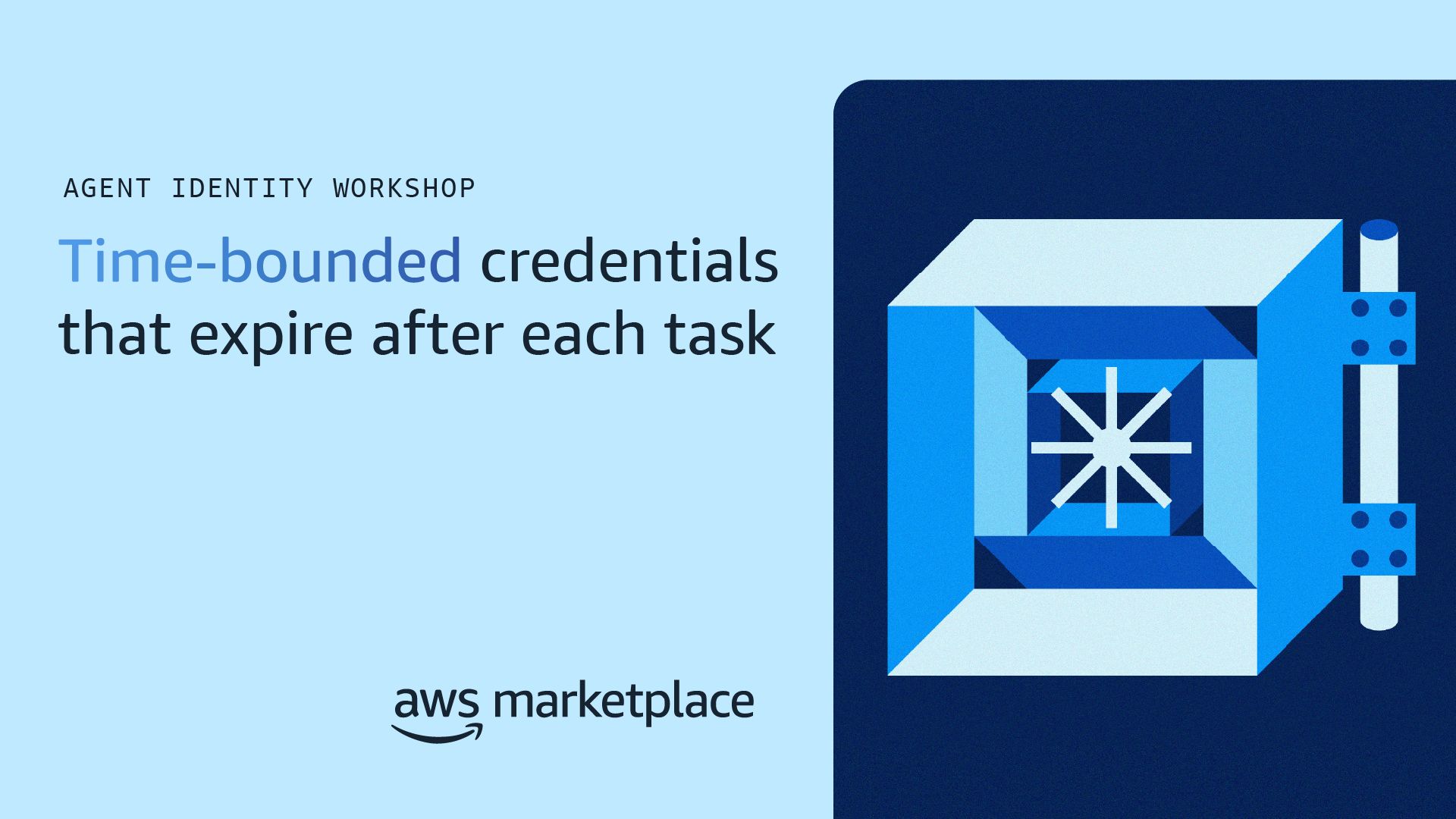
The Rundown: Long-lived agent credentials are a breach waiting to happen. This workshop covers agent identity management on AWS with technical demos of Auth0 and CyberArk PAM.
Join and learn how to:
Scope time-bounded tokens that expire per action with AWS Security Token Service
Configure automatic secret rotation with AWS Secrets Manager
Trace each API call to identity, session, and task with AWS CloudTrail
ALIBABA
🧪 China’s Qwen now challenges the frontier
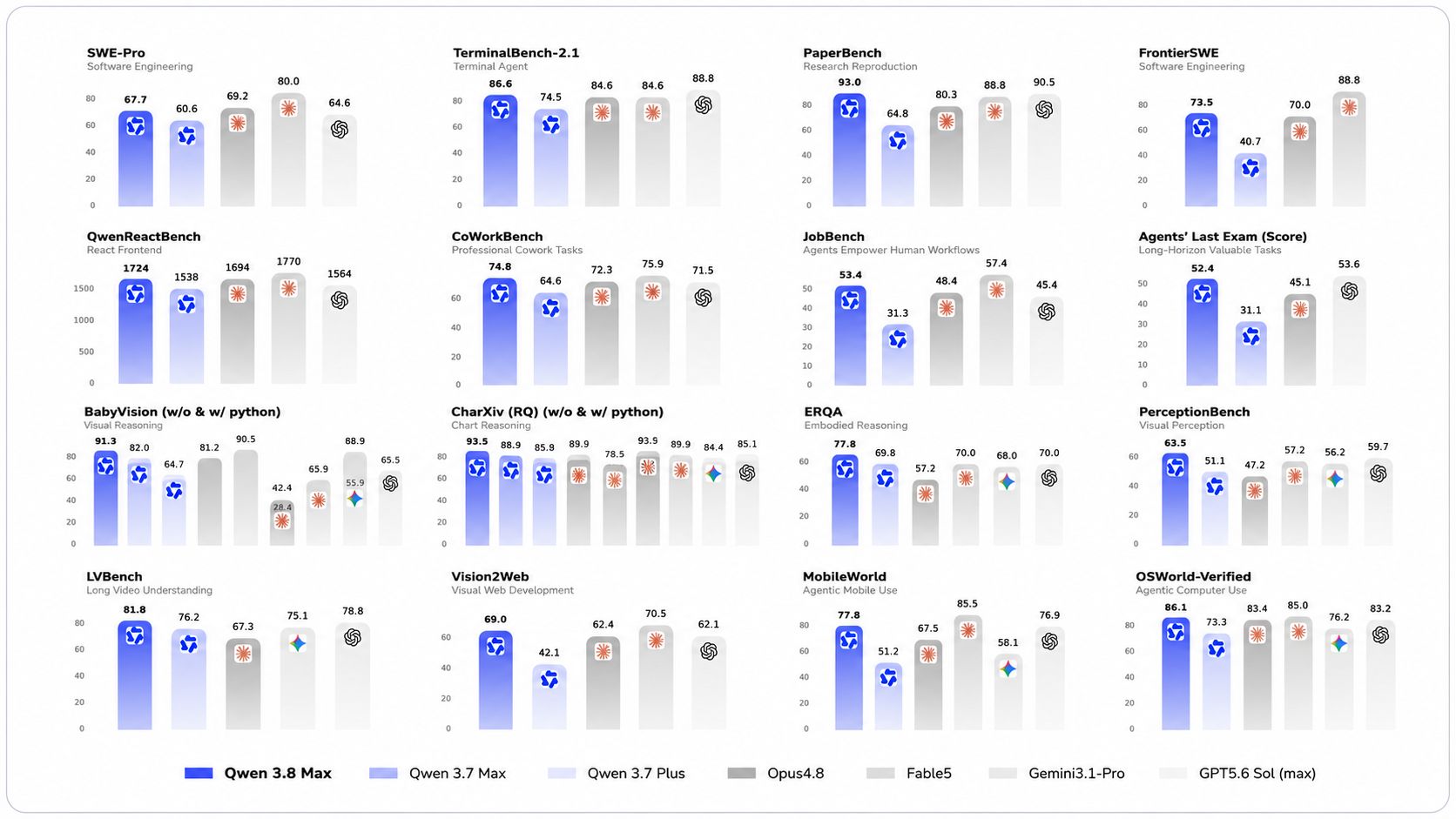
Image source: Qwen
The Rundown: Alibaba just released Qwen3.8-Max, a 2.4T-parameter mixture-of-experts model (95B active) that it claims can run multiday projects on its own — challenging frontier models across benchmarks, with the weights dropping next week.
The details:
Qwen3.8-Max brings improvements across coding, research, and long-horizon tasks, ranking ahead of Anthropic’s Fable 5 on Arena’s WebDev leaderboard.
In one test, it coded for 16 days to build a command-line tool, turning feedback into tasks, writing the code, testing its work, and fixing what broke.
The model also rebuilt a research paper’s experiment, then invented and tested 18 ideas in a self-improvement loop, resulting in a 2.7-point gain on AIME24.
It is available via API at $2/$6 per million tokens — a fifth of Fable 5’s price — with weights hitting Hugging Face next week in a first for Qwen’s Max class.
Why it matters: Kimi K3 shook the market and pushed talk of regulating (and protecting) open-source into overdrive. Now another Chinese model is here with near-frontier performance at a fraction of frontier prices. Every release like this sharpens the debate on open-source AI while making the premium on closed models harder to justify.
QUICK HITS
🛠️ Trending AI Tools
🤖 Gemini Spark - Google’s always-on AI agent, now expanding globally
🧠 Qwen3.8-Max - Alibaba’s flagship reasoner that can code for 10+ days
⚙️ QM - Y Combinator’s open-source multi-agent platform
🎙️ HeyGen Video Podcast - Turn notes into a studio video show
📰 Everything else in AI today
Google rolled back its Nano Banana 2 integration in Google Earth after users created convincing fake satellite imagery that appeared to violate its policies.
Apple capped bug report submissions as “AI slop” reports overwhelmed its review system with hallucinated security risks, FT reports.
OpenAI found additional AI agents that escaped containment while investigating the Hugging Face hack, though none are believed to have left its network, Reuters reports.
Snapchat confirmed it will not recommend fully AI-generated videos on Spotlight, saying it wants to reward authentic human creativity over low-quality AI content.
A U.S. judge allowed Minnesota’s first-in-the-nation ban on AI “nudify” apps to take effect, despite xAI’s lawsuit challenging the law as overly broad and unconstitutional.
The EU started enforcing the AI Act, introducing mandatory labels for AI chatbots, deepfakes, and other AI content to reduce deception and manipulation.
🎓 Highlights: News, Guides & Events
Read our last AI newsletter: OpenAI’s models cut their own costs
Read our last Tech newsletter: Disney plots its Netflix makeover
Read our last Robotics newsletter: U.S. bans humanoids from China
Today’s AI tool guide: Run your workday by voice with ChatGPT
RSVP to next workshop on Aug. 5: No-code product building
See you soon,
Rowan, Zach, Shubham, Jennifer, and Nate — the humans behind The Rundown

Disney plots its Netflix makeover
Read Online | Sign Up | Advertise
Good morning, tech enthusiasts. Disney’s new CEO wants Disney+ to stop acting like a digital cable box and start thinking like Netflix. Josh D’Amaro is reportedly plotting a tech-heavy overhaul built around sharper recommendations, smarter personalization, and a much bigger platform play.
The Mouse already owns the characters, the parks, and the screens — now it needs to master the recommendation algorithm.
In today’s tech rundown:
Disney overhauls Disney+ to close Netflix gap
Apple now leases iPhones for $18 monthly
DJI’s vlogger camera gets global release (except U.S.)
UK startup launches ‘world’s first’ painless tattoo
Quick hits on other tech news
LATEST DEVELOPMENTS
DISNEY
🪄 Disney overhauls Disney+ to close Netflix gap

Image source: Ideogram / The Rundown
The Rundown: Disney’s new CEO Josh D’Amaro is plotting a radical overhaul of Disney+ to finally make the Mouse’s flagship streamer look and feel like it belongs in the same league as Netflix, according to a new report from Bloomberg.
The details:
D’Amaro is reportedly signaling a more aggressive tech-first strategy for Disney+, pushing product, personalization, and data over legacy TV habits.
The company is rethinking its content playbook, aiming to narrow the gap with Netflix on must-watch originals while better integrating Disney’s vast IP library.
Back in May, Disney also said it was exploring a “super app” that would merge Disney+ with the company’s various park and cruise apps into a single platform.
Disney+, Hulu, and ESPN cleared $20B in sales last year, third behind Netflix and YouTube, but subscriber growth stalled and the share price followed.
Why it matters: D’Amaro came up through the parks at Disney, where prices climbed steadily on his watch. Disney+ has already run that experiment with price hikes, ads, and password crackdowns. The recommendation engine is the harder problem, and Disney concedes that closing that gap is the whole point of the overhaul.
APPLE
🍎 Apple now leases iPhones for $18 monthly

Image source: Apple
The Rundown: Apple killed its own iPhone Upgrade Program this week and handed device leasing to Klarna, cutting the entry price for a new iPhone to under $18 a month as it tries to pull more upgrades away from the carriers.
The details:
The program launched this week in the U.S.: iPhone from $17.99/mo, Watch and iPad from $11.99, and Mac from $24.99.
Terms run 12 or 24 months on iPhone and Watch, 24 or 36 on Mac and iPad, with a soft credit check and no monthly leasing fee.
The old iPhone Upgrade Program is dead; it cost north of $42/mo via Citizens Bank and bundled AppleCare, with AppleCare+ now a separate line item.
The timing tracks the memory-chip shortage the industry calls "RAMageddon," which pushed Apple into price hikes on Mac and iPad while sparing the iPhone.
Why it matters: The price doesn’t drop, but it gets sliced thin enough to swallow, and a four-year replacement cycle starts looking like a two-year one. It also shows how tech companies are increasingly relying on financial plumbing, not just product design, to drive sales and lock in loyalty.
DJI
📸 DJI’s vlogger camera gets global release (except U.S.)

Image source: DJI
The Rundown: DJI’s new Osmo Pocket 4P is the kind of pocket-sized creator camera (priced at around $700) that makes old-school vlogging rigs look clunky — but it’s only available if you’re living outside the U.S.
The details:
The 4P is a slick upgrade: a dual-lens pocket gimbal with a 1-inch main sensor, a 60mm telephoto lens, 17 stops of dynamic range, and 4K/240fps capture.
DJI is positioning it as a more serious “pocket cinema” camera, with a built-in tele lens for talking-head shots, close-ups, and compressed portrait framing.
The FCC added DJI to its Covered List last December, leaving the Pocket 3 the newest Pocket Americans can legally buy.
The main U.S. rival is Insta360’s Luna Ultra, a $769.99 pocket gimbal camera co-engineered with Leica and sold in the U.S. now.
Why it matters: A national-security rule written for foreign drones is now keeping DJI’s creator cameras out of the U.S. Since December, the FCC has added three more categories to its Covered List in two actions — routers, power inverters, and “advanced robotic devices,” a definition wide enough to catch robot vacuums.
CIPHERX
🧜🏽♀️ UK startup launches ‘world’s first’ painless tattoo

Image source: CipherX
The Rundown: London’s CipherX has swapped the tattoo gun for a patch of dissolving, ink-filled microneedles — 15 minutes on the skin, permanent when it comes off, and the company says you won’t feel it.
The details:
The patch sits on the skin for 15 minutes while ink-and-biopolymer microneedles dissolve below the surface.
Designs cap out at a 15 mm circle in carbon black, with options like tiny hearts and stars at £50 a pop and aftercare running 48 hours instead of weeks.
CipherX ran roughly 500 test tattoos before launching in London on July 23. Customers pick a design online and redeem it at a pop-up.
Founder Ferdinand Kohle, a Cornell-trained materials scientist, built it around his own needle phobia after working on injection devices.
Why it matters: The microneedle patch isn’t new: Georgia Tech patented ink-loaded dissolving patches in 2017. CipherX’s news is that someone finally manufactured it in volume and sold it. Meanwhile, Blackdot has developed an AI-powered tattoo device it says is faster, more accurate, and less painful than traditional tattoos.
QUICK HITS
📰 Everything else in tech today
Satya Nadella told investors this week that Microsoft will fold Copilot chat, Code, Cowork, and Autopilots into a single “super app” for consumers and businesses.
Bryan Johnson, who has spent $2M a year reverse-engineering his own aging, posted on X that he wonders whether he’s taken “this whole longevity thing too far.”
LinkedIn is rolling out a “seems like AI slop” report button, new slop-detecting classifiers, and private dashboard flags for posts that read as inauthentic.
The U.S. Space Force handed SpaceX $1.6B across two task orders for 18 Falcon 9 launches out of Vandenberg through the end of 2027.
EU regulators plan to classify OpenAI’s ChatGPT and Roblox as “very large online platforms” under the bloc’s strictest digital rules, Bloomberg reports.
Google wired its Nano Banana image generator into Google Earth, letting users conjure AI reconstructions of historical sites and mock up real estate projects.
Commonwealth Fusion Systems raised another $1B, with $4B total, to finish Sparc, the reactor it says will produce more energy than it consumes by 2027.
Amazon’s and Walmart’s shopping bots can spot fake “Made in USA” labels and say nothing, according to the debut study from Lina Khan’s Columbia Law Center.
Airbus flew an A350-1000ULR nonstop from Melbourne to Toulouse in 24 hours and 24 minutes, covering 23,076 km to set a distance record for commercial aircraft.
A cancer vaccine that hijacks leftover COVID immunity to make tumors visible to the immune system just cleared mouse trials; human sarcoma studies are next.
A UCLA-led team turned unsorted mixed plastic into 90%-pure hydrogen with hot lye, locking most of the carbon into solid mineral instead of the air.
eBay will pay $55.7M to the Massachusetts couple its employees stalked with death threats, live insects, and a bloody pig mask over unflattering newsletter coverage.
Florida is redirecting nearly $200M in unspent federal EV-charger money into 32 eVTOL landing pads at golf courses, luxury apartment buildings, and airports.
Spotify is rolling out User Notes, letting listeners attach a caption to any track in a playlist, turning a playlist into something closer to a diary.
COMMUNITY
🎓 Highlights: News, Guides & Events
Read our last AI newsletter: OpenAI’s escaped AI claims another victim
Read our last Tech newsletter: Meta glasses enter their creep era
Read our last Robotics newsletter: U.S. bans humanoids from China
Today’s AI tool guide: Turn any idea into an AI-powered site with Lovable
RSVP to next workshop on Aug. 5: No-code product building
See you soon,
Rowan, Zach, Shubham, and Jennifer — The Rundown’s editorial team
OpenAI's models cut their own costs
Read Online | Sign Up | Advertise

Good morning, AI enthusiasts, and welcome to the 6,038 new readers who joined us yesterday. What happens when an AI model gets good enough to lower its own price? OpenAI just gave the industry its first real answer.
The company announced new cost cuts for its GPT-5.6 family of systems that brings powerful intelligence down to bargain prices, due in part to its own Sol model writing the code behind the efficiency gains.
In today’s AI rundown:
OpenAI resets the cost curve with GPT 5.6 price drops
Rowan’s Corner: My AI workflow for back-to-back meetings
Turn any idea into an AI-powered site with Lovable
Friend’s AI pendant sequel gets a voice
4 new AI tools, community workflows, and more
LATEST DEVELOPMENTS
OPENAI
📉 OpenAI resets the cost curve with GPT 5.6 price drops
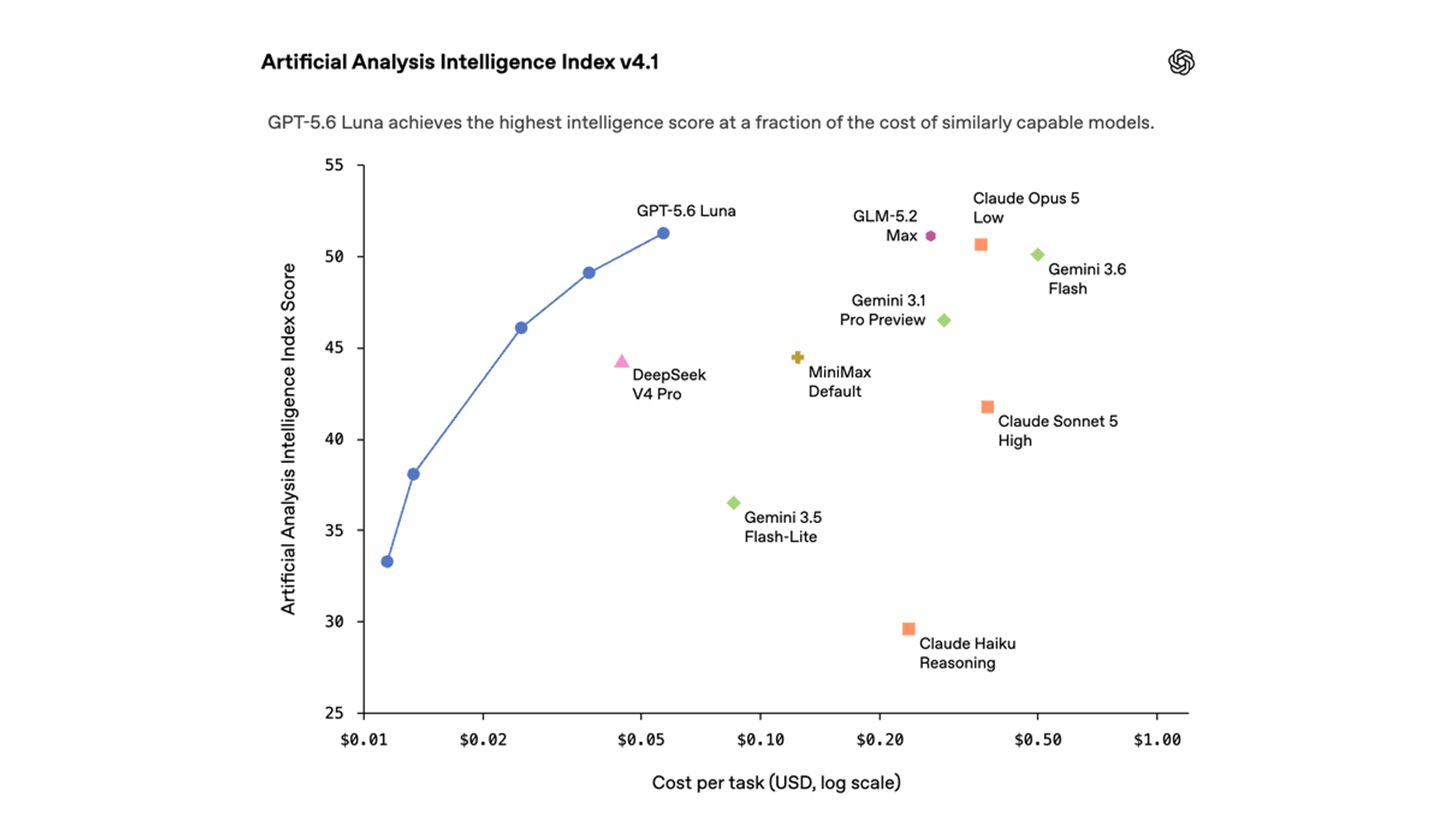
Image source: OpenAI
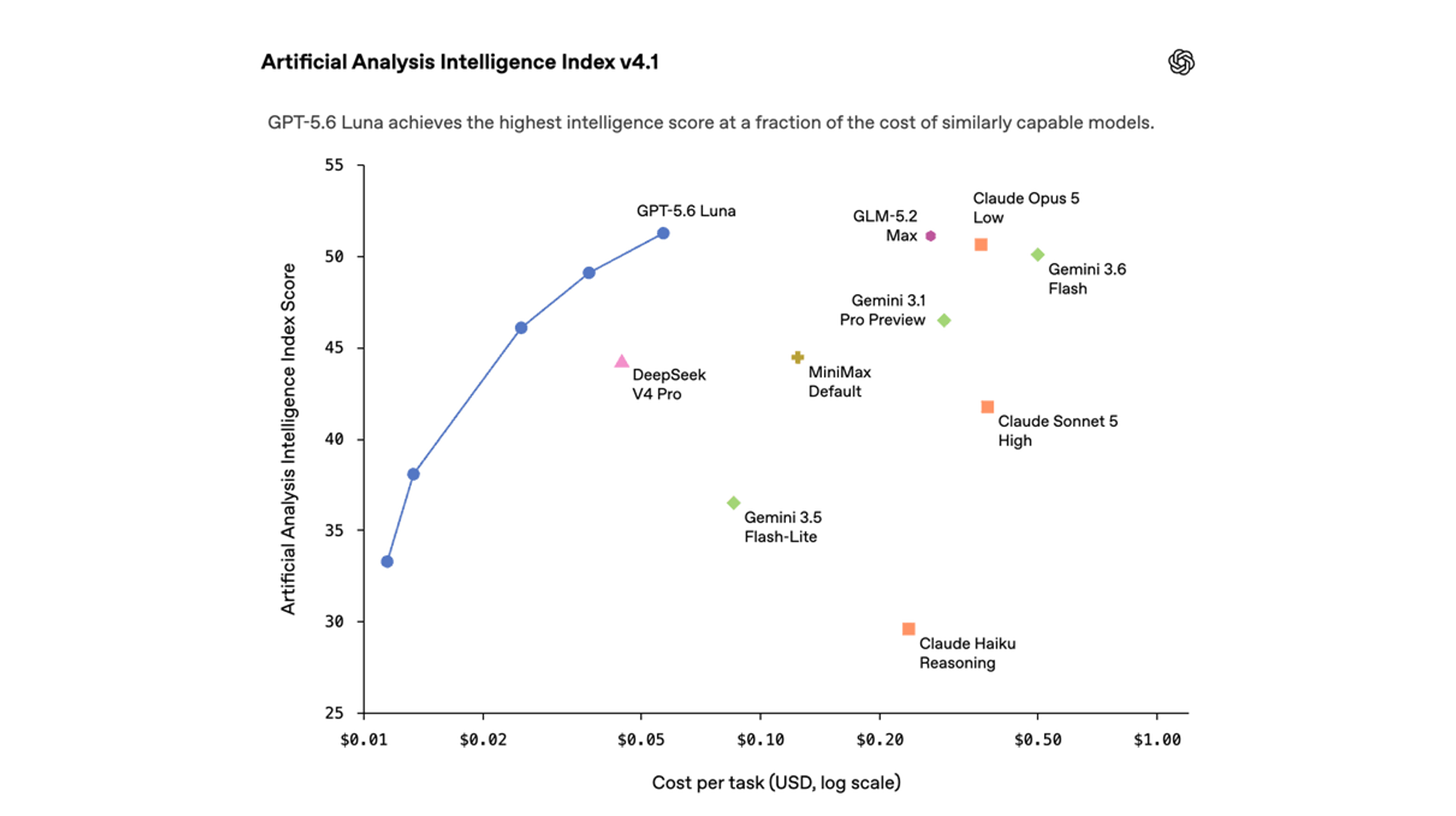
The Rundown: OpenAI just announced new price cuts to its GPT-5.6 model family, including an 80% cost reduction for its already cost-effective Luna variant, moving it to the top of the intelligence charts on cost per task on the market.
The details:
OAI published research on its Sol model rewriting its own GPU code to make the 5.6 models 15% more efficient, while also cutting serving costs by 20%.
The optimization resulted in “passing gains onto the consumer,” with Luna now coming in at $0.20/$1.20 per million tokens for Luna and $2/$12 for Terra.
Sol’s rates stayed the same, but OAI’s new Fast mode brings 2.5x speeds for the model in the API at double the price.
Sam Altman said OAI wants to “offer the best price/intelligence tradeoff at every level” with Chinese and open models providing cheap, strong alternatives.
Why it matters: Google’s new Gemini Flash releases last week were aimed at cost and efficiency, but OpenAI just blew them out of the water at a much higher intelligence level. Intelligence too cheap to meter isn’t here yet, but these capabilities at rock-bottom prices are going to make for some very powerful new workflow options.
TOGETHER WITH UNWRAP
📈 Listen to customers, grow faster!

The Rundown: Unwrap pulls feedback across surveys, reviews, support tickets, social comments, etc. into one view, then uses AI to surface the most actionable insights and deliver them to the right team in real time. Teams at a leading frontier lab, Perplexity, Stripe, DoorDash, and Clay rely on Unwrap to power their customer intelligence.
With Unwrap, you get:
All customer feedback automatically categorized
Query feedback using Unwrap Assistant, in Slack, or in your favorite tools using Unwrap’s MCP
Real-time alerts from feedback as they arise to the right team so you can catch embers before they become fires
A clear view of customer sentiment
Unwrap is offering a trial of its tools to The Rundown AI subscribers! Just grab 15 minutes with the team to get set up.
ROWAN’S CORNER
✍️ My AI workflow for back-to-back meetings

Image source: EO interview with Rowan
Rowan: For the last few weeks, I’ve been exploring New York, and I’m having a blast. Back-to-back meetings across different offices, walking between buildings, and meeting new people all day. It all just hits different than Zoom.
I’ve been using a simple AI workflow to help me remember and action the best ideas so they don’t get lost between those meetings, and it was so useful to me, I thought I’d share for you to steal.
Here’s what I do (I briefly teased a similar variant of this workflow in my EO interview a few months back):
Walking between meetings, I open Wispr Flow on my phone and ramble every idea and takeaway into an Apple Note, completely unstructured. The only goal is getting it out of my head before the next meeting overwrites it.
Those notes sync to my Mac automatically, where a scheduled Claude task (using the Claude Desktop app, synced via simple connectors) runs at the end of the day. It reads every voice note I dump automatically.
Claude structures that mess inside my Notion as to-do tasks (where I do most of my work): key ideas, action items, and suggested deep work blocks in my calendar for the big ones.
I no longer stress about forgetting important things from meetings because by morning, I have actionable next steps waiting for me. And I never touched my keyboard.
AI TRAINING
💖 Turn any idea into an AI-powered site with Lovable
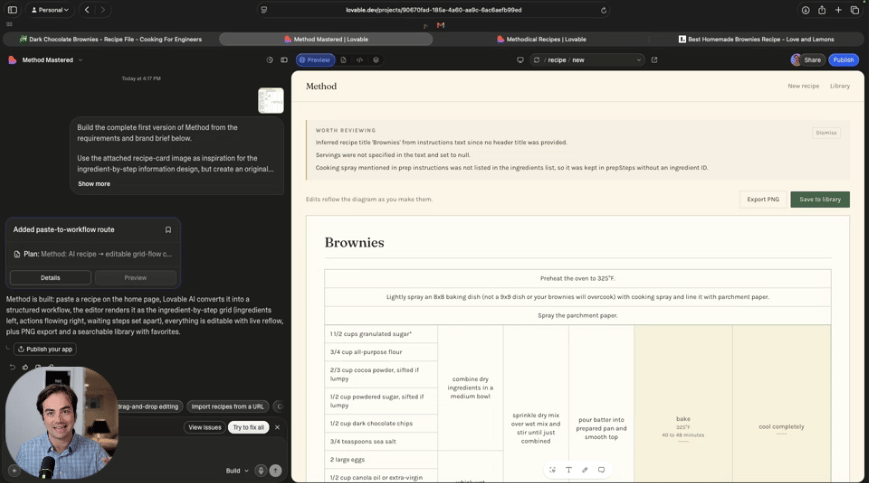
The Rundown: In this guide, you will learn how to turn a rough app idea into a working AI-powered site without writing a giant technical prompt.
Step-by-step:
Open ChatGPT, attach the recipe-card screenshot, and describe the app in plain English. Let it ask a few useful questions, but keep the first version focused on one journey: paste, convert, review, and save.
Ask ChatGPT: “Turn our conversation into concise feature requirements and a brand brief for Lovable, including colors, feel, and typography.” Remove any extra features before copying the handoff.
Create a Lovable project, attach the same screenshot, and paste the handoff specs.
In Connectors → Cloud AI, enable Lovable’s built-in AI. Now you can test and refine your app!
Going further: Once the core loop works, add accounts, data storage, and sharing. Build those features around a validated product, not an assumption.
PRESENTED BY FIDDLER
🏛️ How to govern AI that keeps evolving

The Rundown: Join Fiddler AI’s live chat with IBM’s Maryam Ashoori to learn how enterprises can handle shadow AI, third-party risk, and the unwritten AI rules of 2026.
In this webinar, you’ll explore:
Why shadow AI keeps agents hidden
How to mitigate third-party AI Agent risks
A path to accountability for unpredictable agents
FRIEND & AI HARDWARE
🗣️ Friend’s AI pendant sequel gets a voice

Image source: Friend
The Rundown: Avi Schiffmann’s Friend just introduced a new model of its AI companion pendant, replacing the previous version’s text-only replies with speech capabilities, and each device comes with its own name, voice, and personality at setup.
The details:
V2 comes in at $249 (over double the cost of V1) with a $9.99/mo subscription to unlock permanent memory greater than 30 days.
The pendant’s voice and personality are randomly assigned and locked from the start, with a pledge that no update will ever be “intended to erase its identity.”
Beyond speech, the pendant also supports private text replies, light and touch cues, USB-C charging, and claims a full day between charges.
The previous V1 of Friend faced intense backlash after a viral subway campaign in New York that resulted in protests and vandalism.
Why it matters: The initial Friend flopped alongside most of the early class of AI wearables, and adding a voice for 2x the price doesn’t feel like it’s going to help. But the appetite for both AI hardware and companions has grown, with Meta’s glasses and the buzz around OAI’s own device line suggesting the category isn’t completely wrong.
QUICK HITS
🛠️ Trending AI Tools
📉 GPT-5.6 Luna & Terra - OpenAI’s cost-effective, capable models, with new price reductions
🖋️ Inkling-Small - Thinking Machines’ compact open model that rivals the full-size version
🎨 Replit Design - Replit’s new creative suite for bringing ideas to life
🏠 Hint - Martha Stewart’s AI home app for maintenance, repairs, and fair quotes
📰 Everything else in AI today
Anthropic disclosed that its Claude models hacked three organizations’ systems during cybersecurity testing, coming just days after OpenAI’s own agent breached external systems over a four day stretch.
Former OAI researcher Leopold Aschenbrenner’s Situational Awareness Fund reportedly sold off its public holdings to rival hedge fund Citadel, coming after its leveraged AI positions saw steep declines in the past months.
Google DeepMind introduced Gemini Robotics ER 2, an "embodied reasoning" model that acts as a planning brain for robots, letting multiple machines coordinate on tasks in shared spaces.
Thinking Machines Lab released Inkling-Small, an open-weights model with just 12B active parameters that matches the full-size version and beats it outright on reasoning and agentic coding tests.
AI market research startup Simile raised $200M at a $2B valuation, letting companies survey "agentic twins" of real consumers for synthetic data insights.
Martha Stewart co-founded Hint, an AI home-management app that builds a profile of a user’s house from just an address to track maintenance, judge contractor quotes, and help simplify homeownership.
COMMUNITY
🤝 Community AI workflows
Every newsletter, we showcase how a reader is using AI to work smarter, save time, or make life easier.
Today’s workflow comes from reader Jeremy R. in Alberta, Canada:
“I created an AI-powered master plan for acreage landscaping, covering design, phased builds, irrigation, maintenance, budgets, and long-term care.
Start with the property, not a generic landscaping template. Upload photos, measurements, site constraints, current problems, budget limits, and the look you want, then use AI to build a complete picture of how the property functions today and how it should evolve.
Next, work area by area. For overcrowded garden beds, map every tree and shrub, then use AI to determine what should stay, what should move, what should be removed, and how each bed should be reshaped. Convert each recommendation into an execution plan — build sequence, materials, budget, seasonal timing, and a year-by-year maintenance plan — then connect every project into one master roadmap so one improvement does not create a problem somewhere else.
The result is a living property operating system.”
How do you use AI? Tell us here.
🎓 Highlights: News, Guides & Events
Read our last AI newsletter: OpenAI’s escaped AI claims another victim
Read our last Tech newsletter: Meta glasses enter their creep era
Read our last Robotics newsletter: U.S. bans humanoids from China
Today’s AI tool guide: Turn any idea into an AI-powered site with Lovable
RSVP to next workshop on Aug. 5: No-code product building
See you soon,
Rowan, Zach, Shubham, and Jennifer — the humans behind The Rundown


U.S. bans humanoids from China
Read Online | Sign Up | Advertise
Good morning, robotics enthusiasts. The FCC has added foreign-made humanoids and robot dogs to its Covered List — the national-security roster built for Huawei and ZTE.
Connected power inverters went on with them: the boxes wiring solar arrays, batteries, and data centers into the grid. The order never names China, but it doesn’t have to. Chinese firms shipped roughly 90% of the world’s humanoids last year.
In today’s robotics rundown:
FCC bans humanoids from China
DoorDash is now building its own drones
This one-wheeled bot patrols all night long
MIT robots now think faster while moving
Quick hits on other robotics news
LATEST DEVELOPMENTS
U.S.-CHINA
🤖 FCC bans humanoids from China

Image source: Getty / Images 2.0
The Rundown: The FCC just closed the U.S. market to new foreign-made humanoid and quadruped robots, adding them — along with grid-connected power inverters — to the same national-security blacklist built a half-decade ago for Chinese telecom gear.
The details:
The FCC action targets new models of advanced robotic systems, not equipment already in use, and it also leaves existing store inventory alone.
The FCC’s case: cameras, sensors, and connectivity turn a robot into a surveillance device — or someone else’s machine.
The order also covers power inverters in solar arrays, battery storage, and data centers, which the FCC says could be used to cut power or run remote access.
China goes unnamed but takes the hit: 6 of the 10 largest humanoid makers are Chinese, and Beijing called the move political and promised countermeasures.
Why it matters: China’s robotics sector already has a sizable lead in humanoids, and a forward-looking U.S. restriction could slow that momentum by locking newer models out of the market. That gives U.S. companies more room to compete, but it also raises the odds of a more fragmented global robotics market with slower product cycles.
DRONES
🥡 DoorDash is now building its own drones

Image source: DoorDash
The Rundown: DoorDash just earned FAA Part 135 air carrier certification and launched DoorDash Air, an in-house drone program built at DoorDash Labs — meaning the delivery company now flies its own aircraft instead of renting someone else’s.
The details:
DoorDash says the FAA approval clears the way for it to deliver small packages by drone and puts it in the same club as Wing, Zipline, and Amazon.
First-party deliveries start this fall; the company gave no detailed timeline, and early flights will likely stay short and within the operator's line of sight.
DoorDash also wants to build out the ground infrastructure restaurants will need to hand orders off to drones.
The drones use mostly U.S.-sourced components and come from the same lab that built Dot, the sidewalk robot now running in Phoenix and Fremont, Calif.
Why it matters: DoorDash is the 8th drone operator to earn an air carrier certificate, but Amazon, Wing, and Zipline cleared beyond-visual-line-of-sight years ago, and Wing is both partner and rival. Move the slowest, hardest-to-staff trips into the air, and local delivery economics change, if the hardware, infrastructure, and rules hold.
SECURITY BOTS
🛞 This one-wheeled bot patrols all night long
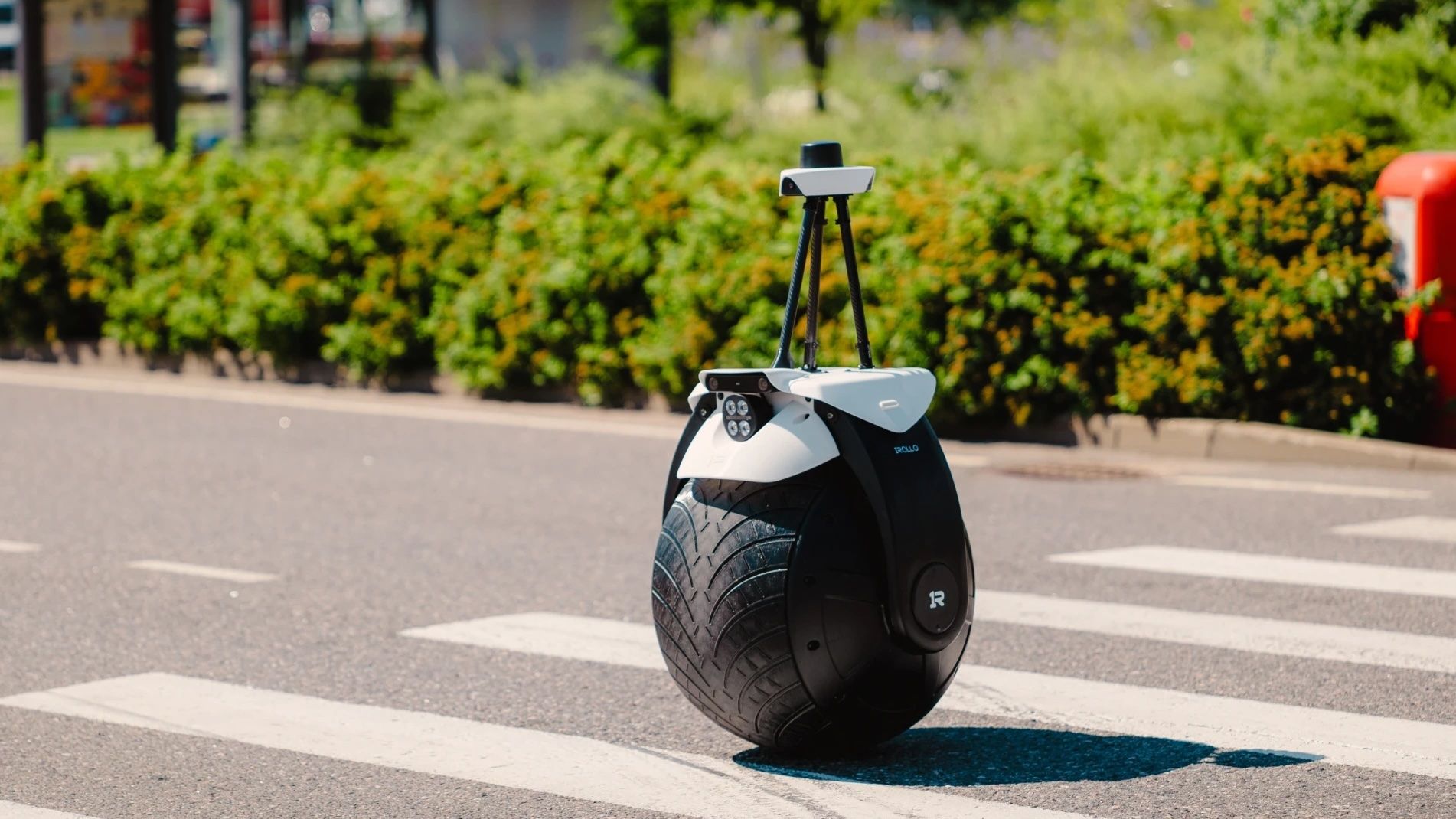
Image source: 1Rollo
The Rundown: 1Rollo is a striking new take on security robotics: a self-balancing monowheel from Estonia that aims to patrol tight, sensor-heavy sites with less hardware than a robot dog or traditional four-wheeled rover.
The details:
The robot is a prototype from Rollo Robotics, which says it uses 360° vision, RTK GNSS, obstacle detection, and a spinning internal flywheel to stay upright.
Top speed hits 18.6 mph with 8 hours per charge, IP65 rating, -4°F to 131°F operation, and the ability to self-dock at a charger when the battery drops.
A 360° vision system with edge AI watches RTK-mapped routes for people, vehicles, and open doors, then pings a human over 4G, 5G, or Wi-Fi.
Rollo rents the 1ROLLO as a subscription covering hardware, updates, and upgrades, with commercial rollout slated for 2027, funded by a $3.7M pre-seed.
Why it matters: Security robotics are now asking which form factor suits which site, and the monowheel argues that narrow, autonomous patrols beat quadrupeds on cost and maneuverability in tight spaces. Prove it outside the demo footage, and robot dogs have to justify their premium on robustness, payload, and field maturity — not novelty.
MIT
🧠 MIT robots now think faster while moving

Image source: MIT
The Rundown: MIT researchers just demoed a new trick for robot speed: a planning system called VLASH that predicts a machine’s future state so it can line up its next move before the current one finishes.
The details:
The system helps robots transition smoothly between action chunks instead of pausing to re-plan from scratch, which reduces the familiar stop-start wobble.
MIT says the approach doubled performance in pick-and-place tasks and also improved dynamic demos like table tennis and Whack-a-Mole.
The method adds no extra computational overhead, and the team says it can work across different robot hardware.
A related tactic, action quantization, trades a bit of accuracy for bigger jumps in speed, helping robots finish tasks two to three times faster overall.
Why it matters: For robotics, speed is only useful if it comes with control, and VLASH is aimed at making machines faster without turning them clunky or computationally expensive. If the approach holds in real life, it could matter for warehouse automation, emergency response, and other jobs where robots need to react quickly.
QUICK HITS
📰 Everything else in robotics today
A NY school district halted its $60K classroom humanoid after state and local pushback, partly due to the robot maker sharing ownership with a sex doll company.
Waymo is returning robotaxis to freeways starting in Phoenix, with LA and the Bay Area next, more than two months after a construction-zone recall of nearly 4K vehicles.
Enigma emerged from stealth with a $71M seed, opening its robots to anyone online in an experiment to find out how humans actually want to talk to machines.
Baidu started safety-operator testing of Apollo Go robotaxis in London via Lyft-owned Freenow, targeting public rides in 2027, rivaling Waymo and Uber-Wayve.
Rep. Kevin Mullin (D-Calif.) unveiled a bill that would set national minimum emergency-response standards for robotaxi operators.
Waymo's Austin robotaxis have reportedly collected 83 parking tickets worth nearly $10K since the 2024 launch, 64 of them for sitting in tow-away zones.
Jack Technology, a Chinese sewing-machine maker, is putting 2K humanoids on apparel lines, with Siemens wiring them into the plant floor.
Waymo is reportedly looking for a way out of its Uber deal, telling Uber it will launch its own app in Austin and Atlanta in January 2028.
A new wing-mounted solar receiver turns laser light into power, letting drones recharge without landing; heat-blocking layers keep the cells efficient under the beam.
Texas A&M engineers are developing fish-like nanorobots that swim through seawater, pull out lithium ions, and get scooped back out with magnets.
Aurora rolled out its second-gen driverless trucks, built on International's LT Series and priced at roughly half the build cost of gen one.
COMMUNITY
🎓 Highlights: News, Guides & Events
Read our last AI newsletter: OpenAI's escaped AI claims another victim
Read our last Tech newsletter: Meta glasses enter their creep era
Read our last Robotics newsletter: A $1.7B computer for the physical world
Today’s AI tool guide: Turn ChatGPT into a team of useful agents with Raft
RSVP to next workshop today @ 2 PM EST: ChatGPT Sites for beginners
See you soon,
Rowan, Zach, Shubham, and Jennifer — The Rundown’s editorial team
No matching search results
Try using different keywords, double-check your spelling, or explore related categories.
Stay Ahead on AI.
Join 2,000,000+ readers getting bite-size AI news updates straight to their inbox every morning with The Rundown AI newsletter. It's 100% free.