Get the latest AI news, understand why it matters, and learn how to apply it in your work — all in just 5 minutes a day. Join over 2,000,000+ subscribers.

Apple loses robotics lead to Meta
Read Online | Sign Up | Advertise

Good morning, robotics enthusiasts. Apple’s AI brainpower is bleeding out: robotics chief Jian Zhang is off to Meta, while three top Foundation Models researchers have departed for OpenAI and Anthropic.
With such talent jumping ship, can the tech giant still compete in the intelligent hardware arena?
In today’s robotics rundown:
Apple’s robotics head defects to Meta
Tesla’s Optimus-heavy Master Plan 4.0
China’s Unitree tees up its IPO
Runway expands beyond video AI to robotics
Quick hits on other robotics news
LATEST DEVELOPMENTS
APPLE/META
🤖 Apple’s robotics head defects to Meta

Image source: Ideogram/The Rundown
The Rundown: Apple’s AI talent drain shows no signs of slowing, with Bloomberg reporting that Jian Zhang, the company’s lead researcher for robotics, has left to join Meta’s Robotics Studio.
The details:
Zhang’s exit delivers a significant setback to Apple’s AI-driven hardware goals, considering his pivotal role in developing next-gen robotic tech.
Bloomberg reports that three additional researchers from Apple’s Foundation Models AI team have also left for OpenAI and Anthropic.
Since January, at least a dozen AI specialists have quit Apple to join Meta, OpenAI, and Anthropic.
For Apple, eager to expand its AI ambitions beyond Siri, the departures reveal a more fundamental structural challenge.
Why it matters: This talent exodus from Apple’s AI teams could hamper the company’s long-term ability to innovate in AI and robotics. As rivals aggressively expand their AI labs and lure away Apple’s best minds, the tech giant may be forced to partner with external companies and rethink its approach if it hopes to stay competitive.
TOGETHER WITH SANA
💡AI agents that deliver real work
The Rundown: What if your best minds could produce polished reports, decks, and analysis — without the manual grind? That’s how Nepa achieved 10x faster sales prep with Sana’s AI agents, trusted by Fortune 500 leaders to turn expertise into outputs, fast.
With Sana Agents, you can:
Draft docs and decks 10x faster
Collaborate live and export to any format
Use a no-code setup to deploy AI agents across teams in minutes
TESLA
☄️ Tesla’s Optimus-heavy Master Plan 4.0
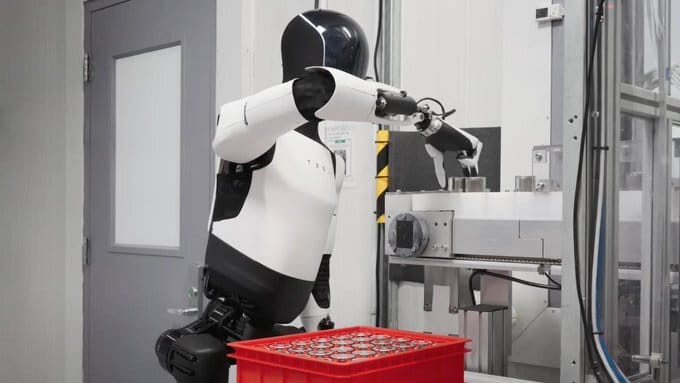
Image source: Tesla
The Rundown: Tesla just announced its Master Plan 4.0, which puts AI, robotics, and the Optimus humanoid front and center, but critics slam it as a foggy mix of buzzwords and big promises with few concrete details.
The details:
Tesla’s new strategy shifts its focus to AI and robotics, with Elon Musk predicting 80% of the company’s value coming from Optimus.
This is a departure from Tesla’s historic emphasis on electric vehicles, with plans to deeply integrate AI into physical services and manufacturing.
Tesla’s original Master Plan from 2006 mapped out a strategy to launch a high-performance electric sports car (the Roadster), then produce mass-market EVs.
Critics have called the new plan “AI slop” and “buzzword salad,” questioning whether Tesla’s vision is grounded in practical roadmaps.
Why it matters: Tesla’s Master Plan 4.0 marks a break from its core identity as an EV and energy company, into a claim that Optimus will be central to Tesla’s growth toward “sustainable abundance.” But even Tesla enthusiasts are questioning the lack of concrete execution details backing up the aspirational tone.
UNITREE
🦄 China’s Unitree tees up its IPO
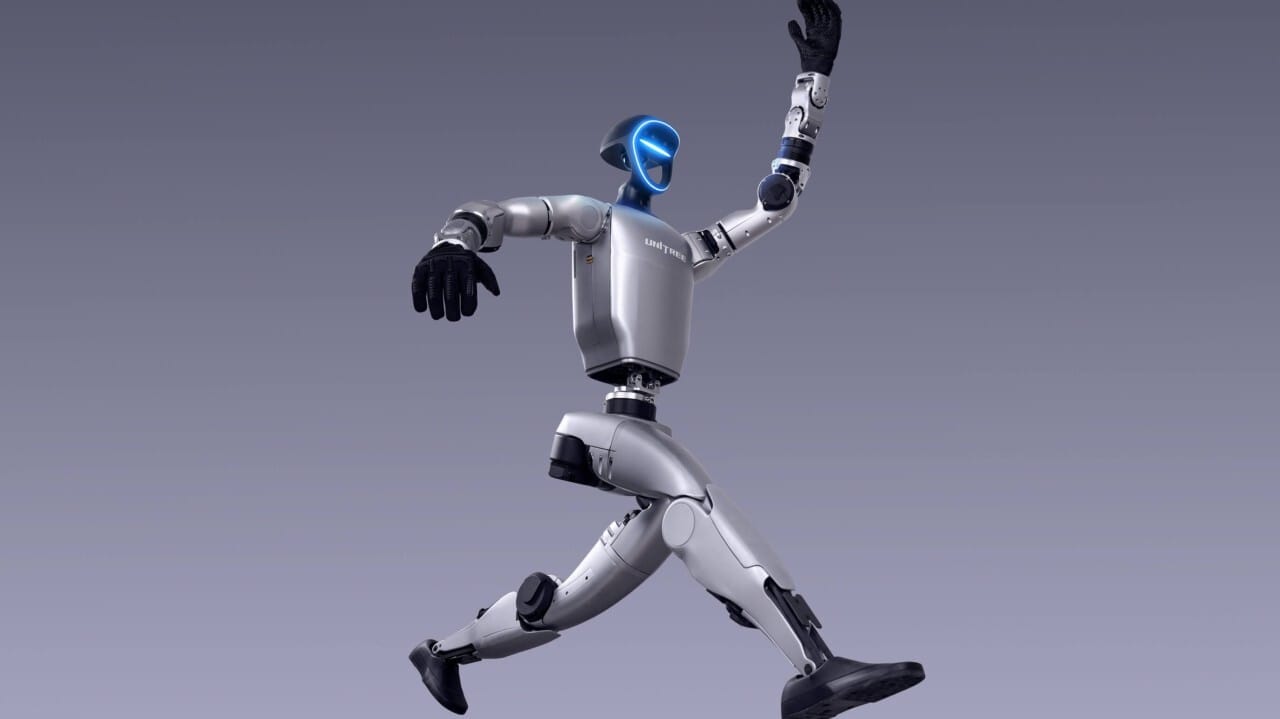
Image source: Unitree
The Rundown: Unitree Robotics, one of China’s rising robotics players, said on X that it plans to file IPO documents between October and December 2025, marking the next big step in its listing journey.
The details:
Investors include China Mobile, Alibaba, Tencent, Ant Group, and Meituan, pushing valuations past 10B yuan ($1.4B).
In 2024, Unitree grabbed nearly 70% of the global quadruped robot market, shipping over 23K units annually.
The Hangzhou-based company moved from a limited company to a joint-stock firm this year and has been in an official guidance phase since July.
Unitree aims to be the first A-share listed company focused on humanoids, as it is distancing itself from military use controversies.
Why it matters: Unitree’s lineup — dominated by robot dogs and humanoids, which drive nearly all its sales — has already secured mass-market dominance and the biggest share of the global quadruped market. Now, as it moves toward its IPO, the company is aiming to shed its military-drill image to double down on civilian innovation.
RUNWAY
🎥 Runway expands beyond video AI to robotics

Image source: Runway
The Rundown: Runway, the New York-based AI company best known for pushing the boundaries of video and image generation, is now setting its sights on an entirely new frontier: robotics.
The details:
Runway’s co-founder and CTO, Anastasis Germanidis, told TechCrunch that the company is fielding interest from robotics and self-driving car companies.
It launched its latest model, Gen-4 for cinematic video generation, in March, and followed it up with Aleph, designed for advanced video editing.
Runway has spent seven years refining its world models, with robotics firms now seeking the same hyperrealistic simulations to train and test their systems.
The company has already secured more than $500M in funding from major backers, including Nvidia and Google, reaching a valuation of around $3B.
Why it matters: Runway says simulations can’t replace real-world training, but its tech — like Nvidia’s Cosmos and Google’s Genie 3 — can offer a lot of value in terms of time-saving and scale. For now, it is planning on fine-tuning its existing model for self-driving cars and robotics, and is actively investing in a dedicated robotics team.
QUICK HITS
📰 Everything else in robotics today
Figure released a new video of its F.02 humanoid autonomously loading a dishwasher using its in-house Helix VLA model.
UC Berkeley researchers created a system dubbed HITTER that allows humanoids to play ping pong autonomously to near perfection.
UBTECH Robotics secured a $1B credit line from Infini Capital to launch a joint venture for building a “superfactory,” R&D center, and Middle East headquarters.
China's humanoid sales in 2025 will exceed 10K units, a year-over-year increase of 125%, according to new market data.
Greece hosted a four-day International Humanoid Olympiad this week, with Chinese companies reportedly more willing to showcase progress (and failures) than U.S. firms.
Oceaneering’s Brazil team clinched a $180M Petrobras contract for four years of next-gen subsea robotics work, powering key offshore projects starting late 2025.
UK and Brazil researchers developed a tentacle-like robot that they say makes offshore subsea inspections safer, more precise, and far less reliant on human divers.
COMMUNITY
🎓 Highlights: News, Guides & Events
Read our last AI newsletter: Google keeps Chrome from AI rivals
Read our last Tech newsletter: Japan’s yen just went digital
Read our last Robotics newsletter: Nvidia’s palm-sized robot brain
Today’s AI tool guide: Use your HeyGen digital twin for marketing videos
RSVP to our next workshop @ 4 PM EST Friday: Template-first AI workflows
See you soon,
Rowan, Jennifer, and Joey—The Rundown’s editorial team

🔒 Google keeps Chrome from AI rivals
Read Online | Sign Up | Advertise

Good morning, AI enthusiasts. Google Chrome just survived the antitrust legal axe, and the AI industry's would-be buyers are going home empty-handed.
A federal judge’s ruling credited ChatGPT and AI tools with disrupting Google's monopoly enough to avoid a breakup — meaning the vultures circling Chrome ironically helped keep it safe in Google's nest.
Reminder: Our next live workshop is Friday at 4 PM EST, where you’ll learn how to create templated workflows to scale AI automation. RSVP here.
In today’s AI rundown:
Google dodges Chrome breakup
Google to power Siri's AI search upgrade
Use your HeyGen digital twin for marketing videos
OpenAI’s parental controls for ChatGPT
4 new AI tools, community workflows, and more
LATEST DEVELOPMENTS
⚖️ Google dodges Chrome breakup

Image source: Ideogram / The Rundown
The Rundown: A federal judge just ruled that Google won't face a forced sale of Chrome or Android despite its search monopoly, though the company must abandon exclusive distribution agreements and share certain data with competitors.
The details:
Judge Amit Mehta wrote that "the emergence of GenAI changed the course of this case," saying ChatGPT and other AI now pose a threat to traditional search.
Mehta rejected the Justice Department's push for asset sale, stating they "overreached" in trying to dismantle Google's core products.
Google can continue paying Apple and others for search placement as long as agreements aren't exclusive, preserving $20B in annual payments.
OpenAI's Sam Altman and Perplexity had both signaled interest in acquiring Chrome if forced to sell, with Perplexity floating a $34.5B offer last month.
Why it matters: Despite the interest rolling in from AI vultures looking to scoop up the most popular browser in the world, Chrome is remaining in Google’s hands — ironically, in part due to the search threat the same rivals are presenting. Perhaps the legal clarity will now open the door for Google to push towards its own Gemini-driven browser.
TOGETHER WITH SANA
💡AI agents that deliver real work

The Rundown: What if your best minds could produce polished reports, decks, and analysis — without the manual grind? That’s how Nepa achieved 10x faster sales prep with Sana’s AI agents, trusted by Fortune 500 leaders to turn expertise into outputs, fast.
With Sana Agents, you can:
Draft docs and decks 10x faster
Collaborate live and export to any format
Use a no-code setup to deploy AI agents across teams in minutes
APPLE & GOOGLE
🍎 Google to power Siri's AI search upgrade
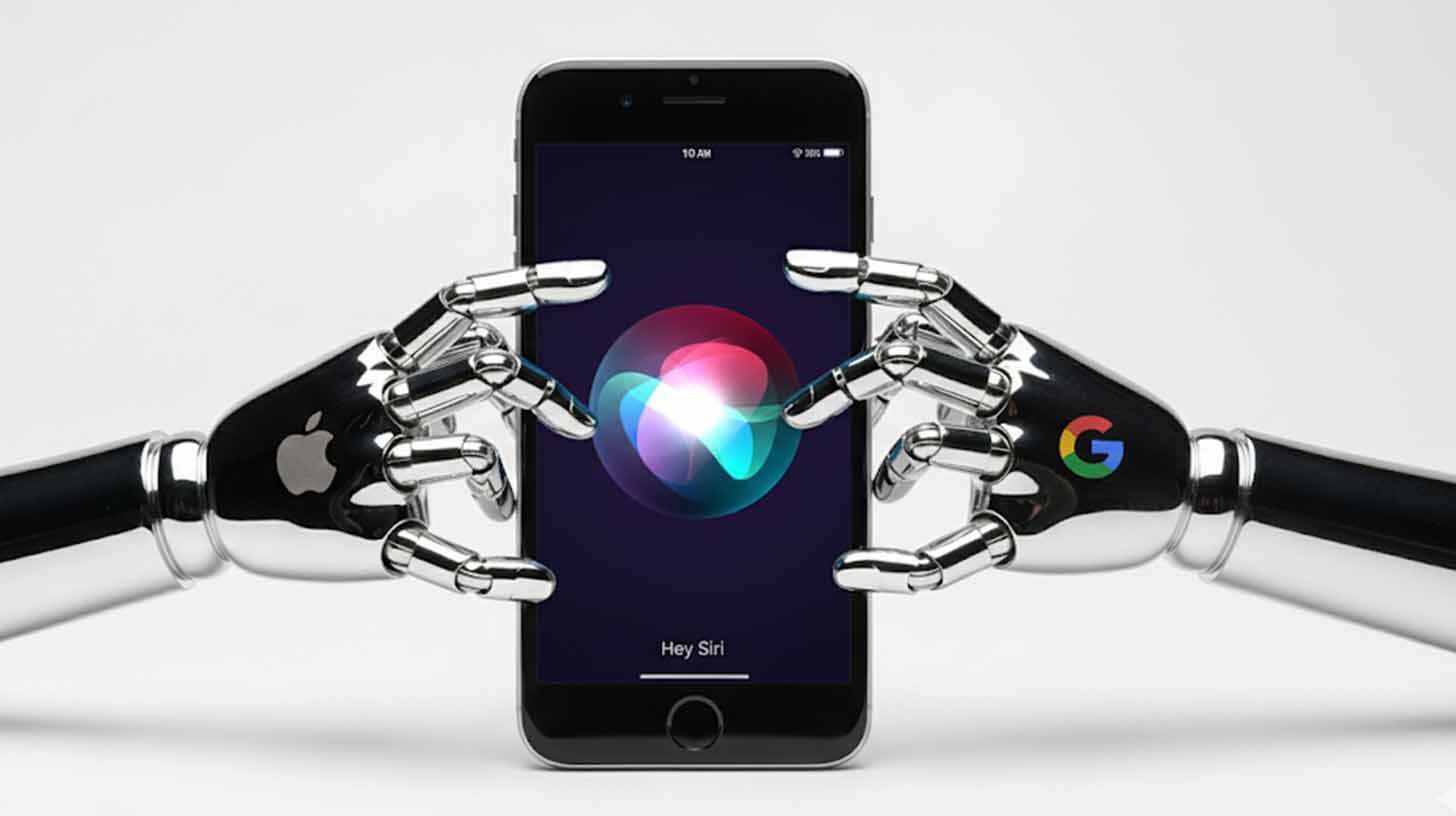
Image source: Gemini / The Rundown
The Rundown: Apple has reportedly struck a deal with Google to test a Gemini model to power web search tools within the AI-upgraded Siri, according to Bloomberg — with the iPhone maker aiming to deliver competitive AI features by spring 2026.
The details:
The internal project, called "World Knowledge Answers," aims to transform Siri into an answer engine combining text, photos, videos, and local info.
Google's custom Gemini model would run on Apple's private cloud servers, offering more favorable terms than Anthropic's reported $1.5B annual price tag.
The company also reportedly shelved acquisition talks with Perplexity, choosing instead to build competing search capabilities internally.
Apple’s internal AI brain drain continued last week, with robotics lead Jian Zhang heading to Meta, and several researchers leaving for OAI and Anthropic.
Why it matters: It’s a jarring contrast to see Apple branching out from its own in-house ambitions for help from its rivals, while at the same time facing a massive exodus across its AI teams. While the infusion of a frontier model like Gemini would go a long way, Apple’s past delays make any coming Siri upgrades a “see it to believe it” deal.
AI TRAINING
👯 Use your HeyGen digital twin for marketing videos
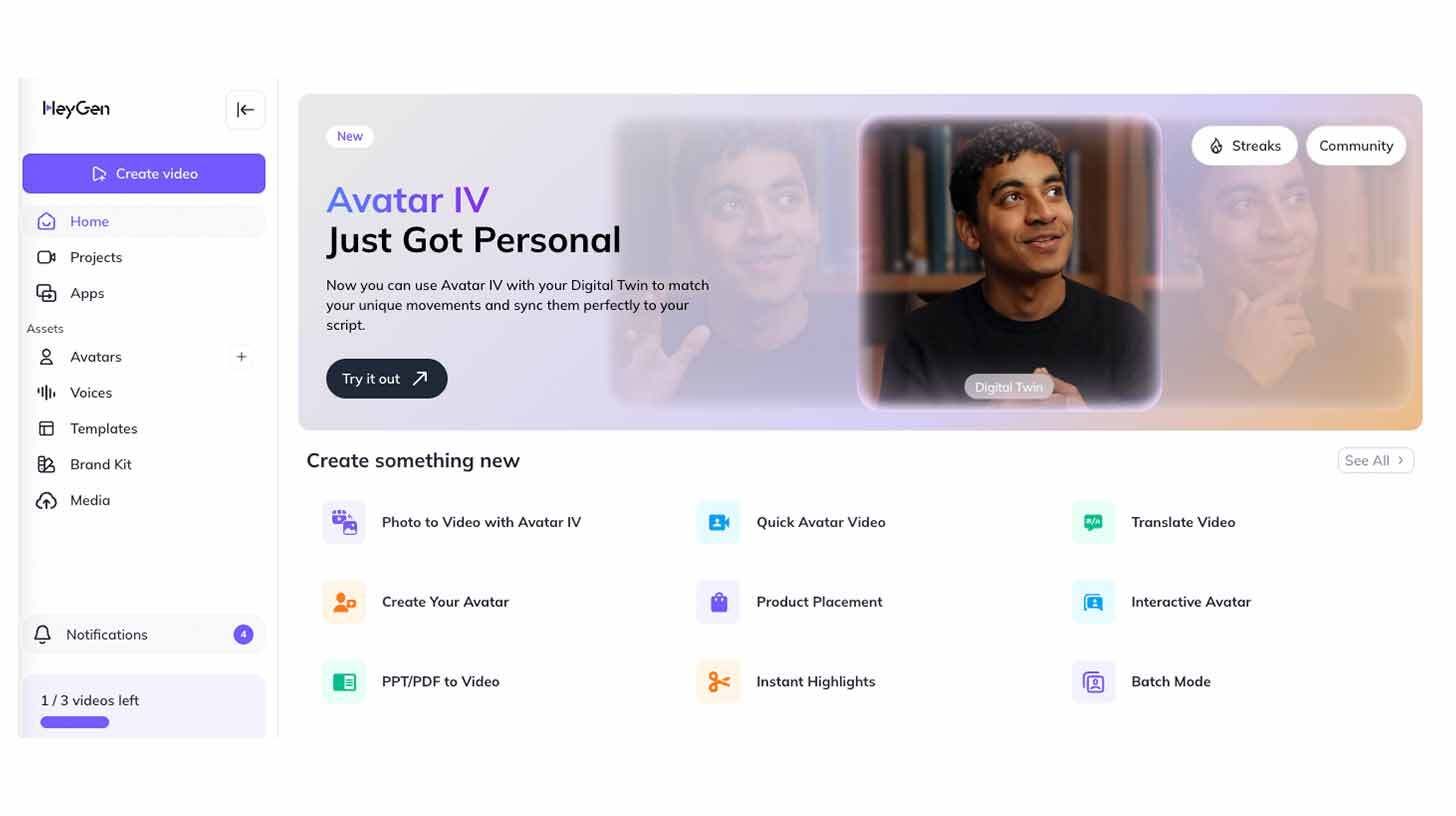
The Rundown: In this tutorial, you will learn how to create your HeyGen avatar and make it deliver any script — perfect for scaling video content while freeing up senior leaders from constant on-camera work.
Step-by-step:
Go to HeyGen, click the "My Avatars" tab, and choose an existing avatar or create a new one with multiple poses (newly launched Avatar IV)
Enter AI Studio, enable Digital Twin experience, and write your script or prompt AI: "Write a short congratulatory speech to my colleagues for a year of hard work"
Select your pre-created voice (premium feature) or choose from defaults, then click "Generate" to process your video
Add captions, backgrounds, or overlays in the editor — free tier gives 3 videos/month, so nail it in the first try or upgrade to Pro
Download or share with password protection — Pro users can create templates for repeatable campaigns
Pro Tip: In “Avatars”, there are hundreds of different avatars, each with multiple different looks to add diversity to your content creation and marketing assets.
PRESENTED BY WARP
🏆 Ride with Warp, the world’s No. 1 coding agent

The Rundown: Warp just launched Warp Code – making it the world’s No. 1 coding agent, trusted by over 600,000 developers and 56% of Fortune 500 engineering teams. One platform to prompt, review, and ship production-ready code with agents.
With Warp Code, you get:
New coding capabilities with code review, code editing, in-line code diffs, and file trees
Tops benchmark performance: No. 1 on Terminal-Bench Verified, 75% on SWE-bench
Access top models: Opus, Sonnet, GPT-5 and more, all in a single subscription
An average of 5 hours saved each week
Download Warp for free to get Pro for only $1 for the first month with code RUNDOWN.
OPENAI
🦺 OpenAI’s parental controls for ChatGPT

Image source: Midjourney / The Rundown
The Rundown: OpenAI just announced that parents will gain oversight capabilities for teenage ChatGPT users within 30 days, with features such as account linking, content filtering, and alerts when the system detects signs of emotional distress.
The details:
Parents will be able to connect their accounts to their teens', managing active features and setting boundaries for how ChatGPT responds.
The system will notify guardians when conversations suggest distress, with guidance from medical professionals shaping OpenAI’s detection thresholds.
OpenAI also plans to redirect emotionally charged conversations to reasoning models to better analyze and handle complex situations.
The rollout follows OAI's first wrongful death lawsuit filed by parents whose son discussed plans with ChatGPT for months before taking his life.
Why it matters: There has been a barrage of troubling headlines of late regarding ChatGPT’s role in tragic cases, and while the addition of parental controls is a positive step for minors on the platform, the problem of “AI psychosis” and users confiding in the chatbot for crises is an ongoing issue without a clear solution.
QUICK HITS
🛠️ Trending AI Tools
🎧 ElevenLabs SFX v2 - Create sound effects from text prompts
🗣️ Respeecher TTS - Real-time, Hollywood quality AI voices, available via API
🔉 Wispr Flow - Vibe coding supercharged with voice
🌎 HunyuanWorld-Voyager - AI world model for explorable 3D environments
📰 Everything else in AI today
Perplexity announced the rollout of its Comet browser to all students, with the company also partnering with PayPal to provide its users early access to the platform.
OpenAI added new features to its ChatGPT free tier, including access to Projects, larger file uploads, new customization tools, and project-specific memory.
Xcode-specific AI coding platform Alex announced that the startup is joining OpenAI’s Codex team.
Google’s NotebookLM introduced the ability to change the tone, voice, and style of its audio overviews with ‘Debate’, a solo ‘Critique’, and ‘Brief’ alternatives.
Scale AI sued former employee Eugene Ling and rival company Mercor over theft of over 100 confidential documents and attempts to poach major clients using them.
Google unveiled Flow Sessions, a pilot program for filmmakers using its Flow AI tool, announcing Henry Daubrez as the program’s mentor and filmmaker in residence.
COMMUNITY
🤝 Community AI workflows
Every newsletter, we showcase how a reader is using AI to work smarter, save time, or make life easier.
Today’s workflow comes from reader Nathan B. in Omaha, NE:
"I’m a learning and development professional for a fintech firm. I take slide decks that have way too much information on each slide and use ChatGPT to break those slides into bite-sized chunks. Then I have AI rewrite the content following plain language principles and re-export it all to a PowerPoint file. This frees up a lot of time for our creative process!"
How do you use AI? Tell us here.
🎓 Highlights: News, Guides & Events
Read our last AI newsletter: Anthropic’s historic $13B round
Read our last Tech newsletter: Japan’s yen just went digital
Read our last Robotics newsletter: Nvidia’s palm-sized robot brain
Today’s AI tool guide: Use your HeyGen digital twin for marketing videos
RSVP to our next workshop @ 4 PM EST Friday: Template-first AI workflows
See you soon,
Rowan, Joey, Zach, Shubham, and Jennifer — the humans behind The Rundown


Anthropic's historic $13B round
Read Online | Sign Up | Advertise

Good morning, AI enthusiasts. Anthropic just pulled off one of the largest funding rounds in tech history… A massive $13B raise that nearly triples its valuation to $183B in just six months.
Despite the bubble warnings, the investor appetite for frontier AI labs is not drying up — and though Claude may not be the household name that ChatGPT has become, its rise in coding and enterprise circles is translating into dollar signs in a big way.
In today’s AI rundown:
Anthropic’s $183B valuation after massive funding
OpenAI acquires Statsig for $1.1B
Create product ads with Nano Banana
Tencent’s Voyager for 3D world creation
4 new AI tools, community workflows, and more
LATEST DEVELOPMENTS
ANTHROPIC
💰 Anthropic’s $183B valuation after massive funding

Image source: Gemini / The Rundown
The Rundown: Anthropic just announced a new $13B funding round that values the company at a whopping $183B, nearly tripling its worth from six months ago and coming amid significant growth from Claude Code and enterprise accounts.
The details:
Anthropic now serves over 300,000 enterprise customers, with accounts worth $100k+ in annual revenue growing sevenfold in 2025.
The company’s Claude Code assistant now generates $500M in annual revenue, with usage up 10x in three months.
The investor list notably includes QIA, the first Middle East participant, as hinted at by CEO Dario Amodei in a leaked memo in July.
Anthropic’s last raise of $3.5B in March valued the company at $61.5B, marking a meteoric 3x rise in the last six months.
Why it matters: While there has been plenty of chatter about an AI investment bubble, the dollars don’t seem to be drying up yet, especially for leaders on the frontier of the industry. While Anthropic previously turned down investments from the Gulf region, the expensive race for global compute from rivals may have changed some perspectives.
TOGETHER WITH HOSTINGER
🚀 Unlimited n8n workflows on your own terms

The Rundown: Hostinger VPS makes self-hosting n8n workflows simple and affordable, cutting costs by up to 75% compared to cloud solutions. Deploy in minutes with pre-installed templates, then scale seamlessly as your automation needs grow — all with complete data privacy.
With Hostinger VPS, you get:
One-click n8n deployment with 100+ ready-to-use workflow templates included
Fast, responsive performance via Hostinger’s powerful hardware
Kodee, an MCP-integrated AI assistant managing your VPS in 50+ languages via simple chat
Use code THERUNDOWN for an exclusive discount on your VPS hosting.
AI ACQUISITIONS
📊 OpenAI acquires Statsig for $1.1B

Image source: Statsig
The Rundown: OpenAI just announced a $1.1B all-stock acquisition of experimentation platform Statsig, bringing its founder Vijaye Raji aboard as CTO of Applications to lead ChatGPT and Codex engineering.
The details:
Raji will oversee product engineering across ChatGPT and Codex, reporting to Applications CEO Fidji Simo, who recently joined from Instacart.
Statsig's platform, which powers A/B testing and feature flagging for companies including OpenAI itself, will continue operating independently.
The deal marks OpenAI's second major acquisition attempt this year, following a failed $3B bid for coding startup Windsurf in July.
OAI also made several other executive moves, with Srinivas Narayanan shifting to CTO of B2B Apps and CPO Kevin Weil leading a new “AI for Science” team.
Why it matters: OpenAI’s last acquisition was a bumpy ride, but the leadership movement appears to have this one on solid ground. With the competition for talent at an all-time high in the AI race, the acqui-hire route may become an even more utilized tool for the giants of the space to bring in top leaders and teams in areas of need.
AI TRAINING
🍌 Create product ads with Nano Banana
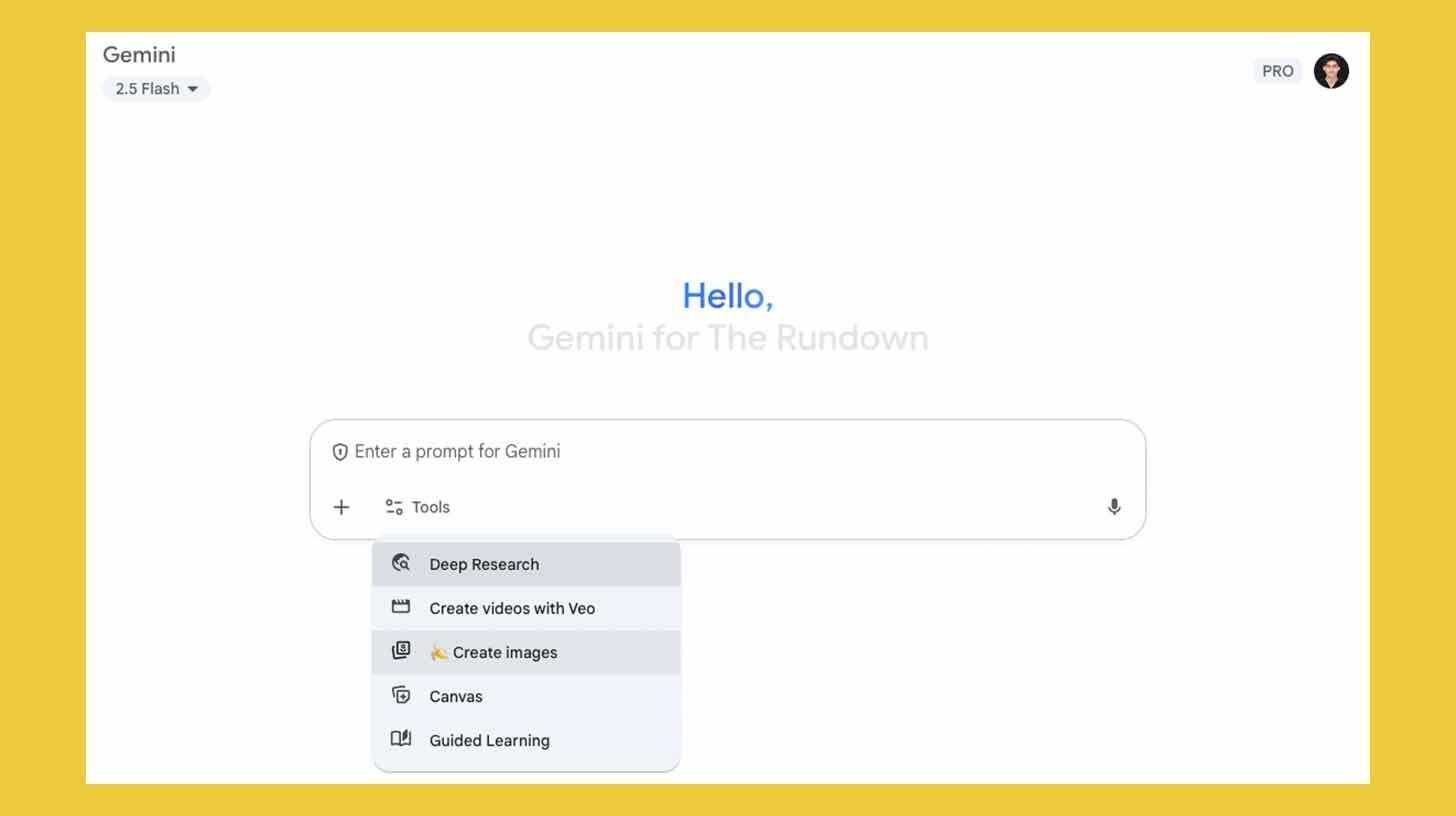
The Rundown: In this tutorial, you will learn how to use Google’s new Nano Banana model (Gemini 2.5 Flash Image) to turn product photos into professional marketing ads and transform sketches into animations — all for about 4 cents per image.
Step-by-step:
Go to gemini.google.com, click "Tools" and toggle on "Create Images" (that's Nano Banana/Gemini 2.5 Flash Image)
Upload your product image and prompt: "Create ads to fit various environments with the attached image — subway, train station, bus stop, luxury magazine"
Watch as it seamlessly integrates your product into realistic ad environments with appropriate lighting and perspective
Transform sketches by uploading black and white drawings — Nano Banana adds color while preserving exact character structure
Take it further: Toggle on "Create videos with Veo" to turn your generated images into animated videos with sound (takes ~2 minutes)
Pro tip: Mock up entire campaigns before spending real money — at 4 cents per image through the API, test different concepts on social media to see what resonates before committing to expensive production.
PRESENTED BY FIN
🏟️ The summit for AI customer service leaders

The Rundown: AI customer service has entered a new era. Join fellow AI leaders at Pioneer on October 9th to explore the incredible opportunity of AI, and hear real stories from those embracing AI Agents to transform their businesses and build smarter support systems.
Join Pioneer live in NYC or online to:
Hear Intercom leadership’s vision for where AI technology is taking us
Connect with AI leaders and meet the team behind Fin
See and experience our latest Fin product launches
TENCENT
🌎 Tencent’s Voyager for 3D world creation

Image source: Tencent
The Rundown: Tencent just released HunyuanWorld-Voyager, an open-source “ultra long-range” AI world model that transforms a single photo into an explorable, exportable 3D environment.
The details:
Voyager uses a "world cache" that stores previously generated scene regions, maintaining consistency as cameras move through longer virtual environments.
It topped Stanford's WorldScore benchmark across multiple metrics, beating out other open-source rivals in spatial coherence tests.
Users can control camera movement through keyboard or joystick inputs, with just a single reference photo needed to create the exportable 3D environments.
The system also remembers what it creates as you explore, so returning to previous areas shows the same consistent scenery.
Why it matters: World models have become one of the hottest frontiers in AI, with labs racing to build systems that understand physical spaces rather than just generating flat images. Between Genie 3, Mirage, World-Voyager, and more, the range of options (and the applications for these interactive 3D environments) is growing fast.
QUICK HITS
🛠️ Trending AI Tools
🍌 Gemini 2.5 Flash Image Preview - Viral ‘Nano Banana’ AI editing model
🗣️ Hunyuan Translation Model - Open-source SOTA AI translation system
🍥 GenSpark AI Designer - Design anything with a single prompt
🔌 Le Chat MCP Connectors - Integrate Mistral with 20+ enterprise platforms
📰 Everything else in AI today
Mistral AI expanded its Le Chat platform with over 20 new enterprise MCP connectors, also introducing “Memories” for persistent context and personalization.
Microsoft announced a new partnership with the U.S. GSA to provide the federal government with free access to Copilot and AI services for up to 12 months.
OpenAI CPO Kevin Weil unveiled "OpenAI for Science," a new initiative aimed at building AI-powered platforms to accelerate scientific discovery.
Swiss researchers from EPFL, ETH Zurich, and CSCS launched Apertus, a fully open-source multilingual language model trained on over 1,000 languages.
Chinese delivery giant Meituan open-sourced LongCat-Flash-Chat, the company’s first AI model that rivals DeepSeek V3, Qwen 3, and Kimi K2 on benchmarks.
ElevenLabs released an upgraded version of its sound effects AI model, with new features including looping, extended output length, and higher quality generations.
COMMUNITY
🤝 Community AI workflows
Every newsletter, we showcase how a reader is using AI to work smarter, save time, or make life easier.
Today’s workflow comes from reader Cathy K. in Salt Lake City, Utah:
"I used ChatGPT and Claude to write complex Excel formulas. I was solving for a way to model assigning media spend (advertising dollars) to individual restaurants for a limited-time offer campaign. I needed a way to account for multiple variables and tiering, all while creating a bell curve distribution. Solution accomplished."
How do you use AI? Tell us here.
🎓 Highlights: News, Guides & Events
Read our last AI newsletter: AI gives paralyzed patients robotic control
Read our last Tech newsletter: Japan’s yen just went digital
Read our last Robotics newsletter: Nvidia’s palm-sized robot brain
Today’s AI tool guide: Create product ads with Nano Banana
RSVP to our next workshop @ 4 PM EST Friday: Template-first AI workflows
See you soon,
Rowan, Joey, Zach, Shubham, and Jennifer — the humans behind The Rundown

Japan's yen just went digital
Read Online | Sign Up | Advertise

Good morning, tech enthusiasts. Japan Post Bank, the world’s largest savings institution, plans to launch a blockchain-based digital yen.
Dubbed DCJPY, it will let depositors instantly convert accounts into tokenized payments. The question is, could this be the model for how programmable money rewires banking worldwide?
In today’s tech rundown:
Japan’s blockchain-based digital yen
Oura vs. Ultrahuman smart ring war rages
Amazon invests $4.4B in New Zealand cloud
Fisker shuts nonprofit after EV startup fails
Quick hits on other tech news
LATEST DEVELOPMENTS
FINTECH NEWS
💴 Japan’s blockchain-based digital yen

Image source: Ideogram/The Rundown
The Rundown: Japan Post Bank, one of the world’s largest retail banks, is reportedly launching a blockchain-backed digital yen called “DCJPY” by the end of fiscal 2026, allowing depositors to convert savings into instant, tokenized payments.
The details:
Depositors can convert savings into tokenized yen instantly, with each token fully backed by traditional deposits.
DCJPY runs on a permissioned blockchain developed with DeCurret DCP, accessible only to banks, businesses, and government bodies.
Backed by bank deposits and Japanese deposit insurance, the yen tokens offer a level of trust most CBDCs (central bank digital currencies) lack.
Western policymakers are watching closely, taking cues from Japan, China, and the EU on scaling digital cash.
Why it matters: More than 130 countries are pushing ahead with CBDCs amid tech and geopolitical shifts. By tying its digital yen to a regulated bank, Japan is turning itself into a proving ground for blending traditional finance with programmable money, and perhaps setting a precedent that could shape how others design their own rollouts.
OURA/ULTRAHUMAN
⚡️Oura vs. Ultrahuman smart ring war rages

Image source: Oura
The Rundown: The smart ring battle just heated up even more. After being sued by Oura and banned in the U.S., Ultrahuman has hit back, filing a patent infringement case in India targeting Oura’s new Ring 4.
The details:
Ultrahuman claims Oura’s Ring 4 infringes its Indian patent covering the design, sensors, and onboard processing of the Ultrahuman AIR.
The launch of Oura Ring 4 in India sparked the legal move, with Ultrahuman accusing Oura of “indiscriminate” patent breaches.
The feud isn’t new: Oura previously won a U.S. patent case, securing a ban on Ultrahuman’s rings being sold in the U.S.; rival RingConn is also banned.
The stakes for both companies are high, with India’s fast-growing wearable tech market serving as a fresh battleground after Oura’s U.S. victory.
Why it matters: The heart of Ultrahuman’s claim lies in proprietary tech for sleep, recovery, and glucose, as well as women’s health and circadian rhythm tools, which Ultrahuman says Oura has mimicked and locked behind a subscription paywall. For its part, Oura counters that the claims are a distraction from its U.S. defeat and lack merit.
AMAZON
💰 Amazon invests $4.4B in New Zealand cloud

Image source: Amazon Web Services
The Rundown: Amazon Web Services has officially landed in New Zealand, kicking off its long-awaited hyperscale cloud rollout and reviving a NZ$7.5B ($4.4B) investment first announced in 2021.
The details:
Kiwi organizations now get local access to cloud storage, AI, and machine learning, cutting latency and keeping sensitive data closer to home.
The launch is expected to boost New Zealand’s GDP by NZ$10.8B and create over 1K tech jobs, from engineers to operations staff.
The region opens with three availability zones, linking New Zealand to AWS’s global network across 38+ countries.
Powered by 100% renewable energy via Mercury NZ’s Turitea South wind farm, the rollout also blends cloud scale with green credentials.
Why it matters: Amazon’s expansion answers a pressing need for data sovereignty, ultra-low latency, and security, while giving New Zealand a shot at revitalizing its economy and drawing in foreign investment. With plans to train 100K locals in cloud skills, the Kiwi cloud is officially open for business.
FISKER
🚗 Fisker shuts nonprofit after EV startup fails

Image source: MB-one/Wikimedia Commons
The Rundown: Henrik Fisker, the founder of the recently collapsed EV startup Fisker, and his wife, Geeta, quietly shuttered their private charity, The Geeta & Henrik Fisker Foundation, just months after the company filed for bankruptcy, TechCrunch reports.
The details:
The foundation launched in late 2021 to drive “innovation in healthcare, education, sustainability, mobility, and all causes that help support the planet.”
Its launch was fueled by a transfer of close to $4M in Fisker Inc. stock and a small cash donation from the Fiskers.
Over its three-year life, the foundation made only about $100K in grants, mainly due to the rapid devaluation of its Fisker stock holdings.
Fisker Inc. filed for Chapter 11 bankruptcy protection in June 2024 after failing to secure a partnership with Nissan and facing ongoing financial distress.
Why it matters: Despite lofty goals and a mission fitting Fisker’s green mobility image, the foundation quietly shut down, publicly unacknowledged by the Fiskers — a final, muted chapter in the EV entrepreneur’s turbulent saga of ambitious promises fading amid financial turmoil.
QUICK HITS
📰 Everything else in tech today
China’s e-commerce giant Alibaba’s June quarter profits exceeded expectations, boosting its U.S. shares by nearly 13% and Hong Kong shares by over 19%.
Meta’s high-profile Superintelligence Labs team is reportedly facing early staff departures and tensions with data partner Scale AI in a rocky start for the new division.
Alibaba is developing a new AI chip, with plans to invest $53.1B in AI over the next three years while continuing to source semiconductors from vendors like Nvidia.
Tesla is appealing a jury verdict that found it partly liable for a fatal Enhanced Autopilot crash and ordered it to pay $242.5M in damages.
OpenAI is planning to build a massive 1-gigawatt data center and establish an office in India as part of its global “Stargate” infrastructure push, Bloomberg reports.
Flip, the California startup that soared to a $1B valuation in 2024 with its TikTok-style shopping and review app, has now shuttered operations.
Exelixis, a leading California-based anti-cancer biotech firm, is laying off 130 workers and consolidating its operations while also shutting down its Pennsylvania site.
Novo Nordisk secured global rights to Replicate Bioscience’s self-replicating RNA tech in a deal worth up to $550M, targeting new therapies for obesity and diabetes.
Finland launched the world’s largest industrial-scale sand battery in Pornainen, replacing a woodchip plant and aiming to cut local heating emissions by up to 70%.
California reached a landmark agreement with Uber and Lyft, enabling rideshare drivers to unionize while retaining their status as independent contractors.
COMMUNITY
🎓 Highlights: News, Guides & Events
Read our last AI newsletter: AI gives paralyzed patients robotic control
Read our last Tech newsletter: Netflix goes full-on theme park
Read our last Robotics newsletter: Nvidia’s palm-sized ‘robot brain’
Today’s AI tool guide: Design and build a mobile app with Figma AI
Join our next live workshop: Build professional AI automation workflows
See you soon,
Rowan, Jennifer, and Joey—The Rundown’s editorial team
AI gives paralyzed patients robotic control
Read Online | Sign Up | Advertise

Good morning, AI enthusiasts. UCLA engineers just turned a standard EEG cap into a mind-reading device powerful enough to control robotic limbs.
By pairing it with AI that interprets intent in real-time, they've given paralyzed users abilities that used to require brain surgery — and a window into the near future of non-invasive, assistive technology.
In today’s AI rundown:
AI helps paralyzed patients control robots
AI’s favorite buzzwords seep into everyday speech
Design and build mobile apps with Figma AI
MIT’s AI to predict flu vaccine success
4 new AI tools, community workflows, and more
LATEST DEVELOPMENTS
OPENAI
🦾 AI helps paralyzed patients control robots

Image source: UCLA
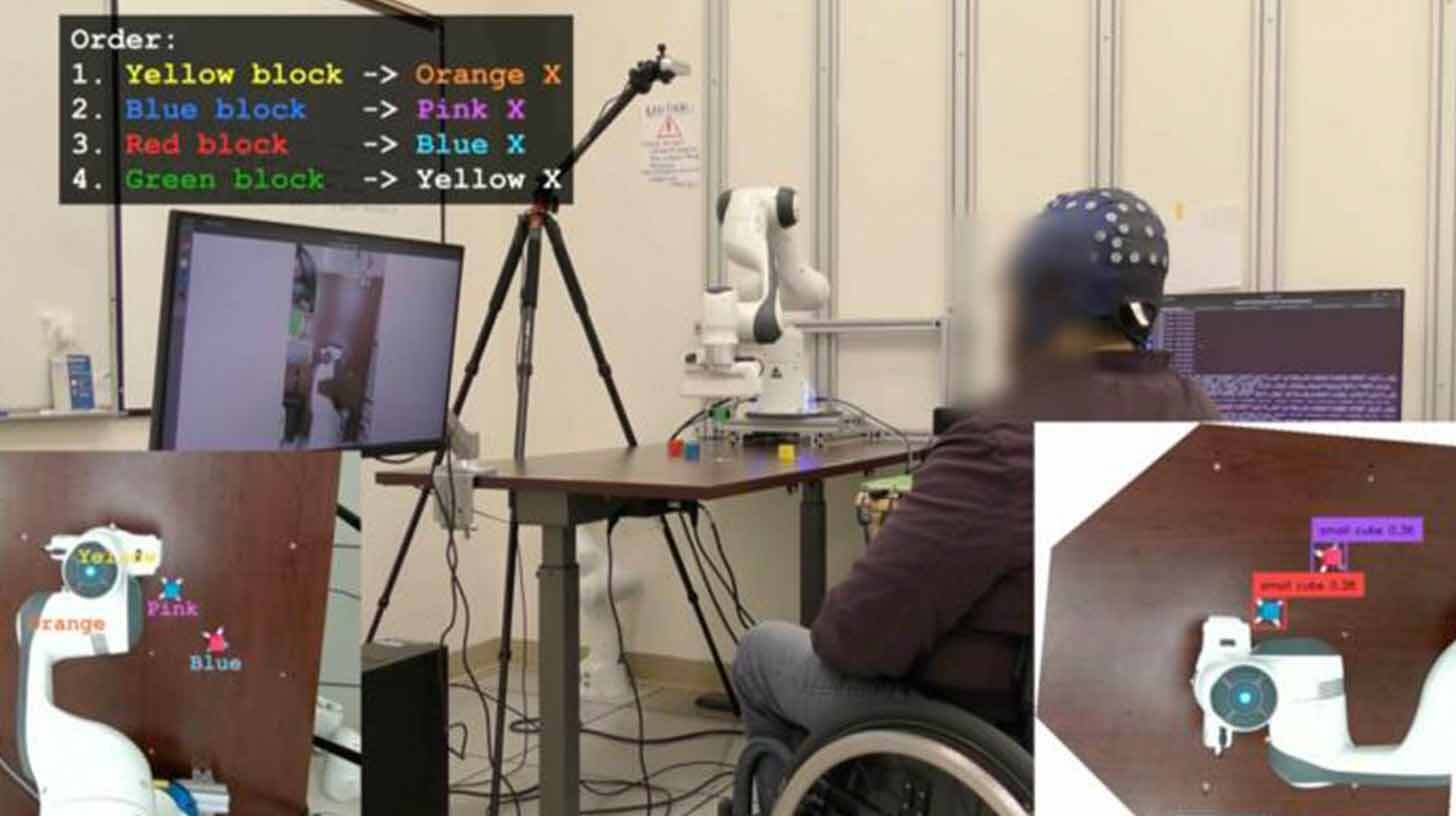
The Rundown: UCLA engineers just created a wearable brain-computer interface that uses AI to interpret EEG signals, enabling paralyzed users to control robotic arms using their thoughts without any invasive surgery.
The details:
Researchers paired a custom EEG decoder with a camera-based AI to interpret a patient’s movement intent in real time.
They tested the BCI with four users, including one paralyzed participant who completed robotic tasks in 6.5 minutes versus being unable to without it.
Participants moved cursors to targets and directed robotic arms to relocate blocks, completing both tasks nearly 4x faster with AI assistance.
The system used standard EEG caps, eliminating surgical risks while still achieving performance levels similar to the invasive alternatives.
Why it matters: Decades after the first brain implants, we're finally seeing non-invasive BCIs that actually work — with AI filling the gaps where brain signals fail. AI co-pilots will eventually help not just with robotic limbs but in wheelchairs, communication devices, and smart homes that anticipate needs before users even think them.
TOGETHER WITH VANTA
🛡️ Building trust in the AI boom

The Rundown: In today's AI boom, shipping fast gets attention — but building trust gets results. Vanta and Mercury show how SOC 2, audit-ready financials, and risk controls have become day-one signals that fuel growth, not later-stage checkboxes.
In this virtual event, learn to:
Pass investor diligence with confidence and fewer follow-ups
Avoid security and procurement blockers before they stall deals
Stay ahead of compliance without hiring full teams
Register now to build enterprise-grade credibility without slowing down.
AI RESEARCH
🗣️ AI’s favorite buzzwords seep into everyday speech

Image source: Ideogram / The Rundown
The Rundown: A new study from Florida State University researchers found that AI-favored buzzwords have seen massive surges in podcast conversations since ChatGPT's 2022 launch, calling the linguistic changes a “seep-in effect.”
The details:
The study analyzed 22.1M words from unscripted content like podcasts, finding 75% of AI-associated terms showed increases post-ChatGPT release.
The research tracked science and tech podcasts where hosts likely use ChatGPT regularly, making them early indicators of the linguistic changes.
Words flagged included “boast”, “meticulous" and “delve”, with experts attributing them to AI training on large amounts of corporate and web content.
A separate German study found similar results, with the same words like “delve” and “meticulous” seeing upticks in YouTube and podcast content.
Why it matters: A few years is all it took for AI to start rewiring how humans talk to each other. Today, it's buzzwords creeping into podcasts, but tomorrow expect AI's fingerprints everywhere — from web designs taking similar AI-created patterns to developers largely writing code with agentic platforms.
AI TRAINING
📲 Design and build mobile apps with Figma AI
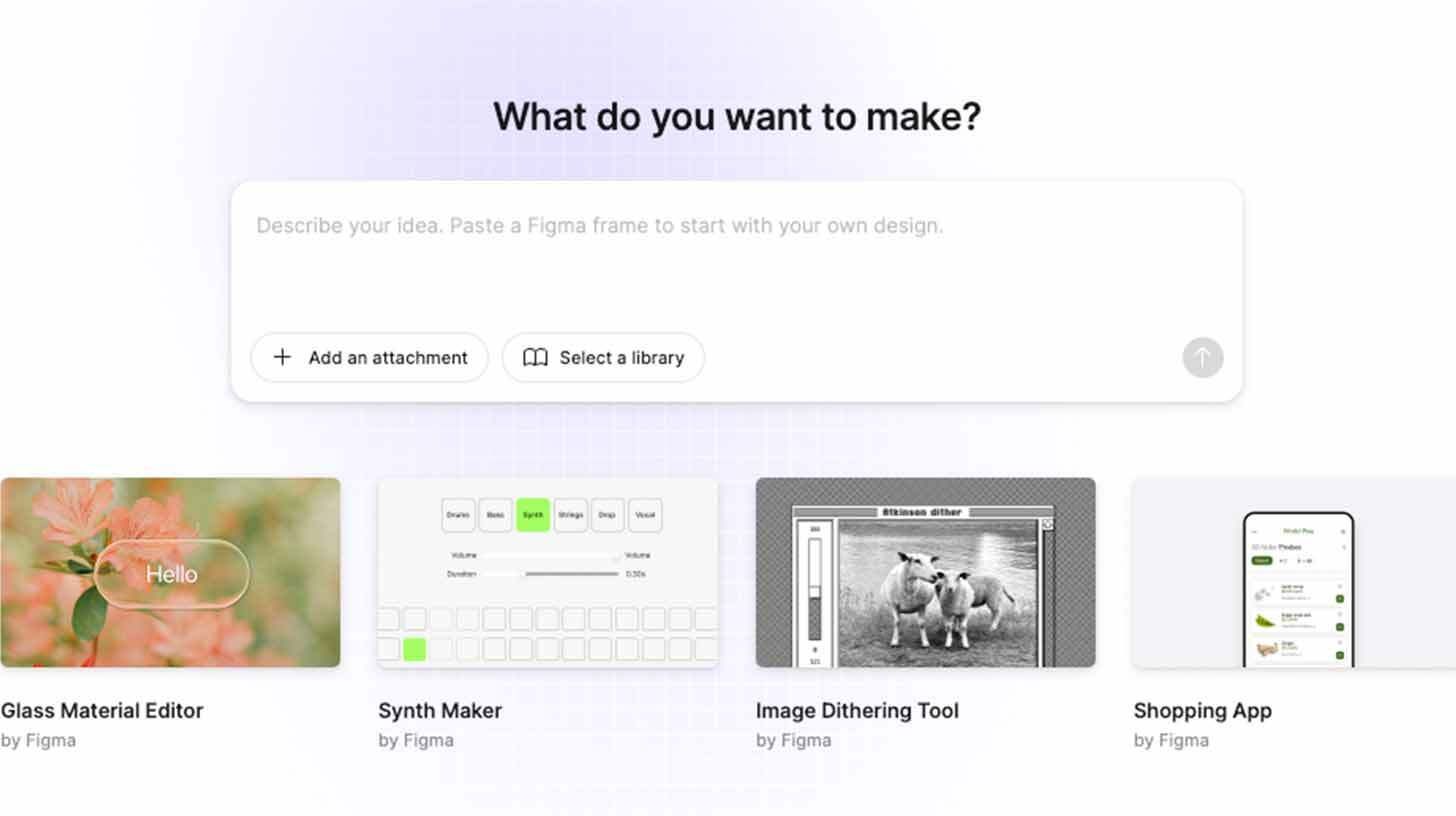
The Rundown: In this tutorial, you will learn how to use Figma AI to design a complete mobile app from simple text prompts, turning ideas into interactive prototypes with working buttons and states in seconds.
Step-by-step:
Go to Figma.com, sign in, and click "Make" in the top menu — you'll see a chat box asking "What do you want to make?"
Type your app idea or start with a template: "Create an app for tennis players to find community courts, track stats, and share activity, similar to Strava but for tennis"
Refine with specific design directions: "Clean white background, deep green text, clay beige accents, small pops of neon yellow" — Figma adjusts spacing, padding, and corners automatically
Add features by prompting: "Add calendar integration for booking courts via Cal.com" — Figma AI suggests Supabase for auth and creates logical button interactions
Preview in a new window, share with teammates, or export the design to Cursor for full-stack development
Pro tip: Think of Figma AI as your junior designer; the clearer your direction, the better the result. Each refinement gets you closer to production-ready designs that already have working interactions built in.
PRESENTED BY FUEL iX
🔎 Demystifying shadow AI

The Rundown: 57% of employees enter sensitive data into public GenAI tools like ChatGPT, Claude, and Gemini at work. Fuel iX’s new report, Demystifying Shadow AI in the Workplace, uncovers how employees are using GenAI and the hidden risks this creates for enterprises.
In this report, you’ll discover how to:
Assess your organization’s exposure to Shadow AI
Identify the key security risks of employees using public GenAI tools
Apply expert strategies to manage AI adoption safely and responsibly
AI RESEARCH
💉 MIT’s AI to predict flu vaccine success
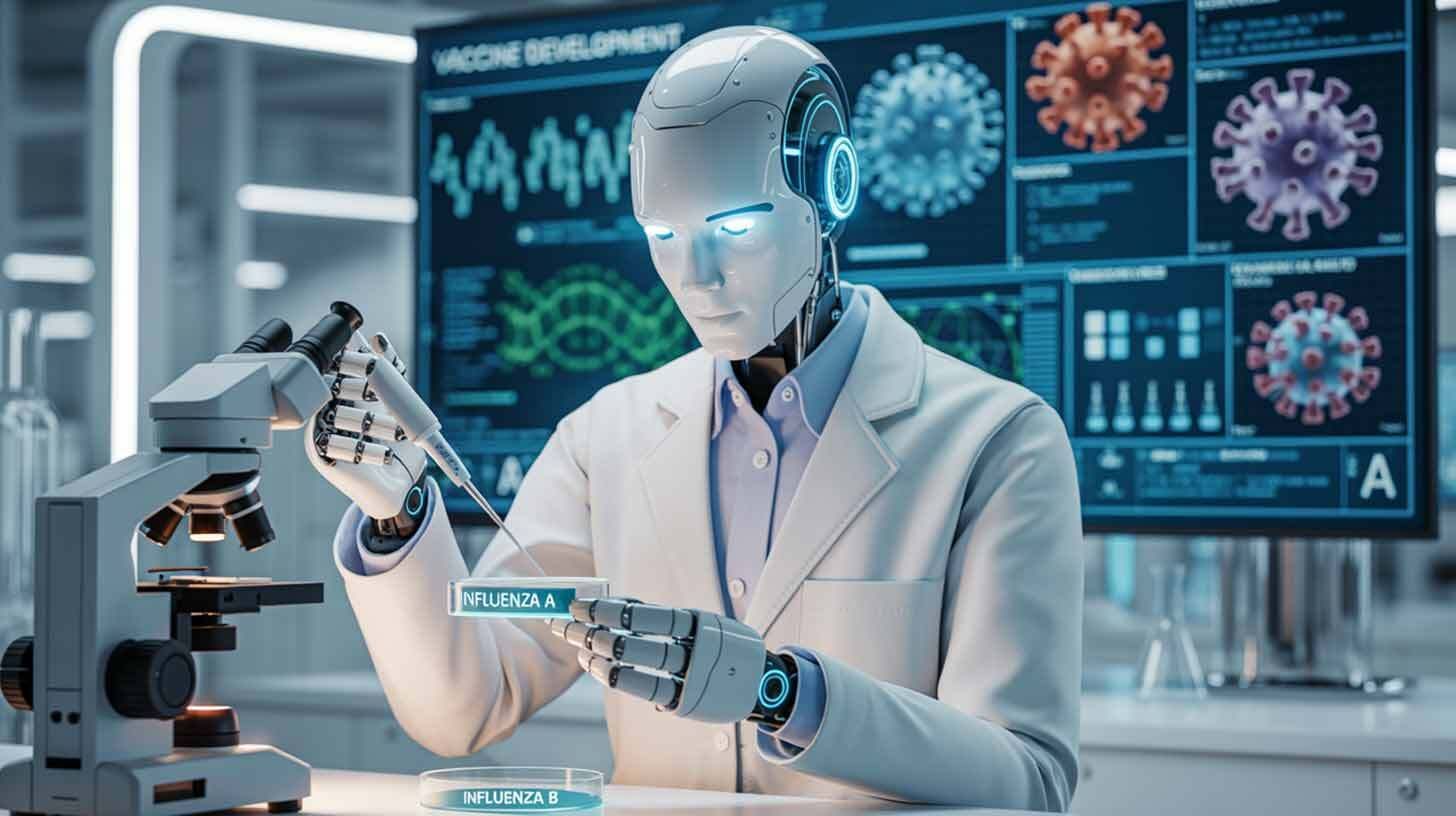
Image source: Ideogram / The Rundown
The Rundown: MIT researchers created VaxSeer, an AI system that predicts which flu strains will dominate future seasons and identifies the most protective vaccine candidates months in advance.
The details:
The system uses deep learning trained on decades of viral sequences and lab test data to forecast strain dominance and vaccine effectiveness.
In testing against past flu seasons, VaxSeer beat the WHO's vaccine picks 15 out of 20 times across two major flu types.
The system also spotted a winning vaccine formula in 2016 that health officials didn't choose until the following year.
VaxSeer's predictions matched up strongly with how well vaccines actually worked when given to real patients.
Why it matters: With vaccines needing to be created ahead of flu season, choosing the correct strain is a guessing game, which often results in hit-or-miss effectiveness. With VaxSeer’s ability to read patterns humans miss to help make better predictions, targeting the correct bug could mean a lot fewer illnesses come flu season.
QUICK HITS
🛠️ Trending AI Tools
💬 Hunyuan-MT - Tiny, open-source SOTA translation model
🍥 USO - ByteDance’s creative model for style and subject generations
🗣️ Higgsfield Speak 2.0 - Make avatars speak with lip-sync and motion
🔊 MAI-Voice-1 - Microsoft’s new in-house voice generation model
📰 Everything else in AI today
Honeycomb Observability Day SF, Sep.11 – Join Charity Majors & Liz Fong-Jones to explore the future of observability in the age of AI. Save your spot.*
OpenAI is reportedly in talks to build a 1GW minimum datacenter in India as part of its Stagate project initiative, with CEO Sam Altman set to visit the country this month.
Tencent released Hunyuan-MT-7B and Hunyuan-MT-Chimera, an open-source joint AI translation system that outperforms rivals in its size category across 33 languages.
CEO Marc Benioff revealed that Salesforce has reduced its support headcount by 45% this year, using AI agents to handle lead response and customer conversations.
Chinese president Xi Jinping spoke on AI at the Shanghai Cooperation Organization, calling for global cooperation and rejecting the “Cold War mentality” around the tech.
*Sponsored Listing
COMMUNITY
🤝 Community AI workflows
Every newsletter, we showcase how a reader is using AI to work smarter, save time, or make life easier.
Today’s workflow comes from reader Hunain A. in Kuala Lumpur, Malaysia:
“I record videos for clients. tons of them. They need to be uploading consistently every day, and it’s all personal branding, so scripting, lighting, filming, cutting, editing then publishing. This took a whole load of time for me and approval cycles from them. I decided to automate that and built a full custom N8N automation that does all of it for me. It has already freed up almost 35 hours a week AT LEAST. The automation comprises GPT for scripts, Heygen for Avatar, and coded stuff for auto-editing. All that happens from now on is a couple of approval cycles, which I will hopefully automate, and publishing to platforms."
How do you use AI? Tell us here.
🎓 Highlights: News, Guides & Events
Read our last AI newsletter: xAI sues ex-engineer for trade secret theft
Read our last Tech newsletter: Netflix goes full-on theme park
Read our last Robotics newsletter: Nvidia’s palm-sized ‘robot brain’
Today’s AI tool guide: Design and build a mobile app with Figma AI
Join our next live workshop: Building professional AI automation workflows
See you soon,
Rowan, Joey, Zach, Shubham, and Jennifer — the humans behind The Rundown

xAI sues ex-engineer for trade secret theft
Read Online | Sign Up | Advertise

Good morning, AI enthusiasts. Elon Musk’s xAI has made headlines suing OpenAI, Microsoft, Apple, and half of Silicon Valley… But its latest lawsuit hits closer to home.
The company is now suing a former engineer who allegedly downloaded Grok's secrets, sold his equity, and was set to walk straight into OpenAI's arms — making for a dark turn in the increasingly cutthroat AI talent wars.
In today’s AI rundown:
xAI sues ex-engineer over trade secret theft
Meta’s superintelligence team faces departures
Create designs with Genspark AI Designer
AI stethoscope spots hidden heart problems
4 new AI tools, community workflows, and more
LATEST DEVELOPMENTS
XAI
👨🏻⚖️ xAI sues ex-engineer over trade secret theft
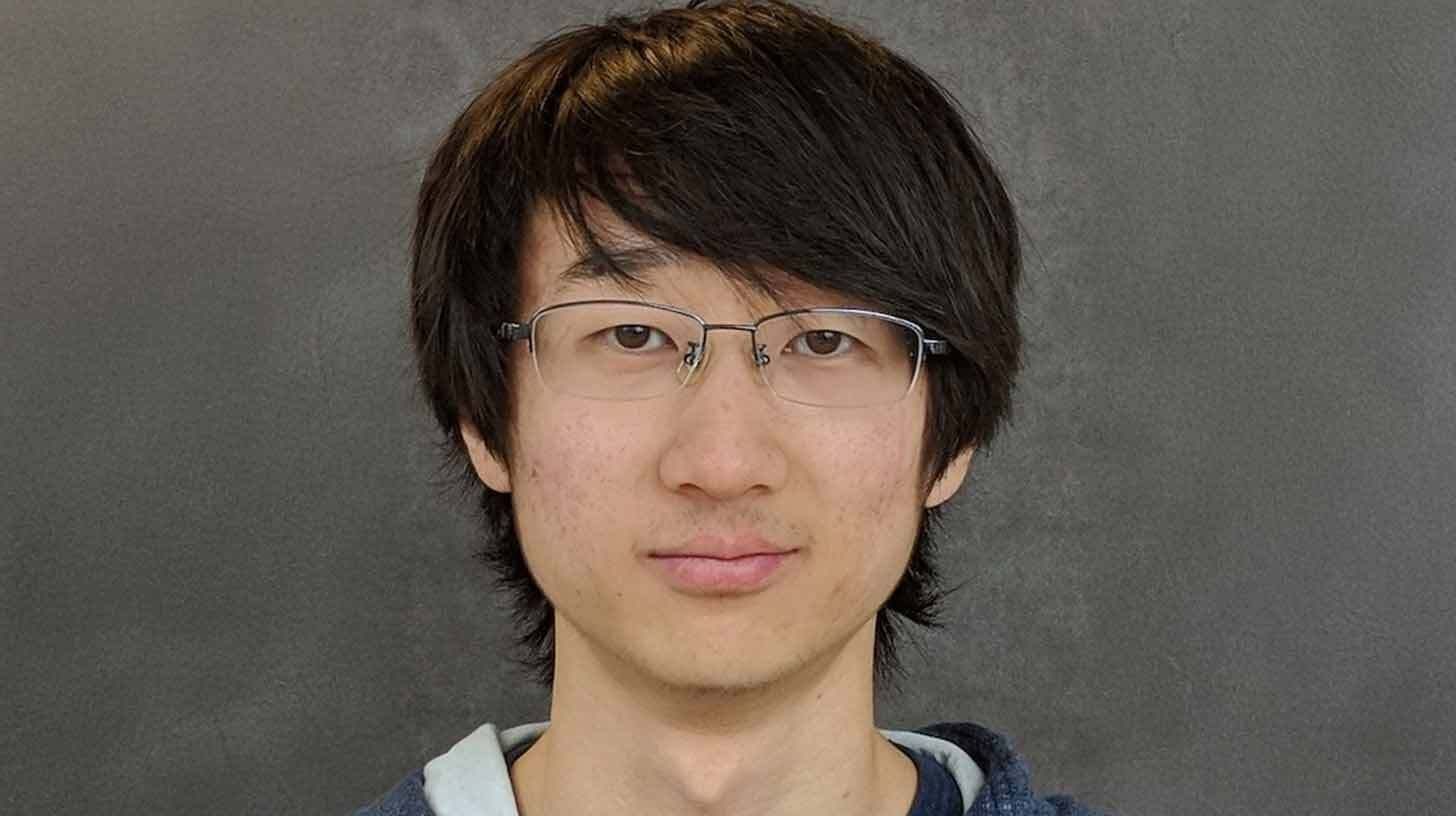
Image source: Stanford HAI
The Rundown: Elon Musk's xAI just filed a lawsuit against former engineer Xuechen Li, accusing him of allegedly stealing Grok trade secrets days before selling millions of dollars in equity and resigning to join OpenAI.
The details:
Li accepted an OAI position in July that was set to start in mid-August, selling $7M in xAI stock and resigning from the company shortly after.
xAI said Li stole “cutting-edge AI tech with features superior to those offered by ChatGPT,” downloading confidential trade secrets to his personal devices.
xAI claims Li admitted to stealing the data during a meeting with the company on Aug. 14, while also trying to cover tracks by deleting logs and renaming files.
Li joined xAI in 2024 as one of the first 20 engineers at the company, working on developing and training its Grok language model.
xAI is seeking an injunction to block Li from working at OpenAI and any other competitor while the case is outstanding, alongside monetary damages.
Why it matters: The AI talent wars are out of control, and so is the temptation to monetize insider knowledge, with engineers carrying billions in IP both in their heads and on their laptops. The fact that this also involves an xAI to OpenAI move will likely only deepen tensions between Elon Musk and his former company.
TOGETHER WITH CISCO
🔌 Powering the workforce for agentic AI

The Rundown: Cisco's AI-native network architecture is purpose-built to power the explosive growth of agentic AI, providing a secure, scalable foundation for your digital workforce.
With Cisco, you get:
Fused security that protects every AI agent and data flow directly at the network level
Autonomous AI agents that collaborate seamlessly with humans for streamlined operations
Network infrastructure that handles the massive traffic demands of AI-augmented workforces
META
🚪 Meta’s superintelligence team faces departures

Image source: Alexandr Wang (@alexandrwang on X)
The Rundown: Meta’s high-profile Superintelligence Labs team is facing a series of early departures and reported turmoil in its relationship with data provider Scale AI, hinting at a chaotic start for the new division after a summer of major overhauls.
The details:
Shengjia Zhao reportedly threatened to quit days after joining MSL, set on returning to OpenAI before eventually being given the chief scientist title.
Meta researchers view Scale AI's data as inferior, according to TechCrunch, opting for competitors despite the $14.3B investment in Wang's company.
Several of Meta’s new hires have already departed or never actually started, with at least two returning to OpenAI.
Why it matters: The story of the summer has been Meta’s poaching and the seemingly infinite amount of money being thrown towards reinventing its AI efforts — and while the vibes were strong externally surrounding the new talent infusion, it’s becoming clear that building a team and executing on Zuck’s vision will take more than just cash.
AI TRAINING
🍥 Create designs with Genspark AI Designer
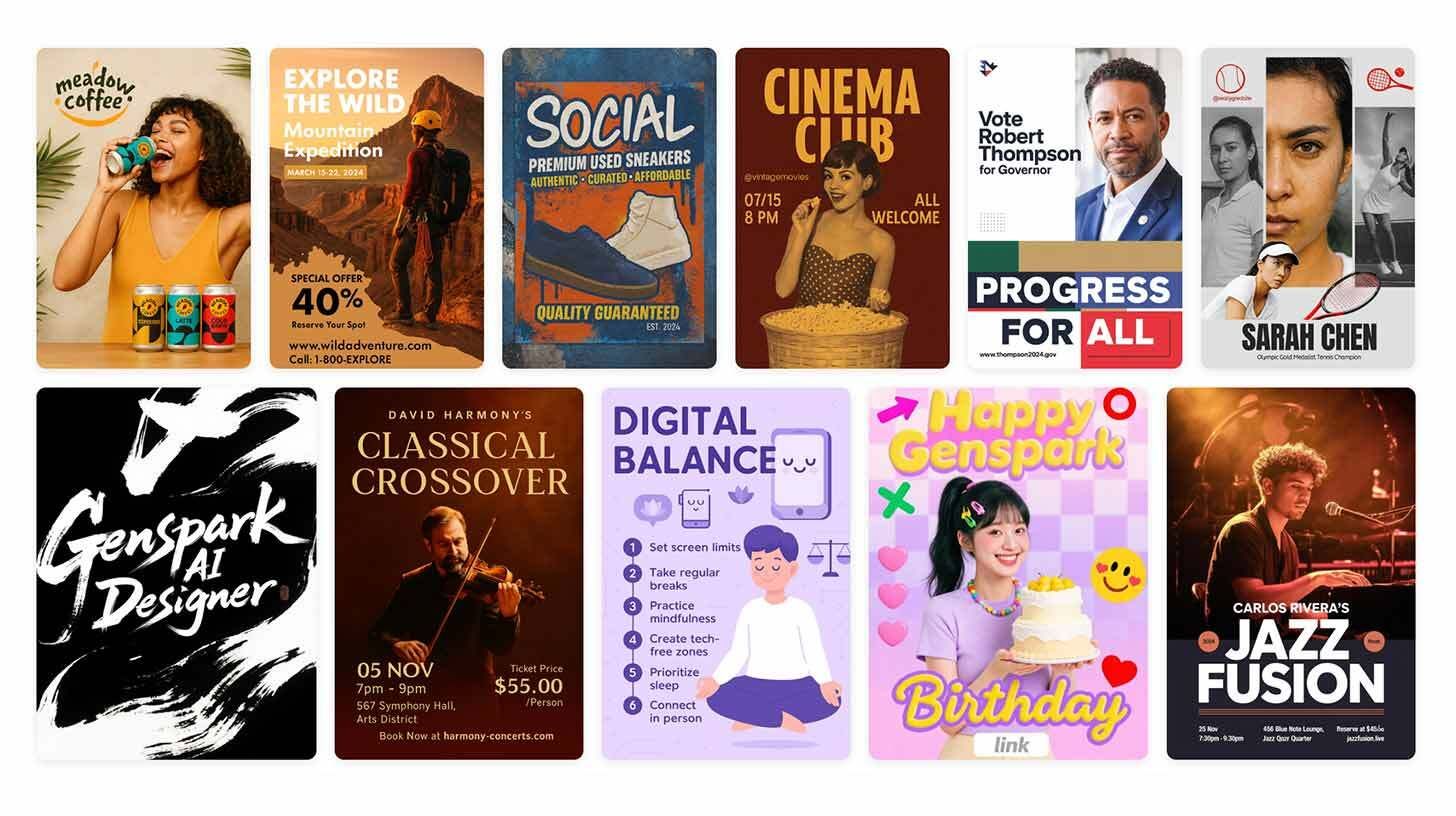
The Rundown: In this tutorial, you will learn how to use Genspark AI Designer to create posters, t-shirts, websites, and more from single prompts — it's like having design agents that search for inspiration before generating your custom layouts.
Step-by-step:
Go to Genspark AI Designer and click into the prompt box
Describe your design: "Create a t-shirt for a company boss that says 'The buck stops here'" or "Design a website for my tennis coaching business"
Watch as Genspark's agents search the web for inspiration, analyze layouts, and then present 4 design options (from minimalist to bold vintage styles)
Refine with follow-ups like "make it viral" or "make it modern minimalist" to improve results
Download the mockup or take it to the GenSpark Developer Agent to convert designs into actual code
Pro tip: The free plan gives 200 credits daily that burn fast — use one-shot prompts wisely, then iterate with specific refinements like "highlight testimonials" or "add booking feature" for production-ready designs.
PRESENTED BY H COMPANY
🚀 Browser automation, unlocked
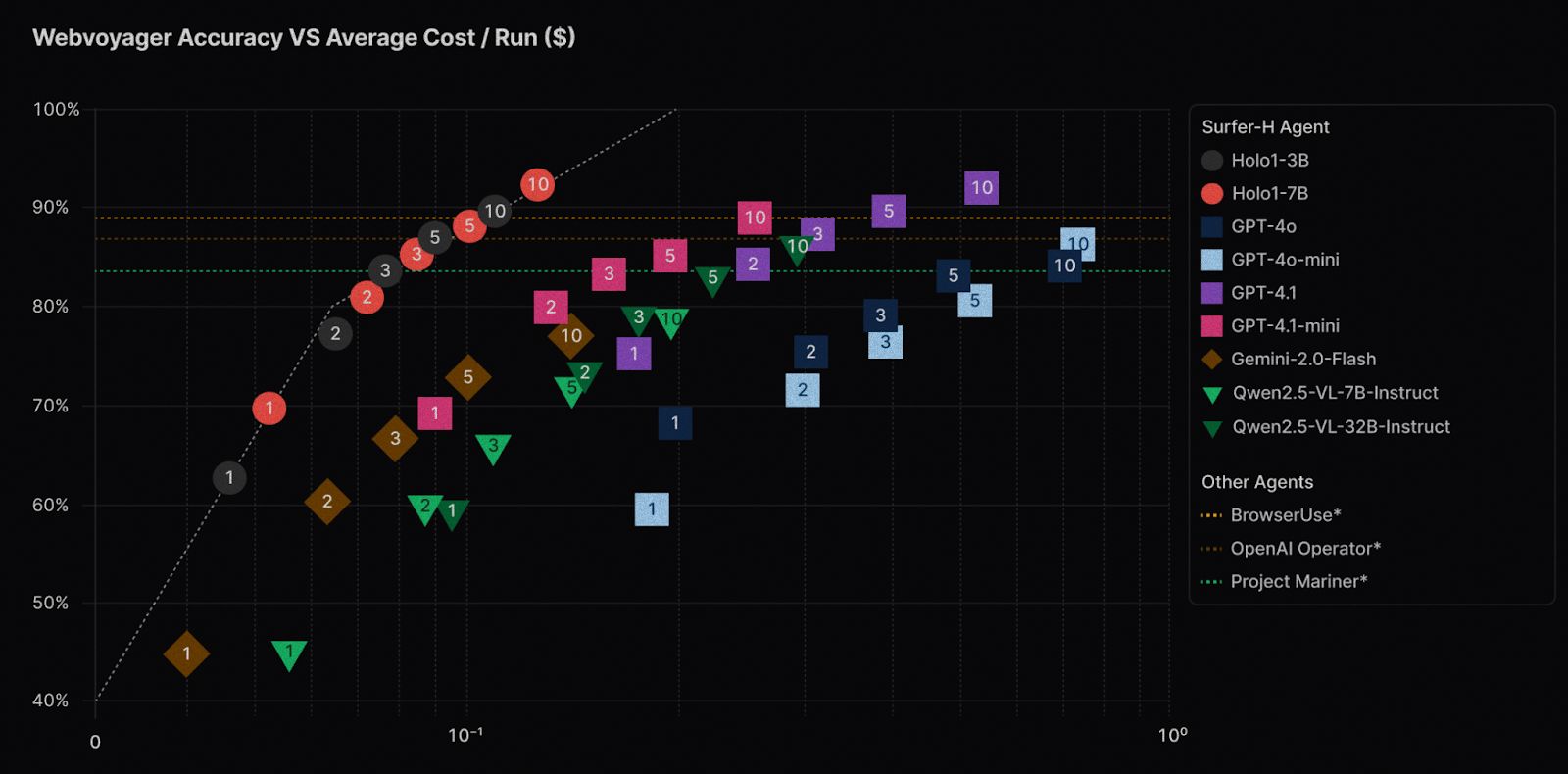
The Rundown: Backed by a historic $220M seed round, H Company just open-sourced Holo1 — the open-source action model behind Surfer H that is now the top-ranked web-browsing agent on WebVoyager.
With Holo1, you can:
Automate multi-step browser workflows to reclaim hours of repetitive work
Experience SOTA accuracy that outperforms OpenAI’s Operator, Gemini Flash, & more
Integrate instantly with RAG workflows, RPA suites, and multi-agent hubs
Trim costs with full browsing flows at just $0.11 – $0.13 per run
Holo 1 is now freely available for deployment, fine-tuning, and scaling — learn more here.
AI RESEARCH
🩺 AI stethoscope spots hidden heart problems

Image source: British Heart Foundation
The Rundown: Researchers from Imperial College London published a study on using an AI-powered stethoscope that can detect major heart issues in just seconds, finding significant increases in potential life-saving early diagnoses over traditional tools.
The details:
The study tested the card-sized device across 200 doctors’ offices with over 12,000 patients, finding 2x rates of heart failure detection.
The AI analyzes heartbeat patterns and blood flow variations undetectable to human ears while simultaneously capturing ECG readings.
The cloud-based AI algorithms process waveform data from over 12,000 patient recordings to flag at-risk individuals within seconds.
Patients examined with the device also showed 3.5x higher detection of atrial fibrillation and nearly double the diagnosis rate for valve disease.
Why it matters: Like other AI medical tools, the key upgrade with the AI stethoscope, which is set to be rolled out across the UK, is proactive prevention. This implementation is also a great example of how a tool invented (and barely changed) since the 1800s can gain incredible powers with a bit of AI integrated into the design.
QUICK HITS
🛠️ Trending AI Tools
⚙️ Grok Code Fast - xAI’s new speedy, SOTA coding model
🗣️ Command A Translate - Cohere’s frontier enterprise translation model
📞 gpt-realtime - OpenAI’s model for creating production-ready voice agents
🎨 USO - ByteDance’s open-source image style editing model
📰 Everything else in AI today
Meta has reportedly discussed partnerships with Google and OpenAI to have third-party models power its Meta AI chatbot while the company trains its next-gen system.
ByteDance released USO, an open ‘style-subject optimized customization model’ that can preserve subjects and apply new artistic styles to create customized images.
UCLA researchers developed optical generative AI models, which create images using light beams instead of processors, capable of faster, energy-efficient outputs.
Higgsfield AI launched Higgsfield Speak 2.0, a new upgrade to its custom avatar tool with more realistic motion, advanced lip-sync, and enhanced video control.
A study found that exposing readers to AI-detection quizzes led to an increase in visits to trusted news sites, suggesting quality journalism may benefit from AI content.
Meta is facing backlash after the images and likenesses of celebrities like Taylor Swift and Scarlett Johansson were used for AI chatbots on its platform without permission.
COMMUNITY
🤝 Community AI workflows
Every newsletter, we showcase how a reader is using AI to work smarter, save time, or make life easier.
Today’s workflow comes from reader Jody W. in Nova Scotia, Canada:
"As an adult with ADHD, I use AI to keep things moving. It helps me get through the tasks that usually slow me down or stop me altogether, like organizing hours, writing up quotes, or keeping projects on track. Instead of getting stuck, I can keep my momentum and stay productive. I've always had a million great ideas and have never really been able to take action on them because of my scattered mind. Now with my AI assistance, I tackle complex problems with ease and have honestly never been more productive."
How do you use AI? Tell us here.
🎓 Highlights: News, Guides & Events
Read our last AI newsletter: Microsoft's homegrown AI debut
Read our last Tech newsletter: Netflix goes full-on theme park
Read our last Robotics newsletter: Nvidia's palm-sized 'robot brain'
Today’s AI tool guide: Create inspiring designs with Genspark AI Designer
Watch our last live workshop: Essential ChatGPT tips
See you soon,
Rowan, Joey, Zach, Shubham, and Jennifer — the humans behind The Rundown

Netflix goes full-on theme park
Read Online | Sign Up | Advertise

Good morning, tech enthusiasts. Netflix is bringing binge culture into the physical realm with Netflix House — two massive entertainment venues opening later this year.
Entry is free; leaving without a Demogorgon latte or Squid Game hoodie is optional. But the question is, can fandom survive outside the algorithm?
In today’s tech rundown:
Netflix opens immersive fan-based venues
SpaceX’s near-flawless Starship launch
Microsoft cracks down on employee protests
Website builder Framer grabs $2B valuation
Quick hits on other tech news
LATEST DEVELOPMENTS
NETFLIX
🎟️ Netflix opens immersive fan-based venues

Image source: Netflix
The Rundown: Netflix is doubling down on its IP empire with Netflix House, revealing fresh details this week about two colossal complexes set to open later this year in Philadelphia and Dallas, with Las Vegas slated for 2027.
The details:
Netflix House is launching its first two permanent locations in Philadelphia on November 12 and Dallas on December 11.
The concept transforms over 100K square feet of former department store space into interactive experiences based on Netflix's most popular content.
Free to enter, the spaces layer arcade games, immersive mini-golf, and VR character experiences around franchises like Stranger Things and Squid Game.
Netflix says that attractions will be refreshed frequently, ensuring that every visit delivers new adventures, all while doubling as strategic marketing.
Why it matters: Streaming isn’t just about screens anymore — it’s about turning brands into physical worlds where fandom, retail, and leisure blur together. By dropping two massive venues into malls, Netflix is testing whether its carousel of streaming hits can hook people IRL as reliably as it does at home.
TOGETHER WITH AUGMENT CODE
👋 Meet Auggie CLI
The Rundown: Augment Code is bringing the power of its AI coding agent and context engine right to your terminal with Auggie CLI, now generally available.
From standalone terminal sessions to every piece of your dev stack, with Auggie CLI, you can:
Build features and debug issues
Get instant feedback suggestions for your PRs and builds
Triage customer issues and alerts from your observability stack
Build with the AI coding platform that gets you, your team, and your code
SPACEX
🚀 SpaceX’s near-flawless Starship launch

Image source: SpaceX
The Rundown: SpaceX’s Starship finally blasted off after a streak of fiery failures, firing 33 Raptor engines, soaring to suborbital heights, and nailing a controlled splashdown — a landmark for the world’s biggest, most powerful rocket.
The details:
Starship’s tenth test flight launched on August 26 from Starbase, Texas, after two days of weather and equipment delays, finally breaking a string of failures.
The 400-foot rocket, powered by 33 Raptor engines, thundered skyward carrying the world’s most powerful thrust: more than 16M pounds.
Both stages executed as planned: Super Heavy boosted Starship upward, then descended for a controlled splashdown in the Gulf Coast.
The Starship upper stage separated cleanly, reached suborbital altitude, and performed a controlled splashdown in the Indian Ocean as programmed.
Why it matters: For the SpaceX team, cheered on by 1.8M livestream viewers, it was vindication: flight data flowed, boosters returned, and a huge leap in super-heavy orbital reusability. Yet despite the win, doubts remain that Starship will be ready in time for NASA’s Artemis III crewed landing on the moon, slated for 2027.
MICROSOFT
🪧 Microsoft cracks down on employee protests

Image source: No Azure for Apartheid
The Rundown: Microsoft fired four employees after a wave of protests over its contracts with the Israeli military, including high-profile sit-ins at President Brad Smith’s office and encampments at company headquarters.
The details:
The firings included Nisreen Jaradat and Julius Shan, both heavily involved in organizing the protest for the No Azure for Apartheid movement.
Advocacy emails sent internally by Jaradat, voicing frustration over Microsoft’s handling of Palestine-related issues, attracted widespread internal attention.
The protests emerged amid revelations from the Guardian about the Israeli military’s use of Azure for large-scale surveillance of Palestinians.
Protesters entered and livestreamed from Smith’s office, barricading themselves and refusing to leave until forcibly removed by law enforcement.
Why it matters: Employees, staging protests and circulating mass emails, have put their jobs on the line to criticize the company’s position on Palestine and Gaza. Microsoft has maintained that subsequent firings were not politically motivated, but the result of “serious breaches” of company policy.
FRAMER
🦄 Website builder Framer grabs $2B valuation

Image source: Framer
The Rundown: Dutch startup Framer, the no-code website builder that’s quietly become a darling of high-growth startups, nabbed $100M in Series D funding at a $2B valuation, earning it a rare “double unicorn” status in design tech.
The details:
Framer boasts over half a million monthly active users and powers sites for startups like Perplexity and enterprise brands like Miro and Scale AI.
The company allows users to visually design, build, and publish complete, high-performance websites fast with no coding required.
Its AI feature lets users generate website pages instantly from natural language prompts, further speeding up the design process.
Framer says the new capital is earmarked for U.S. market acceleration, expanding AI capabilities, and rolling out even more collaboration features.
Why it matters: This double-unicorn milestone comes as website builders heat up, with rivals from Figma to Squarespace and Wix, plus a new crop of vibe coding players like Cursor and Lovable. Framer’s expanding B2B business, targeting $100M in annual recurring revenue next year, could set it apart.
QUICK HITS
📰 Everything else in tech today
Anthropic now requires all Claude users to opt in or out of having their conversations used for AI training by September 28.
ByteDance, the parent company of TikTok, is planning an employee share buyback that values the company at over $330B.
Prosecutors are seeking a 15-year prison sentence for tech giant Kakao founder Kim Beom-su for manipulating stock prices during a takeover battle for SM Entertainment.
Frontier, the Google-backed carbon removal consortium, committed $31.3M to purchase 115,211 metric tons of carbon removal credits from startup Planetary.
Google introduced new AI-powered features to Google Translate aimed at helping users learn new languages, taking a page from Duolingo.
Scientists created a one-step process that converts mixed plastic waste into petrol at room temperature and ambient pressure, achieving over 95% efficiency.
Elon Musk’s The Boring Company has reportedly begun testing Tesla’s Full Self-Driving system in the Las Vegas Convention Center tunnels that link to nearby hotels.
University of Queensland researchers achieved a world first by successfully growing fully functioning human skin in the lab.
COMMUNITY
🎓 Highlights: News, Guides & Events
Read our last AI newsletter: Microsoft’s homegrown AI debut
Read our last Tech newsletter: Klarna gets a $14B reality check
Read our last Robotics newsletter: Nvidia’s palm-sized robot brain
Today’s AI tool guide: Create an AI agent to handle email support
RSVP to our next workshop today at 4 PM EST: Essential ChatGPT tips
See you soon,
Rowan, Jennifer, and Joey—The Rundown’s editorial team

Microsoft's homegrown AI debut
Read Online | Sign Up | Advertise

Good morning, AI enthusiasts. For years, Microsoft's AI strategy has been synonymous with OpenAI — but that narrative just got complicated.
The company's new MAI-Voice-1 and MAI-1-preview models mark its first homegrown AI, signaling a shift that could throw yet another wrench into the AI world’s most-watched partnership.
Reminder: Our next live workshop is today at 4 PM EST with The Rundown’s AI Educator, Nate Grahek — join and learn all the latest tips and tricks for getting the most out of ChatGPT. RSVP here.
In today’s AI rundown:
Microsoft releases homegrown AI
OpenAI’s gpt-realtime for voice agents
Create an AI agent to handle email support
Cohere’s SOTA enterprise translation model
4 new AI tools, community workflows, and more
LATEST DEVELOPMENTS
MICROSOFT
🤖 Microsoft releases homegrown AI

Image source: Microsoft
The Rundown: Microsoft just introduced MAI-Voice-1 and MAI-1-preview, marking its first fully in-house AI models and coming after years of relying on OpenAI's technology in a turbulent partnership.
The details:
MAI-Voice-1 is a speech generation model capable of generating a minute of speech in under a second, already integrated into Copilot Daily and Podcasts.
MAI-1-preview is a text-based model trained on a fraction of the GPUs of rivals, specializing in instruction following and everyday queries.
CEO Mustafa Suleyman said MAI-1 is “up there with some of the best models in the world”, though benchmarks have yet to be publicly released.
The text model is currently being tested on LM Arena and via API, with Microsoft saying it will roll out in “certain text use cases” in the coming weeks.
Why it matters: Microsoft's shift toward building in-house models introduces a new dynamic to its OAI partnership, also positioning it to better control its own AI destiny. While we await benchmarks and more real-world testing for a better understanding, the tech giant looks ready to pave its own path instead of being viewed as OAI’s sidekick.
TOGETHER WITH AUGMENT CODE
👋 Meet Auggie CLI
The Rundown: Augment Code is bringing the power of its AI coding agent and context engine right to your terminal with Auggie CLI, now generally available.
From standalone terminal sessions to every piece of your dev stack, with Auggie CLI, you can:
Build features and debug issues
Get instant feedback suggestions for your PRs and builds
Triage customer issues and alerts from your observability stack
Build with the AI coding platform that gets you, your team, and your code
OPENAI
🗣️ OpenAI’s gpt-realtime for voice agents
Image source: OpenAI
The Rundown: OpenAI moved its Realtime API out of beta, also introducing a new gpt-realtime speech-to-speech model and new developer tools like image input and Model Context Protocol server integrations.
The details:
gpt-realtime features nuanced abilities like detecting nonverbal cues and switching languages while keeping a naturally flowing conversation.
The model achieves 82.8% accuracy on audio reasoning benchmarks, a massive increase over the 65.6% score from its predecessor.
OpenAI also added MCP support, allowing voice agents to connect with external data sources and tools without custom integrations.
gpt-realtime can also handle image inputs like photos or screenshots, giving the voice agent the ability to reason on visuals alongside the conversation.
Why it matters: The mainstream adoption of voice agents feels like an inevitability, and OpenAI’s additions of upgraded human conversational abilities and integrations like MCP and image understanding bring even more functionality for enterprises and devs to plug directly into customer support channels or customized voice applications.
AI TRAINING
✉️ Create an AI agent to handle email support
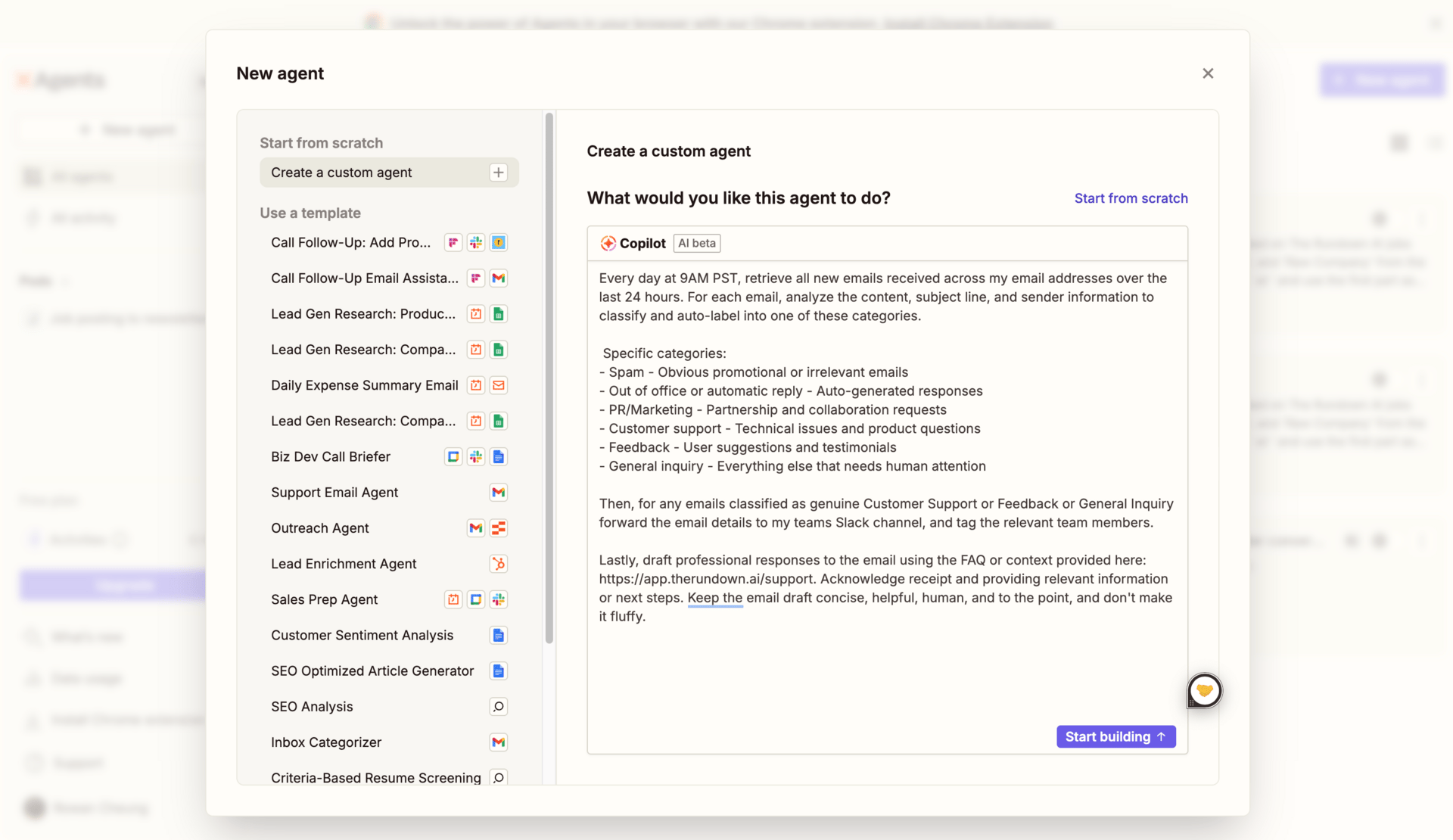
The Rundown: In this tutorial, you will learn how to build an AI agent that automatically triages incoming emails, tags team members in Slack, and drafts professional responses, turning your overwhelming inbox into an organized workflow.
Step-by-step:
Go to Zapier Agents, click "New Agent", name it "Email Triage Assistant", and set it to run daily at 9 AM (batch processing saves Zapier calls)
Click Copilot and paste: "Every day at 9 AM PST, retrieve all emails from the last 24 hours. Classify as: Spam, Auto-replies, PR/Marketing, Customer Support, Feedback, or General Inquiry"
Add team tagging rules customized for your team members to funnel to specific departments or responsibilities
Click "Add tools" and connect Gmail, Slack, and your FAQ URLs — grant full permissions for autonomous operation
Test with your current inbox, verify categorization accuracy, then enable the daily schedule
Pro tip: Feed your agent FAQ URLs, Notion docs, and previous support threads in the instructions. The more context you provide, the better it handles edge cases and knows exactly who to loop in.
PRESENTED BY STACK AI
🛠️ Your secure enterprise AI toolkit
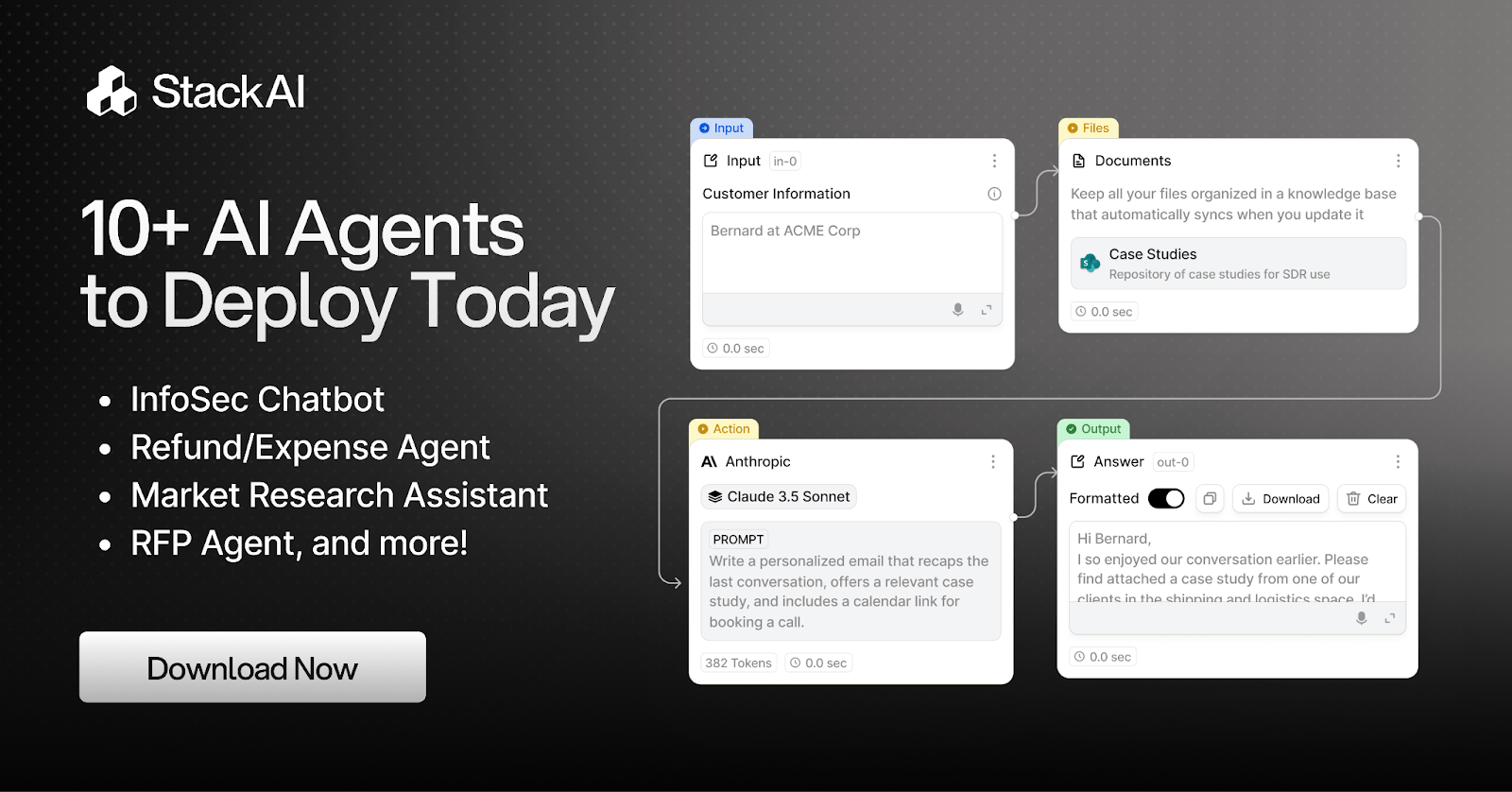
The Rundown: Deploy 10 AI agents that actually drive ROI on StackAI—the secure enterprise AI toolkit trusted by finance, legal, ops, & IT teams who move 80% faster than the rest.
With StackAI’s toolkit, you’ll get:
Drag and drop platform + ship as chatbots, forms, apps
Built-in PII protections, guardrails, audit trails, SSO, and compliance
Seamless integrations with 100+ tools you already use
COHERE
🌍 Cohere’s SOTA enterprise translation model
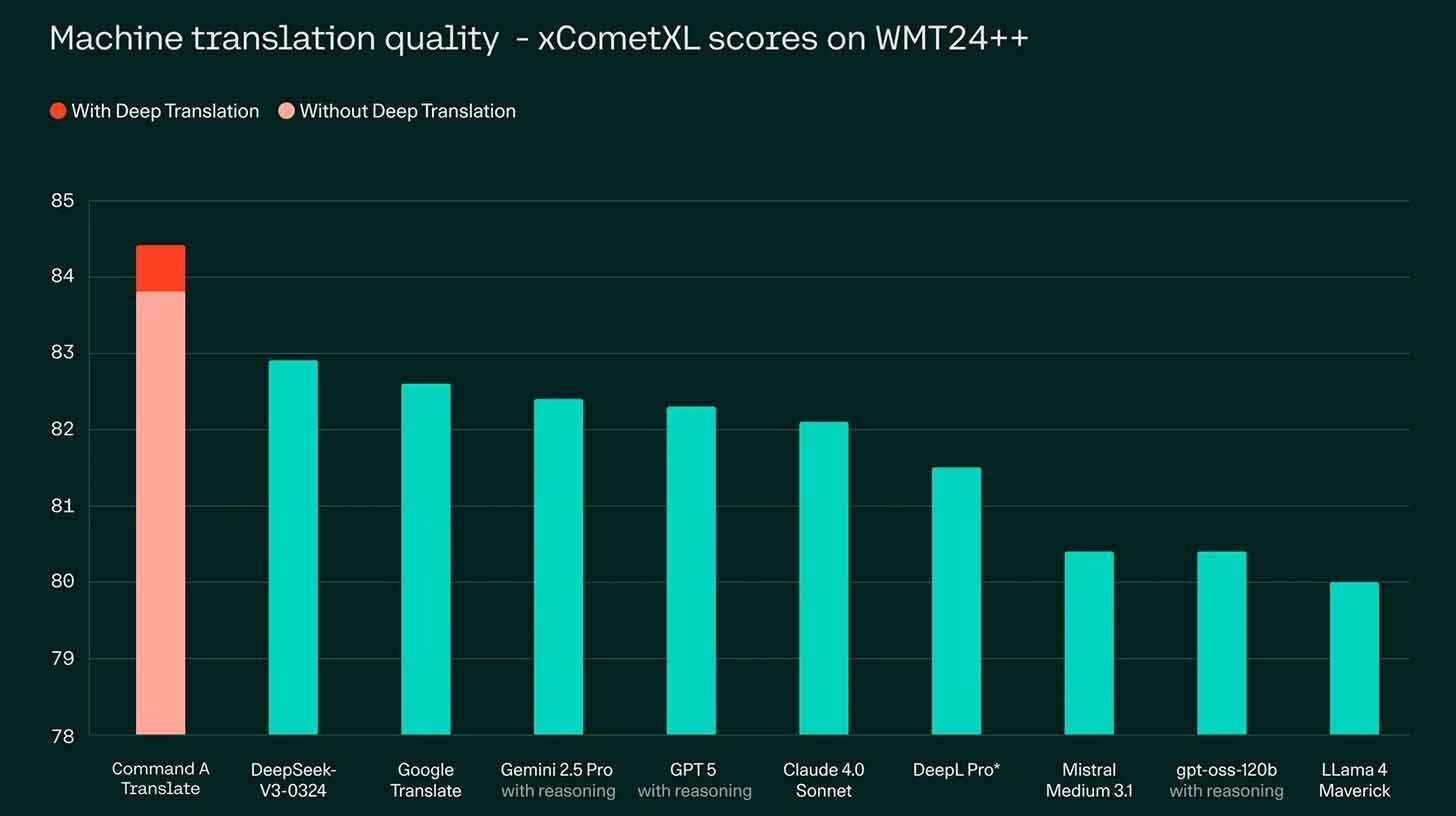
Image source: Midjourney
The Rundown: Cohere introduced Command AI Translate, a new enterprise model that claims top scores on key translation benchmarks while allowing for deep customization and secure, private deployment options.
The details:
Command A Translate outperforms rivals like GPT-5, DeepSeek-V3, and Google Translate on key benchmarks across 23 major business languages.
The model also features an optional ‘Deep Translation’ agentic workflow that double-checks complex and high-stakes content, boosting performance.
Cohere offers customization for industry-specific terms, letting pharmaceutical companies teach their drug names or banks add their financial terminology.
Companies can also install it on their own servers, keeping contracts, medical records, and confidential emails completely offline and secure.
Why it matters: Security has been one of the biggest issues for companies wanting to leverage AI tools, and global enterprises face a choice of uploading sensitive documents to the cloud or paying for time-consuming human translators. Cohere’s model gives businesses customizable translation in-house without data privacy risks.
QUICK HITS
🛠️ Trending AI Tools
🎥 Google Vids - Create and edit videos with AI-powered tools
🔊 MAI-Voice-1 - Microsoft’s new in-house voice generation model
🗣️ gpt-realtime - OpenAI’s new advanced speech-to-speech model
🥁 HunyuanVideo-Foley - Open-source model for professional-grade audio
📰 Everything else in AI today
Free Event: The Future of AI Agents in Coding with Guy Gur-Ari & Igor Ostrovsky, co-founders of Augment Code. Ask them anything today in r/webdev.*
xAI released Grok Code Fast 1, a new advanced coding model (previously launched under the codename sonic) that features very low costs for agentic coding tasks.
Anthropic published a new threat report revealing that cybercriminals exploited its Claude Code platform to automate a multi-million dollar extortion scheme.
OpenAI rolled out new features for its Codex software development tool, including an extension to run in IDEs, code reviews, CLI agentic upgrades, and more.
Krea introduced a waitlist for a new Realtime Video feature, enabling users to create and edit video using canvas painting, text, or live webcam feeds with consistency.
Tencent open-sourced HunyuanVideo-Foley, a new model that creates professional-grade soundtracks and effects with SOTA audio-visual synchronization.
TIME Magazine released its 2025 TIME100 AI list, featuring many of the top CEOs, researchers, and thought leaders across the industry.
*Sponsored Listing
COMMUNITY
🤝 Community AI workflows
Every newsletter, we showcase how a reader is using AI to work smarter, save time, or make life easier.
Today’s workflow comes from reader Scott M. in Franklin, TN:
"My client was using a legacy version of QuickBooks Desktop, which lacked the feature for sending automated follow-up emails for overdue invoices. To address this, I built a custom automation using Zapier AI: the workflow logs into the accounting email, IDs invoices that are more than 60 days past due, and follows the invoice link to verify whether it's been paid. If payment has not been made, the automation sends a reminder email stating that the invoice is late and includes the original payment link. Every communication includes the accounting department, ensuring they stay informed about delinquent payments."
How do you use AI? Tell us here.
🎓 Highlights: News, Guides & Events
Read our last AI newsletter: The AI app power rankings
Read our last Tech newsletter: Klarna gets a $14B reality check
Read our last Robotics newsletter: Nvidia’s palm-sized robot brain
Today’s AI tool guide: Create an AI agent to handle email support
RSVP to our next workshop today at 4 PM EST: Essential ChatGPT tips
See you soon,
Rowan, Joey, Zach, Shubham, and Jennifer—the humans behind The Rundown
No matching search results
Try using different keywords, double-check your spelling, or explore related categories.
Stay Ahead on AI.
Join 2,000,000+ readers getting bite-size AI news updates straight to their inbox every morning with The Rundown AI newsletter. It's 100% free.