Ideogram and Reve rethink how AI images get made
PLUS: Automate your social content calendar with Manus

Zach Mink
June 4, 2026
Read Online | Sign Up | Advertise

Good morning, AI enthusiasts. How you use an AI image model is starting to change, and two back-to-back releases show where it's going.
The new (open-source!) Ideogram 4.0 and Reve 2.0 make a similar case: the prompt gets you close, but letting users edit and control typography, regions, and layout after the fact is where the next breakthrough lives.
In today’s AI rundown:
New image models swap text prompts for layouts
Meta turns business chats into AI agents
Automate social content calendar with Manus
Study: AI tutors edge out law faculty
4 new AI tools, community workflows, and more
LATEST DEVELOPMENTS
IDEOGRAM & REVE
🖼️ New image models swap text prompts for layouts

Image source: Ideogram / Reve
The Rundown: Two image labs just shipped new models, with Ideogram open-sourcing Ideogram 4.0 and Reve launching Reve 2.0 — and both pushing a more layout- focused, agentic iteration process for more user input and creative control.
The details:
Ideogram 4.0 takes the top spot for open models and ranks behind only OpenAI and Google’s closed models on Design Arena.
4.0 excels at text rendering, typography, and graphic design, preferred by professional human designers over top rivals on Contra’s testing.
Reve 2.0 surpasses Nano Banana 2 on Arena’s Text-to-Image leaderboard to take the No. 2 overall spot, trailing only GPT-image-2.
The model’s outputs include labeled segments, allowing users to tweak specific parts of an image rather than regenerate it entirely.
Reve creates the image ‘like code’, editing it by rewriting the layout rather than the prompt, while Ideogram uses a similar technique via JSON.
Why it matters: Image models have come a long way from the slot-machine days, when the only move was to re-roll the prompt. The real step change now is the granular control and editing that people used to jump to other apps for. With Ideogram, the open weights are the story: proving open source is not far behind the frontier.
TOGETHER WITH FUNCTION HEALTH
🩺 Your body has receipts

The Rundown: Function gives you access to 160+ lab tests, personalized insights, and ongoing tracking in one place — so you can see what's happening inside your body before symptoms show up.
A Function membership gives you:
160+ lab tests run annually across key health markers
Private AI Chat trained on your individual results
Clinician-reviewed insights to put your data in context
Continuous tracking so you can see what changes over time
Own your health and use code RUNDOWN50 for $50 off your membership.
META
💬 Meta turns business chats into AI agents

Image source: Meta
The Rundown: Meta just launched Meta Business Agent globally, rolling out AI agents across WhatsApp, Instagram, and Messenger that can answer questions, book appointments, and close sales for any business on the platform.
The details:
Meta first floated the feature in October as a free test in international markets, with over 1M businesses already utilizing the tool.
Agents can close sales, recommend items, qualify leads, and book appointments across languages, with human takeover available at any point.
A standalone Business Agent Platform plugs agents into outside tools like Zendesk and Shopify, with broader business operations abilities coming later.
The agent is free to start, though Meta said it will be rolling out paid subscription tiers across different business sizes.
Why it matters: Meta’s sprawling social media empire is already a major driver for businesses, so embedding agents for them is a sharp move. The question will be trust. Stories like hackers fooling Meta's own support bot this week won’t help, as the tech giant hopes businesses will trust its agents with their own customers.
AI TRAINING
🤳 Automate social content calendar with Manus
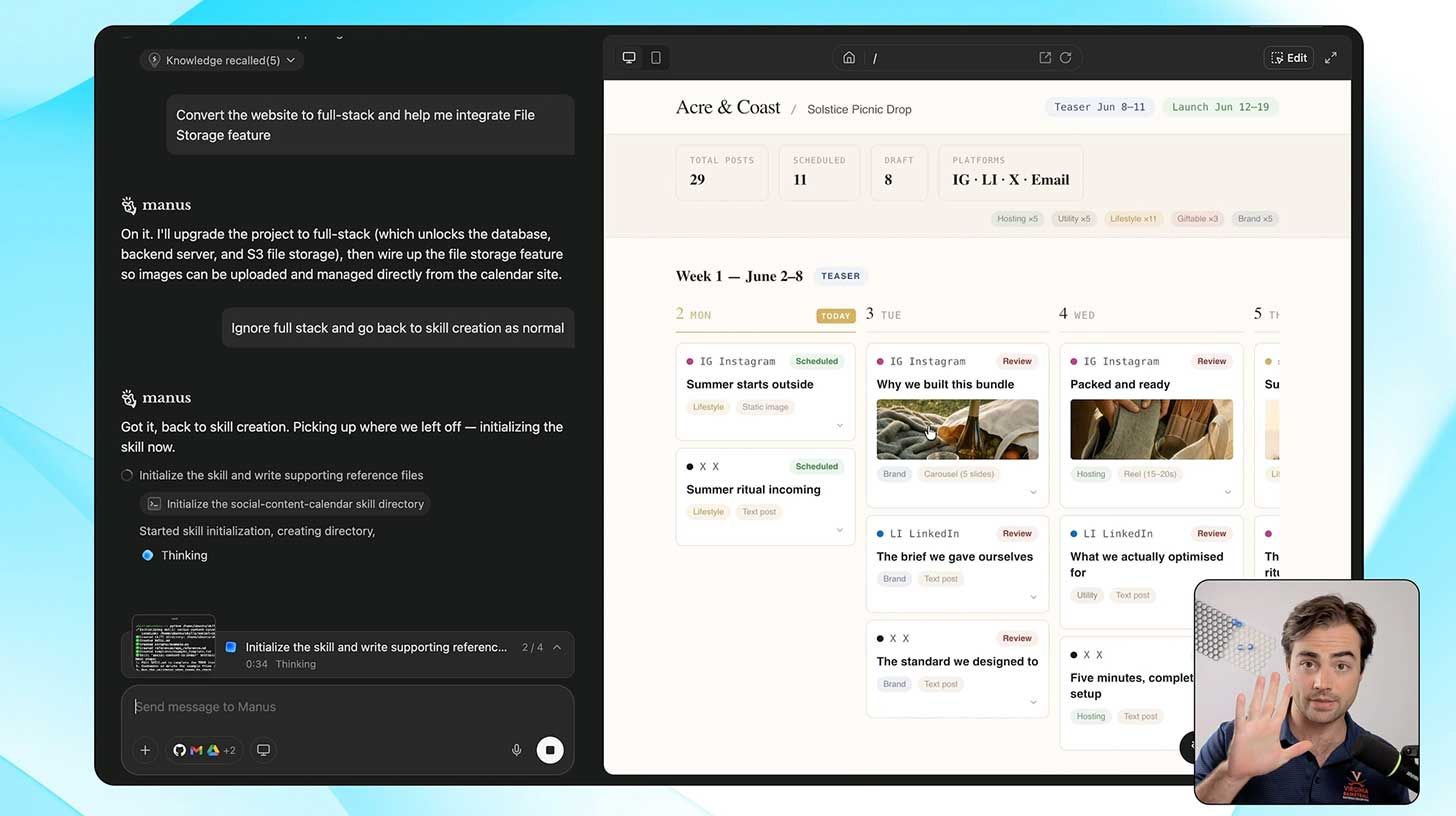
The Rundown: In this guide, you will learn how to build a custom content calendar in Manus that updates, plans, and generates each week of social posts for you. It will automatically save generated posts in your Google Drive so you can easily access them.
Step-by-step:
Sign up for Manus and get its desktop app, then create a Google Drive folder and add your brand documents, briefs, example posts, or product notes
Open the Manus Connectors page, choose Google Drive, authorize your account, then create a new project for this calendar
Prompt: “Build a one-page HTML content calendar I can use as a visual planning dashboard for one week of content. Use the brand documents in my Google Drive folder to generate post titles, captions, and assets for [Instagram, LinkedIn, X, email]. Show each post and asset in the calendar page, and save the generated posts and assets back into Google Drive”
Tell Manus to generate the first week of posts based on the brand assets you added to Google Drive, then turn that planning process into a reusable skill
Pro tip: Once the skill is working, ask Manus to make it a weekly automation that refreshes the next seven days of posts and updates the calendar.
PRESENTED BY VANTA
👋 Find your Calm-pliance

The Rundown: Your employee just added their 67th AI tool. Congrats. You also just created your 67th security blind spot. The Vanta Agent is the sharpest GRC engineer you’ve never had to hire, working tirelessly across the platform to draft policies, complete questionnaires, and flag issues before they escalate.
Here's what Vanta Agent takes off your plate:
Continuous policy drafting as your tool stack grows
Security questionnaires completed automatically
Compliance gaps flagged before they become audit findings
Always-on coverage across your existing Vanta workflows
Don't be the last one scrambling before an audit — watch the on-demand demo to learn more.
AI RESEARCH
⚖️ Study: AI tutors edge out law faculty

Image source: Images 2.0 / The Rundown
The Rundown: A new study led by Stanford ran a blind test of AI legal tutoring, asking 16 contract professors to judge anonymized answers from their peers and from two of Google's AI systems — with the faculty siding with the AI outputs 75% of the time.
The details:
The study tested contract-law office-hours questions, a setting where strong answers need judgment and critical thinking instead of just one correct answer.
Sixteen professors from 14 schools blindly judged 2,918 matchups between their own answers and those of Google’s Gemini 2.5 Pro and NotebookLM.
Faculty chose Gemini 2.5 Pro and NotebookLM responses 75% of the time, with only a single top professor staying level with the models in evaluations.
Extending the testing with an AI stand-in judge, the team ranked nine more systems, with Claude Opus 4.7 on top and all models beating the professors.
Why it matters: Early models like GPT-4 were already passing the bar exam, but this study puts AI in tougher, more subjective judgment situations on office hours contract law questions. AI’s rollout into the education world is still controversial and jagged, but areas like on-demand tutoring can help change the learning process for the better.
QUICK HITS
🛠️ Trending AI Tools
⚡ CData Connect AI - Give Claude, ChatGPT, Copilot or any AI tool live, governed, read & write access to your business data in one unified layer.*
🎆 Ideogram 4.0 - Ideogram's new top-rated open-weight image model
👋 Meta Enterprise Agent - Meta’s AI agent for customer sales and support
💻 Personal Computer - Perplexity’s local orchestrator, now on Windows
*Sponsored Listing
📰 Everything else in AI today
Suno raised over $400M at a $5.4B valuation, with the AI music startup rolling out its first model built in partnership with the music industry “in the coming months.”
Google released Gemma 4 12B, a new multimodal model able to run on a 16GB laptop, and the first Gemma variant of this size built for native audio.
xAI rolled out Grok Imagine 1.5 Preview, the company’s latest image-to-video update, which brings upgraded realism, audio syncing, and prompt following.
Microsoft and the Mayo Clinic are building a frontier healthcare AI, trained on anonymized patient data and owned by the clinic, with Azure handling distribution.
Google Labs launched a new experiment called Dreambeans, connecting to users’ Gmail, Calendar, Photos, and Search to generate a feed of personalized daily stories.
COMMUNITY
🤝 Community AI workflows
Every newsletter, we showcase how a reader is using AI to work smarter, save time, or make life easier.
Today’s workflow comes from reader Jeff M. in Great Falls:
“A simple but surprisingly useful use of AI came while shopping for a used vehicle. I had a browser page open with hundreds of listings and asked Gemini in Chrome to extract the data and plot it by price, model year, and mileage. Within seconds, it generated a visualization showing the distribution of asking prices across different years and mileage ranges.
The chart made it easy to see how much value was gained or lost by moving one model year newer or older, and quickly highlighted listings that deserved further investigation. It also exposed suspicious outliers, such as unusually low-priced vehicles that appeared to be stale or bait listings designed to generate leads and encourage buyers to contact the dealership.
What would have taken hours became digestible in a matter of seconds.”
How do you use AI? Tell us here.
🎓 Highlights: News, Guides & Events
Read our last AI newsletter: Microsoft paves its own AI way at Build
Read our last Tech newsletter: Microsoft’s first AI-native laptop
Read our last Robotics newsletter: Nvidia’s plug-and-play humanoid
Today’s AI tool guide: Automate social content calendar with Manus
RSVP to our next workshop on June 18: Build a Marketing Creative Studio
See you soon,
Rowan, Joey, Zach, Shubham, and Jennifer — the humans behind The Rundown



Stay Ahead on AI.
Join 2,000,000+ readers getting bite-size AI news updates straight to their inbox every morning with The Rundown AI newsletter. It's 100% free.