Apple goes big on 'Made in America'
PLUS: NASA's Artemis get delayed again

Jennifer Mossalgue
February 24, 2026
Read Online | Sign Up | Advertise

Good morning, tech enthusiasts. Apple is bringing Mac Mini production to America, to a Foxconn-run Houston line that will handle U.S.-bound units currently made in China and Vietnam.
It’s a sleek little desktop with a big new job: dodge tariffs and blunt geopolitical risk, with the news perfectly timed with Trump’s State of the Union address.
In today’s tech rundown:
Apple’s ‘Made in America’ plan for Mac Mini
NASA delayed its moon mission again
Uber just got into the parking business
Amazon pumps $12B into data centers
Quick hits on other tech news
LATEST DEVELOPMENTS
APPLE
🍏 Apple’s ‘Made in America’ plan for Mac Mini

Image source: Apple
The Rundown: Apple is bringing Mac Mini production — its lower-volume compact desktop computer — to a Foxconn-run factory in Houston, in a move to shield its hardware supply chain from tariffs and geopolitical risk.
The details:
Apple is converting a roughly 220K square feet of warehouse space at its existing Houston AI server campus into a dedicated Mac Mini production line.
The facility will serve U.S. customers exclusively, while factories in China and Vietnam will continue to supply to the rest of the world.
Apple is positioning the campus as a training ground for advanced domestic manufacturing, building a skilled local workforce to its own exacting standards.
The move is both a geopolitical hedge and a down payment on Apple’s pledge to invest hundreds of billions in U.S. operations.
Why it matters: By adding a Houston line alongside its China and Vietnam network, Apple gets tariff insulation, supply-chain redundancy, and a clean made-in-America headline — without blowing up the manufacturing machine it’s spent decades tuning. It also isn’t Apple’s first U.S.-built Mac: the Mac Pro has long been assembled in Texas.
NASA
🚀 NASA delayed its moon mission again
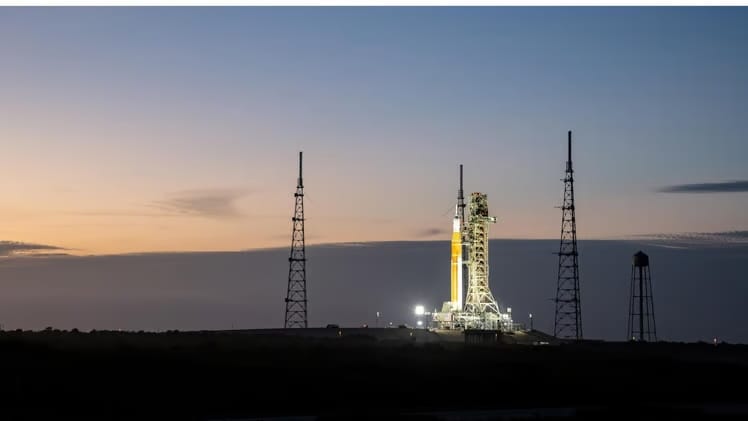
Image source: NASA
The Rundown: NASA’s first crewed Artemis flight has slipped again after engineers discovered a problem with helium flowing into the upper stage of the Space Launch System rocket, forcing the agency to abandon a hoped‑for early‑March launch window.
The details:
The 322‑foot rocket will be rolled off Launch Pad 39B and back into the VAB so technicians can access and repair valves, filters, and plumbing.
This latest snag comes on top of earlier work to address Orion heat‑shield char issues, hydrogen leaks, and life‑support fixes.
NASA now says the mission will not fly before April 2026, slipping from a tentative early‑March target and adding more uncertainty to the timeline.
Artemis II is the program’s first crewed flight, sending four astronauts on a lunar flyby before Artemis III attempts the first Moon landing in 2028.
Why it matters: Artemis II is the first test for eventually landing crews at the Moon’s south pole, and NASA’s 2028 target hinges on proving the whole stack actually works. With doubts hanging over nearly every piece, this flight — and NASA’s reported upcoming briefing — will show whether the Artemis timeline is still remotely realistic.
UBER
🚘 Uber just got into the parking business
Image source: Uber
The Rundown: Uber is acquiring parking-reservation startup SpotHero, folding more than 13K North American garages and lots directly into its app as it aims to pull more commuters and travelers into its ecosystem.
The details:
The deal gives Uber access to more than 13K parking locations across 400 U.S. and Canadian cities, spanning garages and surface lots.
Users will be able to reserve and pay for parking inside the Uber app alongside ride-hailing and food delivery — no separate app required.
Uber says the move is a way to grow its customer base and capture more of the door-to-door journey for drivers and riders.
The acquisition continues Uber’s push beyond rides into a broader “everything transportation” platform spanning cars, micromobility, and now parking.
Why it matters: Uber is using SpotHero to turn parking into another on-ramp to its ecosystem, capturing more of the door-to-door journey instead of just the ride in between. The move sharpens its move against rivals like Lyft and mobility super-apps abroad like Didi and Gojek, bundling driving, parking, and trips in one place.
AMAZON
💰 Amazon pumps $12B into data centers

Image source: Amazon
The Rundown: While investors push against runaway AI spending, Amazon is plowing ahead with a $12B plan to build new data centers in Louisiana, betting that hyperscale infrastructure will matter more than short-term market jitters.
The details:
The project is part of a broader capital spending plan that could reach roughly $200B in 2026 as Amazon doubles down on AI and cloud infrastructure.
State officials say the investment will create hundreds of permanent jobs and thousands of construction roles over the next decade.
The Louisiana buildout will add a major new load to the regional power grid, intensifying debates over energy use, emissions, and environmental impacts.
The news lands as Wall Street questions whether big tech’s AI capex spree is overextended and whether data-center growth can keep delivering returns.
Why it matters: The buildout, part of a $200B 2026 capex blitz, will drop power-hungry AI and cloud campuses into Louisiana’s Caddo and Bossier parishes, adding jobs while deepening AWS’s grip on the Gulf South grid just as regulators and locals question how many more server farms the climate can take.
QUICK HITS
📰 Everything else in tech today
Tesla sued the California DMV to overturn a ruling that it falsely advertised its Autopilot and Full Self-Driving features.
Xbox boss Phil Spencer announced retirement from Microsoft after nearly four decades, with AI executive Asha Sharma taking over as the CEO of Microsoft Gaming.
X is reportedly testing a “Made with AI” label that users can add to posts with AI-generated content, as regulators push for clearer AI disclosure.
An ex-Apple team launched Acme Weather, an iOS app that surfaces multiple forecast scenarios and playful alerts like rainbow notifications.
Eli Lilly launched a new FDA-approved multi‑dose KwikPen version of its obesity drug Zepbound, delivering a full month of once‑weekly injections in a single device.
China is reportedly turning brain-computer interfaces into its next strategic industry, pouring state money and fast-track approvals into Neuralink-rivaling startups.
Lamborghini scrapped its long-planned electric car, the Lanzador, after CEO Stephan Winkelmann said demand for a battery-only Lambo is “close to zero.”
Amazon opened a 1.1M‑square‑foot, 12‑story campus in north Bengaluru — its second-largest office in Asia — designed to house more than 7K employees.
University of Maryland researchers built “Fartbit,” a wearable hydrogen sensor dubbed a Fitbit for farts, to log people’s gas emissions for a study on gut health.
Paramount Skydance submitted an improved, still-undisclosed bid for Warner Bros. Discovery in an effort to derail the studio’s pending Netflix deal.
COMMUNITY
🎓 Highlights: News, Guides & Events
Read our last AI newsletter: Anthropic calls out China’s AI copycats
Read our last Tech newsletter: Zuck vs. Instagram addiction
Read our last Robotics newsletter: Figure’s 24/7 humanoid staff
Today’s AI tool guide: Build better slide decks with AI
RSVP to our next workshop on Feb. 25: Agentic Workflows Bootcamp pt. 3
See you soon,
Rowan, Joey, Zach, Shubham, and Jennifer — The Rundown’s editorial team

Stay Ahead on AI.
Join 2,000,000+ readers getting bite-size AI news updates straight to their inbox every morning with The Rundown AI newsletter. It's 100% free.