Get the latest AI news, understand why it matters, and learn how to apply it in your work — all in just 5 minutes a day. Join over 2,000,000+ subscribers.

OpenAI wants to move faster
Sign Up | Advertise | Podcast | AI University

Welcome, AI enthusiasts.
OpenAI is reportedly flexing its independence and seeking to move faster in computing, and Microsoft might be feeling the strain.
As the AI giant seeks its own servers and chips, are we witnessing cracks in the power couple's already seemingly tenuous relationship? Let’s get into it…
In today’s AI rundown:
OpenAI seeks independence from Microsoft
AI pioneers awarded Nobel Prizes
Control object motion in AI videos
Adobe launches AI attribution system
5 new AI tools & 4 new AI jobs
More AI & tech news
Read time: 4 minutes
LATEST DEVELOPMENTS
OPENAI
👀 OpenAI seeks independence from Microsoft

Image source: The Economist
The Rundown: OpenAI is reportedly looking to reduce its reliance on Microsoft for compute power and has started exploring options to set up its own data servers and secure AI chips independently, according to a new report from The Information.
The details:
CFO Sarah Friar told shareholders that Microsoft ‘hasn’t moved fast enough’ to supply computing power, causing the AI giant to look elsewhere.
OpenAI plans to lease an entire data center in Abilene, TX from Oracle, though Microsoft likely had to ‘bless’ the deal with its rival, according to the report.
OpenAI is also developing its own AI chip, which could lower costs for future computing clusters — its current supply is rented primarily from Microsoft.
Tensions have also reportedly arisen between OpenAI and Microsoft over the design and timeline of a massive joint data center project called ‘Fairwater.’
Why it matters: OpenAI and Microsoft’s relationship has felt a bit off for a while now. While both companies have leveraged each other well to ascend the AI power ladder, it certainly feels like there is trouble in paradise. There is plenty of smoke, and how this partnership shakes out could have fiery implications for the entire AI landscape.
TOGETHER WITH UNBLOCKED
🔎 Make digging for answers a thing of the past

The Rundown: Unblocked is the only developer tool that explains how a codebase works AND why.
Teams who use Unblocked say it saves every developer an hour or more a day by providing:
Instant and helpful answers about their codebase
Relevant context for whatever code they have open in their IDE
Automated answers to questions asked in Slack
AI & THE NOBEL PRIZE
🏆 AI pioneers awarded Nobel Prize

Image source: Getty Images
The Rundown: Scientists Geoffrey Hinton and John Hopfield were jointly awarded the 2024 Nobel Prize in Physics for their groundbreaking work in machine learning and artificial neural networks, which significantly laid the foundation for the current AI boom.
The details:
Hinton, often called ‘The Godfather of AI,’ co-created a method for allowing neural networks to learn from mistakes, influencing modern AI model training.
The 91-year-old Hopfield, currently a professor at Princeton, developed a network model in 1982 that mimics how the brain recalls memories.
Hinton later worked at Google, leaving in 2023 and becoming a vocal critic of current AI advances and sounding the alarm over the tech’s dangers.
Hinton reiterated his concerns at his acceptance, saying his research may lead to ‘systems more intelligent than us eventually taking control.’
Why it matters: While both scientists helped pave the way for today’s AI boom, neither seems particularly comfortable with what the future may hold for the technology. Hinton, in particular, has become the face of the ‘AI doomer’ movement since leaving Google, pushing hard for increased regulation and safety alongside other AI pioneers.
AI TRAINING
🎬 Control object motion in AI videos

The Rundown: Kling AI, one of the most popular AI video generators, now lets you add strategic movement to specific elements in AI video, providing more control in your generated clips.
Step-by-step:
Choose a high-quality image with different elements to animate.
Access Kling AI's Image-to-Video tool and upload your image.
Use the Motion Brush to paint areas you want to animate and set motion paths for each area to define movement direction.
Fine-tune with prompts, adjust settings, and generate your video.
Pro tip: Keep movements subtle and natural for more realistic results, and experiment with different combinations to find what works best for your specific image.
PRESENTED BY INNOVATING WITH AI
💼 Start your career as an AI Consultant

The Rundown: Innovating with AI’s new program, AI Consultancy Project, equips AI enthusiasts with all the resources to capitalize on the rapidly growing AI consulting market – which is set to 8x to $54.7B by 2032.
The program offers:
Tools and framework to find clients and deliver top-notch services
A 6-month roadmap to build a 6-figure AI consulting business
Student landing their first AI client in as little as 3 days
Click here to request early access to The AI Consultancy Project.
AI RESEARCH
🛡️ Adobe launches AI attribution system

Image source: Adobe
The Rundown: Adobe just announced a new free web app called Adobe Content Authenticity, designed to help creators protect their work and receive proper attribution in the era of AI-generated content.
The details:
The web app allows creators to easily apply content credentials to images, audio, and video files, acting as a ‘nutrition label’ for digital content.
Content credentials include creator information and creation details and can signal if the creator doesn't want their work used to train AI models.
The system uses digital fingerprinting, invisible watermarking, and cryptographic metadata to make the credentials difficult to remove.
The web app, which has a waitlist, is expected to launch in Q1 of 2025, while a Chrome extension is available in beta today.
Why it matters: AI is extremely polarizing in the creator and artist community, largely due to the issues of unauthorized training and attribution that Adobe, Meta, OpenAI, and others are trying to address. While these tools are promising, they still rely heavily on widespread adoption and opt-in by creators and tech companies.
NEW TOOLS & JOBS
Trending AI Tools
🗣️ HeyGen Avatar 3.0 - Create realistic AI avatars with full-body dynamic motion
🎥 Eddie AI - Prompt-to-video editing tool
📋 Cove - A visual workspace for thinking with AI
🤖 Opencord AI - An AI agent for 24/7 social engagement via replies
🧠 Kvistly - AI-powered quiz maker for better training and team building
New AI Job Opportunities
QUICK HITS
OpenAI and Hearst announced a strategic partnership to integrate content from over 20 magazine brands and 40+ newspapers into OpenAI's AI products.
Hugging Face released OpenAI-Gradio, a new tool enabling the creation of AI-powered web apps using OpenAI’s models in just minutes with minimal code.
Uber unveiled plans to launch an OpenAI-powered AI assistant in early 2025 to help drivers with electric vehicle questions, aiming to accelerate EV adoption on the platform.
Anthropic launched Message Batches API, allowing developers to submit up to 10,000 queries for async processing in under 24 hours at a 50% discount compared to standard API calls.
Google added the ability to drag and drop any file type to upload directly into its AI Studio without importing it to Google Drive.
KoBold Metals raised $527M for its AI-powered mineral discovery tech that leverages extensive data analysis to uncover deposits with energy-critical minerals like copper, lithium, and nickel.
THAT’S A WRAP


AI glasses doxx strangers in real-time
Sign Up | Advertise | Podcast | AI University

Welcome, AI enthusiasts.
Two Harvard students just demonstrated an unexpected capability of Meta’s smart glasses, instantly accessing strangers’ identities with AI.
As powerful AI systems and wearables collide, it’s time to start getting vigilant about privacy and surveillance concerns. Let’s get into it…
In today’s AI rundown:
Students turn AI glasses into doxing devices
Inflection and Intel team up on enterprise AI
Write an impressive cover letter with Claude
Checklists improve AI model evaluation
5 new AI tools & 4 new AI jobs
More AI & tech news
Read time: 4 minutes
LATEST DEVELOPMENTS
META
🕶️ Students turn AI glasses into doxing devices

Image source: AnhPhu Nguyen (@AnhPhuNguyen1 on X)
The Rundown: Two Harvard students just demoed a proof-of-concept system using Meta’s Ray-Ban smart glasses that allow the wearer to access personal information about strangers, raising major privacy concerns.
The details:
AnhPhu Nguyen and Caine Ardayfio combined Meta’s smart glasses with custom software, enabling the ability to ID people and retrieve personal data.
The system, I-XRAY, uses a combination of facial recognition, reverse image search, and LLMs to find names, addresses, phone numbers, and other details.
The students tested I-XRAY on Harvard’s campus, correctly identifying strangers and their personal info.
The privacy concerns come as Meta recently confirmed it may use any images and videos shared with Meta AI for training purposes.
Why it matters: This demo exposes how much privacy and surveillance are about to change in the AI age—and it is coming fast. If a couple of students can achieve these abilities with a pair of Meta smart glasses and publicly available tools, what will dedicated corporations and governments be capable of?
TOGETHER WITH HUBSPOT
📊 Automate company research with Agent.ai

The Rundown: Agent.ai's Company Research Agent is an interactive tool that generates detailed reports on any company in minutes — transforming how you gather business intelligence.
With Agent.ai, you can:
Access demographic information to understand a company's workforce and audience
Analyze funding data for financial health and investment trends
Examine web traffic patterns to gauge digital engagement
Conduct competitor analysis to stay ahead in your industry
Get started for free and automate your company research today.
INFLECTION AI
🤖 Inflection and Intel team up on enterprise AI

Image source: Inflection
The Rundown: Inflection AI just launched Inflection for Enterprise, a new system built in partnership with Intel and designed for large-scale business deployments – featuring both a cloud service, new commercial API and upcoming local appliance.
The details:
Inflection for Enterprise is built on the new Inflection 3.0 model family and powered by Intel's Gaudi 3 AI accelerators.
An on-premises AI appliance is planned for Q1 2025 release, promising up to 2x improved price-performance over competitors.
Inflection 3.0 comes in two variants — Pi 3.0 for chatbots and Productivity 3.0 for instruction-following tasks.
Inflection also released a commercial API, enabling developers to build advanced conversational AI applications.
Why it matters: After a turbulent year following founder Mustafa Suleyman and much of the team’s departure to Microsoft, Inflection is pivoting from consumer-focused apps to enterprise solutions. While the startup will face no shortage of competitors, a partnership with Intel is a positive start for the new regime.
AI TRAINING
✉️ Write an impressive cover letter with Claude

The Rundown: With this workflow, you can use Claude to draft personalized and compelling cover letters based on company analysis that capture the attention of hiring managers.
Step-by-step:
Access Claude AI.
Gather the job description, your resume, and company information.
Have Claude analyze the job description and company.
Prompt Claude to create a tailored cover letter based on the company analysis and your resume.
Pro tip: Add your personal touch to Claude's draft to make sure the final version truly represents your voice and experiences.
PRESENTED BY SECTION
💡 Discover the real ROI of AI

The Rundown: Join AI experts from leading companies like Moderna and S&P Global on Nov. 14 at Section’s AI: ROI Conference — a virtual event for leaders looking to achieve tangible results with AI.
At this free event, you’ll discover:
Strategies to prioritize AI initiatives that deliver real returns
Lessons from real AI success stories and case studies
How to achieve ROI from productivity gains to securing investor support
AI RESEARCH
✅ Checklists improve AI model evaluation

Image source: Oxford
The Rundown: Researchers from the University of Oxford and Cohere just developed TICK, a new approach for evaluating AI language models that use AI-generated checklists to improve assessment accuracy and interpretability.
The details:
TICK uses an AI model to generate a checklist of yes/no questions to evaluate how well another AI model followed a given instruction.
The checklist-based method showed 5.8% higher agreement with human evaluators than standard AI evaluation techniques.
The researchers also developed STICK (Self-TICK), which uses the checklists for self-improvement, leading to 7.8% better performance on reasoning tasks.
TICK can be fully automated, making it faster and cheaper than checklist-based evaluations requiring human input.
Why it matters: LLMs are weird — and sometimes even simple formatting quirks (remember the ‘take a deep breath’ prompt?) can lead to unexpected results. When looking for new techniques to get the most out of AI models and evaluations, maybe it’s ideal to return to the basics of human organization and learning.
NEW TOOLS & JOBS
Trending AI Tools
🤖 Dashworks Bots - Create AI assistants that answer your team’s questions
📜 Theneo - Generate Stripe-like API docs in seconds
📸 Flash - Supercharge your learning with AI-powered flashcards
🔥 Firebender - A privacy-first coding assistant for Android Studio
🏠 Bramble - AI-backed real estate brokerage to buy a home end-to-end
New AI Job Opportunities
📈 Lakera AI - Senior Marketing Manager
🖥️ Waymo - Backend Software Engineer
📝 Databricks - Sr. Corporate Communications Manager
📱 Cohere - Social Media Strategist
QUICK HITS
Former Google CEO Eric Schmidt argued at the Washington AI Summit that AI advances should take precedence over climate goals, saying, “We're not going to hit the climate goals anyway because we're not organized to do it.”
Northrop Grumman unveiled an AI-powered enhancement to its Forward Area Air Defense system, enabling rapid decision-making against drone swarms.
Grindr is developing an AI "wingman" for its dating app that can scout prospective partners, set up dates, and interact with other AIs to find potential matches.
Nvidia and Peking University researchers introduced EdgeRunner, a new model for high-quality, detailed 3D mesh generation.
Enterprise GenAI startup Writer is reportedly set to raise between $150-200M at a $1.9B valuation, doubling its valuation from its $100M Series B round last September.
Security researcher Harish SG published research showing evidence that LLMs can be prompted to achieve reasoning levels of powerful models like OpenAI’s o1 using a combination of advanced prompt tactics.
THAT’S A WRAP

Meta's new AI video generator
Sign Up | Advertise | Podcast | AI University

Welcome, AI enthusiasts.
Meta just stepped into the AI video generation arena with a blockbuster release that's set to give OpenAI's Sora a run for its money.
But as ‘Movie Gen’ prepares to hit Instagram, is the world ready for the content creation revolution it might unleash? Let’s get into it…
In today’s AI rundown:
Meta unveils advanced AI video model
OpenAI and Altera create digital humans
Run Llama 3.2 locally on your phone
AI identifies drug candidates for pain relief
5 new AI tools & 4 new AI jobs
More AI & tech news
Read time: 4 minutes
LATEST DEVELOPMENTS
META
🎥 Meta unveils advanced AI video model

Image source: Meta
The Rundown: Meta just announced Movie Gen, a powerful new suite of AI models for generating and editing video and audio content, positioning itself as a direct competitor to OpenAI’s Sora and other industry leaders.
The details:
Movie Gen consists of four models: a 30B video generation model, a 13B audio model, a personalized video model, and a video editing model.
The system can generate HD videos up to 16 seconds long from text prompts, along with synchronized audio like sound effects and background music.
Movie Gen also features video editing via natural text prompts and the ability to upload a reference image to create personalized videos.
Meta claims the model outperforms rivals like Runway Gen3, Luma Labs, and OpenAI’s Sora in human video quality and consistency evaluations.
Meta CEO Mark Zuckerberg said that Movie Gen will be ‘coming to Instagram next year’ in a post displaying some of the model’s sample generations.
Why it matters: Meta’s Movie Gen separates itself from other video generators by not only generating videos from text, but also being able to perform precise video editing. With the models coming to Instagram, it could transform the content creation process and give the masses a powerful video editing suite—with only prompting required.
TOGETHER WITH INTERCOM
🚀 Join AI customer service pioneers

The Rundown: Join visionary customer service leaders on Oct.10 to explore the impact and opportunities of AI on the industry.
At Intercom’s customer service summit, you’ll discover:
Practical strategies to seamlessly integrate AI with your support team
An exclusive preview of Intercom’s advanced AI agent, Fin 2
Insights from companies successfully scaling support without added headcount
Register here to watch the summit live or on demand.
ALTERA
🤖 OpenAI and Altera create digital humans
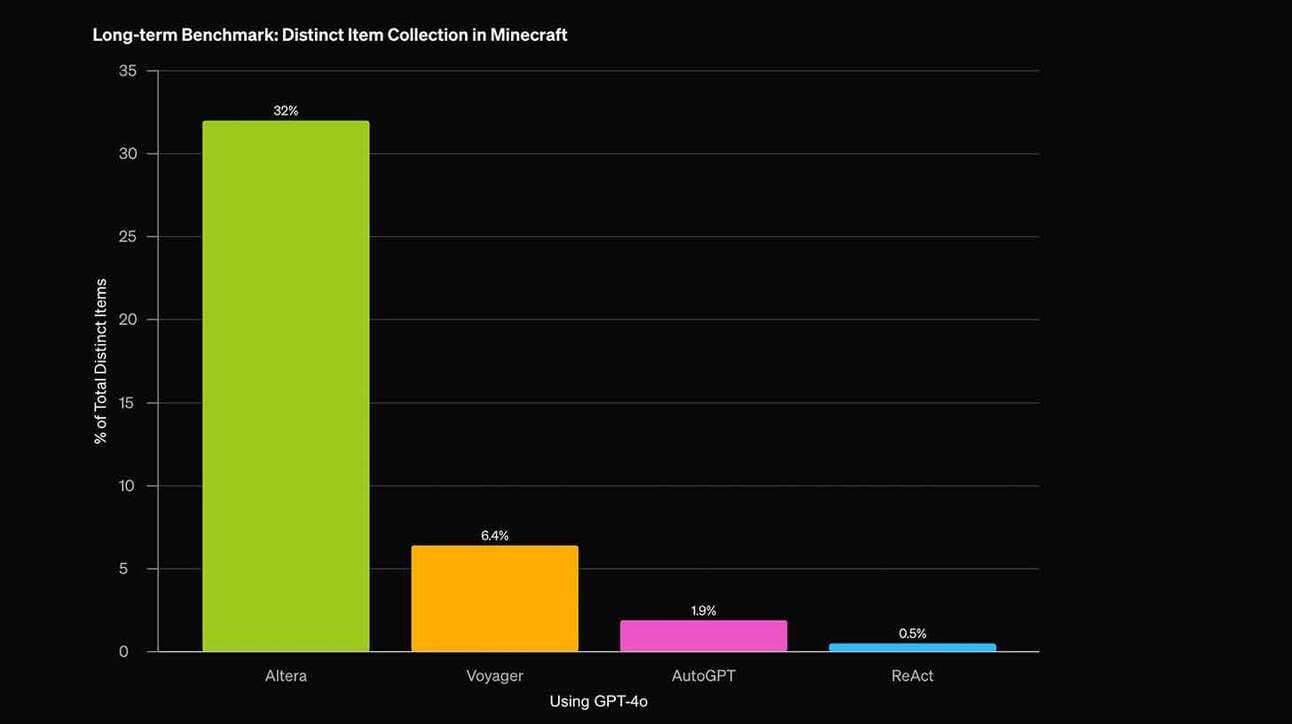
Image source: OpenAI
The Rundown: OpenAI just published a case study on Altera, a startup using GPT-4o to develop AI agents called "digital humans" capable of prolonged, natural interactions with people — significantly outperforming other rivals during testing in Minecraft.
The details:
Altera, founded by ex-MIT professor Dr. Robert Yang, uses GPT-4o to power AI agents that can play Minecraft autonomously for up to 4 hours.
Altera's system combines GPT-4o with a brain-inspired multi-module architecture to simulate cognitive functions and emotional processing.
OpenAI reports that Altera's agents outperform other models in Minecraft tasks, collecting 32% of items compared to 6.4% for the next best model.
The startup plans to expand beyond gaming to create AI ‘coworkers’ and more complex multi-agent simulations.
Why it matters: We’ve constantly heard from Sam Altman and others that AI agents are coming fast — and case studies like this (as well as a cryptic ‘Level 3’ tweet from an OpenAI researcher) might mean the capabilities have already arrived. We might ascend the ‘Stages of AI’ ladder faster than most are anticipating.
AI TRAINING
📱 Run Llama 3.2 locally on your phone

The Rundown: Meta’s new Llama 3.2 3B model can run directly on your smartphone, allowing you to have AI conversations privately and offline.
Step-by-step:
Download PocketPal AI from the App Store.
Open the app, tap the top-left menu, and select "Models.”
Under "Llama,” download "llama-3.2-3b-instruct q4_k" (2.2 GB).
Once downloaded, tap "Load" to activate the model.
Return to the main menu, select "Chat,” and start conversing with AI!
Pro tip: Create a local knowledge base that can be queried alongside the model, allowing you to supplement the AI’s knowledge with custom, up-to-date information without requiring an internet connection.
PRESENTED BY ASSEMBLY AI
🗣️Build smarter voice-driven apps

The Rundown: AssemblyAI’s Speech-to-Text API unlocks industry-leading accuracy — allowing you to build voice bots, meeting transcribers, and more with unmatched quality and advanced AI features.
With AssemblyAI, you can:
Transcribe multiple languages with up to 95% accuracy
Detect speakers with precision
Integrate effortlessly with just 5 lines of code
Future-proof your applications. Start today and claim $50 in API credits.
AI RESEARCH
💊 AI identifies drug candidates for pain relief

Image source: Midjourney
The Rundown: Researchers at Cleveland Clinic and IBM just developed an AI model to predict how drugs and gut microbes interact with pain receptors, potentially uncovering new non-addictive pain treatments.
The details:
LISA-CPI analyzes both the molecular structure of compounds and the 3D shape of pain receptors to predict their interactions.
The model identified FDA-approved drugs, like methylergometrine, that could potentially be repurposed for pain treatment by targeting specific receptors.
LISA-CPI also discovered gut microbes that may interact with pain receptors in beneficial ways.
The approach could accelerate drug discovery for pain and other conditions by more accurately screening potential compounds.
Why it matters: The current opioid crisis highlights the urgent need for effective, non-addictive pain medications, and this AI-driven approach could help researchers more quickly identify promising drug candidates while also opening new avenues for pain management.
NEW TOOLS & JOBS
Trending AI Tools
👨💼 Cheatlayer - Automate your business using natural language
🤝 Mindpal’s SalesBox - Build your own AI sales OS with multi-agent workflows
🤑 Trillion - Track expenses, manage accounts and set financial goals with AI planning
🛒 BuyScout - Your AI copilot for online shopping
🗓️ Selfletter - Break complex goals into simple tasks with AI
New AI Job Opportunities
🖥️ Amazon Web Services (AWS) - ML Data Associate
🧠 Meta - Research Scientist Intern
🔧 Shield AI - Mechanical Engineering Intern
📈 DeepL - Product Marketing Manager
QUICK HITS
Free event: The AI Bill of Rights with Section. How the White House’s Dr. Alondra Nelson is thinking about bias, ethical AI, and the future. RSVP now.*
Apple will reportedly release its Apple Intelligence features on Oct. 28 alongside the iOS 18.1 update, according to Bloomberg insider Mark Gurman.
Google began rolling out the new AI anti-theft features for Android devices showcased at Google I/O, including Theft Detection Lock, Offline Device Lock, and Remote Lock.
Cohere launched improved fine-tuning features for its Command R LLM, including longer context support and a ‘bring your own fine-tune’ option.
AI startup Otherside AI’s Reflection 70B model failed to match performance claims in tests published by the team in a post-mortem of the release after being initially touted as the ‘world’s best open-source model.’
North Carolina musician Michael Smith faces federal charges for allegedly using AI to generate thousands of songs and bots to stream them billions of times, netting over $10M in royalties.
*Sponsored listing
THAT’S A WRAP

ChatGPT levels up with 'Canvas'
Sign Up | Advertise | Podcast | AI University

Welcome, AI enthusiasts.
OpenAI just painted a new picture of AI collaboration with its ‘Canvas’ feature — and ChatGPT may be about to level up in a major way.
Is this new feature a glimpse at the next stage for AI assistants? Let’s get into it…
In today’s AI rundown:
ChatGPT gets a collab boost with Canvas
Google rolls out ads in AI Overviews
Automate video analysis with Gemini AI
Black Forest Labs unveils Flux 1.1 Pro
5 new AI tools & 4 new AI jobs
More AI & tech news
Read time: 4 minutes
LATEST DEVELOPMENTS
OPENAI
🔥 ChatGPT gets a collab boost with Canvas
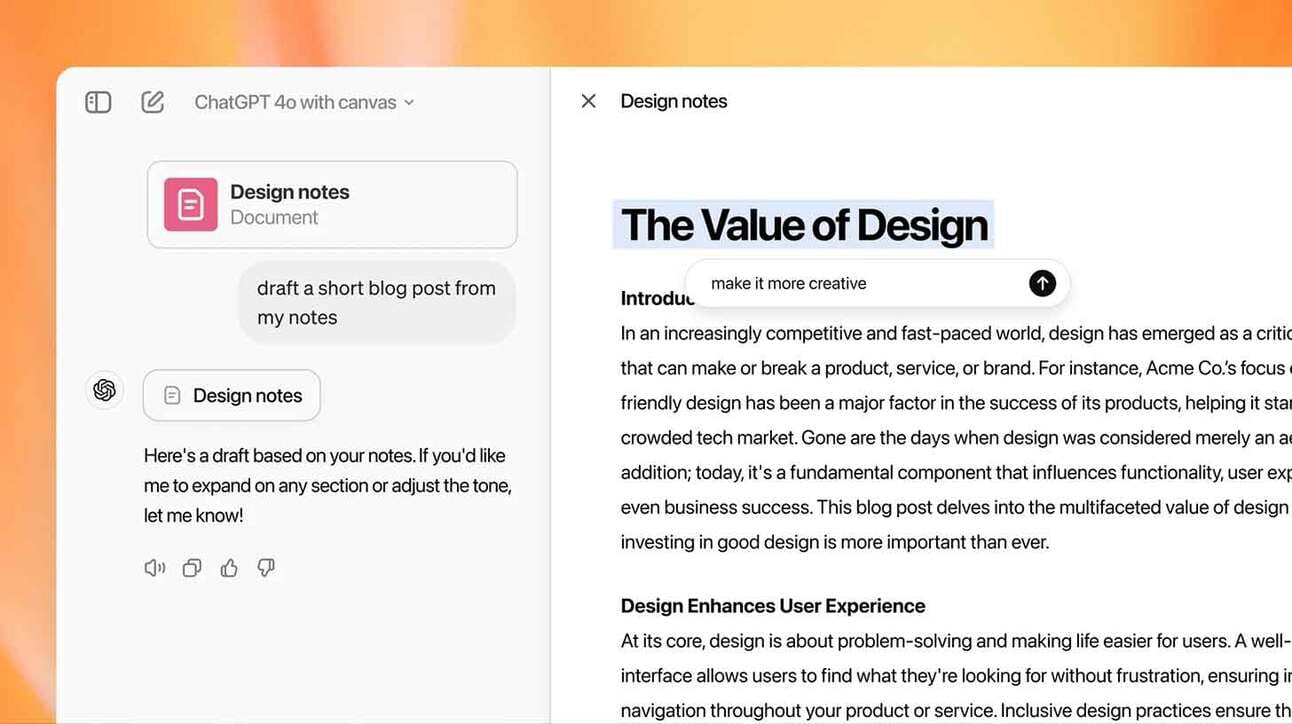
Image source: OpenAI
The Rundown: OpenAI just launched Canvas, a new ChatGPT interface release that enables more collaborative writing and coding projects beyond simple chat interactions with new editing features, shortcuts, and added contextual knowledge.
The details:
Canvas opens in a separate window alongside the chat, allowing users to directly edit and refine specific aspects of an output.
New features include inline feedback, targeted editing, and shortcuts for tasks like adjusting text length, changing reading levels, or debugging code.
In tests, using GPT-4o with Canvas led to a 30% accuracy and 16% quality boost compared to using the model without the interface.
Canvas is rolling out in beta to Plus and Team users, with a broader release expected later.
Why it matters: ChatGPT’s first major UI change takes a leap towards more nuanced, moldable interactions — while also inheriting novice-friendly features seen in other rivals with easy-to-use shortcuts. The simple chatbox was a good first step for human-AI interactions, but more power and capabilities require new collaborative processes.
TOGETHER WITH DECIDR
💼 Automate 80% of your business with AI

The Rundown: Decidr boosts conversions and efficiency by automating 80% of processes in finance, marketing, sales, HR, and more. Its AI solution helps businesses drive conversions and streamlines operations across industries.
Attend Decider’s Product Launch Day on Oct. 23 to learn how to:
Implement AI quickly with fast deployment options Optimize costs by streamlining operations with AI
Apply AI across every aspect of your business
Add real world-value through proven success stories across industries
Register now to start transforming your business with AI.
🔎 Google rolls out ads in AI Overviews

Image source: Google
The Rundown: Google just announced the introduction of ads to its AI Overview search summaries and the launch of several new AI-powered search capabilities, such as video understanding and voice input.
The details:
Ads will now appear within and alongside AI Overviews for ‘relevant queries’ on searches in the United States.
The redesigned AI Overview format will now add prominent in-text links to better source websites for the curated information.
New AI-organized search results pages are rolling out that surface relevant, more diverse content — starting with recipe and meal inspiration queries.
Google Lens is getting video understanding capabilities and voice input options for visual searches.
The Android ‘Circle to Search’ feature also lets users identify songs playing in videos or streaming content.
Why it matters: Google’s first AI Overview experience didn’t exactly go as planned. However, with heavy competition from Perplexity and chatbot rivals, Google’s search future clearly has AI at its core, regardless of the bumps along the way. But infusing paid ads into AI Overviews could be a slippery slope – will Gemini be next?
AI TRAINING
🎥 Automate video analysis with Gemini AI

The Rundown: Google Gemini on AI Studio can analyze videos and provide transcripts, tags, subtitles, and translations to simplify and speed up your content creation workflow.
Step-by-step:
Access Google Gemini on AI Studio and select "Gemini 1.5 Pro 002" from the Models menu.
Upload your video and use this prompt: "Analyze this video and provide the transcript, 5 title ideas, and categorized tags."
Follow up for improvements: "Suggest 5 content improvements, 3 promo clip ideas with timestamps, reach expansion tips."
Implement insights to optimize SEO, create promo clips, and expand your audience reach through translation.
Pro tip: Regularly analyze your video content with Gemini to track improvements and identify trends in your content over time.
PRESENTED BY POSTMAN
🔓 Unlock AI's API potential

The Rundown: Postman is hosting a free webinar on Oct. 24th to help you navigate the explosive growth of APIs and the crucial role they will play in shaping the AI revolution.
In this session, you'll learn to:
Understand the critical role APIs play in the AI landscape
Build high-quality APIs at scale
Maximize the success of your API products
BLACK FOREST LABS
🫐 Black Forest Labs unveils Flux 1.1 Pro

Image source: Black Forest Labs
The Rundown: Black Forest Labs just released Flux 1.1 Pro, a significantly upgraded version of the startup’s text-to-image AI model, and a new API for developers.
The details:
Flux 1.1 Pro generates images six times faster than Flux 1 Pro while improving quality and prompt output adherence.
The model tops the Artificial Analysis image arena leaderboard against rivals like Midjourney, Ideogram, and DALL-E, tested under the codename ‘blueberry.’
1.1 Pro will be a paid model available through partners like Together AI, Replicate, FAL AI, and Freepik, unlike the open-source Flux 1 that powers xAI’s Grok.
BFL’s API allows third parties to integrate the model into their apps, and the 1.1 Pro model costs .05c / image.
Why it matters: From OpenAI’s strawberry to BFL’s blueberry, fruit codenames are having a moment! 1.1 Pro looks to raise the already incredibly high text-to-image bar, continuing to push the boundaries of realism and image generation quality — now equipped with a turbocharged speed increase as well.
NEW TOOLS & JOBS
Trending AI Tools
🐝 Buzzabout - AI-driven insights from billions of discussions on social media
🤖 Base AI - Build serverless, autonomous AI agents with memory
💸 CostGPT - Estimate costs and time for your software project in less than 5 minutes
👀 Lookie AI - Consume, organize, and manage knowledge from YouTube
⏱️ Tackle AI - Automatic time tracking to align everyday actions with key priorities
New AI Job Opportunities
✍️ Writer - Senior Technical Sourcer
🏛️ Palantir Technologies - Account Executive
💼 Captions - Sales
🔗 Notable - Product Integrations Lead
QUICK HITS
OpenAI’s Sora research lead Tim Brooks announced on X that he is leaving the company to join Google DeepMind, where he will work on ‘video generation and world simulators.’
Google released Gemini 1.5 Flash 8B, a lightweight, cost-effective variation with a 50% cost reduction and 2x higher rate limits than 1.5 Flash.
Fourier launched GR-2, the company’s second-generation humanoid robot, which features improvements to battery life, hand dexterity, mobility, and a new developer kit.
The U.S. Commerce Department unveiled a plan to award $100M for AI semiconductor research, hoping to spur the development of more sustainable materials.
OpenAI secured a new $4B credit facility from major banks, boosting its total liquidity to over $10B to fuel future growth and innovation.
AI Coding startup Poolside announced a $500M Series B funding round to accelerate progress towards AGI, bringing the company’s valuation to $3B.
THAT’S A WRAP

A record-breaking AI funding round
Sign Up | Advertise | Podcast | AI University

Welcome, AI enthusiasts.
Despite the constant drama, leadership churn, and stiff competition, investors are still betting BIG on OpenAI as the golden goose of the AI boom.
With a $6.6B funding round at an eye-popping $157B valuation, the AI leader just got a record-breaking boost to fuel its reign at the industry's top. Let’s get into it…
In today’s AI rundown:
- OpenAI secures record-breaking $6.6B in funding
- Google developing reasoning AI to rival OpenAI
- Turn YouTube videos into AI-powered podcasts
- MIT’s ‘Future You’ taps AI to speak with older self
- 6 new AI tools & 4 new AI jobs
- More AI & tech news
Read time: 4 minutes
LATEST DEVELOPMENTS
OPENAI
💰 OpenAI secures record-breaking $6.6B in funding

Image source: Midjourney
The Rundown: OpenAI just closed a massive $6.6B funding round, valuing the company at an unprecedented $157B and solidifying its position as the most well-funded AI startup in the world.
The details:
- Thrive Capital led the round, which included participation from Microsoft, Nvidia, SoftBank, MGX, and others.
- OpenAI announced that it plans to use the funds to expand research, increase computing capacity, and develop new tools.
- OpenAI expects revenue increases to $25B by 2026 and $100B by 2029, according to investor documents.
- The company reportedly asked investors for exclusive arrangements, discouraging them from backing rivals like Anthropic and xAI.
- The move comes amid a corporate restructure to a for-profit entity, which, according to the NYT, will not happen until ‘sometime next year’.
Why it matters: The long-rumored funding round is finally official, and the numbers are staggering. Despite the drama, leadership churn, and heavy competition, the company’s giant’s sky-high valuation shows that investors still see OpenAI as the golden goose of the AI boom — regardless of the noise.
TOGETHER WITH ARTISAN
⚡Automate your outbound with an AI BDR

The Rundown: Artisan unifies your outbound sales tools into one platform, featuring Ava — the AI Business Development Rep who manages it all.
With Artisan, you’ll benefit from:
- Access to 300M+ high-quality B2B prospects
- Automated lead enrichment using 10+ data sources
- Advanced personalization via LinkedIn, Twitter, and web scraping
- Comprehensive email deliverability management tools
Book a demo today to see Artisan in action.
🤔 Google developing reasoning AI to rival OpenAI

Image source: Midjourney
The Rundown: Google is reportedly making significant strides in developing AI models with advanced reasoning capabilities similar to OpenAI’s o1 system, intensifying the rivalry between the two AI giants.
The details:
- Multiple teams at Google are working on AI that can solve complex, multi-step problems, according to Bloomberg.
- The AI uses chain-of-thought prompting, a technique created by Google, to tackle complex math and programming problems by ‘thinking’ before responding.
- Google is taking a more cautious approach to its releases than OpenAI but has already debuted math-focused reasoning models like AlphaProof and AlphaGeometry 2.
- Microsoft also infused reasoning capabilities into its Copilot assistant this week, leveraging OpenAI’s o1 model.
Why it matters: Human-like reasoning and agentic capabilities are clearly the two major developments on every AI firm’s roadmap, and the release of o1 may have signaled a new phase in the LLM race. The question is — will OpenAI’s speed keep it a step ahead, or is the competition for top-tier models about to get a whole lot tougher?
AI TRAINING
🎧 Turn YouTube videos into AI-powered podcasts

The Rundown: NotebookLM's latest update allows users to transform lengthy YouTube videos into concise AI-generated podcasts, saving time and enhancing study efficiency.
Step-by-step:
- Visit NotebookLM and create a new notebook.
- Click on "Link" in the source selection area, choose "YouTube" and paste your desired YouTube video URL.
- Select "Generate" in the Audio Overview section to create your AI podcast.
- Interact with your podcast by playing it, asking questions via chat, or generating additional study materials.
Pro tip: Use the chat feature to ask specific questions about the content, turning your AI podcast into an interactive study session!
PRESENTED BY GALILEO
⚙️ Master the art of RAG

The Rundown: Galileo's free 'Mastering RAG' eBook provides 200 pages of in-depth, expert insights into building powerful RAG systems for enterprise use.
In this guide, you'll learn how to:
- Minimize hallucinations and employ advanced chunking
- Choose optimal embedding and reranking models
- Navigate common challenges in RAG system development
- Optimize for production to enhance performance
Download your free copy today and take your AI projects to the next level.
AI RESEARCH
👴🏻 MIT’s ‘Future You’ taps AI to speak with older self

Image source: MIT
The Rundown: Researchers at MIT have developed an AI system called "Future You" that allows users to interact with and ask questions to a simulated version of their older selves.
The details:
- The system uses personal information provided by users to create a realistic future self-simulation, including generating an age-progressed photo.
- Users engage in text-based conversation with an AI-generated 60-year-old version of themselves, capable of answering questions and offering insights.
- In a study of 344 participants, those who used Future You reported decreased negative emotions and anxiety.
Why it matters: While aging simulation apps are constantly going viral, the implications of AI-driven psychological support are massive. With AI’s ability to create and simulate highly personalized, empathetic experiences, studies like Future You are only scratching the surface of the future of therapy and psychology.
NEW TOOLS & JOBS
Trending AI Tools
- 🎥 Pika 1.5 - AI video update with longer clips, cinematic outputs and new Pikaffects
- ⏱️ Semblian 2.0 - Outsource your time-consuming tasks to AI
- 🧠 Hedy AI - Real-time insights in meetings and classes
- 🏠 Vox - An AI voice agent built for the mortgage industry
- 🔎 Tilores - Customer data search, unification, and retrieval for LLMs
New AI Job Opportunities
- 👥 Waymo - HR Business Partner
- 🏢 UiPath - People Operations Specialist
- 📈 Meta - Growth Marketing Manager
- 🤝 Character AI - Head of Partnerships
QUICK HITS
Free event: The Executive Guide to Building AI Apps. Learn how to build AI apps that have a bottom-line moving impact within your org. RSVP.*
Microsoft announced a $4.8B investment into AI and cloud infrastructure in Italy, with plans to expand its data center in the region to become one of Europe’s largest cloud hubs.
Character AI is reportedly shifting its focus away from building AI models in the wake of its $2.7B deal with Google and prioritizing its consumer chatbot service.
Elon Musk posted ‘OpenAI is evil’ on X in response to reports that the AI giant asked investors to avoid funding competing AI firms like Anthropic and Musk’s xAI.
Accenture announced a new partnership with NVIDIA to accelerate enterprise AI adoption, launching a business group and AI Refinery platform to scale agentic AI systems across industries.
The Cancer AI Alliance formed a $40M collaboration between major medical institutions and tech giants like Microsoft, AWS, Nvidia, and Deloitte to advance AI-driven cancer care.
*Sponsored listing
THAT’S A WRAP
See you soon,
Rowan, Joey, Zach, and Alvaro—aka The Rundown Team


OpenAI's DevDay updates revealed
Sign Up | Advertise | Podcast | AI University

Welcome, AI enthusiasts.
OpenAI's DevDay may have skipped the spectacle this time with no live stream — but we caught the event live and secured exclusive details on new releases.
With four new major developer-focused announcements, and a private Rundown Q&A with OpenAI’s Head of Product, we’ve got a big one today. Let’s get into it…
In today’s AI rundown:
OpenAI makes 4 major announcements at DevDay
Microsoft Copilot gets voice, vision upgrade
Exclusive DevDay Q&A with OpenAI’s Olivier Godement
Extend images for free with HuggingFace
5 new AI tools & 4 new AI jobs
More AI & tech news
Read time: 4 minutes
LATEST DEVELOPMENTS
OPENAI
⚙️ OpenAI makes 4 major announcements at DevDay

Image source: Rowan Cheung @ Dev Day
The Rundown: OpenAI just held its DevDay 2024 event, unveiling a suite of new API features and improvements designed to make its AI systems more accessible, efficient, and cost-effective for developers to build with.
The details:
Realtime API enables speech-to-speech application building using the same model that powers Advanced Voice, with the ability to choose from six voices.
Model Distillation simplifies fine-tuning smaller models using outputs from larger ones, making training more accessible to developers.
Prompt Caching reduces costs by nearly 50% across models and speeds up responses by up to 80% when reusing recent input tokens in API calls.
New Vision Fine-Tuning allows models to be trained with both images and text, allowing developers to optimize tasks like image recognition and analysis.
Why it matters: While this year’s DevDay may have lacked the traditional hype of a typical OpenAI event, the releases are still set to have a tremendous impact. These API updates not only enable the creation of entirely new, exciting experiences but also lower the barrier to entry, for builders across OpenAI’s platform.
TOGETHER WITH SYNTHFLOW
🗣️ AI phone calls that sound human

The Rundown: Synthflow’s AI-powered phone calls enable interactions that are indistinguishable from human conversations — revolutionizing the way businesses handle customer service.
With Synthflow, you can:
Create lifelike AI voices that speak naturally in multiple languages
Design custom conversation flows to handle various scenarios
Integrate seamlessly with your existing systems for efficient call handling
Scale your customer service without compromising on quality
Try Synthflow today and experience the future of customer communication.
MICROSOFT
🚀 Microsoft Copilot gets voice, vision upgrade

Image source: Microsoft
The Rundown: Microsoft just announced a slew of AI upgrades coming to its Copilot assistant for Windows PCs, including new vision and voice capabilities, personalization enhancements, a re-release of the controversial Recall feature, and more.
The details:
Copilot Voice allows users to interact with natural speech, adding conversational and intuitive communication similar to OpenAI’s Voice Mode.
Copilot Vision enables the AI to understand and interact with web content a user is viewing, offering context-aware help within the Microsoft Edge browser.
‘Think Deeper’ gives Copilot new enhanced reasoning capabilities using chain-of-thought reasoning powered by OpenAI’s o1 model.
Microsoft’s ‘Recall’ feature is set to return, requiring an opt-in with upgraded privacy and security measures.
Microsoft AI CEO Mustafa Suleyman highlighted Copilot’s ability to ultimately ‘act on your behalf’ and adapt to user’s personal preferences and needs.
Why it matters: Microsoft is bringing the heat with these major Copilot upgrades, levelling up the assistant to align with the latest cutting-edge AI features across the industry — while bringing users one step closer to a truly agentic experience.
OPENAI DEVDAY
🎤 Exclusive DevDay Q&A with OpenAI’s Olivier Godement

Image source: Rowan Cheung / The Rundown
The Rundown: We caught up with OpenAI Head of Product Olivier Godement after he led the main keynote at Tuesday’s DevDay event for some exclusive insights on the new Realtime API (Godement’s responses are summarized for brevity).
On the Realtime API: Godement says that “Until right now, voice has been a second activity“, and that the Realtime API is going to make AI significantly more accessible because many people in the real world prefer to speak over reading or texting.
On real-world use cases: Godement believes the Realtime API will have a “no-brainer” impact on customer support, education, and coaching. He also believes there will be many ‘non-obvious‘ use cases that are hard to predict now.
On pricing: Converted to seconds, audio input is ~6 cents per minute, and output is ~24 cents per minute. While currently high, Godement confirmed that there are “huge pricing decreases on the roadmap.”
On the Twitter misinterpretation: Godement also mentioned a misinterpretation of pricing after the announcement—when users mentioned how much it costs per hour, they multiplied cost as if the input/output were constant. However, whenever humans talk, there is silence—it’s not a constant flow. The model won’t charge you for silence.
On future modalities: For now, Realtime API only supports text and audio. However, Godement believes that image and video are the next milestones on the road to agents that can perceive the world just like a human. He also mentioned that image and video understanding specifically, will “turbocharge customer support” when the model has the ability to understand pixels on a screen in real-time.
PRESENTED BY INNOVATING WITH AI
💼 Start your career as an AI Consultant

The Rundown: Innovating with AI’s new program, AI Consultancy Project, equips AI enthusiasts with all the resources to capitalize on the rapidly growing AI consulting market – which is set to 8x to $54.7B by 2032.
The program offers:
Tools and framework to find clients and deliver top-notch services
A 6-month roadmap to build a 6-figure AI consulting business
Student landing their first AI client in as little as 3 days
Click here to request early access to The AI Consultancy Project.
AI TRAINING
🖼️ Extend images for free with HuggingFace

The Rundown: Hugging Face's free AI image outpainting tool allows users to extend their images with custom aspect ratios for various use cases, such as optimizing images for any social media platform.
Step-by-step:
Visit the "diffusers-image-outpaint" Hugging Face space.
Upload your image to expand.
Set your desired aspect ratio and alignment (e.g., 1:1, middle).
Adjust advanced settings like output size and input image resize.
Click "Generate" and watch AI expand your image!
NEW TOOLS & JOBS
Trending AI Tools
🎥 Video SDK 3.0 - Build and integrate real-time multimodal AI characters
📭 Inbox Zero - An open-source, AI personal assistant for email
👩🏻💻 Graphite - Your AI code review companion
📚 Ello - An AI reading companion for children offering personalized support
🗣️ VivaChat - FaceTime video chat with realistic AI personas
New AI Job Opportunities
💼 Palantir Technologies - Mobility Tax Manager
📈 Databricks - Business Development Representative
🤖 C3 AI - Pre-Sales AI Director
🚀 Notable - Solution Delivery Manager
QUICK HITS
OpenAI founding member Durk Kingma announced that he is joining Anthropic, reuniting with several former OpenAI employees and highlighting the company’s mission of responsible AI development in his X post.
Pika Labs unveiled Pika 1.5, a new video generation model upgrade featuring enhanced effects, realistic movement, longer clip creation, and cinematic capabilities.
Anyscale unveiled major upgrades to its AI platform at Ray Summit 2024, including a GPU-native Ray architecture, RayTurbo for enhanced performance, Ray Data for unstructured data processing, and more.
U.S. AI chipmaker Cerebras officially filed for an IPO, with the Sam Altman-backed Nvidia competitor expected to be valued at between $7-8B.
Meta released the open-source code and developer suite for its Segment Anything Model (SAM) 2.1, an upgraded version of its image and video segmentation tool.
Nvidia introduced NVLM 1.0, an open-source family of multimodal models that achieve SOTA performance on vision-language and text tasks.
Pinterest launched Performance+, a suite of new AI tools for advertisers that includes the ability to create background images for products and automation features for ad campaigns.
THAT’S A WRAP

California blocks AI safety bill
Sign Up | Advertise | Podcast | AI University

Welcome, AI enthusiasts.
The tug-of-war between AI acceleration and safety just took a new turn — with California vetoing a controversial AI bill set to shake up the tech landscape.
Is this a decisive victory for Silicon Valley and Big Tech, or is the AI regulatory battle just getting started? Let’s get into it…
In today’s AI rundown:
California’s controversial AI safety bill vetoed
OpenAI secures SoftBank funding as Apple exits raise
Unlock multiple ChatGPT tools in one chat
Liquid AI unveils efficient new LFM models
5 new AI tools & 4 new AI jobs
More AI & tech news
Read time: 4 minutes
LATEST DEVELOPMENTS
AI REGULATION
❌ California’s controversial AI safety bill vetoed

Image source: Associated Press
The Rundown: California Governor Gavin Newsom just vetoed S.B. 1047, a groundbreaking AI safety bill that would have imposed stricter regulations on Silicon Valley AI firms and the release of new models in the state.
The details:
The bill would have required safety testing for AI models before their public release and held AI companies liable for any ‘severe harm’ (over $500M in damages) caused.
Tech giants, including OpenAI and Google, VCs, and politicians like Nancy Pelosi lobbied heavily against the bill, arguing it would stifle innovation.
The bill had notable support from Elon Musk, Anthropic, the ‘Godfather of AI’ Geoffrey Hinton, and over 120 Hollywood actors, directors, and workers.
Newsom said the bill was ‘well-intentioned’ but flawed, vowing to consult with AI experts to craft guardrails for future legislation efforts.
Why it matters: As the U.S. federal government continues to lag in AI regulation, states are stepping up to fill the void. While S.B. 1047 is shelved for now, the debate over AI governance is far from settled—and will likely continue to pit AI safety advocates against those pushing for rapid development throughout Silicon Valley.
TOGETHER WITH INNOVATING WITH AI
💼 Start your career as an AI Consultant

The Rundown: Innovating with AI’s new program, AI Consultancy Project, equips AI enthusiasts with all the resources to capitalize on the rapidly growing AI consulting market – which is set to 8x to $54.7B by 2032.
The program offers:
Tools and framework to find clients and deliver top-notch services
A 6-month roadmap to build a 6-figure AI consulting business
Student landing their first AI client in as little as 3 days
Click here to request early access to The AI Consultancy Project.
OPENAI
💰 OpenAI secures SoftBank funding as Apple exits raise

Image source: Midjourney
The Rundown: Despite Apple reportedly no longer participating in OpenAI’s upcoming funding round, the AI giant has secured billions of dollars from Japanese investment giant Softbank, Microsoft, and Thrive Capital.
The details:
OpenAI is rumored to be raising up to $6.5B via convertible notes, at an eye-popping $150B valuation.
Microsoft plans to participate with an additional $1B, adding to its previous $13B investment in the AI giant.
Investment firm Thrive Capital is also investing $1B, with a reported option to add an additional $1B the following year based on revenue goals.
The Wall Street Journal reported that Apple is no longer involved in the funding round, despite partnerships with OpenAI and its inclusion in Apple Intelligence.
The raise comes amid OpenAI’s controversial restructuring to a for-profit entity, with Sam Altman denying rumors that he will receive equity in the move.
Why it matters: OpenAI’s latest raise and for-profit turn is another saga in its convoluted and controversial business structure. Despite the recent high-profile departures and continued drama, the ChatGPT maker is still clearly seen as a top horse to bet on in the AI boom—and there is no shortage of major players who want in.
AI TRAINING
🧰 Unlock multiple ChatGPT tools in one chat

The Rundown: ChatGPT's new shortcut feature lets you instantly switch between image generation, web search, and advanced reasoning tools directly in one chat—avoiding the need to reset chats.
Step-by-step:
Start a new chat in ChatGPT and type "/" in the input field.
Choose from three options: Picture (DALL-E), Search (web), or Reason (GPT-o1).
For images, use "/picture [description]" (e.g., "/picture quantum computer").
For web searches, use "/search [query]" (e.g., "/search quantum computer").
For complex reasoning, use "/reason [task]" (e.g., "/reason Explain quantum computing").
Pro tip: When using the /search command, try adding "latest" or a specific year to your prompt.
PRESENTED BY SECTION
🏆 Build winning AI applications

The Rundown: Join Section and Ed Ortega of Machine + Partners on Oct. 29 for a free event tailored to leaders looking to build AI applications.
In this session, you’ll learn how to:
Prioritize which AI projects to tackle first
Avoid AI “traps” and build winning AI products
Get beyond the “hype” and get real ROI with AI
RSVP for free today and start making AI work for your business.
LIQUID AI
💧 Liquid AI unveils efficient new LFM models

Image source: Liquid AI
The Rundown: Liquid AI just introduced a new series of AI models called Liquid Foundation Models (LFMs), challenging the traditional transformer architecture while achieving state-of-the-art performance and enhanced memory efficiency at smaller model sizes.
The details:
The company released its LFMs in 1.3B, 3B, and 40B parameter sizes, based on a new architecture utilizing computational units rooted in dynamical systems rather than traditional transformers.
The models surpass transformer-based counterparts like Meta's Llama 3.2 and Microsoft's Phi-3.5 on major benchmarks like MMLU.
LFMs require significantly less memory for inference, particularly with long-context tasks — supporting up to 32k tokens while maintaining memory efficiency.
The models are not open-source and are only currently available via the company’s Lambda (Chat UI and API) and on Perplexity AI.
Why it matters: Liquid AI's LFMs are a significant shakeup from the transformer architecture standard that has dominated models since 2017. The benchmarks show that there is more than one formula for achieving state-of-the-art AI performance—and could open new possibilities for more efficient and accessible AI systems.
NEW TOOLS & JOBS
Trending AI Tools
🎤 Udio Lyric Editor - Create and refine song lyrics based on melody
📷 Expression Editor - Easily edit facial expressions
🚀 PandaETL - Automate document processes with AI and data
🤖 Gaia - Train and deploy neural machine translation models
🔍 Lumona - AI search engine leveraging social media insights
New AI Job Opportunities
👷♂️ Waymo - Principal Engineer
🤖 Weights & Biases - AI Engineer
⚙️ Sanctuary AI - Controls Software Engineer
💼 DeepL - Enterprise Sales Manager
QUICK HITS
Google agreed to invest $1B into Thailand to expand AI and cloud infrastructure in Southeast Asia, aiming to build new data centers amid increasing regional competition.
TikTok parent company ByteDance is reportedly planning to develop a new AI model primarily using Huawei chips, diversifying from U.S. suppliers like Nvidia to counteract export restrictions.
Artisan AI secured $7.3M in seed funding for its sales-focused AI virtual employees, with its first AI assistant Ava already assisting over 120 companies on the platform.
Luma Labs upgraded its Dream Machine AI video model speed, allowing for full-quality generations in under 20 seconds.
Qodo announced a $40M funding round for its AI-powered code testing software, with plans to expand services and target larger enterprise clients.
AI reading coach startup Ello launched ‘Storytime’, a new feature allowing kids to create personalized stories using AI.
THAT’S A WRAP

An exclusive look into Google's new AI models

Welcome, AI enthusiasts.
We have an exclusive for you today.
In case you missed it, last week Google released two new upgraded Gemini 1.5 models—achieving new, state-of-the-art performance across math benchmarks.
We partnered with Google to help explain what makes these new models so special for developers, real-world use cases, AI agents, and more. Let’s get into it…
In today’s AI rundown:
Google’s two new Gemini 1.5 models
Gemini 1.5 compared to other AI models
The age of the AI-first developer
Real-world use cases of Gemini 1.5
Proactive AI agent systems
– Rowan Cheung, founder
EXCLUSIVE Q&A WITH LOGAN KILPATRICK
GEMINI
✨ Google rolls out two new Gemini 1.5 models

Image credits: Kiki Wu / The Rundown
The Rundown: Google just released two new upgraded versions of Gemini 1.5 across the Gemini API, including 1.5 pro-002, which achieved state-of-the-art performance across math benchmarks, and 1.5-flash-002, which makes big gains in instruction following.
Cheung: “Can you give us the rundown on everything being released and why it actually matters?”
Kilpatrick: “Today, we're rolling out two new production-ready Gemini models and also improving rate limits, pricing for 1.5 Pro, and some of the filter settings enabled by default. Really, all these are focused on enabling developers to go in and build more of the stuff that they're excited about.”
Cheung: “What exactly makes the new models so unique?“
Kilpatrick: “Math, the ability for the models to code, which is obviously super important for people who care about developer stuff. It's been a lot of listening and sort of iterating on the feedback that we've been getting from the ecosystem.“
Kilpatrick added: “The linear amount of progress that we've seen with, and in some cases, exponential in different benchmarks with this iteration of Gemini models… has been incredibly exciting"
Why it matters: Google’s new Gemini 1.5-pro-002 model achieves state-of-the-art performance across challenging math benchmarks like AMC + AIME 24, and MATH. This means that the model is able to solve advanced mathematical problems and tasks that require deep domain expertise, a major hurdle from most previous AI models.
You can try AI Studio and the new Gemini 1.5 models for free here.
HEAD-TO-HEAD
💎 Gemini 1.5 compared to other AI models

Image credits: Kiki Wu / The Rundown
The Rundown: Google also announced significant improvements to accessibility for developers building with Gemini models, including a 50% reduced price on 1.5 Pro, 2x higher rate limits on Flash and 3x higher on 1.5 Pro, 2x faster output, and 3x lower latency.
Cheung: “In addition to the new updates, higher rate limits, expanded feature access, and high context windows, what other capabilities does Gemini 1 .5 offer that developers should be really excited about?“
Kilpatrick: "Part of my perspective is the financial burden to build with AI is one of the rate limiters of this technology being accessible… our strategy to combat this is we have the most generous free tier of any language model that exists in the world”
Kilpatrick added: "One of the big differentiators is you can come to AI Studio, fine-tune Gemini 1.5 Flash for free, and then ultimately put that model into production and pay the same extremely competitive, per million token cost. There's no incremental cost to use a fine-tuned model, which is super differentiated in the ecosystem.”
Why it matters: Google's latest Gemini updates significantly lower the financial barrier for AI development while boosting performance, especially in math. With these updates, Gemini now tops the LLM leaderboard in terms of performance-to-price ratio, context windows, video understanding, and other LLM benchmarks.
The pace of innovation: Google’s Gemini project is only around a year old. Google was the first to ship 1M context windows (and 2M) and context caching, and they’ve been making rapid progress ever since.
THE AI ERA
🚀 The age of the AI-first developer

Image credits: Kiki Wu / The Rundown
The Rundown: AI is helping developers tackle significantly harder problems faster while simultaneously lowering the entry barrier for non-developers to contribute to new innovation and even build their own AI apps.
Cheung: “I think what's really, cool with the age of AI, is seeing anyone, even people who are not technical, being able to build their own AI apps. If someone were to start from zero, is there a tool stack, documentation, courses, videos, or maybe tutorials from Google that you would recommend?“
Kilpatrick: "To your point…As someone who was formerly a software engineer, I really can go and tackle 10x more difficult problems now.”
Kilpatrick added: “For the person who's never coded before, they're now able to tackle like any problem with code because they have this co-pilot in their hands.”
Kilpatrick added: "[For beginners] ai.google.dev is our default landing page that also links out to the Gemini API documentation. On GitHub, we have a Quickstart repo where you can literally run four commands have a local version of AI Studio and Gemini running on your computer to play around with the models.”
Why it matters: With AI as an assistant, some developers are tackling 10x more challenging software problems—which also means 10x the speed of improvements and 10x the innovation, for those who use the tech wisely. Google also has great resources to help even complete beginners get started in less than 5 minutes.
USE CASES
🌎 Real-world use cases of Gemini 1.5

The Rundown: Gemini 1.5's multimodal capabilities allow a host of real-world applications that other models can't match, such as processing and analyzing hour-long videos or entire books—thanks to its impressive 2M token context window.
Cheung: “Can you share an example or some use cases of how customers are using these experimental models of Gemini in the real world?”
Kilpatrick: “Taking in video, I think, is one of the coolest things… Being able to go into an AI studio and just drop an hour-long video in there and ask a bunch of questions is such a mind-blowing experience. And to be able to try it for free.”
Kilpatrick added: "The intent was to build a multimodal model from the ground up…the order of magnitude of important use cases for the world, for developers and for people who want to build with this technology, so many of them are multimodal."
Why it matters: Gemini 1.5's 2M context window allows it to process and analyze long-form content like long videos, entire books, and lengthy podcasts, opening new possibilities for content analysis and interaction. For a full look at its potential, check out Google's list of 185 real-world gen AI use cases from leading organizations.
AI AGENTS
📈 Proactive AI agent systems

Image credits: Kiki Wu / The Rundown
The Rundown: The future of AI is likely to shift from reactive to proactive systems, with AI agents capable of initiating actions and asking for clarification or permission, much like human assistants do today.
Cheung: “What do you think the most surprising way AI will change our daily lives in the future?”
Kilpatrick: "With most AI systems today, it's one way. Sort of, I prompt the system and then it gives me a response back or I tell it to do something and it sort of does what I might instruct it to do.”
Kilpatrick added: “I think the future is, in the medium term, the system actually asking me for permission or clarification on things that I might want it to go do and really solving those problems.”
Kilpatrick added: “It's actually very interesting to me that very few AI systems, if any today, ask me how they can help in an actual, not surface-level way that ends up being meaningful.“
Why it matters: By shifting from purely reactive to proactive systems, AI could become more like a true “Her-like“ assistant, anticipating needs and offering solutions before being prompted. At the current state, no AI systems do this effectively, but as AI continues to advance with projects like Astra, this is likely the next stage for AI.
GO DEEPER
INTERVIEW
🎥 Watch the full interview live

In the full interview with Logan Kilpatrick & Rowan Cheung:
Dive deep into state-of-the-art math achievements of the new models
Talk about real-world use cases of Gemini 1.5, and exciting possibilities
Go in-depth on how to succeed and thrive in the new age of AI
Nerd out on the final form factors of AI and proactive AI agents
Listen on Twitter/X, Spotify, Apple Music, or YouTube.
No matching search results
Try using different keywords, double-check your spelling, or explore related categories.
Stay Ahead on AI.
Join 2,000,000+ readers getting bite-size AI news updates straight to their inbox every morning with The Rundown AI newsletter. It's 100% free.