Get the latest AI news, understand why it matters, and learn how to apply it in your work — all in just 5 minutes a day. Join over 2,000,000+ subscribers.

OpenAI's regulatory power play
Read Online | Sign Up | Advertise

Good morning, AI enthusiasts. OpenAI just revealed its vision for AI governance — seeking copyright exemptions for themselves while pushing to restrict Chinese open-source rivals like DeepSeek.
As the $500B Stargate architect flexes its growing influence in Washington, has OpenAI's political strategy become as calculated as its AGI roadmap?
In today’s AI rundown:
OpenAI pushes for federal shield in AI Action Plan
Cohere’s new efficient enterprise AI model
Turn your health data into personalized insights
Gemini taps into Google history with personalization
4 new AI tools & 4 job opportunities
LATEST DEVELOPMENTS
OPENAI
🏛️ OpenAI pushes for federal shield in AI Action Plan

Image source: Getty Images
The Rundown: OpenAI just published its 15-page submission for the White House’s request for public input towards the AI Action Plan, seeking to shield AI companies from state regulations in exchange for federal oversight.
The details:
OpenAI warns that the 781 state-level AI bills introduced this year could hinder American innovation and competitiveness against China's AI ambitions.
The proposal includes additional calls for infrastructure investment, copyright reform, and expanding access to government datasets for AI development.
They notably called out China’s “unfettered access to data”, calling the race for AI ‘effectively over’ if fair use copyright laws are not applied in the U.S.
OpenAI also pushed for the U.S government to ban models like DeepSeek due to security risks, calling the lab “state-controlled”.
Why it matters: Between its $500B Stargate Project and growing influence in Washington, OpenAI's regulatory ambitions now rival its technical ones. But the push for state law exemptions while advocating to restrict open-source rivals comes at an awkward time given heavy criticism over closed-source models and copyright battles.
TOGETHER WITH TURING
🤝 Join the Generative AI Gathering at GTC

The Rundown: Attending GTC next week or Bay Area based? Turing and Fireworks AI invite you to join the Generative AI Gathering in San Jose on Wednesday, March 19, from 5-7 PM PT.
Attend and enjoy:
Global networking with leaders from the AI/LLM communities
Discussions ranging from AI-assisted software development to the future of LLM training
An evening of creative cocktails and fabulous food with your peers
Space is limited — RSVP now.
COHERE
🚀 Cohere’s new efficient enterprise AI model

Image source: Cohere
The Rundown: Cohere just unveiled Command A, a new enterprise-focused AI model that matches top competitors' performance while running on just two GPUs — also featuring strong multilingual capabilities and a large context window.
The details:
Command A achieves 156 tokens per second, running 1.75x faster than GPT-4o and 2.4x faster than DeepSeek-V3 while requiring just two GPUs.
Cohere’s model also matches or surpasses GPT-4o and DeepSeek-V3 across human evaluations for business, STEM, coding, and agentic tasks.
The model features a 256k context window, support for 23 languages, and specialized enterprise features like advanced RAG capabilities.
Command A will also integrate into Cohere’s North platform, allowing enterprises to securely deploy agents with their own internal databases.
Why it matters: Much of the AI space is chasing higher benchmarks, but Cohere's efficiency push could be ripe for enterprise adoption. The ability to run competitive, agentic AI capabilities on minimal hardware not only cuts costs but also makes private deployments more practical for companies concerned about data security.
AI TRAINING
🩺 Turn your health data into personalized insights

The Rundown: In this tutorial, you’ll learn how to use Perplexity Spaces to create a personalized AI health assistant by uploading your health documents and setting custom instructions.
Step-by-step:
Visit Perplexity, click on "Spaces" in the left bar, and select "Create a Space."
Name your health space, add a description, and set custom AI instructions to guide how the AI interprets your questions and what context it prioritizes when generating responses.
Upload your health documents including medical records, medication lists, and wellness tracking data (do not include sensitive data you don’t want to share).
Start asking health questions that leverage your personal data for truly customized insights.
Note: While your personalized health assistant can provide valuable insights, it should never replace professional medical advice. Consult healthcare providers if any significant findings emerge from your analysis.
PRESENTED BY INNOVATING WITH AI
🤝 Turn AI passion into a consulting career

The Rundown: Innovating with AI's new program, AI Consultancy Project, transforms AI enthusiasts into professional consultants — tapping into a market projected to reach $54.7B by 2032.
The 6-month program delivers:
Proven frameworks for client acquisition and service delivery
A step-by-step path to six-figure consulting income
Students who land their first AI client in as little as 3 days
Click here to request early access to The AI Consultancy Project.
🤖 Gemini taps into Google history with personalization

Image source: Google
The Rundown: Google just released new personalization features for its Gemini AI assistant, allowing the AI to tap into users' Search history and eventually other Google apps to deliver more tailored responses and contextually aware conversations.
The details:
The experimental feature uses the Gemini 2.0 Flash Thinking model to analyze when personal data could enhance responses.
Google is starting with user’s search history, with plans to expand to apps like Google Photos and YouTube for additional data insights.
Users maintain control through opt-in permissions and the ability to disconnect their history at any time, with the feature restricted to users over 18.
Free users can also now access Gems (custom chatbots) and improved Deep Research capabilities previously limited to Advanced subscribers.
Why it matters: Google is leveraging its massive web of user data to create a more personalized experience — which also comes with the tricky dance of leveraging personal info without violating user trust. But with prominent opt-ins and a user base already used to connecting via apps, Google is well-positioned to pull it off.
QUICK HITS
🛠️ Trending AI Tools
🤖 Gemma 3 - Google’s multimodal, multilingual, 128k context AI model family
⚡️ Gemini 2.0 Flash exp - Upload, create, and edit images directly via text conversations with new native image generation
👁️ R1-Omni - Alibaba’s new open-source multimodal reasoning model that can ‘read’ emotions
🧠 Perplexity MCP - Connect Perplexity’s Sonar model to Claude for real-time web search capabilities
💼 AI Job Opportunities
📢 Luma AI - Recruiter, GTM
🏢 Together AI - Office Coordinator
🤖 Writer - Customer AI Engineer
🤝 OpenAI - Engagement Manager
📰 Everything else in AI today
AI2 released OLMo 2 32B, the first fully open model to outperform GPT-3.5 and GPT-4o mini on academic benchmarks while requiring just a third of the training compute used by comparable models like Qwen 2.5 32B.
Microsoft and Xbox introduced "Copilot for Gaming," an AI-powered assistant designed to help players get into games faster, provide in-game coaching, and enhance social experiences — with early access coming soon to mobile users.
Alibaba launched New Quark, a redesigned version of the company’s AI assistant mobile app now powered by its new Qwen reasoning model.
Google added new support for YouTube in the Gemini API and Google AI Studio, allowing the model to use vision capabilities to interact with video content.
Former OpenAI researcher Andrej Karpathy predicted that AI will usher in a fundamental shift in web content design, with pages being optimized for LLMs and context windows over human readability.
Insilico Medicine secured $110M funding for its AI-powered drug discovery platform, which includes multimodal foundation models and a fully automated robotic lab with a bipedal humanoid AI Scientist.
COMMUNITY
🎥 Join our next live workshop

Join our next workshop today at 4 PM EST to learn about how to use Manus AI to boost productivity and automate everyday tasks easily with Dr. Alvaro Cintas, The Rundown’s AI professor.
RSVP here. Not a member? Join The Rundown University on a 14-day free trial.
🤝 Share The Rundown, get rewards
We’ll always keep this newsletter 100% free. To support our work, consider sharing The Rundown with your friends, and we’ll send you more free goodies.

See you soon,
Rowan, Joey, Zach, Alvaro, and Jason—The Rundown’s editorial team

Meta launches X-like Community Notes
Read Online | Sign Up | Advertise

Good morning, tech enthusiasts. In the coming days, Meta is set to launch a major overhaul of its content moderation strategy by introducing Community Notes, a crowdsourced feature inspired by X's model.
This move marks a dramatic shift from Meta's previous reliance on third-party fact-checkers across Instagram, Facebook, and Threads — but many are asking, is this the best way to combat misinformation?
In today’s tech rundown:
Meta launches crowdsourced fact-checking
Niantic sells Pokémon GO division for $3.5B
Sesame open-sources its humanlike voice assistant
World-first success for titanium heart
Quick hits on other major news
LATEST DEVELOPMENTS
META
✏️ Meta launches crowdsourced fact-checking

Image source: Meta
The Rundown: Meta is set to begin testing its new Community Notes next week across Facebook, Instagram, and Threads, replacing the previous third-party content moderation approach with a crowdsourced model for combatting misinformation.
The details:
Meta first announced its plans to replace fact-checkers with a version of X’s Community Notes in January, saying it would be “less prone to bias.”
The new system will allow users to write and rate notes providing context or identifying misleading information in posts, using X’s open-source algorithm.
The feature will be limited to 500 characters per note and require consensus from contributors with diverse perspectives before publication.
Some 200,000 people in the U.S. have already signed up to become contributors, with Meta planning to test the system before making notes public.
Why it matters: Meta says that Community Notes will enhance transparency and accountability on its platforms, with decisions based on a diverse group of users rather than an outsourced team of fact-checking professionals. However, critics worry that crowdsourcing could easily lead to false information running rampant on its platforms.
NIANTIC
🐸 Niantic sells Pokémon GO division for $3.5B

Image source: Ideogram/The Rundown
The Rundown: In a major shake-up of the mobile gaming industry, Saudi Arabia-backed mobile gaming giant Scopely just agreed to acquire Pokémon GO maker Niantic's gaming division for a whopping $3.5 billion.
The details:
The deal will see Scopely take control of its popular augmented reality games, including Pokémon GO, Pikmin Bloom, and Monster Hunter Now.
It also includes Niantic's social companion apps Campfire and Wayfarer, along with the entire game development team of over 2,300 employees.
Niantic, based in California, will contribute an additional $350 million in cash, bringing the total value for Niantic equity holders to approximately $3.85 billion.
Niantic's games have over 30 million monthly active users, with annual revenue exceeding $1 billion in 2024.
Why it matters: Niantic has released a few new games in recent years but hasn’t been able to match the epic success of Pokémon GO. Niantic says the sale will allow it to refocus on advancing its AI-powered geospatial and AR tech through a new standalone entity called Niantic Spatial, led by the company’s CEO and founder, John Hanke.
SESAME
🗣️ Sesame open-sources its humanlike voice assistant

Image source: Ideogram/The Rundown
The Rundown: Sesame, an AI startup founded by Oculus co-creator Brendan Iribe, just released the base AI model powering its remarkably humanlike voice assistant, Maya, which mimics how humans naturally speak and can detect emotions.
The details:
The model, now available under an Apache 2.0 license via GitHub and Hugging Face, combines Meta's Llama language model with an audio decoder.
It uses Residual Vector Quantization (RVQ), a multi-stage audio compression technique, to convert audio signals into compact digital tokens, or codes.
Maya can engage in natural conversations with human-like emphasis and micro-pauses and can remember past interactions and detect emotions.
While Maya is English-only, Sesame aims to expand the AI’s capabilities to support over 20 languages in the coming months.
Why it matters: Sesame’s open-source model is a step toward democratizing access to advanced voice AI tech, potentially accelerating innovation in the field. But critics warn that its lack of built-in safeguards and reliance on an “honor system” raises concerns about voice cloning, deepfakes, and the spread of misinformation.
BIVACOR
❤️ World-first success for titanium heart

Image source: BiVACOR
The Rundown: In a groundbreaking medical achievement, an Australian man in his 40s lived for 100 days with an artificial titanium heart while he awaited a donor transplant, the longest period to date for anyone with the new technology.
The details:
The patient received the Australian-designed BiVACOR heart, which promises to become the world’s first permanent artificial heart replacement.
The patient was the first person to leave the hospital with the device, which kept him alive for 105 days until a heart donor became available in early March.
The BiVACOR uses advanced magnetic levitation technology and has only one moving part, potentially reducing complications and improving durability.
Existing heart replacements substitute the left side of the heart, but this tech replaces both sides, which could help patients with whole-heart failure.
Why it matters: The BiVACOR started early human testing last year, using the device as a stopgap to keep patients alive until donor hearts can be found. The goal is that, once it has proven itself, it can get regulatory approval to serve as a permanent heart replacement and perhaps eliminate the need for live-organ transplants altogether.
QUICK HITS
📰 Everything else in tech today
Amazon, Google, and Meta said that they support efforts to at least triple nuclear energy worldwide by 2050, joining a pledge signed by more than 20 governments.
Sonos, best known for its speakers, has reportedly halted its plans to launch a video streaming device this year.
Facebook is rolling out the ability for content creators to earn money for views on public stories, with the new option available globally via its monetization program.
SpaceX is expected to finally launch the Crew-10 mission to the International Space Station today to rescue stranded astronauts Sunita Williams and Butch Wilmore.
Oracle Corp., led by Larry Ellison, has emerged as the leading contender to help manage TikTok in the U.S., according to sources cited by The Information.
Food delivery startup Wonder is acquiring media company Tastemade for $90M in its mission to create a mealtime “super app” for takeout, delivery, and meal kits.
Apple is reportedly planning to bring live translation to Airpods, letting users translate conversations in real time similar to Google’s Pixel Buds.
Spotify just announced the launch of its new publishing program that allows independent authors to submit short-form stories they’d like to turn into audiobooks.
SoftBank has reportedly confirmed that it is paying $676 million to convert a Sharp factory in Japan used to build LCD panels into an AI data center.
COMMUNITY
🎥 Join our next live workshop

Join our next workshop today at 4 PM EST to learn about how to use Manus AI to boost productivity and automate everyday tasks easily, with Dr. Alvaro Cintas, The Rundown’s AI professor.
RSVP here. Not a member? Join The Rundown University on a 14-day free trial.
See you soon,
Rowan, Jennifer, and Joey—The Rundown’s editorial team
OpenAI's regulatory power play
Read Online | Sign Up | Advertise
Good morning, AI enthusiasts. OpenAI just revealed its vision for AI governance — seeking copyright exemptions for themselves while pushing to restrict Chinese open-source rivals like DeepSeek.
As the $500B Stargate architect flexes its growing influence in Washington, has OpenAI's political strategy become as calculated as its AGI roadmap?
In today’s AI rundown:
OpenAI pushes for federal shield in AI Action Plan
Cohere’s new efficient enterprise AI model
Turn your health data into personalized insights
Gemini taps into Google history with personalization
4 new AI tools & 4 job opportunities
LATEST DEVELOPMENTS
OPENAI
🏛️ OpenAI pushes for federal shield in AI Action Plan
Image source: Getty Images
The Rundown: OpenAI just published its 15-page submission for the White House’s request for public input towards the AI Action Plan, seeking to shield AI companies from state regulations in exchange for federal oversight.
The details:
OpenAI warns that the 781 state-level AI bills introduced this year could hinder American innovation and competitiveness against China's AI ambitions.
The proposal includes additional calls for infrastructure investment, copyright reform, and expanding access to government datasets for AI development.
They notably called out China’s “unfettered access to data”, calling the race for AI ‘effectively over’ if fair use copyright laws are not applied in the U.S.
OpenAI also pushed for the U.S government to ban models like DeepSeek due to security risks, calling the lab “state-controlled”.
Why it matters: Between its $500B Stargate Project and growing influence in Washington, OpenAI's regulatory ambitions now rival its technical ones. But the push for state law exemptions while advocating to restrict open-source rivals comes at an awkward time given heavy criticism over closed-source models and copyright battles.
TOGETHER WITH TURING
🤝 Join the Generative AI Gathering at GTC
The Rundown: Attending GTC next week or Bay Area based? Turing and Fireworks AI invite you to join the Generative AI Gathering in San Jose on Wednesday, March 19, from 5-7 PM PT.
Attend and enjoy:
Global networking with leaders from the AI/LLM communities
Discussions ranging from AI-assisted software development to the future of LLM training
An evening of creative cocktails and fabulous food with your peers
Space is limited — RSVP now.
COHERE
🚀 Cohere’s new efficient enterprise AI model
Image source: Cohere
The Rundown: Cohere just unveiled Command A, a new enterprise-focused AI model that matches top competitors' performance while running on just two GPUs — also featuring strong multilingual capabilities and a large context window.
The details:
Command A achieves 156 tokens per second, running 1.75x faster than GPT-4o and 2.4x faster than DeepSeek-V3 while requiring just two GPUs.
Cohere’s model also matches or surpasses GPT-4o and DeepSeek-V3 across human evaluations for business, STEM, coding, and agentic tasks.
The model features a 256k context window, support for 23 languages, and specialized enterprise features like advanced RAG capabilities.
Command A will also integrate into Cohere’s North platform, allowing enterprises to securely deploy agents with their own internal databases.
Why it matters: Much of the AI space is chasing higher benchmarks, but Cohere's efficiency push could be ripe for enterprise adoption. The ability to run competitive, agentic AI capabilities on minimal hardware not only cuts costs but also makes private deployments more practical for companies concerned about data security.
AI TRAINING
🩺 Turn your health data into personalized insights
The Rundown: In this tutorial, you’ll learn how to use Perplexity Spaces to create a personalized AI health assistant by uploading your health documents and setting custom instructions.
Step-by-step:
Visit Perplexity, click on "Spaces" in the left bar, and select "Create a Space."
Name your health space, add a description, and set custom AI instructions to guide how the AI interprets your questions and what context it prioritizes when generating responses.
Upload your health documents including medical records, medication lists, and wellness tracking data (do not include sensitive data you don’t want to share).
Start asking health questions that leverage your personal data for truly customized insights.
Note: While your personalized health assistant can provide valuable insights, it should never replace professional medical advice. Consult healthcare providers if any significant findings emerge from your analysis.
PRESENTED BY INNOVATING WITH AI
🤝 Turn AI passion into a consulting career
The Rundown: Innovating with AI's new program, AI Consultancy Project, transforms AI enthusiasts into professional consultants — tapping into a market projected to reach $54.7B by 2032.
The 6-month program delivers:
Proven frameworks for client acquisition and service delivery
A step-by-step path to six-figure consulting income
Students who land their first AI client in as little as 3 days
Click here to request early access to The AI Consultancy Project.
🤖 Gemini taps into Google history with personalization
Image source: Google
The Rundown: Google just released new personalization features for its Gemini AI assistant, allowing the AI to tap into users' Search history and eventually other Google apps to deliver more tailored responses and contextually aware conversations.
The details:
The experimental feature uses the Gemini 2.0 Flash Thinking model to analyze when personal data could enhance responses.
Google is starting with user’s search history, with plans to expand to apps like Google Photos and YouTube for additional data insights.
Users maintain control through opt-in permissions and the ability to disconnect their history at any time, with the feature restricted to users over 18.
Free users can also now access Gems (custom chatbots) and improved Deep Research capabilities previously limited to Advanced subscribers.
Why it matters: Google is leveraging its massive web of user data to create a more personalized experience — which also comes with the tricky dance of leveraging personal info without violating user trust. But with prominent opt-ins and a user base already used to connecting via apps, Google is well-positioned to pull it off.
QUICK HITS
🛠️ Trending AI Tools
🤖 Gemma 3 - Google’s multimodal, multilingual, 128k context AI model family
⚡️ Gemini 2.0 Flash exp - Upload, create, and edit images directly via text conversations with new native image generation
👁️ R1-Omni - Alibaba’s new open-source multimodal reasoning model that can ‘read’ emotions
🧠 Perplexity MCP - Connect Perplexity’s Sonar model to Claude for real-time web search capabilities
💼 AI Job Opportunities
📢 Luma AI - Recruiter, GTM
🏢 Together AI - Office Coordinator
🤖 Writer - Customer AI Engineer
🤝 OpenAI - Engagement Manager
📰 Everything else in AI today
AI2 released OLMo 2 32B, the first fully open model to outperform GPT-3.5 and GPT-4o mini on academic benchmarks while requiring just a third of the training compute used by comparable models like Qwen 2.5 32B.
Microsoft and Xbox introduced "Copilot for Gaming," an AI-powered assistant designed to help players get into games faster, provide in-game coaching, and enhance social experiences — with early access coming soon to mobile users.
Alibaba launched New Quark, a redesigned version of the company’s AI assistant mobile app now powered by its new Qwen reasoning model.
Google added new support for YouTube in the Gemini API and Google AI Studio, allowing the model to use vision capabilities to interact with video content.
Former OpenAI researcher Andrej Karpathy predicted that AI will usher in a fundamental shift in web content design, with pages being optimized for LLMs and context windows over human readability.
Insilico Medicine secured $110M funding for its AI-powered drug discovery platform, which includes multimodal foundation models and a fully automated robotic lab with a bipedal humanoid AI Scientist.
COMMUNITY
🎥 Join our next live workshop
Join our next workshop today at 4 PM EST to learn about how to use Manus AI to boost productivity and automate everyday tasks easily with Dr. Alvaro Cintas, The Rundown’s AI professor.
RSVP here. Not a member? Join The Rundown University on a 14-day free trial.
🤝 Share The Rundown, get rewards
We’ll always keep this newsletter 100% free. To support our work, consider sharing The Rundown with your friends, and we’ll send you more free goodies.
See you soon,
Rowan, Joey, Zach, Alvaro, and Jason—The Rundown’s editorial team

Google's new AI for robots
Read Online | Sign Up | Advertise

Good morning, robotics enthusiasts. Google DeepMind just unveiled a new AI model to make robots more capable, adaptive, and helpful.
Gemini Robotics enables humanoids to perform complex, previously unseen tasks—like folding origami or making a salad—just from vocal instructions. Could this be the breakthrough that redefines human-machine interaction?
In today’s robotics rundown:
Google DeepMind’s Gemini Robotics AI
AgiBot humanoid riding bike and ‘breathing’
iRobot brings eight new Roombas
New worm robot to modernize power grids
Quick hits on other robotics news
LATEST DEVELOPMENTS
GOOGLE DEEPMIND
🤖 Google DeepMind’s Gemini Robotics AI

Image source: Google DeepMind
The Rundown: Google DeepMind introduced Gemini Robotics, a groundbreaking AI model built on Gemini 2.0 to bring advanced reasoning, adaptability, and dexterity to robots operating in the physical world.
The details:
The model integrates vision, language, and action modalities to enable robots to perform previously unseen tasks by directly interpreting human instructions.
A companion model, Gemini Robotics-ER, provides spatial reasoning and embodied intelligence for third-party developers.
DeepMind is partnering with companies like Apptronik, Boston Dynamics, and Agile Robots to integrate Gemini Robotics with humanoids in development.
The models are adaptable to various robot types, from industrial robotic arms to humanoids, making it suitable across diverse use cases.
Why it matters: Unlike traditional robots that require training for specific tasks, Gemini-powered robots can generalize behaviors and adapt to new situations on the fly. With this and Figure’s recently announced Helix, the push for real-world-capable humanoids is gaining momentum—signaling a clear shift in the trajectory of embodied AI.
AGIBOT
🚲 AgiBot humanoid riding bike and ‘breathing’

Image source: AgiBot/YouTube
The Rundown: Shanghai-based AgiBot unveiled Lingxi X2, a humanoid capable of remarkable feats—riding a bike, balancing on a hoverboard, detecting emotions, and even mimicking realistic breathing patterns.
The details:
AgiBot founder Zhihui Peng says X2 features 28 degrees of freedom and integrates powerful motion, interaction, and task intelligence.
With its multimodal interaction model and GO-1 AI framework, the robot can walk, run, and even ride a bike—learning tasks simply by observing.
It detects emotional states through facial expressions and voice tone, responding in milliseconds for more natural interactions.
But perhaps the most striking feature: X2 mimics human breathing rhythms and body language, appearing and behaving remarkably lifelike.
Why it matters: By mastering bicycle riding, X2 joins mainstream robots like Boston Dynamics’ Atlas and Unitree’s G1 in executing complex movements. But what sets it apart is its emotional intelligence and lifelike traits, making it ideal for future roles in elder care and home assistance.
IROBOT
🧹 iRobot brings eight new Roombas

Image source: iRobot
The Rundown: iRobot, the company that invented the robot vacuum over 20 years ago, announced a major overhaul of its Roomba lineup with eight new models—but the company continues to face considerable financial challenges.
The details:
iRobot has finally replaced camera-based vSLAM with lidar navigation and fast mapping, enhancing Roombas’ ability to navigate homes and avoid obstacles.
Like Roborock and Dreame, iRobot is also providing suction power specs, with the new Roombas offering 70x more suction than the previous models.
The company has also replaced the retracting mop pad with two rotating disc-shaped pads on its Plus models.
Starting at $299, the new Roombas come in black and white finishes and will be available in North America and select European markets starting March 18.
Why it matters: iRobot has completely redesigned its new robots, taking cues from competitors in a last-ditch effort to stay afloat. After a turbulent 2024—marked by its founder and CEO’s departure and Amazon’s abandoned acquisition—the company is betting on this design overhaul for a turnaround.
CASE WESTERN RESERVE UNIVERSITY
🪱 New worm robot to modernize power grids

Image source: CWRU Biorobotics Lab
The Rundown: The U.S. power grid’s 5.5M miles of power lines remain vulnerable to natural hazards, but building them has been too costly—until now. U.S. researchers are developing a worm-inspired robot that could make the underground work feasible.
The details:
Funded by a $2M grant from the U.S. Department of Energy, the robot mimics the peristaltic, wavelike motion of earthworms to burrow underground.
Researchers at Case Western University are developing the project to address critical challenges in modernizing the U.S. power grid.
Rather than digging large trenches, the robotic sleeve expands and contracts in segments, pulling itself forward while simultaneously laying conduit.
With a potential turning radius of just 5 feet—compared to over 1K feet required by conventional methods—it can safely navigate dense urban infrastructure.
Why it matters: The robot's design eliminates the need for heavy excavation equipment, cutting costs and installation time. While still in the early stages, this tech could provide a safer, faster, and cheaper solution for burying power lines in densely populated areas, contributing to a more reliable and sustainable energy infrastructure.
QUICK HITS
📰 Everything else in robotics today
Chinese EV maker Xpeng, which unveiled its Iron humanoid in November, says it may invest up to $13.8B to scale the production of its robots.
California-based Dexterity AI closed a $95M funding round, taking its valuation to $1.65B, to develop physical AI for its industrial robot arms.
Stanford University researchers are developing a new framework designed to enhance whole-body manipulation for robots performing diverse household tasks.
Japanese researchers developed a wearable robotic hand to help professional piano players play complex patterns faster than ever.
Pony AI, a Chinese self-driving technology company, is gearing up to expand to 1,000 robotaxis this year and grow its fleet to more than 10,000 within three years.
U.S. startup Charge Robotics developed a portable robotic system that assembles and installs large solar farms to cut costs and speed up installation.
Japanese researchers are attaching tiny robotic sensors to cockroaches to develop bug bots capable of inspecting dangerous rubble after disasters.
New York lawmakers proposed a bill that aims to ban arming robots and drones with firearms, lasers, or any type of explosives.
COMMUNITY
🎥 Join our next live workshop
Join our next workshop this Friday at 4 PM EST to learn about how to use Manus AI to boost productivity and automate everyday tasks easily with Dr. Alvaro Cintas, The Rundown’s AI professor.
RSVP here. Not a member? Join The Rundown University on a 14-day free trial.
See you soon,
Rowan, Jennifer, and Joey—The Rundown’s editorial team

Google's ultra-efficient Gemma 3
Read Online | Sign Up | Advertise

Good morning, AI enthusiasts. The era of massive compute requirements for cutting-edge AI may be coming to an end, with Google’s latest open-source release outperforming giants at just a fraction of the size.
With Gemma 3’s high-level performance, multimodal capabilities, and on-device operation on just a single GPU, the AI efficiency barrier is quickly getting destroyed.
In today’s AI rundown:
Google’s Gemma 3 for single-GPU deployment
Gemini Flash with new image capabilities
Create your AI-powered Telegram assistant
Sakana’s peer-reviewed AI-authored paper
4 new AI tools & 4 job opportunities
LATEST DEVELOPMENTS
🧠 Google’s Gemma 3 for single-GPU deployment

Image source: Google
The Rundown: Google just unveiled Gemma 3, a new family of lightweight AI models built from the same technology as Gemini 2.0 — delivering performance that rivals much larger models while running efficiently on just a single GPU or TPU.
The details:
The model family comes in four sizes (1B, 4B, 12B, and 27B parameters) optimized for different hardware configurations from phones to laptops.
The 27B model outperforms larger competitors like Llama-405B, DeepSeek-V3, and o3-mini in human preference evaluations on the LMArena leaderboard.
Other new capabilities include a 128K token context window, support for 140 languages, and multimodal abilities to analyze images, text, and short videos.
Google also released ShieldGemma 2, a 4B parameter image safety checker that can filter explicit content — with easy integration into visual applications.
Why it matters: Gemma 3’s performance is mind-blowing, beating out top-level systems that dwarf it in both size and compute. Running on just a single GPU, these models hit a once incomprehensible sweet spot of being open-source, powerful, fast, multimodal, and small enough to be deployed across devices — a truly massive feat.
TOGETHER WITH DAGSTER
🚀 Streamline your AI stack with Dagster

The Rundown: Dagster consolidates your AI capabilities into one powerful orchestrator that developers love — helping reduce costs, eliminate complexity, and ensure reliable pipelines from prototype to production.
With Dagster, you can:
Consolidate all AI capabilities under one intuitive interface
Save 40%+ on infrastructure costs by optimizing AI workloads
Ship AI features 3x faster with standardized development practices
Schedule a demo to learn more about how Dagster can simplify your AI platform.
📸 Gemini Flash gets new image capabilities

Image source: Google
The Rundown: Google released new experimental image-generation capabilities for its Gemini 2.0 Flash model, letting users upload, create, and edit images directly from the language model without requiring a separate image-generation system.
The details:
A 2.0-flash-exp model is available via API and in the Google AI Studio with support for both image and text outputs and editing via text conversation.
Gemini uses reasoning and a multimodal foundation to maintain character consistency and understand real-world concepts throughout a conversation.
For instance, you can prompt it to generate a story with pictures and then guide it to the perfect version through natural dialogue.
Google says Flash 2.0 also excels at text rendering compared to competitors, allowing for ads, social posts, and other text-heavy design generations.
Why it matters: This upgrade is a major step in shifting how AI generates visual content — moving away from dedicated image models toward language models that natively understand both text and visuals. Just as natural language prompting has taken over other domains, image editing appears to be next on the list.
AI TRAINING
🤖 Create your AI-powered Telegram assistant
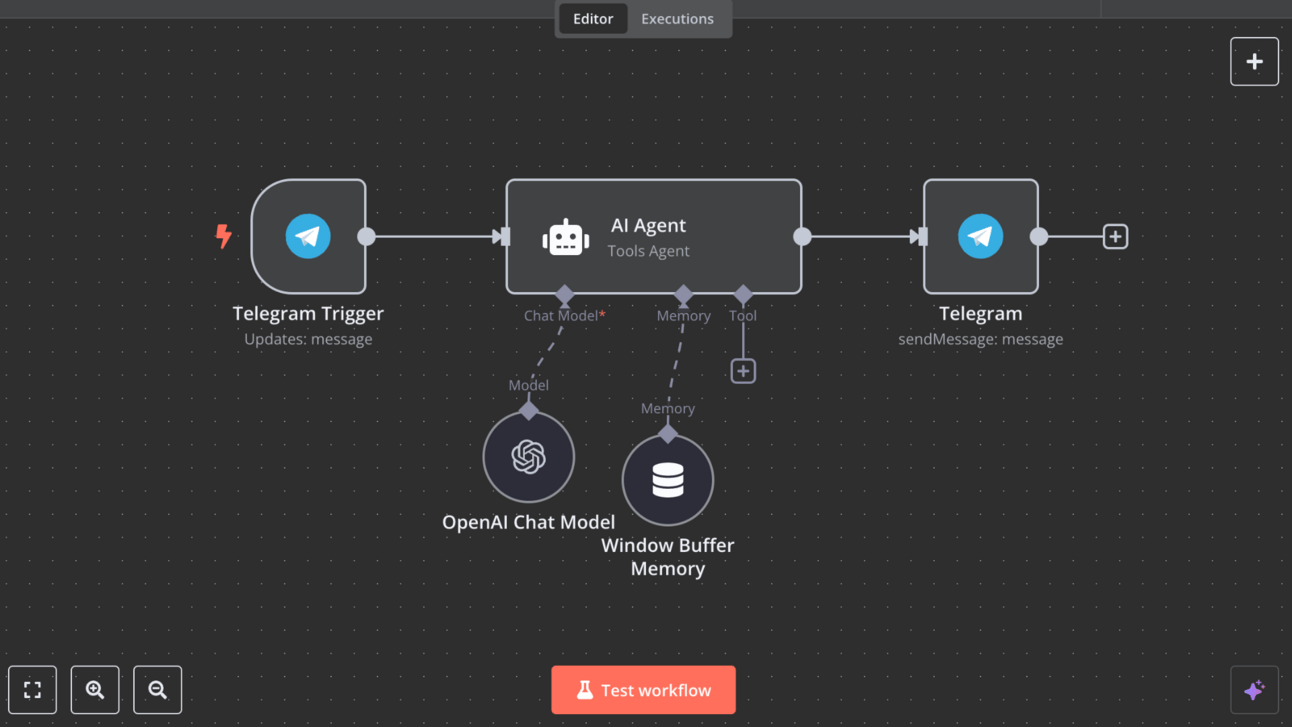
The Rundown: In this tutorial, you will learn how to build a personal AI assistant on Telegram that can answer questions, remember conversations, and eventually connect to other services using n8n's automation platform.
Step-by-step:
Create a Telegram bot - search for "BotFather" in Telegram, type /newbot, and save the API token you receive.
Sign up for n8n (free 14-day trial) and create a new workflow with a Telegram trigger using your bot token.
Add an AI Agent node after the trigger, connect it to your preferred AI model (like those from OpenAI), and use the message text as the prompt.
Add a Telegram "Send Message" node to return the AI's responses to your chat using the chat ID from the trigger.
Enable Window Buffer Memory in the AI Agent settings so your bot remembers previous conversations.
Pro tip: You can also expand the assistant’s capabilities by connecting it to calendars, emails, notes apps, and other services. We did an extensive workshop on how to create your own AI Agent to automate tasks with n8n here.
PRESENTED BY JOTFORM
🤖 Handle customer interactions at scale with no-code AI agents

The Rundown: Jotform AI Agents let organizations provide 24/7, conversational customer service across multiple platforms — no coding required.
With Jotform AI Agents, you can:
Get started easily with over 7,000 ready-to-use AI agent templates
Automate workflows and trigger custom actions in real time
Handle voice, text, and chat inquiries seamlessly
Customize your agent’s look and feel to align with your brand identity
SAKANA AI
🔬 Sakana’s peer-reviewed AI-authored paper

Image source: Sakana AI
The Rundown: Japanese AI startup Sakana announced that its AI system successfully generated a scientific paper that passed peer review, with the company calling it the first fully AI-authored paper to clear the scientific bar.
The details:
AI Scientist-v2 generated three papers, creating the hypotheses, experimental code, data analyses, visualizations, and text without human modification.
One submission was accepted at the ICLR 2025 workshop with an average reviewer score of 6.33, ranking higher than many human-written papers.
Sakana also pointed out some caveats, including the AI making citation errors and workshop acceptance rates being higher than typical conference tracks.
The company concluded that the paper did not meet its internal bar for ICLR conference papers but displayed “early signs of progress.”
Why it matters: While this milestone comes with significant asterisks, it also represents a major early marker of AI's advancing role in academic research processes. Between models like Sakana’s and Google’s AI co-scientist, a seismic shift is getting closer and closer for the scientific world.
QUICK HITS
🛠️ Trending AI Tools
⚙️ Responses API and Agents SDK - OpenAI’s DIY tools for custom agents
⚡️ Reka Flash 3 - Open, 21B parameter reasoning AI for on-device deployment
👨🏻⚖️ Harvey - AI for law firms, service providers, and Fortune 500 companies
🗣️ Wispr Flow for Windows - Use voice to write 3x faster in every application
📰 Everything else in AI today
New legal filings revealed that Google owns 14% of Anthropic, with its investments totaling over $3B in the rival AI startup.
Alibaba researchers open-sourced R1-Omni, a new multimodal reasoning model that can ‘read’ emotions using visual and audio context.
Google DeepMind introduced Gemini Robotics and Gemini Robotics-ER, two Gemini 2.0-based models to help robots accomplish real-world tasks without training.
Perplexity launched a new Model Context Protocol (MCP) server for its Sonar model, allowing Claude to access real-time web search capabilities.
Snap released its first AI Video Lenses, powered by its own in-house model, offering premium subscribers three AR animations with new options planned to launch weekly.
Moonvalley released Marey, an AI video model that claims to be trained exclusively on licensed content for use in filmmaking — capable of creating 30-second-long HD clips.
Captions unveiled Mirage, a foundation model designed specifically for generating UGC-style content for ad campaigns.
COMMUNITY
🎥 Join our next live workshop
Join our next workshop this Friday at 4 PM EST to learn about how to use Manus AI to boost productivity and automate everyday tasks easily, with Dr. Alvaro Cintas, The Rundown’s AI professor.
RSVP here. Not a member? Join The Rundown University on a 14-day free trial.
🤝 Share The Rundown, get rewards
We’ll always keep this newsletter 100% free. To support our work, consider sharing The Rundown with your friends, and we’ll send you more free goodies.
See you soon,
Rowan, Joey, Zach, Alvaro, and Jason—The Rundown’s editorial team

OpenAI's new agent toolkit
Read Online | Sign Up | Advertise

Good morning, AI enthusiasts. The year of AI agents just got a major push forward — with OpenAI releasing powerful new tools that let businesses build their own autonomous assistants.
With capabilities like web browsing, file management, and computer use in a single API, is this the breakthrough that finally transforms the agent hype into an enterprise-ready reality?
In today’s AI rundown:
OpenAI releases new DIY agent tools
Manus, Qwen team up for China push
Connect AI coding assistants with external tools
Meta testing its own AI training chip
4 new AI tools & 4 job opportunities
LATEST DEVELOPMENTS
OPENAI
🤖 OpenAI releases new DIY agent tools

Image source: OpenAI
The Rundown: OpenAI just launched new tools that let businesses build their own AI agents—enabling custom bots to handle tasks like web browsing and file management and marking a major push toward bringing autonomous AI assistants into the enterprise.
The details:
The new Responses API combines web search, file scanning, and computer use capabilities, replacing the older Assistants API, which will sunset in 2026.
It allows companies to develop agents using the same tech powering Operator, with built-in tools for searching the web and navigating computer interfaces.
A new open-source Agents SDK will help developers orchestrate single and multi-agent systems while also providing safety guardrails and monitoring tools.
Early adopters include Stripe, which built an agent to handle invoicing, and Box, which created agents to search through enterprise documents.
Why it matters: 2025 has already been declared the year of AI agents, and China’s Manus took the hype to another level in the past week. While most agents have generated more hype than results, OpenAI expanding the ability for users to build and customize agentic tools may help bridge the gap between demos and real-world utility.
TOGETHER WITH TELY AI
📝 Run a lead-generating SEO blog on autopilot
The Rundown: With Tely AI, you don’t need an SEO or content team — AI does it all. It researches your industry, competitors, and website to find the best keywords to rank on Google and produces expert-level articles promoting your company & product.
With Tely AI, you can:
Publish up to 60 articles every month
See Google index results in just 2 weeks
Enjoy full automation for writing, SEO, and publishing
Convert traffic into valuable business leads
MANUS & ALIBABA
🤖 Manus, Qwen team up for China push

Image source: Manus
The Rundown: Manus just announced a strategic partnership with Alibaba's Qwen team to develop a Chinese version of its autonomous agent platform, following the company’s viral success over the past week.
The details:
The collaboration will integrate Manus's agent capabilities with Qwen's open-source language models and computing infrastructure.
Manus, which currently runs on both Anthropic’s Claude and Qwen, will adapt its full feature set for Chinese users and domestic platforms.
The partnership follows Manus' invitation-only preview that demonstrated capabilities surpassing OpenAI’s DeepResearch on agentic benchmarks.
Qwen has also had a busy month, launching a new open-source reasoning model (QwQ-32B) and major upgrades to its chat platform.
Why it matters: We’ve seen plenty of viral AI products fade fast, but a partnership with one of China’s top AI labs suggests there’s more here than just hype. While many dismissed Manus for running on Claude, it’s becoming clear that real value lies in packaging top models with the right tools, workflows, and interface.
AI TRAINING
🛠️ Connect AI coding assistants with external tools

The Rundown: In this tutorial, you will learn how to connect your favorite AI coding assistants, like Cursor or Windsurf, to powerful external tools using MCP (model context protocol) servers to tackle more complex coding tasks.
Step-by-step:
Choose your AI coding assistant (Windsurf or Cursor) and locate the MCP configuration area.
For Windsurf: Click the tools icon, select "Configure," and add the JSON code that connects to your desired service.
For Cursor: Open Settings > Features > MCP Servers and add a new server with the command that includes your API key.
Start using enhanced capabilities by asking your AI assistant to access external tools in your prompts.
Pro tip: Many MCP tool providers offer detailed documentation on GitHub repositories. Check these resources for specific commands and capabilities available for each tool.
PRESENTED BY INNOVATING WITH AI
💼 Launch your AI consulting career

The Rundown: Innovating with AI’s new program, AI Consultancy Project, trains AI enthusiasts with all the skills and strategies they need to capitalize on the rapidly growing AI consulting market – which is set to 8x by 2032.
The program offers:
The tools and frameworks to find clients and deliver top-notch services
A 6-month plan to build a 6-figure AI consulting business
Students getting their first AI client in as little as 3 days
META
🏗️ Meta testing its own AI training chip

Image source: Ideogram / The Rundown
The Rundown: Meta just began testing its first in-house AI training chip, according to a new report from Reuters — with the company hoping to reduce dependence on Nvidia and control its soaring AI infrastructure costs.
The details:
The chip is being manufactured by TSMC and is part of Meta's MTIA series—aimed specifically at AI training and inference workloads.
Its test follows the company’s successful first "tape-out" — a crucial development milestone that proves a chip design can be manufactured at scale.
Meta already uses in-house chips for Facebook and Instagram’s recommendation systems, with plans to expand to power genAI products.
It plans to start deploying the new training chips at scale by 2026, potentially saving billions on its projected $65B AI infrastructure spend.
Why it matters: With infrastructure costs skyrocketing and AI systems scaling rapidly, tech giants are increasingly investing in in-house silicon to cut costs and gain greater control. Meta is the latest to join this shift, aligning with OpenAI, Amazon, ByteDance, and others in reducing reliance on Nvidia—the chipmaking king.
QUICK HITS
🛠️ Trending AI Tools
💼 Fyxer AI - An AI Executive Assistant to help you gain an hour daily with organized emails, tone-matched replies, and crisp meeting notes*
🤖 Hunyuan-TurboS - Tencent AI that beats SOTA models on math, reasoning
🔎 Perplexity Windows App - New desktop app for AI-powered web search
🦉OWL - An open-source alternative to Manus AI’s agentic platform
*Sponsored Listing
📰 Everything else in AI today
Anthropic has seen its annualized revenue grow to $1.4B this month, coming on the heels of Claude powering Manus and the recent Claude Code and 3.7 Sonnet release.
Reka open-sourced Flash 3, a 21B parameter reasoning model rivaling OpenAI's o1-mini with a 32k context length and size for on-device deployment.
Anthropic CEO Dario Amodei predicted that AI will be writing 90% of the world’s code in the next 3-6 months and reaching nearly 100% in the next year.
Voice AI platform Cartesia announced $64M in Series A funding and unveiled Sonic 2.0 and Sonic Turbo AI with speed, ultra-realistic speech, and support for 16 languages.
Sam Altman revealed that OpenAI has trained a new model that excels at creative writing, saying it is the “first time I have been really struck by something written by AI”.
Harvey unveiled new AI agents with planning and adaptation capabilities that match or exceed lawyer performance on key legal tasks.
Luma Labs introduced Inductive Moment Matching, a new pre-training technique to generate superior quality images 10x more efficiently than current approaches.
COMMUNITY
🎥 Join our next live workshop
Join our next workshop this Friday at 4 PM EST to learn about how to use Manus AI to boost productivity and automate everyday tasks easily with Dr. Alvaro Cintas, The Rundown’s AI professor.
RSVP here. Not a member? Join The Rundown University on a 14-day free trial.
🤝 Share The Rundown, get rewards
We’ll always keep this newsletter 100% free. To support our work, consider sharing The Rundown with your friends, and we’ll send you more free goodies.
See you soon,
Rowan, Joey, Zach, Alvaro, and Jason—The Rundown’s editorial team
OpenAI's new agent toolkit
Read Online | Sign Up | Advertise
Good morning, AI enthusiasts. The year of AI agents just got a major push forward — with OpenAI releasing powerful new tools that let businesses build their own autonomous assistants.
With capabilities like web browsing, file management, and computer use in a single API, is this the breakthrough that finally transforms the agent hype into an enterprise-ready reality?
In today’s AI rundown:
OpenAI releases new DIY agent tools
Manus, Qwen team up for China push
Connect AI coding assistants with external tools
Meta testing its own AI training chip
4 new AI tools & 4 job opportunities
LATEST DEVELOPMENTS
OPENAI
🤖 OpenAI releases new DIY agent tools
Image source: OpenAI
The Rundown: OpenAI just launched new tools that let businesses build their own AI agents—enabling custom bots to handle tasks like web browsing and file management and marking a major push toward bringing autonomous AI assistants into the enterprise.
The details:
The new Responses API combines web search, file scanning, and computer use capabilities, replacing the older Assistants API, which will sunset in 2026.
It allows companies to develop agents using the same tech powering Operator, with built-in tools for searching the web and navigating computer interfaces.
A new open-source Agents SDK will help developers orchestrate single and multi-agent systems while also providing safety guardrails and monitoring tools.
Early adopters include Stripe, which built an agent to handle invoicing, and Box, which created agents to search through enterprise documents.
Why it matters: 2025 has already been declared the year of AI agents, and China’s Manus took the hype to another level in the past week. While most agents have generated more hype than results, OpenAI expanding the ability for users to build and customize agentic tools may help bridge the gap between demos and real-world utility.
TOGETHER WITH TELY AI
📝 Run a lead-generating SEO blog on autopilot
The Rundown: With Tely AI, you don’t need an SEO or content team — AI does it all. It researches your industry, competitors, and website to find the best keywords to rank on Google and produces expert-level articles promoting your company & product.
With Tely AI, you can:
Publish up to 60 articles every month
See Google index results in just 2 weeks
Enjoy full automation for writing, SEO, and publishing
Convert traffic into valuable business leads
MANUS & ALIBABA
🤖 Manus, Qwen team up for China push
Image source: Manus
The Rundown: Manus just announced a strategic partnership with Alibaba's Qwen team to develop a Chinese version of its autonomous agent platform, following the company’s viral success over the past week.
The details:
The collaboration will integrate Manus's agent capabilities with Qwen's open-source language models and computing infrastructure.
Manus, which currently runs on both Anthropic’s Claude and Qwen, will adapt its full feature set for Chinese users and domestic platforms.
The partnership follows Manus' invitation-only preview that demonstrated capabilities surpassing OpenAI’s DeepResearch on agentic benchmarks.
Qwen has also had a busy month, launching a new open-source reasoning model (QwQ-32B) and major upgrades to its chat platform.
Why it matters: We’ve seen plenty of viral AI products fade fast, but a partnership with one of China’s top AI labs suggests there’s more here than just hype. While many dismissed Manus for running on Claude, it’s becoming clear that real value lies in packaging top models with the right tools, workflows, and interface.
AI TRAINING
🛠️ Connect AI coding assistants with external tools
The Rundown: In this tutorial, you will learn how to connect your favorite AI coding assistants, like Cursor or Windsurf, to powerful external tools using MCP (model context protocol) servers to tackle more complex coding tasks.
Step-by-step:
Choose your AI coding assistant (Windsurf or Cursor) and locate the MCP configuration area.
For Windsurf: Click the tools icon, select "Configure," and add the JSON code that connects to your desired service.
For Cursor: Open Settings > Features > MCP Servers and add a new server with the command that includes your API key.
Start using enhanced capabilities by asking your AI assistant to access external tools in your prompts.
Pro tip: Many MCP tool providers offer detailed documentation on GitHub repositories. Check these resources for specific commands and capabilities available for each tool.
PRESENTED BY INNOVATING WITH AI
💼 Launch your AI consulting career
The Rundown: Innovating with AI’s new program, AI Consultancy Project, trains AI enthusiasts with all the skills and strategies they need to capitalize on the rapidly growing AI consulting market – which is set to 8x by 2032.
The program offers:
The tools and frameworks to find clients and deliver top-notch services
A 6-month plan to build a 6-figure AI consulting business
Students getting their first AI client in as little as 3 days
META
🏗️ Meta testing its own AI training chip
Image source: Ideogram / The Rundown
The Rundown: Meta just began testing its first in-house AI training chip, according to a new report from Reuters — with the company hoping to reduce dependence on Nvidia and control its soaring AI infrastructure costs.
The details:
The chip is being manufactured by TSMC and is part of Meta's MTIA series—aimed specifically at AI training and inference workloads.
Its test follows the company’s successful first "tape-out" — a crucial development milestone that proves a chip design can be manufactured at scale.
Meta already uses in-house chips for Facebook and Instagram’s recommendation systems, with plans to expand to power genAI products.
It plans to start deploying the new training chips at scale by 2026, potentially saving billions on its projected $65B AI infrastructure spend.
Why it matters: With infrastructure costs skyrocketing and AI systems scaling rapidly, tech giants are increasingly investing in in-house silicon to cut costs and gain greater control. Meta is the latest to join this shift, aligning with OpenAI, Amazon, ByteDance, and others in reducing reliance on Nvidia—the chipmaking king.
QUICK HITS
🛠️ Trending AI Tools
💼 Fyxer AI - An AI Executive Assistant to help you gain an hour daily with organized emails, tone-matched replies, and crisp meeting notes*
🤖 Hunyuan-TurboS - Tencent AI that beats SOTA models on math, reasoning
🔎 Perplexity Windows App - New desktop app for AI-powered web search
🦉OWL - An open-source alternative to Manus AI’s agentic platform
*Sponsored Listing
📰 Everything else in AI today
Anthropic has seen its annualized revenue grow to $1.4B this month, coming on the heels of Claude powering Manus and the recent Claude Code and 3.7 Sonnet release.
Reka open-sourced Flash 3, a 21B parameter reasoning model rivaling OpenAI's o1-mini with a 32k context length and size for on-device deployment.
Anthropic CEO Dario Amodei predicted that AI will be writing 90% of the world’s code in the next 3-6 months and reaching nearly 100% in the next year.
Voice AI platform Cartesia announced $64M in Series A funding and unveiled Sonic 2.0 and Sonic Turbo AI with speed, ultra-realistic speech, and support for 16 languages.
Sam Altman revealed that OpenAI has trained a new model that excels at creative writing, saying it is the “first time I have been really struck by something written by AI”.
Harvey unveiled new AI agents with planning and adaptation capabilities that match or exceed lawyer performance on key legal tasks.
Luma Labs introduced Inductive Moment Matching, a new pre-training technique to generate superior quality images 10x more efficiently than current approaches.
COMMUNITY
🎥 Join our next live workshop
Join our next workshop this Friday at 4 PM EST to learn about how to use Manus AI to boost productivity and automate everyday tasks easily with Dr. Alvaro Cintas, The Rundown’s AI professor.
RSVP here. Not a member? Join The Rundown University on a 14-day free trial.
🤝 Share The Rundown, get rewards
We’ll always keep this newsletter 100% free. To support our work, consider sharing The Rundown with your friends, and we’ll send you more free goodies.
See you soon,
Rowan, Joey, Zach, Alvaro, and Jason—The Rundown’s editorial team

Apple's biggest redesign in years
Read Online | Sign Up | Advertise
Good morning, tech enthusiasts. Apple is reportedly gearing up for one of its biggest software revamps ever—bringing sweeping changes to the look and feel of Macs, iPhones, and iPads.
While the announcement conveniently shifts attention away from Apple's AI delays, the bigger question looms: Will iPhone users embrace the first major UI redesign since 2013?
In today’s tech rundown:
Apple’s massive design overhaul
Startup making plastic from seaweed
Ex-Google CEO leading rocket startup
New battery tech for faster, lighter EVs
Quick hits on other major news
LATEST DEVELOPMENTS
APPLE
🍎 Apple’s massive design overhaul

Image source: Ideogram/The Rundown
The Rundown: Apple is reportedly planning a massive software overhaul, with iOS 19, iPadOS 19, and macOS 16 set to radically change the iPhone, iPad, and Mac experience that users have grown accustomed to over the years.
The details:
Expected at WWDC 2025, the revamp will fundamentally change the look of all three operating systems, making them more consistent for users.
Bloomberg reports the new UI will simplify the way users navigate and control their devices, with refreshed icons, menus, apps, windows, and system buttons.
It is also expected to be based on Vision Pro’s software (to some extent) with a modern design language with 3D depth and translucent elements.
The overhaul, if it happens, will mark the most significant upgrade to the Mac since 2020’s Big Sur and the biggest iPhone revamp since 2013’s iOS 7.
Why it matters: Apple’s ecosystem spans over 2 billion devices, making a major design overhaul a bold but risky move—much like the mixed reactions to Big Sur and iOS 7. Still, a unified, modern aesthetic across devices stays true to the company’s design-first approach.
SWAY
🐬 Startup making plastic from seaweed

Image source: Sway
The Rundown: Sway, a California-based cleantech startup, just developed an innovative and entirely scalable solution to replace single-use plastics with a sustainable alternative derived from seaweed.
The details:
Sway has created a seaweed-based material, TPSea, that can be used to produce compostable packaging, including polybags, retail bags, and wrappers.
The material is designed to fit seamlessly into existing plastic production systems, offering a viable and eco-friendly substitute for conventional plastics.
The company uses natural polymers found in seaweed, such as agar and carrageenan, to create the 100% biobased and microplastic-free material.
Sway, led by CEO Julia Marsh, raised $5M in seed funding in 2024 to scale production and has established partnerships with J.Crew and Burton.
Why it matters: Like Notpla and Loliware, Sway embraces circular economy principles—eliminating waste, extending material life cycles, and restoring natural systems. The startup also claims its products can decompose within 48 days, presenting a potential solution to the global plastic pollution crisis.
RELATIVITY SPACE
🚀 Ex-Google CEO leading rocket startup

Image source: Relativity Space
The Rundown: Eric Schmidt, who served as Google’s CEO for nearly a decade from 2001 to 2011, took over as the chief executive of Relativity Space—a California-based startup developing 3D-printed reusable rockets with $2.4 billion in backing.
The details:
Relativity Space, which was part of the Y Combinator W16 batch, uses advanced 3D printing, AI, and robotics to build reusable rockets in 60 days.
The company is currently developing the Terran R rocket, powered by its proprietary Aeon R engine, with a planned first launch in late 2026.
It aims to compete with SpaceX's Falcon 9 and Falcon Heavy and has already secured $2.9 billion in launch contracts.
Previously, the startup said it would achieve a private space mission to Mars by 2024, but its Terran 1 rocket failed to reach orbit in 2023, delaying plans.
Why it matters: Big Tech execs leading rocket companies has become a trend—Elon Musk, Jeff Bezos, and Amazon exec Dave Limp have all taken the leap. Relativity is no less ambitious, with plans to colonize Mars. Schmidt, who has also made investments in the startup, steps in at a pivotal moment as it advances its next-gen reusable rocket.
DAQUS ENERGY
🚘 New battery tech for faster, lighter EVs

Image source: Ideogram/The Rundown
The Rundown: Cleantech startup Daqus Energy is pioneering a new technology that promises a cheaper, faster, and denser battery for electric vehicles—all while eliminating supply chain constraints for critical metals.
The details:
Daqus aims to replace traditional cathodes made from critical metals like cobalt and nickel with affordable and widely available carbon-based compounds.
The material — known as TAQ and developed by MIT in collaboration with Lamborghini — is light, highly conductive, stable, and insoluble.
The company recently secured $6M in seed funding led by Morningside and has now set up a dedicated R&D facility to accelerate its commercialization.
It says TAQ cathodes outperform conventional materials in energy storage and sustainability and are even lighter than LFP (iron-phosphate) batteries.
Why it matters: Affordable, lightweight, and fast-charging batteries have the potential to revolutionize electric mobility. While major players like CATL and LG continue refining battery tech, Daqus claims its production costs could be lower than even the cheapest lithium-ion batteries. However, scaling remains an early-stage challenge.
QUICK HITS
📰 Everything else in tech today
iPhone manufacturer Foxconn announced FoxBrain, its first large language model with reasoning capabilities, developed with Nvidia in only four weeks.
Meta is reportedly testing its first in-house AI training chip, developed in collaboration with TSMC, to reduce reliance on suppliers like Nvidia.
CoreWeave, an artificial intelligence infrastructure startup backed by Nvidia, signed a five-year contract worth $11.9B with OpenAI.
Helion, a startup developing safe and reliable fusion generators for electricity production, secured $425M in a Series F funding round at a $5.2B valuation
Rocket Companies, a fintech firm specializing in real estate services, acquired digital real estate brokerage Redfin in an all-stock deal valued at $1.75B.
Maserati canceled its upcoming MC20 Folgore electric supercar, citing insufficient customer interest in battery-powered luxury supercars as the reason.
Microsoft is ending support for its Remote Desktop app for Windows on May 27 and replacing it with the new Windows app, which launched in September.
Anti-aging advocate Bryan Johnson said he is “building a religion” called Don’t Die, aimed at aligning AI with humanity’s best interests and ensuring human survival.
Microsoft is reportedly planning to expand its gaming hardware lineup with the introduction of an Xbox-branded gaming handheld set in 2025.
Wayve, the U.K.-based autonomous driving startup that raised $1B last year, says it is nearing commercial debut with major automakers in Germany and the U.S.
COMMUNITY
🎥 Join our next live workshop

Join our next special workshop today at 3 PM EST to learn about how AI can make you a full-stack developer using Bolt AI prompts with Tomek Sułkowski, Bolt’s founding engineer. Additionally, attendees will get 4 months of Bolt Pro for free!
RSVP here. Not a member? Join The Rundown University on a 14-day free trial.
See you soon,
Rowan, Jennifer, Joey, and Shubham—The Rundown’s editorial team
No matching search results
Try using different keywords, double-check your spelling, or explore related categories.
Stay Ahead on AI.
Join 2,000,000+ readers getting bite-size AI news updates straight to their inbox every morning with The Rundown AI newsletter. It's 100% free.