Inside the deadlock keeping Mythos offline
PLUS: Build and host a custom CRM with Google Antigravity

Zach Mink
June 18, 2026
Read Online | Sign Up | Advertise

Good morning, AI enthusiasts. While Dario Amodei, Sam Altman, Demis Hassabis, and others gather in France to talk AI safety with G7 world leaders, one of them has a very real security fight going on in real time.
Anthropic’s battle with the U.S. government over restrictions on Mythos and Fable is still at a standstill, and newly leaked letters, internal texts, and demands from Trump officials are dragging the drama right out into the open.
In today’s AI rundown:
AI, world leaders meet at G7 as Mythos standoff continues
Pew: Americans using AI more but trust it less
Build and host a custom CRM with Google Antigravity
Study: Expertise beats skill in Claude Code
4 new AI tools, community workflows, and more
LATEST DEVELOPMENTS
ANTHROPIC & THE U.S. GOVERNMENT
🌎 AI, world leaders meet at G7 as Mythos standoff continues

Image source: Images 2.0 / The Rundown
The Rundown: The U.S. government and Anthropic have remained at an impasse over the export restrictions that took the lab’s top models offline. But new details are emerging: a letter to Anthropic from Washington, employee reactions, and France’s G7.
The details:
Bloomberg released a letter from U.S. Commerce Sec. Howard Lutnick, who warned Anthropic against distributing Mythos/Fable to “foreign persons.”
Internal messages obtained by the NYT show concern from employees that the lab is being “unfairly targeted” and “bullied based on bad vibes.”
The Washington Post reported that the list of companies with Mythos access had “ballooned,” including a S. Korea firm with suspected ties to China.
Dario Amodei, Sam Altman, Demis Hassabis, and others are at the G7 summit in France, expected to discuss AI regulation and safety with world leaders.
Why it matters: Anthropic employees are coming to the same conclusion we initially did — that this is a relationship issue more than a safety one. But details like WaPo’s expanded Mythos list point to a clear situation that would draw the ire of the USG, though its stance on jailbreaks sounds like an impossible ask to comply with.
TOGETHER WITH SLACK FROM SALESFORCE
⚙️ Automate the work slowing you down

The Rundown: What if your team could eliminate the repetitive tasks eating up their day — without writing a single line of code? Slack’s built-in automation tools let you build workflows that move work forward automatically, from routing requests to notifying the right people at the right time.
In this guide, you’ll discover:
How to set up no-code automations in minutes
Ways to connect your favorite apps into seamless workflows
30 real examples of teams automating work in Slack
PEW RESEARCH
📉 Pew: Americans using AI more but trust it less
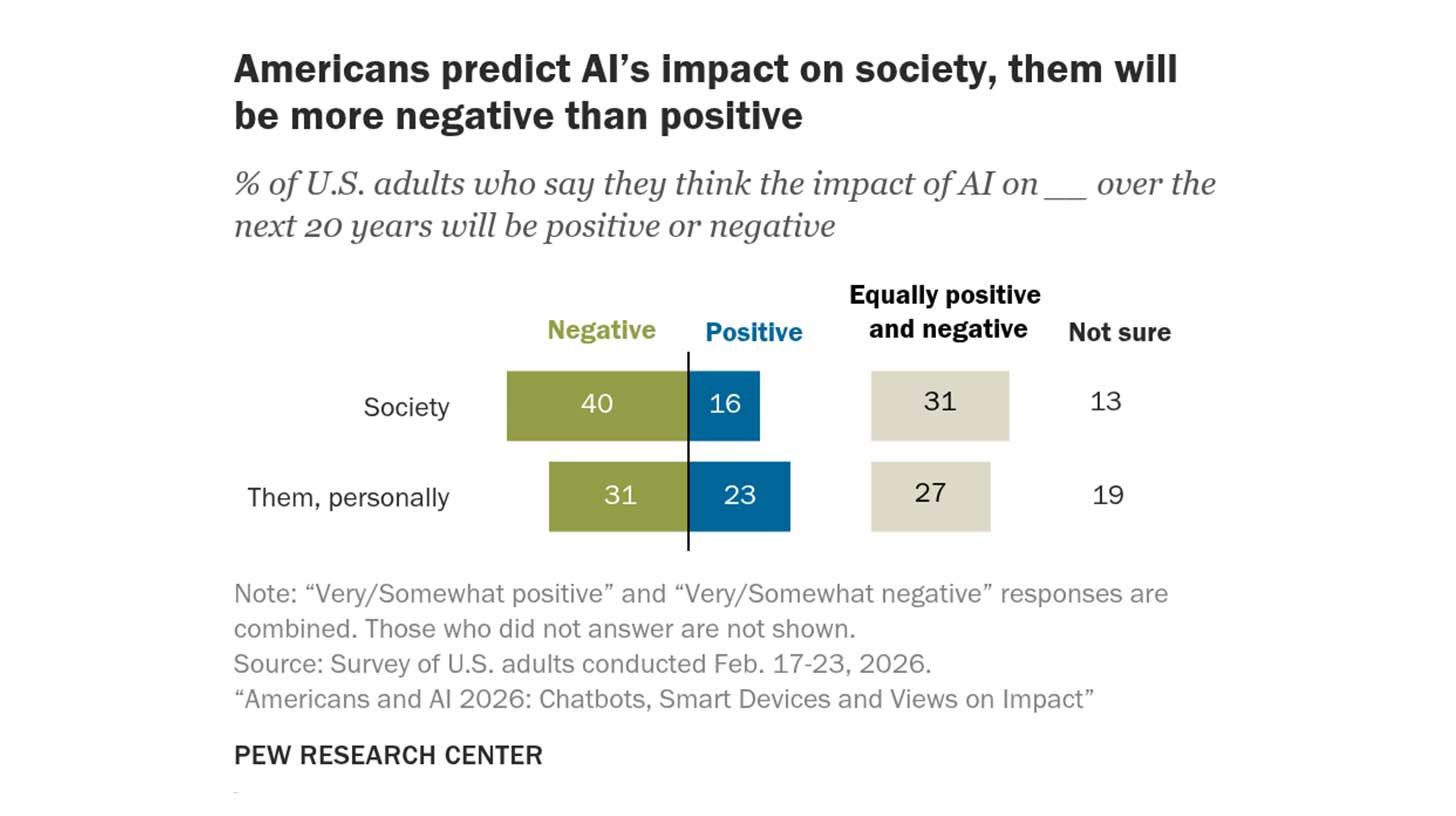
Image source: Pew Research Center
The Rundown: Pew Research just released its 2026 data on more than 5K U.S. adults, measuring both how people use AI and how they feel about it — with the two lines running in opposite directions as adoption climbs while optimism continues to slide.
The details:
Chatbots just crossed a milestone, with about half of U.S. adults now using one, and a quarter do so daily — a leap from just 1/3 of the public in 2024.
Pessimism reigns, with nearly 40% expecting AI to make society worse over the next 20 years and just 16% believing it will change things for the better.
The under-30 crowd leans on AI the hardest but trusts it the least, with only 14% seeing a positive payoff for society.
ChatGPT still dominates the field at 44% of adults, double its 2023 reach, with Gemini at 24% and Claude at just 6%.
Why it matters: This data aligns with our own gut check of AI’s sentiment outside of our narrow bubble, with adoption rising alongside fears for the future. The adoption numbers behind specific platforms are particularly wild, with Anthropic being the constant talk of the industry despite barely registering with the average American.
AI TRAINING
🧑💻 Build and host a custom CRM with Google Antigravity
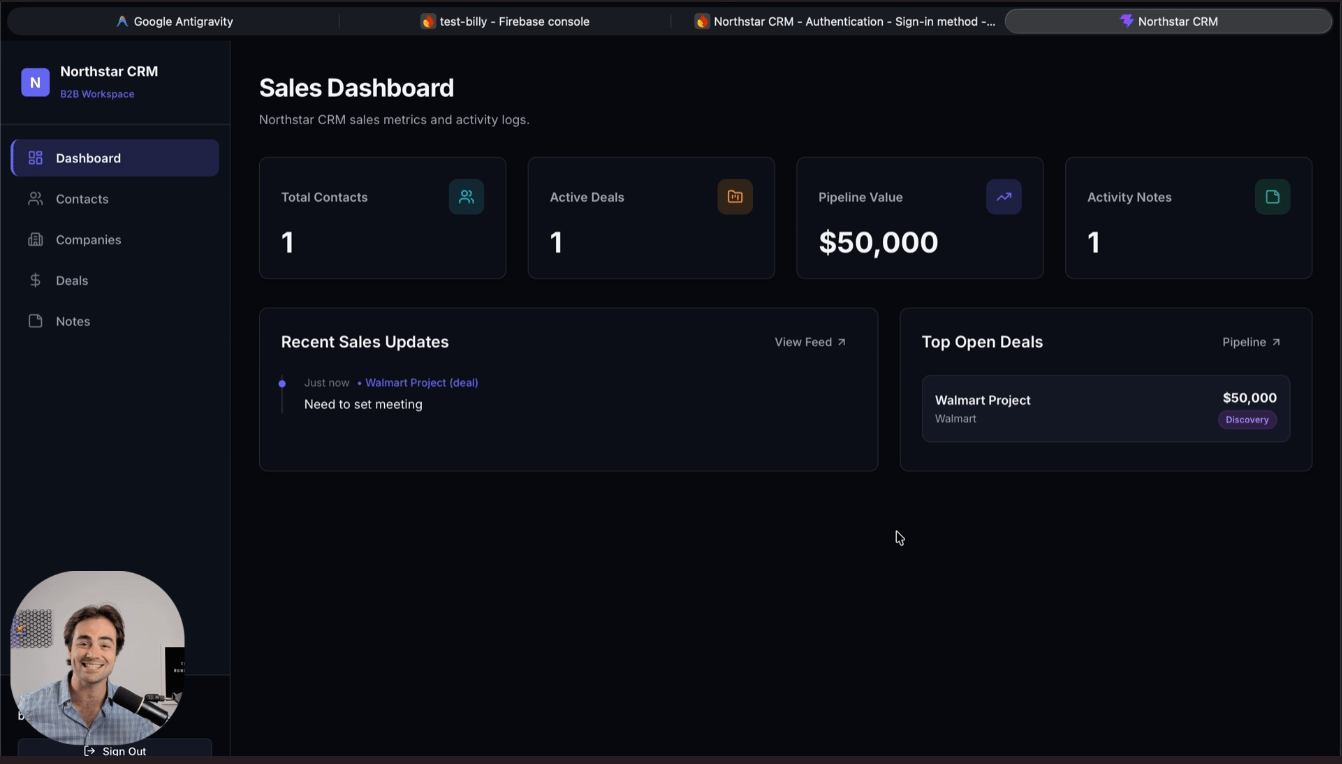
The Rundown: Learn how to use Google Antigravity to turn a plain-English app spec into a hosted full-stack CRM. The key move is making the agent plan first, then using Firebase Auth, Firestore, and Firebase Hosting so the app has login, saved data, search, and a real URL.
Step-by-step:
Click here to download Google Antigravity. Install and open the desktop app.
Create a new folder, then open that folder in Antigravity. A clean folder keeps the agent focused.
Make sure you’re signed in with Google. This is what Antigravity and Firebase will use.
Give Antigravity a two-line app prompt: “Build Northstar CRM with login, contacts, companies, deals, notes, search, and dashboard cards. Use React, Vite, TypeScript, Firebase Auth, Firestore, and Firebase Hosting; plan first.”
Review the plan, then let Antigravity build the app. If it adds billing, teams, or extra SaaS features, cut the scope back.
Ask Antigravity how to install Firebase and follow those instructions. Then have it deploy to Firebase Hosting and test the live URL.
Going further: Ask Antigravity to add Google login, automatically set up Google Analytics, or connect a custom domain after the Firebase deploy works.
PRESENTED BY ONETRUST
📶 Design-driven governance for agentic AI
The Rundown: OneTrust’s ‘From Governance by Committee to Governance by Design’ white paper reveals how leading organizations are embedding AI governance into systems and workflows, enabling faster innovation, stronger oversight, and scalable governance for the age of agentic AI.
In this guide, you’ll learn:
Scale AI governance without bottlenecks
Embed controls across the AI lifecycle
Prepare for the rise of agentic AI
AI RESEARCH
📊 Study: Expertise beats skill in Claude Code
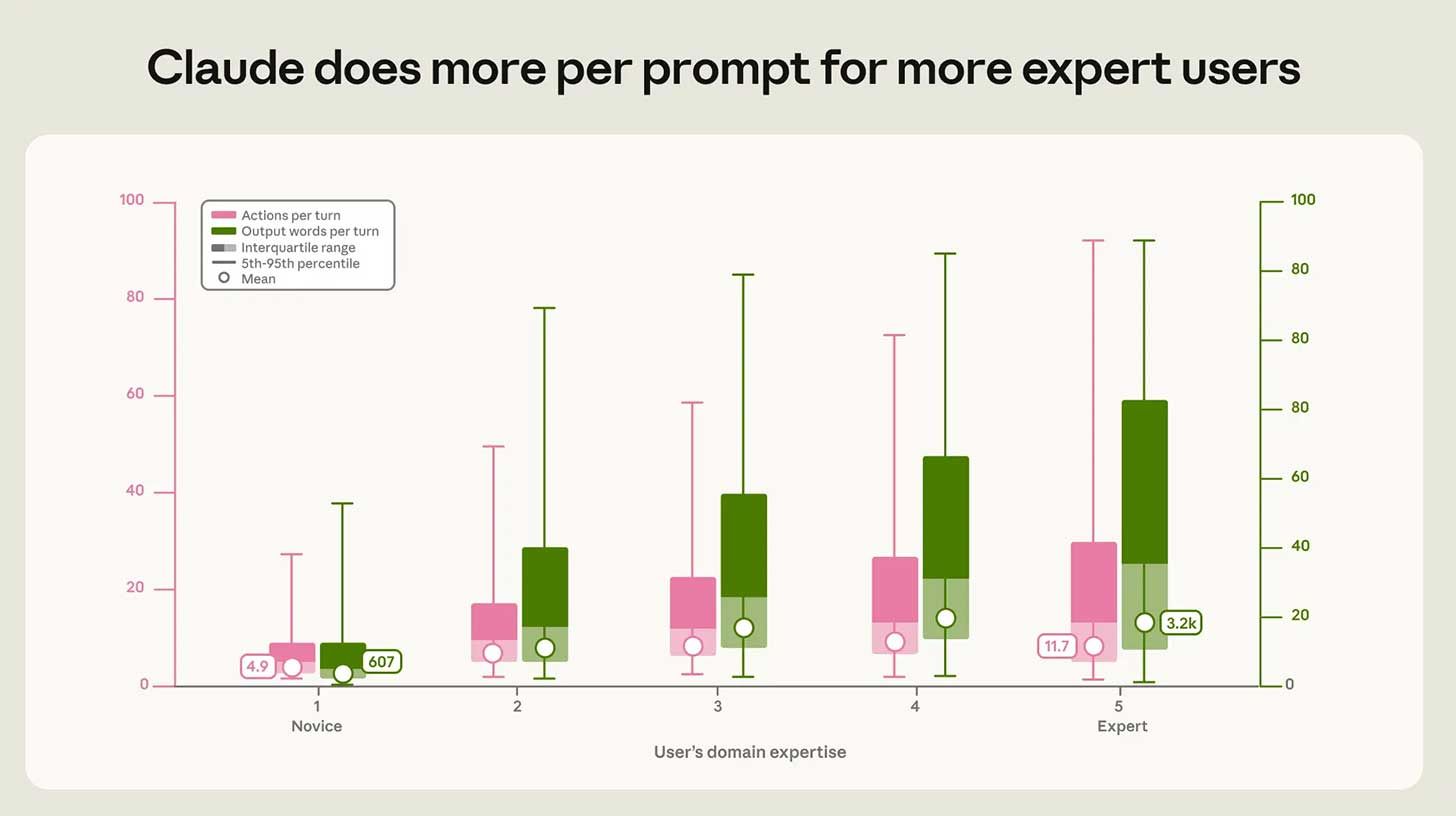
Image source: Anthropic
The Rundown: Anthropic just analyzed 400K Claude Code sessions, studying how work splits between human vs. agent and what drives success — finding that a user’s own expertise in their field matters more than their overall coding expertise.
The details:
Users made roughly 70% of planning decisions in a typical session, while Claude handled around 80% of execution choices.
Skill changed the yield per prompt, with beginners drawing about five actions and 600 words from Claude versus an expert’s 12 actions and 3,200 words.
Verified success rates confirmed by passing tests or saved work climbed to 28–33% for intermediate-and-above users, over double the 15% rate for novices.
Lawyers, managers, and scientists with no coding job title nearly matched software engineers on coding tasks, finishing within just seven points of them.
Why it matters: This data rhymes with the Perplexity-Harvard study we covered last week, where agents pushed people toward harder, cross-field work rather than just faster work. Both point in the same direction, with the value of agents being capped less by the model itself and more by how much its user actually understands the job.
QUICK HITS
🛠️ Trending AI Tools
🎥 Grok Imagine 1.5 - xAI’s newly upgraded image-to-video model
🔎 Exa Agent - Exa’s cost-effective, frontier-level web research API
⚙️ Eve - Vercel’s open-source framework for turning a file directory into an agent
🚀 GLM 5.2 - Z AI’s powerful new open-weights model
📰 Everything else in AI today
Dario Amodei and Demis Hassabis reportedly proposed a “U.S.-led AI coalition” at G7, with international cooperation on model access, chip exports, and safety risks.
OpenAI reported $3.7B in Q1 cash burn against $5.7B in revenue in 2026, with both tripling from a year earlier, according to documents seen by The Information.
Jensen Huang told the AP the AI age demands “new social norms,” comparing the shift to how cars pushed society to add sidewalks and crosswalks.
Odyssey raised $310M at a $1.45B valuation, fueling its push to build general AI world models that simulate physics and human behavior in real time.
ByteDance released Seedance 2.0 mini, a new lower-cost variant of the company’s powerful AI video model.
COMMUNITY
🤝 Community AI workflows
Every newsletter, we showcase how a reader is using AI to work smarter, save time, or make life easier.
Today’s workflow comes from reader Anonymous:
“I’m a retired birder with no formal software development background. Using AI coding tools, I built Chase Report, a web app that helps birders find and evaluate rare bird sightings. The app currently covers New Mexico, North Dakota, and Washington, with more states planned.
One feature automatically reads observer comments from multiple eBird checklists associated with a rare bird and generates a concise field summary describing what people are seeing. It also gathers links to photos, maps, and other relevant information in one place.
The surprising part is that I didn’t write most of the code myself. I described the features I wanted in plain English, tested the results, and kept iterating with AI until the app behaved the way I envisioned.”
How do you use AI? Tell us here.
🎓 Highlights: News, Guides & Events
Read our last AI newsletter: Cursor officially joins the SpaceX AI machine
Read our last Tech newsletter: Xbox’s studio crisis gets bigger
Read our last Robotics newsletter: UBTech’s ultra-realistic robot girlfriend
Today’s AI tool guide: Build and host a custom CRM with Google Antigravity
See you soon,
Rowan, Joey, Zach, Shubham, and Jennifer — the humans behind The Rundown


Stay Ahead on AI.
Join 2,000,000+ readers getting bite-size AI news updates straight to their inbox every morning with The Rundown AI newsletter. It's 100% free.