Gemini's busy agentic day at Google I/O
PLUS: Build automated business reports with AI

Zach Mink
May 20, 2026
Read Online | Sign Up | Advertise

Good morning, AI enthusiasts. Google had a lot to show at I/O, but the theme was even cleaner than the release list: Gemini being turned into the agentic engine behind every one of Google’s products.
New launches, including Omni, Gemini 3.5 Flash, Spark, Antigravity 2.0, and a Search overhaul, point to the same strategy — making Gemini capable, fast, and cheap enough to live wherever users already are, with an agent doing the work.
In today’s AI rundown:
Gemini’s busy agentic day at Google I/O
Anthropic lands OpenAI co-founder Andrej Karpathy
Build automated business reports with AI
Google’s smart glasses push with ‘Intelligent Eyewear’
4 new AI tools, community workflows, and more
LATEST DEVELOPMENTS
GOOGLE I/O
🚀 Gemini’s busy agentic day at Google I/O

Image source: Google
The Rundown: Google just introduced a wave of new Gemini-powered releases and features at its flagship I/O event, including a new Omni model, 3.5 Flash, Spark agent, Antigravity 2.0, and new agentic Search upgrades.
The details:
Gemini Omni can turn text, images, audio, or video inputs into video outputs, with Google describing the model as “Nano Banana for video”.
The Gemini 3.5 family kicks off with Flash, which nears rivals like Opus 4.7 and GPT-5.5 across a variety of benchmarks at 4x the speed and half the cost.
Gemini Spark is a new 24/7 personal agent that runs on Google Cloud virtual machines to take agentic actions across Workspace, Chrome, email, and chat.
Google framed Search's update as its biggest redesign in a generation, adding cross-modal inputs, 24/7 info agents, and generative UI for custom layouts.
Other features and tools included Gemini for Science, Intelligent Eyewear (more below), Street View simulations, SynthID AI watermarking, and more.
Why it matters: The biggest theme across these upgrades: a more agentic, multimodal Gemini getting integrated across Google’s suite in a big way. Their 3.5 Flash benchmarks don’t blow the competition away, but combining fast, cheap near-frontier capabilities with the normie-friendly tools millions of users already live in is powerful.
TOGETHER WITH DATADOG
🚀 Ship Faster with Less Guessing

The Rundown: Datadog LLM Observability gives teams end-to-end visibility into their LLM applications, from prompts and tool calls to infrastructure performance and cost, so production AI systems stay reliable, secure, and worth the investment.
With Datadog, you can:
Debug multi-step AI workflows before they become incidents
Monitor quality and catch regressions across model versions
Secure LLM pipelines against prompt injection and data risks
ANTHROPIC
🚪 Anthropic lands OpenAI co-founder Andrej Karpathy

Image source: Images 2.0 / The Rundown / @Karpathy on X
The Rundown: OpenAI co-founder and famed AI researcher Andrej Karpathy just announced that he has joined Anthropic, reportedly working to create an internal group focused on automating the AI training pipeline with Claude.
The details:
Karpathy helped co-found OpenAI in 2015, led Tesla's Autopilot until 2022, briefly returned to OAI, and then left in 2024 to start an AI education startup.
Karpathy is joining the pre-training team under Nick Joseph and will also lead the new internal effort to apply Claude to Anthropic's own training pipeline.
"The next few years at the frontier of LLMs will be especially formative," Karpathy wrote on X, adding he plans to resume his education work "in time."
Why it matters: This is a massive get for Anthropic. Karpathy is one of the most respected AI researchers in the world, and luring him back to the frontier after leaving OAI (again) is notable. What’s also notable is what he’s doing there, pushing forward on the same self-building model quest we’ve seen throughout the industry this year.
AI TRAINING
📈 Build automated business reports with AI
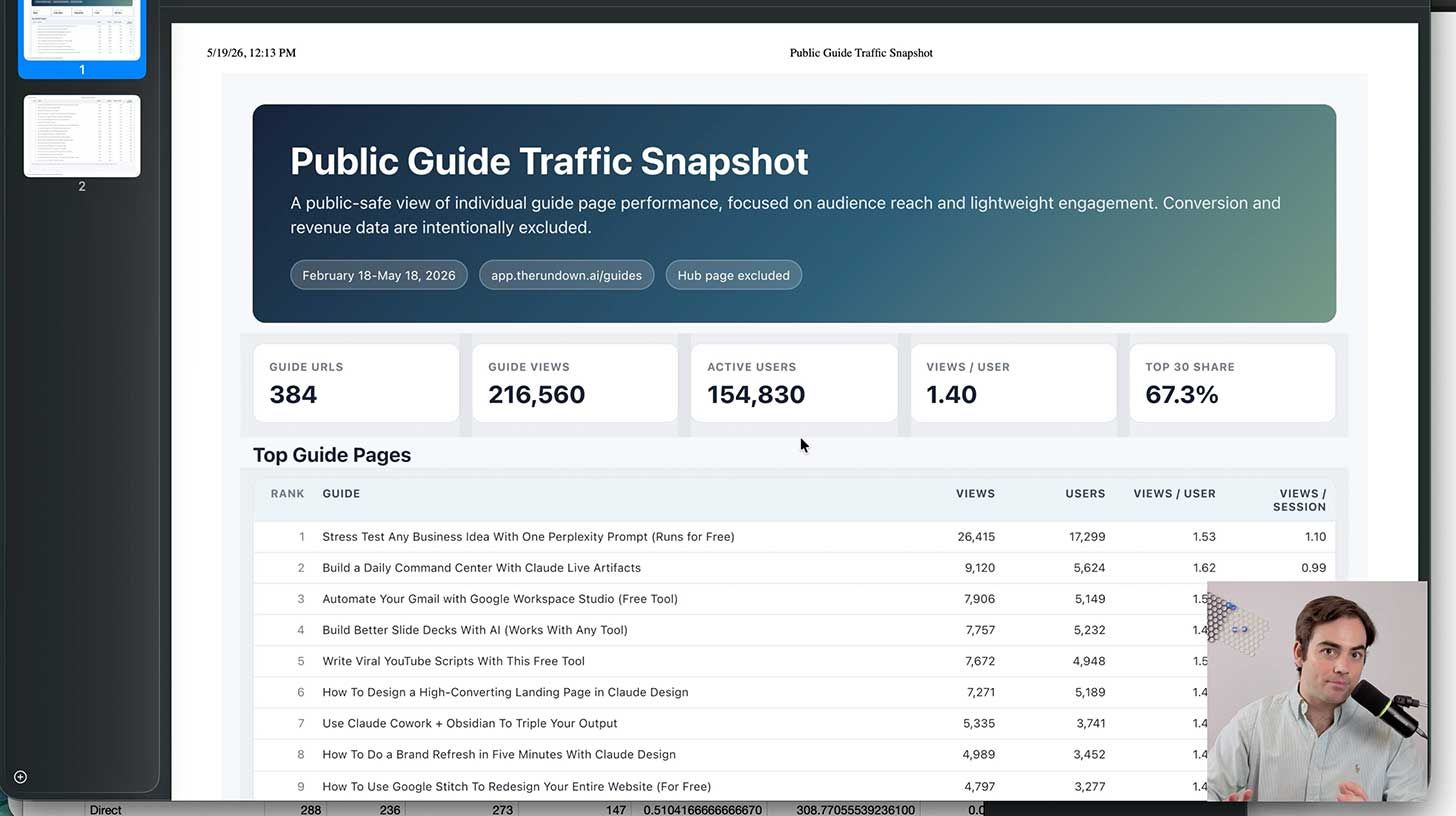
The Rundown: In this guide, you will learn how to connect Codex (or Claude Code) to Google Analytics using a free tool called Composio. You will use simple prompts to explore your data and build a Markdown report that you can schedule to run weekly.
Step-by-step:
Create a Composio account, connect the Google Analytics toolkit, open Codex in Terminal, and copy and paste your custom install script from here
In Codex, prompt: “Use the Composio CLI tool to inspect our Google Analytics setup. Identify the available accounts and properties, find the property that tracks [SITE_OR_APP], and tell me which dimensions and metrics you would use for a useful traffic report. Do not create the report yet”
Once reviewed, prompt: “Use Composio + GA to identify the three most important trends over the last 90 days. Return a markdown report with an executive summary, tables, source notes, and recommended actions”
Tell Codex to visualize the report as a PDF/website, and finally turn the steps into reusable skills, with an automation to run those skills daily/weekly/monthly
Pro tip: Ask Codex to audit the Composio toolkit for useful connections. Use the Explore, Analyze, Visualize framework on other connectors like YouTube or Shopify.
PRESENTED BY FIDDLER
🧮 Run the math on your AI evals TCO

The Rundown: External LLM evaluation charges you per API call and increases as you scale. If you try to control spend with reduced sampling, you risk incidents slipping through undetected. Fiddler Centor Models run evals in your own infrastructure with no per-call costs, reducing your evaluation Total Cost of Ownership as you scale.
Put in your numbers to see:
Your annual eval cost across GPT, Claude, and Gemini models at your trace volume
How each evaluator you add increases your per-trace spend
How your evaluation costs curves shift as agent traffic grows
👓 Google’s smart glasses push with ‘Intelligent Eyewear’

Image source: Google
The Rundown: Google just provided a teaser of its Intelligent Eyewear Gemini-powered smart glasses, partnering with Warby Parker and Gentle Monster on voice-first AI frames shipping this fall, and a display-equipped Project Aura to follow.
The details:
The audio frames pair with Android or iOS phones, running Gemini for voice, navigation, messaging, photos with Nano Banana editing, and live translation.
The glasses will feature cameras, mics, over-ear speakers, and Gemini access through "Hey Google" or a tap on the frame for quick help.
The lineup is Google's first glasses push since Google Glass folded, with Samsung on hardware and Gentle Monster and Warby Parker handling frames.
XReal’s Android XR ‘Project Aura’ display glasses are farther away, which will allow users to see videos or content for interactive experiences.
Why it matters: Google’s Meta Ray-Ban competitor is officially coming, and its first iteration is a light one — with the audio-first frames coming in a step behind their rival’s already screen-equipped options. But the allure of the Google and Gemini ecosystem can definitely be the stickier option for consumers to tie their AI-powered life together.
QUICK HITS
🛠️ Trending AI Tools
📱 Metabind - Build native MCP Apps with interactive UI. One click to ChatGPT, Claude, or your iOS/Android AI Assistant*
🧠 Gemini 3.5 Flash - Google's new flash model, 4x faster at half price
🤖 Gemini Spark - Google's personal agent that runs 24/7 on Cloud VMs
🎥 Gemini Omni Flash - Google's multimodal video model that edits via chat
*Sponsored Listing
📰 Everything else in AI today
New reporting revealed that Google Deepmind’s Demis Hassabis was an early angel investor in Anthropic, with Google also separately investing billions in the AI rival.
Anthropic rolled out sandboxes and MCP tunnels to Claude Managed Agents, letting teams run tool execution and reach internal servers without exposing them publicly.
METR published its first Frontier Risk Report, finding agents from top labs can autonomously finish multi-week engineering work, but struggle on hard-to-verify tasks.
OpenAI is adopting Google's SynthID watermarking for ChatGPT images, alongside a public verification tool that detects whether an image came from its models.
Google and Blackstone formed a joint AI cloud venture to rent out Google's TPU chips, with the PE giant's $5B investment marking a deep push into AI infrastructure.
COMMUNITY
🤝 Community AI workflows
Every newsletter, we showcase how a reader is using AI to work smarter, save time, or make life easier.
Today’s workflow comes from reader Anonymous:
"I occasionally see a ‘sponsored’ ad on Facebook that intrigues me to look. After reading through pages and pages exhorting the over-the-top values of the item and further pages of testimonials, the price eventually shows up IF I believe 1/2 the pomp and circumstance.
I had the wild idea of feeding the link to my AI preceded by "Is this a scam?" and I get a detailed yes, no, maybe with details, background, and usually an "avoid this and go to 'other website/store' and check out the same item".
How do you use AI? Tell us here.
🎓 Highlights: News, Guides & Events
Read our last AI newsletter: OpenAI beats Musk on the clock
Read our last Tech newsletter: Meta’s cyborg smart glasses for soldiers
Read our last Robotics newsletter: Figure’s humanoid bingewatch continues
Today’s AI tool guide: Build automated business reports with AI
RSVP to next workshop on May 27: Become an AI-native leader
See you soon,
Rowan, Joey, Zach, Shubham, and Jennifer — the humans behind The Rundown

Stay Ahead on AI.
Join 2,000,000+ readers getting bite-size AI news updates straight to their inbox every morning with The Rundown AI newsletter. It's 100% free.