Anthropic writes Washington an AI regulation playbook
PLUS: Close more deals with Codex sales followups

Zach Mink
June 11, 2026
Read Online | Sign Up | Advertise

Good morning, AI enthusiasts. Anthropic CEO Dario Amodei opened his new policy essay with quite the Lord of the Rings reference: Washington as Treebeard, the talking tree so slow a hello takes all day.
In the past week, his company put self-improving AI on the clock and released the industry's most powerful model. Now, Amodei's new proposal argues the risks are no longer theoretical — and that policy needs to stop moving at tree speed.
In today’s AI rundown:
Amodei warns AI is outrunning regulation
Musk shares his space AI datacenter plans
Close more deals with Codex sales follow-ups
Altman ties OpenAI's IPO to self-improving AI
4 new AI tools, community workflows, and more
LATEST DEVELOPMENTS
ANTHROPIC
🏛️ Amodei warns AI is outrunning regulation

Image source: Images 2.0 / The Rundown
The Rundown: Anthropic CEO Dario Amodei penned an essay called “Policy on the AI Exponential”, calling on AI regulation to move faster to match the ‘lightning pace’ of the industry, coming alongside policy proposals on AI testing and employment disruption.
The details:
Amodei said Claude Mythos Preview’s hacking risks are a major turning point, making frontier models "tools of global and national strategic consequence."
The CEO wants regulators to have the power to ground frontier models, with Amodei proposing systems independently screened across four risk areas.
A jobs framework aims to plan for unprecedented unemployment at several levels, including investment accounts with shares of AI companies and UBI.
Other asks include faster approval of AI-designed drugs, limits and bans on autonomous weapons, and stronger advanced chip export controls.
Why it matters: Amodei's comparison of Washington to the slow-moving Treebeard from Lord of the Rings is a hilarious but strong illustration of the situation. "Regulate me harder" from a market leader will read as inauthentic to skeptics, but Amodei has been sounding the alarm for a while, and the urgency is only scaling with each release.
TOGETHER WITH PAVE
👨💻 Pave builds apps that go beyond the demo

The Rundown: Most AI builders get you a prototype. Pave gets you software your business can actually run. Describe what you need in plain language, and Pave builds it with the data model, workflows, UI, hosting, and governance already in place.
With Pave, you can:
Build a ready-to-run app from a prompt
Turn spreadsheets into working applications
Launch with hosting, governance, and permissions built in
SPACEX
🛰️ Musk shares his space AI datacenter plans

Image source: SpaceX
The Rundown: SpaceX just provided the first preview of AI1, a solar-powered satellite built to run AI chips in orbit, dropping the design video three days before a market debut that's set to be the biggest IPO in history.
The details:
AI demand is pushing data centers into power fights on Earth, and SpaceX says orbit offers solar energy without the local grid battles seen across the U.S.
Musk said each satellite will have as much computing power as one of Nvidia's top server racks, with SpaceX able to change which chips go inside over time.
To Musk, the craft is "much simpler than a Starlink satellite", trading "super complex antennas" for solar panels, radiators, and lasers that beam data.
SpaceX's planned Bastrop factory could cover 11M+ square feet, with AI1 production targeted before 2028 if timelines hold.
Why it matters: Google and Anthropic have already signed on as orbital compute customers, putting two frontier labs on the other side of Sam Altman's "ridiculous" verdict on space-based datacenters. AI1 is the first hard look at the tech behind it, and it certainly looks less like a moonshot and more like a viable manufacturing plan.
AI TRAINING
🤝 Close more deals with Codex sales follow-ups
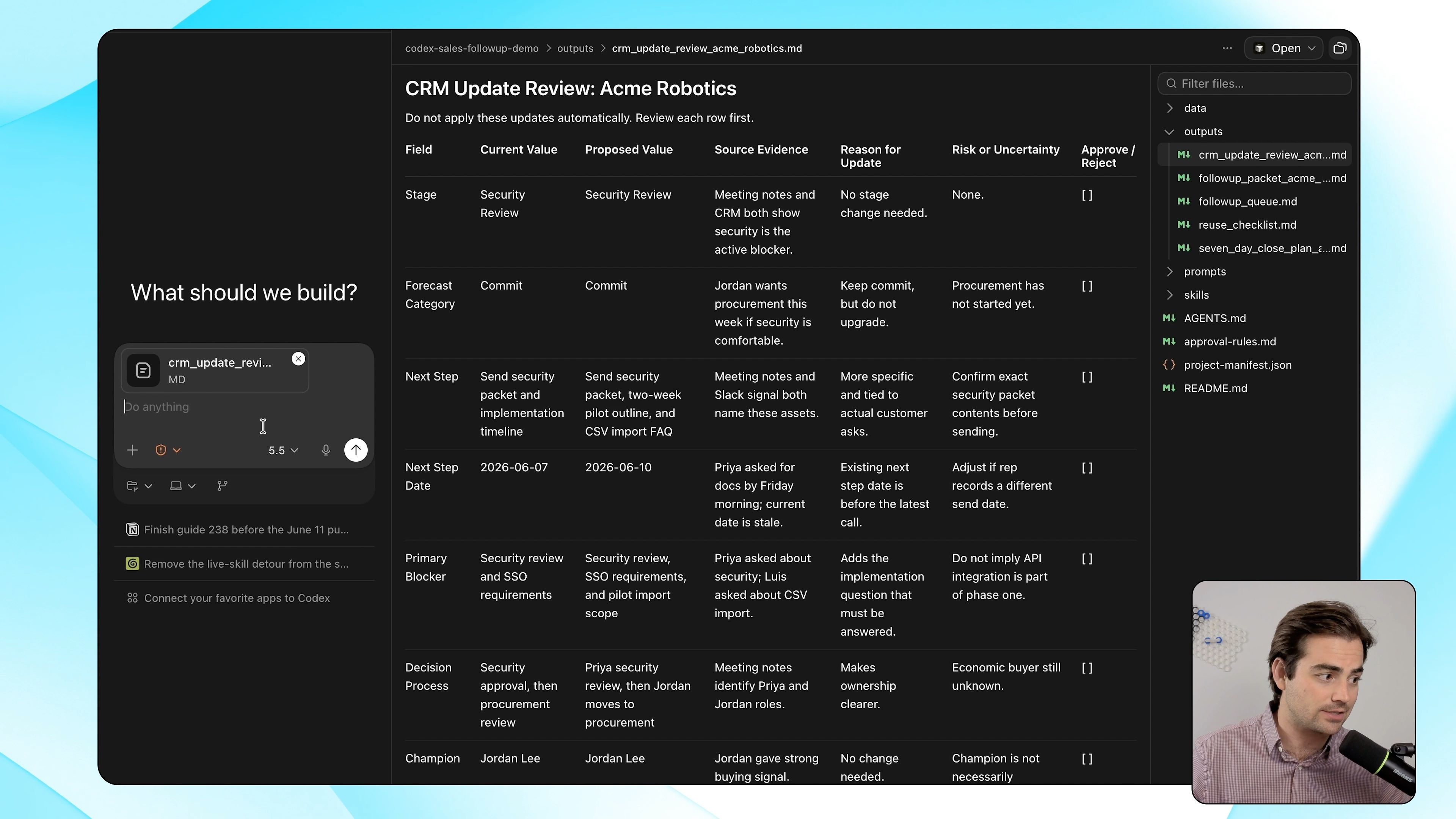
The Rundown: In this guide, you will learn how to use Codex to send better sales follow-ups, faster. It helps you figure out which accounts need attention, draft the next email, clean up your CRM, and build a plan to save time and keep more deals moving.
Step-by-step:
Get Codex, sign in, start a project in a blank folder, and use Plugins to connect your notetaker, CRM, and the platform used to talk to prospects (Slack/email)
Prompt Codex: “Extract all accounts, key deal fields, latest notes, blockers, next steps, and source evidence. Save the list as a reviewable account table”
Now, run the ranking flow, prompting: “Look at Slack signals and meeting notes and use them to prioritize our accounts and make a follow-up priority queue”
Review the queue and approve/reject/edit the next actions and evidence. Then, after a prospect call, ask: “Create a follow-up packet for [ACCOUNT_NAME], plus a CRM review table, email draft, and seven-day close plan”
Pro tip: Tell Codex to create a skill out of this process so you can trigger it anytime you're reviewing an account.
PRESENTED BY WEIGHTS & BIASES
🔐 How to operationalize governance for AI agents
The Rundown: Many organizations have AI policies, but far fewer have a practical way to decide whether an agent is ready for production, who signs off, and how that decision gets documented. This guide shows how leading enterprises connect evaluations, traces, human review, and approval workflows into an auditable record of deployment readiness.
Download the guide to learn how to:
Move from high-level AI principles to measurable controls and testing strategies
Evaluate AI agents in high-impact domains using structured assessments and expert review
Build a governance program informed by the EU AI Act, NIST AI RMF, and emerging frameworks
OPENAI
💸 Altman ties OpenAI's IPO timing to self-improving AI

Image source: Images 2.0 / The Rundown
The Rundown: OpenAI plans to go public “within the next year,” according to CEO Sam Altman's internal Slack message to employees seen by The Information, with factors like RSI takeoff and the need for compute potentially impacting timelines.
The details:
OpenAI filed a draft S-1 with the SEC earlier in the week, announcing the submission of the IPO paperwork, following Anthropic’s filing last week.
Altman's potential case for waiting: if self-improving AI looks close, it "could be advantageous to delay an IPO" instead of rushing to market during uncertainty.
Compute may also factor into the decision, with OpenAI weighing infrastructure needs that may require hundreds of billions in financing.
Chief scientist Jakub Pachocki also reportedly told staff a model codenamed 5.6, a "meaningful improvement" on flagship GPT-5.5, is coming this month.
Why it matters: Self-improving AI just showed up as a potential factor in IPO planning. Whatever you make of lab timelines, Altman treating the speed of a potential "RSI takeoff" as a factor in when to take public money tells you the frontier labs see it as a serious near-term business variable, not just a hyperbolic claim to boost funding.
QUICK HITS
🛠️ Trending AI Tools
🧊 Cube - Embedded AI analytics your customers trust, governed by a semantic layer*
📱 Siri AI - Apple’s newly overhauled on-device AI assistant
🧠 DiffusionGemma - Google's new AI that quadruples text generation speed
💼 Poetic - AI that learns your procedures, then self-heals when apps change
*Sponsored Listing
📰 Everything else in AI today
Anthropic is facing backlash over Fable 5, with users reporting constant flagging for topics like biology, chemistry, and cybersecurity, as well as restrictions on research.
Microsoft is restricting employee access to Fable model due to a data retention policy that requires all Fable chats to be saved and reviewed for up to 30 days.
Google released DiffusionGemma, an experimental open model that writes text in parallel chunks, quadrupling output speed and hitting 1,000+ t/s on one Nvidia H100.
OpenAI is reportedly closing in on a 20-year lease for a 10GW, $500B Ohio data center campus, potentially financed by Nvidia.
The Art Directors Guild criticized director Martin Scorsese's new advisor role at AI startup Black Forest Labs, accusing him of "turning his back on the human artists.”
COMMUNITY
🤝 Community AI workflows
Every newsletter, we showcase how a reader is using AI to work smarter, save time, or make life easier.
Today’s workflow comes from reader Anonymous:
"I am working as a teacher for German as a second language. In my classes are people from a refugee background who want to qualify for the German job market. Most of them are not able to understand legal German letters.
I vibecoded an app for them. The use case of this app is to translate legal letters in their native languages, help them to learn new legal vocabulary, and write response emails for them. They also receive a checklist with to-dos and possible deadlines. It’s very helpful for them."
How do you use AI? Tell us here.
🎓 Highlights: News, Guides & Events
Read our last AI newsletter: Anthropic hands the public Mythos-class AI
Read our last Tech newsletter: Apple’s iOS upgrade is less flash, more fix
Read our last Robotics newsletter: Amazon’s robot army gets chatty
Today’s AI tool guide: Close more deals with Codex sales follow-ups
RSVP to our next workshop on June 18: Build a Marketing Creative Studio
See you soon,
Rowan, Joey, Zach, Shubham, and Jennifer — the humans behind The Rundown





Stay Ahead on AI.
Join 2,000,000+ readers getting bite-size AI news updates straight to their inbox every morning with The Rundown AI newsletter. It's 100% free.